
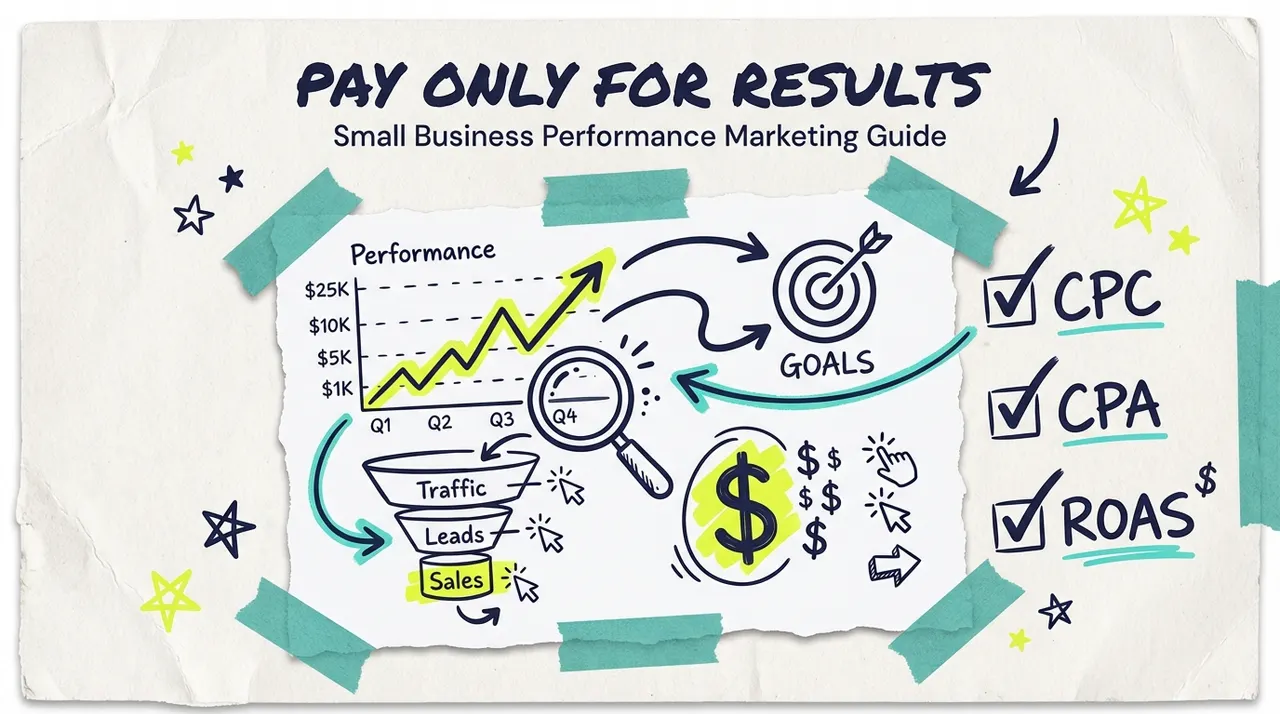
Every dollar counts when you're running a small business. That's why performance marketing has become one of the most popular approaches for business owners who want real, measurable results from their advertising spend. Instead of paying upfront and hoping for the best, you only pay when someone takes a specific action, like clicking your ad, filling out a form, or making a purchase.
The global performance marketing industry was valued at $6.8 billion in 2024, and it's growing fast (Statista, 2024). That growth isn't just coming from big brands with massive budgets. Small businesses are jumping in because the model makes sense: spend money on what works, skip what doesn't.
This guide covers planning a performance marketing campaign, setting a budget, and measuring results.
What Is Performance Marketing?
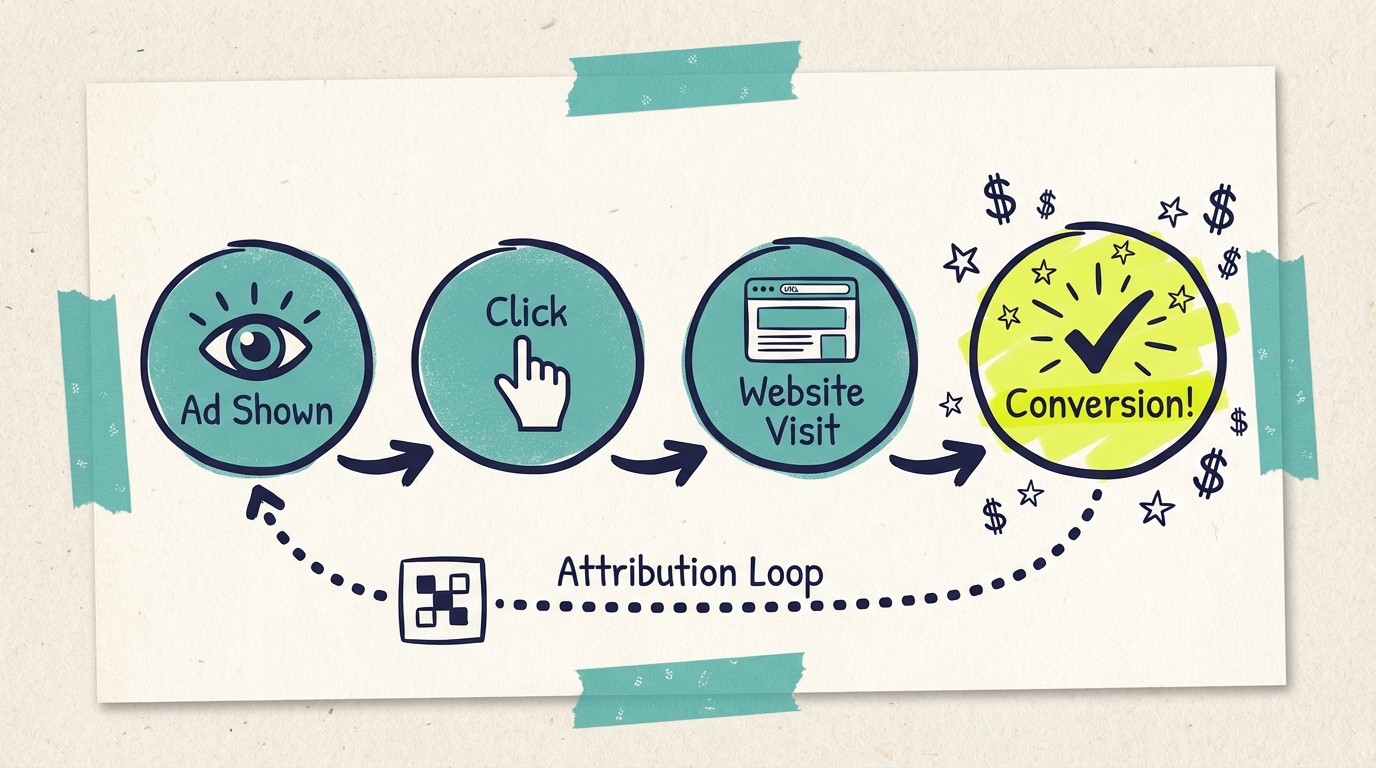
Performance marketing is a type of digital advertising where you pay based on results. Unlike traditional advertising (think billboards, print ads, or old-school TV commercials), you're not paying for impressions or eyeballs alone. You're paying when a specific, measurable action happens.
Those actions might include:
A click on your ad
A form submission or sign-up
A completed purchase
A phone call to your business
An app download
This pay-for-results model shifts the risk away from you, the advertiser. If nobody clicks, you don't pay. If nobody converts, your costs stay low. That's a big deal for small businesses working with tight budgets.
Traditional advertising works on a "pay and pray" model. You buy a newspaper ad or a radio spot, and you hope people notice. Performance marketing flips that. Every dollar you spend is tied to a trackable outcome, which means you always know what you're getting for your money.
How Performance Marketing Works
The mechanics behind performance marketing are straightforward, even if the technology powering it is sophisticated. Here's what happens behind the scenes.
Tracking and Attribution
When you launch a performance marketing campaign, tracking tools monitor every interaction between your ad and your audience. This starts with a small piece of code (called a pixel or tracking tag) installed on your website. That pixel records what visitors do after they see or click your ad.
For example, if someone clicks your Google ad, lands on your website, and books an appointment, the tracking pixel connects that booking back to the specific ad that drove it. This is called attribution, and it's the backbone of performance marketing.
Conversion Events
A conversion event is the action you want people to take. You define this upfront when setting up your campaign. Common conversion events include:
Purchases: Someone buys your product or service
Leads: Someone fills out a contact form or requests a quote
Calls: Someone taps "call now" from a mobile ad
Sign-ups: Someone subscribes to your email list
The platform you're advertising on (Google, Meta, a streaming service) optimizes your campaign to generate more of whatever conversion event you've chosen.
The Optimization Loop
Performance marketing isn't a "set it and forget it" situation. The best results come from a continuous cycle: launch, measure, adjust, repeat. You start with a hypothesis ("this ad creative will resonate with homeowners aged 30-50"), test it, review the data, and refine. Over time, your campaigns get more efficient because you're constantly cutting what doesn't work and doubling down on what does.
Performance Marketing Channels for Small Businesses
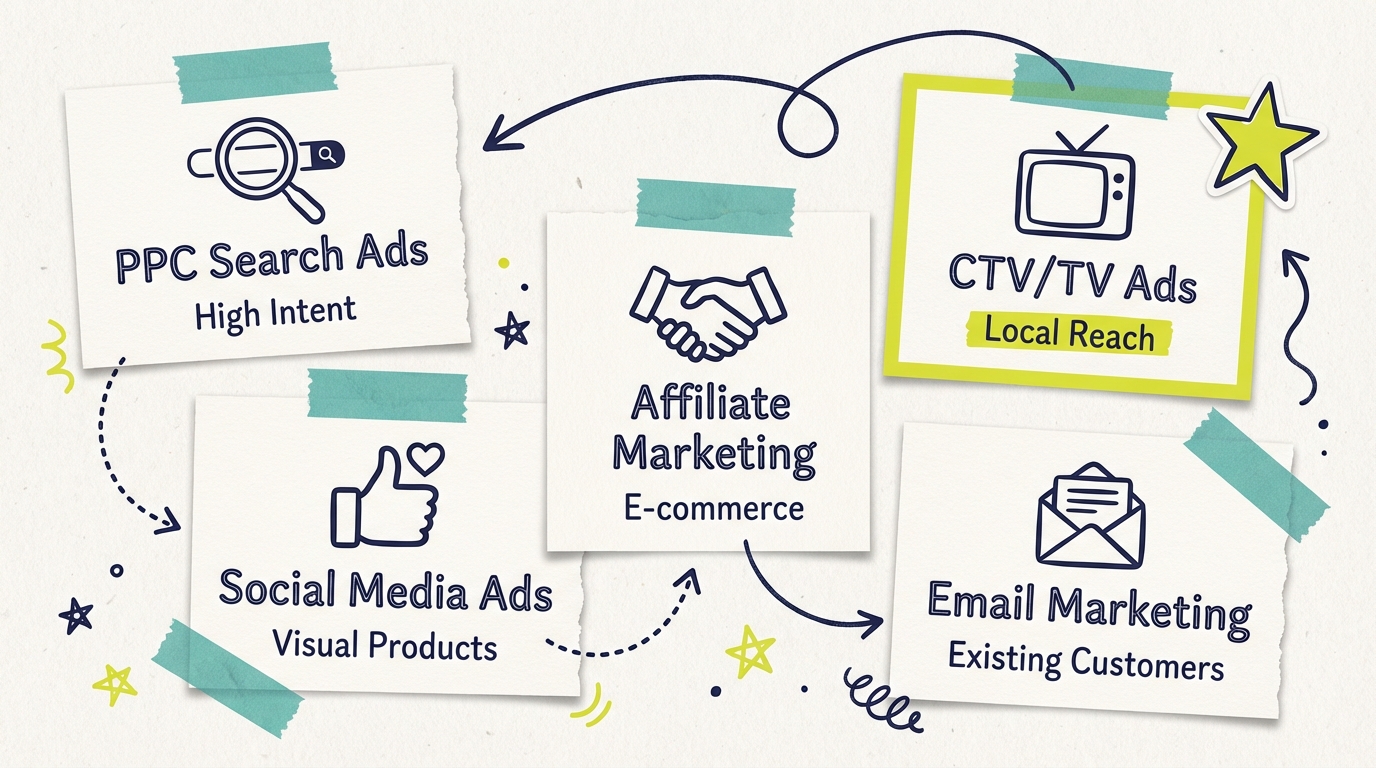
Not every advertising channel fits the performance marketing model equally well. Here are the ones that matter most for small businesses.
PPC (Pay-Per-Click) Search Ads
Google Ads and Microsoft Ads are the classic performance marketing channels. You bid on keywords related to your business, and your ad shows up when people search for those terms. You only pay when someone clicks.
Best for: Businesses with customers who actively search for solutions (plumbers, dentists, lawyers, local services).
Watch out for: Costs can climb quickly in competitive categories. A single click for "emergency plumber" might run $30-50 in some markets (WordStream, 2025).
Social Media Advertising
Platforms like Meta (Facebook and Instagram), TikTok, and LinkedIn let you target users based on demographics, interests, and behaviors. You can optimize campaigns for clicks, leads, purchases, or other specific actions.
Best for: Businesses with visually appealing products or services, or those targeting specific demographics.
Watch out for: Social media ads interrupt people rather than meeting them at the point of need. That means you'll typically need stronger creative to capture attention.
Affiliate Marketing
With affiliate marketing, you partner with publishers, bloggers, or influencers who promote your product to their audience. You only pay a commission when someone makes a purchase through their unique tracking link.
Best for: E-commerce businesses, subscription services, and businesses with products that lend themselves to reviews and recommendations.
Watch out for: Quality control can be tricky. Make sure your affiliates represent your brand the way you want.
CTV (Connected TV) Advertising
Here's where things get interesting. TV advertising used to be the opposite of performance marketing. You'd spend thousands on a 30-second spot and have almost no way to measure whether it drove results.
That's changed. Connected TV (CTV) advertising now offers real attribution tools that tie ad views to website visits, purchases, and other conversions. You can see exactly how your TV ad performed, which brings CTV squarely into the performance marketing conversation.
With platforms like Adwave, you can launch a TV ad campaign for as little as $50, running across 100+ premium networks including NBC, Hulu, and ESPN. The real-time analytics dashboard shows you exactly what your spend is producing. That's performance marketing at its core: measurable results tied to real business outcomes.
Want to understand the full picture? Check out our guide on what connected TV advertising is and how it works.
Email Marketing
Email remains one of the highest-ROI marketing channels, and it fits the performance model well. You can track open rates, click-through rates, and conversions tied directly to each campaign. The key difference is that email typically works with your existing audience rather than acquiring new customers.
Best for: Nurturing leads, repeat purchases, and staying familiar with customers who already know you.
Key Metrics to Track
You can't manage what you don't measure. Here are the metrics that matter most in performance marketing.
Cost Per Acquisition (CPA)
This is the big one. CPA tells you how much it costs to acquire one customer (or lead, or sale). If you spend $500 on ads and get 10 new customers, your CPA is $50.
Why it matters: CPA is the clearest indicator of whether a campaign is profitable. Compare your CPA to your average customer lifetime value. If you spend $50 to acquire a customer who spends $500 over their lifetime, you're winning.
Return on Ad Spend (ROAS)
ROAS measures how much revenue you earn for every dollar spent on advertising. A ROAS of 4:1 means you earn $4 for every $1 spent.
Why it matters: ROAS helps you compare the efficiency of different campaigns and channels side by side.
Conversion Rate
The percentage of people who take your desired action after clicking your ad. If 100 people click and 5 buy, your conversion rate is 5%.
Why it matters: A low conversion rate might mean your ad is attracting the wrong audience, or your landing page needs work. This metric helps you diagnose problems.
Click-Through Rate (CTR)
The percentage of people who see your ad and click on it. CTR tells you how compelling your ad creative and copy are.
Why it matters: A high CTR with a low conversion rate usually means your ad promises something your landing page doesn't deliver.
Pricing Models Explained
Performance marketing uses several pricing models. Understanding them helps you pick the right one for your goals.
Performance Marketing vs. Brand Marketing
Performance marketing focuses on immediate, measurable actions. Brand marketing focuses on building recognition and trust over time. Both matter, and the smartest small businesses use a mix of both.
The good news is you don't have to choose one or the other. A TV ad that builds brand recognition can also drive measurable website visits. A search ad that captures a click also plants your business name in someone's mind.
We've written a full deep dive on this topic. If you want to understand how these two approaches work together (and when to prioritize one over the other), read our guide on brand vs. performance marketing.
How to Get Started with Performance Marketing
Ready to put this into practice? Here's a practical roadmap.
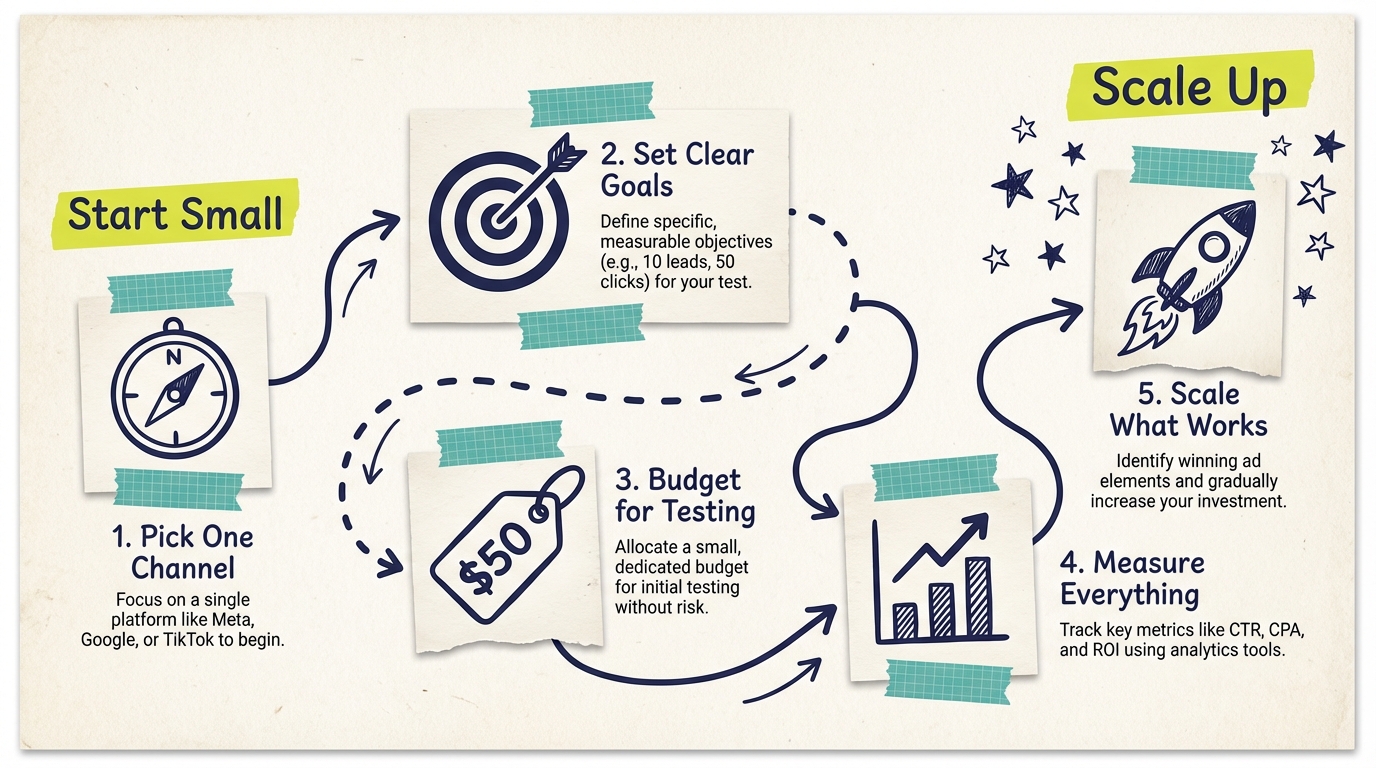
Start Small and Pick One Channel
Don't try to be everywhere at once. Pick the channel that best matches how your customers find you. If people Google your services, start with search ads. If your product is visual, try social media ads. If you want to reach a local audience at scale, CTV advertising is worth a look.
Set Clear Goals Before You Spend
Decide what success looks like before you launch. Do you want phone calls? Website form submissions? Online purchases? Your goal determines which conversion events to track and which pricing model to use.
Budget for Testing
Your first campaigns are experiments, not finished products. Set aside a testing budget (even $50-100 is enough to start on many platforms) and plan to learn from the data before scaling.
With Adwave, for example, you can run a TV ad campaign for just $50. That's enough to see real data on how your target audience responds, without betting the farm.
Measure Everything
Install tracking pixels on your website from day one. Set up conversion tracking for every campaign. Review your metrics weekly. The whole point of performance marketing is that it's measurable, so measure it.
Scale What Works
Once you find a channel, ad creative, or audience segment that's performing well, put more budget behind it. Cut what isn't working. This is the optimization loop in action, and it's how small businesses get outsized results from modest budgets.
For more ideas on the best advertising channels for small businesses, check out our full comparison guide.
Common questions answered
What is performance marketing in simple terms? Performance marketing is a type of advertising where you only pay when someone takes a specific action, like clicking your ad, filling out a form, or making a purchase. It's the opposite of paying a flat fee upfront and hoping for results. Every dollar you spend is tied to something measurable.
Is performance marketing good for small businesses? It's one of the best fits for small businesses because it minimizes risk. You're not committing thousands of dollars to a campaign with no guaranteed results. You set your budget, define what counts as a result, and only pay when that result happens. That makes it easier to control costs and prove ROI.
How much does performance marketing cost? Costs vary widely by channel and industry. Google search ads might cost $1-5 per click for some businesses and $30+ for others. Social media ads often run $5-20 per lead. CTV advertising through Adwave starts at just $50 with CPMs averaging $25. The right budget depends on your goals, your market, and which channels you choose.
What's the difference between performance marketing and digital marketing? Digital marketing is the umbrella term for all online marketing activities, including content marketing, SEO, email, social media, and paid ads. Performance marketing is a subset of digital marketing where every campaign is specifically optimized for and measured by concrete actions. All performance marketing is digital marketing, but not all digital marketing is performance marketing.
Which performance marketing channel should I start with? Start with the channel that matches your customer's behavior. If people search for your services on Google, PPC search ads are a natural fit. If you want to reach a broad local audience with a memorable message, CTV advertising gives you TV-level impact with digital-level tracking. There's no single right answer. It depends on your business and your goals.
Can TV advertising be considered performance marketing? It can now. Traditional TV advertising had almost no attribution. But with connected TV (CTV), you get detailed analytics showing exactly how your ad influenced website visits, conversions, and other actions. Platforms like Adwave provide a real-time analytics dashboard so you can see your TV ad's performance the same way you'd track a Google or Facebook campaign.


