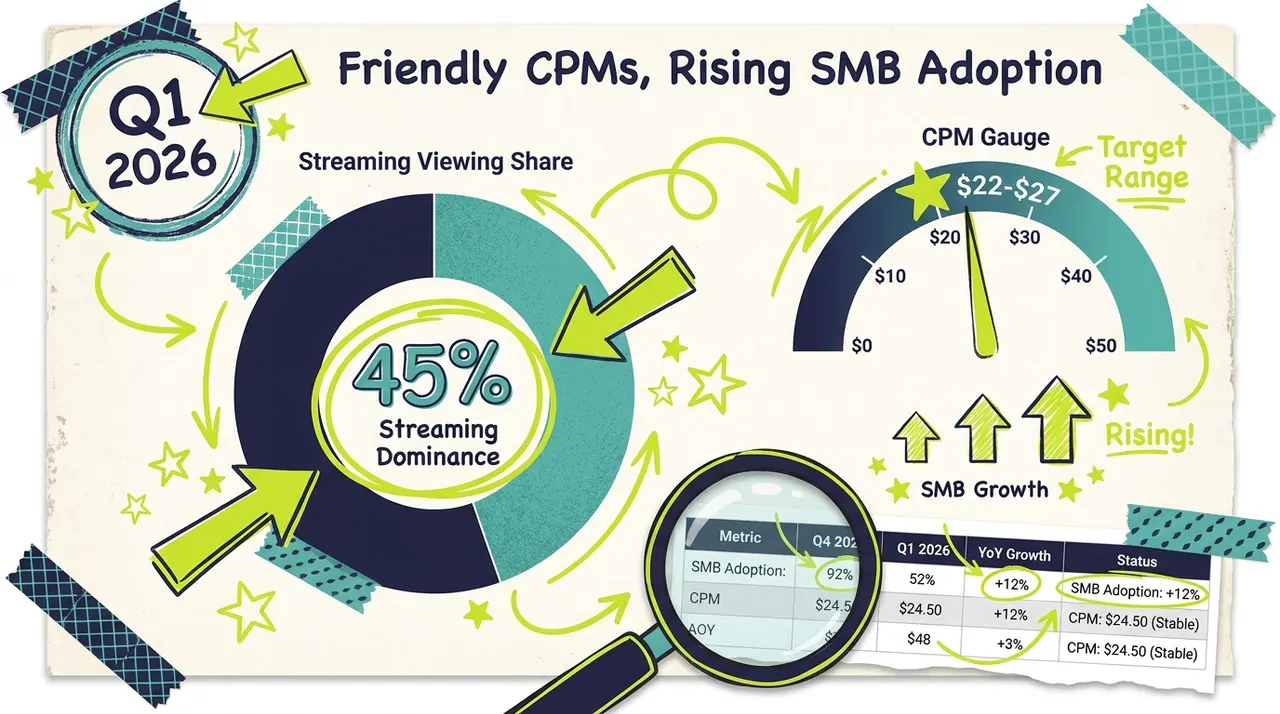
The first quarter of 2026 produced one of the more interesting CTV data sets in recent memory. Streaming continued to expand its share of total TV viewing, ad pricing settled in a small business-friendly range, and a meaningful shift in how SMBs allocate budget across CTV and digital channels showed up in spend reporting. This article summarizes the Q1 2026 trends that matter most for small business advertisers planning the rest of the year.
The viewing share picture
Streaming's share of total TV viewing has continued to expand. According to Nielsen's quarterly Gauge reports, streaming's share of total TV time held above the 45% mark through Q1 2026, with cable in the high 20s and broadcast in the low-to-mid 20s. The shift that's mattered most for small business advertisers isn't just total streaming growth; it's the composition of streaming viewing across platforms.
YouTube TV remained the largest single streaming property by share through Q1, with Netflix close behind. Hulu, Disney+, Amazon Prime, Peacock, Tubi, and Roku Channel each captured meaningful shares of ad-supported viewing. For small business advertisers running on premium CTV inventory, the implication is that running campaigns across multiple networks (which Adwave does by default with 100+ premium channels) produces broader reach than buying any single network.
The 25-54 demographic, which decides most local small business spending categories, was especially streaming-heavy in Q1. Connected device penetration in this demographic now exceeds 85% in most metros, with multiple streaming services per household being the norm rather than the exception.
What happened to CPMs in Q1
CTV CPMs in Q1 2026 settled into a small business-friendly range. Across major small business CTV platforms, average CPM ran roughly $22-$27, with the spread typically $15-$35 depending on inventory tier and targeting precision. A few specific patterns shaped the quarter:
Post-election cooling. The 2024 cycle and the early 2026 midterm ramp had pushed political-adjacent inventory CPMs meaningfully higher in late 2025. Q1 2026 saw a modest cooling as political spending paused between the late-2025 special elections and the May-June primary ramp.
January CPM dip. As expected, the first two weeks of January saw the lowest CPMs of the quarter, with rates 8-12% below the quarter's average. Many small businesses took advantage of this window for "new year, new look" creative refreshes and post-holiday campaigns.
February through March stabilization. CPMs rose modestly from mid-February through the end of the quarter as Super Bowl-adjacent inventory pressure and the early start to political pre-buying tightened available inventory.
Quarterly mix. Programmatic inventory (the bulk of small business CTV impressions) ran 4-8% below late-2025 averages. Premium direct inventory (closer to traditional TV buying) ran closer to flat. The combined small-business average sat in the friendly range described above.
Small business CTV adoption continued to accelerate
The most striking Q1 trend was the continued acceleration of small business CTV adoption. Several signals support this:
Platform subscription growth. Subscription-based CTV platforms targeting small businesses reported sustained quarter-over-quarter customer growth through Q1 2026. The composition of new customers continued to shift toward smaller businesses (those with monthly digital spend under $5,000) rather than the larger SMBs that adopted CTV in 2023-2024.
AI creative usage. AI-generated CTV creative continued to gain share. By late Q1, AI-generated spots represented a meaningful share of new SMB CTV creative launched across major platforms, up from roughly 30-40% a year earlier. The shift has been driven by the cost difference (AI generation effectively free versus $3,000-$10,000 for traditional production) and the speed advantage (2-5 minutes vs 1-3 weeks).
Cross-channel coordination. SMBs running CTV alongside Meta and Google increasingly reported coordinating creative across channels rather than treating each as a separate campaign. The cross-channel coordination pattern that emerged in 2025 became a default approach in Q1 2026, not an experimental one.
What categories drove CTV adoption in Q1
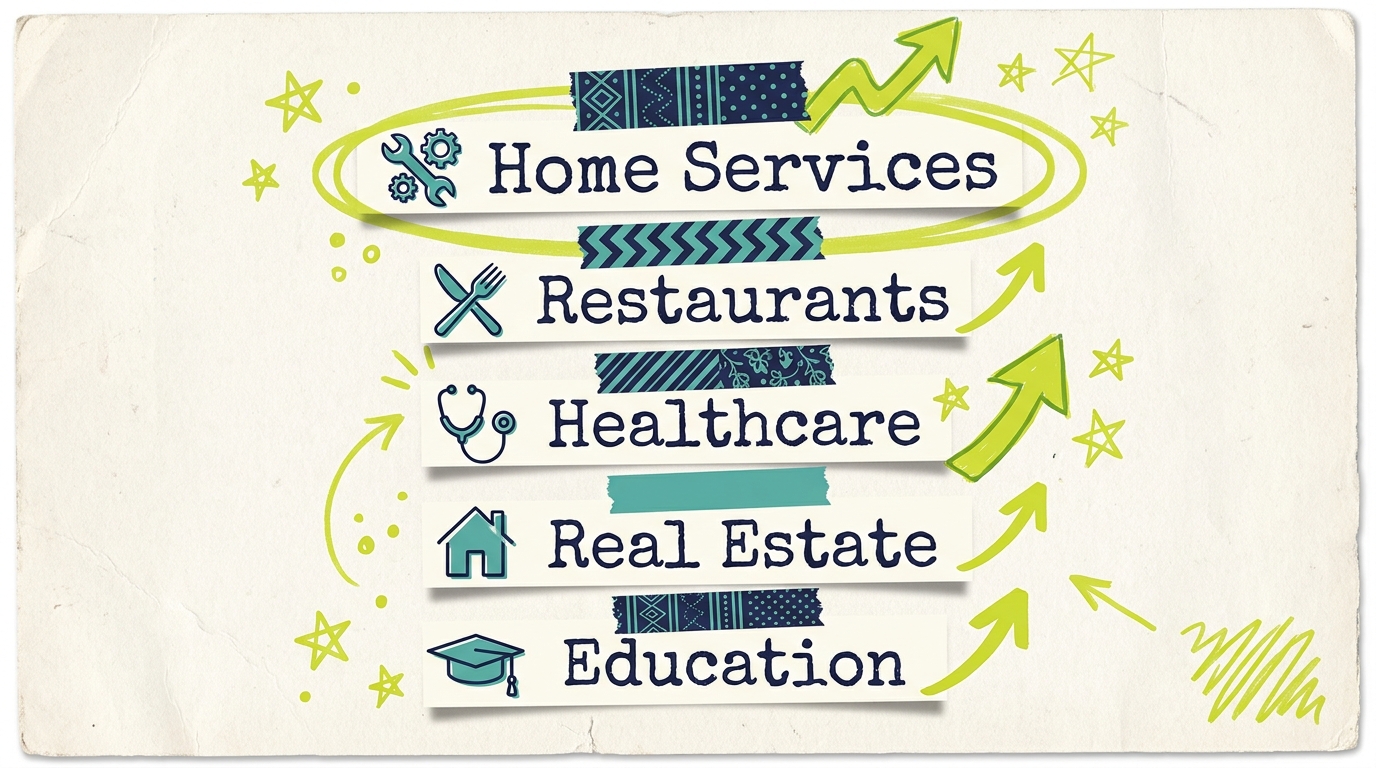
Several category patterns emerged in the Q1 SMB CTV adoption data:
Local home services led growth. HVAC, plumbing, roofing, exterior services, and similar categories represented the largest single category of new SMB CTV advertisers in Q1. The combination of seasonal pre-summer demand and the trust-building advantage of TV for in-home services drove the category's growth.
Restaurant and food service activity rose. Independent restaurants, especially those with multi-location franchise structures, expanded CTV use through Q1. The cost reduction at the subscription tier put CTV in reach of single-location operators for the first time.
Healthcare practices showed measurable adoption. Dental practices, urgent care chains, mental health services, and specialty medical practices added CTV to their mix in growing numbers. The compliance-friendly nature of well-built CTV creative (compared to some social media formats) made the channel an easier institutional sell inside healthcare organizations.
Real estate agents accelerated. Individual agents and small brokerages continued to be one of the fastest-adopting categories. The household-level reach of CTV (where listing decisions are made together) was the most-cited reason in agent adoption surveys.
Education and enrichment grew. Tutoring services, music lessons, dance studios, youth sports programs, and similar categories saw measurable Q1 growth. Spring enrollment cycles drove the timing.
Attribution measurement matured
A pattern worth noting: small business attribution measurement on CTV matured meaningfully through Q1.
Three measurement practices became substantially more common:
Pre/post baseline reporting. SMB CTV platforms increasingly built pre/post baseline reporting into their dashboards by default rather than requiring advertisers to do the comparison themselves. The shift gave small business owners cleaner visibility into total campaign lift.
Cross-channel lift attribution. Reports that include branded search lift, direct traffic lift, and changes in other channel performance during CTV windows became more common. Several platforms began publishing aggregate cross-channel lift benchmarks by category to help SMBs benchmark against industry norms.
Foot traffic measurement. Third-party foot traffic measurement partnerships expanded across the major SMB CTV platforms. For local businesses with physical locations, the ability to attribute foot traffic to CTV campaigns became more practical at small budgets than it had been a year earlier.
The attribution maturity is closing the historical gap between TV and digital channel measurement. SMB owners reported substantially higher confidence in their ability to read CTV's true impact than they had in surveys 12-18 months earlier.
The H1 2026 outlook
Three patterns from Q1 2026 set up the remainder of the first half:
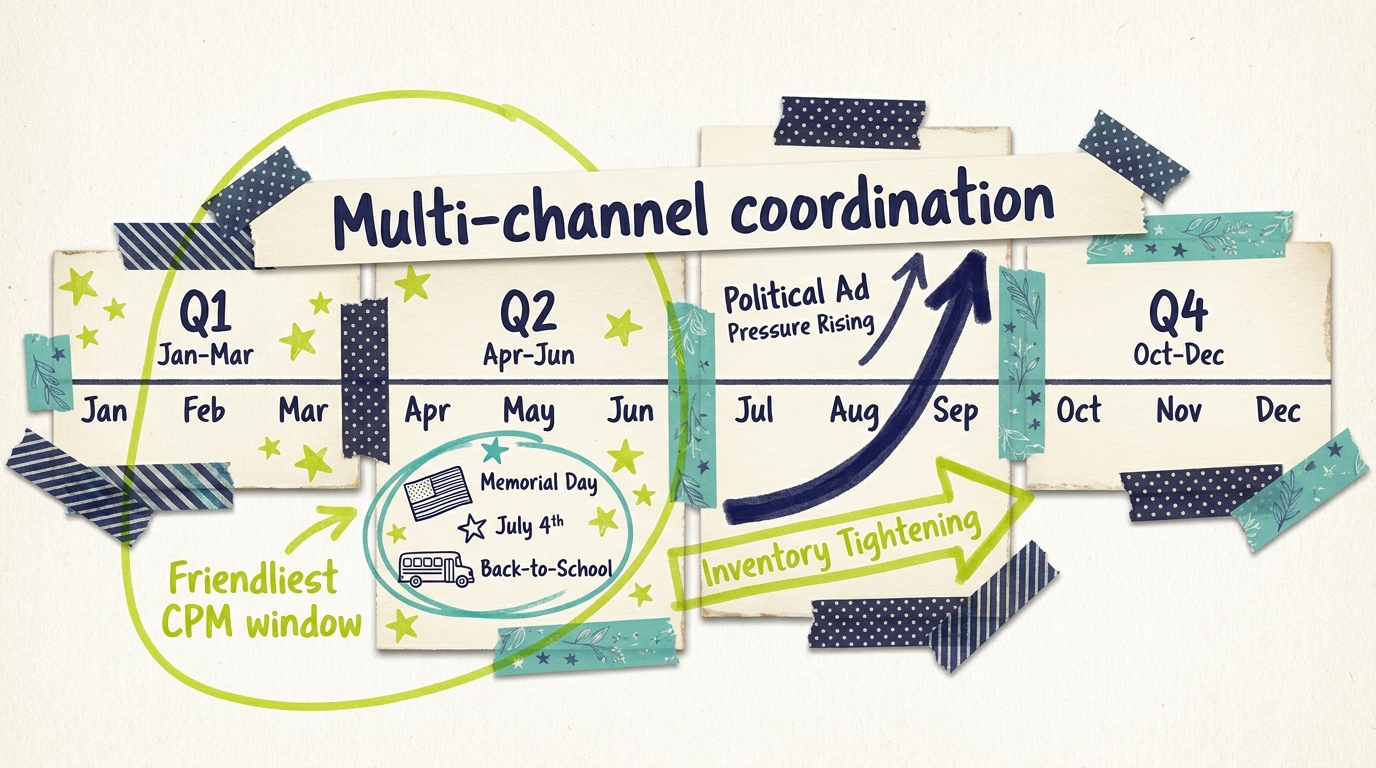
1. Political ad pressure will build through Q2 and Q3. The 2026 midterm cycle will tighten CTV inventory in competitive districts and states beginning in earnest in June-July. SMBs operating in those districts should lock in CTV inventory for August-October by early summer.
2. Summer holiday-pegged campaigns are concentrating earlier. Memorial Day, Father's Day, July 4th, and back-to-school campaigns are starting earlier each year. Q2 2026 advertisers are launching seasonal pushes 7-14 days earlier than the equivalent campaigns in 2024.
3. Multi-channel coordination is now table stakes. The advantage of running CTV in coordination with Meta and Google is no longer a competitive edge for early-adopting SMBs; it's becoming the default expectation. The remaining advantage is in the quality of coordination (synchronized creative, baseline measurement, cross-channel lift tracking) rather than just running multiple channels.
What this means for small business advertisers
A few practical takeaways for the rest of 2026:
The window for friendlier CPMs is closing. Q1 2026 produced some of the most small business-friendly CPM conditions in recent memory. By mid-Q3, political pressure will push CPMs higher in competitive districts. SMBs planning summer or fall campaigns should book inventory windows by early summer.
The cost case for CTV testing has never been stronger. Subscription-tier platforms, AI creative tools, and post-election inventory mean a small business can test CTV for less total cost than was practical even a year ago. SMBs with $1,500+ monthly digital budgets that haven't yet tested CTV are leaving meaningful cross-channel lift uncaptured.
Attribution literacy now matters as much as ad spend. The gap between SMBs measuring CTV cleanly (pre/post baseline + cross-channel signals) and those measuring it through direct attribution alone is producing very different conclusions about whether the channel works. Investing in measurement literacy is now one of the highest-ROI moves available.
Coordination beats isolated channels. The era of running CTV, Meta, and Google as separate campaigns with different creative is ending. The SMBs producing the best Q1 2026 ROAS were the ones running coordinated multi-channel programs with synchronized creative, timing, and measurement.
Category-specific timing matters. For seasonal categories, planning ahead of demand windows beats reacting to them. HVAC businesses launching pre-summer creative by mid-April outperformed those launching in May. Wedding venues running pre-engagement-season creative in November-December outperformed those waiting until February.
What to watch in Q2
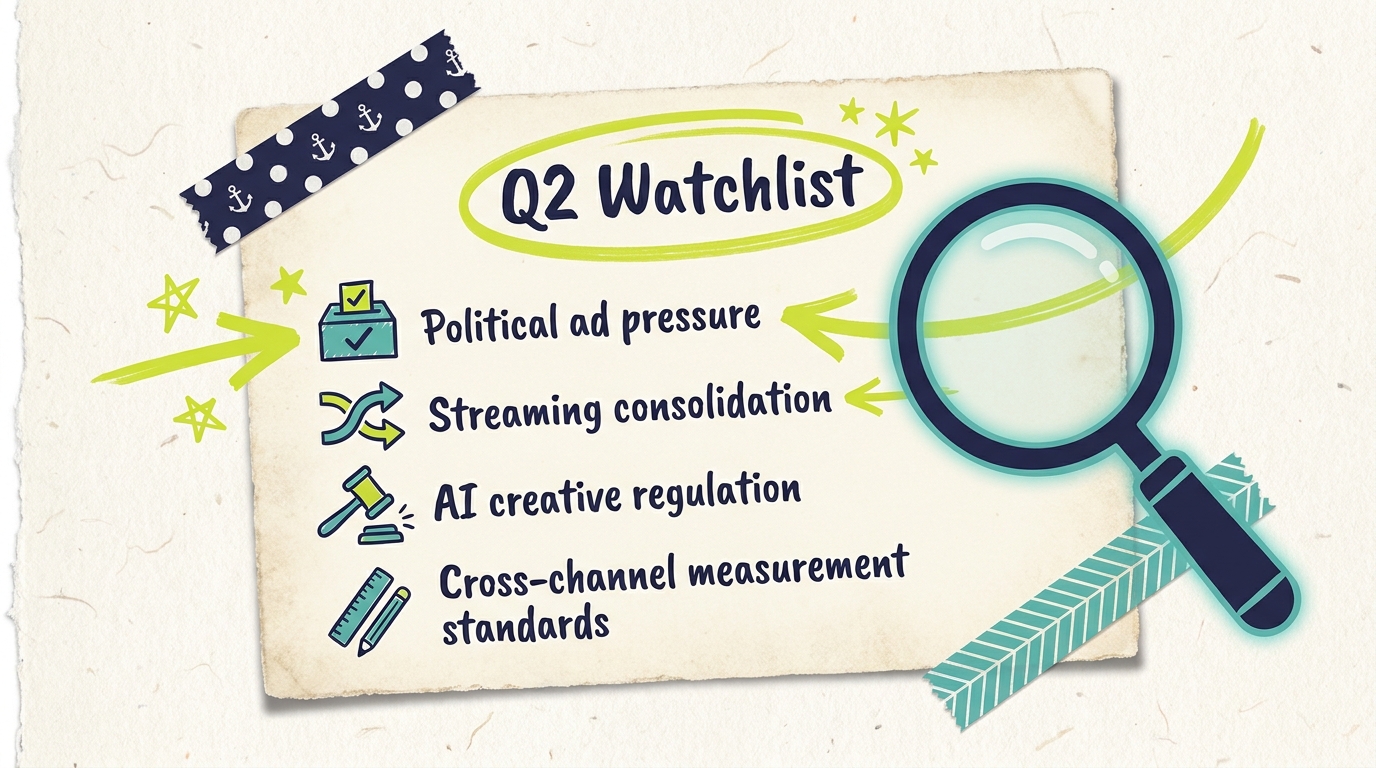
A few things worth keeping an eye on through Q2 2026:
Political ad inventory pressure. As primary season and the early general-election period unfold, watch CPMs in your local political-relevant district or state. Inventory pressure that builds early can compress what's available in fall.
Streaming platform consolidation. Continued mergers, acquisitions, and platform shifts among streaming services will affect inventory availability and pricing. Watch for any major streaming platform changes that affect ad-tier viewership share.
AI creative regulation. As AI-generated creative has scaled, several states and the federal government have been discussing disclosure and labeling requirements. Q2 2026 may produce concrete rules that affect creative workflows.
Cross-channel measurement standardization. Industry efforts to standardize CTV attribution and cross-channel lift measurement continued through Q1. Watch for any major standardization announcements that affect how platforms report performance.
Common questions answered
Is now a good time for a small business to start running CTV?
Q2 2026 (May-June) is one of the most small business-friendly CPM windows of the year, with political inventory pressure not yet at full ramp and post-election cooling still in effect. For SMBs with monthly digital ad spend of $1,500+, this window is unusually attractive for a first CTV test.
Should I be worried about political ad pressure on my CTV campaigns?
Depends on your geography. In competitive states and congressional districts, expect CPMs to rise 15-25% from late July through early November. In safe states and uncompetitive districts, the impact is meaningfully smaller. Small businesses in competitive areas should book August-October inventory by early July to lock in pricing.
How does Q1 2026 compare to Q1 2025 for small business CTV adoption?
SMB CTV adoption growth continued through Q1 2026 at a pace consistent with Q1 2025. The composition of adoption shifted toward smaller businesses (those previously priced out at higher entry points) and toward categories that had under-penetrated in earlier cycles (healthcare, real estate agents, education services).
What's the average CPM small businesses are paying on CTV in 2026?
Across major SMB-focused CTV platforms, Q1 2026 average CPM landed around $22-$27, with most campaigns falling in the $15-$35 range depending on inventory tier and targeting precision. CPMs vary by season, geography, and category demand patterns.
Is AI-generated creative considered "lower-quality" than agency-produced creative on CTV?
Q1 2026 data shows no meaningful conversion-rate gap between AI-generated and agency-produced CTV creative when both follow strong production grammar. The viewer cannot distinguish between them in normal viewing. The quality difference that matters is between locally-anchored creative (whether AI or agency-produced) and generic stock-style creative (whether AI or agency-produced).
Should I run my own CTV measurement or rely on the platform's reports?
Platform reports give you direct attribution and most cross-channel signals you need. Your own pre/post baseline measurement (comparing 4 weeks pre-launch to campaign weeks across total conversions, branded search, and direct traffic) closes the remaining attribution gap. The combination produces a fuller picture than either alone.
What categories should expect the strongest CTV lift in the rest of 2026?
Categories with strong seasonal peaks (HVAC, fitness, retail, hospitality, education) typically see the largest CTV lift when campaigns are timed to demand windows. Categories with long sales cycles (real estate, financial services, healthcare) see compounding lift over time as the brand-building work accumulates.
Looking ahead
Q1 2026 set up a year that should be favorable for small business CTV advertisers, with friendly pricing through Q2, the maturing measurement infrastructure that closes historical attribution gaps, and the AI creative tools that have democratized production costs. The competitive advantage available to SMBs who run CTV in coordination with their existing digital channels (rather than as a separate campaign) is the most meaningful pattern from the quarter.
If your business is among the SMBs that haven't yet tested CTV at scale, Q2 2026 is one of the more advantageous testing windows in recent memory. Ready to put the Q1 trends to work for your business? Create your first ad with Adwave in about two minutes, target your service area, and start your own Q2 baseline this week.