
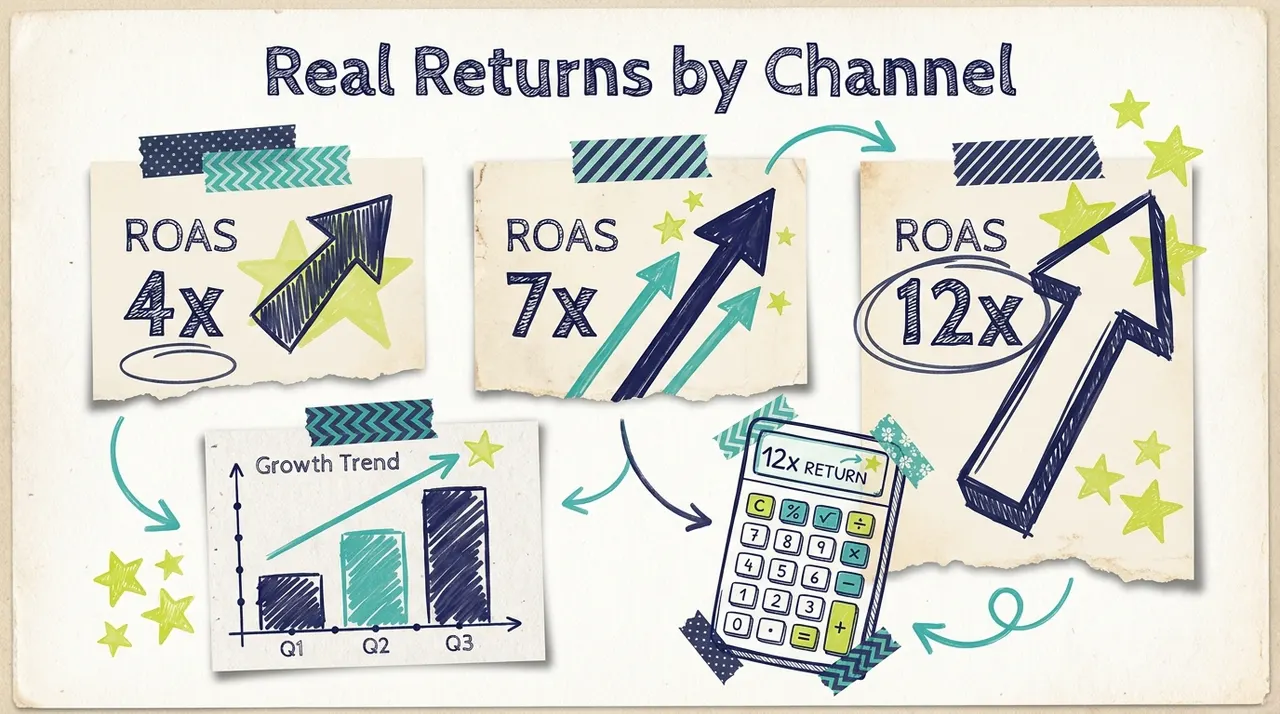
Every small business owner who's ever paid for advertising has asked the same question at some point: "What kind of return should I expect from this?" The honest answer is "it depends on a lot of things," but that's not useful for someone trying to plan a budget. So let's get specific.
This guide walks through eight major advertising channels small businesses use in 2026, what realistic ROI looks like for each, what drives the variance, and how to think about ROI when channels work together rather than separately. The numbers are based on benchmarks across small business categories; your specific business will vary.
A note on how to read ROI numbers
Before we get to the channel breakdowns, a quick orientation on what we're measuring.
Return on ad spend (ROAS) is revenue divided by ad spend. A $1,000 campaign that produces $4,000 in attributable revenue has a 4x ROAS.
Cost per acquisition (CPA) is total ad spend divided by acquired customers. A $1,000 campaign that produces 25 new customers has a $40 CPA.
Cost per lead (CPL) is total ad spend divided by leads generated. A $1,000 campaign producing 80 leads has a $12.50 CPL.
Lifetime ROAS is the same as ROAS but measured against customer lifetime value rather than first-purchase revenue. A $50 first purchase from a customer who'll spend $1,200 over three years has a dramatically different ROAS than first purchase alone suggests.
For most small businesses, lifetime ROAS is the truer measure than first-purchase ROAS, because the advertising work that brings a customer in often pays off for years. We'll reference both throughout.
Channel 1: Google Ads (Search)
What it does: catches active demand. Someone searching "plumber near me" or "wedding photographer Phoenix" is showing strong purchase intent in real time. Search ads put your business in front of that intent.
Typical first-purchase ROAS for SMBs: 2-6x for service businesses, 3-8x for retail and e-commerce.
Typical CPA range:
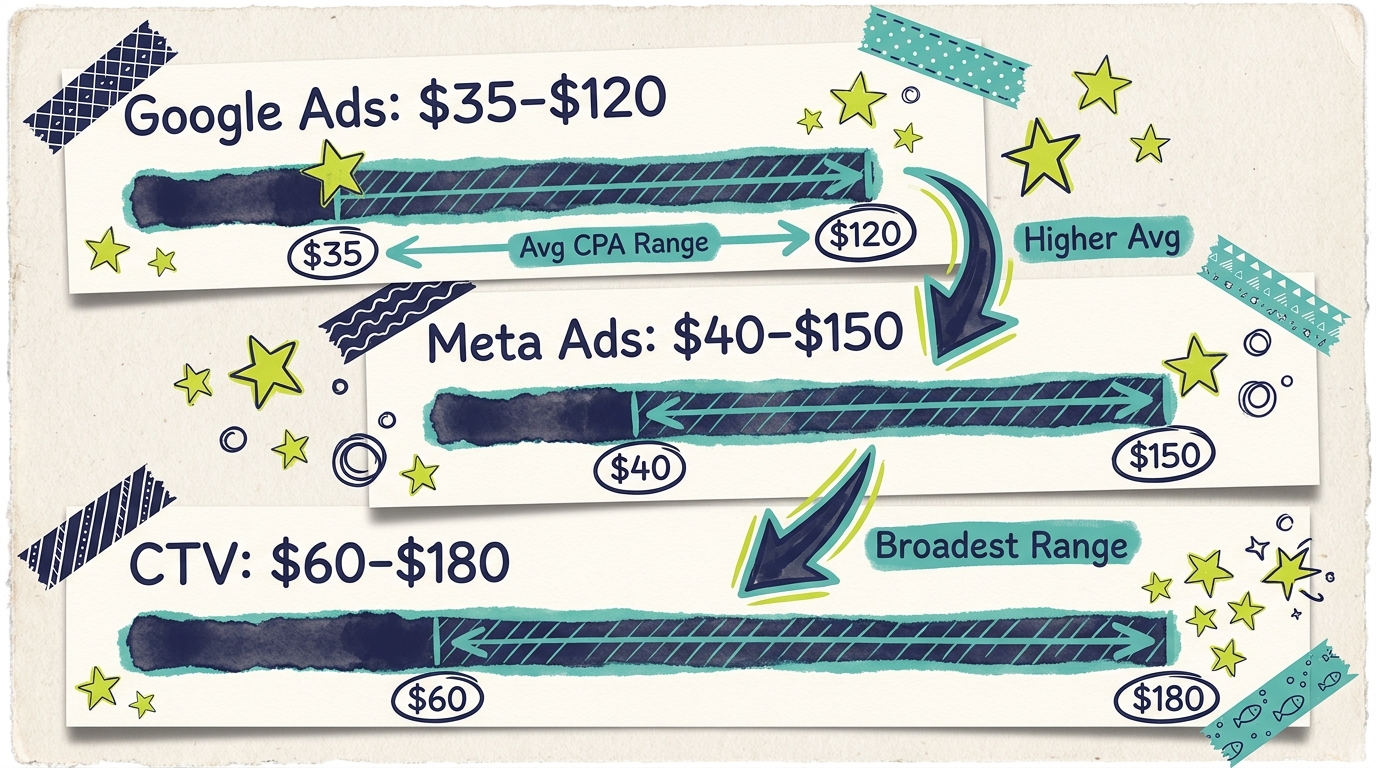
Local services (plumbing, HVAC, electrical, locksmith): $35-$120
Professional services (accountants, attorneys, financial advisors): $80-$250
Health and wellness services: $30-$90
Retail and e-commerce: $15-$60
What drives variance: Quality of landing page (a search ad sending traffic to a slow or confusing page often shows 50-70% lower conversion than the same ad sending to an optimized page), match between keyword and offer, geographic and time-of-day targeting precision, and competition for the keyword.
When ROI is weakest: When keywords are too broad (generic "marketing" rather than "small business marketing in Atlanta") or when the landing page doesn't match the ad's promise.
When ROI is strongest: Long-tail intent keywords paired with landing pages that directly answer the searcher's question. A search for "emergency plumber Tampa weekend" landing on a page that confirms availability and provides a one-tap call button converts dramatically better than the same search landing on a generic homepage.
Channel 2: Meta Ads (Facebook + Instagram)
What it does: builds awareness and interest before active intent. Most Meta conversions come from users who weren't actively searching but became interested after seeing a compelling ad in their feed.
Typical first-purchase ROAS for SMBs: 1.5-5x for service businesses, 2-7x for e-commerce, with significant category variance.
Typical CPA range:
E-commerce DTC brands: $15-$60
Local services: $40-$150
Subscription services: $25-$90
High-ticket services (real estate, financial, legal): $100-$400
What drives variance: Creative quality is the single largest variable. The same audience, the same offer, the same landing page, with two different creatives can produce 3-5x different conversion rates. Audience targeting (lookalikes, interest stacks, retargeting) is the second-largest variable.
When ROI is weakest: Generic creative on broad audiences, sending traffic to homepages rather than purpose-built landing pages.
When ROI is strongest: Strong creative (video over static, native-looking content over polished branded creative) targeting retargeting and lookalike audiences with offer-specific landing pages.
Channel 3: Connected TV (CTV) Advertising
What it does: builds the trust and familiarity that other channels later convert. CTV reaches viewers in lean-back streaming mode, which produces higher attention quality and stronger brand recall than digital scrolling channels.
Typical first-purchase ROAS for SMBs: 1.5-4x in directly-attributed conversions, 3-7x when cross-channel lift is included.
Typical CPA range (direct attribution):
Local services: $60-$180
Healthcare practices: $80-$250
Retail and restaurants: $50-$140
Fitness studios and wellness: $45-$130
Typical CPM: $15-$35, average around $25 on premium streaming inventory.
What drives variance: Geographic targeting precision (the single biggest variable), frequency in the 3-5 sweet spot, creative quality, and how cleanly cross-channel lift is measured. Direct attribution alone usually captures 30-50% of CTV's real impact; pre/post baseline measurement closes the gap.
When ROI is weakest: Geographic targeting that's too broad (impressions landing outside the real service area), under-frequency (audience seeing ad once or twice but never hitting recall threshold), or measurement that only counts direct attribution.
When ROI is strongest: Tight geographic targeting, frequency of 3-5 per household, creative that builds trust and emotional preference (rather than direct response), and cross-channel measurement that includes lift to digital channels.
Notable 2026 shift: Subscription-priced CTV platforms have made the channel accessible at small business budgets ($50-$500/month entry tiers). The cost democratization has not been matched by an awareness democratization yet, so CTV remains one of the most underused high-ROI channels for SMBs with $1,500+ monthly ad budgets.
Channel 4: Local SEO and Google Business Profile
What it does: surfaces your business in local search and on Google Maps when prospects search for your category in your area.
Typical "first-purchase ROAS": Hard to calculate cleanly because there's no direct ad spend, but the time-and-tool investment typically returns 8-20x on the equivalent budget allocation.
Typical cost: $0-$500/month in tools and time. Some businesses invest in local SEO audits at $1,500-$5,000 annually.
What drives variance: Consistency of NAP (name, address, phone) data, frequency of review collection, photo and post freshness on Google Business Profile, and structured data on the business website.
When ROI is weakest: Inconsistent business information across the web (different phone numbers on different directories), no recent reviews, stale Google Business Profile with photos from years ago.
When ROI is strongest: Active Google Business Profile management (new photos monthly, responses to every review, regular posts), strong review velocity (10+ reviews/month for active local businesses), and on-site schema markup that helps Google understand the business.
Channel 5: Email Marketing
What it does: nurtures existing leads and customers through retention, repeat purchase, and referral.
Typical ROAS for SMBs: 15-40x for service businesses with strong email lists, 8-25x for e-commerce.
Typical cost: $20-$300/month in platform fees (Mailchimp, Klaviyo, ConvertKit, etc.) plus time for content production.
What drives variance: List quality (purchased lists produce dramatically worse results than organically-grown lists), segmentation, frequency, and content quality.
When ROI is weakest: Generic monthly newsletters sent to entire list without segmentation. Open rates of 10-15%, click rates under 1%, and minimal revenue attribution.
When ROI is strongest: Segmented campaigns (by customer behavior, purchase history, or interest), automated sequences (welcome series, abandoned cart, post-purchase, win-back), and content that provides value to subscribers beyond promotion.
Important note: Email is the only major channel where the platform costs are tiny relative to the revenue produced. For most small businesses with engaged customer lists, email is consistently the highest-ROI channel by a wide margin. The constraint is usually list size rather than spend efficiency.
Channel 6: Local Print and Direct Mail
What it does: reaches specific geographic households in a physical format. Local newspapers, neighborhood magazines, and direct mail campaigns.
Typical first-purchase ROAS for SMBs: 1-3x for service businesses, 0.5-2x for retail.
Typical CPA range: $35-$200 depending on category and mail piece quality.
What drives variance: List quality (geo-targeted to ideal customer demographics versus blanket mail to a ZIP), offer specificity, and how easily the call to action can be acted on (a QR code beats a phone number beats a URL alone).
When ROI is weakest: Untargeted bulk mail with generic offers and no tracking mechanism. Many small businesses still run these and don't realize how badly they underperform.
When ROI is strongest: Highly-targeted direct mail (specific demographics, behavioral data, or proximity to a competitor) with strong, time-bound offers and clean tracking.
Notable trend: Print and direct mail ROI has been declining over the past five years for most categories, but specific use cases (high-value home services targeting affluent neighborhoods, real estate, certain B2B) still produce strong results when executed with precision.
Channel 7: Influencer and Creator Partnerships
What it does: uses the audience and trust of content creators to reach potential customers.
Typical first-purchase ROAS for SMBs: Highly variable. 0.5-15x range, with most campaigns landing 1-4x.
Typical cost: $200-$5,000 per partnership for SMB-scale campaigns, with significant variance based on creator size and platform.
What drives variance: Match between creator's audience and business's customer profile (the single biggest variable), authenticity of the integration, and trackability of conversions.
When ROI is weakest: Generic sponsorships with creators whose audience doesn't match the business's customer profile, or where the integration feels forced and inauthentic.
When ROI is strongest: Highly-targeted partnerships with micro-creators (10K-50K followers) whose audience exactly matches the business's customer profile, paired with creator-specific tracking URLs or discount codes.
Important caveat: Influencer ROI is the most variable of any channel in this list. For some categories (beauty, fashion, fitness, food) influencer partnerships are foundational. For others (legal services, B2B, complex services) they're rarely effective.
Channel 8: Local Sponsorships and Community Events
What it does: builds local presence through tangible community involvement. Sponsoring a Little League team, a charity 5K, a school event, a local festival.
Typical first-purchase ROAS for SMBs: Hard to measure directly, but the long-term local-presence value is real for businesses serving tight geographies.
Typical cost: $250-$5,000 per sponsorship.
What drives variance: Whether the sponsorship comes with meaningful activation (signage, mentions, on-site presence) or is purely a name-on-a-banner play.
When ROI is weakest: Logo-on-banner sponsorships with no activation, no on-site presence, no follow-up engagement with attendees.
When ROI is strongest: Sponsorships paired with on-site presence, lead capture (a tablet for free quotes, an entry-to-win event), and follow-up engagement. Often paired with CTV campaigns running in the surrounding ZIPs to compound the local recognition.
ROI when channels work together
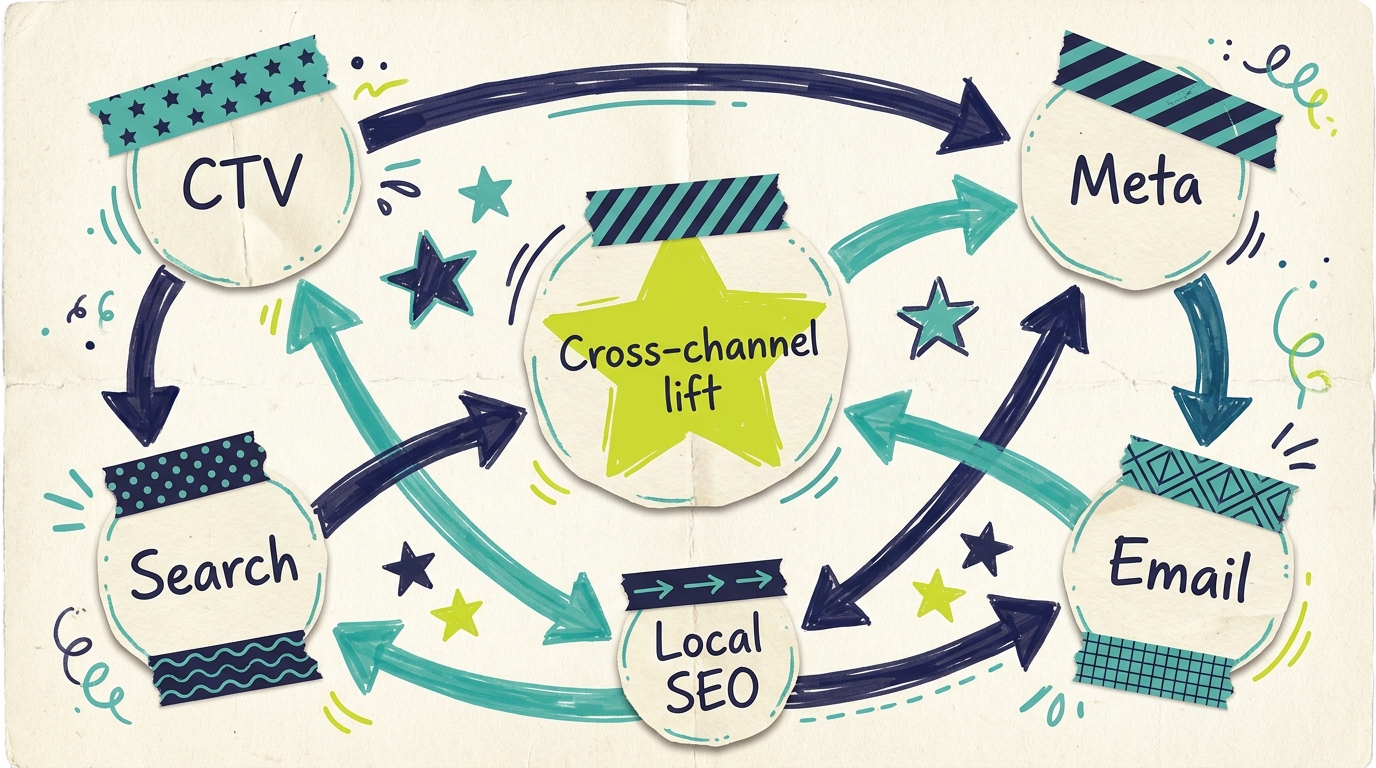
The most underappreciated dynamic in small business advertising is that channels lift each other's performance when run in coordination. A few patterns from cross-channel ROI studies:
CTV lifts search ROAS by 15-35% during active flights. Branded search rises, click-through rates on Google ads improve, and conversion rates on landing pages rise. A Google Ads campaign that ran at 3x ROAS without CTV often runs at 3.5-4x during a coordinated CTV flight.
Meta + Google works as a coordinated funnel. Meta retargets visitors who didn't convert from Google, often producing 2-4x ROAS on retargeting traffic that Google search alone would have lost.
Email amplifies every paid channel. A customer who converts through Google ads and then enters an email nurture sequence delivers 2-5x more lifetime value than a customer left without email follow-up. The paid acquisition is the start; email is the multiplier.
Local sponsorships compound with CTV. A business sponsoring a local event with simultaneous CTV in the surrounding ZIPs sees recognition compound. The CTV pre-warms the audience; the event presence converts the recognition into trial or purchase.
The implication is that ROAS-per-channel numbers in isolation are misleading. The right measurement is total revenue lift against total ad spend across all channels, not channel-by-channel attribution.
What "good" ROI looks like for typical small business spending
For a small business with $3,000-$5,000 in total monthly ad spend across multiple channels, healthy overall ROI looks roughly like:
Total ad-driven revenue: 4-8x ad spend in first-purchase terms
Customer acquisition cost (across all channels): $25-$120 depending on category
Lifetime ROAS: 8-20x ad spend
Cross-channel lift signal: non-paid channels (organic traffic, branded search, direct traffic, word-of-mouth) growing during active paid campaigns
Underperforming campaigns typically show: total ad-driven revenue at 2x ad spend or below, CAC trending up over time without offsetting LTV growth, no measurable lift to non-paid channels.
The right diagnostic question when ROI is underperforming is rarely "which channel should we cut?" It's usually "where is the foundation weakest?" Common foundations that suppress ROI: a website that doesn't convert, weak email follow-up, poor geographic targeting, mismatched creative-to-offer, or no measurement infrastructure.
Building a realistic ROI expectation
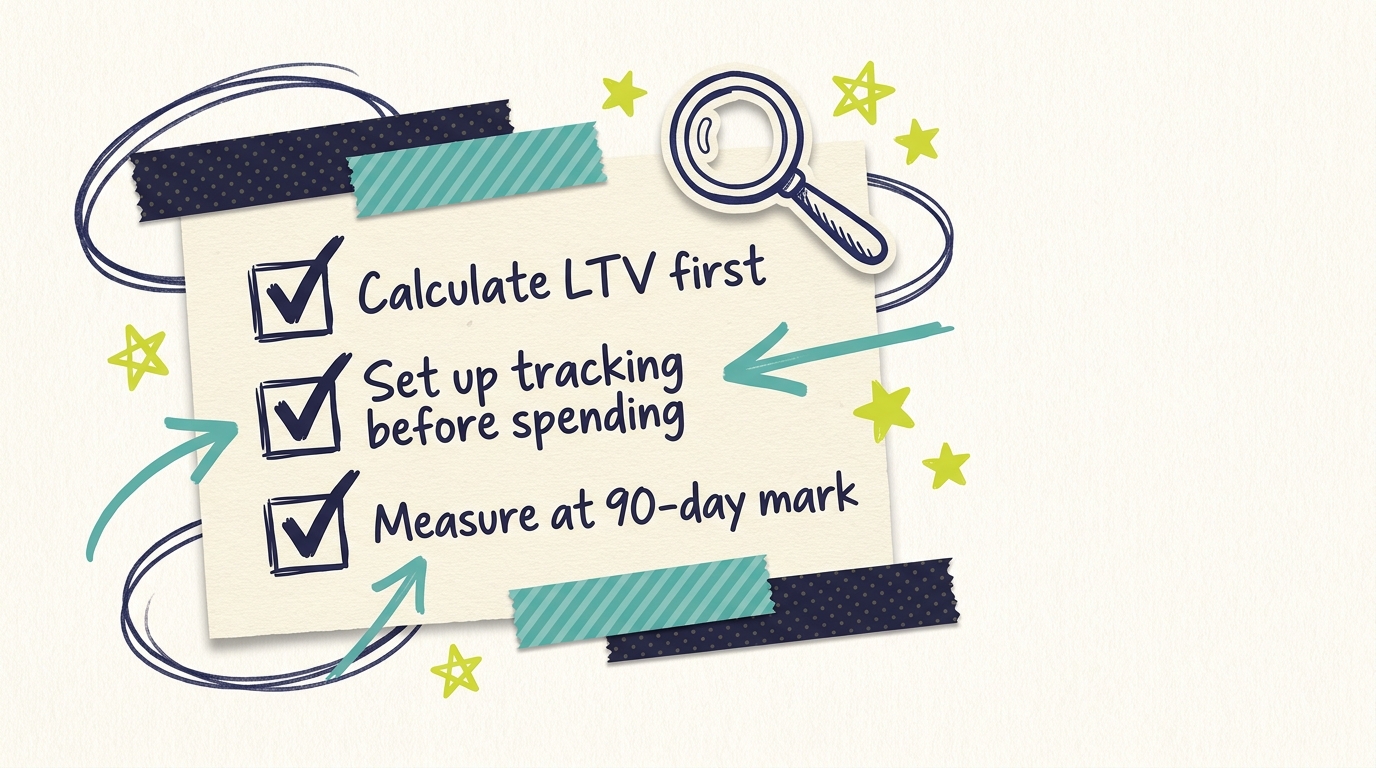
Three things every small business owner should do to set realistic ROI expectations:
1. Calculate your customer lifetime value before you set ad budgets. A customer worth $300 over their lifetime supports a different acquisition cost than a customer worth $4,000. Budget against LTV, not first-purchase revenue.
2. Set up measurement before you spend, not after. UTM tagging, baseline reporting, intake questions on inquiry forms, and at minimum a "how did you hear about us?" capture. Without measurement, ROI calculations are guesses.
3. Plan for a 90-day measurement window per channel. Two-week ROI judgments produce wrong conclusions. Most channels need 30-60 days to stabilize and 60-90 days to demonstrate their full contribution.
Common questions answered
What's the highest-ROI channel for most small businesses?
For businesses with existing customer lists, email marketing is almost always the highest-ROI channel (15-40x ROAS) because the platform cost is small relative to the revenue produced. For acquisition (bringing in new customers), Google Ads tends to have the highest first-purchase ROAS among paid channels, while CTV produces the highest cross-channel lift (which boosts ROAS on every other channel).
Is CTV really worth the spend for a small business?
Yes, increasingly. The combination of subscription-tier platforms ($50-$500/month entry points), AI creative tools, and the well-documented cross-channel lift effect means CTV is one of the highest-ROI channels for small businesses with $1,500+ monthly ad budgets when measured across the full funnel rather than just by direct attribution.
Should I expect immediate ROI from a new ad channel?
No. Plan for 60-90 days before judging any new channel's true ROI. The first 2-3 weeks of any channel are settling-in. Real performance signal emerges in weeks 4-8. The most defensible ROI read is at the 90-day mark when pre/post baseline comparisons can be made cleanly.
Why is my ROAS lower than what I see in case studies?
Case study ROAS numbers are often best-case scenarios for the businesses featured. Several factors that aren't always disclosed: how attribution was measured (direct only vs. cross-channel), whether the business had a strong baseline before the campaign, and how long the data window was. Realistic ROAS for typical small business campaigns runs roughly half of what most case studies report.
Does brand-building advertising have measurable ROI?
Yes, though it shows up in cross-channel lift and lifetime value rather than first-purchase direct attribution. Channels that build trust and familiarity (CTV, local sponsorships, content marketing) raise the conversion rates of every other channel. The mistake is measuring brand-building channels by direct-response standards.
How do I know if my advertising ROI is competitive for my industry?
Realistic benchmarks vary by category. For local service businesses, healthy ROI is usually 3-6x first-purchase, with 8-20x lifetime ROAS. For e-commerce, 2-5x first-purchase with 5-15x lifetime is the typical healthy range. For high-ticket services, first-purchase ROAS is often below 2x but lifetime ROAS can be 15-40x because of the larger ticket sizes and longer customer lifetimes. Compare against your customer LTV, not against industry averages.
What's the most common ROI mistake small business owners make?
Measuring channels in isolation rather than as a coordinated system. Channels that work together produce ROI that's higher than the sum of their parts. Channels measured separately and optimized separately often deliver lower combined results than the same total spend coordinated across channels with shared creative and synchronized timing.
Make ROI work for your business
Setting realistic ROI expectations is the first step toward building an advertising plan that produces real returns rather than chasing benchmarks you can't replicate. The right starting point is your customer LTV, the right time horizon is 90 days per channel, and the right measurement is total revenue lift across coordinated channels rather than channel-by-channel attribution.
If your current ad mix is missing the trust-and-familiarity layer that lifts every other channel, CTV is one of the highest-impact additions you can make in 2026. Create your first ad with Adwave in about two minutes, target your service area, and start measuring what the layer does for your awareness and conversion ROI.


