-
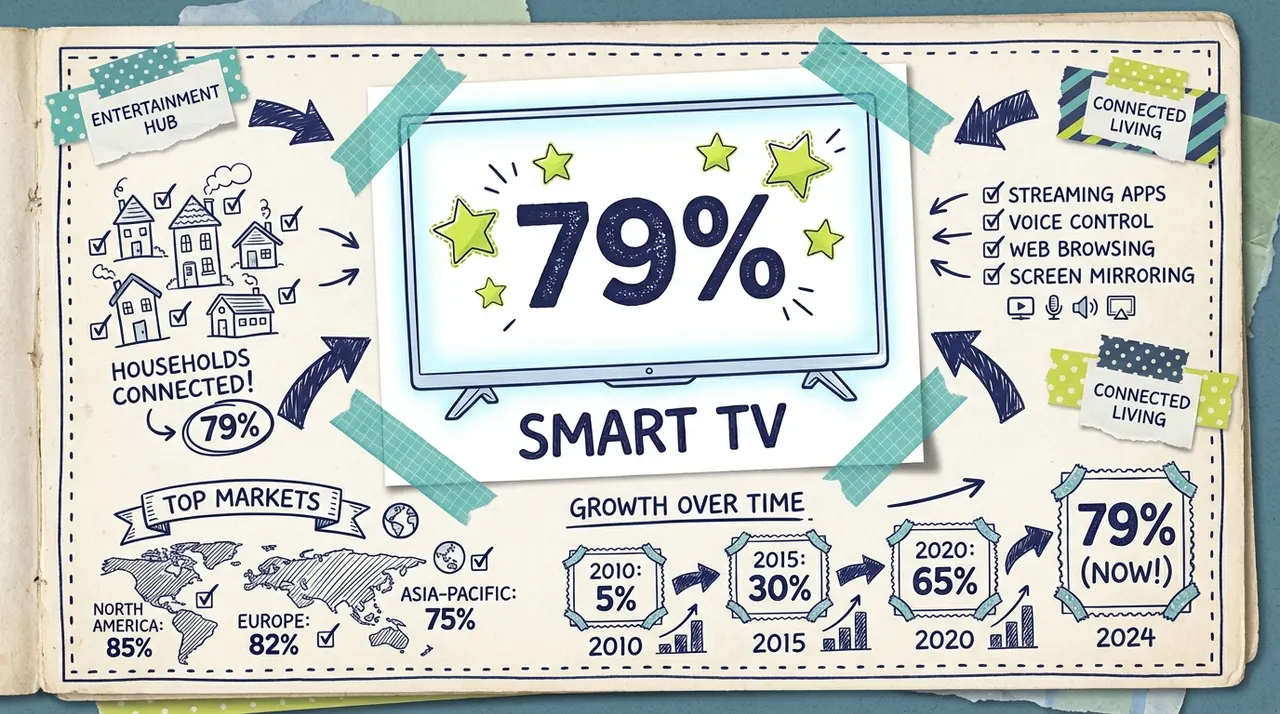
79%
U.S. households with smart TVs
-
68%
Internet homes with smart TV (Parks Associates)
-
+13%
Growth since 2020 (66% to 79%)
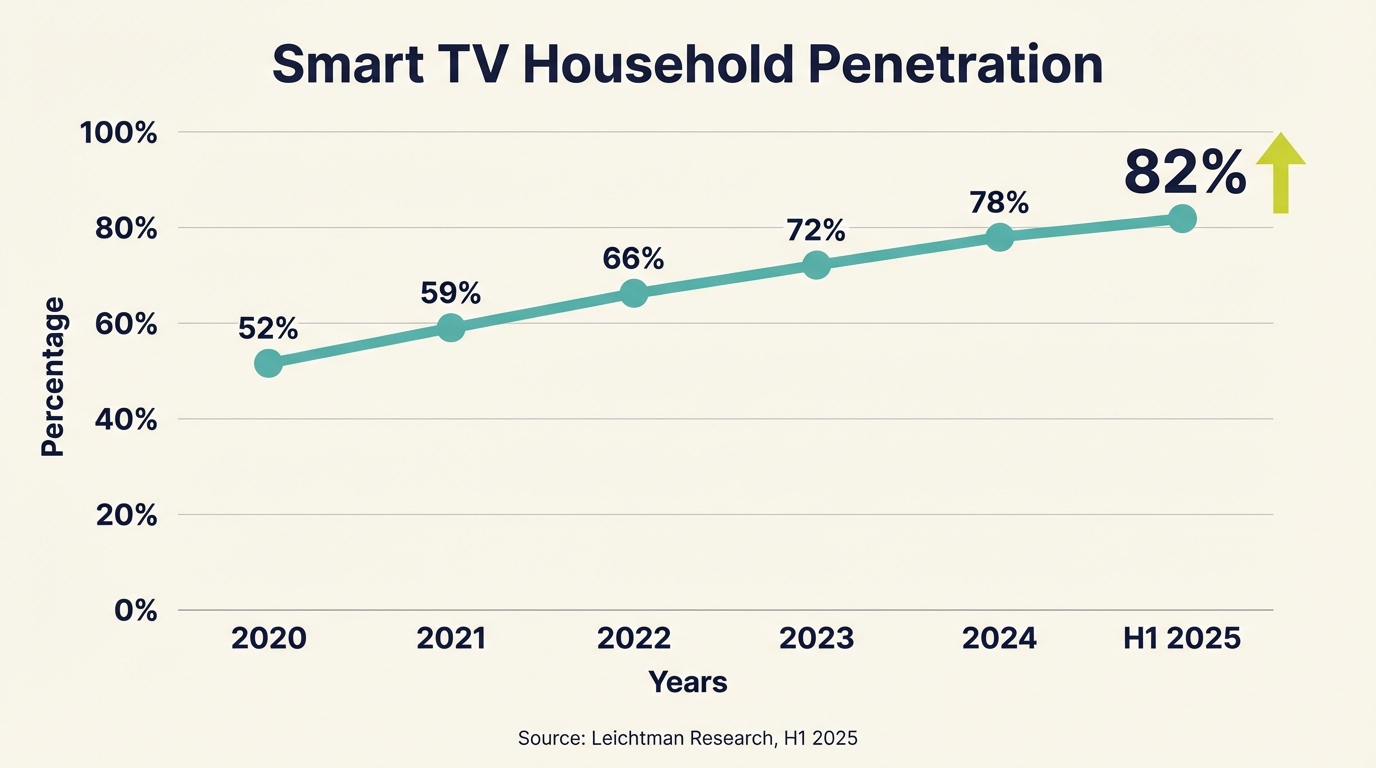
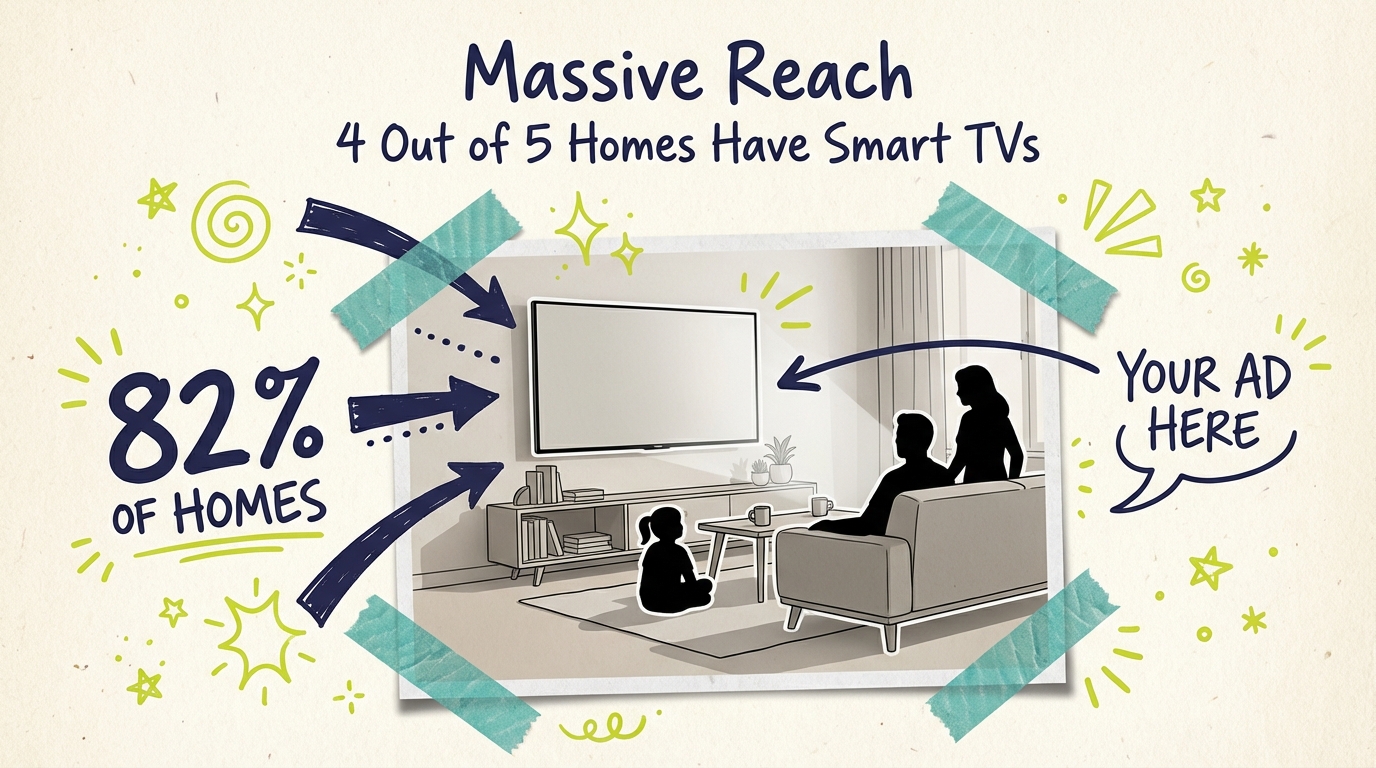
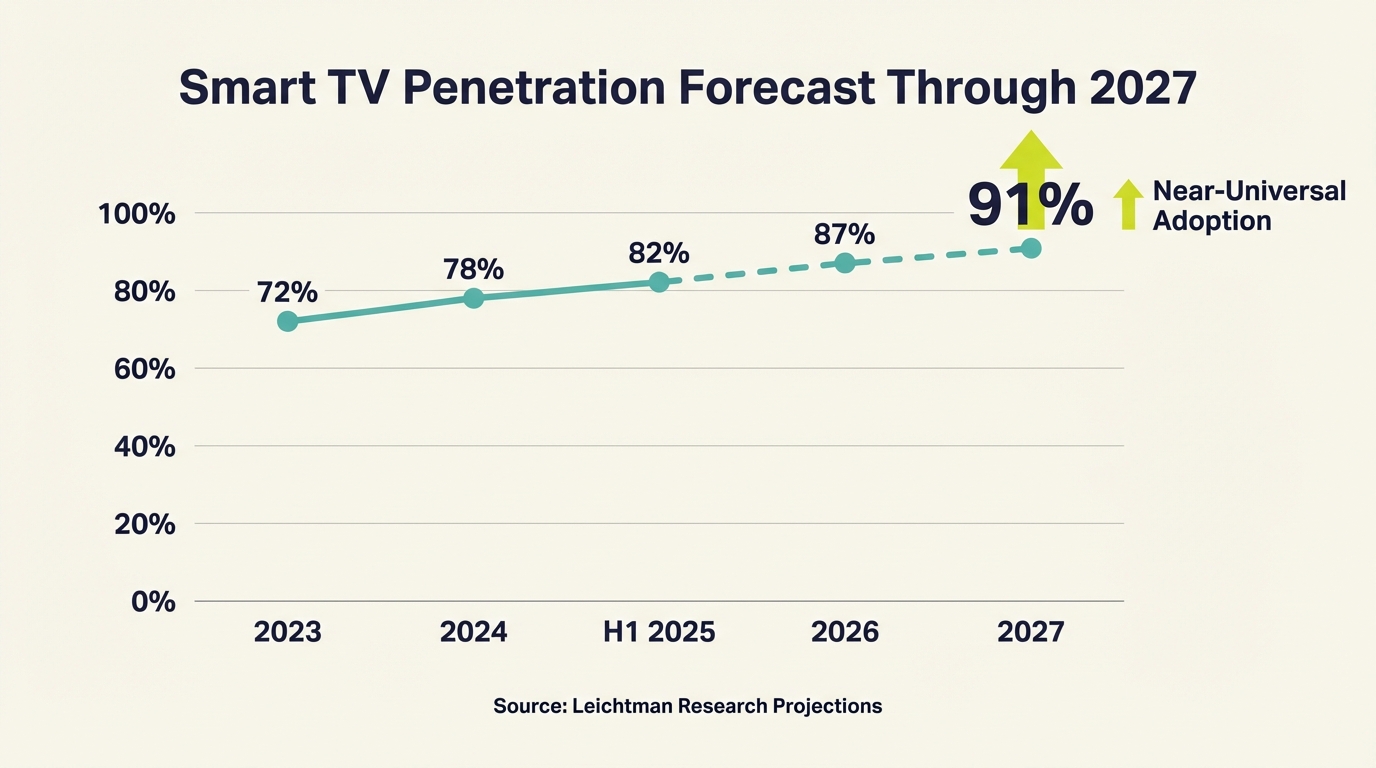
Approximately 82% of U.S. TV households now own a smart TV, according to Hub Entertainment Research's 2025 data as reported by Marketing Charts. This represents continued growth from 79% the previous year and 70% in 2021. The rapid adoption of smart TVs has fundamentally changed how Americans access television content and, critically for advertisers, how they can be reached through connected TV advertising. For small businesses considering TV advertising, these penetration numbers mean that the vast majority of American households are now accessible through streaming TV ads.
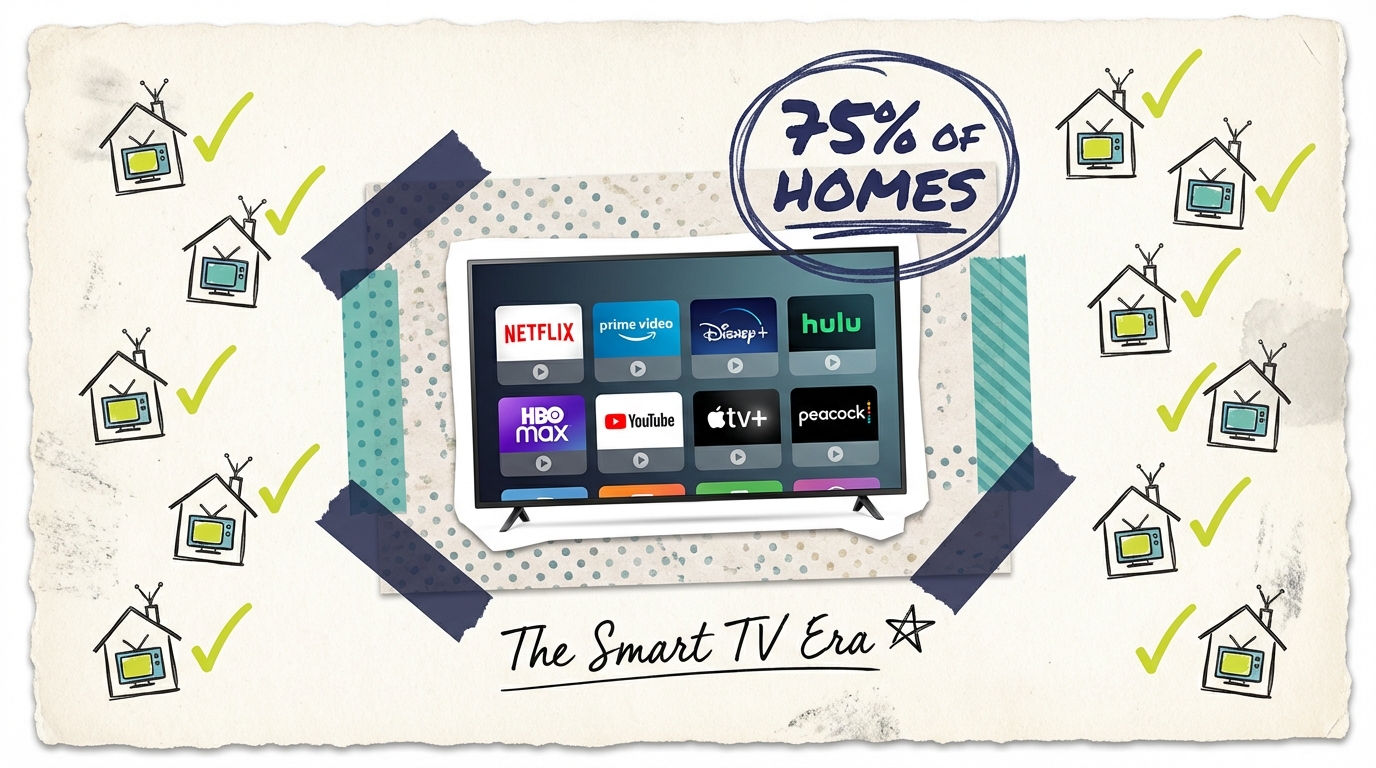
The distinction between smart TVs and connected TV (CTV) matters for understanding the full picture. A smart TV is a television set with built-in internet connectivity and streaming capabilities. Connected TV is the broader category that includes smart TVs plus any television connected to the internet through external devices like Roku, Amazon Fire TV, Apple TV, or gaming consoles. When we factor in all CTV devices, household penetration climbs even higher, with some estimates suggesting over 90% of U.S. households have some form of connected TV access.
What the data shows
Multiple research firms track smart TV and connected TV penetration, with some variation in methodology and definitions. Understanding the full landscape of data helps advertisers grasp the true opportunity.
Smart TV ownership statistics
According to Hub Entertainment Research as reported by Marketing Charts, smart TV penetration continues its upward trajectory:
82% in 2025: Current smart TV household penetration
79% in 2024: Previous year's penetration level
70% in 2021: Baseline from four years ago
66% in 2020: Pre-pandemic baseline according to The Current
+12 percentage points: Growth from 2021 to 2025
The pace of growth has been remarkable. Smart TV penetration increased 12 percentage points in just four years, outpacing typical consumer electronics adoption curves. This acceleration was driven by falling smart TV prices, improved streaming app ecosystems, and increased consumer demand for streaming access.
Connected TV device ownership
Looking at the broader CTV category, which includes both smart TVs and external streaming devices, penetration is even higher:
115 million households (approximately 88%) owned at least one CTV device as of 2024, according to AI Digital's analysis
90% of households use internet-connected TV devices at least once per month, according to industry research
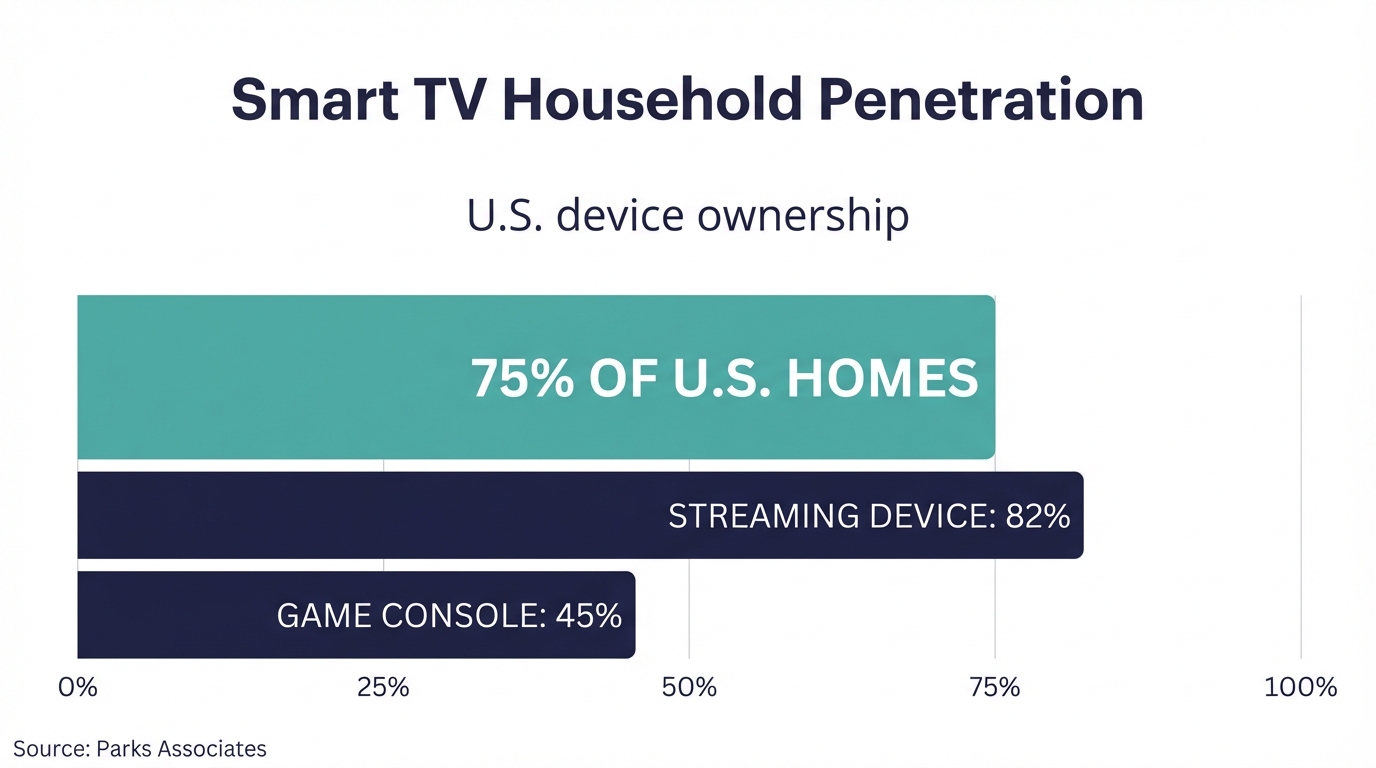
46% of households own a dedicated streaming media player (like Roku or Fire TV) in addition to or instead of a smart TV, according to Parks Associates
The combination of smart TVs and streaming devices means that CTV advertising can reach nearly 9 in 10 American households, a remarkable level of accessibility for what was once an exclusive advertising channel.
Weekly streaming behavior
Raw ownership statistics tell only part of the story. What matters for advertisers is whether these devices are being used for streaming content:
66% of TV households watch streaming video on a smart TV at least weekly
47%+ of all TV viewing now happens through streaming platforms
Multiple hours daily is typical viewing time for CTV households
These usage patterns confirm that smart TV ownership translates to active streaming behavior, making these households viable advertising targets.
Global and regional variations
Smart TV adoption varies by region, with North America leading globally:
North America: 85% smart TV penetration (highest globally)
Europe: 82% penetration
Asia-Pacific: 75% penetration
Global: 50%+ of households projected to own smart TVs by 2026 (1.1+ billion homes)
According to Market.us, smart TV penetration is expected to continue growing globally, with over half of all households worldwide projected to own a smart TV by 2026.
Breaking down the numbers
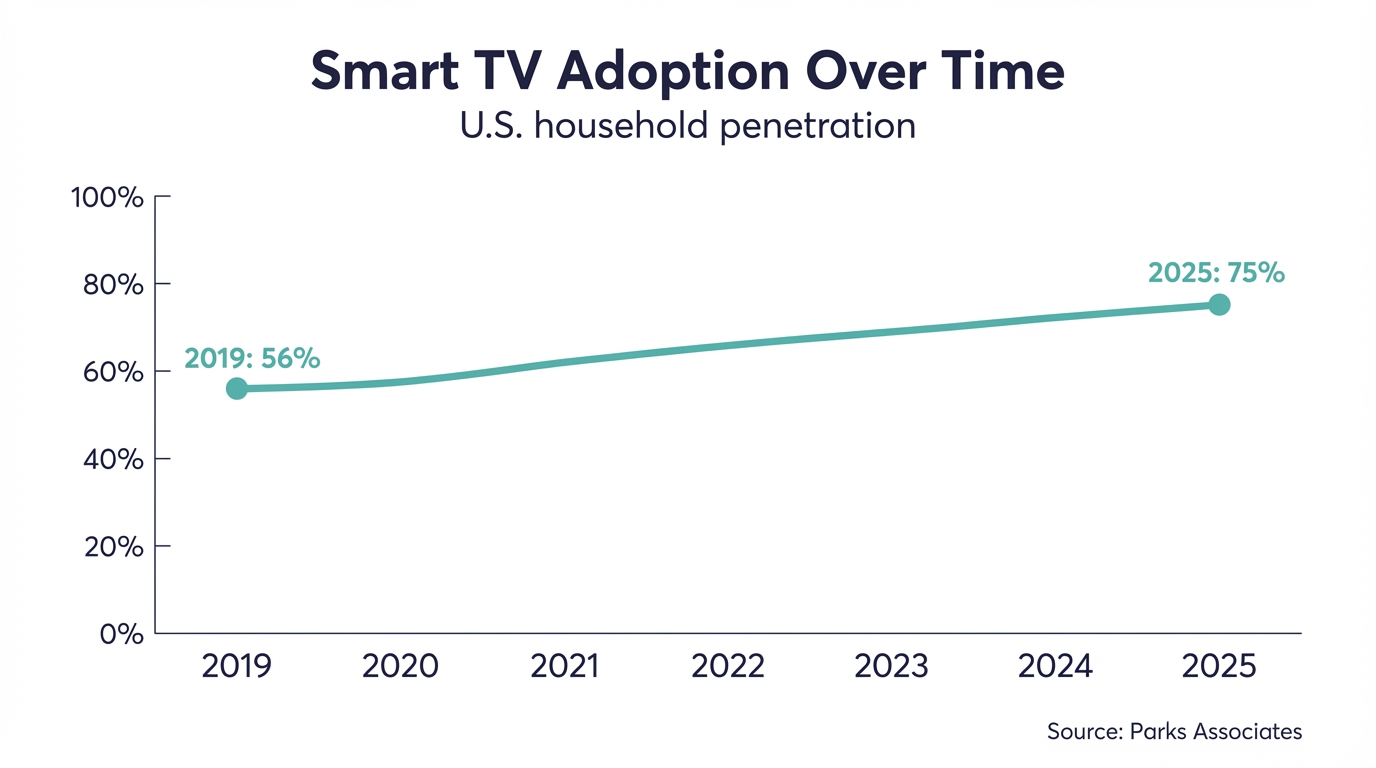
Understanding what's driving smart TV adoption and how different segments behave helps advertisers target effectively.
Why smart TVs have become the default
Several factors have driven smart TV adoption to near-ubiquity:
Price commoditization: Smart TV prices have fallen dramatically. Today, smart functionality is standard on nearly all new television sets, even budget models. A consumer buying any new TV is likely getting a smart TV by default, regardless of whether they specifically sought that feature.
Streaming ecosystem maturity: Smart TV operating systems (Roku TV, Amazon Fire TV, Google TV, Samsung Tizen, LG webOS) have become sophisticated and user-friendly. Consumers no longer need technical expertise to access streaming content. Turn on the TV, select an app, and watch, it's that simple.
Content migration: As content has migrated from linear TV to streaming platforms, consumers have followed. With must-watch shows available exclusively on streaming services, having streaming access has become essential rather than optional.
Cord-cutting economics: As consumers cut the cord from traditional cable and satellite TV, smart TVs provide the infrastructure to replace that viewing. For cord-cutters, a smart TV isn't a luxury; it's the primary way they watch television.
Demographic patterns
Smart TV adoption varies somewhat by demographic factors:
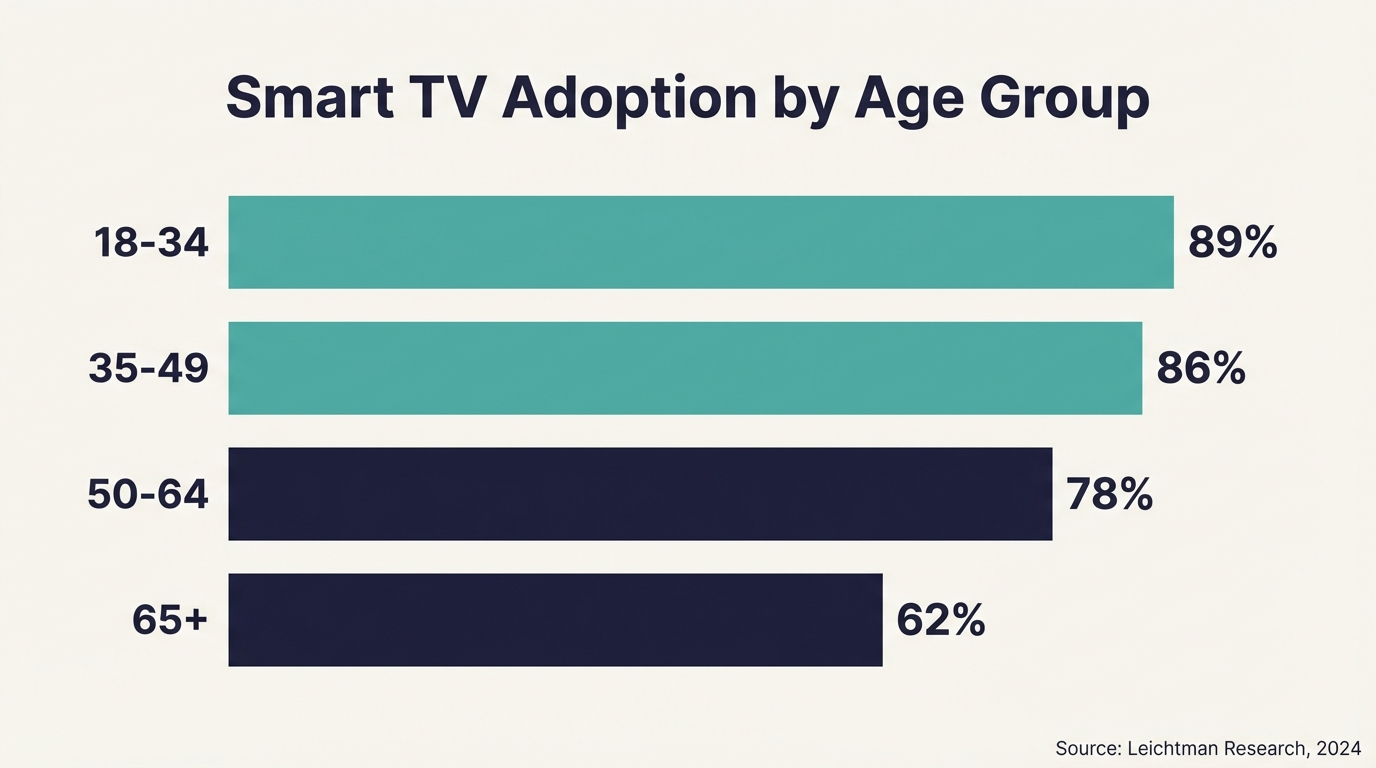
Age: Younger households show higher smart TV usage intensity, though ownership rates are high across age groups. Seniors have closed much of the adoption gap in recent years.
Income: Higher-income households were early adopters, but price reductions have largely eliminated the income gap in basic ownership. Usage intensity and number of streaming subscriptions still correlate with income.
Geography: Urban and suburban areas show slightly higher penetration than rural areas, partly due to broadband availability differences.
Household composition: Families with children show high smart TV engagement, driven by children's content on streaming platforms.
The multi-device household
Many households have multiple connected TV access points:
Primary smart TV in the living room or family room
Secondary smart TVs in bedrooms
Streaming devices connected to older TVs
Gaming consoles with streaming app access
This multi-device reality means advertisers can reach households at multiple touchpoints throughout the day, from morning news streaming to evening entertainment viewing.
Why it matters for your business
High smart TV penetration has practical implications for businesses considering CTV advertising.
Reach is no longer a barrier
When 82-90% of households have connected TV access, reach constraints largely disappear. The question shifts from "can I reach enough people?" to "how do I reach the right people efficiently?" This is a fundamental change from even five years ago, when CTV was primarily an urban, affluent-household phenomenon.
For small business TV advertising, this means television is now a viable channel regardless of your target market. Whether you're reaching young professionals in cities or families in suburbs, the infrastructure exists to deliver your message.
Geographic targeting becomes precise
Smart TV and CTV advertising platforms can target by geography with precision impossible in traditional TV advertising. Want to reach households within 10 miles of your business location? CTV can do that. Want to target specific zip codes or DMAs? That's standard functionality.
This geographic precision, combined with high household penetration, makes local TV advertising practical for businesses of all sizes. A local restaurant, dentist, or retailer can now advertise on premium television content to their specific service area.
The big screen advantage
Smart TV viewing happens on the largest screen in the home, typically 50+ inches. This creates different engagement dynamics than mobile or desktop advertising:
Higher attention: Living room viewing is often more focused than phone browsing
Shared viewing: Multiple household members may see the same ad
Premium perception: Ads on the big screen carry the prestige association of television advertising
Better recall: Larger screens and engaged viewing correlate with better ad recall
For brand building, these characteristics matter. Television advertising has always been valued for its ability to create memorable brand impressions, and CTV delivers that big-screen experience to modern streaming audiences.
Cost accessibility
The expansion of CTV inventory through high smart TV penetration has helped moderate pricing. More inventory means more competitive CPMs. Current CTV CPMs range from $15-35, with an average around $25 for small business advertisers.
Platforms like Adwave further democratize access by aggregating inventory across 100+ channels and offering campaigns starting at just $50. This low barrier to entry, combined with near-universal household reach, makes TV advertising accessible to businesses that couldn't previously afford it.
How to take advantage of this trend
Understanding that smart TVs are nearly everywhere is one thing; reaching those households with advertising is another. Here's how businesses can capitalize on high smart TV penetration.
Start with aggregated platforms
Rather than trying to advertise directly on specific streaming services (which often have high minimums), start with platforms that aggregate CTV inventory. Services like Adwave provide access to 100+ channels including major streaming services, with campaigns starting at $50.
This approach lets you reach smart TV households across the streaming ecosystem without managing multiple platform relationships or meeting various minimum requirements.
Use geographic targeting for local businesses
If you serve a local market, use CTV's geographic targeting capabilities. Target by:
Radius around your location (e.g., 15 miles)
Specific zip codes in your service area
DMAs for regional businesses
States for businesses with broader geographic reach
Geographic targeting ensures your advertising budget reaches households that can become customers, rather than being wasted on viewers outside your service area.
Consider your audience's streaming behavior
Different streaming platforms and content types attract different audiences. Consider where your target customers are likely watching:
Free ad-supported services (Tubi, Pluto TV, Roku Channel) reach price-conscious viewers
Premium services with ad tiers (Netflix, Disney+, Hulu) reach engaged streaming audiences
Sports streaming reaches sports enthusiasts
News streaming reaches news-attentive audiences
Aggregated platforms handle this optimization for you, but understanding where your audience streams helps you evaluate campaign performance and make strategic decisions.
Build for the big screen
When creating TV commercials for CTV delivery, remember that viewers will see your ad on their largest screen. Your creative should:
Use high-quality visuals that hold up on big screens
Keep text legible at living room viewing distances
Use the premium environment with polished production
Include clear calls to action since CTV isn't clickable like web ads
AI-powered creative tools, like those offered by Adwave, can generate TV-quality commercials from your existing assets, eliminating the traditional production barrier.
The bigger picture
Smart TV penetration is part of a broader transformation in how Americans consume video content and, consequently, how advertisers reach them.
The streaming transition is permanent
Smart TV adoption has enabled the permanent shift from traditional TV to streaming. This isn't a trend that will reverse. Younger generations have grown up with streaming as their primary video consumption method; they won't "graduate" to cable. As older generations adopt streaming (accelerated by smart TV ubiquity), linear TV viewership will continue declining.
For advertisers, this means CTV advertising skills are essential, not optional. Businesses that develop expertise in reaching streaming audiences now will have advantages as the transition continues.
Traditional TV's decline
As smart TVs enable streaming, traditional cable and satellite TV subscriptions decline:
Cable/satellite penetration has fallen below 50% and continues declining
Broadcast TV viewing represents only about 20% of total TV time
Combined streaming viewership now exceeds broadcast and cable combined
This shift means that traditional TV advertising reaches a shrinking audience, while CTV reaches a growing one. Advertisers following audience attention should be increasing CTV allocation.
Industry investment follows penetration
The high penetration of smart TVs and CTV devices has attracted significant advertising industry investment:
CTV advertising spending reached approximately $26 billion in 2024 and is projected to hit $33 billion in 2025
Major streaming services have launched or expanded ad-supported tiers
Measurement and attribution solutions have matured
Self-serve platforms have made CTV accessible to SMBs
This investment creates a virtuous cycle: more advertiser spending funds better platforms and measurement, which attracts more advertisers, which drives further investment. Small businesses benefit from infrastructure built to serve enterprise advertisers.
What experts are saying
Industry analysts have noted the significance of near-universal smart TV penetration:
Marketing Charts reports that smart TV penetration "yet to plateau" suggests continued growth ahead, even from the current 82% level. The remaining non-adopter households represent either economic barriers (which continue to fall) or preference-based choices.
Hub Entertainment Research's data shows that two-thirds of TV households watch streaming video on smart TVs weekly, confirming that ownership translates to active usage, the metric that matters for advertisers.
Common questions answered
What percentage of U.S. households have a smart TV in 2025?
Approximately 82% of U.S. TV households own a smart TV as of 2025, according to Hub Entertainment Research. This is up from 79% in 2024 and 70% in 2021. When including all connected TV devices (smart TVs plus streaming devices), penetration reaches approximately 88-90% of households.
How fast is smart TV adoption growing?
Smart TV penetration increased 12 percentage points from 2021 (70%) to 2025 (82%), averaging about 3 percentage points per year. The growth rate has been faster than typical consumer electronics adoption curves, driven by smart functionality becoming standard on all new TV sets and continued price reductions.
What's the difference between smart TV and CTV penetration?
Smart TV refers specifically to televisions with built-in internet connectivity and streaming apps. Connected TV (CTV) is the broader category including smart TVs plus any television connected to the internet through external devices (Roku, Fire TV, Apple TV, gaming consoles). Smart TV penetration is approximately 82%; total CTV penetration is approximately 88-90%.
Can small businesses reach smart TV households with advertising?
Yes, small businesses can reach smart TV households through aggregated CTV advertising platforms like Adwave, which provide access to 100+ streaming channels with campaigns starting at $50. These platforms make it possible to advertise on premium streaming content without the high minimums traditionally required for TV advertising.
How many smart TVs does the average household have?
Many U.S. households have multiple connected TV access points, including primary smart TVs in living rooms, secondary smart TVs in bedrooms, streaming devices on older TVs, and gaming consoles with streaming capabilities. The multi-device reality means advertisers can reach households at multiple touchpoints throughout the day.
Supporting data
Additional statistics that contextualize smart TV household penetration:
82%: Current smart TV household penetration (2025)
79%: Smart TV penetration in 2024
70%: Smart TV penetration in 2021
66%: Smart TV penetration in 2020
88%: Households with at least one CTV device (115 million households)
90%: Households using CTV devices at least monthly
66%: TV households watching streaming on smart TV weekly
46%: Households owning dedicated streaming media player
85%: North American smart TV penetration (highest globally)
47%+: Share of TV viewing on streaming platforms
$50: Minimum budget to start CTV advertising on platforms like Adwave
Data sources:
Start advertising on smart TVs
Ready to reach the 82% of households with smart TVs? Connected TV advertising makes it possible to put your business on the biggest screen in the home, with targeting and pricing that works for businesses of all sizes.
Adwave makes CTV accessible with AI-powered creative generation and campaigns starting at just $50. Your ads run on 100+ premium streaming channels including YouTube, Netflix, Hulu, Peacock, and more.
No video production experience required. No massive budgets. No complex media buying.