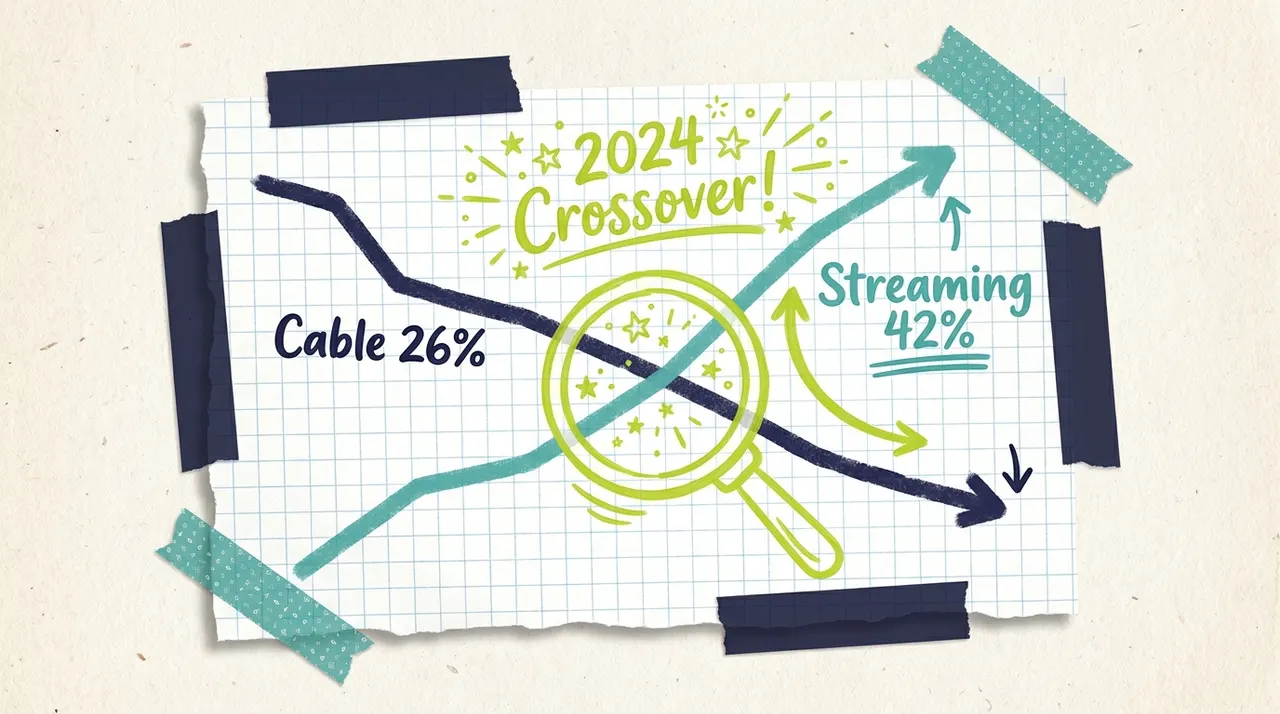
-
47.3%
Streaming's share of US TV viewing (2025)
-
26.7%
Cable's share of TV viewing (declining)
-
6M
US households cut the cord in 2024
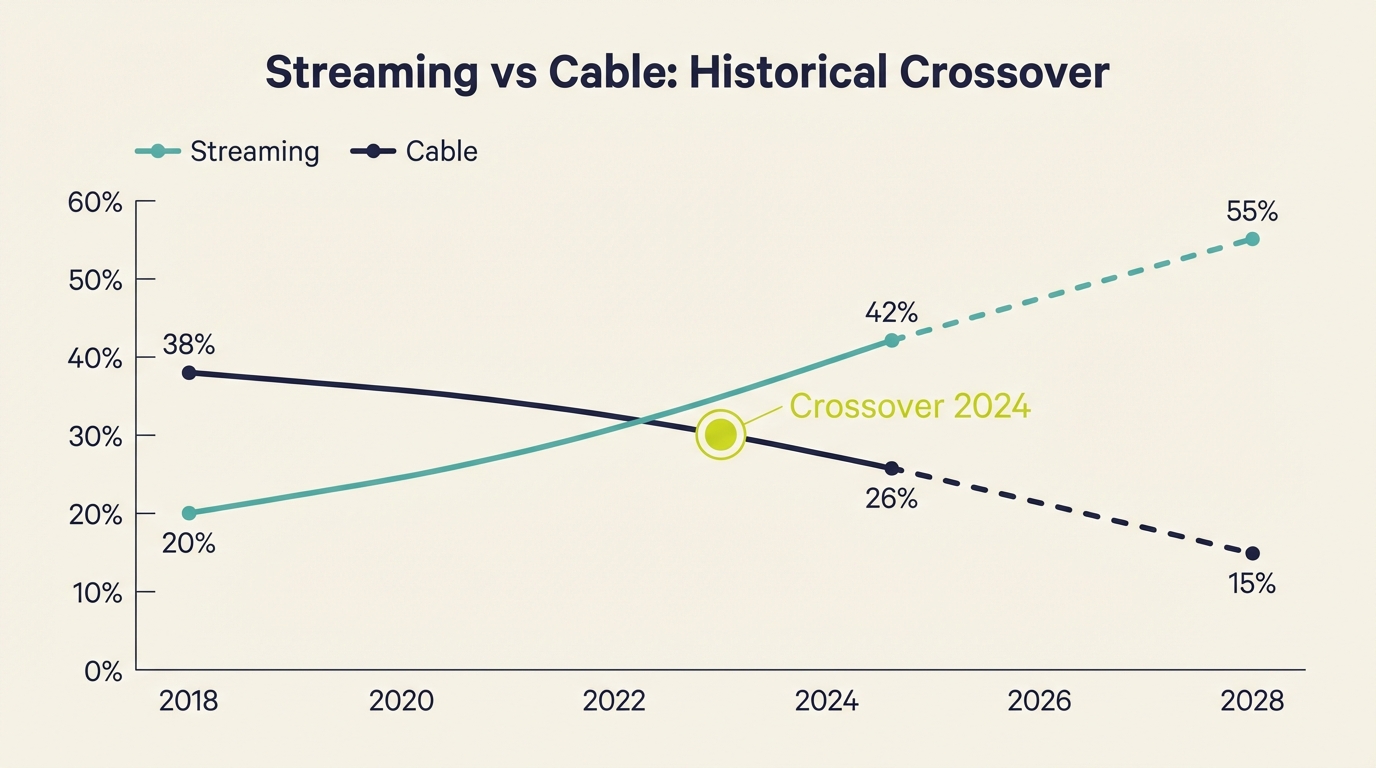
Streaming has already overtaken cable in TV viewing share, and the gap will only widen. According to Nielsen Gauge data, streaming now commands 47.3% of all US TV viewing, while cable has fallen below 27% and continues declining. In May 2025, streaming crossed a historic milestone by surpassing broadcast and cable viewing combined for the first time ever. The question is no longer whether streaming will overtake cable, but whether cable will survive at all as a meaningful distribution channel. For advertisers, this shift demands a fundamental reallocation of media spend from traditional TV to streaming platforms.
What the data shows
The evidence for streaming's dominance is overwhelming and accelerating.
Current viewing shares
Nielsen's Gauge report tracks the distribution of TV viewing across all sources:
July 2025 data:
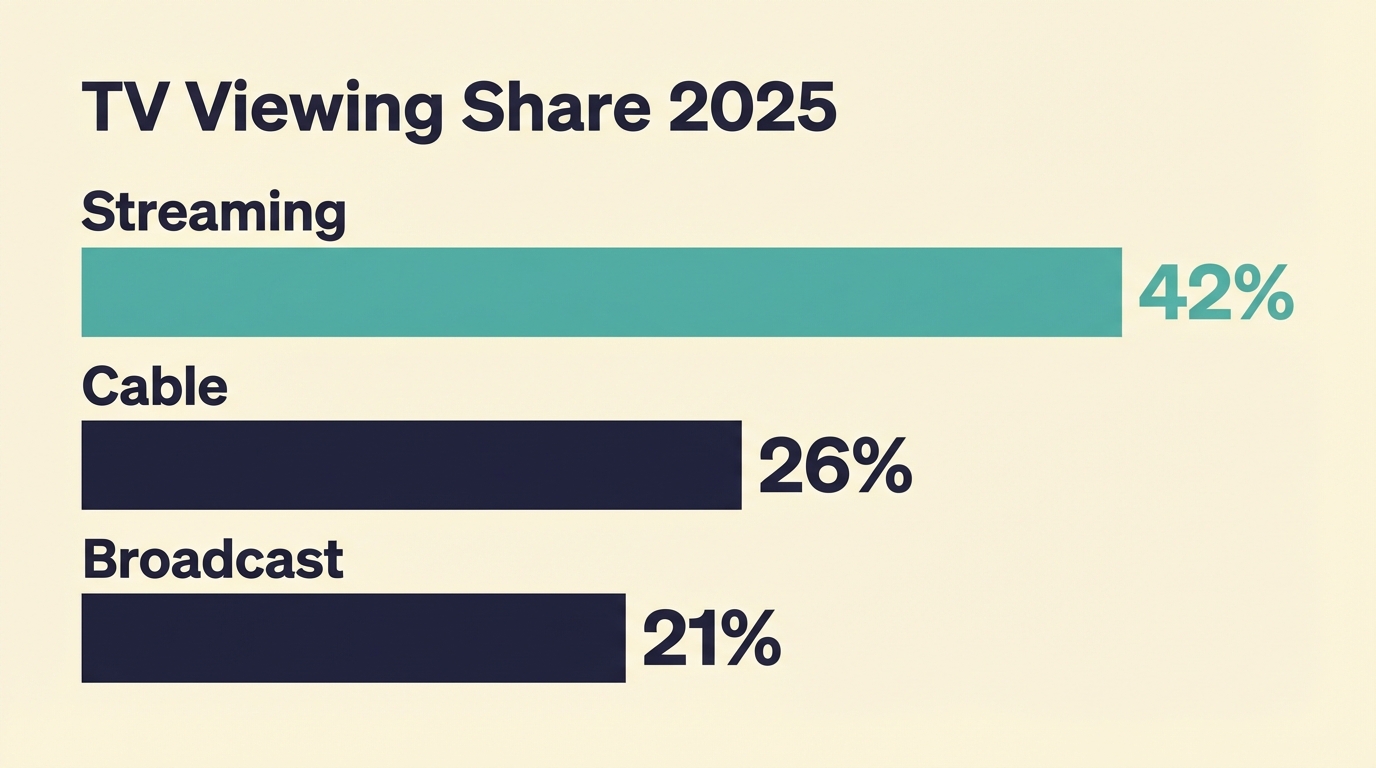
Streaming: 47.3% of total TV viewing (record high)
Cable: 26.7% of total TV viewing
Broadcast: 20.1% of total TV viewing
Other: 5.9% (DVR, gaming, etc.)
Streaming's 47.3% share represents nearly double cable's 26.7%, a complete reversal from just five years ago when cable dominated the viewing landscape.
The historic crossover
May 2025 marked a turning point in television history:
Streaming reached 44.8% of TV viewing
Broadcast + cable combined totaled 44.2%
For the first time, streaming exceeded traditional TV
This crossover, while symbolic, represents the culmination of a decade-long shift in viewing behavior. The traditional television model built over 70 years has been supplanted in less than 15 years of streaming competition.
Trajectory analysis
The growth rates tell the story of where television is heading:
Streaming growth:
2020: Approximately 28% of TV viewing
2022: Approximately 35% of TV viewing
2024: Approximately 41% of TV viewing
2025: 47.3% of TV viewing (accelerating)
Cable decline:
2020: Approximately 35% of TV viewing
2022: Approximately 32% of TV viewing
2024: Approximately 29% of TV viewing
2025: Below 27% of TV viewing (accelerating)
Streaming has gained approximately 19 percentage points since 2020, while cable has lost approximately 8 percentage points. The pace of change is accelerating as cord-cutting reaches critical mass.
Cord-cutting statistics
The subscriber data reinforces the viewing trends:
6 million US households cut the cord in 2024
Pay TV subscribers have declined from 100+ million to under 70 million since 2015
Approximately 25% of US households have "never" subscribed to cable
Cable subscriber losses accelerate each year
According to Kantar research, streaming now reaches 96% of US households, while cable penetration continues declining toward 50%.
Breaking down the numbers
Understanding the forces driving streaming's rise helps predict future trajectories.
Demographic shifts
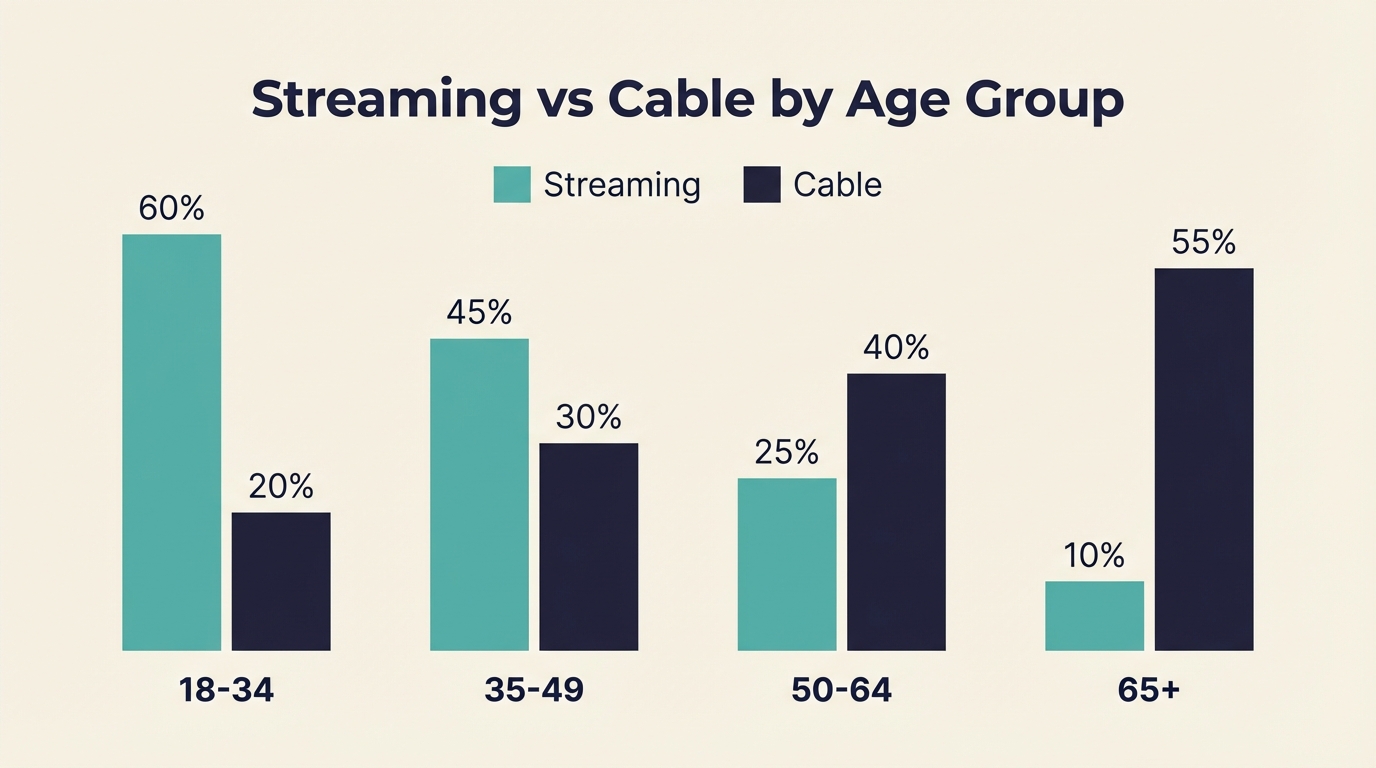
Viewing habits differ dramatically by age:
18-34 age group:
Streaming: 60%+ of TV time
Cable: Under 15% of TV time
Many are "cord-nevers" who have never subscribed
35-49 age group:
Streaming: Approximately 50% of TV time
Cable: Approximately 25% of TV time
Active cord-cutting in this demographic
50-64 age group:
Streaming: Approximately 40% of TV time
Cable: Approximately 35% of TV time
Slower transition but accelerating
65+ age group:
Streaming: Approximately 30% of TV time
Cable: Approximately 40% of TV time
Still cable-leaning but changing
As younger demographics age into higher-spending brackets and older demographics either adopt streaming or exit the market, cable's position will only weaken.
Content migration
Premium content increasingly moves to streaming:
Sports (cable's last stronghold):
NFL: Games on Prime Video, Peacock, YouTube
NBA: Adding streaming components in new deals
MLB: Apple TV+ exclusive games
MLS, soccer: Primarily streaming distribution
News:
CNN, Fox News, MSNBC available on streaming
Local news increasingly on apps
YouTube and social media replacing cable news for younger viewers
Entertainment:
New shows premiere on streaming first
Theatrical films have shorter theatrical-to-streaming windows
Cable originals declining in volume and prestige
The content that once justified cable subscriptions increasingly lives on streaming platforms.
Economic factors
Cost comparisons favor streaming:
Cable costs:
Average cable bill: $100-150+ per month
Requires long-term contracts
Equipment rental fees
Hidden fees and price increases
Streaming costs:
Ad-supported options: $0-$8 per month
Premium subscriptions: $10-20 per month
No contracts, cancel anytime
Transparent pricing
A household can access Netflix, Hulu, Disney+, and HBO Max for less than most cable packages while receiving more content flexibility.
Technology adoption
Device proliferation accelerates streaming:
85% of US households have at least one smart TV
Streaming devices (Roku, Fire TV, Apple TV) cost $30-150
Built-in streaming on new TVs eliminates setup friction
Broadband speeds support 4K streaming in most markets
The technical barriers to streaming have essentially disappeared for most consumers.
Why it matters for your business
The streaming-cable shift has immediate implications for advertising strategy.
Where audiences are going
Advertising follows audiences. Consider where your target customers spend TV time:
If targeting under-50 audiences:
Streaming is likely their primary or exclusive TV experience. Cable advertising will miss significant portions of this demographic.
If targeting 50+ audiences:
Cable still reaches this demographic, but streaming adoption is accelerating. A hybrid approach captures both viewing behaviors.
If targeting cord-nevers:
These consumers cannot be reached through cable at any price. Streaming is the only TV advertising option.
Cost efficiency considerations
Media efficiency favors streaming in many cases:
Streaming advantages:
Lower CPMs than premium cable ($15-35 vs. $25-50)
Precise targeting reduces waste
Frequency capping prevents oversaturation
Performance measurement improves optimization
Cable advantages (diminishing):
Reach for 65+ demographics
Live sports adjacency (though moving to streaming)
Local news environments
For most advertisers, streaming delivers better efficiency and measurement than cable advertising.
Transition timing
When to shift budget depends on your specific situation:
Aggressive transition (shift 70%+ to streaming now):
Target audience under 50
Performance marketing focus
Budget under $100K annually
Local/regional business
Moderate transition (shift 50% to streaming):
Target audience 35-65
Mix of brand and performance goals
Budget $100K-$1M annually
Regional/national business
Conservative transition (shift 30% to streaming):
Target audience 55+
Brand advertising focus
Budget over $1M annually
Categories with older buyers
Most small and medium businesses should be in the aggressive or moderate categories.
How to take advantage of this trend
Capitalizing on streaming's rise requires practical steps.
Reallocate budget from cable to streaming
For businesses still buying cable:
Audit current cable spend: Identify what you're paying and what reach you're achieving
Test streaming alternatives: Run parallel campaigns to compare performance
Measure incrementality: Determine what streaming reaches that cable doesn't
Phase transition: Shift 20-30% initially, increase based on results
Most advertisers who test streaming find comparable or better results at lower costs.
Start with aggregated CTV platforms
Aggregated platforms simplify the transition:
Access streaming inventory without individual platform negotiations
Single campaign reaches viewers across 100+ channels
Geographic and demographic targeting built in
Low minimums ($50 on Adwave) enable testing
This approach provides immediate streaming access without complexity.
Develop streaming-appropriate creative
Creative considerations for streaming differ from cable:
Non-skippable formats: Viewers will watch the entire ad; make every second count
Big screen viewing: Ensure visuals work on large displays
Sound-on environment: Use audio for message delivery
Call to action: Direct viewers to websites or apps
AI creative tools can generate streaming-ready commercials from existing assets, removing production barriers.
Plan for full streaming transition
Long-term planning should assume streaming dominance:
Build streaming measurement capabilities
Develop creative for streaming environments
Train teams on streaming platforms
Budget for streaming-first media plans
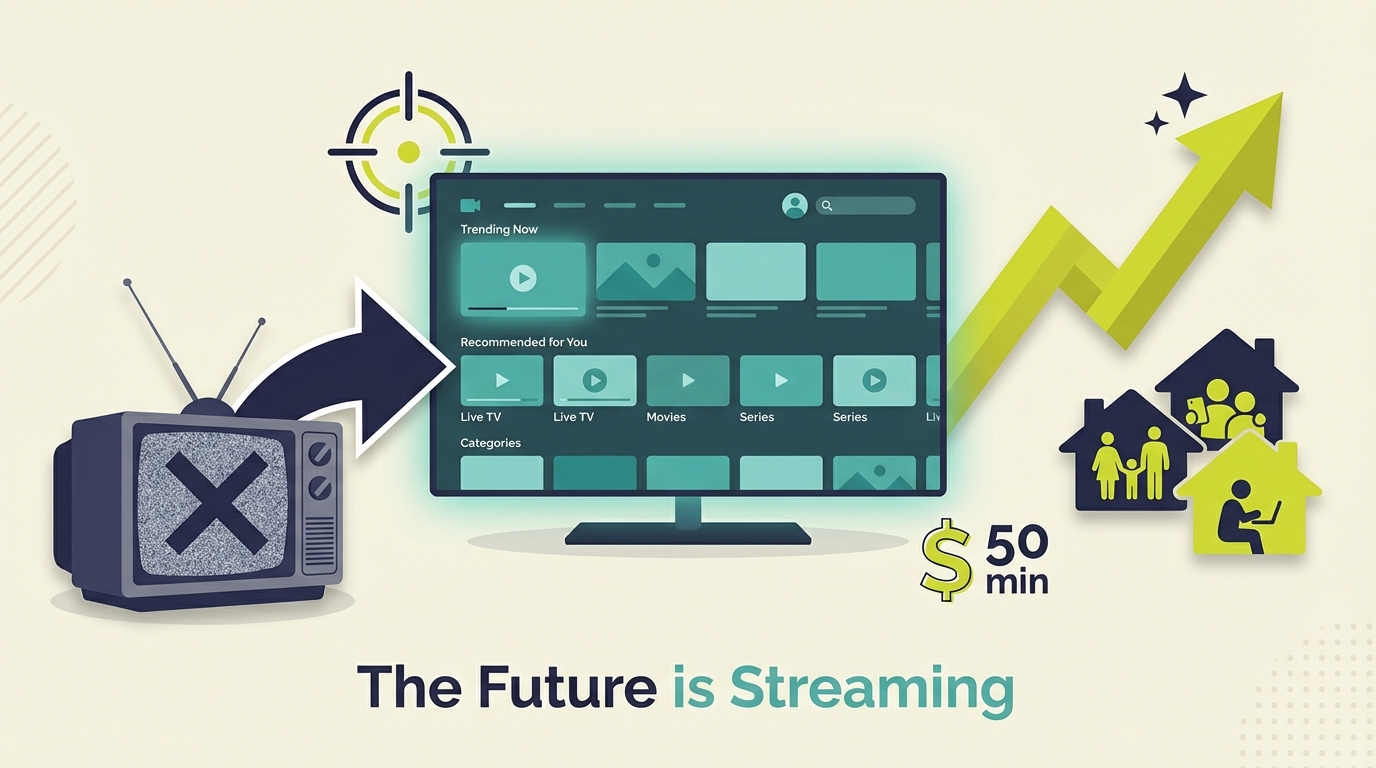
The advertisers who transition effectively now will have competitive advantages as cable continues declining.
The bigger picture
Cable's decline reflects broader media transformation with long-term implications.
The cable business model collapse
Cable's challenges extend beyond viewing share:
Subscriber economics:
Fewer subscribers means less revenue
Fixed costs (content rights, infrastructure) don't decline proportionally
Price increases accelerate cord-cutting
Negative spiral of decline
Content rights pressure:
Sports rights increasingly go to streaming
Entertainment networks lose relevance
Local stations face uncertain futures
News networks struggle for younger audiences
Industry responses:
Comcast spinning off cable networks
Warner Bros. Discovery restructuring
Charter and other distributors facing existential questions
Cable as we know it is not just declining but potentially ending within the next decade.
Broadcast television's stability
Broadcast maintains roughly 20% share due to:
Free over-the-air access
Local news and sports
Major events (Super Bowl, Oscars)
Habit among older viewers
Broadcast may survive longer than cable due to its free model, though streaming will continue taking share from both.
Streaming's evolution
Streaming itself continues evolving:
Ad-supported models becoming standard
Bundling and aggregation increasing
Live sports migration accelerating
Interactive and shoppable TV emerging
The streaming of 2030 will look different from today's streaming, just as today's streaming differs from 2015's.
Global implications
US trends lead global markets:
UK, Canada, Australia: 2-3 years behind US streaming adoption
Europe: Mixed by country, generally following US trajectory
Asia: Varied patterns, mobile-first in many markets
Latin America: Ad-supported models dominating
The US streaming transition provides a roadmap for global advertising strategy.
Common questions answered
Has streaming already overtaken cable?
Yes. Streaming captured 47.3% of US TV viewing in July 2025, nearly double cable's 26.7%. In May 2025, streaming surpassed broadcast and cable combined for the first time. The overtaking has already happened; the question now is how quickly cable continues declining.
Will cable television disappear completely?
Cable as a mass-market distribution channel is likely ending. However, cable infrastructure will persist for broadband delivery. Cable networks may survive through streaming distribution or consolidation. The traditional cable TV subscription model, with hundreds of channels for $100+ monthly, is unsustainable and will likely cease within 10-15 years for most consumers.
How should advertisers respond to this shift?
Advertisers should reallocate budget from cable to streaming progressively, starting with 30-50% of TV budget. Test streaming campaigns to establish baselines, then increase allocation based on performance. Most advertisers find streaming delivers comparable or better results at lower costs. Small businesses should prioritize streaming given its lower barriers and better targeting.
What about live sports on cable?
Live sports, cable's last stronghold, is rapidly moving to streaming. NFL, NBA, MLB, and soccer have significant streaming components. The 2024-2025 NFL season includes Prime Video, Peacock, and YouTube exclusive games. Within 5-10 years, most live sports will be available primarily on streaming platforms.
Are streaming CPMs comparable to cable?
Streaming CPMs ($15-35 through aggregated platforms) are generally lower than premium cable inventory ($25-50+). More importantly, streaming offers better targeting, reducing waste and improving effective CPMs. Measurement capabilities also allow optimization that cable cannot match.
What happens to local TV advertising?
Local advertising is transitioning to streaming through geographic targeting. Platforms like Adwave enable local TV advertising on streaming with precise geographic targeting. Local broadcast and cable advertising will decline alongside overall cable viewing, but streaming provides an alternative path to local audiences.
Supporting data
Key statistics on streaming's overtaking of cable:
Current viewing shares (July 2025, Nielsen):
Streaming: 47.3% of total TV viewing
Cable: 26.7% of total TV viewing
Broadcast: 20.1% of total TV viewing
Streaming + broadcast + cable: 94.1% (remainder: DVR, gaming, other)
Historic milestone (May 2025):
Streaming: 44.8%
Broadcast + cable combined: 44.2%
First time streaming exceeded traditional TV
Trajectory data:
Streaming growth since 2020: +19 percentage points
Cable decline since 2020: -8 percentage points
Annual cord-cutting: 6 million households (2024)
Projections:
Streaming: Expected to exceed 50% by late 2025
Cable: Projected to fall below 25% by 2026
Pay TV subscribers: Declining toward 50 million by 2028
Advertising metrics:
Streaming CPM range: $15-35
Cable CPM range: $25-50+
Average CTV CPM: $25 through aggregated platforms
Data sources:
Industry cord-cutting reports
Get started with streaming TV advertising
The streaming transition is happening now. Advertisers who adapt will reach audiences where they're watching; those who don't will find their TV advertising increasingly ineffective.
Adwave makes streaming TV advertising accessible for any budget, with campaigns starting at just $50. Access 100+ streaming channels, target by geography and demographics, and measure performance. AI-powered creative tools generate TV commercials from your website in minutes.
No cable contracts. No massive minimums. No production budget required.