
"TV advertising costs too much" was true for decades, and the conventional wisdom hasn't fully caught up to the new reality. In 2026, a small business can run a meaningful, measurable TV advertising test at monthly budgets that fit alongside existing Meta and Google spend. The numbers work. The tools work. The question for most small business owners isn't whether they can afford to test TV. It's whether they're willing to do it carefully enough to get a clean read.
This guide is a practical playbook for testing TV advertising at small-budget scale. It covers what "small budget" means in 2026, how to structure a low-risk test, what to measure, what to skip, and how to know when to scale, pause, or pivot. No fluff, no aspirational case studies. Just the framework.
What "small budget" means in 2026
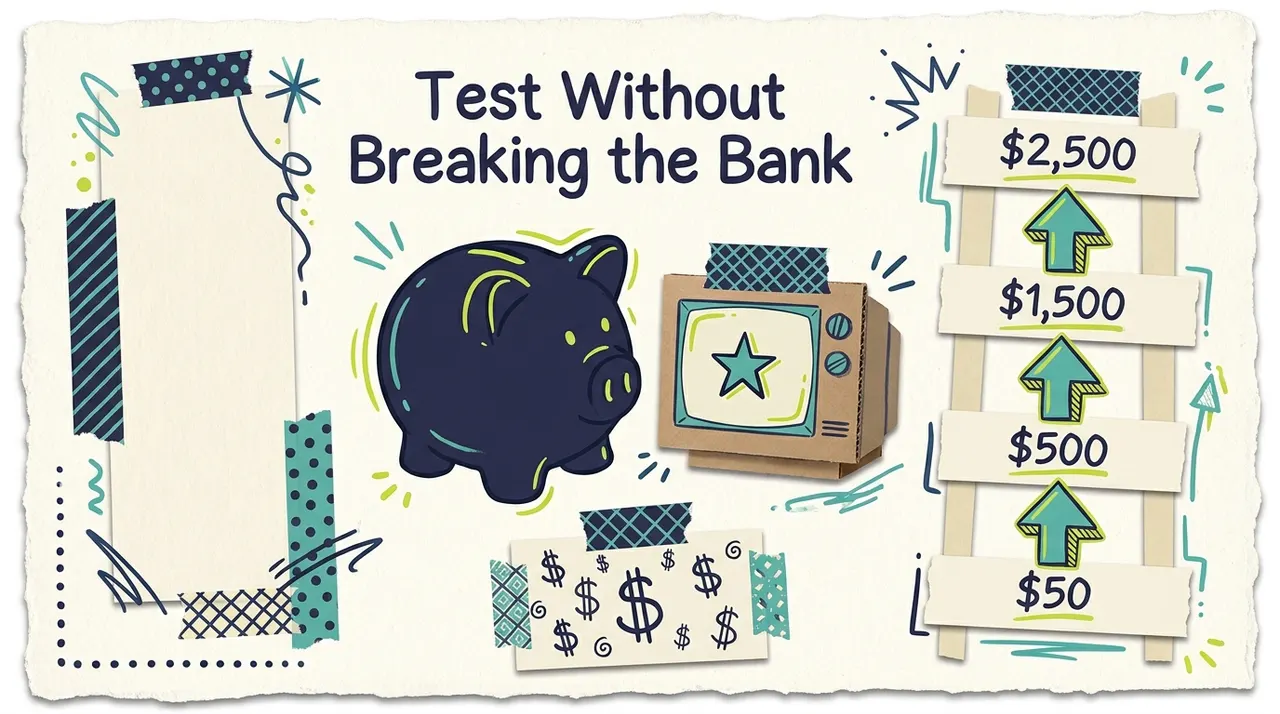
The single biggest shift in CTV economics over the past three years is the entry price. Subscription-based platforms now offer starting tiers around $50, with the most common small-business CTV test budget falling in the $800-$2,500/month range.
For context, here's how to think about what each budget tier can produce:
$50-$500/month. Useful for very tight local geographies (a 3-5 mile radius around a single location) and businesses with strong cross-channel signal that just needs the CTV layer to complete the funnel. Won't produce meaningful local frequency on its own; works best as a complement to other channels.
$800-$1,500/month. The sweet spot for a first real CTV test for most local small businesses. Enough to build meaningful frequency (3-5 impressions per household) in a 5-12 mile service area over a 30-day window. This budget tier is where most testing decisions get made.
$1,500-$2,500/month. Strong test budget that produces clean read at the 60-90 day mark. Works well for businesses with regional draw (multi-location operators, destination services) or competitive local categories.
$2,500-$5,000/month. No longer "small budget" territory, but worth noting as the tier where most small businesses settle in once a test has proven out. Sustainable for permanent inclusion in the media mix.
This guide focuses on the $800-$2,500 range, which is where the most decisions get made and where the test framework matters most.
Why testing matters more than committing
The mistake we see most often when small businesses approach TV is treating it as a binary: either commit to a $5,000/month TV budget for 12 months, or skip TV entirely. Both extremes leave money on the table.
A well-structured test does two things:
It produces evidence. After 60-90 days, you'll know whether TV works for your business at your budget level. Not "TV works in general" or "case studies say TV works." Whether it works for you, with your customers, in your geography, with your offer.
It limits downside. A $1,500/month test for 75 days commits $3,750 to the test. If it doesn't work, you learn something and walk away. If it works, you've proven the case for scaling and can do so with confidence rather than hope.
The framework matters because it's the difference between making an informed decision and guessing. Most small businesses guess. The ones that test rigorously make better decisions about every channel, not just TV.
The 90-day test framework
A clean small-budget CTV test runs across roughly 90 days. The structure:
Weeks 1-4: Baseline (no TV running)
Before TV launches, capture a clean baseline of your current performance. This is the most important step and the one most small businesses skip.
What to capture, week by week:
Total leads, inquiries, or sales by channel and total
Foot traffic if you have a physical location (count it manually if needed)
Branded search volume (Google Search Console)
Direct website traffic (Google Analytics)
Meta CTR, Google CTR, conversion rates for any active paid campaigns
Average ticket or average sale value if applicable
Four weeks of pre-launch data is the minimum. Six weeks is better. The baseline is what you'll compare the campaign weeks against to read TV's true lift.
While you're capturing baseline, do the prep work:
Tighten existing Meta and Google geographic targeting to match what your CTV targeting will be
Make sure UTMs are clean on all paid channel URLs
Add a "how did you find us?" question to your inquiry forms or registers if it isn't already there
Generate two creative variations using Adwave or similar AI tools (no production cost beyond platform subscription)
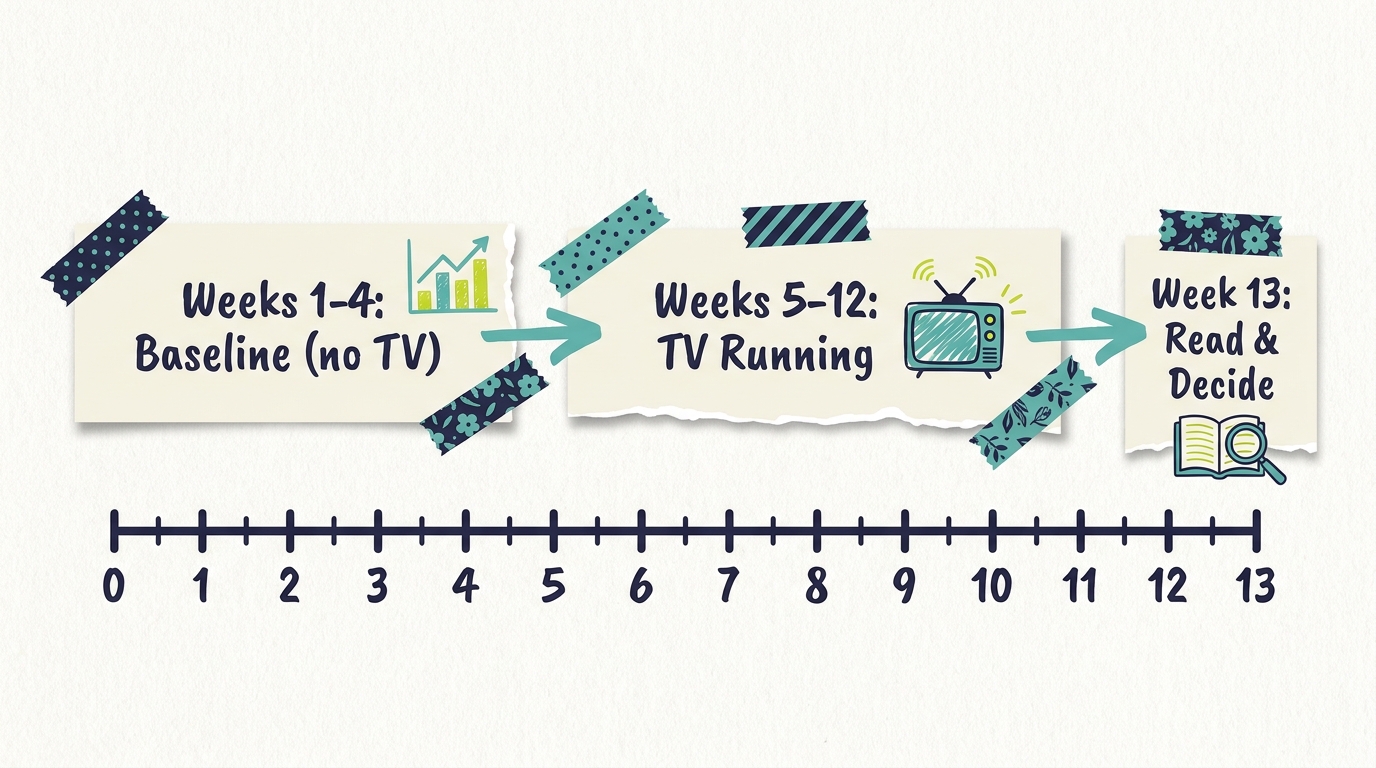
Weeks 5-12: TV running, digital steady
For 8 weeks (60 days), run TV alongside your existing digital plan. Hold everything else steady. The cleaner the test, the cleaner the read.
What to watch in this period:
Weeks 5-6: Don't optimize. The platform needs the first 2 weeks to settle into your area and find inventory. Frequency, reach, and impressions will look noisy. Resist the urge to make changes.
Week 7: First read on geographic distribution. If more than 20-25% of impressions are landing outside your real service area, contact CTV platform support to tighten targeting. This single change often drives most of the campaign's eventual lift.
Week 8: Creative-level performance check. If one of your two creatives is converting at meaningfully lower rates, pause it and let the stronger creative carry the rest of the campaign.
Week 9-10: Watch the cross-channel signals. Is branded search rising? Is direct traffic rising? Are Meta CTR and conversion rate trending up? You're not making decisions yet; you're observing whether the lift is happening.
Week 11-12: Final delivery and stabilization. The data from this window is what you'll compare against baseline for the test read.
Week 13: Read and decide
The clean read happens at the end of the 90-day window. Compare your campaign-period metrics against the pre-campaign baseline. Three questions:
1. Total conversion lift. Did total leads, foot traffic, or sales rise during the TV window vs. The baseline? By how much? If by less than 5%, the test isn't reading as a win. If by more than 15%, the test is reading as a clear win. Anywhere in between requires interpretation.
2. Cross-channel lift. Did your other channels (Meta, Google, organic) perform better during the TV window? A modest direct-attribution number paired with strong cross-channel lift is often a stronger signal than the reverse.
3. Cost-per-acquired-customer math. Total TV spend divided by incremental customers acquired (using total lift over baseline, not just directly-attributed). Is the CAC sustainable for your business model?
Based on the answers, three decisions:
Scale. Strong lift, sustainable CAC. Move TV from "test" to "permanent line item" and consider modest budget increases (25-50% over the first 6 months).
Iterate. Modest lift, mixed signals. Run another 60-day cycle with adjusted creative, tighter geography, or different frequency targets. Sometimes the second cycle is when the lift compounds.
Pause. No meaningful lift, no cross-channel signal, no path to sustainable CAC. Pull back. Either the channel isn't fit for your category, the geography wasn't right, or something fundamental about your funnel needs to be fixed first.
The five small-budget mistakes to avoid
Patterns we see consistently when small-budget TV tests underperform:
Mistake 1: Skipping the baseline
The most common and most damaging mistake. Without 4-6 weeks of pre-launch baseline data, you can't tell whether the campaign worked. Directly-attributed conversions will undercount TV's true impact. Without baseline, you're left guessing whether the channel produced lift.
Fix: don't launch until you have at least 4 weeks of clean pre-launch baseline data. The patience pays off in measurement quality.
Mistake 2: Targeting too broadly
Small budgets get murdered by broad targeting. If you have $1,200/month and you target a 30-mile radius, your frequency per household will be too low to drive recall. The same budget concentrated on a 7-mile radius produces meaningful frequency.
Fix: define your real service area honestly. Where do 80% of your customers come from? Target that area tightly. Resist the urge to "see if we can find new markets we didn't know about."
Mistake 3: Running one creative
Even a great creative is one variation. With one creative, you can't tell whether it's working as well as it could be. Two or three creatives in rotation let the data show you which framing your audience responds to.
Fix: launch with two creatives at minimum. AI generation tools make production effectively free. There's no excuse for testing on one creative when two takes 5 minutes.
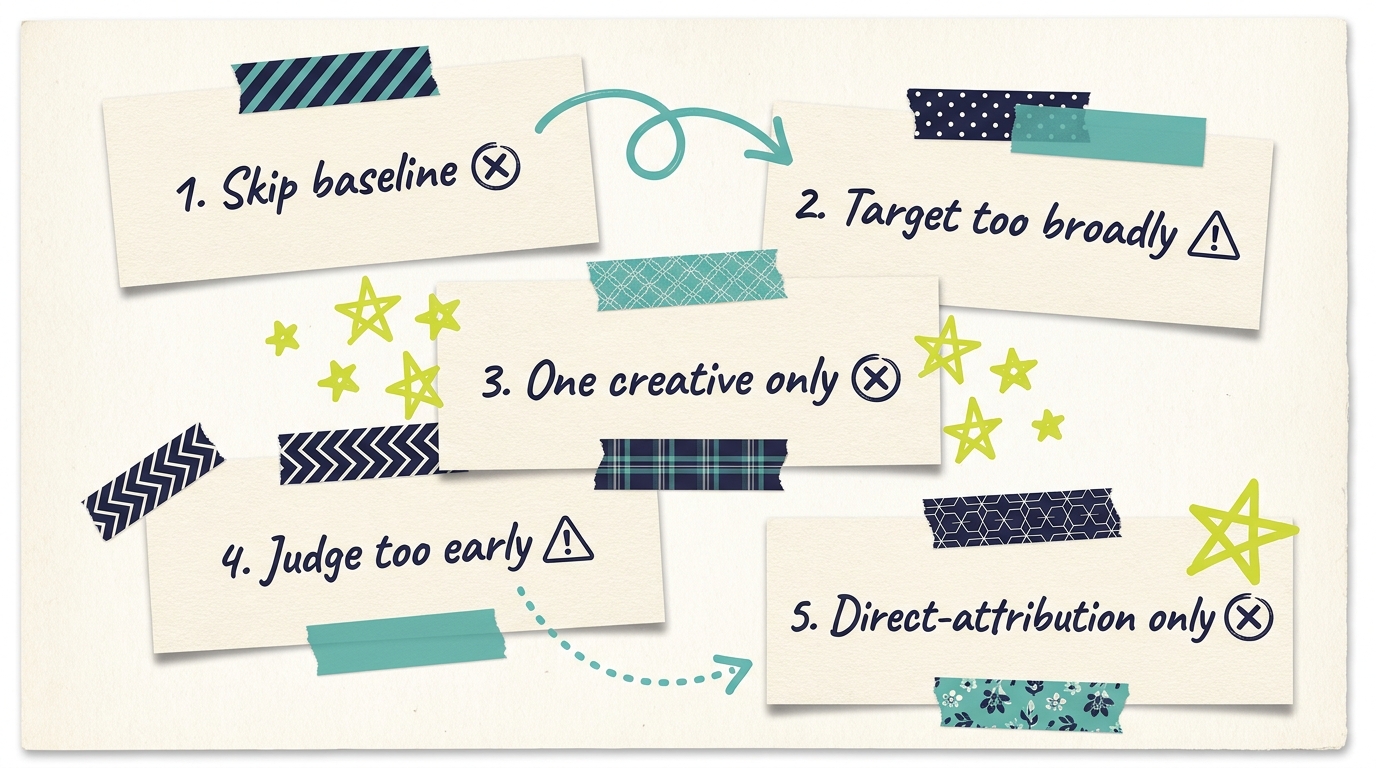
Mistake 4: Judging too early
Small budgets create temptation to declare success or failure within the first 2-3 weeks. The data isn't there yet. CTV needs 2-3 weeks to settle and another 4-6 weeks to demonstrate its lift on the broader funnel.
Fix: commit to 60-90 days before judging. If your budget is so tight that 60-90 days feels risky, the test budget might be too large for your current cash position. Wait 3-6 months until you can sustain the test window without anxiety.
Mistake 5: Direct-attribution-only measurement
If you only count "TV-attributed" conversions (QR scans, vanity URL traffic, survey responses), you'll capture 30-50% of TV's real impact. The other 50-70% lives in lift to your other channels, which you'll miss unless you're measuring it.
Fix: pre/post baseline measurement, plus tracking cross-channel signals (branded search lift, Meta CTR lift, conversion rate changes during the TV window). The fuller picture is what justifies continued investment.
What to spend the budget on (and skip)
For a small-budget CTV test, here's what each dollar should go toward:
Spend on:
Platform subscription ($50-$500 of your monthly budget depending on platform tier)
Media spend (the rest of your monthly budget, going toward actual impressions)
Measurement infrastructure if you don't already have it (analytics, UTM tagging, intake question setup, baseline tracking)
Skip:
Custom creative production agencies. AI tools handle 30-second TV-quality creative at no per-spot cost beyond platform subscription. Save the $3,000-$8,000 traditional production cost for later (when scaling) if you decide you need premium custom creative.
Agency fees on small-budget tests. Most small business CTV tests at $1,000-$2,500/month can be self-served. Agency fees of $1,500-$3,500/month would more than double your test cost without proportionate improvement in results.
Premium reporting dashboards. Free analytics tools (Google Analytics, your CTV platform's own dashboard) handle the measurement work for tests at this scale.
Multi-market testing. Pick one market for the test. Multi-market testing dilutes signal at small budgets.
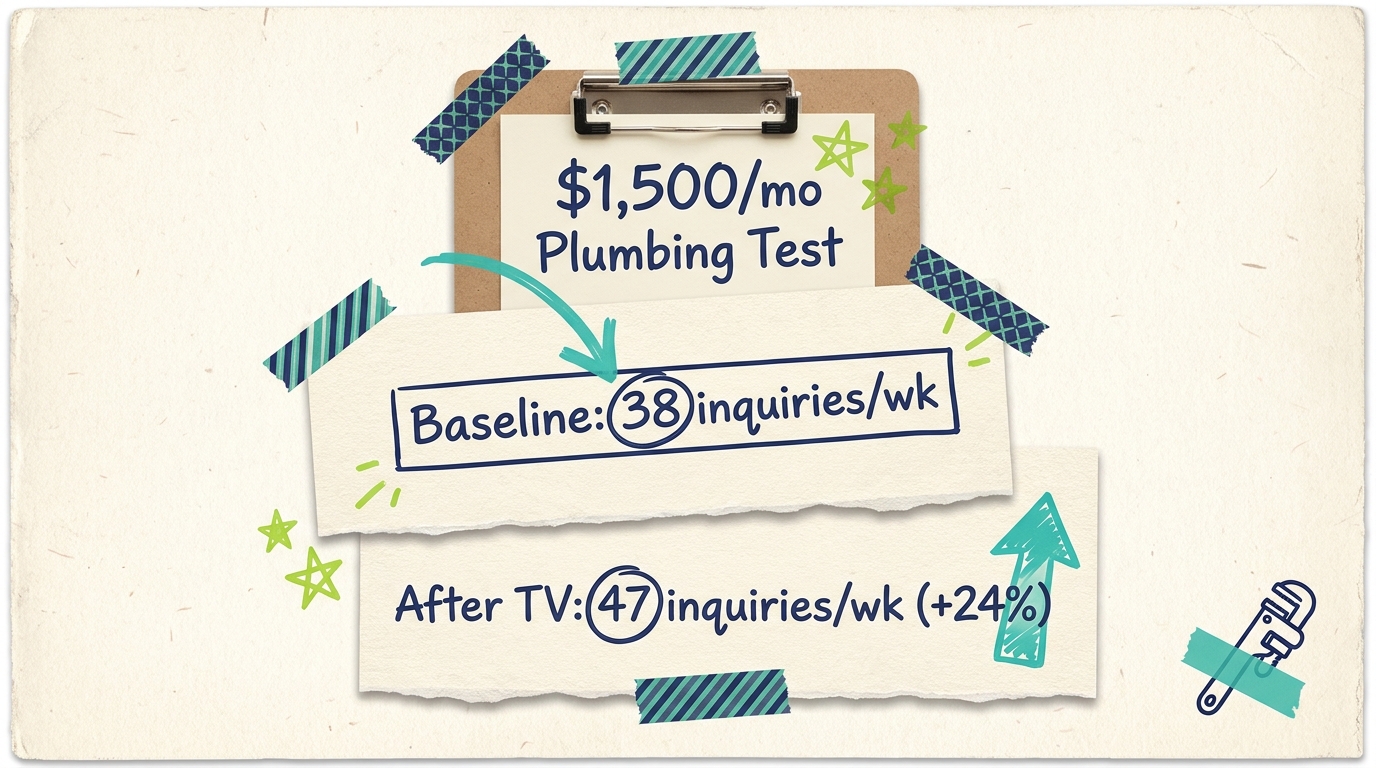
A worked example: $1,500/month test
A concrete walkthrough of a small-budget CTV test for a local services business:
Business: Plumbing company in a mid-sized Midwest metro. Existing $1,800/month Meta + $1,200/month Google = $3,000/month digital spend. 12 active service zones within a 14-mile radius.
Test setup:
TV budget: $1,500/month for 90 days (total commitment: $4,500)
Geographic targeting: tight 10-mile radius (smaller than service area to concentrate frequency)
Two creatives: an emergency-service spot and a maintenance-service spot
Baseline window: 4 weeks pre-launch
Pre-launch capture:
Average weekly inquiries: 38
Average weekly emergency calls: 14
Branded search (Google Search Console): roughly 220/week
Meta CTR: 1.6%, conversion rate 8.5%
Google ads CTR: 4.2%, conversion rate 11%
Weeks 5-12 in the campaign window:
Average weekly inquiries: 47 (+24% over baseline)
Average weekly emergency calls: 19 (+36% over baseline)
Branded search: roughly 295/week (+34%)
Meta CTR: 1.9% (+19%); conversion rate 9.1% (+7%)
Google ads CTR: 4.5% (+7%); conversion rate 11.8% (+7%)
Week 13 read:
Incremental inquiries during the 8-week TV window: roughly 72 (9 per week × 8 weeks). At the company's average customer lifetime value of $1,800, that's $129,600 in additional lifetime customer value attributable to the campaign window. Against $3,000 in TV spend over the window, lifetime ROAS works out to roughly 43x. First-purchase (single-job) ROAS is lower but still strongly positive.
The decision: scale TV from $1,500 to $2,200/month, integrated as permanent line item. Hold digital steady. Continue baseline measurement quarterly.
Results vary by business. Set a budget, track responses, and compare the value of new customers with the cost of the test.
When small-budget TV testing isn't right
A few situations where the answer is "fix something else first, then test":
Your website doesn't convert. If your Meta and Google traffic doesn't convert at acceptable rates, TV won't fix the funnel. The lift TV produces lands on whatever conversion mechanism is in place. Fix the conversion side first.
You have no measurement infrastructure. Without baselines, UTMs, and intake questions, the test won't read cleanly regardless of how it performs. Build measurement before spending on TV.
Your monthly digital spend is under $1,000. TV layers best on top of working digital. Below that threshold, your digital channels are still in optimization and adding TV adds noise.
Cash flow can't sustain 90 days. If a $4,500 commitment over 90 days feels like a stretch, the budget is too tight for a clean test. Wait until cash flow can absorb the test window without pressure.
You serve a single very small geography. If your business serves a single ZIP or a 1-3 mile radius, hyper-local channels (direct mail, local print, hyper-targeted Meta) often produce stronger results than CTV at small budgets. CTV works best when there's at least a 5-mile radius to build frequency within.
Common questions answered
What's the cheapest CTV test that produces real signal?
Most local small businesses need at least $800-$1,200/month to build meaningful local frequency (3-5 impressions per household) in a 5-10 mile radius. Below that level, the channel can still deliver impressions, but the frequency tends to be too low to drive recall and conversion. The 60-90 day commitment matters more than the monthly budget; consistency beats budget size at small scale.
Can I test TV with $500/month?
Possible but limited. At $500/month, your impressions and frequency in a meaningful local geography will be modest. The test can produce useful directional signal, but won't deliver the kind of lift signal a higher budget produces. Some businesses use $500/month CTV as a permanent supplemental layer rather than a primary channel.
How long should my first CTV test run?
90 days minimum (with 4-week baseline + 8-week campaign + 1-week read). Some businesses extend the campaign window to 12 weeks for additional signal. Going shorter than 60 campaign days produces noisy data; longer than 12 weeks usually produces diminishing returns on test signal.
Should I cut my Meta or Google to fund the TV test?
No, not during the test window. Hold everything steady. TV's cross-channel lift typically improves Meta and Google performance, which you'll miss measuring if you've cut those channels at the same time. Rebalance after the 90-day test, when you have data, not before.
What's the easiest way to set up the baseline?
Spreadsheet with weekly columns. Pull weekly totals for: total inquiries, foot traffic (if applicable), branded search, direct traffic, Meta CTR, Google CTR, total revenue. Do this for 4-6 weeks pre-launch. After launch, continue the same spreadsheet for the campaign weeks. The pre/post comparison falls right out of the spreadsheet.
Do I need an agency to run a small-budget CTV test?
No. Subscription CTV platforms like Adwave are built for self-service at small business budgets. The AI creative tools handle production, the dashboard handles measurement, and platform support handles targeting tweaks. Most $1,000-$2,500/month CTV tests run cleanly without agency involvement.
What if my first test produces mixed results?
Most first tests produce mixed results. Run a second 60-day cycle with adjustments based on what you learned: tighter geography, different creative, different frequency target. The second cycle often produces clearer signal than the first. Don't conclude "TV doesn't work for us" after a single mixed-signal test.
Make small-budget testing work
Testing TV at small-budget scale is one of the most underused growth moves available to small businesses in 2026. The cost has dropped dramatically, the measurement infrastructure has matured, and the cross-channel lift effects are well-documented. The question for most owners isn't whether to test. It's whether to test cleanly enough to get a real read.
If your monthly digital spend is at least $1,500-$2,000, your website converts at acceptable rates, and you can sustain a $1,000-$2,500/month commitment for 90 days, you're ready to test. The framework in this guide is the practical path.


