
A 30-second TV ad for a roofing company and a 30-second TV ad for a kitchen-goods retailer should not look the same. They share the same format, the same channel, the same audience attention dynamics, but the customer journey behind each is fundamentally different. Treat them the same way and you'll under-perform both.
This guide breaks down how TV creative should differ between service businesses and product businesses, why those differences matter, and what to do if you're a hybrid business that does both. By the end, you'll have a clear framework for your next 30-second spot.
Why the customer journey shapes the creative
The cleanest way to understand the service-vs-product creative split is by asking what the viewer needs to feel by the end of the spot for the spot to "work."
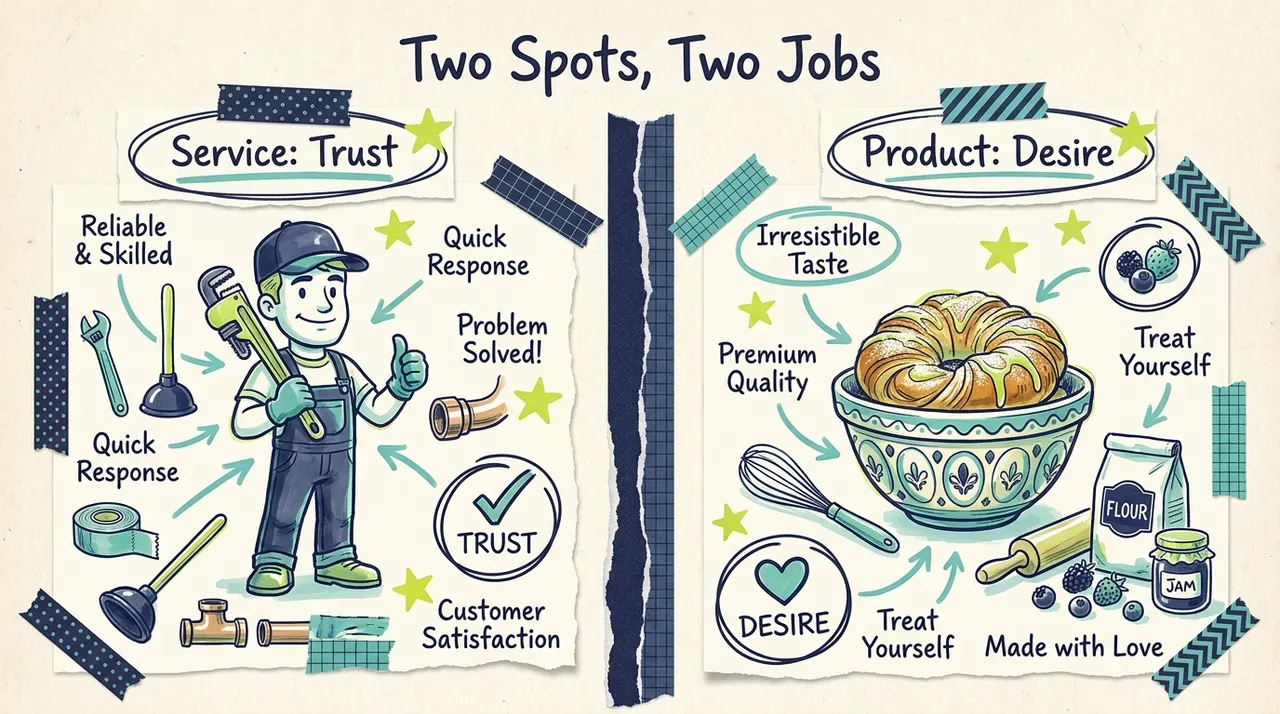
For a service business (a plumber, a financial advisor, a dental practice, a home services company), the viewer needs to feel trust. Service purchases are decisions about who to let into your home, your finances, or your body. The risk feels personal. The viewer needs to believe the business is competent, friendly, and not going to embarrass or harm them.
For a product business (a retailer, an e-commerce brand, a food and beverage company), the viewer needs to feel desire. Product purchases are decisions about what to bring into your life. The risk feels low (most products can be returned or replaced). The viewer needs to be pulled toward the product by either novelty, attractiveness, or a specific moment of need.
That's a meaningful difference. A trust-building spot doesn't look like a desire-building spot. They use different visual grammar, different audio cues, different pacing, different actors, and different calls to action.
The service business creative framework
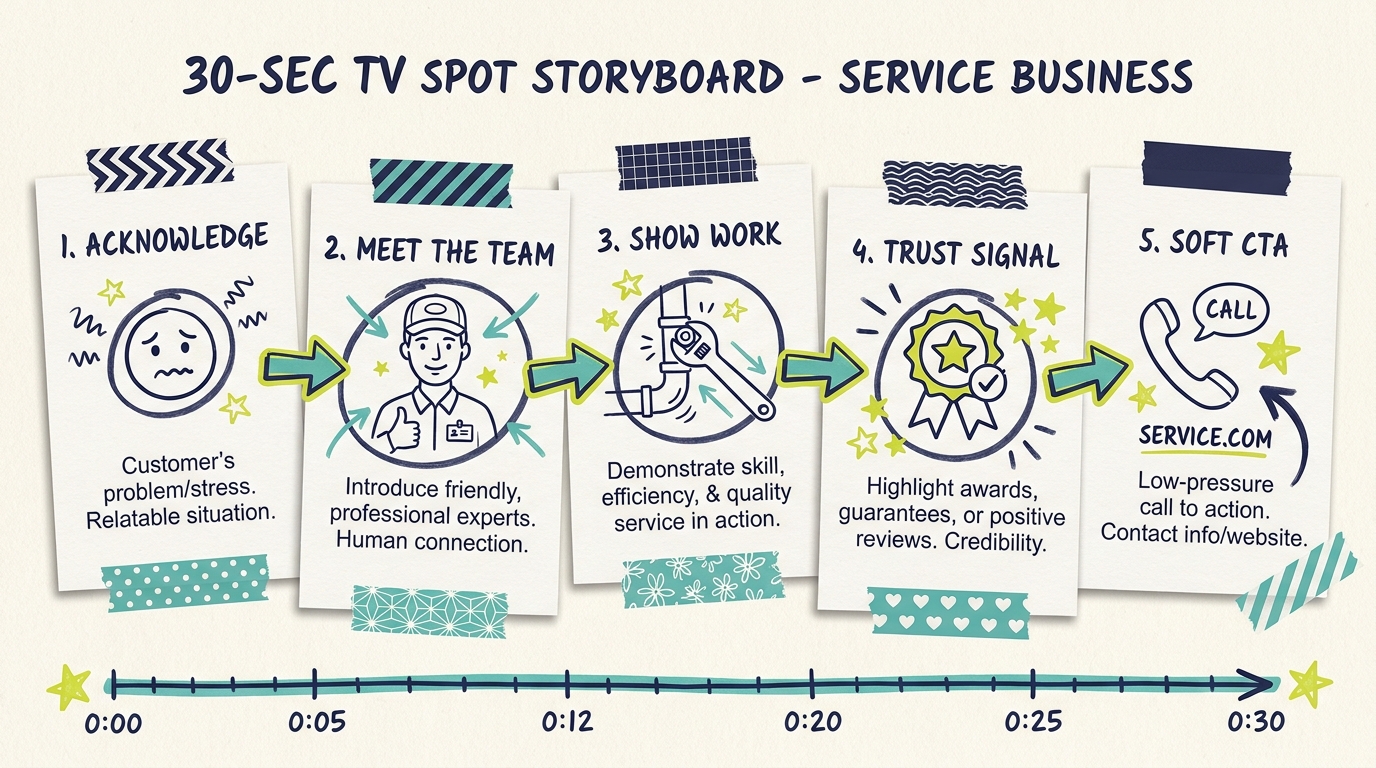
A great 30-second spot for a service business does five things:
1. Introduce the people
Service businesses are about people. The viewer hires a person, not an abstract company. The most successful service-business spots feature the actual owner, an actual technician, or an actual client. Stock-acting "professionals in scrubs" or "smiling contractors holding clipboards" pattern-matches as generic and fails to build the trust the spot exists to build.
If you're a one-person business, you should usually be on camera. If you have a team, feature 2-3 specific employees by name in your creative rotation. The viewer's brain processes named individuals as more trustworthy than anonymous "team members."
2. Acknowledge the discomfort
Most service purchases are triggered by discomfort. A broken pipe. A toothache. An estate-planning question after a family death. A roof leak after a storm. The viewer's relationship with your category is often anxious, not aspirational.
Strong service creative acknowledges that. A line like "Plumbing emergencies happen at the worst times" or "When your roof needs repair, you don't have time to wonder who to call" lands harder than aspirational positioning because it meets the viewer where they are emotionally.
The acknowledgment doesn't have to be heavy or anxious. A warm tone can do the work. The point is to signal "we understand what you're going through" before pitching the solution.
3. Show the work, briefly
Viewers want a quick sense of what the work looks like. A 5-7 second sequence of footage from real work (a technician at a job site, a planner sitting with a client, a hygienist working) builds credibility that a logo-and-narration approach can't match.
The key is "real." Stock footage of generic professionals reads as inauthentic; viewers pattern-match on it and tune out. Actual footage from your business builds the trust the spot exists to build.
4. Make the trust signal explicit
Service businesses earn the call through trust signals. These need to land in the spot. Common trust signals that work in 30-second formats:
Local-tenure signal: "Serving Phoenix homeowners for 23 years."
Volume signal: "Over 8,000 jobs completed in the East Bay."
Quality signal: "5-star average from 1,200+ reviews."
Personal commitment signal: "Family-owned and operated since 1989."
Promise signal: "We do it right the first time, or it's free."
One trust signal per spot, delivered cleanly. Multiple trust signals dilute each other.
5. Soft, specific call to action
Service businesses are rarely impulse purchases. The CTA should match. "Call us when you need us" is too soft. "Call now for 50% off" feels desperate and erodes the trust the rest of the spot built.
The sweet spot is concrete-but-low-pressure: "Get a free estimate at [URL]" or "Schedule your consultation today" or "Visit us online for transparent pricing." A specific action is what the viewer will remember when the need arises.
The product business creative framework
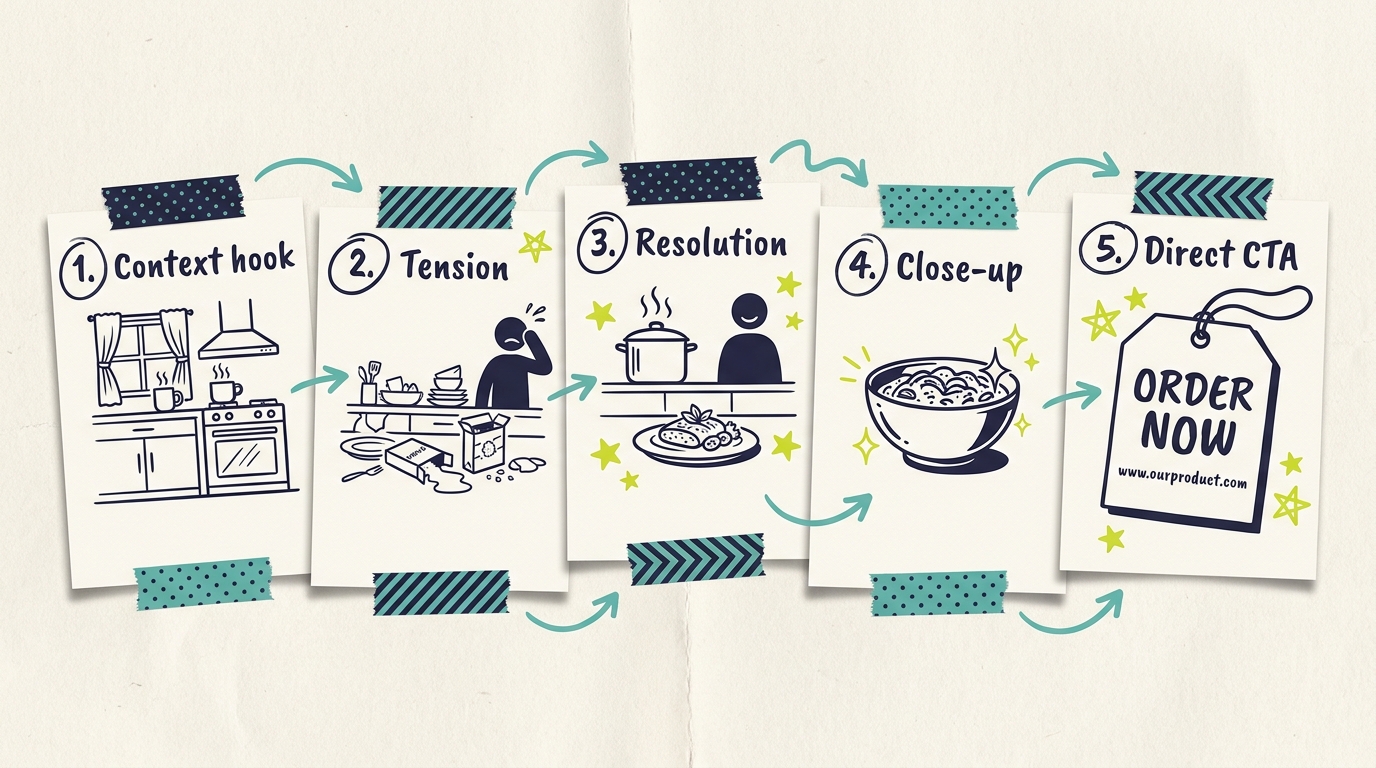
A great 30-second spot for a product business does five different things:
1. Make the product the hero
For product spots, the product itself is the center of attention. The actors, the location, the storyline are all there to support the product, not to be the product.
This is where many small business product spots fail. They put the owner on camera talking about why they love the business, with the product as background. Effective product creative does the opposite: the product takes center frame in beautiful lighting, with the owner or narration serving as supporting context.
If you're selling kitchen goods, the kitchen goods are in the frame for at least 20 seconds. If you're selling clothing, the clothing is being worn and shown in context. If you're selling a craft beverage, the beverage is being poured, held, and tasted.
2. Show the moment of use
Products live in moments. The right moment of use makes the viewer imagine themselves in that moment, which is the desire-building work the spot is doing.
A kitchen-tool spot shows the tool being used to make a beautiful meal, with the kind of cooking-show care that signals "this product fits in a great kitchen." A clothing spot shows the clothing worn in a specific moment (a morning coffee run, a dinner date, a weekend hike) that makes the viewer imagine themselves there.
Generic "product on a white background" framing might work for an Amazon product photo. It doesn't build TV desire. The moment of use is what does the emotional work.
3. Sensory grammar
Products are sensed before they're considered. Color, texture, sound, the imagined taste or feel of the product all matter. Effective product TV creative uses sensory grammar more deliberately than service creative.
A bakery's spot has the sound of a fork through pastry. A jewelry retailer's spot has the soft sparkle of light catching a gemstone. A craft beverage's spot has the specific glug-and-foam sound of a quality pour. These are micro-moments, often 1-2 seconds, but they're the moments viewers remember.
Service spots tend to underweight sensory grammar; product spots tend to over-weight it. Get the balance right for your category.
4. Tension and resolution
The most-watched product spots have a small narrative arc: a moment of tension or want, followed by the resolution your product provides. The viewer's brain is wired to follow tension-and-resolution sequences, and applying that structure to a 30-second product spot dramatically increases recall.
The tension doesn't have to be dramatic. "Dinner is in 20 minutes and the kitchen still feels chaotic" sets up the resolution of "with the right tools, the chaos becomes calm." That's a 5-second setup; the resolution can play out across the next 20.
Service spots use a similar structure (problem → service → relief), but product spots get to be more visual and less verbal in setting up the tension because the product is the resolution.
5. Direct, specific call to action
Product spots can support harder, more specific CTAs than service spots. "Order online for delivery in 2 days" or "Visit our store at [address]" or "20% off your first order with code TV20" all work because product purchases are lower-risk and more impulse-driven.
The CTA should be tied to a specific action the viewer can take that day or that week. Vague CTAs ("learn more at our website") under-perform specific CTAs ("order this weekend, free shipping over $50").
Where they overlap
Despite the differences, service and product spots share some common principles:
30 seconds is the right length. Both formats are calibrated for 30-second delivery on streaming inventory.
The first 5 seconds matter most. Both formats need a hook that establishes "this is for me" or the viewer's attention is gone.
Local-specific beats generic. Spots that feel anchored in your actual community, your actual store, your actual customers consistently outperform spots that could be from anywhere.
Production quality must match category. The spot needs to look like it belongs on TV next to other TV ads. AI creative tools now produce broadcast-quality grammar without large production budgets.
One message per spot. Trying to be both a trust-builder AND a direct-response offer in 30 seconds dilutes both.
Brand lock-in at the end. Both formats need the final 3-5 seconds to lock in your brand name, URL, and visual identity.
Hybrid businesses: when you sell both
Many small businesses don't fit cleanly into "service" or "product." A bakery sells both pastries (product) and custom catering (service). A salon sells both haircuts (service) and beauty products (product). A landscaper sells both maintenance (service) and outdoor furnishings (product).
For hybrid businesses, the right answer is usually multiple spots, each one anchored on one side of the business at a time. Running them in rotation lets you build trust for the service side and desire for the product side without confusing the viewer.
The most common hybrid mistake is trying to feature both in a single 30-second spot. The viewer comes away with a vague sense of "they do a lot of things" rather than a sharp memory of either offering. Two spots, each doing one job, beats one spot trying to do two.
If you have to pick one (because creative production budget is tight), pick the one that drives the larger share of revenue, then add the second one in your next creative cycle.
Common mistakes by category
A few patterns we see repeatedly in underperforming small business TV creative:
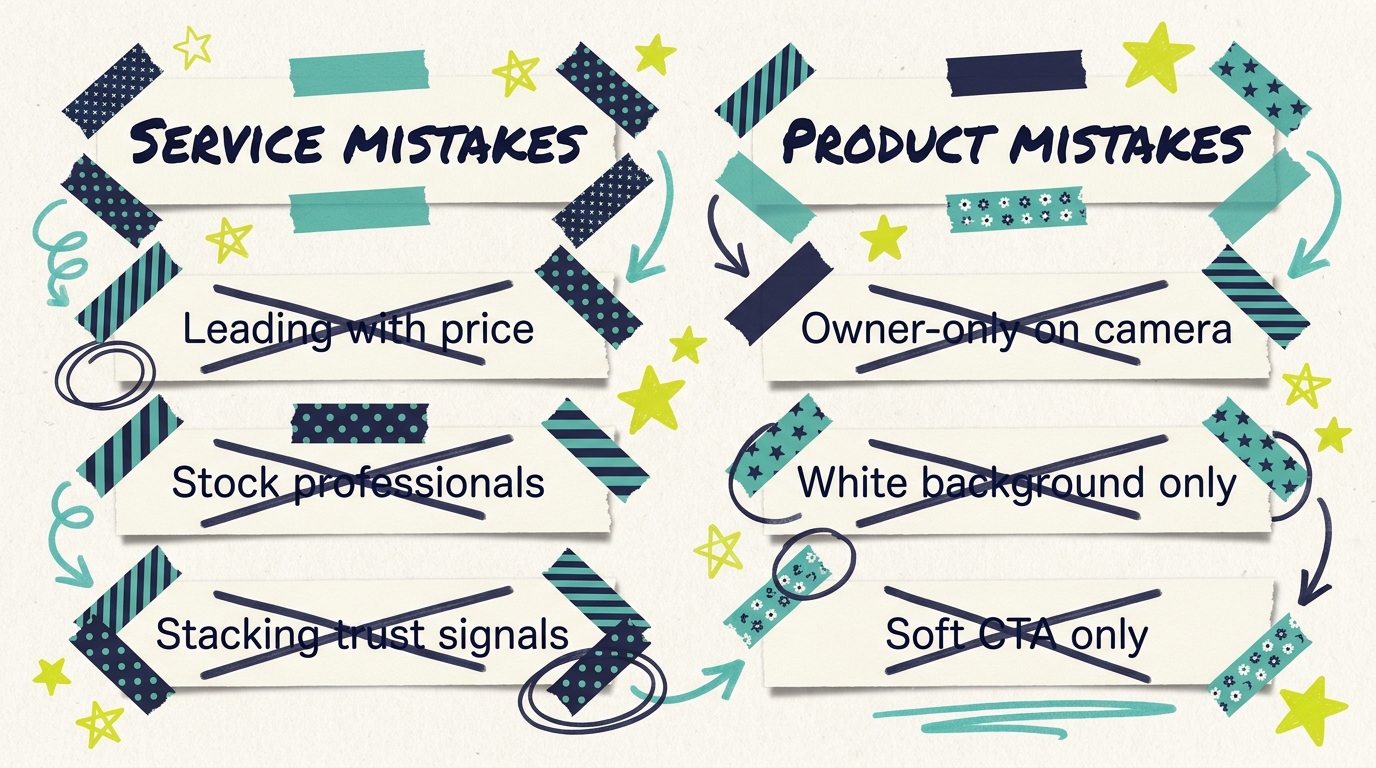
Service business mistake #1: Leading with price. "Plumbing services from $79" might be a strong Google ad header. As a TV opener, it signals desperation and erodes trust before the spot can build it.
Service business mistake #2: Generic professional imagery. Stock footage of "smiling professionals in branded uniforms" pattern-matches as inauthentic. Real footage of real team members, even if simpler, builds more trust.
Service business mistake #3: Stacking multiple trust signals. "Family-owned, 5-star rated, 25 years in business, fully licensed and insured" trying to fit in 30 seconds dilutes each signal. Pick one.
Give the product enough screen time. The owner can narrate or appear briefly where that helps explain it.
Product business mistake #2: Product on white background. Works for Amazon, fails on TV. The viewer needs to see the product in context, in use, in a moment that makes them want it.
Product business mistake #3: Soft CTA on a desire-building spot. Once you've built desire across 25 seconds, the spot needs to convert with a specific, time-bound CTA. "Visit our website" is too soft when the viewer is in a moment of wanting.
Hybrid mistake: One spot trying to do both. Two spots, each doing one job, beats one spot trying to do two.
A 30-second template by category
A practical template you can adapt for your next spot:
Service business template
0:00-0:05: Hook acknowledging the discomfort or moment of need. Lighting and tone calm and grounded.
0:06-0:14: Introduce the people. Owner or specific team member on camera. Brief, warm, specific.
0:15-0:22: Show the work. 5-7 seconds of actual footage from real jobs.
0:23-0:26: One clean trust signal. Local tenure, volume, or quality.
0:27-0:30: Soft CTA + brand lock-in. "Visit [URL] for a free estimate."
Product business template
0:00-0:05: Hook moment that establishes context for use. Product visible in the frame.
0:06-0:14: Tension or want setup. Brief narrative moment that pulls the viewer in.
0:15-0:22: Resolution. Product in beautiful lighting and natural use. Sensory grammar.
0:23-0:26: Specific desire reinforcement. Close-up product shot or moment of satisfaction.
0:27-0:30: Direct CTA + brand lock-in. "Order this weekend at [URL]" or "Visit us at [address]."
How AI creative tools change the math
Until very recently, the cost of producing service-specific or product-specific creative was prohibitive for most small businesses. A custom 30-second spot from a production agency typically cost $3,000-$15,000, which meant most small businesses ran a single spot for years.
AI creative tools have changed that. Platforms like Adwave can generate 30-second TV-ready creative from a business's website in roughly 2 minutes, at no per-spot cost beyond the platform subscription. The implications:
Test multiple creative variations. Running two or three variations from launch (instead of one) lets the data tell you which framing your audience responds to.
Refresh creative every 60-90 days. Even great creative degrades. AI-generated refresh is fast enough that the historical excuse for stale creative no longer holds.
Match creative to channel context. Run a different spot for your Saturday-morning streaming inventory than your Tuesday-evening inventory. Each can speak to a different moment.
Adjust by season. Holiday creative, summer creative, back-to-school creative, all produced in 2-5 minutes each rather than a quarterly $5,000 production cycle.
The strategic shift for 2026 is that the best service and product creative isn't necessarily the highest-budget creative anymore. It's the creative that's been iterated on based on real performance data. AI tools make that iteration economically possible for small businesses for the first time.
Common questions answered
Can a service business and a product business use the same 30-second template?
Sometimes, but rarely well. The customer journey behind a service purchase (trust, anxiety reduction, relationship) is fundamentally different from the customer journey behind a product purchase (desire, novelty, moment of use). Spots built on a single template tend to under-perform for one of the two business types. Tailor the template to your category.
What's the single most important creative decision for a service business?
Featuring real people from your business (the owner, an actual technician, an actual client) rather than stock-acting professionals. Service is a relationship, and TV creative that feels relational outperforms creative that feels corporate. Show the actual humans whose work the viewer is being asked to trust.
What's the single most important creative decision for a product business?
Showing the product in a specific, beautiful moment of use rather than against a generic background. The product needs to be in the frame for at least 20 of the 30 seconds, lit well, in a context that makes the viewer imagine themselves owning or using it.
Should I include pricing in my TV ad?
For products, sometimes yes (especially when the price is a competitive advantage or a specific offer is tied to the spot). For services, usually no. Leading with price on a service spot signals commodity positioning and erodes the trust the spot is supposed to build. Save pricing for the call or the inquiry form.
Do I need a professional production crew to make TV-quality creative?
In 2025, mostly yes. In 2026, increasingly no. AI creative tools have dropped the production cost of TV-quality 30-second spots dramatically. The new bottleneck is the strategy, the script, and the willingness to test multiple variations. Platforms like Adwave handle the production grammar, voiceover, music, and pacing automatically once you've provided the inputs.
How often should I refresh my TV creative?
For both service and product businesses, plan to refresh creative every 60-90 days. Even great creative degrades after that point as viewers pattern-match and tune out. AI creative tools make refresh fast enough that it shouldn't be a barrier.
Can I A/B test TV creative the same way I A/B test digital ads?
Yes, with looser statistical thresholds. Most CTV platforms allow you to run two or three creative variations in rotation, with conversion data shown per creative in the dashboard. You can't get the same volume of impressions as you can on Meta in two weeks, but a 4-6 week rotation usually produces enough signal to identify the stronger creative and double down.
Make creative work for your business
The 30-second TV ad format is one of the most-studied creative formats in advertising history, and the data is clear on what works for service businesses and what works for product businesses. The mistake most small businesses make is ignoring those category-specific patterns and treating their TV creative as a single homogenized format.
Service spots build trust through real people, acknowledged discomfort, and one clean trust signal. Product spots build desire through product-as-hero framing, moments of use, and specific direct CTAs. Hybrid businesses run multiple spots rather than trying to combine the two. AI creative tools have made all of this economically accessible for the first time.


