-
$25
Average CTV CPM for SMB advertisers
-
$50
Minimum budget to start streaming TV ads
-
16%
CTV ad spend growth year-over-year
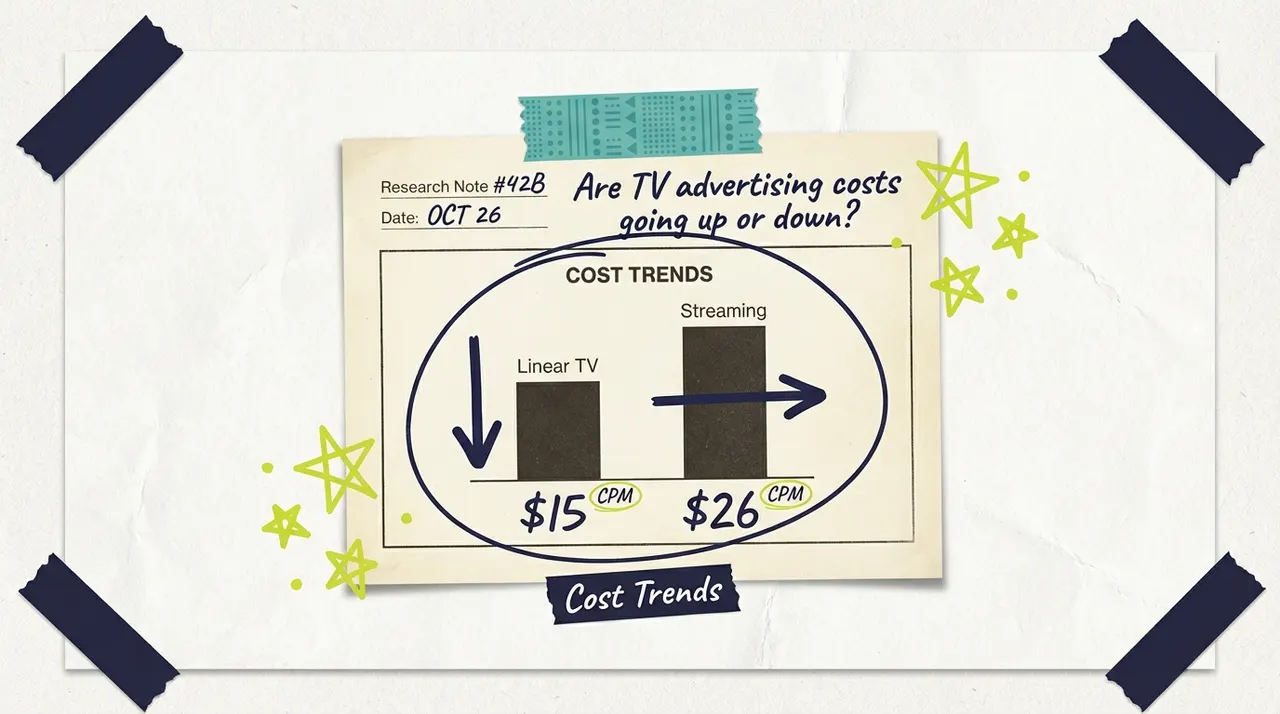
TV advertising costs are diverging dramatically between streaming and linear channels, with streaming CPMs holding relatively stable while traditional TV faces pricing pressure from declining audiences. According to eMarketer, streaming-service CPMs average around $26-27 and are expected to remain in that range through the next several quarters. Meanwhile, linear TV continues losing viewers, with prime-time ad sales down 3.2% year-over-year to $17.8 billion. For small businesses, the pricing dynamics favor streaming: CTV offers lower effective CPMs, better targeting that reduces waste, and entry points starting at just $50 per campaign. The traditional TV economics that once priced out small advertisers are collapsing, while streaming creates accessible pathways to television audiences.
What the data shows
The cost landscape for TV advertising has fundamentally shifted, with streaming and linear pricing moving in opposite directions.
Linear TV advertising costs reflect a market in structural decline. According to Marketing Dive, linear TV's total prime-time ad sales amounted to $17.8 billion in 2024, down 3.2% from the previous year's $18.4 billion. The decline isn't about rate cuts. It reflects reduced demand as advertisers shift budgets to streaming platforms with better targeting and measurement.
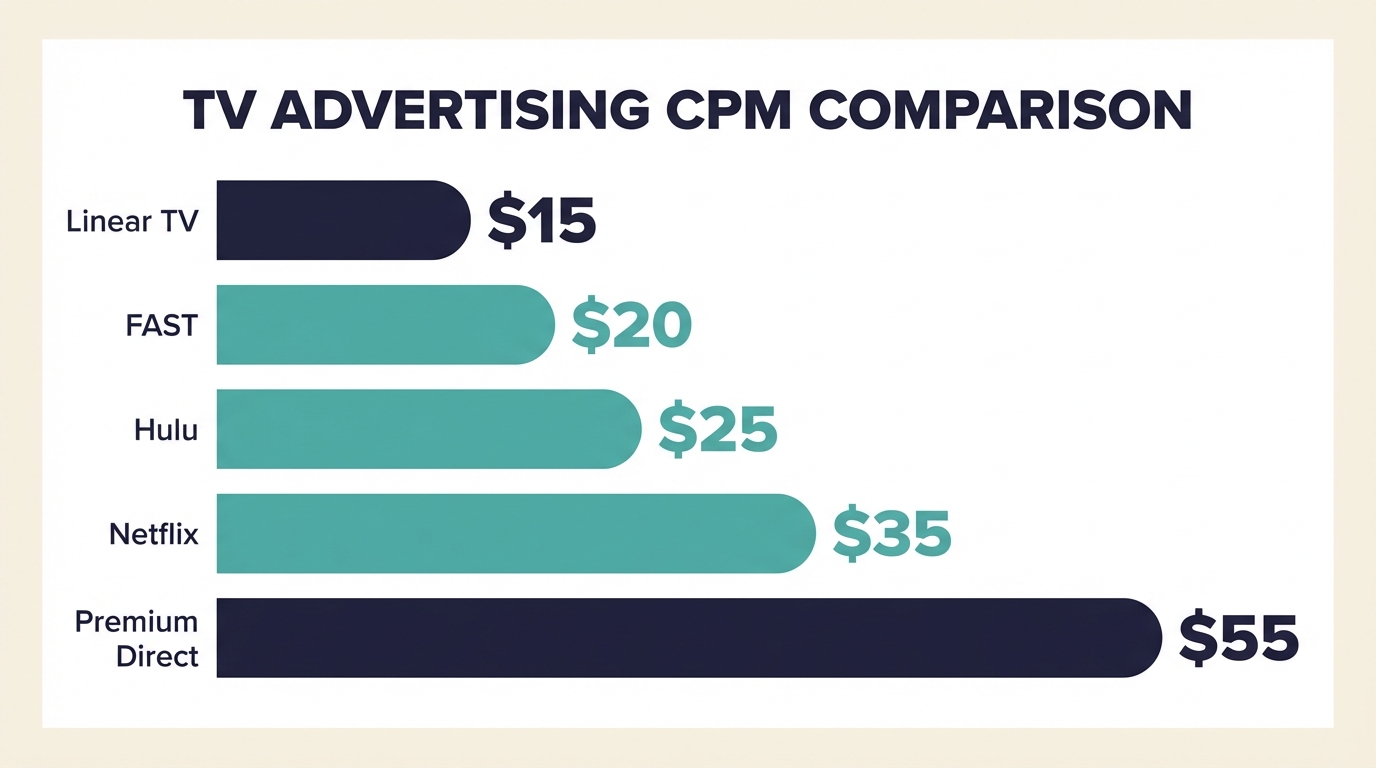
Cable and broadcast CPMs vary significantly by inventory quality and buying method. According to Keynes Digital, median CPMs for broadcast and cable linear television run $10-15. However, premium inventory during live sports or major events commands significantly higher rates, sometimes exceeding $50 CPM. The wide range reflects the fragmented nature of traditional TV buying.
Streaming CPMs tell a more nuanced story. eMarketer projects streaming-service CPMs will average around $26-27 over the next few quarters. However, rates vary dramatically by platform and buying approach:
Netflix: $20-30 CPM (programmatic), $45-65 CPM (direct buys)
Hulu: $10-30 CPM
Amazon Prime Video: $25-60 CPM
YouTube (TV viewing): $20-25 CPM
FAST channels (Tubi, Pluto): Generally lower, $15-25 CPM
The range matters for small business planning. According to nScreenMedia, the median cost-per-thousand for connected TV runs $35-65 for premium inventory, while broadcast and linear CPM rates are in the $10-15 range. However, that comparison is misleading. Linear TV's lower CPMs come with significant waste from untargeted reach, while CTV's higher CPMs deliver precision that improves effective cost per action.
Average CTV CPM through aggregated platforms like Adwave typically falls in the $25-35 range, providing access to premium streaming inventory at accessible prices. This middle ground offers the quality and targeting of streaming without the premium pricing of direct platform buys.
The trend lines are clear. Linear TV pricing faces downward pressure from declining viewership. Streaming pricing remains stable or rises slightly as demand increases. For advertisers, the value proposition increasingly favors streaming, even when raw CPMs appear higher.
Production costs represent another critical dimension of TV advertising economics. Traditional TV commercials often required $25,000-100,000 or more for professional production. This barrier priced out most small businesses before they even considered media costs. AI creative tools have collapsed this barrier entirely. Platforms like Adwave generate broadcast-quality commercials from existing assets (websites, photos, logos) at no additional cost. The total economics of TV advertising have shifted dramatically when production costs drop from $50,000 to $0.
Media buying efficiency has improved as well. Traditional TV buying required relationships with media buyers, minimum commitments, and complex negotiations. Programmatic streaming access enables self-service campaigns with transparent pricing and no minimum beyond the platform floor. A business can launch a streaming TV campaign in minutes, not weeks, at whatever budget level makes sense.
Breaking down the numbers
Understanding what drives TV advertising costs helps businesses make smarter budget decisions.
By platform category
The TV advertising market has segmented into distinct pricing tiers:
Premium streaming (Netflix, Disney+, Max direct): CPMs ranging from $40-65 for direct buys. These platforms offer brand-safe, premium content environments but require significant minimum spends and often direct sales relationships.
Mid-tier streaming (Hulu, Peacock programmatic): CPMs typically $20-35. Accessible through programmatic channels with lower minimums than premium direct buys.
FAST channels (Tubi, Pluto TV, Roku Channel): CPMs often $15-25. Free ad-supported content draws large audiences, though content quality varies.
Aggregated platforms (Adwave, similar): CPMs $25-35. Single campaigns reach inventory across 100+ channels without platform-by-platform management.
Linear broadcast/cable: CPMs $10-15 for standard inventory, $30-50+ for premium programming. Declining audiences reduce effective value despite lower nominal rates.
By targeting method
Targeting precision significantly impacts effective costs:
Run of network (broad reach): Lowest CPMs but maximum waste. Advertisers pay for impressions that will never convert because viewers aren't in target geography or demographics.
Geographic targeting: Moderate CPM premium, but dramatically reduced waste for local businesses. A restaurant pays only to reach households within delivery range, not statewide audiences.
Demographic targeting: Additional CPM premium for age, income, or household composition targeting. Valuable for businesses with specific customer profiles.
Behavioral/interest targeting: Highest CPM premiums but strongest relevance. Reach viewers who have demonstrated interest in relevant categories.
The math often favors precision over volume. A $35 CPM campaign reaching 10,000 targeted households may outperform a $15 CPM campaign reaching 50,000 random households, because conversion rates from relevant audiences dramatically exceed broad reach.
By buying method
How you buy affects what you pay:
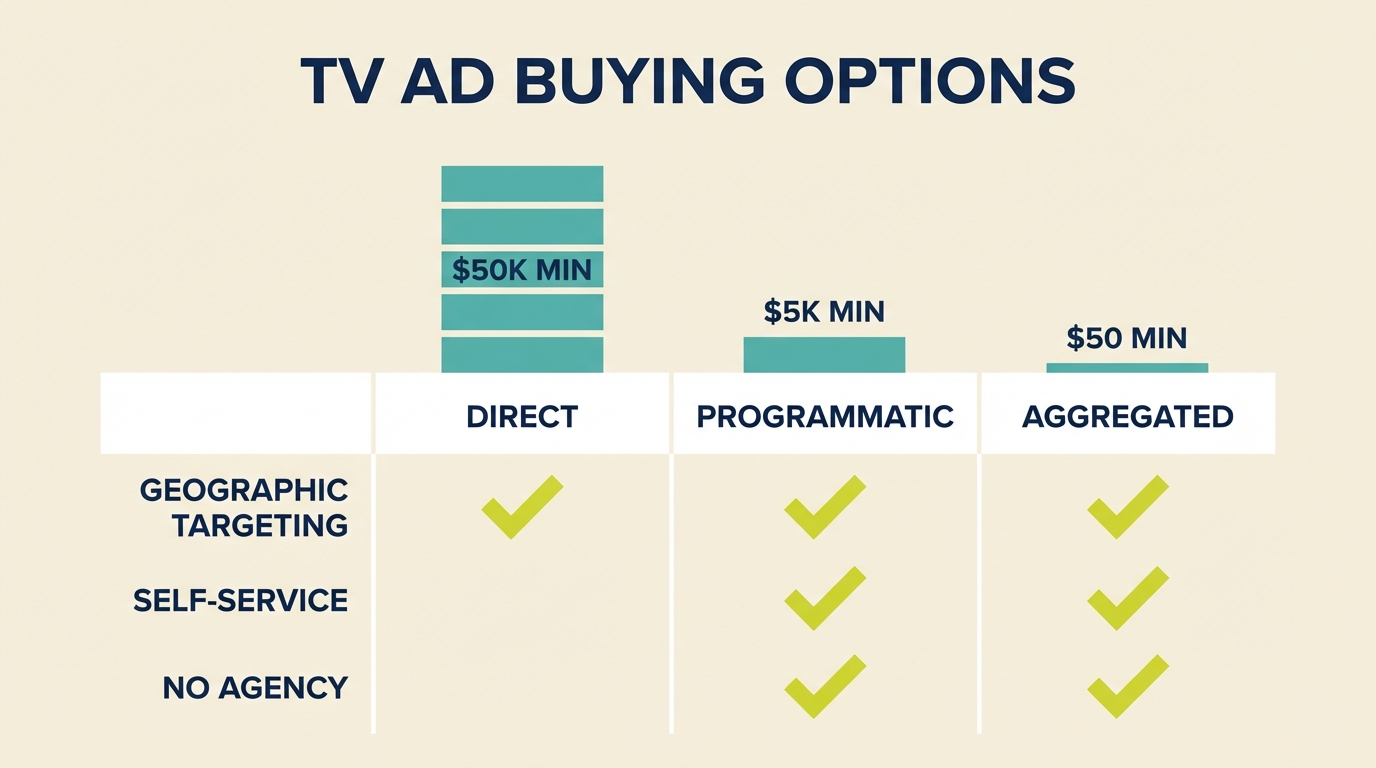
Direct platform buys: Highest rates, but access to premium inventory and often guaranteed placements. Typically requires $25,000-100,000+ minimum commitments.
Programmatic buying: Market-rate pricing through automated exchanges. Lower minimums enable smaller advertisers. Less control over exact placement.
Aggregated platforms: Simplified access to programmatic inventory across multiple services. Fixed, transparent pricing. Adwave offers campaigns starting at $50 with no agency markup.
Why it matters for your business
TV advertising pricing trends create opportunities for businesses that understand the landscape.
The headline is straightforward: TV advertising is more accessible than ever for small businesses. The combination of streaming inventory growth, programmatic buying options, and aggregated platforms has collapsed barriers that once limited television to large advertisers.
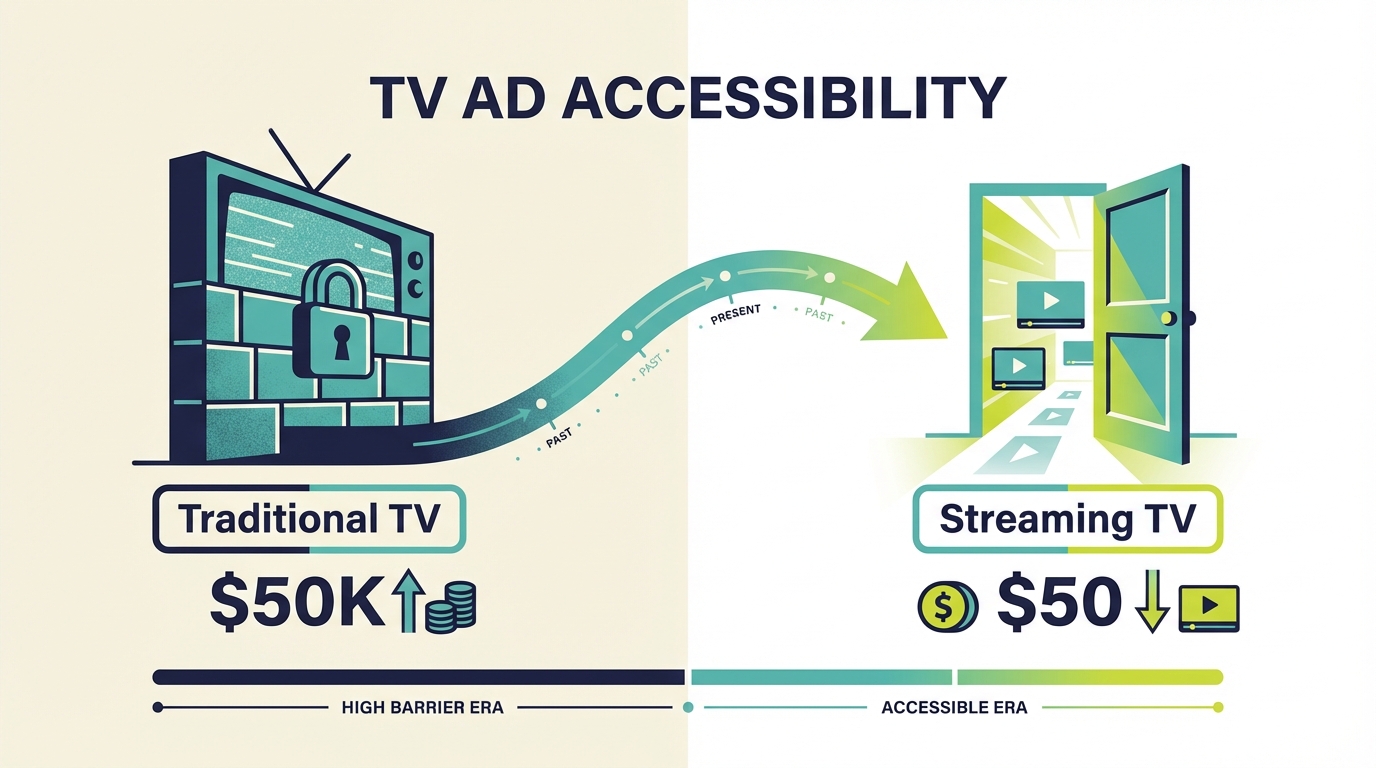
Consider what this means practically. Five years ago, a local business wanting TV presence faced minimum spends of $10,000-25,000 for cable, plus $25,000-50,000 for production. The total investment before a single ad aired could exceed $50,000. Today, that same business can launch streaming TV campaigns starting at $50, with AI-generated creative that costs nothing extra.
The cost efficiency extends beyond raw pricing. CTV's targeting capabilities mean you're not paying for wasted reach. A dentist in Phoenix pays only to reach households within their practice radius, not viewers in Tucson or Flagstaff. A restaurant targets households during meal-decision hours, not overnight when no one is thinking about dinner. This precision, unavailable on traditional TV, transforms effective cost per acquisition even when CPMs appear similar.
Measurement changes the equation further. Traditional TV advertising relied largely on faith that ads reached claimed audiences. CTV provides verification. You know your ads ran. You can track outcomes. You can optimize based on data rather than guesswork. This accountability makes every dollar work harder.
The trend lines favor streaming. Linear TV's audience decline will continue, pressuring the economics that once made broadcast and cable valuable. Streaming's audience growth creates more inventory, more competition among platforms, and ultimately more accessible pricing for advertisers. Small businesses that establish streaming TV presence now will benefit from these dynamics.
How to take advantage of this trend
Smart advertisers use cost trends to maximize value from TV budgets.
Start with clear budget parameters. Know what you can invest before evaluating platforms. For most small businesses, $200-500 per month provides enough budget to achieve meaningful reach and frequency in a local market. Campaigns below $100 monthly may not deliver sufficient impressions to impact results.
Choose your buying approach based on budget scale. Businesses spending under $5,000 monthly typically benefit most from aggregated platforms that provide simplified access and transparent pricing. Larger budgets may warrant exploring direct platform relationships for premium inventory access.
Prioritize targeting over reach. Resist the temptation to chase the lowest CPMs. A $15 CPM that reaches random households across your state wastes money compared to a $30 CPM that reaches qualified prospects in your service area. Calculate effective cost per relevant impression, not raw CPM.
Test before committing. The low minimums on streaming platforms enable testing that traditional TV never allowed. Run a $200 campaign for two weeks. Evaluate results. Adjust targeting, creative, or timing based on data. Then scale what works.
Monitor local TV advertising costs in your market. CPMs vary by geography, with major metros typically commanding premium rates compared to smaller markets. Understanding your local cost structure helps set realistic expectations for campaign reach at various budget levels.
Use AI creative tools. Production costs once represented a major barrier to TV advertising. AI-generated commercials eliminate that barrier entirely. Focus your budget on media rather than production. Quality creative at zero production cost beats expensive production with minimal media spend.
The bigger picture
TV advertising cost trends reflect fundamental market transformation that will accelerate in coming years.
The streaming premium debate
Some argue that streaming CPMs seem expensive compared to traditional TV. This view misses critical context. Traditional TV's lower CPMs reflect declining value, not superior efficiency. When viewership drops 10% annually and targeting remains crude, lower prices simply reflect market adjustment.
Streaming's stable CPMs reflect sustained demand. Advertisers willingly pay premium rates for targeting, measurement, and growing audiences. The "premium" is fair pricing for a superior product. As streaming matures and inventory expands, prices will likely moderate, but the fundamental value proposition will strengthen.
Retail media convergence
Retail media networks represent an emerging force in TV advertising costs. Amazon, Walmart, and other retailers are combining purchase data with streaming TV inventory, enabling attribution that neither traditional TV nor standard CTV can match. These capabilities command premium pricing because they deliver premium results.
For small businesses, retail media on CTV creates new options. Targeting past purchasers or lookalike audiences on streaming TV combines the reach of television with the precision of digital performance marketing. Expect these capabilities to expand and become more accessible.
What small businesses should expect
Cost trends favor small business advertisers. Streaming inventory continues growing as more platforms launch ad tiers and FAST channels proliferate. More inventory means more competition, which benefits buyers. Programmatic access continues improving, lowering technical barriers. AI creative tools eliminate production costs entirely.
The businesses that benefit most will be those that start now. Learning what works, building audience data, and developing effective creative takes time. The cost of entry has never been lower. The opportunity cost of waiting increases as competitors establish their TV presence.
Local market considerations
TV advertising costs vary significantly by market. Major metros like New York, Los Angeles, and Chicago command premium rates for both linear and streaming inventory. Smaller markets offer more accessible pricing but may have less inventory available through some platforms.
For local businesses, the market dynamics generally favor streaming. Geographic targeting on CTV allows precise targeting within a service area regardless of the market's overall size. A business in a major metro can target just their neighborhood rather than the entire DMA. A business in a smaller market gains access to inventory that local cable operators might not offer.
The cost of local TV advertising through streaming typically ranges from $200-500 monthly for meaningful local campaigns. That's a fraction of what cable TV would require for comparable reach in most markets.
Industry-specific considerations
Different industries face different cost considerations for TV advertising:
Service businesses (restaurants, home services, healthcare) benefit most from geographic targeting's efficiency. Their customers come from defined service areas, and streaming's precision eliminates waste inherent in broader linear TV reach.
Retail businesses can use both geographic and dayparting strategies. Reaching viewers during evening hours when purchase decisions happen often improves cost efficiency compared to round-the-clock exposure.
E-commerce businesses use TV primarily for brand awareness before retargeting through other channels. The cost equation includes TV's contribution to overall conversion paths, not just direct response from TV alone.
Professional services (attorneys, accountants, financial advisors) benefit from TV's trust-building environment. The premium context of television advertising supports positioning as established, credible providers. Cost efficiency improves when geographic targeting limits reach to relevant markets.
Seasonal considerations
TV advertising costs fluctuate seasonally. Q4 sees highest demand and pricing as holiday advertisers flood the market. Q1 often offers better rates as post-holiday demand drops. Political advertising in election years temporarily spikes pricing in contested markets. Planning campaigns around these patterns can improve cost efficiency.
Sports programming creates predictable cost premiums. NFL, NBA playoffs, March Madness, and similar events command premium pricing. Advertisers not specifically targeting sports audiences may find better value during non-sports periods or on non-sports content.
Understanding these seasonal and content-driven cost fluctuations helps businesses time campaigns for maximum budget efficiency. A local service business launching awareness campaigns might target Q1 when rates are lower, building presence before peak season demand requires their attention elsewhere.
The key insight is that TV advertising costs are more variable and negotiable than many small businesses realize. Testing at multiple times, across different platforms, with various targeting parameters reveals the specific cost structure for reaching your audience in your market.
For businesses new to TV advertising, the learning curve itself has value. Initial campaigns teach what works before committing larger budgets. The low entry barriers on streaming platforms enable this testing approach that traditional TV, with its high minimums, never allowed. Budget accordingly: allocate test budget for learning, then scale based on proven performance.
What experts are saying
Industry analysts have noted the diverging cost dynamics between streaming and traditional TV.
EMarketer's analysis of streaming CPMs projects stability around $26-27 for the next several quarters, noting that "US Video Streaming Ad Prices Will Remain Stable" even as inventory expands. The research firm attributes this stability to sustained advertiser demand for streaming's targeting and measurement capabilities.
Marketing researchers have emphasized the shift in advertiser priorities. "The focus has moved from cost per thousand to cost per outcome," noted one industry analysis. "Advertisers willingly pay streaming premiums because they can measure results in ways linear TV never enabled."
Trade publications have highlighted the democratization effect. The combination of programmatic buying, aggregated platforms, and AI creative has "effectively removed every traditional barrier to TV advertising for small businesses," according to IAB analysis.
Common questions answered
What factors determine TV advertising costs?
Several factors influence what you'll pay for TV advertising. Platform choice matters significantly, with premium streaming services commanding higher CPMs than FAST channels or traditional cable. Geographic targeting affects costs, with major metros commanding premiums. Timing impacts pricing, with prime time and sports adjacencies costing more than daytime or overnight. Buying method (direct vs. programmatic vs. aggregated) creates different pricing structures. And creative quality, while not directly affecting media costs, influences campaign effectiveness and therefore cost efficiency.
How do I calculate the true cost of TV advertising?
Look beyond CPM to understand true costs. Factor in targeting efficiency (what percentage of impressions reach your actual target audience), production costs (zero with AI creative, potentially $25,000+ for traditional production), management overhead (agency fees vs. self-service platforms), and measurement costs (what does it take to understand campaign impact). The true cost of reaching a relevant customer through streaming is often lower than nominal CPM comparisons suggest, once waste elimination and production savings are considered.
Are TV advertising costs going up or down?
It depends on the channel. Linear TV advertising costs face downward pressure as audiences decline, though premium inventory like live sports maintains pricing. Streaming TV CPMs remain relatively stable around $26-27 on average, with variation by platform. The overall trend shows streaming holding value while traditional TV faces price erosion.
What is the average CPM for TV advertising?
CPMs vary significantly by platform and buying method. Linear broadcast/cable runs $10-15 for standard inventory. Streaming platforms range from $15-25 (FAST channels) to $40-65 (premium services direct). Aggregated CTV platforms typically deliver $25-35 CPMs. The wide range reflects fragmentation across the TV advertising market.
Is streaming TV advertising more expensive than cable?
On a raw CPM basis, streaming often appears more expensive than cable. However, effective cost comparison requires accounting for targeting efficiency. A $30 streaming CPM that reaches only relevant prospects often delivers better ROI than a $12 cable CPM that reaches mostly non-customers. Calculate cost per relevant impression or cost per action, not just CPM.
What is the minimum budget for TV advertising?
Traditional linear TV typically requires $5,000-25,000 minimum commitments. Streaming TV through aggregated platforms can start as low as $50 (Adwave's minimum). Meaningful local campaigns typically require $200-500 monthly to achieve sufficient reach and frequency. The barriers that once priced out small businesses have largely collapsed.
Will TV advertising costs continue rising?
Streaming CPMs are projected to remain stable near-term, with potential for moderate increases as demand grows. Linear TV faces continued pricing pressure from audience decline. The overall trajectory favors streaming, where advertiser demand and inventory growth should balance to maintain accessible pricing for years to come.
How can I reduce TV advertising costs?
Focus on targeting efficiency rather than chasing lowest CPMs. Use geographic targeting to eliminate waste from irrelevant markets. Use AI creative tools to eliminate production costs. Start with aggregated platforms that provide transparent pricing without agency markups. Test small before scaling to ensure budget efficiency.
Supporting data
Key statistics on TV advertising costs and pricing trends:
Streaming CPM average: $26-27 (eMarketer, Q4 2025)
Linear TV CPM median: $10-15 (Keynes Digital, 2025)
Premium CTV CPM range: $35-65 (nScreenMedia, 2025)
Netflix CPM range: $20-30 programmatic, $45-65 direct (Simulmedia, 2025)
Hulu CPM range: $10-30 (Simulmedia, 2025)
Amazon Prime Video CPM: $25-60 (Simulmedia, 2025)
Linear prime-time ad sales: $17.8 billion, down 3.2% YoY (Marketing Dive, 2024)
YouTube TV CPM: $20-25 (Keynes Digital, 2025)
All sources linked above. Data current as of December 2025.
Get started with affordable TV advertising
TV advertising costs have never been more accessible for small businesses. Whether you choose streaming's precision targeting or take advantage of declining linear rates, the opportunity to reach television audiences exists at every budget level.
Adwave makes streaming TV advertising accessible starting at just $50. Access 100+ channels including Hulu, Discovery, and Peacock. Geographic targeting ensures you reach local audiences without paying for national waste. AI creative generates broadcast-quality commercials in minutes.
No production costs. No agency fees. No minimum spend that prices out small businesses.
See how it works | View pricing