-
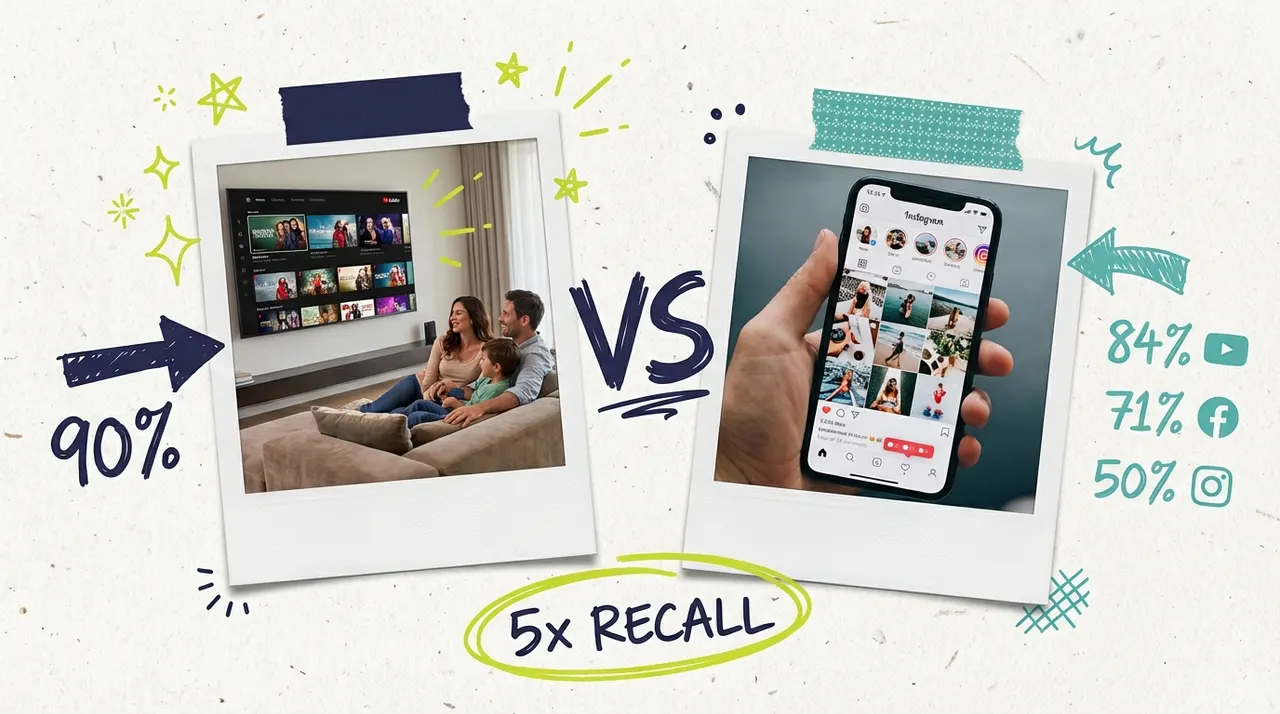
90%
U.S. households reached by CTV advertising
-
5x
Higher brand recall for TV + social vs social-only
-
92%+
CTV ad completion rates
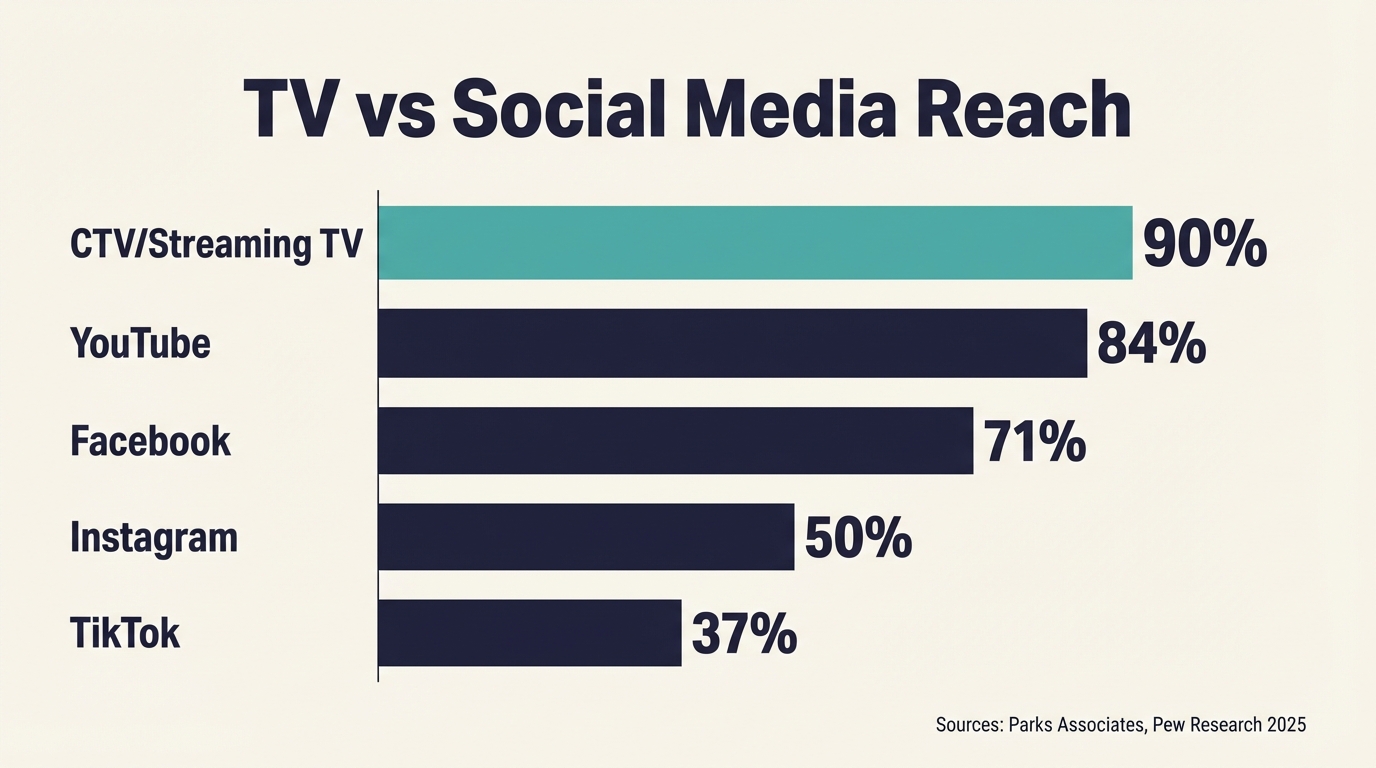
TV advertising reaches approximately 90% of U.S. households through connected TV devices, while social media platforms like YouTube (84%), Facebook (71%), and Instagram (50%) each reach significant but smaller portions of the adult population, according to Pew Research Center data and industry research. But the raw reach numbers only tell part of the story. What makes TV advertising especially compelling for small businesses is how viewers engage with ads on the big screen versus the small screen. When streaming TV ads are combined with social media campaigns, brand recall is 5x higher than social-only advertising strategies, according to recent research from Universal Ads and MediaPost. For businesses deciding where to invest their advertising budgets, understanding these differences is essential.
What the data shows
The gap between TV and social media advertising reach has narrowed considerably over the past decade, but the two channels serve fundamentally different purposes in a marketing strategy.
Connected TV now reaches roughly 90% of American households, with over 250 million viewers in the United States accessing streaming content through smart TVs, streaming devices, and gaming consoles. According to Nielsen's March 2025 data, streaming represents 43.8% of total TV time in the U.S., an increase of 10 percentage points in just two years. More importantly for advertisers, 72.4% of all TV viewing time occurs on ad-supported content, meaning the vast majority of those viewers can be reached with advertising.
Social media reach tells a different story. YouTube leads all platforms with 84% of U.S. adults reporting they use the service, making it the closest comparison to traditional TV in terms of broad reach. Facebook follows at 71%, Instagram at 50%, and TikTok at 37%, according to Pew Research Center's November 2025 survey. These numbers represent people who use these platforms at all, not necessarily those who see advertising on them.
What separates TV from social media isn't just reach, it's the quality of that reach. CTV ads deliver completion rates between 90% and 98%, according to industry research. Viewers generally can't skip streaming TV ads the way they can scroll past social media content or skip YouTube pre-roll after five seconds. This non-skippable environment creates a fundamentally different advertising experience.
The attention metrics reinforce this difference. CTV advertising achieved an attention rate of 51.5% in early 2024, according to analytics firm Adelaide, significantly outperforming most digital formats. Research from Comcast Advertising found that after two ad exposures, unaided brand recall was twice as high among viewers who saw TV ads compared to those who saw mobile video ads. The bigger screen and lean-back viewing environment appear to create more memorable advertising moments.
Perhaps most compelling for businesses running multi-channel campaigns: combining streaming TV with social media advertising delivers dramatically better results than either channel alone. Research reported by MediaPost found that brand recall was 5x higher when a streaming TV ad preceded social media exposure compared to two social-only exposures. Universal Ads research showed that emerging brands see up to 2.8x higher brand recall and a 24% lift in purchase intent when combining streaming and social campaigns.
Breaking down the numbers
Understanding the aggregate reach statistics requires looking at how different audiences engage with TV versus social media. The patterns reveal important strategic implications for where and when to advertise.
By age group
The generational divide in media consumption shapes how reach translates to actual advertising opportunity. Among adults 18 to 29, YouTube captures roughly 15% of all TV viewing time, making it the dominant streaming destination for this cohort. But the same young adults are also the heaviest social media users: 80% use Instagram, and approximately half use TikTok daily, according to Pew Research.
For viewers 50 and older, the pattern reverses. This group watches significantly more traditional and streaming TV content but uses social media platforms at lower rates. Only 19% of adults 65 and older use Instagram, compared to their much higher TV consumption. For businesses targeting older demographics, TV advertising delivers reach that social media simply cannot match.
The middle age groups (30-49 and 50-64) present the most balanced media diet, with strong engagement on both TV and social platforms. For these audiences, a multi-channel approach combining TV and social advertising makes the most strategic sense.
By viewing context
TV viewing happens in a fundamentally different context than social media scrolling. TV viewers are typically settled in for entertainment, watching on the largest screen in their home, often with other household members. This creates what advertisers call "lean-back" viewing: relaxed, attentive, and receptive to brand messages.
Social media consumption, by contrast, happens in "lean-forward" mode: quick, distracted, and interruptible. Users scroll through feeds while waiting in line, during commercial breaks, or while doing other activities. The average social media session involves rapid switching between content, with most posts receiving only a fraction of a second of attention.
This contextual difference explains why TV ads generate higher recall even when reach numbers are similar. A 30-second TV ad commands focused attention on a large screen, while a social media ad competes with dozens of other posts for fleeting glances on a small screen.
By ad spend allocation
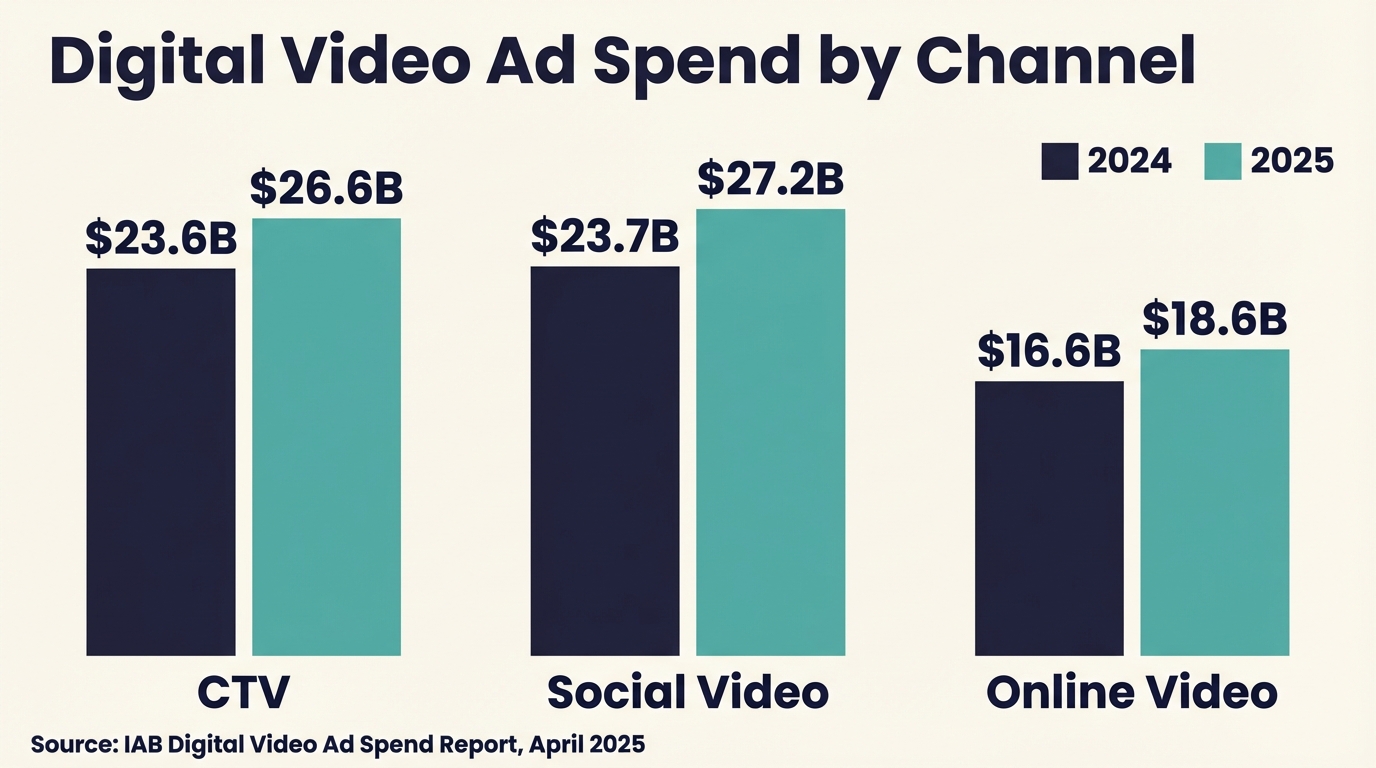
The advertising industry's budget allocation reflects growing confidence in TV and video advertising. According to the IAB's 2025 Digital Video Ad Spend Report, digital video (including CTV, social video, and online video) is set to capture nearly 60% of all TV and video ad spend in 2025, double its share from five years ago.
The breakdown reveals interesting competitive dynamics:
CTV: $23.6 billion in 2024, projected to reach $26.6 billion in 2025 (16% YoY growth)
Social Video: $23.7 billion in 2024, projected to reach $27.2 billion in 2025 (21% YoY growth)
Online Video: $16.6 billion in 2024, projected to reach $18.6 billion in 2025 (17% YoY growth)
The near-parity between CTV and social video spend reflects advertisers recognizing value in both channels. However, the IAB report notes that most CTV budget increases come from reallocations, primarily from linear TV (36%) and social media (36%), suggesting advertisers are shifting from less effective channels toward CTV's higher-impact environment.
Why it matters for your business
If you're running a small business and trying to decide between TV advertising and social media, the data suggests you shouldn't choose between them. The real question is how to use each channel for what it does best.
TV advertising excels at building brand awareness and trust. The big-screen, living-room environment creates a premium context that transfers to your brand. When viewers see your business on the same screen where they watch their favorite shows and sports, it signals legitimacy and scale. This halo effect is especially valuable for local businesses competing against national chains. A dentist's office, a local restaurant, or a home services company advertising on streaming TV immediately looks more established and trustworthy to potential customers.
The brand recall advantage of TV translates directly to business results. Research from Comscore found that CTV advertising led to a 25% lift in both brand awareness and ad recall, outperforming typical online video benchmarks. For businesses that depend on being the first name people think of when they need a service, that awareness advantage can be decisive.
Social media advertising, meanwhile, excels at direct response and retargeting. The detailed targeting options, click-through capabilities, and conversion tracking make social ideal for bottom-of-funnel activities. If someone has already visited your website or interacted with your brand, social media's retargeting capabilities can efficiently bring them back.
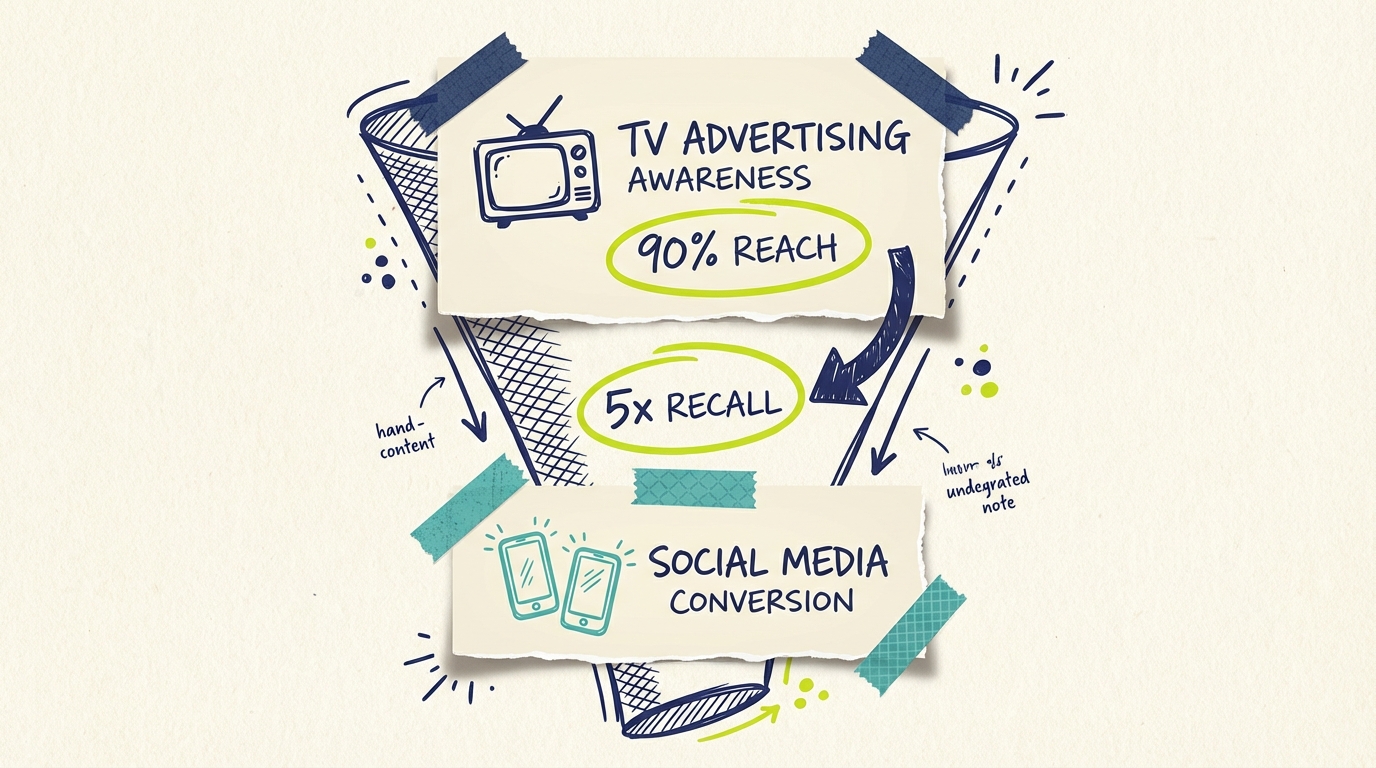
The smartest approach combines both channels. Run TV ads to build broad awareness in your market, then use social media to retarget and convert viewers who've shown interest. The research showing 5x higher recall for combined campaigns versus social-only isn't just an interesting statistic, it's a blueprint for how to structure your advertising mix.
What makes this combination newly accessible for small businesses is the dramatic reduction in entry barriers. Platforms like Adwave let you launch streaming TV campaigns starting at just $50, with AI-generated creative that eliminates the need for expensive production. You can now afford to add TV to your media mix without abandoning your existing social campaigns.
How to take advantage of this trend
Understanding the reach and effectiveness differences between TV and social media advertising is useful. Knowing how to apply that understanding to your business is what drives growth.
Start by evaluating your current marketing mix. If you're spending 100% of your advertising budget on social media, you're likely leaving awareness and brand-building opportunities on the table. Consider reallocating 20-30% of your budget toward streaming TV to capture the attention and recall benefits the research demonstrates. For a business spending $500 per month on Meta ads, that might mean running $350 on social and $150 on TV to test the combined approach.
When you add TV to your mix, think about audience overlap strategically. Your TV ads should reach the same geographic area and demographic profile as your social campaigns. This ensures that when someone sees your social ad, they may have already been primed by your TV presence, creating the multiplier effect that drives 5x better recall.
Combine local TV targeting with relevant search and social campaigns to reach customers in your service area.
Timing matters for maximizing the combined effect. Run your TV campaigns during evening hours (6-10 PM) when viewership peaks and households are gathered. Then schedule your social retargeting to run the following day, catching viewers while your TV ad is still fresh in their memory. This sequencing takes advantage of the research showing that TV exposure before social exposure drives the highest recall.
Measure success with a brand-building mindset, not just direct-response metrics. Track brand search volume in Google (are more people searching for your business name?), monitor overall website traffic trends, and ask new customers how they heard about you. TV advertising builds awareness that converts over time, not immediately, so patience with measurement is essential.
The key is starting. Many small businesses have never considered TV advertising because of historical cost barriers. Those barriers have effectively vanished. With $50 minimum budgets, AI-generated creative, and precise geographic targeting, there's no longer a valid reason to limit yourself to social-only advertising. The research is clear: combining channels beats single-channel strategies. The only question is whether you'll take advantage of that insight.
The bigger picture
The convergence of TV and digital advertising represents one of the most significant shifts in the media industry in decades. Understanding where this trend is heading helps businesses make smarter long-term advertising decisions.
The ad-supported streaming explosion
The rise of ad-supported streaming has fundamentally expanded TV advertising inventory and accessibility. When streaming was primarily subscription-based (Netflix, early Disney+), advertisers had limited options beyond traditional linear TV. Today, nearly every major streaming platform offers an ad-supported tier, and viewers are embracing them. Nielsen's Ad Supported Gauge reports that 72.4% of all TV viewing time in the U.S. now occurs on ad-supported content.
This shift has created a massive new pool of advertising inventory, helping to moderate CPM prices and making TV advertising more accessible to smaller budgets. The supply-demand dynamics favor advertisers: more ad-supported viewing time means more opportunities to reach audiences without premium pricing.
Social and TV are converging
The traditional boundaries between "TV advertising" and "social media advertising" are increasingly blurring. YouTube, nominally a social platform, is now the largest streaming service by viewing share. TikTok is experimenting with TV apps. Amazon Prime Video, a streaming service, runs ads with shoppable links that feel distinctly social in their interactivity.
For advertisers, this convergence means thinking less about "TV vs. social" and more about "big screen vs. small screen" or "lean-back vs. lean-forward" viewing contexts. The platform matters less than the viewing environment and attention level you're capturing.
What's next for small business advertising
Industry analysts project continued growth in both CTV and social video advertising through at least 2027. 56% of global marketers plan to increase their CTV spending in 2025, according to Nielsen's Annual Marketing Report. The expansion of self-serve and programmatic tools is making CTV increasingly accessible to small and mid-size businesses.
For small businesses, this means the opportunity gap between "what big brands can do" and "what you can afford" continues to narrow. The same streaming platforms where national brands run Super Bowl follow-up campaigns are now accessible to local businesses with modest budgets. The democratization of TV advertising is real, and it's accelerating.
What experts are saying
Industry analysts and researchers have highlighted the strategic implications of the TV-social reach comparison.
The IAB's 2025 Digital Video Ad Spend Report describes streaming TV and social video as complementary channels for reach, targeting, and measurement.
Nielsen's analysis of the streaming advertising market noted: "The combination of self-service technology, accessible pricing, and the ability to link spend to outcomes has empowered small and mid-size businesses to get a piece of the CTV pie, making it easier and effective to promote, reach, and engage with audiences."
Research from Comcast Advertising on attention and recall reinforced the unique value of TV: "After two ad exposures on both TV and mobile video, unaided recall was twice as high among those who saw the TV ads as those who saw the mobile video ads." The study attributed this to the lean-back viewing environment and larger screen format that commands greater attention.
Industry observers have also noted the strategic shift in how businesses approach multi-channel advertising. The old model of choosing between TV and digital is giving way to integrated approaches that use each channel's strengths. The research on combined campaign effectiveness is driving this shift from competitive to complementary media strategies.
Common questions answered
Does TV advertising reach more people than social media?
TV advertising through connected TV reaches approximately 90% of U.S. households, making it one of the broadest-reaching advertising channels available. Individual social platforms reach smaller portions of the population, with YouTube reaching 84% of adults, Facebook 71%, Instagram 50%, and TikTok 37%, according to Pew Research. However, combining multiple social platforms can create comparable overall reach, though viewers engage with TV and social content in fundamentally different ways.
Why does TV advertising have higher brand recall than social media?
TV advertising generates higher brand recall primarily because of the viewing context. Viewers watching TV are typically in a relaxed, attentive state on a large screen, often with other household members. This "lean-back" environment allows for focused attention on advertising. Social media consumption, by contrast, happens in "lean-forward" mode with rapid scrolling and divided attention. The non-skippable nature of most TV ads also ensures full message delivery, while social ads can be scrolled past in fractions of a second.
Can small businesses afford TV advertising to compete with social media reach?
Yes, the barriers to TV advertising have dropped dramatically. Platforms like Adwave enable streaming TV campaigns starting at just $50, with AI-generated creative eliminating production costs. This makes TV accessible to virtually any advertising budget. Small businesses can now run TV campaigns alongside their existing social media advertising without requiring the five- and six-figure budgets that traditional TV demanded.
Should I replace my social media advertising with TV advertising?
No, the research strongly suggests using both channels together rather than replacing one with the other. Combined streaming TV and social campaigns deliver 5x higher brand recall than social-only campaigns. TV excels at building broad awareness and brand trust, while social media excels at targeting, retargeting, and direct response. The most effective strategy uses TV for awareness at the top of the funnel and social for conversion at the bottom.
How do I measure TV advertising effectiveness compared to social media?
TV advertising effectiveness requires different measurement approaches than social media. While social provides click-through rates and conversion tracking, TV advertising success shows up in brand search volume (more people Googling your business), overall website traffic increases, and customer surveys asking how they heard about you. Advanced measurement tools can also track website visits and conversions from households exposed to your TV ads, though the attribution window is typically longer than social media's immediate click-based tracking.
Which age groups does TV advertising reach better than social media?
TV advertising reaches older demographics more effectively than social media. Adults 50 and older watch significantly more TV and streaming content while using social platforms at lower rates. Only 19% of adults 65+ use Instagram, for example. For younger demographics (18-34), both channels achieve strong reach, though the viewing contexts differ. Social platforms reach these audiences throughout the day on mobile devices, while TV reaches them during evening leisure time in the home environment.
Supporting data
Additional context on TV and social media advertising reach and effectiveness:
CTV household reach: 90% of U.S. households have at least one CTV device (Parks Associates, 2025)
Ad-supported TV viewing: 72.4% of all TV viewing time is ad-supported (Nielsen Ad Supported Gauge, Q1 2025)
YouTube reach: 84% of U.S. adults use YouTube (Pew Research Center, November 2025)
Facebook reach: 71% of U.S. adults use Facebook (Pew Research Center, November 2025)
Instagram reach: 50% of U.S. adults use Instagram (Pew Research Center, November 2025)
CTV ad completion rates: 90-98% completion rates for streaming TV ads (SEO Design Chicago, 2025)
Combined campaign recall: 5x higher brand recall for TV + social vs social-only (MediaPost, 2025)
CTV ad spend 2025: $26.6 billion projected U.S. CTV ad spending (IAB, April 2025)
Social video ad spend 2025: $27.2 billion projected U.S. social video spending (IAB, April 2025)
Streaming share of TV: 43.8% of total U.S. TV time is streaming (Nielsen, March 2025)
All sources linked above. Data current as of Q4 2025.
Get started with TV advertising
Your customers are watching TV. Now you can reach them there without a massive budget.