
TV advertising for restaurants isn't just for national chains with million-dollar budgets. Today, independent restaurants and small chains use restaurant TV commercials to fill tables, launch new menu items, and compete with the big players in their local markets.
Whether you're a fine dining establishment, a family restaurant, or a quick-service spot, restaurant CTV advertising puts your food on the biggest screen in your customers' homes, right when they're deciding where to eat.
This guide covers everything you need to know about restaurant marketing TV: from setting budgets and creating mouthwatering commercials to running seasonal campaigns that drive real results.
Why TV Advertising Works for Restaurants
Restaurants are uniquely suited to TV advertising. Here's why the medium works so well for food businesses:
Visual impact that digital can't match:
Food is inherently visual. A sizzling steak, a cheese pull on pizza, a perfectly crafted cocktail. These moments translate powerfully to the big screen in ways that a static social media image simply can't replicate.
When your restaurant video advertising appears on someone's 65-inch TV during their evening relaxation time, the impact is fundamentally different from a thumb-stopping moment on a phone.
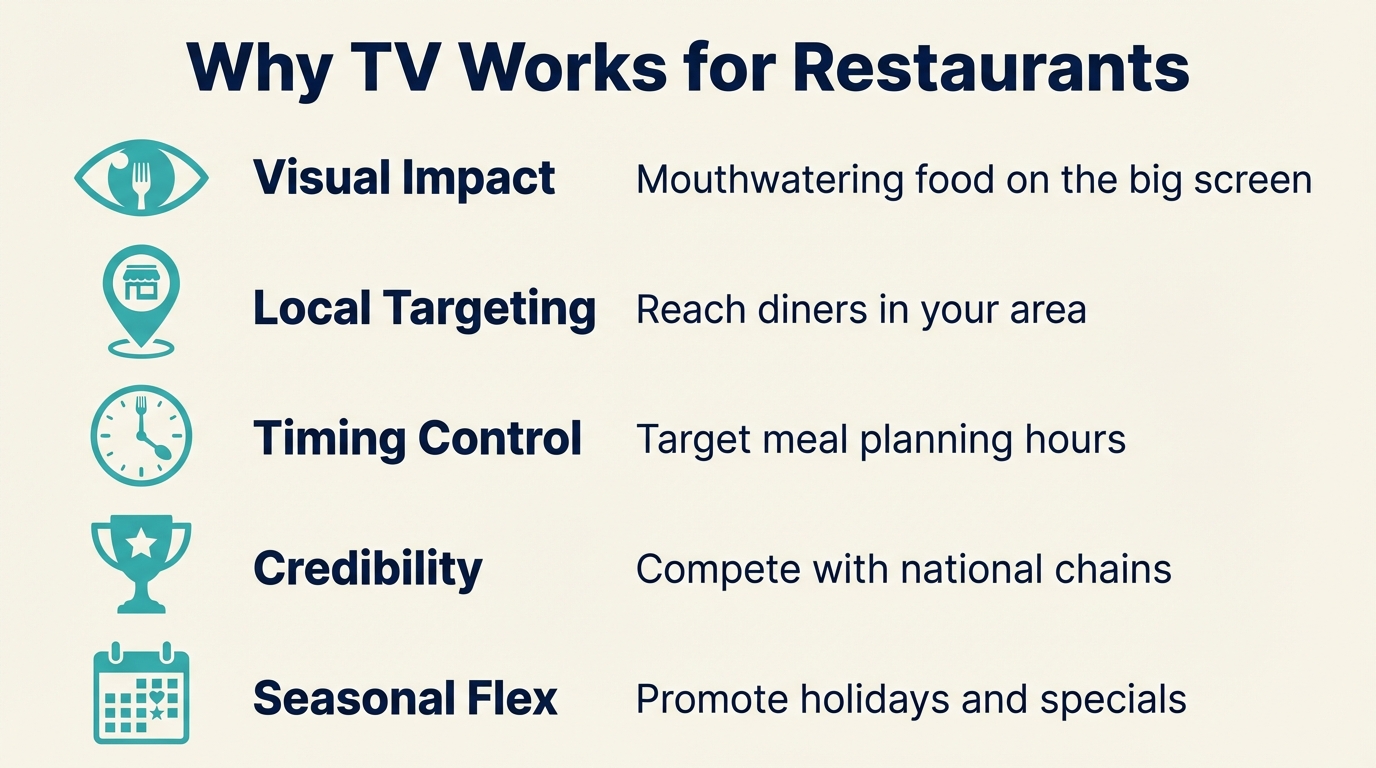
Local targeting precision:
Unlike traditional TV, streaming TV lets you target by geography. A family restaurant in suburban Phoenix can reach households within a 15-mile radius without wasting budget on viewers who would never drive that far for dinner.
Daypart strategy opportunities:
You can target your ads to run during specific times. Running lunch specials? Target late morning. Promoting date night? Hit the 5-7 PM window when couples are deciding on dinner plans.
Seasonal campaign flexibility:
Restaurants live and die by seasonal moments: Valentine's Day, Mother's Day, graduation season, the holidays. TV advertising lets you ramp up during peak periods and scale back during slower times.
Credibility that builds trust:
When diners see your restaurant on the same screen where they watch national chain commercials, you gain instant credibility. You're another local spot. You're a legitimate option worth considering.
Understanding Your Restaurant's TV Options
The restaurant TV advertising landscape has changed dramatically. Here's what's available:
Traditional broadcast/cable:
Higher production requirements
Broad reach but less precise targeting
Minimum buys often $2,000-5,000+
Best for restaurants with regional/multi-location footprint
Connected TV (CTV) / Streaming:
Modern streaming platforms (Hulu, Roku, etc.)
Precise geographic and demographic targeting
Lower minimums (starting at $50 on some platforms)
Best for most independent restaurants
For most single-location or small-chain restaurants, CTV is the clear winner. You get the impact of television with the targeting precision of digital advertising and the accessibility of social media.
Learn more about CTV advertising basics and how it differs from traditional TV.
Setting Your Restaurant TV Budget
What should a restaurant spend on TV advertising? Here's a practical framework.
Industry benchmarks:
Restaurants typically allocate 3-6% of revenue to marketing
Of that, TV/video advertising might be 20-40% of total marketing budget
Successful restaurant TV campaigns often run $500-2,500/month
Budget by restaurant type:
Seasonal budget considerations:
Smart restaurant marketers increase spend during high-value periods:
Valentine's Day: 2-3x normal budget (2-3 weeks before)
Mother's Day: 2x normal budget (2 weeks before)
Holiday season: Sustained increase Nov-Dec
Summer slowdowns: Maintain presence, don't disappear
For detailed cost information, see our guide on local TV advertising costs.
Targeting the Right Diners
Effective restaurant CTV advertising starts with smart targeting.
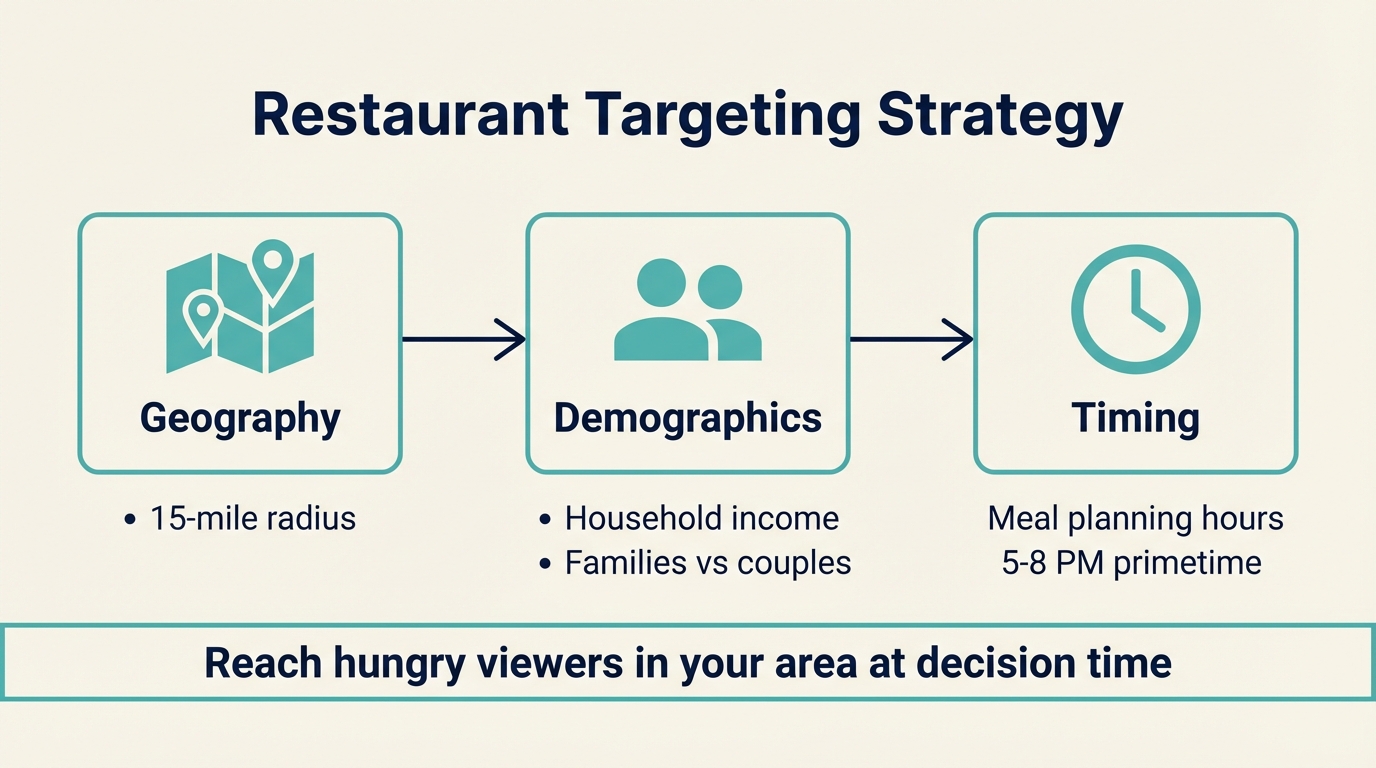
Geographic targeting:
Start with your actual service area. For dine-in restaurants, this is typically a 10-20 minute drive radius. For delivery, it's your delivery zone.
Don't over-expand. A restaurant in downtown Austin doesn't need to reach suburbs 30 miles away. Focus your budget where customers will come from.
Demographic targeting:
Match your targeting to your restaurant's positioning:
Fine dining: Higher household income, adults without young children
Family restaurant: Households with children, middle income
Fast casual: Broad demographics, working professionals
Quick service: Broad reach, value-conscious households
Daypart strategy:
Creating Mouthwatering Restaurant Commercials
Your TV commercial is your chance to make viewers hungry. Here's what works.
The elements of effective restaurant ads:
Hero food shots: Lead with your best-looking dishes. Close-ups, steam rising, cheese pulls, sizzling sounds. Make viewers crave it.
Atmosphere showcase: Show your space. The warm lighting, the bustling energy, the cozy corner booth. People eat experiences, not just food.
Show people enjoying a meal in a natural setting.
Clear identity: What makes you different? Farm-to-table? Family recipes? The best burger in town? State it clearly.
Location clarity: Always include where you are. Address, neighborhood, "just off Main Street." Make it easy to find you.
Call to action: "Reserve your table," "Order online," "Visit us tonight." Tell viewers what to do next.
Production options:
You don't need a $10,000 production budget. Here's the range:
Professional production: $2,000-10,000+ for polished, high-end spots
Food photographer + editor: $500-2,000 for still-to-video approach
AI-generated commercials: Platforms like Adwave can create professional restaurant ads from your existing photos and website
DIY with guidance: $200-500 for basic equipment and editing software
The key is quality food photography. If you have great photos of your food, modern tools can turn them into broadcast-quality commercials.
For tips on creating effective spots, see our guide on what makes a good TV commercial.
Seasonal Campaign Strategies
Restaurants have natural peaks throughout the year. Here's how to use them with TV advertising.
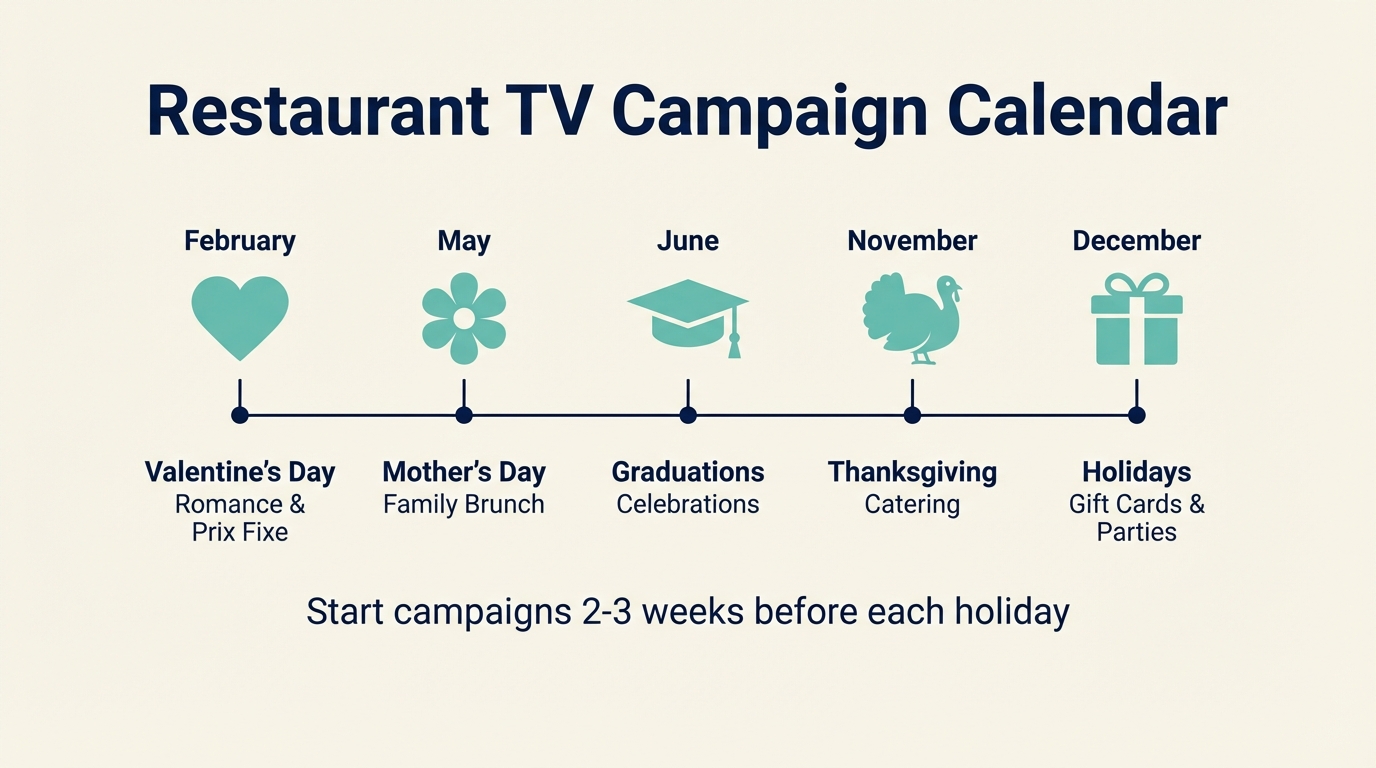
Valentine's Day (February 14):
Start advertising: January 25
Message: Romance, special menus, reservation availability
Targeting: Couples, higher income households
Budget: 2-3x normal spend
Mother's Day (Second Sunday of May):
Start advertising: April 20
Message: Celebrate mom, brunch specials, family gatherings
Targeting: Adults 25-55, households with children
Budget: 2x normal spend
Graduation Season (May-June):
Start advertising: Early May
Message: Celebration dinners, group accommodations
Targeting: Households with teens, specific school districts
Budget: 1.5x normal spend
Holiday Season (November-December):
Start advertising: November 1
Message: Holiday parties, gift cards, catering, NYE reservations
Targeting: Broad, with emphasis on hosts/planners
Budget: 1.5-2x sustained through season
Pro tip: Don't just advertise during peaks. Consistent presence during slower periods builds the brand equity that pays off during busy times.
Measuring What Matters
Restaurant TV advertising measurement focuses on business outcomes, not just ad metrics.
Direct tracking methods:
Reservation tracking: Monitor reservation volume during and after campaigns
"How did you hear about us?": Train staff to ask and record responses
Promo codes: Unique codes for TV viewers ("Mention TVDEAL for 10% off")
QR code scans: If included in your ad, track scans
Gift card sales: Track increases during campaigns
Proxy metrics:
Branded search volume: Are more people Googling your restaurant name?
Website traffic: Traffic increases during campaign periods
Social media mentions: People talking about your ads
Google Business views: Increases in profile views
Setting expectations:
TV advertising works over time. You're building awareness and familiarity. The viewer who sees your ad tonight might not visit until next month when they're looking for a dinner spot and remember your name.
Expect 4-6 weeks of consistent advertising before drawing conclusions. Short tests rarely show TV's full impact.
A restaurant campaign on TV, search, and social
The situation:
Popular among regulars but invisible to potential customers
Slow weeknight traffic despite strong weekend business
Competing against national chains with bigger marketing budgets
The strategy:
$500/month CTV budget
15-mile radius targeting
Evening daypart focus (dinner decision time)
3-month commitment
The results:
18% increase in weeknight dinner traffic
25% increase in branded Google searches
Regular "I saw you on TV" mentions from new customers
First-time customers converting to regulars
Common Restaurant TV Advertising Mistakes
Avoid these pitfalls that trip up restaurant advertisers:
Mistake 1: One-and-done campaigns TV advertising builds over time. A two-week test won't show real results. Commit to at least 3 months.
Mistake 2: Targeting too broadly You don't need to reach your entire metro area. Focus budget on your actual customer radius.
Mistake 3: Generic creative "Great food, great service" says nothing. What makes YOUR restaurant worth visiting?
Mistake 4: Ignoring daypart strategy Running ads at 2 PM when you want dinner traffic wastes budget. Time your ads strategically.
Mistake 5: No call to action Viewers need direction. "Reserve now at [website]" or "Visit us tonight at [address]."
Mistake 6: Expecting immediate ROI TV builds awareness over time. If you need immediate conversions, combine TV with direct response channels.
Getting Started with Restaurant TV Advertising
Ready to fill more tables with TV advertising? Here's your action plan:
Step 1: Define your goals
Building general awareness?
Promoting a specific offer or new menu?
Driving traffic during slow periods?
Supporting a seasonal campaign?
Step 2: Set your budget
Start with at least $500/month for meaningful reach
Plan for 3+ months minimum commitment
Increase during seasonal peaks
Step 3: Prepare your creative
Gather your best food photography
Use AI tools or professional production
Keep the message focused and location clear
Step 4: Set up targeting
Geographic: Your service area radius
Demographic: Match to your customer profile
Daypart: Align with desired meal periods
Step 5: Launch and monitor
Track reservations, mentions, and business metrics
Give it time before adjusting
Optimize based on results
Common questions answered
When should a restaurant advertise on TV during the week?
For most restaurants, advertising Thursday through Sunday generates the best return since these are peak dining-out days. However, if you're trying to fill slower periods like Tuesday dinners, target those specific days to shift behavior. Breakfast and lunch spots should focus ads during morning and early afternoon hours on weekdays. The beautiful thing about CTV is you can schedule ads for specific days and dayparts, unlike traditional TV where you buy broad time blocks.
How do I make my restaurant's TV ad stand out?
Focus on what makes you unique rather than generic "great food" messaging. Feature signature dishes that can't be found elsewhere, highlight your atmosphere and experience, or lean into your origin story if it's compelling. Use close-up food shots that make viewers hungry. Include a clear call to action like visiting for a specific promotion or trying a particular menu item. Avoid cluttered visuals or trying to say too much in 30 seconds.
What targeting works best for restaurant TV advertising?
Geographic targeting is essential. Set your radius based on how far customers typically drive to visit you (usually 5 to 15 miles for casual dining, potentially farther for destination restaurants). Layer in demographic targeting for your ideal customer: families for family restaurants, younger professionals for trendy spots, higher income households for upscale dining. You can also target food and dining enthusiasts based on behavioral data.
How much should a restaurant spend on CTV advertising?
Start with $500 to $1,000 per month to test whether CTV moves the needle for your location. This provides enough impressions to build local awareness while keeping risk manageable. Track table reservations, online orders, and foot traffic during campaign periods. If you see positive results, scale gradually. Many successful restaurant advertisers eventually spend $2,000 to $5,000 monthly during peak seasons or for new location launches.
Can TV advertising help during slow seasons or slow nights?
Absolutely. TV advertising is excellent for shifting behavior because you're reaching people before they've decided where to eat. Run campaigns specifically promoting Tuesday specials to fill slow nights, or advertise lunch deals during morning hours. Use compelling offers that give viewers a reason to try you when they otherwise might not. Many restaurants find that promoting specific limited-time offers drives stronger response than general brand advertising.


