-
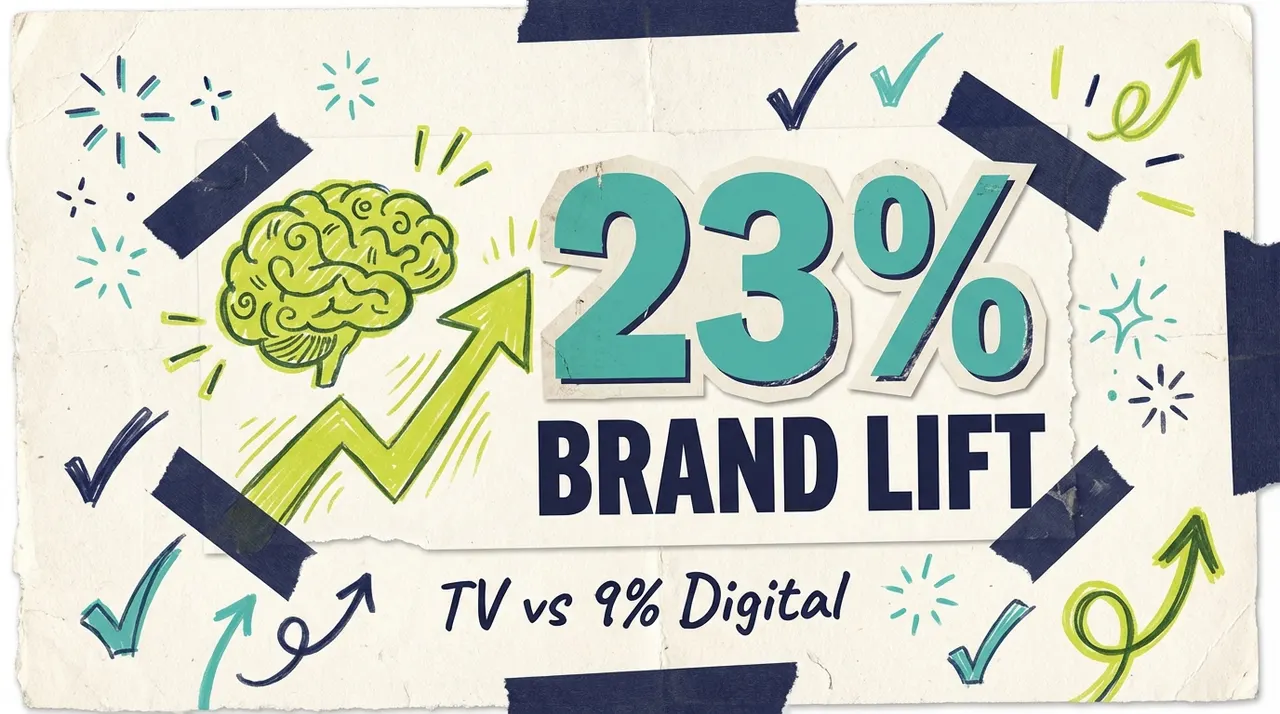
23%
TV brand awareness lift
-
9%
Digital brand awareness lift
-
25%
CTV brand awareness and recall lift
Television advertising generates a 23% lift in brand awareness compared to just 9% for digital advertising according to Nielsen research, representing a 2.5x advantage for brands seeking to build recognition and recall. This effectiveness gap persists across multiple studies and methodologies, consistently demonstrating that TV's combination of sight, sound, motion, and premium content environment creates brand impressions that stick more effectively than digital alternatives.
The numbers become even more compelling when examining connected TV specifically. Comscore research found CTV advertising delivers a 25% lift in brand awareness, a 20% lift in purchase intent, and a 25% improvement in ad recall. These metrics demonstrate that streaming TV has preserved and potentially enhanced the brand-building capabilities that traditional television has long provided, while adding the targeting and measurement capabilities that modern marketers expect.
For businesses investing in brand awareness, these effectiveness metrics translate directly to strategic implications. First-time TV advertisers see measurable results: VAB research tracking 201 brands found an average 12% increase in website traffic during TV launch month, with sustained 20% monthly traffic increases throughout campaign duration. The channel's ability to drive mid-funnel activity like consideration and intent makes it especially valuable for businesses looking to build awareness that converts.
Breaking down the numbers
Brand lift research consistently demonstrates TV's superiority for awareness building:
TV vs digital brand lift: TV generates 23% brand awareness lift vs. 9% for digital advertising (Nielsen)
Purchase intent advantage: TV drives 14% purchase intent lift vs. 4% for digital (Nielsen)
CTV brand awareness: Connected TV advertising generates 25% brand awareness lift (Comscore)
CTV recall impact: CTV delivers 25% lift in ad recall, outperforming typical online video benchmarks (Comscore)
CTV consideration lift: 20% improvement in brand consideration from CTV campaigns (VAB)
Website traffic impact: First-time TV advertisers see 12% traffic increase during launch month (Marketing Dive)
Sustained traffic gains: 20% average monthly traffic increase sustained throughout TV campaigns (Marketing Dive)
Investment correlation: $10M+ TV spenders see 36% launch month traffic increase, 42% sustained monthly increase (VAB)
The Video Advertising Bureau study evaluating 201 first-time TV advertisers between 2020 and 2024 provides especially robust evidence, demonstrating consistent performance across budget levels and business types. Over $4 billion has been invested by 931 first-time advertisers since 2021, and the consistent results across this substantial sample size validate TV's effectiveness beyond anecdotal success stories.
Investment level correlations reveal important patterns. Brands spending $500,000 or less saw 8% launch-month traffic increases and 20% monthly sustained increases. Those investing $2-5 million saw 9% launch-month and 25% sustained increases. The largest investors at $10 million and above achieved 36% launch-month and 42% sustained monthly traffic improvements. This dose-response relationship confirms that results scale with investment while demonstrating meaningful returns even at modest budget levels.
Direct-to-consumer brands showed especially strong results, generating average monthly increases of 622,000 unique website visitors while on TV, nearly double the overall average of 387,000. This highlights how TV's awareness-building translates especially effectively for business models where awareness directly drives website engagement and subsequent conversion.
Thinkbox research from the UK adds international perspective, finding TV advertising generates 15% brand awareness increase compared to online video, plus 27% improvement in brand consideration. This cross-market consistency strengthens confidence in TV's fundamental effectiveness rather than attributing results to any single market's characteristics. The Advertising Research Foundation similarly found 20% awareness lift for TV versus 12% for digital, reinforcing the pattern across research methodologies.
Why TV builds brand awareness more effectively
The mechanisms behind TV's brand awareness advantage reflect both cognitive science and media economics. Understanding these factors helps explain why the effectiveness gap persists despite digital advertising's technological advantages.
Television's combination of sight, sound, and motion creates richer memory encoding than static or audio-only formats. The human brain processes multimodal stimuli more deeply, forming stronger memory traces that persist longer and retrieve more easily. When consumers encounter a brand decision, the richer encoding from TV exposure surfaces more readily than the thinner impressions from display advertising or social media scrolling.
The lean-back viewing environment typical of television creates more receptive conditions for brand messaging. Viewers have chosen to engage with content and accept advertising as part of that exchange. This contrasts with digital environments where users often resist advertising intrusion, scrolling past or actively blocking ads. The psychological receptivity in TV viewing contexts enhances both attention and processing depth.
Premium content adjacency transfers credibility and emotional resonance from programming to advertising. When a brand's commercial appears during quality entertainment content, it benefits from the positive associations viewers have with that programming. This halo effect doesn't exist in most digital environments where ad quality varies wildly and content adjacency is often problematic or unpredictable.
Video completion rates on streaming platforms (95%) dramatically exceed digital video norms (65-82%), so that brand messages are seen in their entirety. For awareness building, completion matters enormously because incomplete exposure fragments the brand impression and undermines message coherence. Television's non-skippable format ensures the complete brand story reaches viewers.
The emotional storytelling capacity of television creates lasting brand associations that other formats struggle to match. Sound, visuals, and narrative combine to generate emotional responses that encode brand memories more durably than rational messaging alone. Research consistently shows emotional advertising outperforms rational approaches for brand building, and television's production capabilities enable emotional storytelling at its most effective.
Social legitimacy emerges from television's mass reach characteristics. When consumers know that others in their community have seen the same advertising, it creates a shared reference that reinforces brand legitimacy. This social proof effect doesn't exist for narrowly targeted digital advertising that individuals experience in isolation. The sense that "everyone has heard of this brand" contributes meaningfully to awareness quality beyond simple recognition metrics.
The measurement challenge and emerging solutions
Brand awareness has historically been difficult to measure precisely, leading some marketers to undervalue TV's contribution relative to more trackable digital channels. However, the measurement landscape is evolving rapidly, providing clearer visibility into TV's brand-building effectiveness.
Brand lift studies have become the standard methodology for quantifying TV's awareness impact. These studies compare survey responses from exposed versus unexposed audiences, measuring changes in awareness, consideration, favorability, and purchase intent. The consistent positive results across hundreds of such studies demonstrate TV's effectiveness with statistical rigor that standalone campaign analysis cannot achieve.
Modern streaming TV platforms enable measurement capabilities that traditional broadcast lacked. CTV advertising connects exposure to subsequent website visits, search queries, and conversion events, providing attribution data that validates awareness-building effects through behavioral evidence. This closes the measurement gap that historically made TV's brand contribution harder to demonstrate.
First-time advertiser studies provide especially compelling evidence because they establish clear before-and-after comparisons. The VAB research showing 12% launch-month traffic increases represents brands with no prior TV presence, isolating the TV effect from other factors. The sustained 20% monthly increases demonstrate that awareness effects persist beyond initial campaign periods.
The correlation between investment level and results provides additional validation. Brands spending $10 million or more saw 36% launch-month traffic increases versus 8% for brands spending under $500,000. This dose-response relationship confirms that measured effects reflect actual TV impact rather than coincidental factors that would affect all advertisers equally.
How streaming TV enhances brand building
Connected TV has preserved TV's brand-building strengths while adding capabilities that enhance effectiveness for modern marketers. This evolution makes TV's awareness-building power accessible to advertisers who previously couldn't access the channel.
Geographic targeting enables local and regional brands to concentrate awareness building where it matters. Rather than paying to reach an entire designated market area, advertisers can focus on specific zip codes and neighborhoods where their customers live. This concentration delivers higher frequency within target areas, building awareness more efficiently than broad reach approaches.
Audience targeting layers demographic, behavioral, and interest data onto TV advertising. Brands can build awareness specifically among likely customers rather than general populations. This precision means awareness spending generates consideration among prospects rather than incidental exposure to consumers who will never be in-market.
Budget accessibility has transformed who can use TV for brand building. Traditional broadcast required minimum investments that excluded most small businesses. Streaming platforms like Adwave enable campaigns starting at $50, making TV's awareness-building capabilities available to businesses of virtually any size.
Real-time optimization allows advertisers to adjust campaigns based on performance data. If certain creative or targeting approaches generate stronger awareness metrics, budgets can shift accordingly. This iterative improvement capability enhances effectiveness compared to traditional TV's set-and-forget campaign structures.
Cross-device integration connects TV awareness building with digital retargeting and conversion. When streaming platforms identify households exposed to TV advertising, subsequent digital campaigns can reinforce messaging across mobile, desktop, and social channels. This integrated approach delivers 200% higher conversions than TV-only campaigns, demonstrating how streaming TV's data capabilities enhance awareness-to-conversion efficiency.
Creative testing at scale becomes practical through streaming TV's flexibility. Advertisers can test multiple creative versions across audience segments, identifying which approaches generate the strongest awareness response. Traditional TV's production and placement costs made such testing impractical, but streaming enables data-driven creative optimization that improves campaign effectiveness over time.
Why it matters for your business
Brand awareness isn't merely a vanity metric; it directly influences business outcomes through multiple mechanisms that compound over time.
Consideration set inclusion determines whether your business can compete for sales opportunities. When consumers begin evaluating purchase options, they typically consider a small set of brands they already know. Without awareness, your business simply doesn't enter consideration regardless of product quality or pricing. TV's awareness-building effectiveness determines whether you compete or get excluded.
Lower customer acquisition costs result from awareness that precedes active shopping. When prospects already know your brand, paid search and conversion advertising work more efficiently. The 12-20% website traffic increases that first-time TV advertisers experience represent warm prospects who cost less to convert than cold audiences encountered through other channels.
Brand awareness for small businesses has historically been challenging to build without the budgets larger competitors deploy. Streaming TV's accessibility changes this dynamic, enabling smaller brands to build recognition within targeted geographic and demographic segments. The playing field hasn't fully leveled, but the gap has narrowed significantly.
Competitive differentiation through awareness matters especially in crowded categories. When multiple businesses offer similar products or services, the brand consumers recognize and recall wins disproportionate consideration. TV presence creates this recognition advantage more effectively than digital channels where attention is fragmented and impressions are shallow.
Long-term brand equity accumulates through sustained awareness building. While individual campaigns generate measurable short-term effects, consistent TV presence over time builds brand equity that provides ongoing competitive advantages. This accumulated awareness represents an asset that compounds, making each subsequent marketing investment more efficient because it builds on an established foundation of recognition.
Local businesses benefit especially from TV's awareness advantages in geographically concentrated markets. When competing against businesses with similar offerings, the brand with TV presence often wins default consideration. This local awareness advantage proves especially valuable for service businesses where trust and familiarity influence provider selection, from restaurants and retailers to professional services and home contractors.
How to take advantage of this trend
Businesses looking to build brand awareness through TV should consider several strategic approaches:
Define awareness goals specifically: Determine whether you're building general brand recognition, category association, or attribute awareness. Different goals may require different creative and measurement approaches.
Start with concentrated targeting: Begin campaigns with tight geographic or demographic targeting to build awareness deeply within core markets before expanding broadly. Depth of awareness within target audiences often matters more than breadth of reach.
Invest in creative quality: TV's effectiveness depends on creative that captures attention and builds positive associations. Budget appropriately for production that meets viewer expectations for television content.
Plan for sufficient frequency: Single exposures rarely build lasting awareness. Design campaigns with enough impression volume to achieve 3-5+ frequency within target audiences over campaign duration.
Measure detailedly: Track brand lift metrics alongside direct response indicators. Website traffic, search volume, and survey-based awareness measures all provide perspective on TV's contribution.
Integrate with digital: Use TV awareness to enhance digital performance. Retarget TV-exposed audiences, coordinate messaging across channels, and measure how TV investment improves other channel efficiency.
The accessibility of streaming TV makes testing practical for businesses without established TV budgets. Starting with $500-2,000 monthly investments enables learning before larger commitments.
Plan seasonal advertising before demand usually rises so customers have time to consider your business.
Category-specific messaging builds awareness around particular attributes or associations. Rather than generic brand awareness, effective TV campaigns often build specific mental associations: convenience, quality, value, innovation, or other positioning elements. This attribute-level awareness building creates differentiation that influences consideration and preference beyond simple name recognition.
The bigger picture
Television advertising's brand awareness effectiveness represents a fundamental characteristic of the medium that technological change hasn't disrupted. Despite decades of digital innovation, TV continues to build awareness more effectively than alternatives, and connected TV has extended this capability to new advertiser categories.
The market reflects this reality. US TV advertising remains a $101+ billion market projected to grow despite cord-cutting trends, as streaming platforms capture shifting viewership while maintaining advertising environments that deliver results. Advertisers continue investing because the channel works.
For businesses evaluating marketing channel allocation, TV's brand awareness effectiveness represents a strategic consideration that pure direct-response metrics miss. Channels that build awareness create value that compounds through improved performance across the entire marketing funnel. Underinvesting in awareness to chase immediate conversions often proves short-sighted.
The convergence of TV's brand-building effectiveness with streaming's accessibility and measurement creates opportunity for businesses historically excluded from television advertising. Brands that recognize this shift and incorporate TV into their awareness strategies gain competitive advantages that purely digital competitors cannot match.
The shift from linear to streaming doesn't diminish TV's awareness effectiveness; research indicates CTV achieves equivalent or superior brand lift to traditional television. As streaming reaches 43.8% of total TV viewing time in 2025 (up 10 points in two years), the audience migration reinforces rather than undermines the case for TV advertising. Advertisers simply need to follow audiences to streaming platforms while maintaining the brand-building strategies that work.
Industry-specific research reinforces TV's awareness effectiveness across categories. Whether building awareness for restaurants, real estate, automotive, or healthcare services, the fundamental dynamics of TV's awareness advantage apply. The specific metrics may vary by category, but the directional finding of TV outperforming digital for brand awareness remains consistent.
Frequently asked questions
How long does it take to see brand awareness results from TV advertising?
Brand awareness effects typically begin appearing within the first month of TV advertising, with the VAB study showing 12% website traffic increases during launch month. Sustained effects build over time, with ongoing TV presence generating 20%+ monthly traffic improvements. Full awareness building often requires 3-6 months of consistent presence to achieve significant recognition among target audiences.
What budget is needed to build brand awareness through TV?
Budget requirements depend on market size, targeting precision, and awareness goals. Streaming TV enables testing with budgets starting at $50, though meaningful awareness building typically requires $1,000-$5,000 monthly for local markets. National awareness campaigns require significantly larger investments, but geographic targeting allows businesses to build awareness market-by-market with manageable budgets.
How do I measure brand awareness from TV advertising?
Multiple measurement approaches provide perspective on TV's awareness contribution: Brand lift studies survey exposed versus unexposed audiences; website traffic analysis tracks increases during campaign periods; search volume monitoring measures branded query growth; and attribution platforms connect TV exposure to subsequent online behavior. Combining methods provides detailed understanding of TV's awareness impact.
Is CTV as effective as traditional TV for brand awareness?
Research indicates CTV is equally or more effective than traditional TV for brand awareness. Comscore studies show 25% brand awareness lift from CTV, comparable to or exceeding traditional TV benchmarks. CTV adds targeting and measurement capabilities while maintaining the video completion rates and premium content environment that drive TV's effectiveness.
Should I prioritize awareness or direct response in my TV advertising?
Most effective TV strategies incorporate both awareness and response elements, as awareness-building enhances response performance. For businesses new to TV, awareness-focused creative and measurement often provides the foundation for subsequent response optimization. The specific balance depends on business model, competitive position, and marketing funnel dynamics.
Supporting data
The effectiveness of TV advertising for brand awareness is documented across multiple research sources:
Nielsen brand lift research: 23% awareness lift for TV vs. 9% for digital (Nielsen)
Comscore CTV effectiveness: 25% brand awareness lift, 25% recall lift, 20% purchase intent lift (Comscore)
VAB first-time advertiser study: 12% launch-month traffic increase, 20% sustained monthly increase (Marketing Dive)
Thinkbox UK research: 15% awareness increase, 27% consideration increase vs. online video (Thinkbox)
ARF comparative study: 20% TV awareness lift vs. 12% digital (Advertising Research Foundation)
Simulmedia advanced TV research: 20% awareness lift, 15% purchase intent lift from advanced TV solutions (Simulmedia)
These studies collectively demonstrate TV's consistent effectiveness across methodologies, markets, and time periods. The convergence of findings from academic researchers, industry groups, measurement providers, and advertising technology companies reinforces confidence in TV's fundamental brand-building advantage.
The methodological diversity across these studies strengthens the conclusions. Survey-based brand lift studies capture attitudinal changes, while behavioral studies track website traffic, search queries, and conversion events. Both approaches consistently demonstrate TV's effectiveness, suggesting that the measured effects reflect genuine consumer response rather than methodological artifacts.
Time series analysis across these studies shows TV's effectiveness has remained stable even as media consumption patterns have shifted dramatically. The fundamental mechanisms of TV's brand building, including audiovisual processing advantages, premium content association, and completion rate benefits, persist regardless of delivery mechanism. This stability suggests TV will continue delivering brand awareness effectively as streaming continues displacing traditional viewing.