

Think about the last time you watched something on TV. Chances are, you picked what you wanted to watch, hit play, and started streaming. That experience has a name: VOD, or Video on Demand. It's a shift from the old days of scheduled programming, and it's completely changed how people consume content.
For small businesses, this shift isn't just interesting trivia. It's opened up an entirely new advertising channel that used to be reserved for big brands with massive budgets.
What Does VOD Mean?
VOD (Video on Demand) is any video content that viewers can access whenever they want, rather than watching on a scheduled broadcast. Unlike traditional television where you tune in at a set time, VOD lets audiences press play on their terms, whether that's 3 PM or 3 AM.
The term has been around since the early days of cable "on-demand" menus, but it's exploded with the rise of streaming platforms. Today, VOD encompasses everything from Netflix and Hulu to free platforms like Tubi and Pluto TV. If you're watching pre-recorded content that you selected yourself, you're watching VOD.
The Three Types of VOD Explained
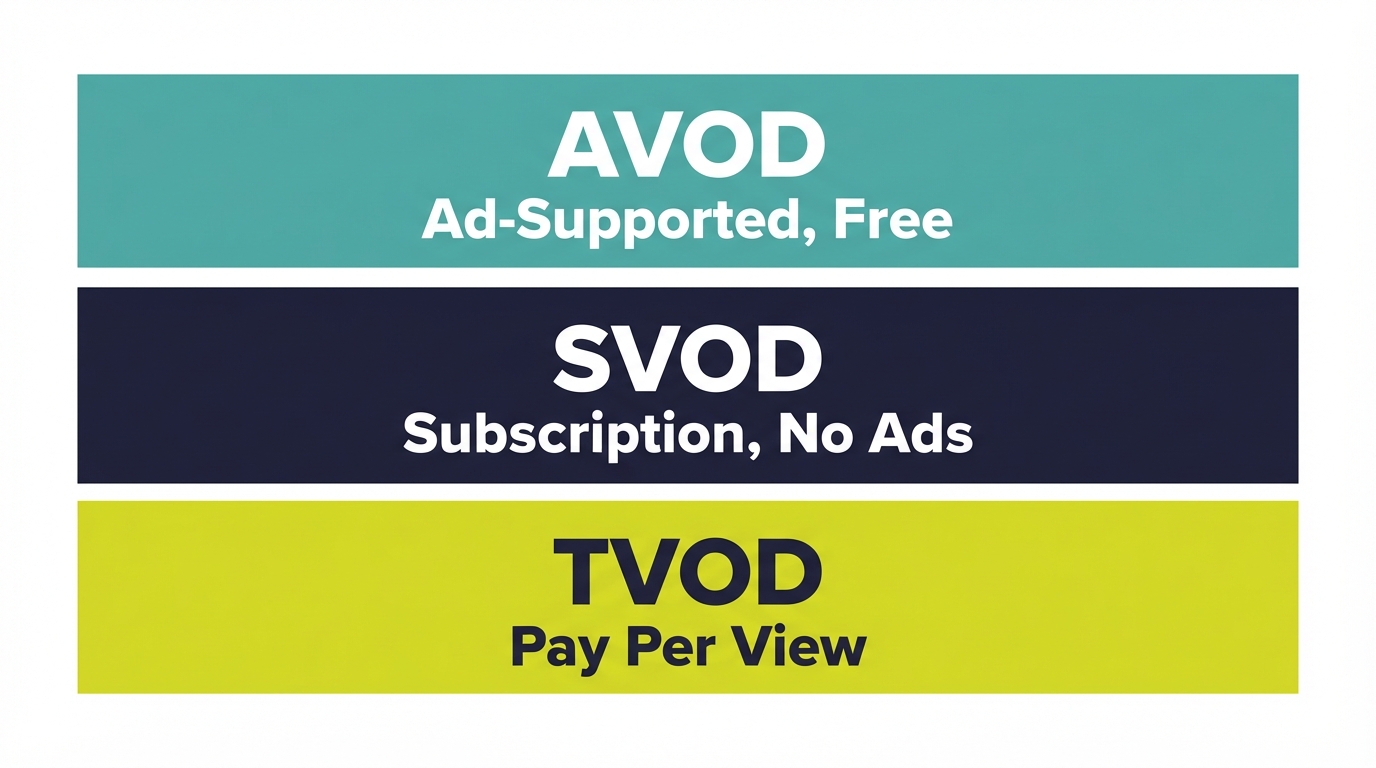
Not all VOD is created equal, especially when it comes to advertising opportunities. The industry splits VOD into three main categories based on how viewers pay for access, and understanding these differences is essential for any business looking to advertise on streaming TV.
AVOD (Ad-Supported Video on Demand)
AVOD platforms are free for viewers because advertisements cover the cost. This is where the opportunity lives for small business advertisers.
Think of platforms like Tubi, Pluto TV, Freevee, and the ad-supported tiers of Peacock and Hulu. These services offer movies, TV shows, and original content at no cost to the viewer. In exchange, ads play during commercial breaks, just like traditional TV.
For advertisers, AVOD is the most accessible VOD category. You don't need massive budgets or agency relationships. Platforms like Adwave let you run ads on AVOD inventory starting at just $50, reaching viewers in specific zip codes while they watch content on over 100 premium channels.
AVOD audiences are growing fast too. Free streaming services have seen massive adoption as cord-cutting accelerates, giving businesses access to millions of viewers who've abandoned cable but still want quality content.
SVOD (Subscription Video on Demand)
SVOD platforms charge a monthly fee for access. The classics here are Netflix, Disney+, HBO Max, and Amazon Prime Video.
Netflix and Disney+ offer subscription tiers with ads. Buying options and minimum budgets vary by platform.
The shift toward ad-supported SVOD tiers reflects a broader trend: viewers are willing to watch ads if it means lower subscription costs. According to Nielsen, ad-supported streaming tiers have seen strong adoption since launching, creating new opportunities across the streaming landscape.
TVOD (Transactional Video on Demand)
TVOD is the pay-per-view model. Viewers rent or purchase individual pieces of content rather than subscribing. Apple TV rentals, Amazon Video purchases, and Google Play Movies all fall into this category.
Because viewers are paying directly for specific content, TVOD doesn't typically include advertising. It's less relevant for small business advertisers, but understanding it helps complete the picture of how video distribution works today.
Where Can Small Businesses Advertise on VOD?
Here's where things get practical. Small businesses should focus on AVOD platforms, where the combination of accessible pricing and precise targeting creates real opportunity.
The most advertiser-friendly AVOD platforms include:
Free Streaming Services (Lowest Entry Barrier)
Tubi: Owned by Fox, offering thousands of movies and TV shows with strong local targeting options
Pluto TV: Owned by Paramount, featuring linear-style channels and on-demand content
Freevee: Amazon's free streaming service with premium content
Ad-Supported Premium Tiers
Peacock (ad-supported tier): NBC content including news, sports, and entertainment
Hulu (ad-supported tier): Next-day network TV and original series
Paramount+ (ad-supported tier): CBS content and original programming
Device-Based Platforms
Roku Channel: The free streaming channel built into Roku devices
Samsung TV+: Free channels on Samsung smart TVs
The beauty of these platforms is that they're all accessible through aggregated buying, meaning you don't need to negotiate with each one individually. Platforms like Adwave aggregate this inventory, letting you run campaigns across multiple AVOD services from a single dashboard.
For a deeper look at your options, check out our guide to streaming TV advertising platforms.
VOD Advertising Costs for Small Budgets
Let's talk real numbers. VOD advertising costs are measured in CPM (cost per thousand impressions), and they vary significantly based on the platform and targeting.
Typical VOD CPM Ranges:
AVOD platforms (Tubi, Pluto): $15-25 CPM
Premium ad-supported tiers (Hulu, Peacock): $30-45 CPM
Connected TV overall: $20-35 CPM average
What does this mean in practice? Here's what different budgets can achieve:
$200/month example: At a $20 CPM, $200 buys approximately 10,000 impressions. With geographic targeting to your local area, that could mean reaching 3,000+ unique households multiple times over the month.
$500/month example: At the same CPM, $500 delivers about 25,000 impressions. This is enough frequency to build brand recognition in a targeted market, with viewers seeing your ad 3-4 times on average.
$1,000/month example: Now you're reaching approximately 50,000 impressions, enough to make a measurable impact on awareness and website traffic in a local market.
Compare this to traditional TV, where a single local cable spot might cost $500 or more with no targeting precision. VOD advertising lets you reach the right people, in the right places, at a fraction of the old costs.
For detailed pricing information, see our complete guide to TV advertising costs.
How to Access VOD Inventory Without an Agency
You can buy VOD advertising through self-service platforms as well as agencies.
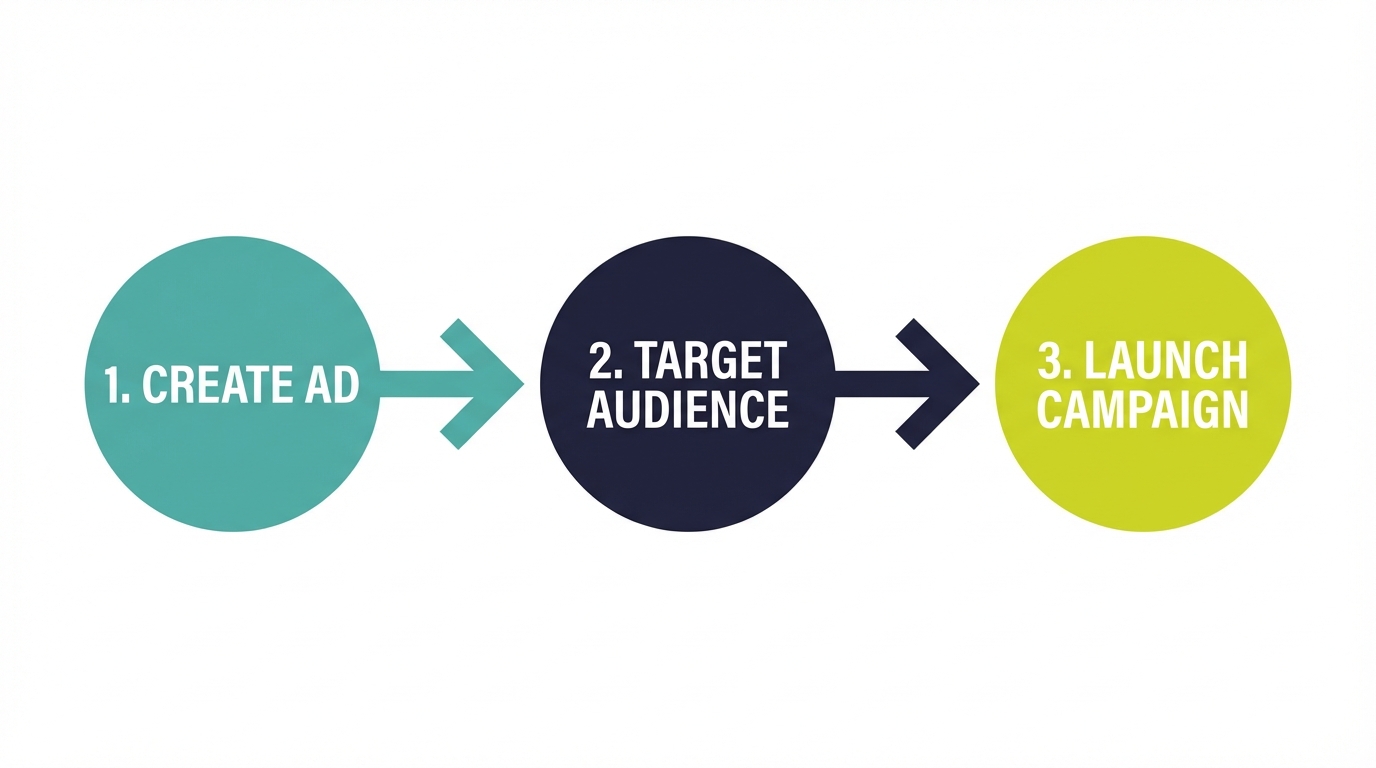
Traditional TV advertising required relationships with networks, media buyers, and production companies. VOD advertising, especially on AVOD platforms, has been democratized by technology. Self-serve platforms let small businesses:
Upload or create video ads - Many platforms offer AI tools to generate professional ads from your website or assets
Set geographic targeting - Focus on specific zip codes, cities, or a radius around your location
Define audience parameters - Target by demographics, interests, or viewing behaviors
Set your budget - Start as low as $50, scale up as you see results
Launch and track performance - See real-time metrics on impressions, completion rates, and more
Adwave is built specifically for this. The platform aggregates AVOD inventory across 100+ channels, handles the technical complexity of programmatic buying, and lets you launch campaigns in minutes. You get the reach of TV advertising without the gatekeepers, minimum commitments, or agency markups.
It's worth understanding the broader context here. For background on how streaming delivery works, see our explanation of OTT advertising.
Creating Effective VOD Ads
VOD platforms deliver your ads on the big screen in living rooms. Your creative needs to match that context.
Technical Requirements:
Format: MP4 or MOV
Resolution: 1080p minimum (4K preferred)
Length: 15 or 30 seconds (30 seconds most common)
Audio: Broadcast-quality, clear dialogue
Aspect Ratio: 16:9 (standard widescreen)
Creative Best Practices for VOD:
1. Design for the Living Room
Your ad will appear on televisions, viewed from across the room. Text needs to be large and readable. Avoid tiny details that get lost at viewing distance. Think billboard design principles applied to video.
2. Front-Load Your Message
Unlike YouTube where viewers skip after 5 seconds, VOD ads are typically non-skippable. Still, front-load your key message. Get your business name and primary benefit in the first 5 seconds in case attention wanders.
3. Match the Premium Environment
Your ad appears alongside professional content from major studios. Low-production-value creative sticks out negatively. You don't need a massive budget, but clean visuals, professional audio, and competent editing are expected.
4. Include Local Signals
Since you're targeting specific geographic areas, make your local presence clear. Mention your city or neighborhood. "Proudly serving [Your City] since 2005" builds immediate relevance and trust.
5. Clear Calls to Action
What should viewers do after seeing your ad?
Simple website URL (avoid complicated paths)
QR code that leads to a landing page
Phone number for call-based businesses
Physical address for retail locations
6. Consider Sound-Off Viewing
While most VOD viewing is sound-on, adding captions ensures your message gets through regardless. Text overlays reinforce your spoken message.
No Video Creative?
This used to be a major barrier. Professional TV commercial production could cost $10,000 to $50,000. Today, platforms like Adwave include AI-powered creative tools that generate professional video ads from your website content, photos, and business information. You can have broadcast-ready creative in minutes.
Measuring VOD Advertising Effectiveness
VOD advertising offers better measurement than traditional TV, though it differs from digital advertising.
Metrics You'll Receive:
Impressions: How many times your ad was shown across VOD platforms.
Video Completion Rate (VCR): What percentage of viewers watched your entire ad. Expect 90%+ on VOD since most ads are non-skippable.
Reach and Frequency: Unique households reached and average exposures per household.
Geographic Distribution: Confirmation that your targeting is working correctly.
Business Impact Measurement:
Track these during campaign periods:
Website Traffic: Use Google Analytics to monitor traffic changes, especially direct visits and branded search traffic.
Phone Calls: Are inquiries increasing? Use call tracking numbers to attribute calls to campaigns.
Foot Traffic: For retail locations, monitor in-store visits during and after campaigns.
Customer Source Tracking: Ask new customers "How did you hear about us?" and track mentions of TV/streaming ads.
Search Volume: TV advertising typically increases searches for your business name. Monitor branded search in Google Search Console.
Attribution Realities:
VOD advertising doesn't offer click-through tracking like digital campaigns. You won't see direct conversions attributed to specific ad exposures. Instead, measure overall business performance lift during campaign periods compared to baseline.
Look for patterns:
Does website traffic increase when campaigns are running?
Are more customers mentioning they saw your ad?
Is overall business performance improving alongside your VOD investment?
These aggregate measures tell the story of VOD advertising effectiveness.
VOD vs. Linear TV: What's the Difference?
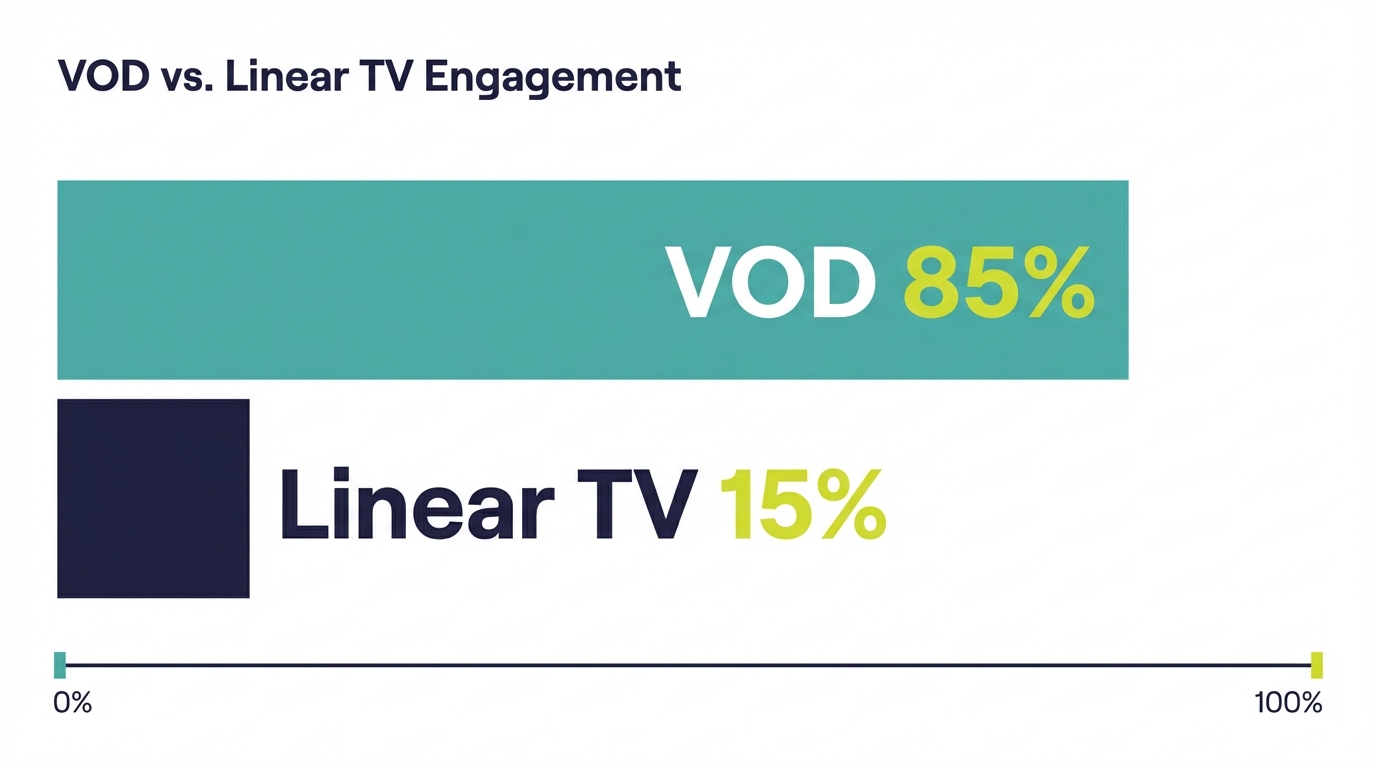
One more distinction worth understanding: VOD is the opposite of linear TV.
Linear TV is traditional scheduled programming, whether delivered by cable, satellite, or over-the-air broadcast. When a show airs at 8 PM on Thursday, that's linear. Everyone watching sees the same thing at the same time.
VOD is on-demand content. No schedules. Viewers choose what they want, when they want it. This fundamental difference shapes how advertising works on each platform:
Viewing Time: Linear TV follows network schedules where viewers must tune in at specific times. VOD lets viewers choose when they watch, giving advertisers access to attention throughout the day rather than just primetime windows.
Ad Targeting: Linear TV relies on broad demographic assumptions based on programming, reaching everyone watching a particular show. VOD enables household-level precision, targeting specific neighborhoods, interests, and behaviors.
Minimum Spend: Traditional linear TV often requires $10,000+ commitments with agency relationships. VOD advertising through platforms like Adwave starts at just $50 with no minimums required.
Measurement: Linear TV provides estimated ratings based on sample audiences. VOD delivers digital metrics with actual impression counts, completion rates, and geographic distribution.
Best For: Linear TV excels at mass reach campaigns requiring broad exposure. VOD works better for targeted local campaigns where precision matters more than raw scale.
For most small businesses, VOD offers the better combination of affordability, precision, and measurability. You're not paying to reach everyone in a metro area. You're paying to reach the specific households most likely to become customers.
Learn more in our guide to TV advertising for small businesses.
Common questions answered
What's the difference between VOD and streaming?
VOD and streaming are often used interchangeably, but they're technically different concepts. Streaming refers to the delivery method, where content is transmitted over the internet in real-time without downloading. VOD refers to the access model, where viewers choose what to watch on-demand rather than following a schedule. Most modern streaming services are VOD platforms, but you can also have linear streaming (live channels delivered over the internet).
Can small businesses really afford to advertise on VOD?
Yes, and it's more affordable than most business owners realize. AVOD platforms like Tubi and Pluto TV are accessible through self-serve platforms with no minimum contracts. A local restaurant, gym, or service business can start testing VOD advertising for a few hundred dollars per month, targeting only the neighborhoods that matter to them. The key is working with platforms designed for small budgets, not enterprise solutions with $10,000+ minimums.
Which VOD platforms accept small business advertising?
Most AVOD (ad-supported) platforms accept advertising from businesses of all sizes when you work through the right channels. The most accessible include Tubi, Pluto TV, Freevee, and the ad-supported tiers of Hulu and Peacock. Rather than approaching each platform individually, most small businesses use aggregated platforms like Adwave that provide access to inventory across 100+ streaming channels from a single campaign.
How is VOD advertising targeted differently than traditional TV?
Traditional TV advertising targets at the program or daypart level, showing the same ad to everyone watching a particular show. VOD advertising targets at the household or device level, using data to reach specific audiences regardless of what content they're watching. This means a plumber can target homeowners within their service area, or a restaurant can reach viewers within a five-mile radius, with precision that broadcast TV simply can't match.
What types of ads work best on VOD platforms?
VOD ads are typically 15 or 30 seconds, just like traditional TV commercials. The key difference is that most VOD ads are non-skippable, giving you the viewer's full attention. Effective VOD ads get to the point quickly, include a clear call to action, and work well without sound initially (many viewers watch with audio off before turning it up). High production values help, but authenticity often matters more than polish, especially for local businesses.
VOD Budget Planning for Small Businesses
Planning your VOD advertising investment requires understanding realistic costs and outcomes.
Monthly Budget Recommendations:
$150-300/month (Test Phase): At a $20 CPM, this delivers approximately 7,500-15,000 impressions reaching an estimated 2,500-5,000 unique households. This is a solid starting point to test whether VOD works for your business before committing larger budgets.
$400-800/month (Local Impact): Approximately 20,000-40,000 impressions reaching an estimated 6,700-13,000 unique households. This provides meaningful exposure in a local market with viewers seeing your ad multiple times.
$1,000-2,000/month (Market Presence): Approximately 50,000-100,000 impressions reaching an estimated 17,000-33,000 unique households. At this level, you're building real brand recognition with consistent market presence.
$2,500+/month (Dominant Presence): Strong impression volume with multiple touchpoints per household. Can support multiple creative executions, daypart testing, and audience segmentation experiments.
Budget Allocation Tips:
Start conservatively: Don't commit your entire annual budget upfront. Test with smaller amounts to understand performance in your market.
Focus geographically: It's better to dominate a smaller area than lightly cover a large one. Concentrate your budget for impact in your core service area.
Allow time to work: VOD advertising builds awareness over time. Commit to at least 8-12 weeks of consistent advertising before evaluating effectiveness.
Balance reach and frequency: A common mistake is spreading budget too thin, reaching many people once rather than fewer people multiple times. Frequency builds brand recognition.
The Future of VOD Advertising
VOD isn't just the present of TV advertising; it's the future. Understanding the trajectory helps small businesses plan ahead.
Continued Cord-Cutting:
Traditional cable subscriptions continue declining. Every month, more households shift to streaming-only consumption. For advertisers, this means VOD inventory becomes increasingly essential for reaching TV audiences.
Growing Ad-Supported Tiers:
Netflix, Disney+, and other premium platforms that launched as ad-free are adding advertising tiers. This expands the total VOD advertising inventory and puts previously unreachable premium audiences within reach.
Improved Targeting:
VOD targeting capabilities continue to advance. Better data integration, improved household-level targeting, and more sophisticated audience segmentation make VOD advertising increasingly precise.
Better Measurement:
Attribution technology is improving. Future VOD campaigns will offer even better insights into business impact, bridging the gap between digital advertising's precision and TV's brand-building power.
What This Means for Small Businesses:
The trend favors small business advertisers. More inventory means more competitive pricing. Better targeting means less waste. Improved measurement means clearer ROI understanding. VOD advertising will only become more accessible and effective over time.
Start Advertising on VOD Platforms Today
VOD has fundamentally changed TV advertising. What used to require agency relationships, massive budgets, and months of planning can now happen in an afternoon. Small businesses can reach local audiences on premium streaming content for a fraction of traditional costs.


