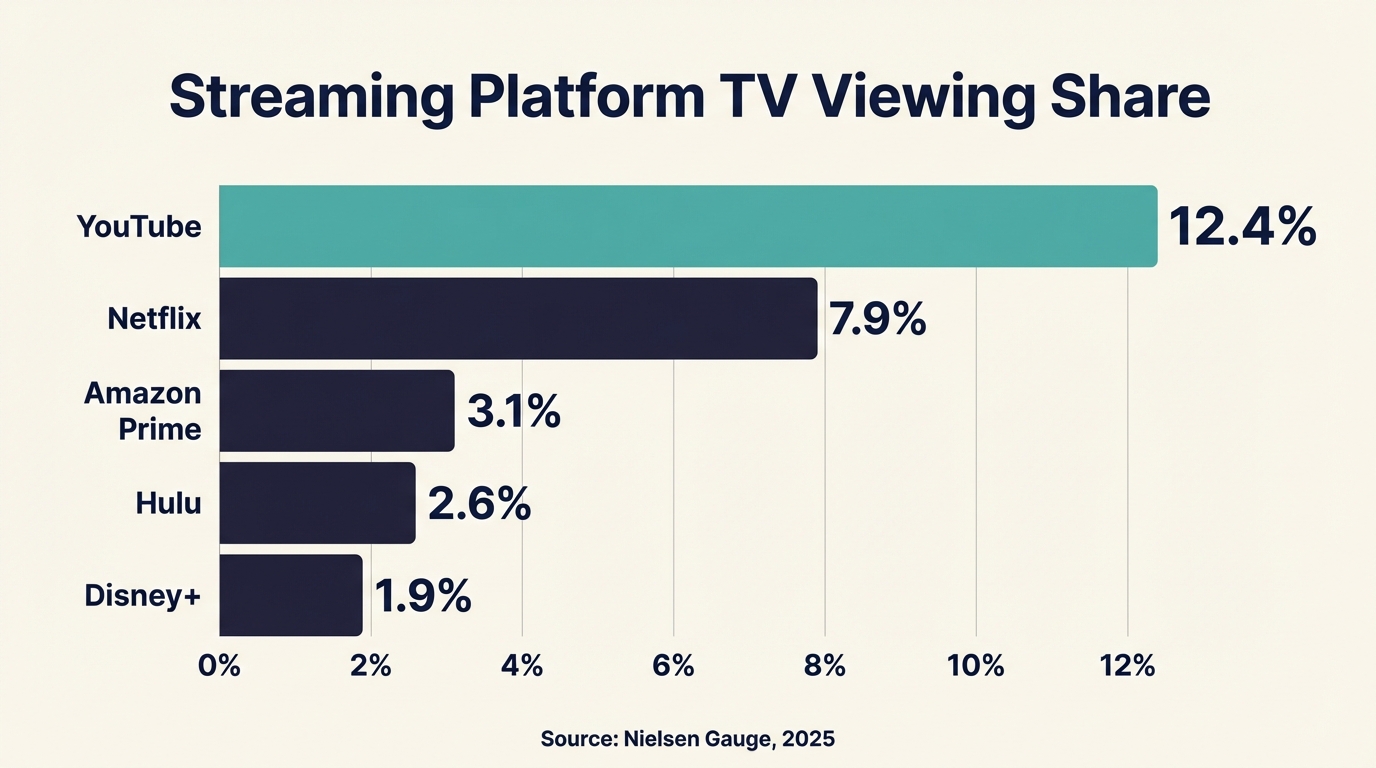
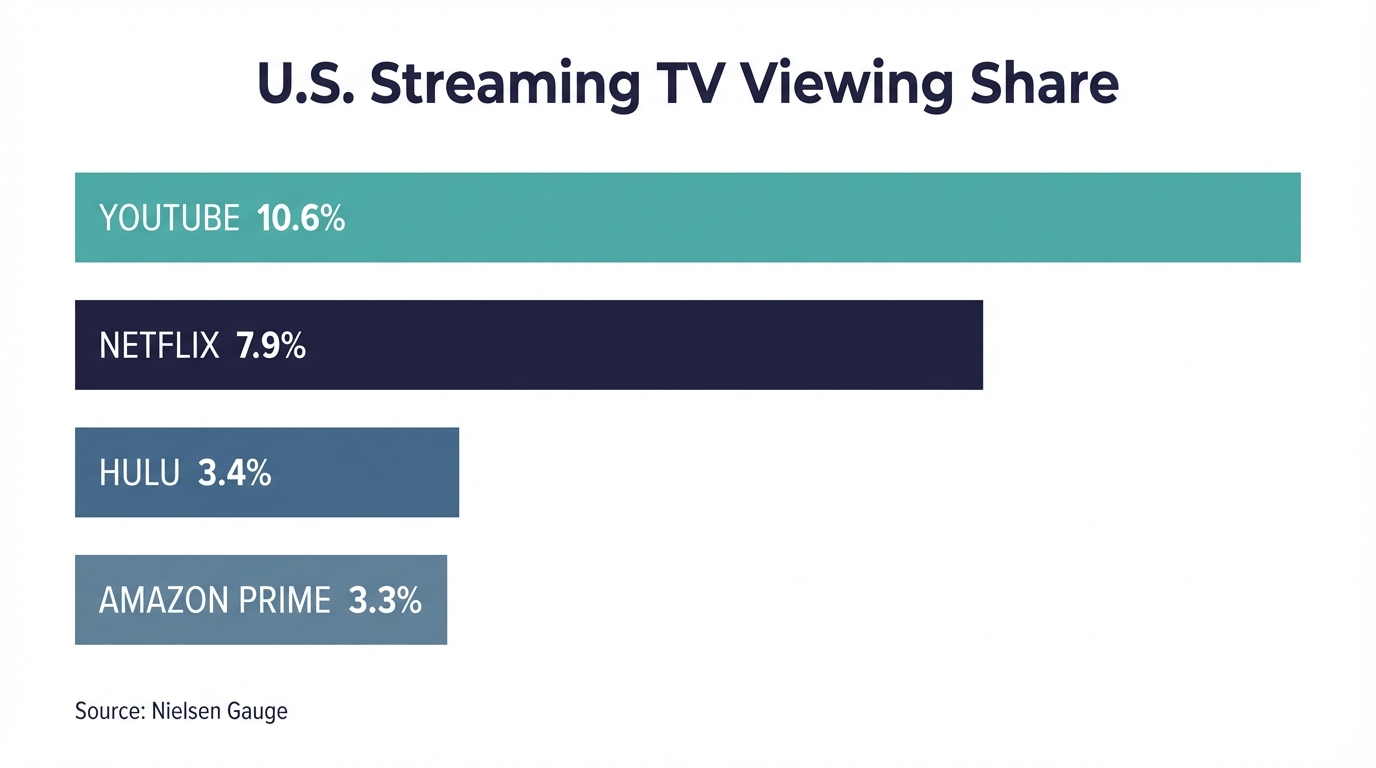
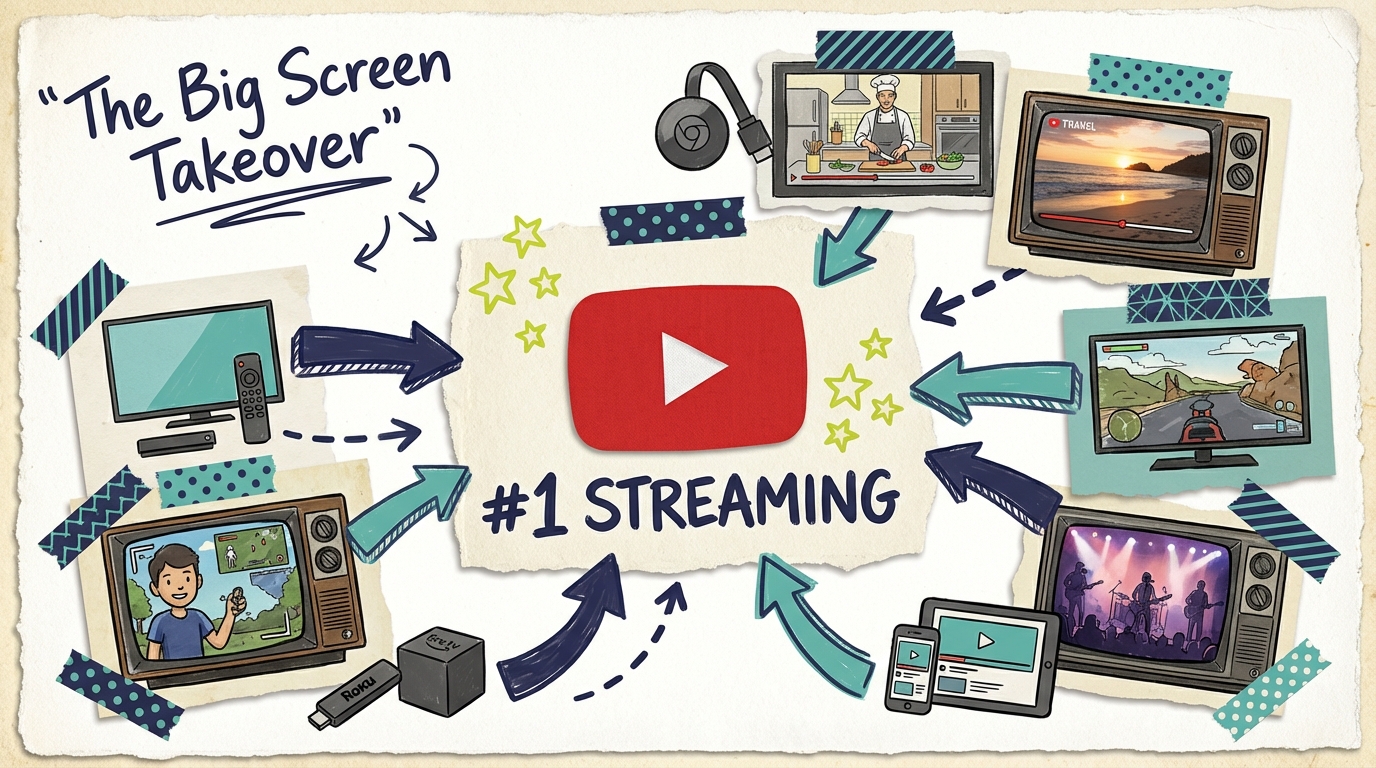
YouTube, the video platform, held 12.4% of total U.S. TV time in April 2025, according to Nielsen's April 2025 Media Distributor Gauge report. That figure is YouTube watched on television sets. It is not YouTube TV, the paid live-TV subscription. For the third consecutive month in that report, YouTube led media companies on time spent watching TV.
Five years ago YouTube was mostly watched on phones and laptops. In April 2025 it led every media company on TV-set viewing time.
For small business owners who have always assumed TV advertising was out of reach, this shift opens new doors. Where traditional TV advertising required six-figure budgets and agency relationships, connected TV advertising now makes it possible to reach these same audiences. On Adwave, a TV campaign, including YouTube, starts at $30 a day. Google Search starts at $67 a day. See pricing.
What the data shows
According to Nielsen's Gauge reports for 2025, here's how YouTube's TV viewing share has evolved:
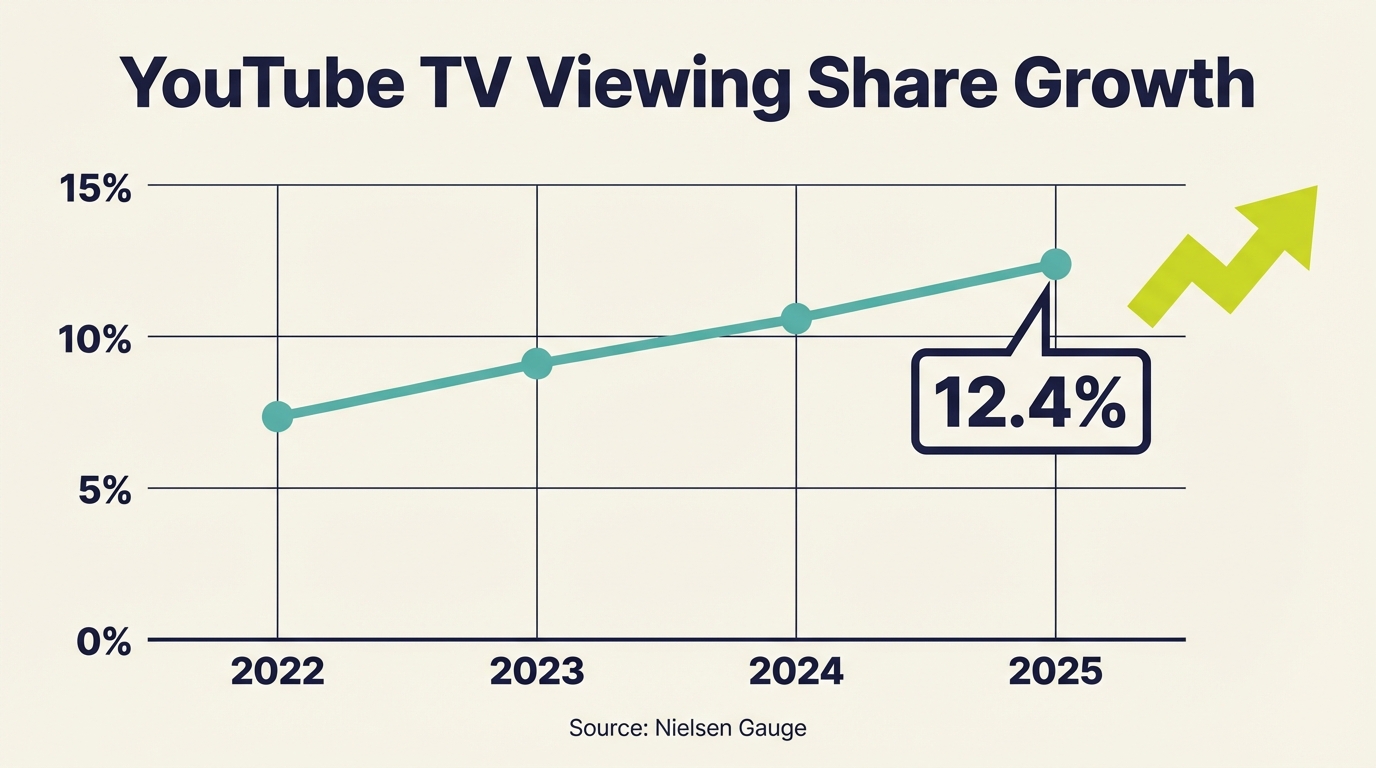
12.4% share in April 2025: YouTube's highest share recorded at that time, representing audiences' time spent watching TV
13.4% share in July 2025: YouTube reached its peak share mid-year, according to Variety's Nielsen analysis
12.6% share in September 2025: A slight pullback but still commanding a dominant position per VideoWeek reporting
+2.8 percentage points YoY growth: YouTube's share increased by 2.8 points compared to April 2024, according to NetInfluencer's analysis
4-point lead over Disney: YouTube widened its lead over second-place Disney (9.4%) by 4 share points according to MediaPlayNews
11.6% share in February 2025: YouTube moved to the top spot earlier in the year according to Hollywood Reporter
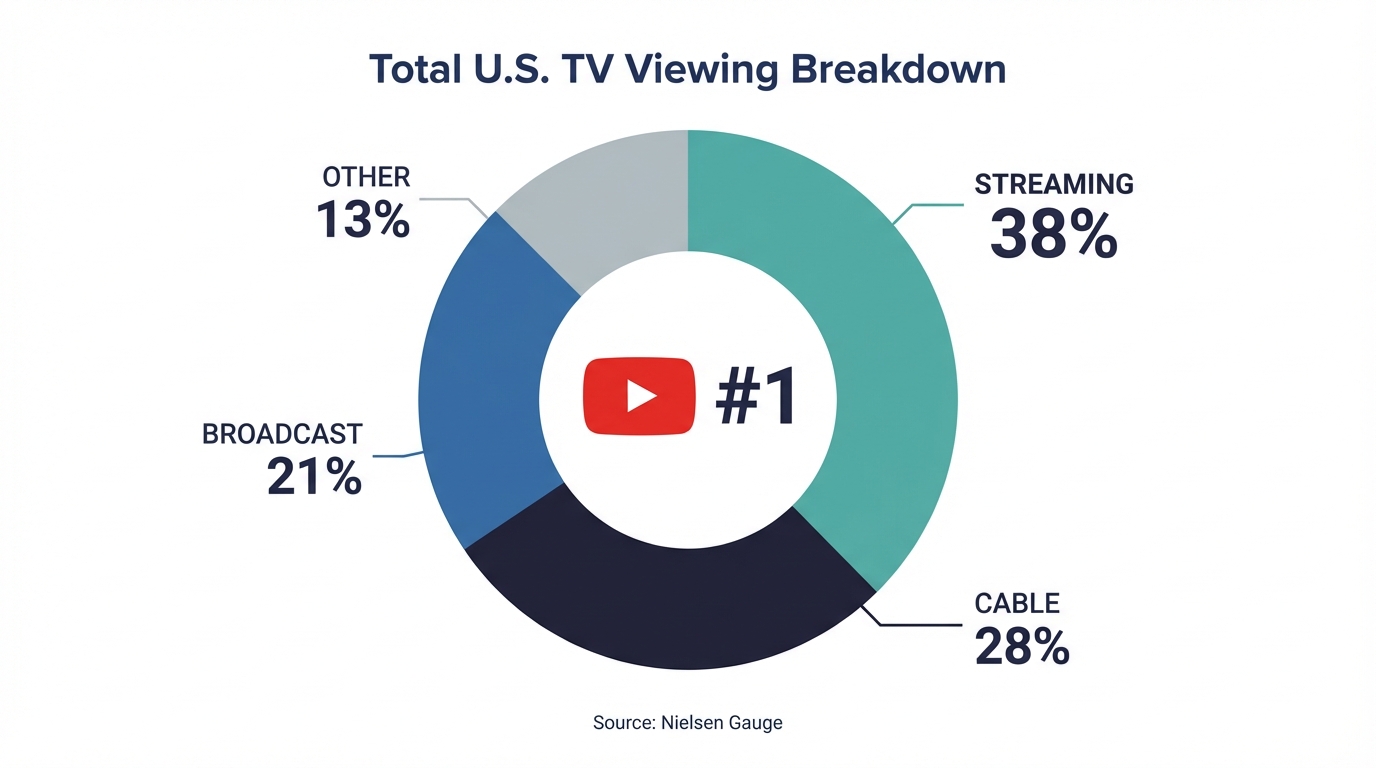
To put these numbers in perspective, the entire streaming category represented 44.8% of TV viewership in May 2025, which Nielsen reported as a historic milestone when streaming eclipsed combined broadcast (20.1%) and cable (24.1%) viewing for the first time. YouTube alone accounts for more than a quarter of all streaming viewership.
In April 2025, Nielsen put YouTube at 12.4% of U.S. TV time. The Disney share cited on this page is 9.4% (MediaPlayNews). Netflix's April 2025 TV viewing share, in the question section below, is 7.8%.
For advertisers, this means YouTube on TV represents one of the largest audiences available for video advertising, rivaling or exceeding the reach of traditional broadcast networks during prime time.
Breaking down the numbers
Who watches YouTube on TV matters as much as the share. The age mix below is a user mix, not a Nielsen share of TV time.
Age demographics
The age mix below is YouTube's user base as published by DemandSage, not a Nielsen share of TV time, and not a YouTube TV subscriber count. The page does not state a month for the DemandSage mix:
15.7% of users are aged 18-24: Young adults who grew up with YouTube
21.5% are aged 25-34: YouTube's largest demographic segment according to DemandSage
17.9% are aged 35-44: Mid-career professionals and young families
12.9% are aged 45-54: An often-overlooked but significant segment
9.4% are aged 55-64: Baby boomers increasingly adopting streaming
According to Global Media Insight's YouTube statistics, the 25-34 age group represents YouTube's largest audience segment worldwide. This is especially valuable for advertisers because this demographic is often considered the most desirable for marketers: they have disposable income, are forming brand loyalties, and are highly engaged digital consumers.
Gender breakdown
This page does not cite a sourced gender split for YouTube on TV screens. The DemandSage age mix above is a user mix, not a Nielsen TV-time share.
Device and viewing context
In April 2025, Nielsen's Media Distributor Gauge put YouTube at 12.4% of U.S. TV time. That is YouTube on television sets, not the YouTube TV subscription.
Content preferences on TV
What are people watching on YouTube via their TVs? The content mix differs from mobile viewing:
Long-form content: Documentaries, vlogs, and educational content perform well on TV
Music and music videos: Background entertainment for households
Sports highlights and commentary: Short clips people put on the TV
Kids' content: YouTube remains a go-to for children's entertainment
Podcasts and talk shows: Audio-visual podcasts gaining TV traction
Why it matters for your business
The democratization of TV advertising
For decades, TV advertising was reserved for brands with massive budgets. A national TV campaign could easily cost millions of dollars, and even local cable advertising required tens of thousands. YouTube's rise as the top TV platform has coincided with the democratization of TV advertising through connected TV (CTV) platforms.
Today, platforms like Adwave let small businesses run a TV campaign, including YouTube on TV screens. A TV campaign, including YouTube, starts at $30 a day. Google Search starts at $67 a day. See pricing.
Reaching cord-cutters and cord-nevers
One of the most significant advantages of advertising through YouTube and other streaming platforms is the ability to reach audiences who are increasingly difficult to find through traditional TV:
Cord-cutters: Households that have cancelled cable or satellite subscriptions
Cord-nevers: Younger viewers who never subscribed to traditional TV in the first place
Light TV viewers: People who watch sparingly but engage heavily with streaming
According to cord-cutting statistics, streaming now represents over 47% of all TV viewing time. If your target audience includes anyone under 50, you likely need a streaming strategy to reach them effectively.
The attention advantage
YouTube viewers on TV represent an especially valuable audience for several reasons:
Active choosing: Unlike traditional TV where viewers might passively watch whatever is on, YouTube viewers actively choose content
Lean-in engagement: The large screen format encourages focused viewing rather than second-screen behavior
Less ad fatigue: With fewer ads than traditional TV, each ad exposure carries more weight
Skip-resistant formats: YouTube's non-skippable ad formats ensure your message gets delivered
Local targeting meets massive scale
One of YouTube's unique advantages for small businesses is the combination of massive scale with precise targeting capabilities. You can reach millions of potential customers while still targeting specific:
Geographic areas: Target by ZIP code, city, or DMA
Demographics: Age, gender, household income, and more
Interests: Based on viewing behavior and content preferences
Life events: Reaching people during key purchasing moments
This combination makes YouTube an ideal platform for local TV advertising that can compete with national brands for local attention.

How to take advantage of this trend
Understanding YouTube's TV dominance is one thing; capitalizing on it is another. Here's a practical guide for businesses looking to tap into this massive audience.
Step 1: Understand your audience on YouTube
Before you buy ads on YouTube where it plays on TV screens, check whether your customers match the audience you can actually target:
Best fit: B2C products and services, local businesses, e-commerce brands, restaurants, real estate, automotive, healthcare
Consider carefully: B2B services with narrow enterprise targets (though YouTube can still work for brand awareness)
Think about context: What content might your ideal customers be watching?
Step 2: Choose the right advertising approach
There are several ways to advertise on YouTube through TV screens:
Direct YouTube Ads (Google Ads)
Requires Google Ads account and creative expertise
Offers precise targeting and bidding control
Can be complex for beginners
Higher minimum budgets typically needed
Connected TV platforms (like Adwave)
Simplified interface for small businesses
Access to YouTube on TV screens, plus other streaming channels
AI-powered ad creation (no video production needed)
A TV campaign, including YouTube, starts at $30 a day. Google Search starts at $67 a day (pricing).
For most small businesses, starting with a CTV platform provides the easiest entry point with the lowest risk.
Step 3: Create TV-ready content
Ads that run while YouTube is on a TV screen need to work on the big screen. Consider:
Clear visuals: Ensure text and images are readable from across the room
Strong audio: Many TV viewers watch with sound on (unlike mobile)
Compelling hook: You have seconds to capture attention
Clear call-to-action: Tell viewers exactly what to do next
Appropriate length: 15-30 second spots work best
Don't have video? Platforms like Adwave use AI to create professional TV commercials from your existing assets.
Step 4: Set realistic budgets and expectations
Getting started with ads on YouTube on TV screens still needs a budget you can check. On Adwave a TV campaign, including YouTube, starts at $30 a day, so a $50 total test is below that daily floor. The ranges below are planning sketches, not a rate card:
$200-$500 total: a short test, if it stays at or above $30 a day while it runs
$500-$2,000 a month: a longer flight, still subject to the $30 a day floor
Remember that TV advertising, including YouTube, works best for brand awareness and consideration. Don't expect direct-response metrics like those from search ads.
Step 5: Measure what matters
Track these metrics for ads that run while YouTube is on a TV screen:
Impressions: How many times your ad was shown
Completion rate: How many viewers watched your entire ad
Brand lift: Changes in brand awareness and consideration
Website visits: Traffic increases correlated with campaign timing
Store visits: For local businesses, foot traffic changes
The bigger picture
YouTube's rise to TV dominance is part of a larger transformation in how Americans consume video content. Understanding this broader context helps explain why this trend matters and where it's heading.
The streaming revolution reaches maturity
In May 2025, streaming achieved a historic milestone: for the first time ever, streaming viewership (44.8%) exceeded the combined total of broadcast (20.1%) and cable (24.1%) television. This wasn't a temporary blip; it represented the culmination of a decade-long shift in viewing habits.
YouTube's position at the top of this streaming hierarchy is especially significant because:
Free with ads: YouTube's Premium FAQ says: "If a viewer chooses not to become a member, they'll continue to experience the same free of charge YouTube (with ads) as they do today."
Available on most TV devices: YouTube's help center says: "The YouTube app is already available on most smart TVs, game consoles, and streaming devices."
The advertising implications
For the advertising industry, YouTube's TV dominance has profound implications:
Shifted attention: Ad dollars are following viewers from traditional TV to streaming
New measurement challenges: Traditional TV metrics don't directly apply to streaming
Democratized access: Smaller advertisers can now compete for TV attention
Changed creative requirements: Ads need to work in both skippable and non-skippable contexts
According to CTV advertising statistics, connected TV ad spending continues to grow at double-digit rates as advertisers recognize where audiences have moved.
What reporters said about the April 2025 Gauge
Barrett Media reported that "YouTube held its position as the top media company in Nielsen's April 2025 Media Distributor Gauge report, capturing 12.4% of audiences' time spent watching TV." The publication noted this represented the platform's highest share to date at that time.
The Hollywood Reporter observed that "YouTube moved to the top spot in February's media distributor rankings from Nielsen, scoring 11.6 percent of all TV use in the U.S."
An ad on YouTube watched on a TV plays on a big screen in a shared room, so plan it like a TV spot, not a mobile video ad. That is still YouTube the video platform, not the YouTube TV subscription.
Common questions answered
How does YouTube compare to Netflix in TV viewing share?
YouTube (12.4%) has surpassed Netflix (7.8%) as the largest streaming platform by TV viewing share, according to Nielsen's April 2025 data. YouTube's lead is approximately 4.6 percentage points, making it the clear leader among streaming services. Netflix remains strong in subscription-based streaming, but YouTube's free, ad-supported model has allowed it to capture a larger overall audience.
Can small businesses advertise where YouTube is watched on TV?
Yes. Google Ads can buy YouTube directly. On Adwave, a TV campaign, including YouTube, starts at $30 a day. Google Search starts at $67 a day. See pricing. That buy is YouTube on TV screens, not a subscription to YouTube TV.
What is the CPM for YouTube on TV screens?
This page does not have a sourced CPM for YouTube ads on TV screens. For the national 2026-27 primetime upfront streaming average, see the average CTV CPM. That figure is not a YouTube rate and not a YouTube TV subscription price.
Is YouTube's share of TV viewing growing or declining?
From April 2024 to April 2025, YouTube's share of TV rose 2.8 points, to 12.4% of total TV watch-time, according to Nielsen's Gauge. VideoWeek reported that the share then fell for a second straight month, from 13.4% in July 2025 to 12.6% in September 2025.
How long should an ad be when YouTube is on a TV?
15-second and 30-second spots are the lengths Adwave prices on the pricing page ($6 for a 15-second TV spot and $12 for a 30-second TV spot, as extra creation). This page does not cite a sourced length that "performs best."
Supporting data
Additional statistics and research that support YouTube's TV viewing dominance:
2.5 billion monthly users: YouTube's global monthly active user base according to company data
1 billion+ hours watched daily: Total daily YouTube viewing across all devices globally
100+ countries: Markets where YouTube is available
80 languages: Languages supported by the YouTube platform
70% of YouTube watch time: Comes from mobile devices globally, but TV is the fastest-growing screen
$31.5 billion: YouTube's advertising revenue in 2023, according to Alphabet earnings
#2 search engine: YouTube is the second-largest search engine after Google
500 hours of video uploaded per minute: Content volume added to YouTube continuously
For current CTV and streaming advertising data, see Adwave's CTV Advertising Statistics 2025.
Data sources used in this article:
Get started with TV advertising
YouTube's dominance in TV viewing isn't just a statistic; it's an opportunity. For the first time, small businesses can reach the same massive TV audiences that were once exclusive to Fortune 500 brands.
Adwave pricing starts a TV campaign, including YouTube, at $30 a day. Google Search starts at $67 a day. The Nielsen figures above are YouTube on TV screens, not the YouTube TV subscription.
No video production experience required. No massive budgets. No agencies.