<?xml version="1.0" encoding="utf-8"?><feed xmlns="http://www.w3.org/2005/Atom" ><generator uri="https://jekyllrb.com/" version="4.4.1">Jekyll</generator><link href="https://adwave.com/feed.xml" rel="self" type="application/atom+xml" /><link href="https://adwave.com/" rel="alternate" type="text/html" /><updated>2026-09-09T17:32:23+00:00</updated><id>https://adwave.com/feed.xml</id><title type="html">Adwave | Resources</title><subtitle>Adwave is the company behind Waverunner, advertising software that turns your website into finished ads and runs them on TV, search, social, and the web from one daily budget.</subtitle><entry><title type="html">YouTube TV Advertising (Not YouTube Ads) (2026)</title><link href="https://adwave.com/resources/youtube-tv/" rel="alternate" type="text/html" title="YouTube TV Advertising (Not YouTube Ads) (2026)" /><published>2026-09-09T17:32:23+00:00</published><updated>2026-09-09T17:32:23+00:00</updated><id>https://adwave.com/resources/youtube-tv</id><content type="html" xml:base="https://adwave.com/resources/youtube-tv/"><![CDATA[<p>YouTube TV is not the same thing as YouTube. It&#39;s important to get that distinction right up front, because the advertising opportunities are completely different.</p>
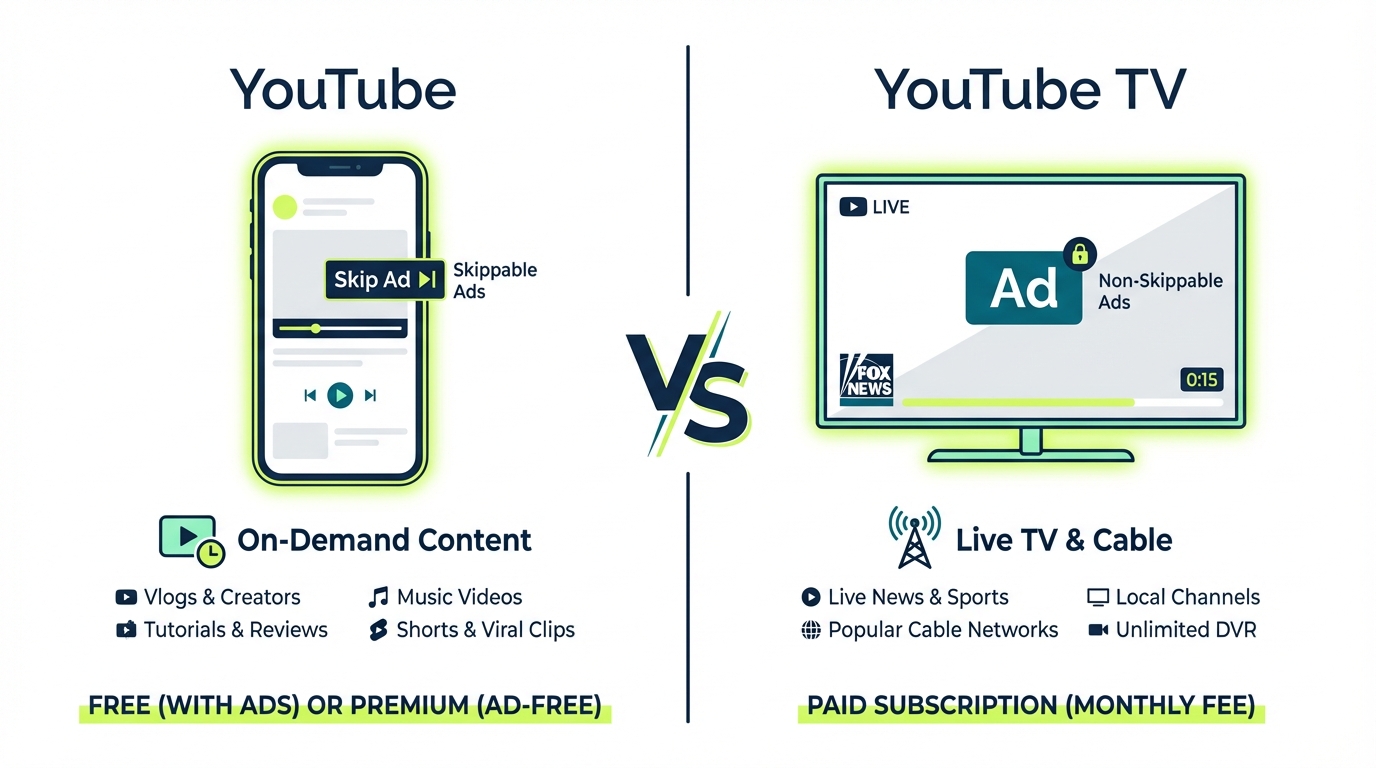
<p>YouTube is a video platform with 2+ billion users watching creator content. YouTube TV is a live television streaming service with approximately 11 million subscribers watching the same broadcast and cable channels you&#39;d get from a traditional cable package: ABC, CBS, NBC, Fox, ESPN, CNN, HGTV, TNT, and roughly 130 other live channels. It&#39;s cable TV, delivered over the internet.</p>
<p>YouTube TV is now the fastest-growing pay TV provider in America, on track to become the largest by 2026-2027, passing both Comcast and Charter. It holds about 40-44% of the virtual MVPD market. And here&#39;s what makes it uniquely powerful for advertisers: it&#39;s owned by Google. That means YouTube TV can apply Google&#39;s search, browsing, and purchase intent data to live television advertising. No other live TV provider can do that.</p>
<p>The challenge for small businesses is access. Buying YouTube TV ads through Google&#39;s managed services requires a minimum spend of $35,000, and the primary buying platform is DV360 (Display &amp; Video 360), not the standard Google Ads interface most small businesses are familiar with. It&#39;s built for agencies and enterprise advertisers.</p>
<p>Through <a href="https://adwave.com">Adwave</a>, you can access YouTube TV inventory alongside 100+ other premium channels starting at $50. Your 30-second commercial is created automatically from your website URL in about 2 minutes, and the whole campaign can be live in roughly 4 minutes. Phone, email, and chat support on every plan.</p>
<h2 id="why-youtube-tv-stands-out-for-advertisers">Why YouTube TV Stands Out for Advertisers</h2>
<p>YouTube TV&#39;s advertising value comes down to one thing no other live TV platform can match: Google&#39;s data.</p>
<p><b>Google&#39;s first-party data on TV inventory.</b> This is the game-changer. Because YouTube TV requires a Google account login, every viewer is authenticated. Google knows what they search for, what websites they visit, what products they&#39;re researching, and what they&#39;ve purchased. That data can be applied to television ad targeting. Want to reach people who recently searched for &quot;HVAC repair near me&quot;? YouTube TV can do that on a living room TV screen. No other live TV service comes close.</p>
<p><b>Professional broadcast content.</b> YouTube TV carries approximately 130 live channels including all four major broadcast networks (ABC, CBS, NBC, Fox), major cable channels (ESPN, CNN, TNT, Disney Channel, HGTV, FX), and exclusive rights to NFL Sunday Ticket through 2030. Your ad runs alongside the same programming that traditional cable delivers.</p>
<p><b>Non-skippable, high-completion ads.</b> Unlike regular YouTube where many ads can be skipped after 5 seconds, YouTube TV ads are primarily non-skippable, just like traditional TV commercials. Video completion rates reach up to 96% on CTV, compared to 50-60% on mobile YouTube. Viewers see your entire message.</p>
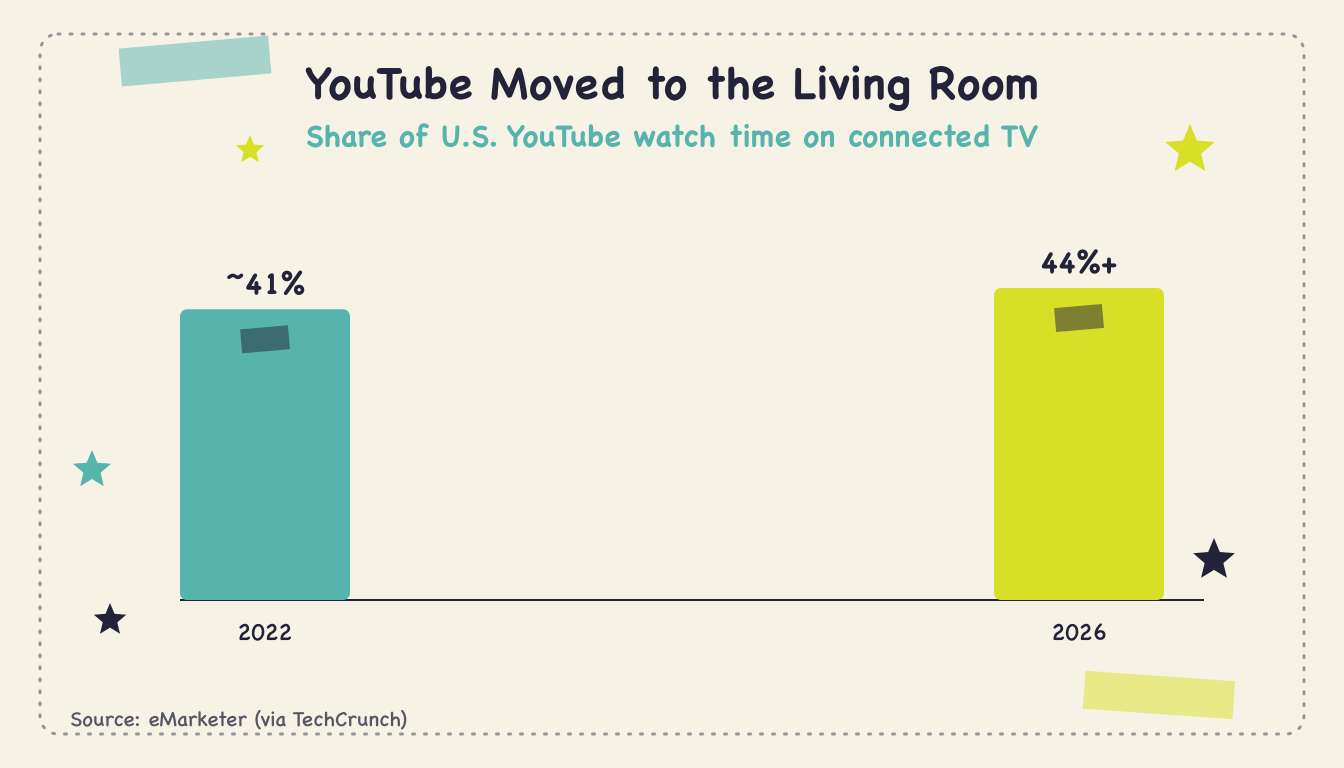
<p><b>The fastest-growing pay TV provider.</b> YouTube TV added 750,000 subscribers in Q3 2025 alone, reaching approximately 11 million total. It&#39;s projected to surpass Comcast and Charter to become the largest pay TV provider in the US within the next year or two. The audience is growing fast while traditional cable shrinks.</p>
<h2 id="youtube-tv-ad-formats">YouTube TV Ad Formats</h2>
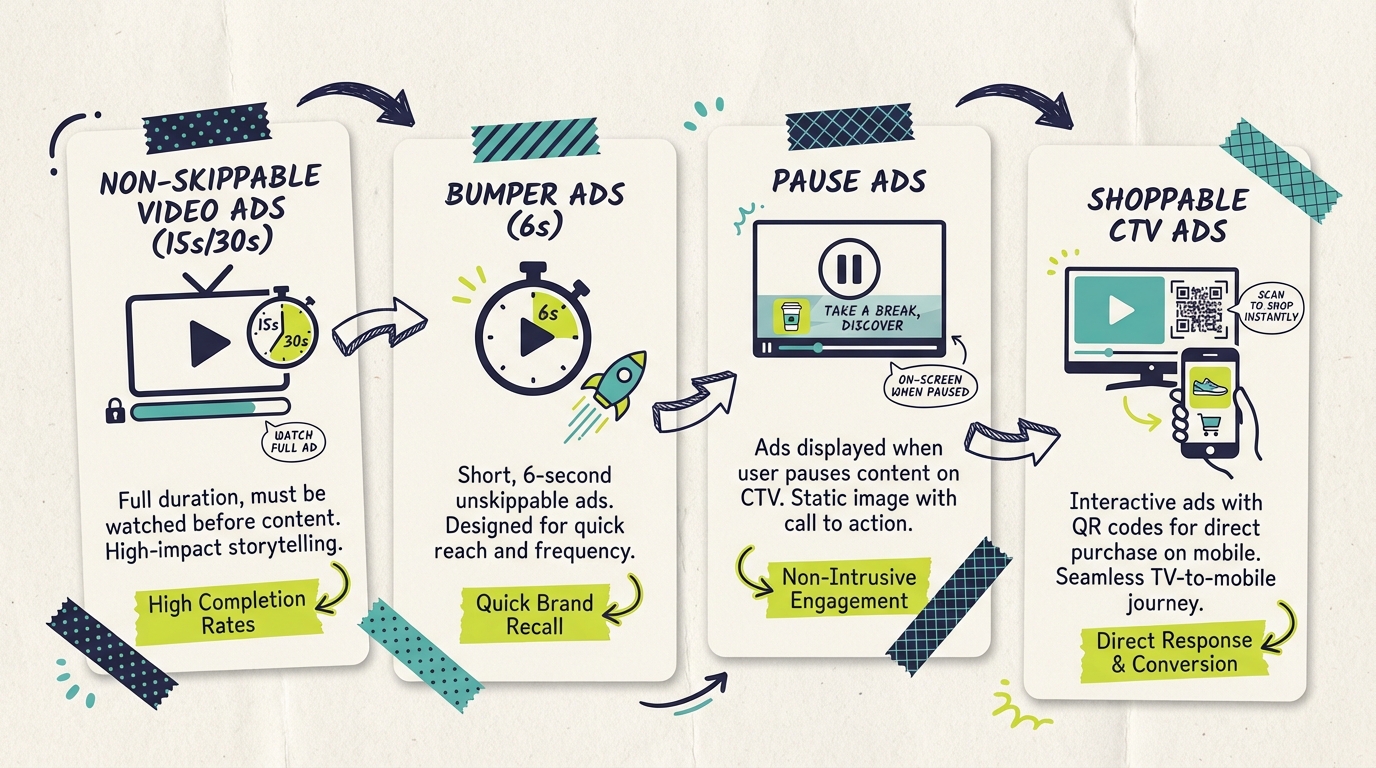
<p>YouTube TV offers several ad formats, from standard TV commercials to interactive CTV experiences.</p>
<figure class="embedded-asset"><img src="https://media.adwave.com/fia320z3blxi/3FLX9KasdDxCWlsZqs6715/6b98ce0a5896263687520a03023c4fb7/body1.png" alt="YouTube TV Advertising Guide - Body1" loading="lazy" /></figure>
<p><b>Non-Skippable In-Stream Ads (15s and 30s)</b> The primary format. Pre-roll and mid-roll spots delivered within live TV commercial breaks. Full-screen, sound-on, no skip button. This is what you get through programmatic channels and delivers the strongest completion rates. Up to 96% of viewers watch the entire ad.</p>
<p><b>Bumper Ads (6s)</b> Short, non-skippable spots designed for quick brand messages. Effective for reinforcing awareness when paired with longer 30-second spots in the same campaign.</p>
<p><b>Pause Ads</b> Introduced in 2025, a full-screen ad appears when viewers press pause. Catches attention during a natural break without interrupting content. A growing format across CTV platforms.</p>
<p><b>Shoppable CTV Ads</b> Interactive ads that display product carousels with QR codes on screen. Product data pulls directly from Google Merchant Center, letting viewers scan and shop from their couch. Best for e-commerce and retail businesses with products to sell directly.</p>
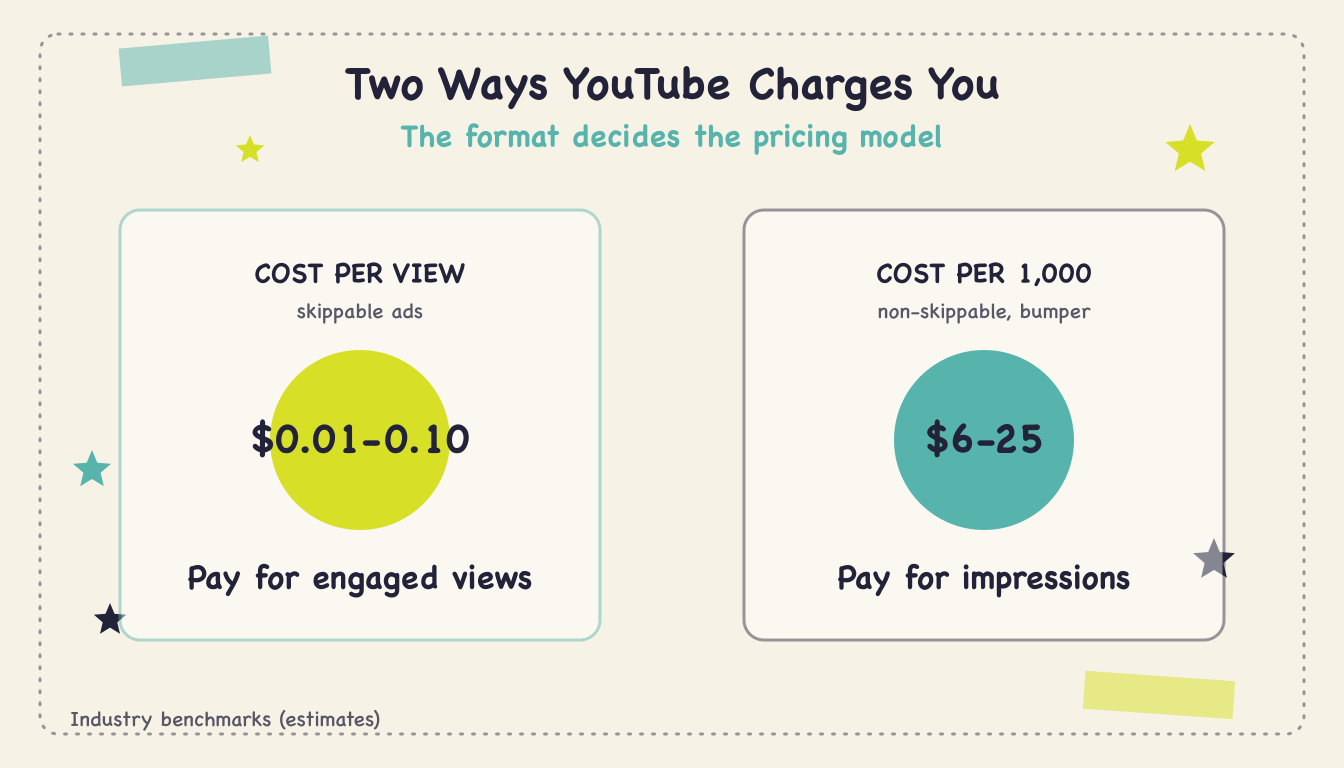
<p><b>Skippable In-Stream Ads</b> Available through auction buying with target CPM bidding. Viewers can skip after 5 seconds. Lower CPMs but also lower completion rates than non-skippable formats.</p>
<p>For small businesses, <b>standard 30-second non-skippable ads</b> deliver the most value. They run within live TV programming, viewers watch the full message, and they&#39;re available through programmatic channels.</p>
<h2 id="what-does-youtube-tv-advertising-cost">What Does YouTube TV Advertising Cost?</h2>
<p>YouTube TV carries premium pricing because of its authenticated audience and Google&#39;s data targeting capabilities.</p>
<div class="embedded-table"><h4>YouTube TV Advertising Costs by Buying Method</h4><div class="table__body w-full overflow-x-auto table-wrapper"><table><tr><th>Buying Method</th><th>Minimum Spend</th><th>Typical CPM</th><th>Best For</th></tr><tr><td>Google Managed Services (DV360 Direct)</td><td>$35,000</td><td>$32+</td><td>Enterprise brands, guaranteed delivery</td></tr><tr><td>DV360 Programmatic Guaranteed</td><td>Varies</td><td>$20-35</td><td>Agencies, reserved inventory</td></tr><tr><td>DV360 Auction (non-guaranteed)</td><td>Varies</td><td>$20-25</td><td>Agencies, flexible budgets</td></tr><tr><td>Programmatic (via Adwave)</td><td>$50</td><td>$15-35</td><td>Small businesses, local advertisers</td></tr></table></div></div>
<p><b>Why YouTube TV CPMs are higher.</b> You&#39;re paying for two things: live TV content and Google&#39;s data. A $32 CPM on YouTube TV gets you an authenticated viewer whose search history, purchase intent, and browsing behavior inform your targeting. Compare that to a $5 CPM on regular YouTube where you might reach someone watching cat videos on their phone. The quality difference is significant.</p>
<p><b>DV360, not Google Ads.</b> This is a critical distinction. YouTube TV inventory is primarily bought through Display &amp; Video 360, Google&#39;s enterprise ad buying platform. Standard Google Ads can buy regular YouTube placements, but DV360 is required for guaranteed YouTube TV inventory. This creates an access barrier for small businesses.</p>
<p><b>The Adwave advantage.</b> <a href="https://adwave.com/pricing">Adwave</a> removes the DV360 requirement and the $35,000 minimum. You access YouTube TV inventory as part of a campaign across 100+ premium channels, starting at $50. AI creates your commercial, and you&#39;re live in about 4 minutes.</p>
<h2 id="who-watches-youtube-tv">Who Watches YouTube TV?</h2>
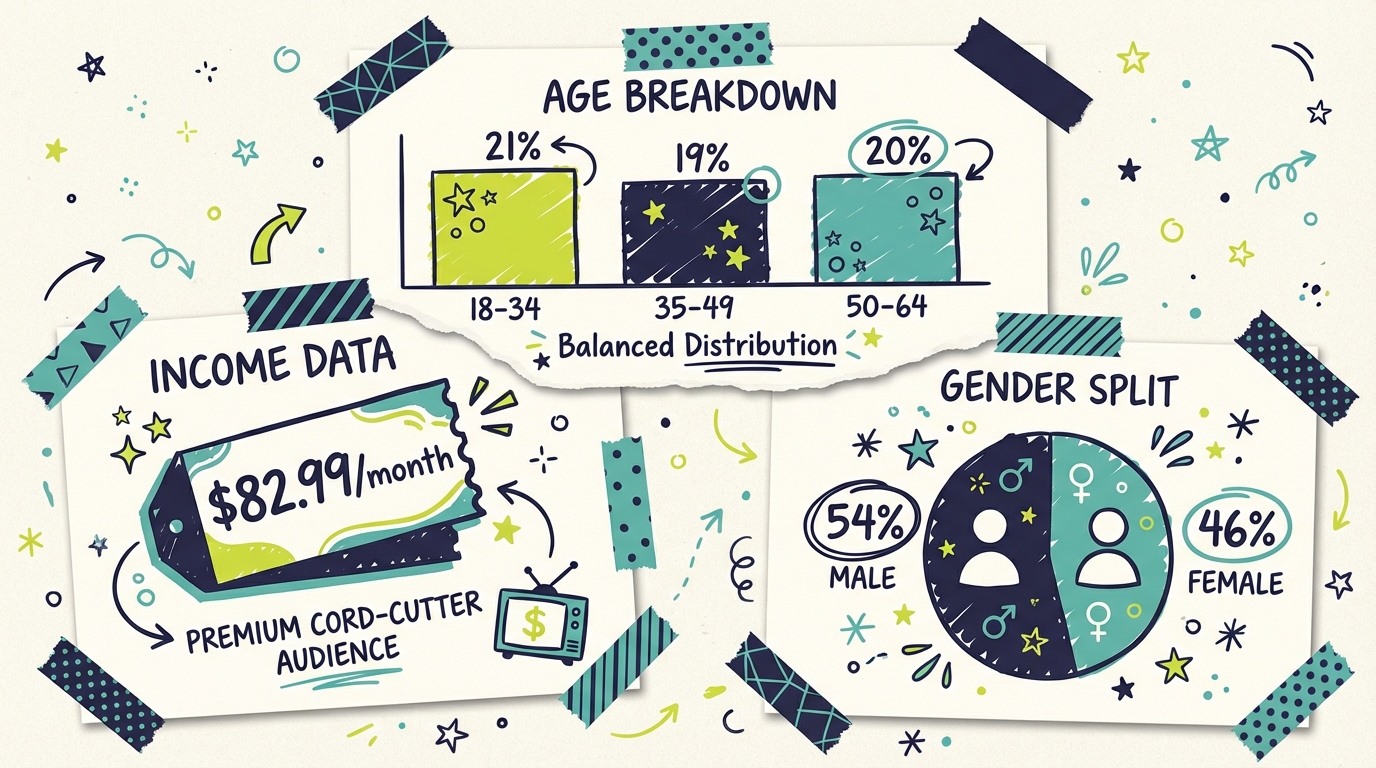
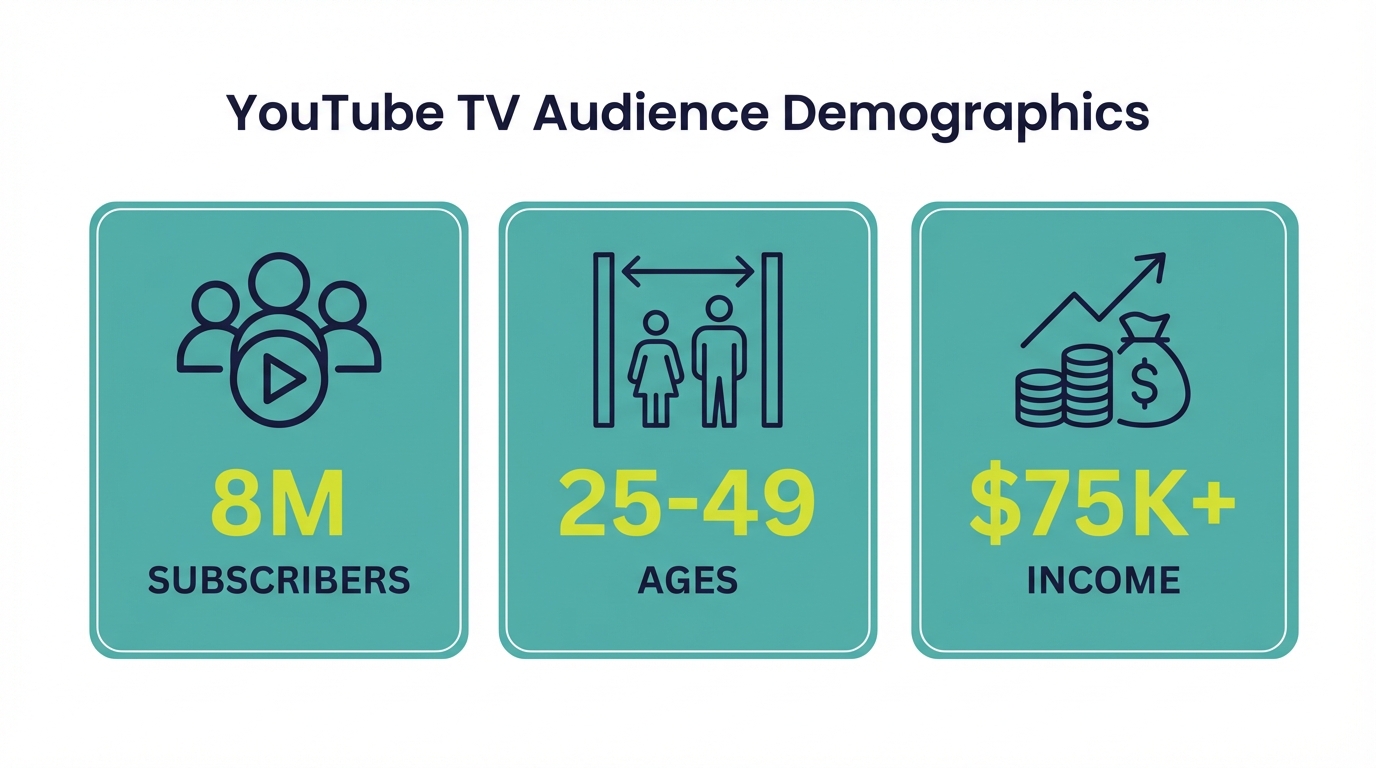
<p>YouTube TV subscribers are a valuable advertising audience: cord-cutters with disposable income who&#39;ve chosen to maintain a live TV experience.</p>
<figure class="embedded-asset"><img src="https://media.adwave.com/fia320z3blxi/2LYvh2fosTDivl1i30B3A4/5bbeba010832ec391862e2ae4f8cf01f/body2.png" alt="YouTube TV Advertising Guide - Body2" loading="lazy" /></figure>
<p><b>Age:</b></p>
<ul><li><p>21% are 18-34</p></li><li><p>19.4% are 35-49</p></li><li><p>20.4% are 50-64</p></li><li><p>15.4% are 65+</p></li><li><p>Balanced distribution across adult age groups, unlike most streaming platforms that skew younger</p></li></ul>
<p><b>Gender:</b> Approximately 54% male, 46% female. The male skew is driven by sports content, particularly NFL Sunday Ticket.</p>
<p><b>Income:</b> YouTube TV subscribers pay $82.99 per month, which indicates middle-to-upper income households. These are viewers who value live TV enough to pay for it but have chosen streaming over traditional cable. The 25-34 demographic is especially valuable: high disposable income, forming brand loyalties, and highly engaged.</p>
<p><b>Cord-cutter profile:</b> 73% of YouTube TV subscribers cite cost as their primary reason for leaving cable. They haven&#39;t abandoned live TV. They&#39;ve just found a better way to access it. This means they watch the same channels and programming as cable subscribers, but they&#39;re younger, more tech-savvy, and authenticated through Google.</p>
<p><b>What this means for your business:</b> YouTube TV reaches a premium audience that&#39;s difficult to find elsewhere. They watch live sports, news, and primetime programming. They have spending power. And because they&#39;re Google-authenticated, your targeting is more precise than any other live TV platform. Especially valuable for <a href="https://adwave.com/industries/automotive">automotive</a>, <a href="https://adwave.com/industries/home-services">home services</a>, and professional services businesses.</p>
<h2 id="youtube-tv-targeting-options">YouTube TV Targeting Options</h2>
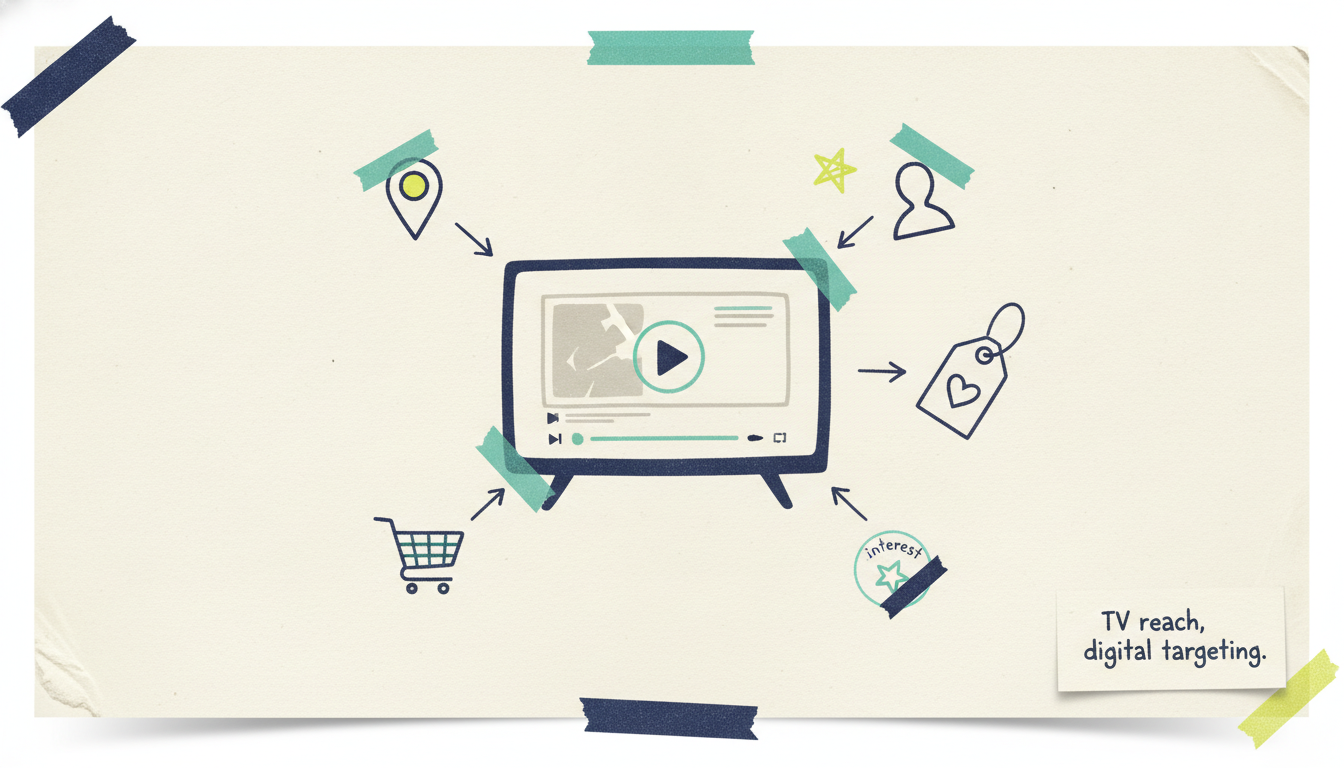
<p>This is where YouTube TV truly separates itself from every other TV advertising option. Google&#39;s data makes YouTube TV targeting more precise than anything available on traditional TV or other streaming platforms.</p>
<p><b>Demographic:</b> Age, gender, parental status, household income. Standard across most platforms, but more accurate on YouTube TV because every viewer is authenticated.</p>
<p><b>In-Market Segments:</b> Reach people actively researching a purchase. Google knows when someone is searching for &quot;best HVAC companies&quot; or &quot;new car deals near me,&quot; and you can target those exact viewers on their TV screen.</p>
<p><b>Custom Intent:</b> Build audiences based on specific Google Search queries. If people have searched for terms related to your business in the past 7 days, you can show them your TV ad.</p>
<p><b>Affinity and Custom Affinity:</b> Broad and narrow interest categories. Target &quot;Sports Fans&quot; broadly or build a custom audience of &quot;Avid Marathon Runners&quot; specifically.</p>
<p><b>First-Party Data:</b> Upload your CRM customer list for matching. Show TV ads to your existing customers or build lookalike audiences.</p>
<p><b>Geographic:</b> DMA, metro area, and ZIP code targeting. Critical for local businesses.</p>
<p>Through programmatic channels (including <a href="https://adwave.com/features">Adwave</a>), you access standard demographic and geographic targeting. The advanced Google data targeting (in-market, custom intent) requires DV360 or managed service buying.</p>
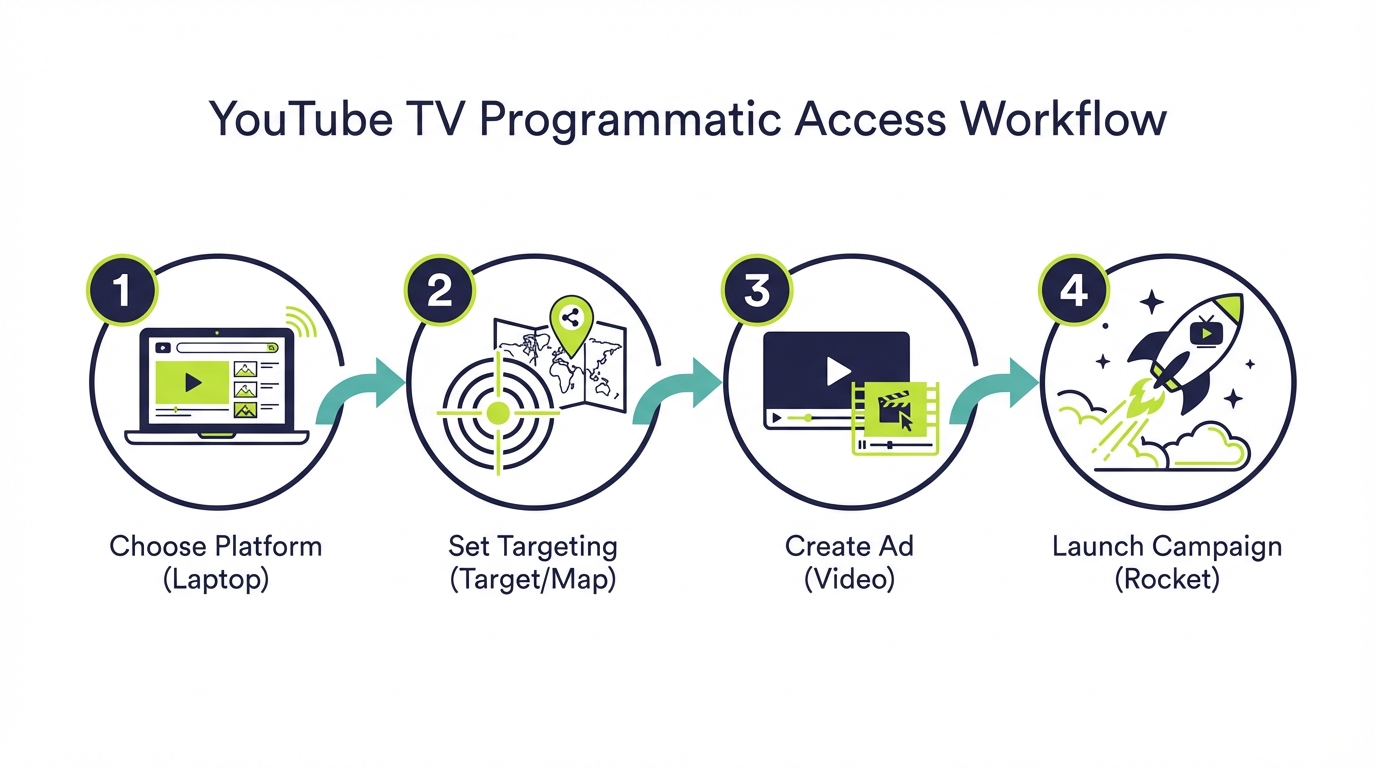
<h2 id="how-to-advertise-on-youtube-tv">How to Advertise on YouTube TV</h2>
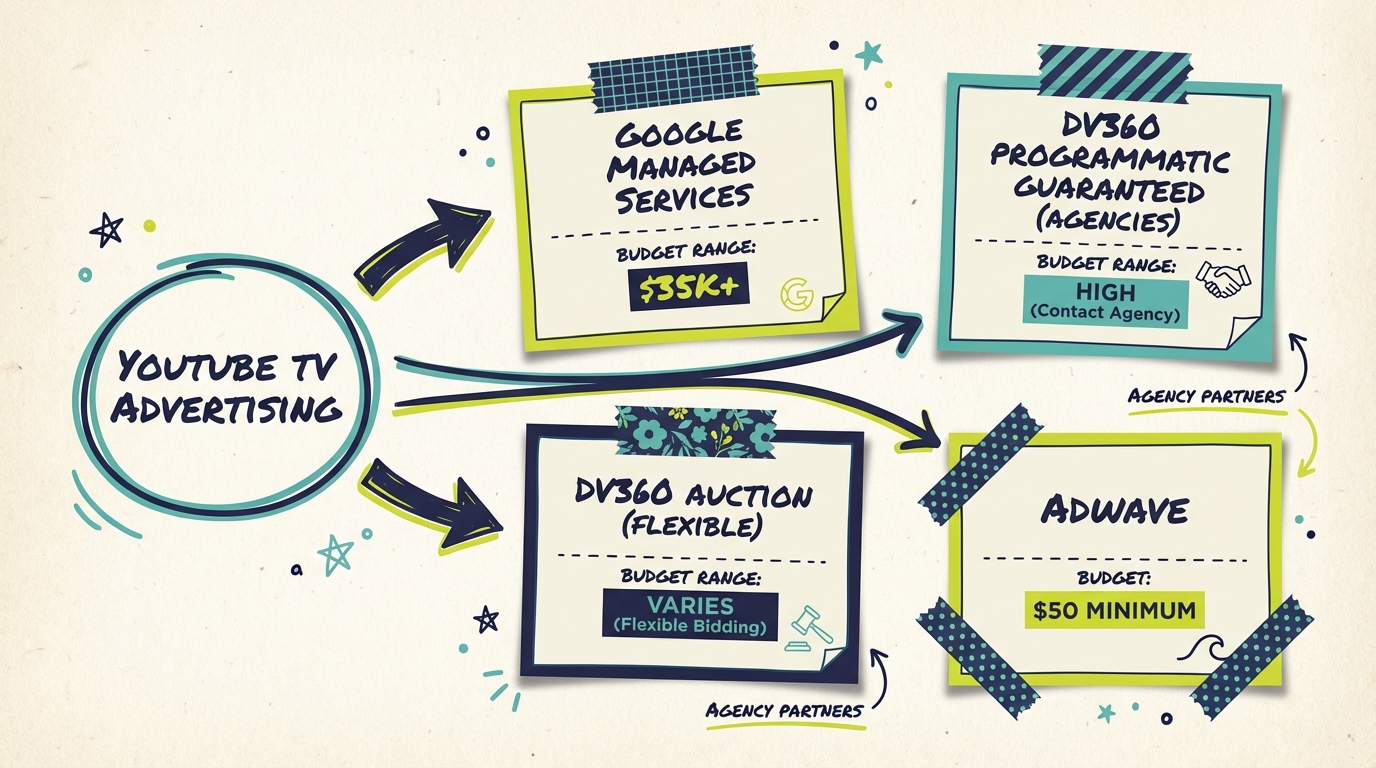
<p>There are several paths to YouTube TV advertising, but the access barriers are higher than most streaming platforms.</p>
<figure class="embedded-asset"><img src="https://media.adwave.com/fia320z3blxi/BPM5ENCW31yFBEXTT84Tv/7b7506e3c23e542ba380fbfd5efaccde/body3.png" alt="YouTube TV Advertising Guide - Body3" loading="lazy" /></figure>
<p><b>Option 1: Google Managed Services (DV360 Direct)</b> Work with Google&#39;s advertising team for guaranteed YouTube TV placements. Minimum spend of $35,000. Full access to Google&#39;s targeting stack, YouTube Select curated lineups, and reserved inventory. Best for enterprise brands and large agencies.</p>
<p><b>Option 2: DV360 Programmatic Guaranteed</b> Buy guaranteed YouTube TV inventory through Display &amp; Video 360. Requires a DV360 account and media buying expertise. Includes Instant Deals for quick quotes and reserved impressions at fixed CPMs. Best for agencies running multi-platform CTV campaigns.</p>
<p><b>Option 3: DV360 Auction</b> Non-guaranteed buying through DV360 using target CPM bidding. Your ad may serve on YouTube TV if it meets format and bidding criteria, but delivery isn&#39;t guaranteed. Lower barrier than managed services but still requires DV360 access.</p>
<p><b>Option 4: Adwave</b> The simplest path for small businesses. <a href="https://adwave.com">Adwave</a> gives you access to YouTube TV inventory alongside 100+ other premium channels, starting at $50. AI creates your 30-second commercial from your website URL. No DV360 account, no $35,000 minimum, no media buying expertise needed. Live in about 4 minutes with phone, email, and chat support on every plan.</p>
<h2 id="measuring-youtube-tv-ad-performance">Measuring YouTube TV Ad Performance</h2>
<p>Google&#39;s measurement ecosystem is among the most sophisticated in advertising, though it operates within Google&#39;s walled garden.</p>
<p><b>Ads Data Hub.</b> Google&#39;s privacy-safe measurement tool for cross-device attribution. Since YouTube stopped accepting third-party pixels, all measurement runs through Google&#39;s own ecosystem. This provides detailed attribution without relying on cookies or external tracking.</p>
<p><b>Brand Lift Studies.</b> Available through Google to measure awareness, consideration, and purchase intent lift from your YouTube TV campaigns. Compares exposed viewers to control groups.</p>
<p><b>Co-viewing Measurement.</b> Panel observation and real-time surveys measure how many people in a household are watching together. If three people see your ad on one TV, that&#39;s three impressions worth of impact.</p>
<p><b>Video Completion Metrics.</b> YouTube TV CTV ads achieve up to 96% video completion rates, significantly higher than mobile or desktop video. Your full message gets seen.</p>
<p><b>Through Adwave:</b> When you run through Adwave, you get a real-time analytics dashboard showing performance across all channels. Simple reporting without navigating Google&#39;s enterprise measurement tools.</p>
<p><b>How [TV advertising attribution](https://adwave.com/resources/ctv-measurement-attribution-guide) works:</b> YouTube TV ads deliver brand awareness in a premium, lean-back environment. A viewer sees your ad during Monday Night Football, and when they search for your service later that week, your business has the advantage of recognition. TV consistently ranks as the <a href="https://adwave.com/why-tv-works">most trusted advertising medium</a>, and YouTube TV&#39;s live broadcast environment reinforces that trust.</p>
<h2 id="common-questions-about-youtube-tv-advertising">Common Questions About YouTube TV Advertising</h2>
<p><b>Is YouTube TV advertising the same as YouTube advertising?</b> No. YouTube is a video platform with creator content and self-serve Google Ads buying. YouTube TV is a live television service with broadcast and cable channels, primarily bought through DV360. CPMs, audiences, ad formats, and buying methods are completely different. YouTube TV ads are non-skippable and run within live TV programming.</p>
<p><b>Can a small business advertise on YouTube TV?</b> Not easily through Google&#39;s direct channels, which require $35,000+ minimums and DV360 access. But YouTube TV inventory is available programmatically through platforms like Adwave starting at $50. You get non-skippable video ads within YouTube TV&#39;s live TV content.</p>
<p><b>What makes YouTube TV targeting better than other TV platforms?</b> Google&#39;s data. Every YouTube TV viewer is logged into a Google account, so Google can apply search history, browsing behavior, and purchase intent signals to TV ad targeting. No other live TV provider has this capability. You can target people who recently searched for products or services like yours.</p>
<p><b>How much does YouTube TV advertising cost?</b> Direct buying through Google starts at $35,000 with CPMs of $32+. Programmatic buying through DSPs like DV360 runs $20-35 CPM. Through Adwave, you access YouTube TV inventory starting at $50 as part of a campaign across 100+ channels.</p>
<p><b>Does YouTube TV have a lighter ad load than cable?</b> No. YouTube TV streams the same network feeds as cable, including the same commercial breaks. That means 12-19 minutes of ads per hour, similar to traditional TV. The difference is in targeting precision and measurement, not ad load.</p>
<p><b>Is YouTube TV good for local businesses?</b> Yes. YouTube TV supports geographic targeting at the DMA, metro, and ZIP code level. Combined with Google&#39;s audience data (in-market segments, custom intent), local businesses can target viewers in their service area who are actively searching for related services. Through <a href="https://adwave.com/resources/local-tv-ad-cost">Adwave</a>, you get local targeting starting at $50.</p>
<h2 id="get-your-business-on-youtube-tv">Get Your Business on YouTube TV</h2>
<p>YouTube TV combines something no other platform can: live broadcast television with Google&#39;s audience intelligence. It&#39;s the fastest-growing pay TV service in America, with 11 million subscribers watching the same channels as traditional cable, but with targeting capabilities that make every ad dollar work harder.</p>
<p>The barrier to entry used to be a $35,000 minimum and a DV360 account. <a href="https://adwave.com">Adwave</a> removes both. Your business can run on YouTube TV and 100+ other premium channels in about 4 minutes, starting at $50.</p>
<p><a href="https://adwave.com">Create your free TV ad now</a> and reach YouTube TV&#39;s 11 million subscribers with Google-powered precision.</p>]]></content><author><name>[{&quot;slug&quot; =&gt; &quot;david-naffis&quot;, &quot;display_name&quot; =&gt; &quot;David Naffis&quot;, &quot;first_name&quot; =&gt; &quot;David&quot;, &quot;last_name&quot; =&gt; &quot;Naffis&quot;, &quot;role&quot; =&gt; &quot;CEO&quot;, &quot;byline&quot; =&gt; &quot;Making TV advertising accessible to every business&quot;, &quot;short_biography&quot; =&gt; &quot;Co-founder and CEO building technology that makes TV advertising simple, affordable, and accessible for SMB&apos;s.&quot;, &quot;linkedin_url&quot; =&gt; &quot;https://www.linkedin.com/in/naffis/&quot;, &quot;avatar&quot; =&gt; {&quot;url&quot; =&gt; &quot;https://media.adwave.com/fia320z3blxi/5B6OdA0EbyBM0gcGfkQfvg/afefabcf228d1d5744e50882d97de1f4/naffis-headshot.png&quot;, &quot;description&quot; =&gt; &quot;&quot;, &quot;title&quot; =&gt; &quot;naffis-headshot.png&quot;}, &quot;sys&quot; =&gt; {&quot;id&quot; =&gt; &quot;3l4TGc9ngQ9b4hY02K9U6B&quot;}}]</name></author><summary type="html"><![CDATA[YouTube TV advertising guide for small business. Learn costs, ad formats, targeting options, and how Google's data makes YouTube TV ads smarter than traditional TV.]]></summary><media:thumbnail xmlns:media="http://search.yahoo.com/mrss/" url="https://media.adwave.com/fia320z3blxi/1NeeFowwli5WXnCo6XQ1mJ/d26d4eb4b4bb102d551ee04ced741f19/hero.png" /><media:content medium="image" url="https://media.adwave.com/fia320z3blxi/1NeeFowwli5WXnCo6XQ1mJ/d26d4eb4b4bb102d551ee04ced741f19/hero.png" xmlns:media="http://search.yahoo.com/mrss/" /></entry><entry><title type="html">What is YouTube’s share of TV viewing? (Q2 2025)</title><link href="https://adwave.com/resources/youtube-tv-viewing-share/" rel="alternate" type="text/html" title="What is YouTube’s share of TV viewing? (Q2 2025)" /><published>2026-09-09T17:32:23+00:00</published><updated>2026-09-09T17:32:23+00:00</updated><id>https://adwave.com/resources/youtube-tv-viewing-share</id><content type="html" xml:base="https://adwave.com/resources/youtube-tv-viewing-share/"><![CDATA[<ul class="not-prose grid grid-cols-1 gap-4 xl:grid-cols-3"><li class="flex flex-col rounded-md border-2 border-primary p-8 bg-primary h-full text-white shadow-lg"><p class="text-4xl font-bold pb-4">10.6%</p><p class="text-body">YouTube&#39;s share of total U.S. TV viewing</p></li><li class="flex flex-col rounded-md border-2 border-primary p-8 bg-primary h-full text-white shadow-lg"><p class="text-4xl font-bold pb-4">#1</p><p class="text-body">Largest streaming platform by viewing share</p></li><li class="flex flex-col rounded-md border-2 border-primary p-8 bg-primary h-full text-white shadow-lg"><p class="text-4xl font-bold pb-4">+120%</p><p class="text-body">Growth in YouTube TV viewing since 2021</p></li></ul>
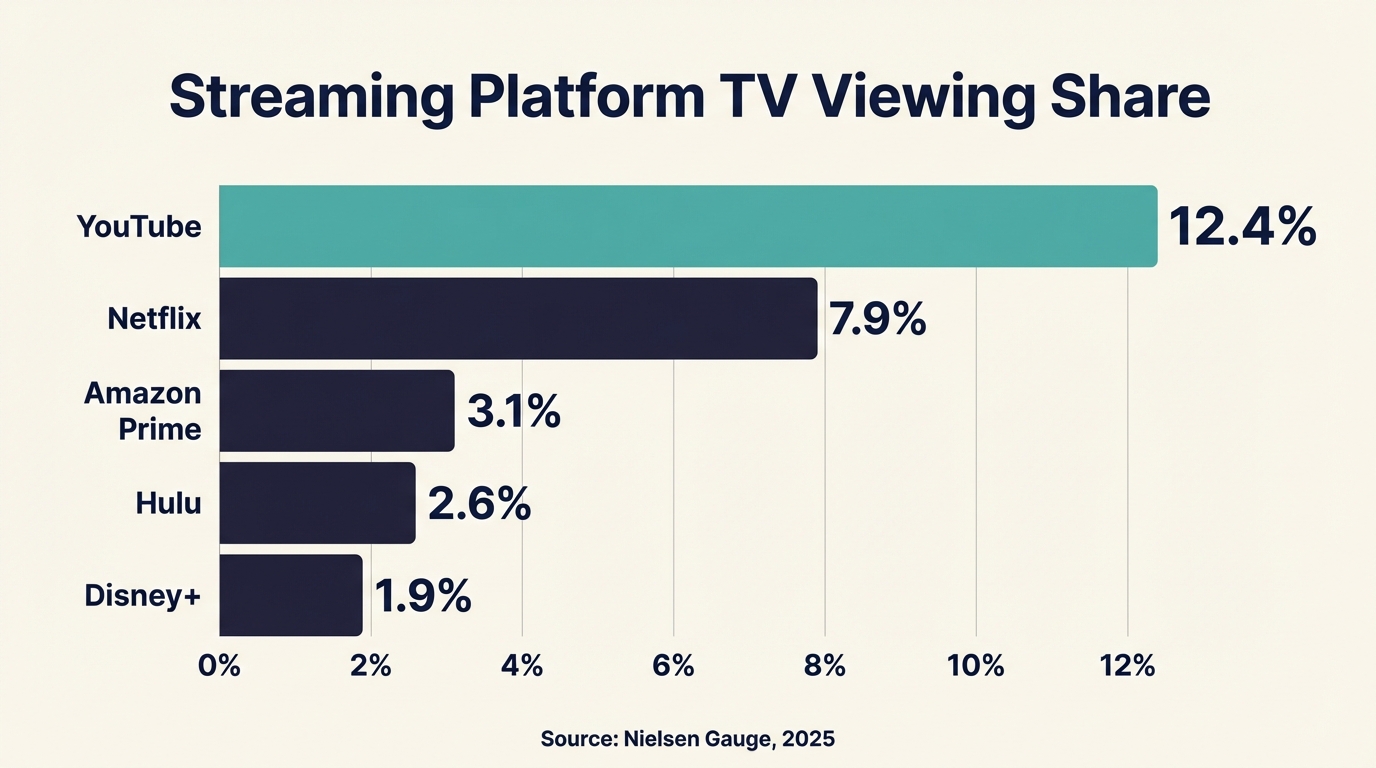
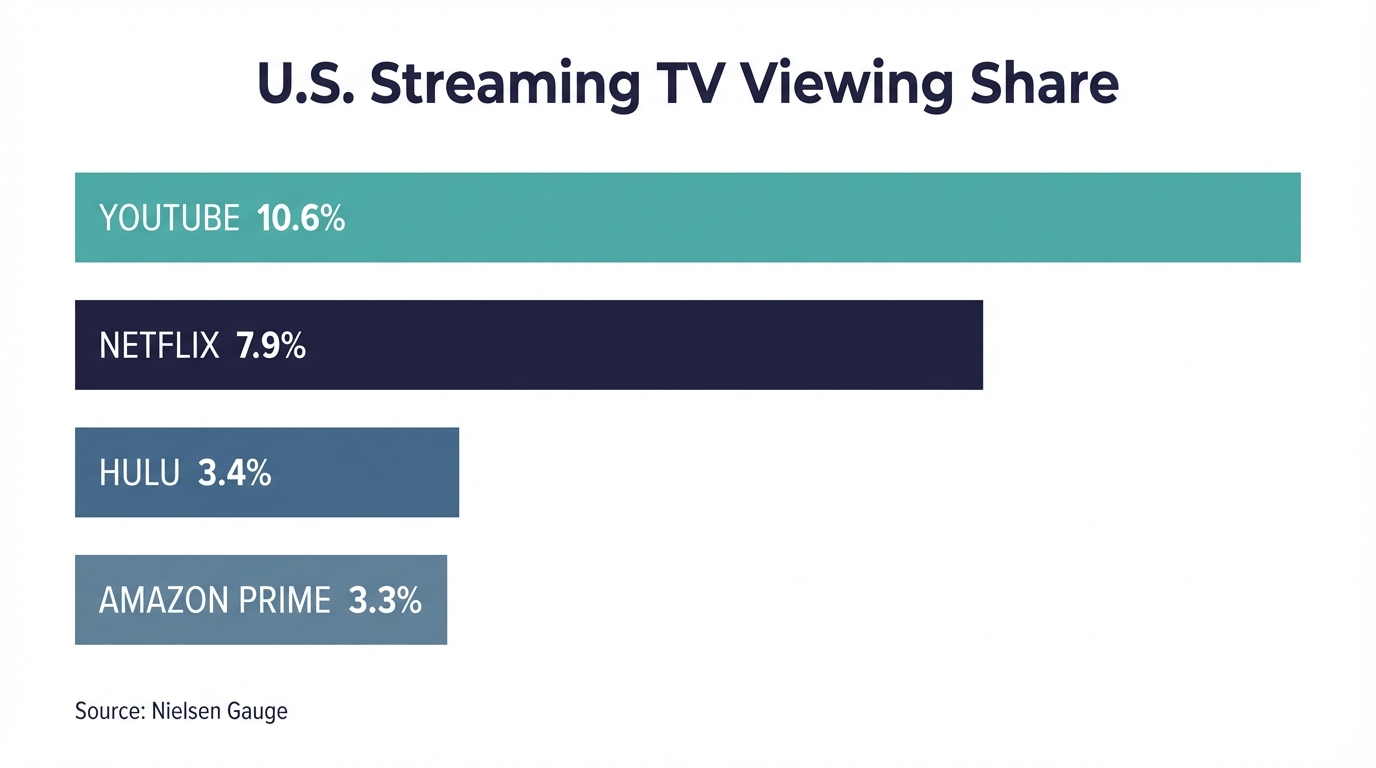
<p>YouTube commands 12.4% of total U.S. TV viewing time, making it the single largest streaming platform by viewing share, according to <a href="https://www.nielsen.com/news-center/2025/youtube-maintains-largest-share-of-tv-viewing-among-media-companies-for-third-consecutive-month/">Nielsen&#39;s April 2025 Media Distributor Gauge report</a>. That means YouTube now commands more TV attention than Netflix, Hulu, Disney+, or any other streaming service. For the third consecutive month, YouTube has maintained its lead among media companies, capturing the attention of millions of Americans on the biggest screen in the house.</p>
<p>This dominance represents a seismic shift in how Americans consume video content. Just five years ago, YouTube was primarily associated with mobile phones and laptop screens. Today, it has become the centerpiece of living room entertainment, fundamentally reshaping the advertising landscape and creating unprecedented opportunities for businesses of all sizes to reach audiences through TV advertising.</p>
<p>For small business owners who have always assumed TV advertising was out of reach, this shift opens new doors. Where traditional TV advertising required six-figure budgets and agency relationships, <a href="https://adwave.com/resources/what-is-connected-tv-advertising">connected TV advertising</a> now makes it possible to reach these same audiences starting at just $50.</p>
<h2 id="what-the-data-shows">What the data shows</h2>
<p>The numbers behind YouTube&#39;s TV dominance tell a compelling story of rapid growth and sustained leadership in an increasingly competitive streaming landscape.</p>
<p>According to <a href="https://www.nielsen.com/data-center/the-gauge/">Nielsen&#39;s Gauge reports</a> for 2025, here&#39;s how YouTube&#39;s TV viewing share has evolved:</p>
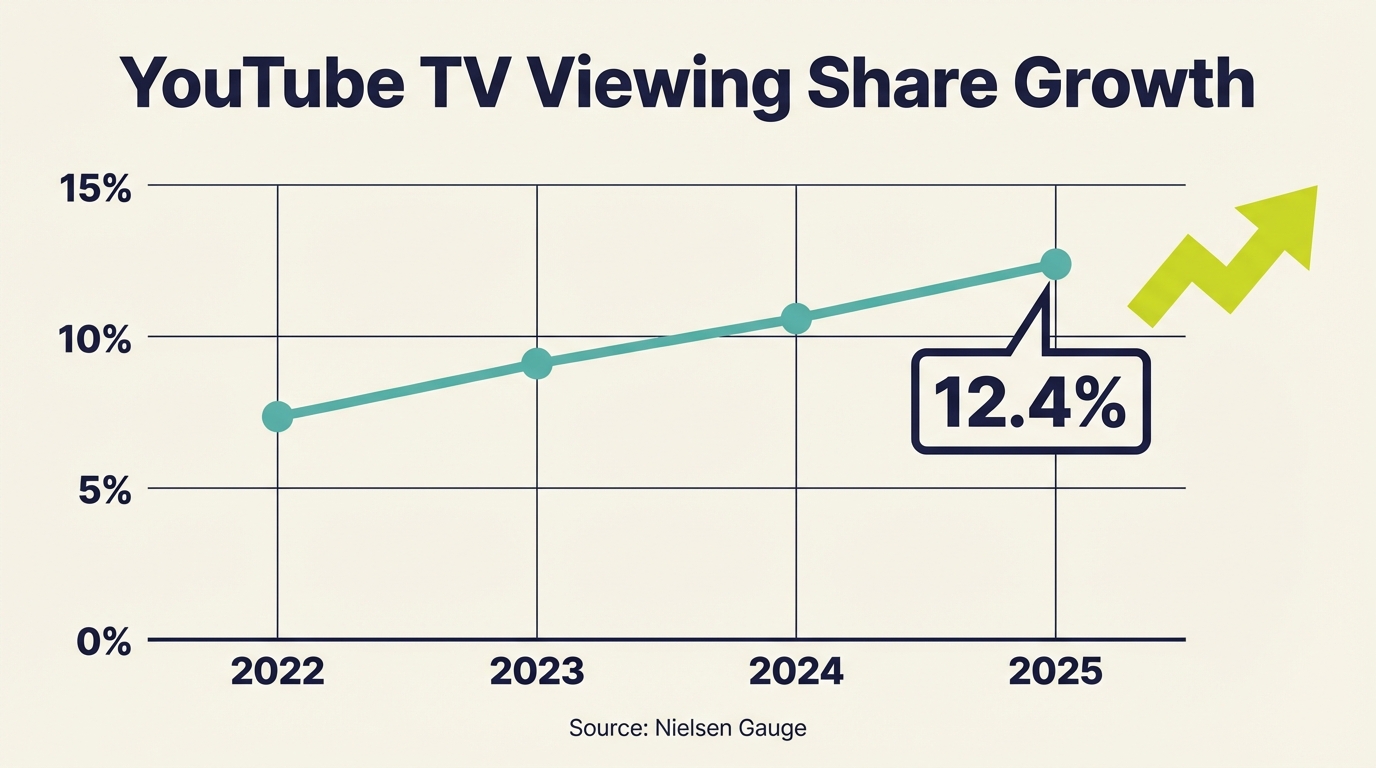
<ul><li><p><b>12.4% share in April 2025</b>: YouTube&#39;s highest share recorded at that time, representing audiences&#39; time spent watching TV</p></li><li><p><b>13.4% share in July 2025</b>: YouTube reached its peak share mid-year, according to <a href="https://variety.com/2025/tv/news/youtube-remains-top-most-watched-streamer-nielsen-1236498774/">Variety&#39;s Nielsen analysis</a></p></li><li><p><b>12.6% share in September 2025</b>: A slight pullback but still commanding a dominant position per <a href="https://videoweek.com/2025/10/23/youtubes-us-tv-viewing-share-drops-for-second-consecutive-month/">VideoWeek reporting</a></p></li><li><p><b>+2.8 percentage points YoY growth</b>: YouTube&#39;s share increased by 2.8 points compared to April 2024, according to <a href="https://www.netinfluencer.com/youtube-achieves-highest-viewership-in-april-per-nielsen/">NetInfluencer&#39;s analysis</a></p></li><li><p><b>4-point lead over Disney</b>: YouTube widened its lead over second-place Disney (9.4%) by 4 share points according to <a href="https://www.mediaplaynews.com/nielsen-youtube-expands-household-tv-market-share-lead/">MediaPlayNews</a></p></li><li><p><b>11.6% share in February 2025</b>: YouTube moved to the top spot earlier in the year according to <a href="https://www.hollywoodreporter.com/business/business-news/youtube-most-tv-use-us-february-2025-1236171731/">Hollywood Reporter</a></p></li></ul>
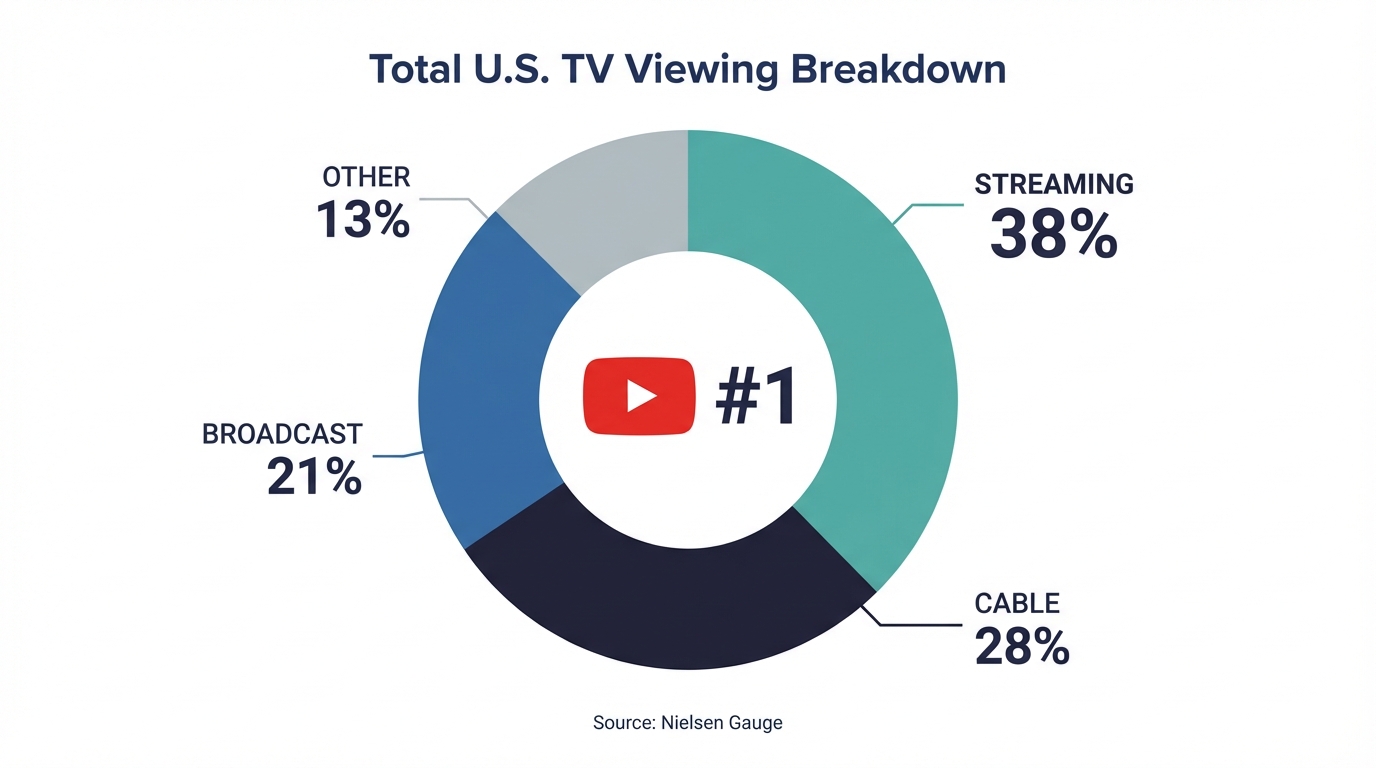
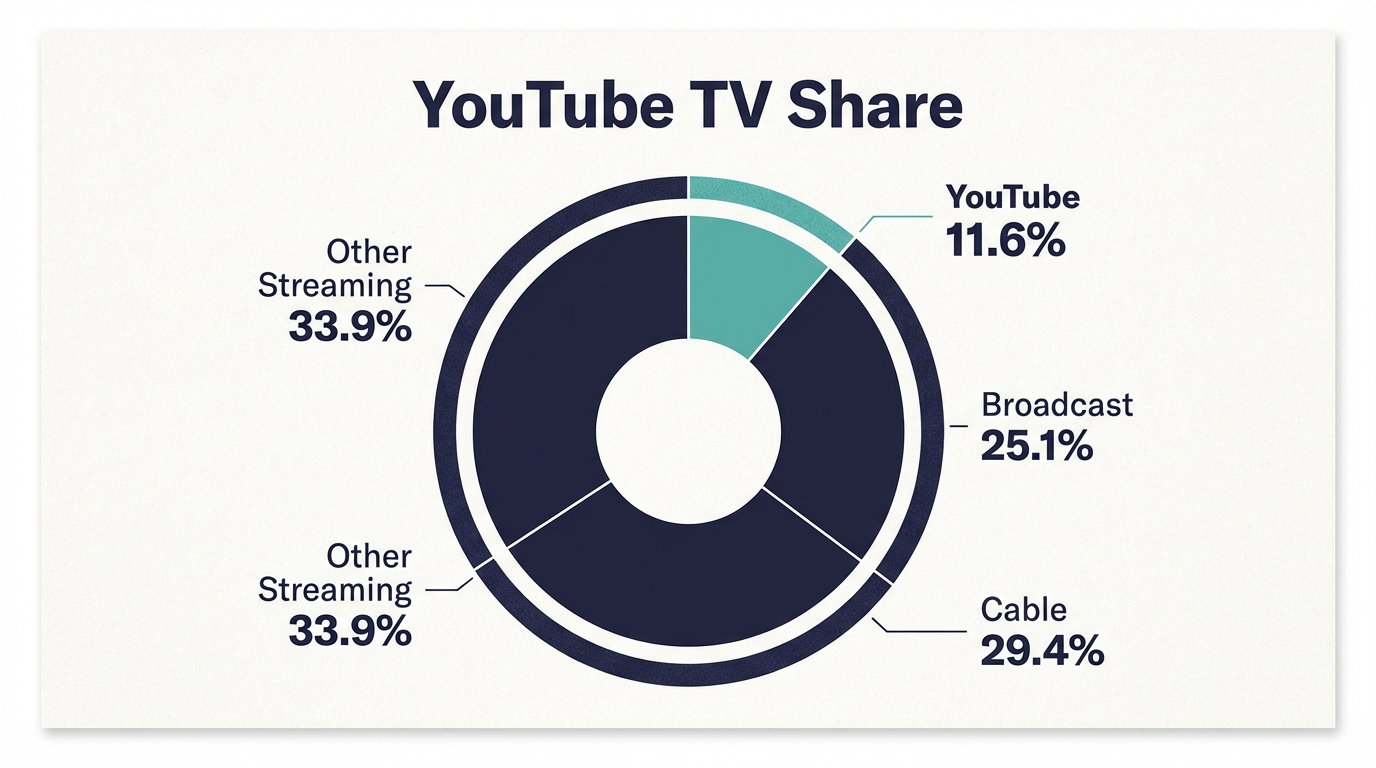
<p>To put these numbers in perspective, the entire streaming category represented 44.8% of TV viewership in May 2025, which Nielsen reported as <a href="https://www.nielsen.com/news-center/2025/streaming-reaches-historic-tv-milestone-eclipses-combined-broadcast-and-cable-viewing-for-first-time/">a historic milestone</a> when streaming eclipsed combined broadcast (20.1%) and cable (24.1%) viewing for the first time. YouTube alone accounts for more than a quarter of all streaming viewership.</p>
<p>The platform&#39;s growth trajectory is particularly impressive when you consider the competitive landscape. YouTube isn&#39;t just competing with other streaming services; it&#39;s winning against Netflix, Amazon Prime Video, Hulu, Disney+, and dozens of other platforms all vying for viewer attention. The fact that a free, ad-supported platform has emerged as the leader speaks volumes about changing consumer preferences and the effectiveness of YouTube&#39;s content strategy.</p>
<p>For advertisers, this means YouTube on TV represents one of the largest audiences available for video advertising, rivaling or exceeding the reach of traditional broadcast networks during prime time.</p>
<figure class="embedded-asset"><img src="https://media.adwave.com/fia320z3blxi/5o6mHGw1IY2tS2YI9SHn90/86b1495f60365d7952b3e922b933c11e/platform-comparison.png" alt="YouTube TV Viewing Share - Platform Comparison" loading="lazy" /></figure>
<h2 id="breaking-down-the-numbers">Breaking down the numbers</h2>
<figure class="embedded-asset"><img src="https://media.adwave.com/fia320z3blxi/13aDFn8C94BZKE8QTzKsOh/4fe1d66ef0a2ed814be6fcbe73af2688/chart-platform-comparison.png" alt="Chart Platform Comparison" loading="lazy" /></figure>
<p>Understanding who watches YouTube on TV is just as important as knowing how much they watch. The platform&#39;s audience demographics reveal valuable insights for advertisers and marketers.</p>
<h3 id="age-demographics">Age demographics</h3>
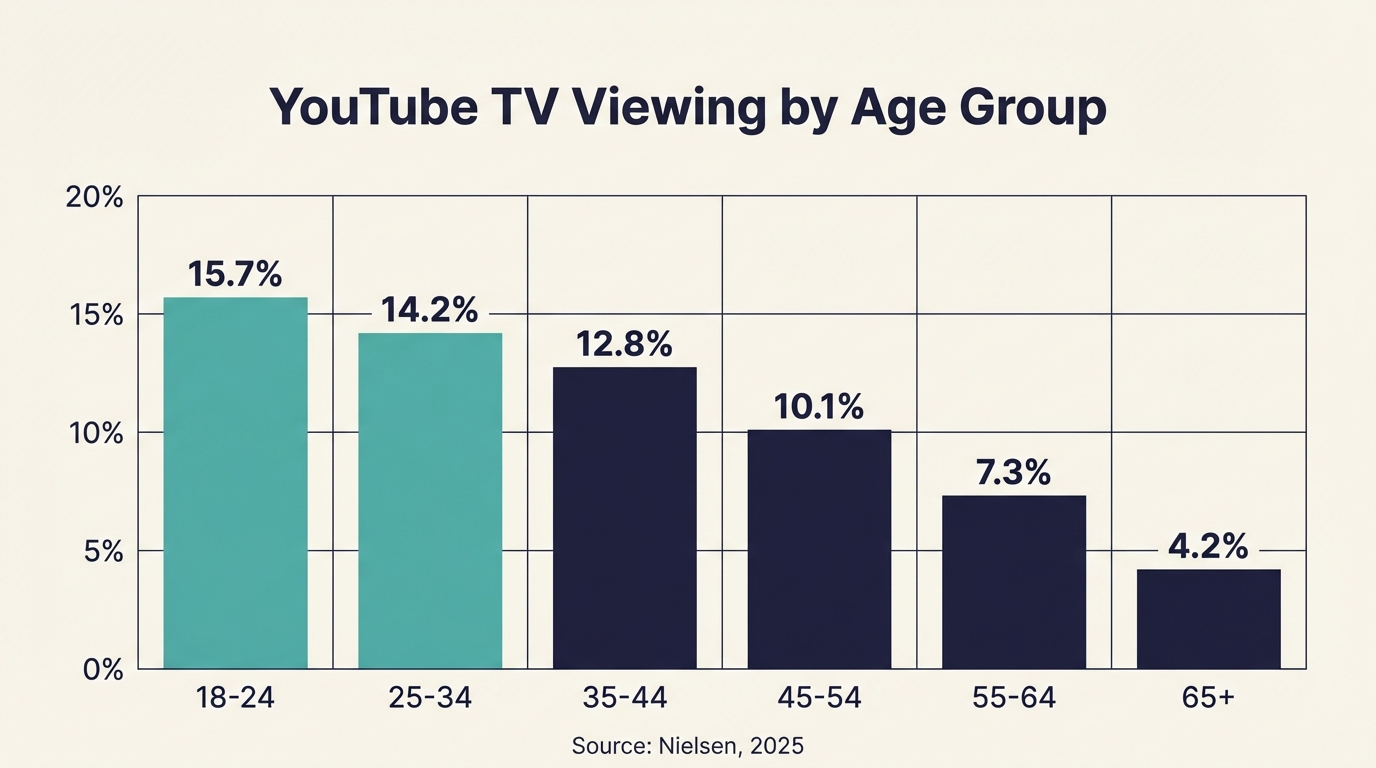
<p>YouTube&#39;s TV audience skews younger than traditional television, but the platform has significant reach across all age groups:</p>
<ul><li><p><b>15.7% of users are aged 18-24</b>: Young adults who grew up with YouTube</p></li><li><p><b>21.5% are aged 25-34</b>: YouTube&#39;s largest demographic segment according to <a href="https://www.demandsage.com/youtube-stats/">DemandSage</a></p></li><li><p><b>17.9% are aged 35-44</b>: Mid-career professionals and young families</p></li><li><p><b>12.9% are aged 45-54</b>: An often-overlooked but significant segment</p></li><li><p><b>9.4% are aged 55-64</b>: Baby boomers increasingly adopting streaming</p></li></ul>
<p>According to <a href="https://www.globalmediainsight.com/blog/youtube-users-statistics/">Global Media Insight&#39;s YouTube statistics</a>, the 25-34 age group represents YouTube&#39;s largest audience segment worldwide. This is particularly valuable for advertisers because this demographic is often considered the most desirable for marketers: they have disposable income, are forming brand loyalties, and are highly engaged digital consumers.</p>
<h3 id="gender-breakdown">Gender breakdown</h3>
<p>YouTube&#39;s audience composition shows a slight male skew, though the platform reaches both genders effectively:</p>
<ul><li><p><b>54% male users</b>: A slight majority of YouTube&#39;s viewing population</p></li><li><p><b>46% female users</b>: Significant reach among women as well</p></li></ul>
<p>This relatively balanced gender distribution makes YouTube an effective platform for reaching broad audiences, whether you&#39;re marketing products or services aimed at men, women, or mixed households.</p>
<h3 id="device-and-viewing-context">Device and viewing context</h3>
<p>The shift to TV viewing represents a fundamental change in how people consume YouTube content:</p>
<ul><li><p><b>Living room viewing dominates</b>: More YouTube content is now consumed on TV screens than ever before</p></li><li><p><b>Shared viewing experiences</b>: Unlike mobile, TV viewing often involves multiple household members</p></li><li><p><b>Longer viewing sessions</b>: TV viewers typically watch for longer periods compared to mobile users</p></li><li><p><b>Prime time competition</b>: YouTube now competes directly with traditional TV programming for evening attention</p></li></ul>
<p>For <a href="https://adwave.com/resources/how-to-advertise-on-tv">small business TV advertising</a>, this means your YouTube ads can reach viewers in the most impactful context: relaxed, attentive, and watching on a large screen.</p>
<h3 id="content-preferences-on-tv">Content preferences on TV</h3>
<p>What are people watching on YouTube via their TVs? The content mix differs from mobile viewing:</p>
<ul><li><p><b>Long-form content</b>: Documentaries, vlogs, and educational content perform well on TV</p></li><li><p><b>Music and music videos</b>: Background entertainment for households</p></li><li><p><b>Sports highlights and commentary</b>: Particularly popular among male viewers</p></li><li><p><b>Kids&#39; content</b>: YouTube remains a go-to for children&#39;s entertainment</p></li><li><p><b>Podcasts and talk shows</b>: Audio-visual podcasts gaining TV traction</p></li></ul>
<figure class="embedded-asset"><img src="https://media.adwave.com/fia320z3blxi/41efnaKD0Ys4l7Ejy1S1x0/1465ea4d7eef7f97d235057fa6116e66/age-demographics.png" alt="YouTube TV Viewing Share - Age Demographics" loading="lazy" /></figure>
<h2 id="why-it-matters-for-your-business">Why it matters for your business</h2>
<p>YouTube&#39;s dominance in TV viewing creates specific opportunities and implications for businesses, especially small and medium-sized companies that have traditionally been priced out of television advertising.</p>
<h3 id="the-democratization-of-tv-advertising">The democratization of TV advertising</h3>
<p>For decades, TV advertising was reserved for brands with massive budgets. A national TV campaign could easily cost millions of dollars, and even local cable advertising required tens of thousands. YouTube&#39;s rise as the top TV platform has coincided with the democratization of TV advertising through connected TV (CTV) platforms.</p>
<p>Today, platforms like <a href="https://adwave.com/how-it-works">Adwave</a> allow small businesses to run TV ads on premium channels, including YouTube, starting at just $50. This represents a fundamental shift in who can access TV audiences.</p>
<h3 id="reaching-cord-cutters-and-cord-nevers">Reaching cord-cutters and cord-nevers</h3>
<p>One of the most significant advantages of advertising through YouTube and other streaming platforms is the ability to reach audiences who are increasingly difficult to find through traditional TV:</p>
<ul><li><p><b>Cord-cutters</b>: Households that have cancelled cable or satellite subscriptions</p></li><li><p><b>Cord-nevers</b>: Younger viewers who never subscribed to traditional TV in the first place</p></li><li><p><b>Light TV viewers</b>: People who watch sparingly but engage heavily with streaming</p></li></ul>
<p>According to <a href="https://adwave.com/resources/us-tv-viewing-share-streaming">cord-cutting statistics</a>, streaming now represents over 47% of all TV viewing time. If your target audience includes anyone under 50, you likely need a streaming strategy to reach them effectively.</p>
<h3 id="the-attention-advantage">The attention advantage</h3>
<p>YouTube viewers on TV represent a particularly valuable audience for several reasons:</p>
<ol><li><p><b>Active choosing</b>: Unlike traditional TV where viewers might passively watch whatever is on, YouTube viewers actively choose content</p></li><li><p><b>Lean-in engagement</b>: The large screen format encourages focused viewing rather than second-screen behavior</p></li><li><p><b>Less ad fatigue</b>: With fewer ads than traditional TV, each ad exposure carries more weight</p></li><li><p><b>Skip-resistant formats</b>: YouTube&#39;s non-skippable ad formats ensure your message gets delivered</p></li></ol>
<h3 id="local-targeting-meets-massive-scale">Local targeting meets massive scale</h3>
<p>One of YouTube&#39;s unique advantages for small businesses is the combination of massive scale with precise targeting capabilities. You can reach millions of potential customers while still targeting specific:</p>
<ul><li><p><b>Geographic areas</b>: Target by ZIP code, city, or DMA</p></li><li><p><b>Demographics</b>: Age, gender, household income, and more</p></li><li><p><b>Interests</b>: Based on viewing behavior and content preferences</p></li><li><p><b>Life events</b>: Reaching people during key purchasing moments</p></li></ul>
<p>This combination makes YouTube an ideal platform for <a href="https://adwave.com/resources/local-tv-advertising-costs">local TV advertising</a> that can compete with national brands for local attention.</p>
<figure class="embedded-asset"><img src="https://media.adwave.com/fia320z3blxi/7fQqvKCVvWWpJEuiiEobfO/b4b5f7d388bd96b997f06da3bf015cf4/business-opportunity.png" alt="YouTube TV Viewing Share - Business Opportunity" loading="lazy" /></figure>
<h2 id="how-to-take-advantage-of-this-trend">How to take advantage of this trend</h2>
<figure class="embedded-asset"><img src="https://media.adwave.com/fia320z3blxi/i2oDRksMwzDneIecDJPLD/110deed9ff9b25edbb5265acefc54885/chart-tv-breakdown.png" alt="Chart Tv Breakdown" loading="lazy" /></figure>
<p>Understanding YouTube&#39;s TV dominance is one thing; capitalizing on it is another. Here&#39;s a practical guide for businesses looking to tap into this massive audience.</p>
<h3 id="step-1-understand-your-audience-on-youtube">Step 1: Understand your audience on YouTube</h3>
<p>Before investing in YouTube TV advertising, take time to understand if your target audience aligns with YouTube&#39;s demographics:</p>
<ul><li><p><b>Best fit</b>: B2C products and services, local businesses, e-commerce brands, restaurants, real estate, automotive, healthcare</p></li><li><p><b>Consider carefully</b>: B2B services with narrow enterprise targets (though YouTube can still work for brand awareness)</p></li><li><p><b>Think about context</b>: What content might your ideal customers be watching?</p></li></ul>
<h3 id="step-2-choose-the-right-advertising-approach">Step 2: Choose the right advertising approach</h3>
<p>There are several ways to advertise on YouTube through TV screens:</p>
<p><b>Direct YouTube Ads (Google Ads)</b></p>
<ul><li><p>Requires Google Ads account and creative expertise</p></li><li><p>Offers precise targeting and bidding control</p></li><li><p>Can be complex for beginners</p></li><li><p>Higher minimum budgets typically needed</p></li></ul>
<p><b>Connected TV platforms (like Adwave)</b></p>
<ul><li><p>Simplified interface for small businesses</p></li><li><p>Access to YouTube and 100+ other channels</p></li><li><p>AI-powered ad creation (no video production needed)</p></li><li><p>$50 minimum budget to start</p></li></ul>
<p>For most small businesses, starting with a <a href="https://adwave.com/resources/what-is-connected-tv-advertising">CTV platform</a> provides the easiest entry point with the lowest risk.</p>
<h3 id="step-3-create-tv-ready-content">Step 3: Create TV-ready content</h3>
<p>YouTube TV ads need to work on the big screen. Consider:</p>
<ul><li><p><b>Clear visuals</b>: Ensure text and images are readable from across the room</p></li><li><p><b>Strong audio</b>: Many TV viewers watch with sound on (unlike mobile)</p></li><li><p><b>Compelling hook</b>: You have seconds to capture attention</p></li><li><p><b>Clear call-to-action</b>: Tell viewers exactly what to do next</p></li><li><p><b>Appropriate length</b>: 15-30 second spots work best</p></li></ul>
<p>Don&#39;t have video? Platforms like Adwave use AI to create <a href="https://adwave.com/resources/ai-tv-commercials-small-business">professional TV commercials</a> from your existing assets.</p>
<h3 id="step-4-set-realistic-budgets-and-expectations">Step 4: Set realistic budgets and expectations</h3>
<p>Getting started with YouTube TV advertising doesn&#39;t require a massive budget, but it does require realistic expectations:</p>
<ul><li><p><b>$50-$100</b>: Test the waters, gather data, learn what works</p></li><li><p><b>$200-$500</b>: Run a meaningful two-week campaign with measurable results</p></li><li><p><b>$500-$2,000/month</b>: Sustained presence with consistent brand building</p></li></ul>
<p>Remember that TV advertising, including YouTube, works best for brand awareness and consideration. Don&#39;t expect direct-response metrics like those from search ads.</p>
<h3 id="step-5-measure-what-matters">Step 5: Measure what matters</h3>
<p>Track these metrics to understand your YouTube TV advertising performance:</p>
<ul><li><p><b>Impressions</b>: How many times your ad was shown</p></li><li><p><b>Completion rate</b>: How many viewers watched your entire ad</p></li><li><p><b>Brand lift</b>: Changes in brand awareness and consideration</p></li><li><p><b>Website visits</b>: Traffic increases correlated with campaign timing</p></li><li><p><b>Store visits</b>: For local businesses, foot traffic changes</p></li></ul>
<h2 id="the-bigger-picture">The bigger picture</h2>
<p>YouTube&#39;s rise to TV dominance is part of a larger transformation in how Americans consume video content. Understanding this broader context helps explain why this trend matters and where it&#39;s heading.</p>
<h3 id="the-streaming-revolution-reaches-maturity">The streaming revolution reaches maturity</h3>
<p>In May 2025, streaming achieved a historic milestone: for the first time ever, streaming viewership (44.8%) exceeded the combined total of broadcast (20.1%) and cable (24.1%) television. This wasn&#39;t a temporary blip; it represented the culmination of a decade-long shift in viewing habits.</p>
<p>YouTube&#39;s position at the top of this streaming hierarchy is particularly significant because:</p>
<ol><li><p><b>It&#39;s free and ad-supported</b>: Unlike Netflix or Disney+, YouTube&#39;s growth hasn&#39;t been limited by subscription barriers</p></li><li><p><b>It&#39;s infinitely diverse</b>: From professional content to user-generated videos, YouTube offers something for everyone</p></li><li><p><b>It&#39;s already on every device</b>: Years of platform development mean YouTube is pre-installed on virtually every smart TV</p></li></ol>
<h3 id="the-advertising-implications">The advertising implications</h3>
<p>For the advertising industry, YouTube&#39;s TV dominance has profound implications:</p>
<ul><li><p><b>Shifted attention</b>: Ad dollars are following viewers from traditional TV to streaming</p></li><li><p><b>New measurement challenges</b>: Traditional TV metrics don&#39;t directly apply to streaming</p></li><li><p><b>Democratized access</b>: Smaller advertisers can now compete for TV attention</p></li><li><p><b>Changed creative requirements</b>: Ads need to work in both skippable and non-skippable contexts</p></li></ul>
<p>According to <a href="https://adwave.com/resources/ctv-advertising-statistics-2025">CTV advertising statistics</a>, connected TV ad spending continues to grow at double-digit rates as advertisers recognize where audiences have moved.</p>
<h3 id="what-this-means-for-the-future">What this means for the future</h3>
<p>Several trends suggest YouTube&#39;s TV dominance will continue:</p>
<ul><li><p><b>Smart TV penetration</b>: As more households upgrade to smart TVs, YouTube access becomes even more universal</p></li><li><p><b>Content investment</b>: YouTube continues investing in premium content and creator partnerships</p></li><li><p><b>Advertising effectiveness</b>: Early results show CTV ads deliver strong ROI, encouraging more ad spend</p></li><li><p><b>Generational habits</b>: Younger viewers who grew up with YouTube will carry these habits forward</p></li></ul>
<p>For small businesses, the message is clear: YouTube on TV is not a niche or experimental channel. It&#39;s mainstream, and it&#39;s where your customers are increasingly spending their attention.</p>
<figure class="embedded-asset"><img src="https://media.adwave.com/fia320z3blxi/3eePepyRNrkH6A2uNpT0v7/fcef20a61e959d13294afebab91a07cd/growth-trend.png" alt="YouTube TV Viewing Share - Growth Trend" loading="lazy" /></figure>
<h2 id="what-experts-are-saying">What experts are saying</h2>
<figure class="embedded-asset"><img src="https://media.adwave.com/fia320z3blxi/1YsgXgVvPcCzjvXq8Yq97m/1d87000998c100ec897f6194fe53f5d4/concept-youtube-streaming.png" alt="Concept Youtube Streaming" loading="lazy" /></figure>
<p>Industry analysts and marketing experts have taken note of YouTube&#39;s TV viewing dominance, offering perspectives on what it means for advertisers.</p>
<p><a href="https://barrettmedia.com/2025/05/27/youtube-maintains-largest-share-of-tv-viewing-for-third-straight-month/">Barrett Media reported</a> that &quot;YouTube held its position as the top media company in Nielsen&#39;s April 2025 Media Distributor Gauge report, capturing 12.4% of audiences&#39; time spent watching TV.&quot; The publication noted this represented the platform&#39;s highest share to date at that time.</p>
<p><a href="https://www.hollywoodreporter.com/business/business-news/youtube-most-tv-use-us-february-2025-1236171731/">The Hollywood Reporter observed</a> that &quot;YouTube moved to the top spot in February&#39;s media distributor rankings from Nielsen, scoring 11.6 percent of all TV use in the U.S.&quot; This marked an important inflection point as YouTube surpassed traditional media companies.</p>
<p>Nielsen&#39;s own analysis highlighted that YouTube&#39;s growth has been particularly impressive among younger demographics, with the platform serving as a primary TV source for viewers under 35. This suggests the trend will only strengthen as these viewers age and increase their overall TV consumption.</p>
<p>Marketing experts recommend that advertisers treat YouTube as a core TV channel rather than a separate digital platform. The viewing context (big screen, living room, often shared viewing) means YouTube TV ads function more like traditional TV spots than like mobile video ads.</p>
<h2 id="common-questions-answered">Common questions answered</h2>
<h3 id="how-does-youtube-compare-to-netflix-in-tv-viewing-share">How does YouTube compare to Netflix in TV viewing share?</h3>
<p>YouTube (12.4%) has surpassed Netflix (7.8%) as the largest streaming platform by TV viewing share, according to Nielsen&#39;s April 2025 data. YouTube&#39;s lead is approximately 4.6 percentage points, making it the clear leader among streaming services. Netflix remains strong in subscription-based streaming, but YouTube&#39;s free, ad-supported model has allowed it to capture a larger overall audience.</p>
<h3 id="can-small-businesses-actually-advertise-on-youtube-tv">Can small businesses actually advertise on YouTube TV?</h3>
<p>Yes, absolutely. While direct YouTube advertising through Google Ads can be complex, <a href="https://adwave.com/resources/what-is-connected-tv-advertising">connected TV platforms</a> like Adwave make it possible for small businesses to reach YouTube viewers (and viewers on 100+ other streaming channels) starting at just $50. No video production experience is required, as AI tools can create professional commercials from your existing business assets.</p>
<h3 id="what-s-the-average-cpm-for-youtube-tv-advertising">What&#39;s the average CPM for YouTube TV advertising?</h3>
<p>YouTube TV CPMs typically range from $15-35 depending on targeting, seasonality, and ad format. This is competitive with traditional TV advertising and often more efficient because of better targeting capabilities. For <a href="https://adwave.com/resources/local-tv-advertising-costs">CTV advertising</a>, you can expect similar ranges when accessing YouTube through programmatic platforms.</p>
<h3 id="is-youtube-tv-viewing-growing-or-declining">Is YouTube TV viewing growing or declining?</h3>
<p>YouTube&#39;s TV viewing share has been consistently growing. The platform gained 2.8 percentage points year-over-year from April 2024 to April 2025. While there are normal monthly fluctuations (a slight dip in September 2025, for example), the overall trend remains strongly upward. As smart TV adoption continues and streaming habits solidify, YouTube&#39;s TV presence is expected to grow further.</p>
<h3 id="how-long-should-my-youtube-tv-ad-be">How long should my YouTube TV ad be?</h3>
<p>For YouTube TV advertising, 15-30 second spots typically perform best. Non-skippable formats ensure viewers see your complete message, while shorter lengths maintain attention and reduce production costs. For brand awareness campaigns, 30 seconds allows enough time to tell a story; for direct response, 15 seconds can be highly effective.</p>
<h2 id="supporting-data">Supporting data</h2>
<p>Additional statistics and research that support YouTube&#39;s TV viewing dominance:</p>
<ul><li><p><b>2.5 billion monthly users</b>: YouTube&#39;s global monthly active user base according to company data</p></li><li><p><b>1 billion+ hours watched daily</b>: Total daily YouTube viewing across all devices globally</p></li><li><p><b>100+ countries</b>: Markets where YouTube is available</p></li><li><p><b>80 languages</b>: Languages supported by the YouTube platform</p></li><li><p><b>70% of YouTube watch time</b>: Comes from mobile devices globally, but TV is the fastest-growing screen</p></li><li><p><b>$31.5 billion</b>: YouTube&#39;s advertising revenue in 2023, according to Alphabet earnings</p></li><li><p><b>#2 search engine</b>: YouTube is the second-largest search engine after Google</p></li><li><p><b>500 hours of video uploaded per minute</b>: Content volume added to YouTube continuously</p></li></ul>
<p>For current CTV and streaming advertising data, see <a href="https://adwave.com/resources/ctv-advertising-statistics-2025">Adwave&#39;s CTV Advertising Statistics 2025</a>.</p>
<p><b>Data sources used in this article:</b></p>
<ul><li><p><a href="https://www.nielsen.com/data-center/the-gauge/">Nielsen&#39;s Media Distributor Gauge</a></p></li><li><p><a href="https://www.nielsen.com/news-center/">Nielsen News Center</a></p></li><li><p><a href="https://www.demandsage.com/youtube-stats/">DemandSage YouTube Statistics</a></p></li><li><p><a href="https://www.globalmediainsight.com/blog/youtube-users-statistics/">Global Media Insight YouTube Statistics</a></p></li></ul>
<h2 id="get-started-with-tv-advertising">Get started with TV advertising</h2>
<p>YouTube&#39;s dominance in TV viewing isn&#39;t just a statistic; it&#39;s an opportunity. For the first time, small businesses can reach the same massive TV audiences that were once exclusive to Fortune 500 brands.</p>
<p><a href="https://adwave.com">Adwave</a> makes TV advertising accessible for businesses of all sizes. Create a professional TV commercial in minutes using AI, then launch it across YouTube, Hulu, Peacock, and 100+ premium channels starting at just $50.</p>
<p>No video production experience required. No massive budgets. No agencies.</p>
<p><a href="https://adwave.com/how-it-works">See how it works</a> | <a href="https://adwave.com/pricing">View pricing</a> | <a href="https://adwave.com">Create your first ad</a></p>]]></content><author><name>[{&quot;slug&quot; =&gt; &quot;david-naffis&quot;, &quot;display_name&quot; =&gt; &quot;David Naffis&quot;, &quot;first_name&quot; =&gt; &quot;David&quot;, &quot;last_name&quot; =&gt; &quot;Naffis&quot;, &quot;role&quot; =&gt; &quot;CEO&quot;, &quot;byline&quot; =&gt; &quot;Making TV advertising accessible to every business&quot;, &quot;short_biography&quot; =&gt; &quot;Co-founder and CEO building technology that makes TV advertising simple, affordable, and accessible for SMB&apos;s.&quot;, &quot;linkedin_url&quot; =&gt; &quot;https://www.linkedin.com/in/naffis/&quot;, &quot;avatar&quot; =&gt; {&quot;url&quot; =&gt; &quot;https://media.adwave.com/fia320z3blxi/5B6OdA0EbyBM0gcGfkQfvg/afefabcf228d1d5744e50882d97de1f4/naffis-headshot.png&quot;, &quot;description&quot; =&gt; &quot;&quot;, &quot;title&quot; =&gt; &quot;naffis-headshot.png&quot;}, &quot;sys&quot; =&gt; {&quot;id&quot; =&gt; &quot;3l4TGc9ngQ9b4hY02K9U6B&quot;}}]</name></author><summary type="html"><![CDATA[YouTube accounts for 10.6% of U.S. TV viewing, making it the #1 streaming platform. Nielsen data, April 2025.]]></summary><media:thumbnail xmlns:media="http://search.yahoo.com/mrss/" url="https://adwave.com/assets/images/og-default.png" /><media:content medium="image" url="https://adwave.com/assets/images/og-default.png" xmlns:media="http://search.yahoo.com/mrss/" /></entry><entry><title type="html">What is YouTube’s share of TV viewing? (Q4 2025)</title><link href="https://adwave.com/resources/youtube-tv-viewing-share-q4-2025/" rel="alternate" type="text/html" title="What is YouTube’s share of TV viewing? (Q4 2025)" /><published>2026-09-09T17:32:23+00:00</published><updated>2026-09-09T17:32:23+00:00</updated><id>https://adwave.com/resources/youtube-tv-viewing-share-q4-2025</id><content type="html" xml:base="https://adwave.com/resources/youtube-tv-viewing-share-q4-2025/"><![CDATA[<ul class="not-prose grid grid-cols-1 gap-4 xl:grid-cols-3"><li class="flex flex-col rounded-md border-2 border-primary p-8 bg-primary h-full text-white shadow-lg"><p class="text-4xl font-bold pb-4">12.7%</p><p class="text-body">YouTube&#39;s share of total U.S. TV viewing</p></li><li class="flex flex-col rounded-md border-2 border-primary p-8 bg-primary h-full text-white shadow-lg"><p class="text-4xl font-bold pb-4">#1</p><p class="text-body">Largest streaming platform by viewing share</p></li><li class="flex flex-col rounded-md border-2 border-primary p-8 bg-primary h-full text-white shadow-lg"><p class="text-4xl font-bold pb-4">+2.1pts</p><p class="text-body">Year-over-year growth in TV viewing share</p></li></ul>
<p>YouTube now commands 12.7% of all U.S. TV viewing time, making it the single largest streaming destination and the dominant force in living room entertainment, according to <a href="https://www.nielsen.com/data-center/the-gauge/">Nielsen&#39;s The Gauge</a> data for December 2025. That share has grown more than 2 percentage points since early 2025, cementing YouTube&#39;s position as the platform that&#39;s fundamentally reshaping how Americans watch television. For small businesses, this shift represents something unprecedented: the ability to reach millions of TV viewers through the same platform where they&#39;ve been building audiences for years. Here&#39;s what the latest data reveals and how to put it to work for your business.</p>
<h2 id="what-the-data-shows">What the data shows</h2>
<p>YouTube&#39;s dominance of TV viewing isn&#39;t just a trend anymore. It&#39;s the new reality of American television. The platform&#39;s 12.7% share of total TV viewing in December 2025 represents more than just a number. It represents a fundamental shift in where and how people spend their evening entertainment hours.</p>
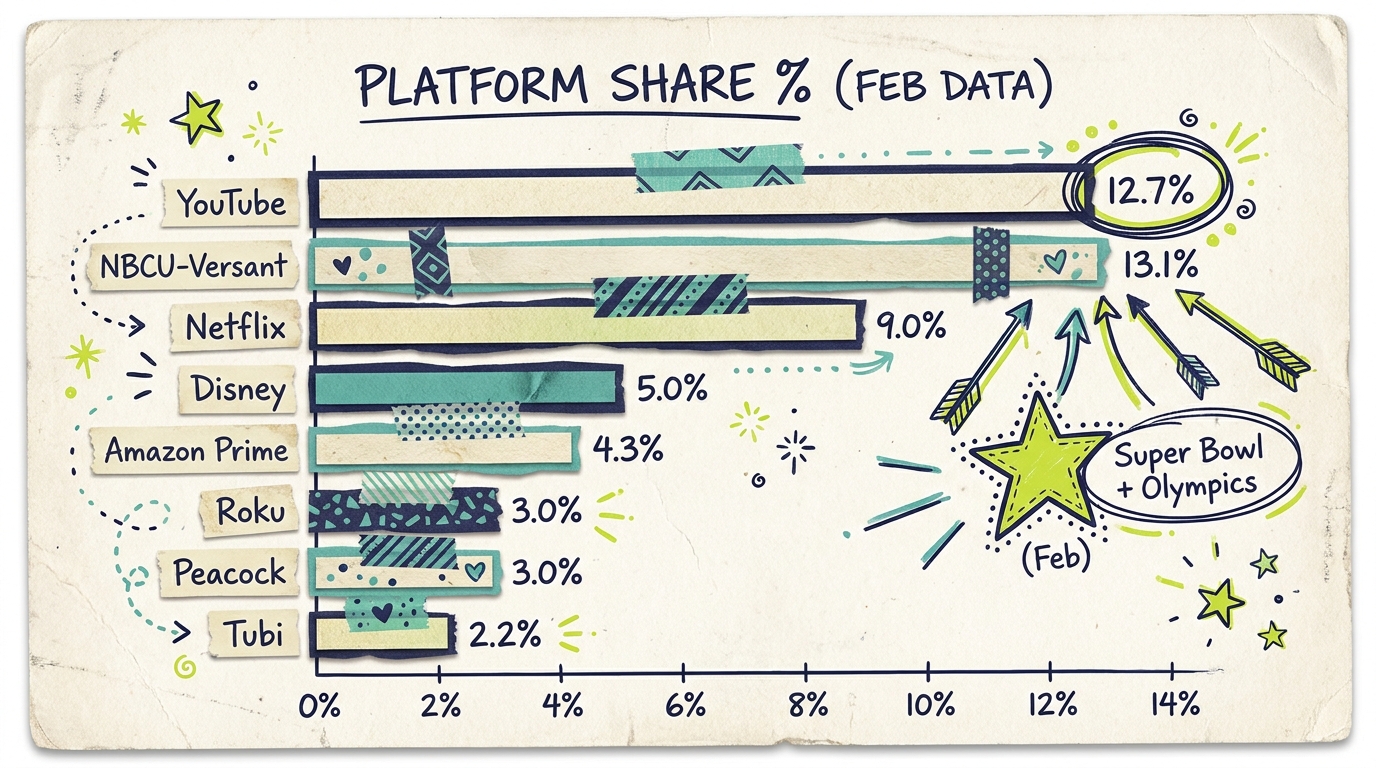
<p>To put this in perspective, YouTube now captures more TV viewing time than any other single streaming service. Netflix, long considered the streaming giant, finished December 2025 with a 9% share of TV viewing. Disney&#39;s combined properties (Disney+, Hulu, and ESPN+) reached 10.7% collectively, but as individual services, none comes close to YouTube&#39;s singular dominance. Amazon Prime Video, despite strong growth driven by Thursday Night Football, captured 4.3% of TV viewing.</p>
<p>What makes YouTube&#39;s position particularly striking is the trajectory. The platform held roughly 10.6% of TV viewing in early 2025. That 2+ percentage point gain over roughly eight months represents massive growth in an industry where fractions of a point typically make headlines. YouTube isn&#39;t just maintaining its lead. It&#39;s actively extending it.</p>
<p>The viewing patterns tell their own story about how Americans now use their televisions. YouTube viewership peaks during prime time hours from 7 to 10 PM, directly competing with scripted television and appointment viewing for household attention. This isn&#39;t background content or quick clips between other activities. This is deliberate, lean-back entertainment consumption on the biggest screen in the house.</p>
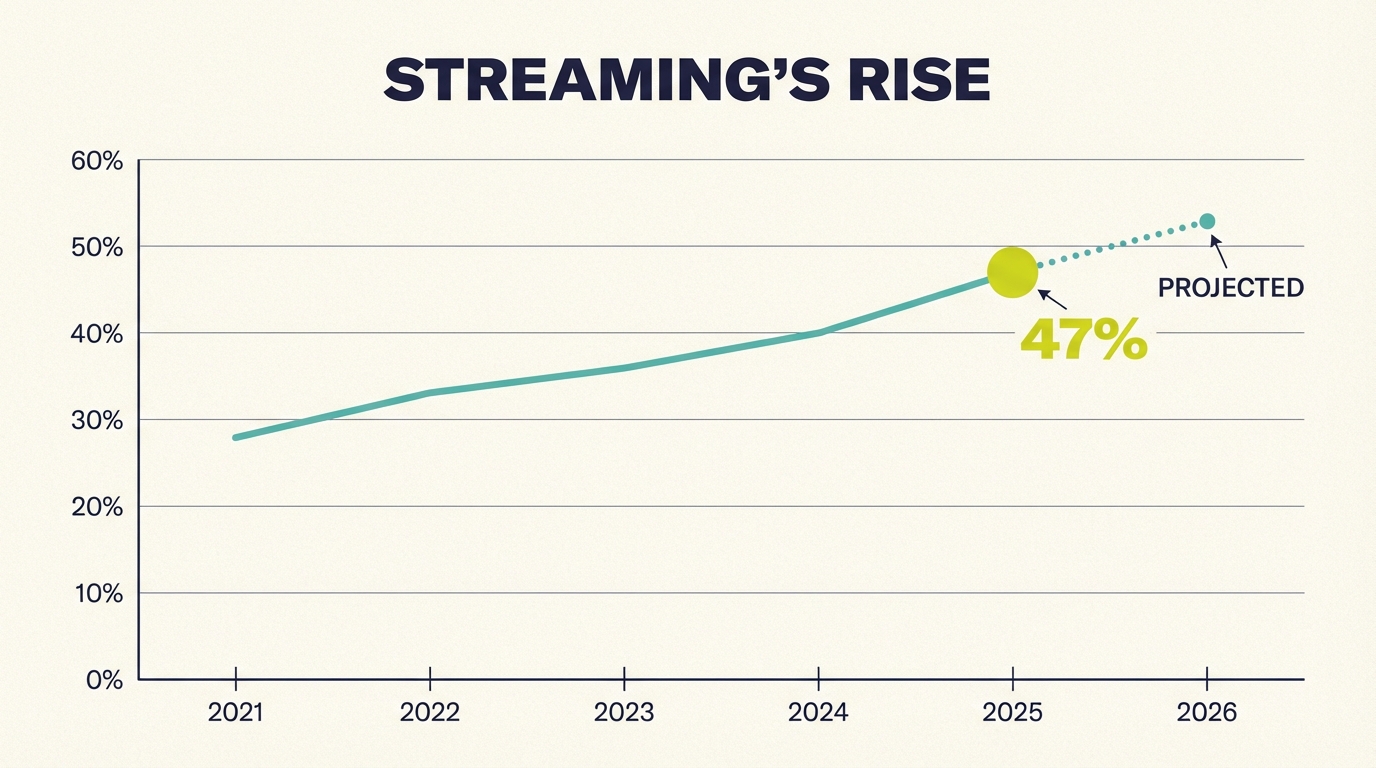
<p>December 2025 proved particularly instructive. Streaming overall captured a record 47.5% of all TV viewing for the month, eclipsing the previous record set in July 2025. Within that streaming surge, YouTube led the pack while nearly every major platform set records. Netflix grew 10% month over month. Amazon Prime Video surged 12%. The Roku Channel hit an all-time high of 3% share. But through it all, YouTube maintained its commanding lead.</p>
<p>The data also reveals something important about the nature of <a href="https://adwave.com/resources/what-is-connected-tv-advertising">connected TV advertising</a>. Unlike mobile YouTube viewing, which often happens in fragmented, distracted moments, TV-based YouTube viewing involves a different kind of attention. Viewers are typically relaxed, often watching with household members, and engaged in lean-back entertainment mode. For advertisers, that distinction matters enormously.</p>
<figure class="embedded-asset"><img src="https://media.adwave.com/fia320z3blxi/5o6mHGw1IY2tS2YI9SHn90/86b1495f60365d7952b3e922b933c11e/platform-comparison.png" alt="YouTube TV Viewing Share - Platform Comparison" loading="lazy" /></figure>
<h2 id="breaking-down-the-numbers">Breaking down the numbers</h2>
<p>Understanding the full picture requires looking beyond the headline 12.7% figure. YouTube&#39;s dominance varies significantly across different demographics, time periods, and viewing contexts, and those variations matter for how you think about reaching your customers.</p>
<h3 id="by-age-group">By age group</h3>
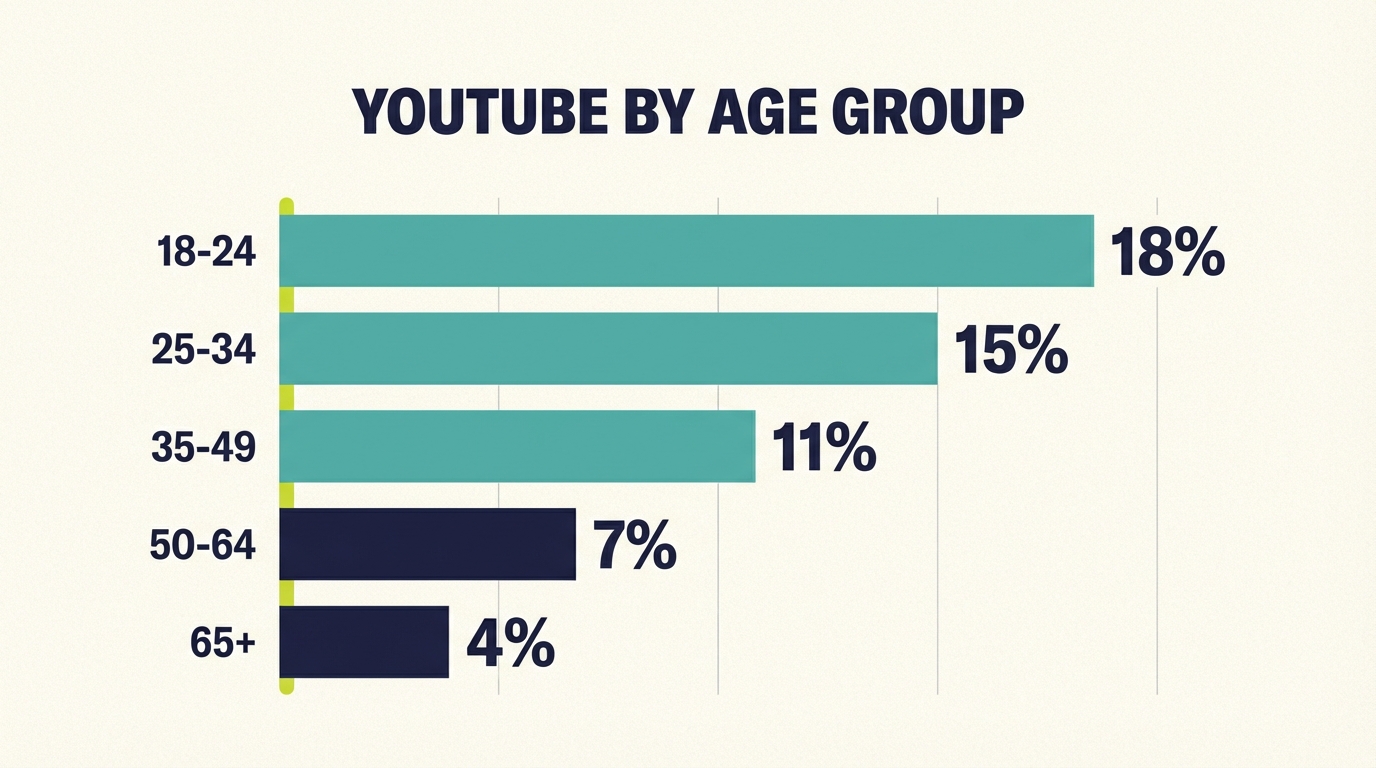
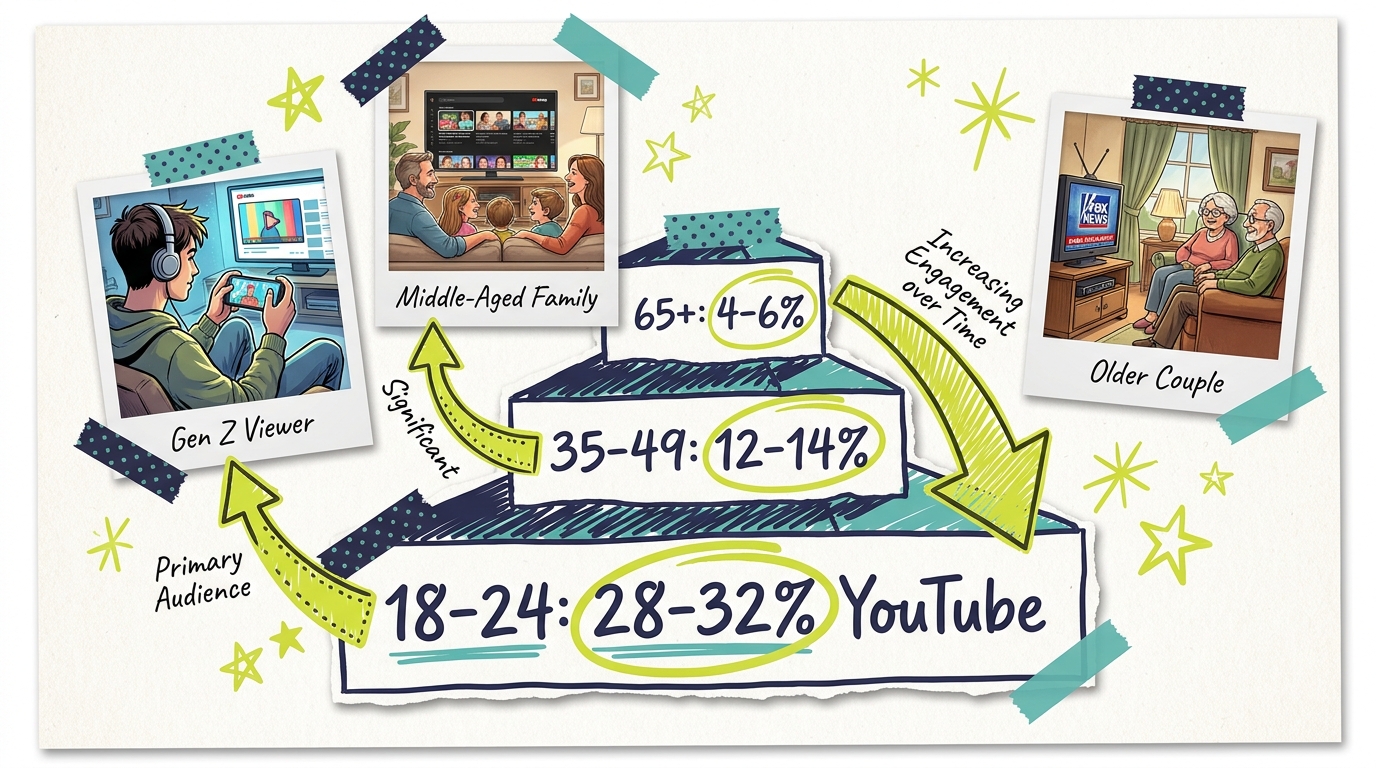
<p>The generational divide in YouTube TV viewing remains stark, though the platform&#39;s growth spans all ages. Among viewers aged 18 to 34, YouTube captures an estimated 16 to 18% of all TV viewing time, making it the dominant streaming destination for this cohort by a wide margin. That share drops to around 13% for viewers aged 35 to 49, and falls further to approximately 9% for those 50 to 64. Among viewers 65 and older, YouTube represents roughly 5 to 6% of TV time.</p>
<p>This pattern reflects viewing habits that formed over decades. Younger audiences grew up with YouTube as a primary entertainment source and naturally gravitate toward it on every screen. Older viewers, while increasingly adopting streaming, still maintain stronger connections to traditional television and services that replicate the broadcast experience.</p>
<p>The business implication is clear: if your target customers skew under 50, YouTube is increasingly where they spend their evening entertainment hours. But even for businesses targeting older demographics, YouTube&#39;s presence on TV is growing faster than most other platforms.</p>
<h3 id="by-time-of-day">By time of day</h3>
<p>YouTube&#39;s viewing patterns diverge from traditional TV in revealing ways. During daytime hours from 6 AM to 4 PM, YouTube viewing indexes higher than its overall share would suggest. Research indicates that YouTube averages around 6.3 million viewers during daytime hours on TV sets, driven partly by work-from-home flexibility and the platform&#39;s utility for background content, tutorials, and informational viewing.</p>
<p>The real competitive story unfolds during prime time. From 8 to 11 PM, YouTube competes directly with scripted television for household attention, particularly among cord-cutting households who&#39;ve abandoned cable entirely. During this window, YouTube often serves as the default destination for households deciding what to watch together.</p>
<p>After 11 PM, YouTube dominates as the platform of choice for late-night viewing. When traditional programming winds down and streaming libraries feel too demanding for tired viewers, YouTube&#39;s endless variety of content meets the moment perfectly.</p>
<h3 id="compared-to-traditional-tv">Compared to traditional TV</h3>
<p>The broader viewing landscape reveals just how dramatically television has changed:</p>
<ul><li><p><b>Streaming overall:</b> 47.5% of total TV viewing (December 2025 record)</p></li><li><p><b>Broadcast:</b> 21.4% of total TV viewing</p></li><li><p><b>Cable:</b> 20.2% of total TV viewing</p></li></ul>
<p>For the first time, streaming now captures nearly half of all TV watching in America. Cable and broadcast combined account for less than 42% of viewing, down from dominant positions just five years ago. Within streaming, YouTube&#39;s 12.7% share means it alone captures more viewing time than entire cable categories that once seemed invincible.</p>
<h3 id="platform-comparison">Platform comparison</h3>
<p>For advertisers evaluating where to spend, here&#39;s how the major streaming platforms compare:</p>
<p>What makes YouTube&#39;s position particularly valuable for advertisers is the ad model. YouTube is ad-supported by default, which means virtually all of that 12.7% viewing share represents addressable advertising inventory. Compare that to Netflix, where a significant portion of subscribers still pay for ad-free tiers, or Disney+, where premium subscribers skip ads entirely. YouTube&#39;s dominance translates more directly into advertising opportunity.</p>
<figure class="embedded-asset"><img src="https://media.adwave.com/fia320z3blxi/5UAWMjpk6MmeuiA9yUxDtE/13b5a5f45ce99559823f9ba494a6a7e4/demographics-breakdown.png" alt="YouTube TV Viewing Share - Demographics Breakdown" loading="lazy" /></figure>
<h2 id="why-it-matters-for-your-business">Why it matters for your business</h2>
<p>If your customers are spending their evenings watching YouTube on their TV, you can reach them there. And you don&#39;t need a Fortune 500 budget to make it happen.</p>
<p>YouTube&#39;s TV viewing surge means small businesses now have access to audiences on the biggest screen in the house through the same platform they&#39;ve used for years. Unlike mobile YouTube ads, which compete with notifications, text messages, and the constant pull of the next scroll, TV-delivered YouTube ads command something different: full-screen, undivided attention. Viewers are engaged, often watching with household members, and in a receptive mindset for brand messages.</p>
<p>The applications vary by business type. Local service businesses like plumbers, HVAC technicians, and <a href="https://adwave.com/resources/contractor-lead-generation">contractors</a> can target homeowners within a specific radius during evening hours, when people are thinking about home projects and services they need. Restaurants can reach hungry viewers during dinner decision-making hours or promote weekend specials to households in their delivery zone. <a href="https://adwave.com/resources/how-to-get-more-patients">Medical practices</a> can build awareness with local families watching together.</p>
<p>For <a href="https://adwave.com/resources/how-to-market-small-business-guide">small business advertising</a>, this moment is genuinely different from even five years ago. Traditional TV advertising required $50,000 or more for production costs alone, plus five-figure media buys for any meaningful reach. The gatekeepers, the agencies, the minimums, and the complexity made TV advertising effectively off-limits for most small businesses.</p>
<p>That world is over. With platforms like Adwave, you can run <a href="https://adwave.com/resources/how-to-advertise-on-tv">TV advertising</a> campaigns across YouTube and 100+ other premium channels starting at just $50. No production budget required because AI generates your commercial from your website. No agency needed. Your ad can be live in minutes, reaching the same audiences that major brands target, on the same screens where they advertise.</p>
<p>The practical implication is straightforward. If you&#39;ve built an audience on YouTube through organic content, you already understand the platform. Now you can extend that presence to the TV screen, reaching viewers in their living rooms with professional advertising that matches the premium environment.</p>
<h2 id="how-to-take-advantage-of-this-trend">How to take advantage of this trend</h2>
<p>Understanding that YouTube dominates TV viewing is useful. Knowing how to act on that information is what actually moves your business forward.</p>
<p>The smartest approach for most small businesses is to start with a test campaign. Don&#39;t overthink it or try to optimize everything from day one. Set aside $100 to $200, run for two weeks, and treat it as a learning exercise. You&#39;re gathering data about what resonates with your audience, not trying to hit a home run immediately.</p>
<p>For local businesses, geographic targeting should be your foundation. Start with a 15 to 25 mile radius around your location. This ensures you&#39;re reaching people who can actually become customers rather than wasting budget on viewers who will never visit. Most platforms, including CTV aggregators like Adwave, make this radius targeting straightforward.</p>
<p>Timing your campaigns strategically amplifies your impact. YouTube&#39;s TV viewing peaks during evening hours, particularly 7 to 10 PM when households gather for entertainment. If you&#39;re a restaurant, targeting the 5 to 7 PM window catches viewers during dinner decision time. If you&#39;re a home services business, evening hours reach homeowners when they&#39;re relaxed and thinking about household projects.</p>
<p>Creative matters, but not in the way most small businesses assume. You don&#39;t need expensive production to succeed on TV. AI-generated video from your website or social profiles can create broadcast-quality 30-second spots that match the professionalism of major brand advertising. Focus on a clear message, a compelling offer, and a memorable call to action rather than production values that exceed your budget.</p>
<p>Here&#39;s a practical starting framework:</p>
<ul><li><p><b>Budget:</b> $100 to $500 for initial two-week test</p></li><li><p><b>Targeting:</b> 15 to 25 mile radius around your business</p></li><li><p><b>Timing:</b> Evening hours (6 to 10 PM) when households are watching together</p></li><li><p><b>Creative:</b> AI-generated from your website or existing content</p></li><li><p><b>Measurement:</b> Track brand search volume, website traffic, and customer mentions</p></li></ul>
<p>Measuring success requires different thinking than performance marketing. TV advertising builds awareness and consideration, not immediate clicks. Watch for increases in brand searches on Google (are more people searching your business name?), overall website traffic during and after campaigns, and new customers mentioning they saw you on TV.</p>
<p>When you find something that works, scale deliberately. Increase budget on winning creative rather than spreading thin across variations. Consider expanding to additional streaming platforms beyond YouTube. Layer in retargeting to capture viewers who&#39;ve shown interest.</p>
<h2 id="the-bigger-picture">The bigger picture</h2>
<p>YouTube&#39;s TV dominance is part of a larger streaming revolution that&#39;s fundamentally reshaping American television. December 2025 marked a milestone: streaming captured 47.5% of all TV viewing, the highest share ever recorded. Christmas Day 2025 shattered records, with streaming generating 55.1 billion viewing minutes, only the second time daily streaming volume exceeded 50 billion minutes.</p>
<p>Cable and broadcast continue their steady decline as viewers shift to on-demand content. Broadcast finished December at 21.4% of viewing. Cable dropped to 20.2%. Together, traditional TV accounts for less than 42% of what Americans watch, down from dominant positions just years ago. The trajectory is unmistakable.</p>
<h3 id="the-ad-supported-shift">The ad-supported shift</h3>
<p>What makes this moment particularly significant for advertisers is where the growth is happening. While subscription streaming services dominate headlines, ad-supported platforms are driving much of the actual expansion. YouTube leads this charge, but the broader FAST (Free Ad-Supported Streaming TV) category is exploding. The Roku Channel grew 45% year over year and has nearly tripled since December 2023. Tubi, Pluto TV, and other free streaming services continue adding viewers.</p>
<p>This ad-supported growth creates more advertising inventory at accessible price points. When Netflix or Disney+ adds subscribers, many choose ad-free tiers that don&#39;t help advertisers. When YouTube or FAST services grow, virtually all that viewing becomes addressable advertising opportunity.</p>
<h3 id="what-s-next">What&#39;s next</h3>
<p>Industry projections suggest streaming will capture 50% or more of all TV viewing by late 2026. Within that:</p>
<ul><li><p>YouTube is expected to maintain or extend its lead as the largest single platform</p></li><li><p>Ad-supported tiers on premium services will continue expanding reach</p></li><li><p>Local advertising options will become more sophisticated and accessible</p></li><li><p>AI-generated creative will further reduce barriers to entry</p></li></ul>
<h3 id="the-democratization-of-tv-advertising">The democratization of TV advertising</h3>
<p>For small businesses, this trend is unambiguously positive. Every percentage point that shifts from linear TV to streaming represents inventory that&#39;s more targetable, more measurable, and more accessible to smaller budgets. The days when <a href="https://adwave.com/resources/how-to-advertise-small-business">TV advertising</a> required six-figure budgets are definitively over.</p>
<p>The competitive implications are significant. Businesses that embrace TV advertising now, while costs remain accessible and competition is still developing, will build brand awareness advantages that compound over time. Those who wait may find themselves competing against entrenched local competitors who&#39;ve already established TV presence.</p>
<figure class="embedded-asset"><img src="https://media.adwave.com/fia320z3blxi/5alPpzAQPPsrK40r1RHozn/85f2e1f123228513a107d37ba5b2bc94/streaming-growth-trend.png" alt="YouTube TV Viewing Share - Streaming Growth Trend" loading="lazy" /></figure>
<h2 id="what-experts-are-saying">What experts are saying</h2>
<p>Industry analysts have noted YouTube&#39;s TV growth as one of the most significant developments in media consumption.</p>
<p>Nielsen&#39;s latest Gauge report highlighted streaming&#39;s record December, noting that &quot;streaming viewership captured 47.5% of television in December 2025, eclipsing its previous record set in July 2025 to achieve the largest share of TV ever reported.&quot; Within that streaming surge, YouTube&#39;s consistent leadership demonstrates the platform&#39;s unique position bridging digital video and traditional television.</p>
<p>Media observers point to the structural advantages driving YouTube&#39;s growth. The platform offers an endless variety of content, from professional productions to creator-driven entertainment, that no other single service can match. Viewers who might exhaust a streaming library in weeks can spend years exploring YouTube&#39;s catalog.</p>
<p>The advertising industry has taken notice of what this means for marketers. With YouTube representing such a large share of ad-supported TV viewing, the platform offers reach that approaches or exceeds traditional broadcast networks, but with targeting capabilities that traditional TV never offered. Advertisers can reach specific demographics, interests, and geographic areas rather than buying broad audiences and hoping their customers are watching.</p>
<p>Trade publications have emphasized the opportunity for smaller advertisers. Marketing researchers note that YouTube&#39;s TV presence combined with accessible buying platforms means businesses of all sizes can now participate in television advertising. The barriers that once made TV the exclusive domain of large brands have largely dissolved.</p>
<p>For <a href="https://adwave.com/resources/local-business-marketing-strategies">local business marketing</a>, this expert consensus points to a clear opportunity. YouTube&#39;s TV dominance isn&#39;t a temporary blip but a structural shift that&#39;s reshaping how Americans consume content and how advertisers can reach them.</p>
<h2 id="common-questions-answered">Common questions answered</h2>
<p><b>How much of YouTube viewing happens on TV screens versus mobile?</b></p>
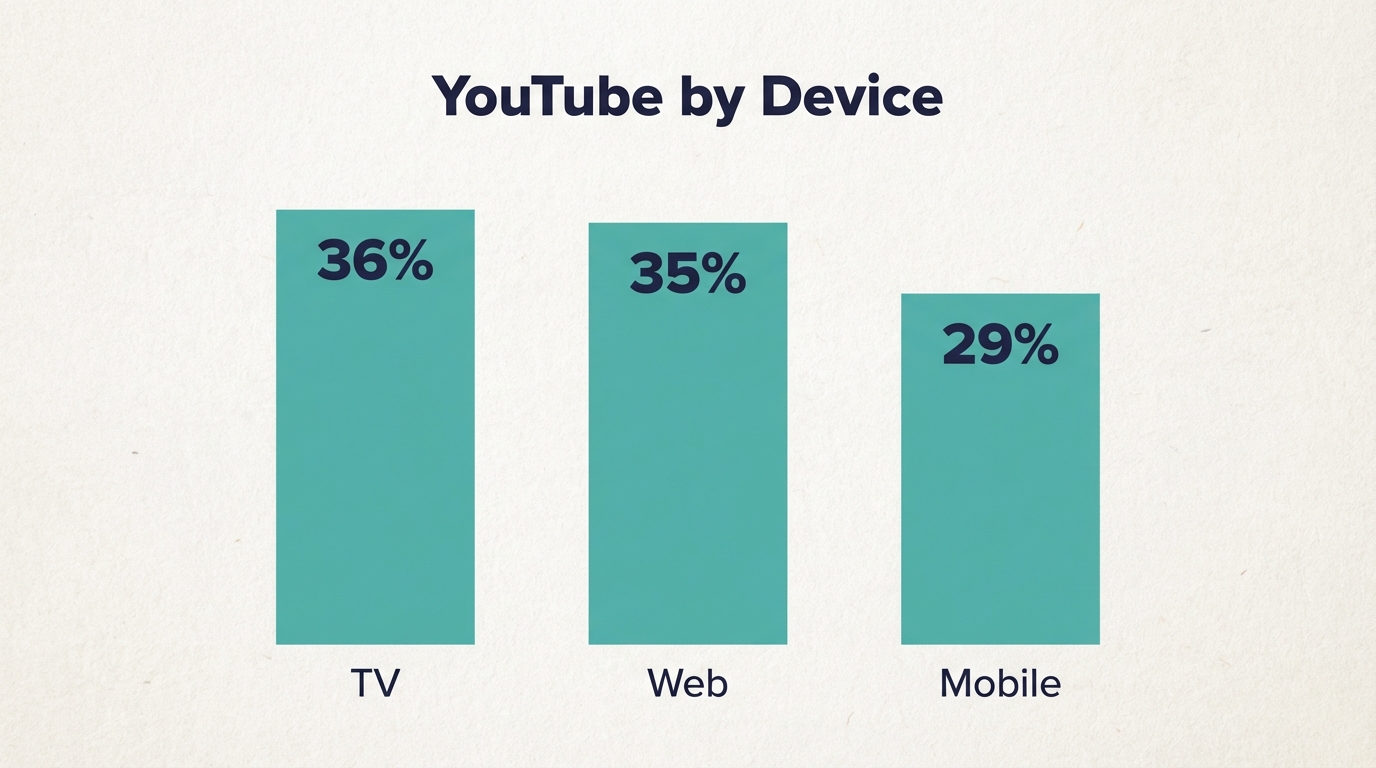
<p>YouTube&#39;s TV viewing has grown significantly, with television now representing a substantial portion of total YouTube watch time. While YouTube doesn&#39;t disclose exact splits, Nielsen data showing 12.7% of all TV viewing going to YouTube suggests tens of billions of monthly viewing minutes on television sets alone. The platform&#39;s growth on TV has outpaced its mobile growth in recent years as smart TVs and streaming devices make YouTube a natural part of the living room experience.</p>
<p><b>Is YouTube TV viewing the same as YouTube TV the subscription service?</b></p>
<p>No, these are different products. YouTube TV viewing refers to people watching regular YouTube content on their television screens through smart TV apps, streaming devices like Roku or Fire TV, or gaming consoles. YouTube TV is a separate subscription service that offers live cable channels for around $73 per month. The viewing share data discussed here covers regular YouTube viewing on televisions, not the YouTube TV subscription service.</p>
<p><b>Can small businesses actually afford to advertise on YouTube TV?</b></p>
<p>Yes, and this is one of the most significant changes in advertising over the past few years. Platforms like Adwave allow small businesses to run TV advertising campaigns, including on YouTube, starting at just $50. You don&#39;t need expensive video production because AI can generate broadcast-quality commercials from your website. The barriers that once made TV advertising exclusive to large brands have largely disappeared.</p>
<p><b>How does YouTube&#39;s TV viewing compare to Netflix?</b></p>
<p>YouTube leads Netflix significantly in TV viewing share. As of December 2025, YouTube captured 12.7% of all TV viewing compared to Netflix&#39;s 9%. This gap has widened over the past year as YouTube&#39;s share has grown while Netflix&#39;s has increased more modestly. For advertisers, YouTube&#39;s lead is even more significant because virtually all YouTube viewing is ad-supported, while a portion of Netflix viewers pay for ad-free tiers.</p>
<p><b>What&#39;s driving YouTube&#39;s growth on TV?</b></p>
<p>Several factors contribute to YouTube&#39;s TV dominance. First, the platform offers an unmatched variety of content spanning every interest and genre. Second, smart TV adoption has made YouTube easily accessible in living rooms. Third, cord-cutting has pushed viewers away from cable toward streaming options they already know. Fourth, YouTube&#39;s free, ad-supported model means no subscription barrier to entry. Finally, younger viewers who grew up with YouTube naturally bring those habits to the TV screen as they establish households.</p>
<p><b>How do I target local customers with YouTube TV ads?</b></p>
<p>Most TV advertising platforms, including aggregators like Adwave, offer geographic targeting that lets you specify a radius around your business or select specific zip codes. You can typically target viewers within 10, 15, 25, or more miles of your location. Combined with demographic and interest targeting, this allows local businesses to reach relevant households in their service area rather than paying for broad audiences they can&#39;t serve.</p>
<h2 id="supporting-data">Supporting data</h2>
<p>Key statistics referenced in this analysis, with sources:</p>
<ul><li><p><b>YouTube TV viewing share (Dec 2025):</b> 12.7% of total U.S. TV viewing, <a href="https://www.nielsen.com/data-center/the-gauge/">Nielsen&#39;s The Gauge</a> via <a href="https://www.thewrap.com/industry-news/business/holiday-movies-football-viewership-gains-nielsen-media-distributor-gauge-december-2025/">TheWrap</a></p></li><li><p><b>Streaming record (Dec 2025):</b> 47.5% of total TV viewing, highest ever recorded, <a href="https://www.nielsen.com/news-center/2026/streaming-shatters-multiple-records-in-december-2025-with-47-5-of-tv-viewing-according-to-nielsens-the-gauge/">Nielsen</a></p></li><li><p><b>Netflix TV viewing share:</b> 9.0% with 10% month-over-month growth, Nielsen December 2025</p></li><li><p><b>Disney combined share:</b> 10.7% across Disney+, Hulu, and ESPN+, Nielsen December 2025</p></li><li><p><b>Amazon Prime Video share:</b> 4.3% with 12% monthly growth, Nielsen December 2025</p></li><li><p><b>The Roku Channel growth:</b> 45% year-over-year, 190% since December 2023, Nielsen</p></li><li><p><b>Christmas Day streaming:</b> 55.1 billion viewing minutes, second time exceeding 50B daily, Nielsen</p></li><li><p><b>Christmas Day streaming share:</b> 54% of daily TV usage, highest single-day share ever, Nielsen</p></li><li><p><b>Broadcast TV share:</b> 21.4% of total viewing, December 2025, Nielsen</p></li><li><p><b>Cable TV share:</b> 20.2% of total viewing, December 2025, Nielsen</p></li><li><p><b>Adwave minimum campaign:</b> $50 starting budget, 100+ premium channels, <a href="https://adwave.com">Adwave</a></p></li></ul>
<h2 id="get-started-with-tv-advertising">Get started with TV advertising</h2>
<p>YouTube&#39;s dominance of TV viewing creates an unprecedented opportunity for small businesses. The same screens where major brands advertise are now accessible at budgets that make sense for local businesses.</p>
<p>With Adwave, you can create a professional TV commercial from your website in minutes and start running on YouTube and 100+ premium channels for as little as $50. No production costs, no agency fees, no minimum commitments beyond what you choose to spend.</p>
<p>Your customers are already watching YouTube on their TVs. The question is whether they&#39;ll see your business there alongside the national brands, or whether your competitors will reach them first.</p>
<p><a href="https://adwave.com">Create your free TV ad</a> and see how easy it is to reach your community on the biggest screen in their home.</p>]]></content><author><name>[{&quot;slug&quot; =&gt; &quot;david-naffis&quot;, &quot;display_name&quot; =&gt; &quot;David Naffis&quot;, &quot;first_name&quot; =&gt; &quot;David&quot;, &quot;last_name&quot; =&gt; &quot;Naffis&quot;, &quot;role&quot; =&gt; &quot;CEO&quot;, &quot;byline&quot; =&gt; &quot;Making TV advertising accessible to every business&quot;, &quot;short_biography&quot; =&gt; &quot;Co-founder and CEO building technology that makes TV advertising simple, affordable, and accessible for SMB&apos;s.&quot;, &quot;linkedin_url&quot; =&gt; &quot;https://www.linkedin.com/in/naffis/&quot;, &quot;avatar&quot; =&gt; {&quot;url&quot; =&gt; &quot;https://media.adwave.com/fia320z3blxi/5B6OdA0EbyBM0gcGfkQfvg/afefabcf228d1d5744e50882d97de1f4/naffis-headshot.png&quot;, &quot;description&quot; =&gt; &quot;&quot;, &quot;title&quot; =&gt; &quot;naffis-headshot.png&quot;}, &quot;sys&quot; =&gt; {&quot;id&quot; =&gt; &quot;3l4TGc9ngQ9b4hY02K9U6B&quot;}}]</name></author><summary type="html"><![CDATA[YouTube captures 12.7% of all U.S. TV viewing in December 2025, leading all streaming platforms. Learn what this means for small business advertising.]]></summary><media:thumbnail xmlns:media="http://search.yahoo.com/mrss/" url="https://adwave.com/assets/images/og-default.png" /><media:content medium="image" url="https://adwave.com/assets/images/og-default.png" xmlns:media="http://search.yahoo.com/mrss/" /></entry><entry><title type="html">What is YouTube’s share of TV viewing? (Q2 2026)</title><link href="https://adwave.com/resources/youtube-tv-viewing-share-q2-2026/" rel="alternate" type="text/html" title="What is YouTube’s share of TV viewing? (Q2 2026)" /><published>2026-09-09T17:32:23+00:00</published><updated>2026-09-09T17:32:23+00:00</updated><id>https://adwave.com/resources/youtube-tv-viewing-share-q2-2026</id><content type="html" xml:base="https://adwave.com/resources/youtube-tv-viewing-share-q2-2026/"><![CDATA[<ul class="not-prose grid grid-cols-1 gap-4 xl:grid-cols-3"><li class="flex flex-col rounded-md border-2 border-primary p-8 bg-primary h-full text-white shadow-lg"><p class="text-4xl font-bold pb-4">13.4%</p><p class="text-body">YouTube&#39;s share of U.S. TV viewing (April 2026)</p></li><li class="flex flex-col rounded-md border-2 border-primary p-8 bg-primary h-full text-white shadow-lg"><p class="text-4xl font-bold pb-4">47.6%</p><p class="text-body">Streaming&#39;s total share of U.S. TV viewing (April 2026)</p></li><li class="flex flex-col rounded-md border-2 border-primary p-8 bg-primary h-full text-white shadow-lg"><p class="text-4xl font-bold pb-4">$50</p><p class="text-body">Minimum to start advertising on connected TV with Adwave</p></li></ul>
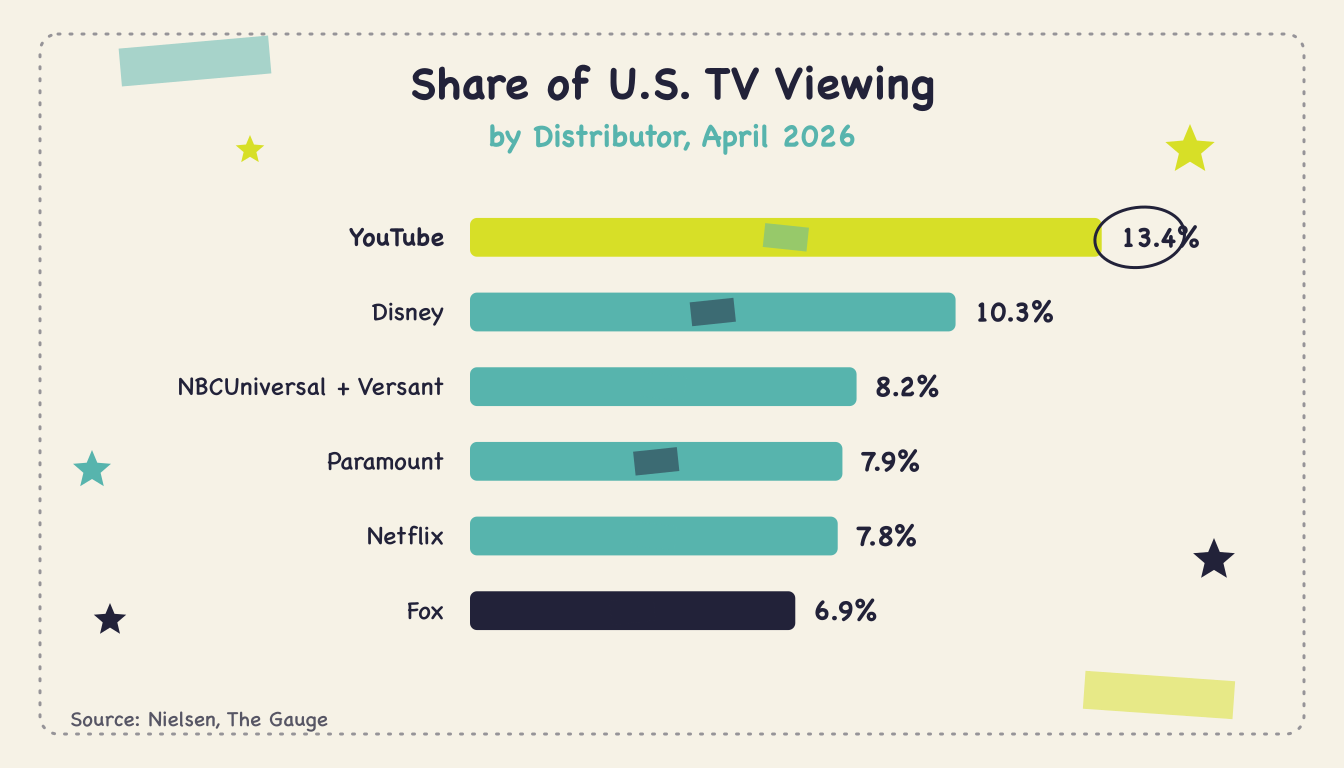
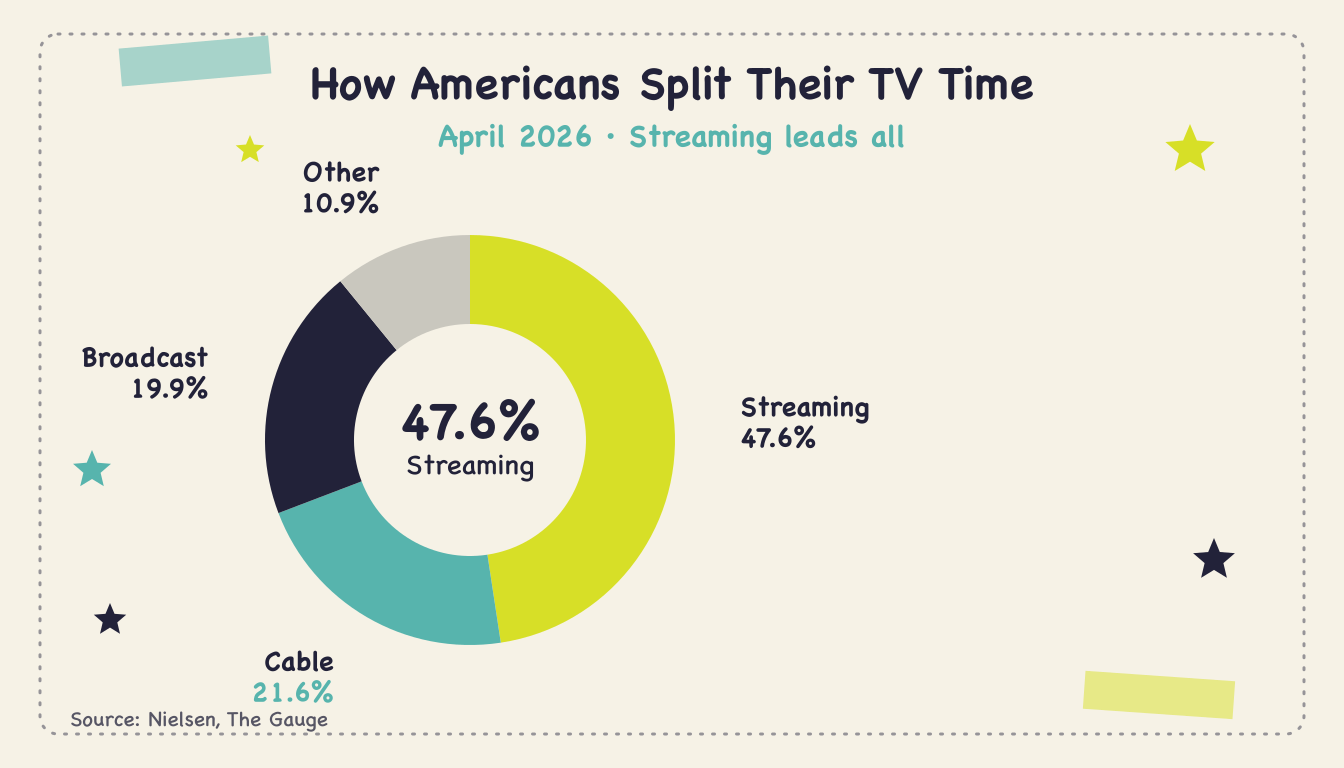
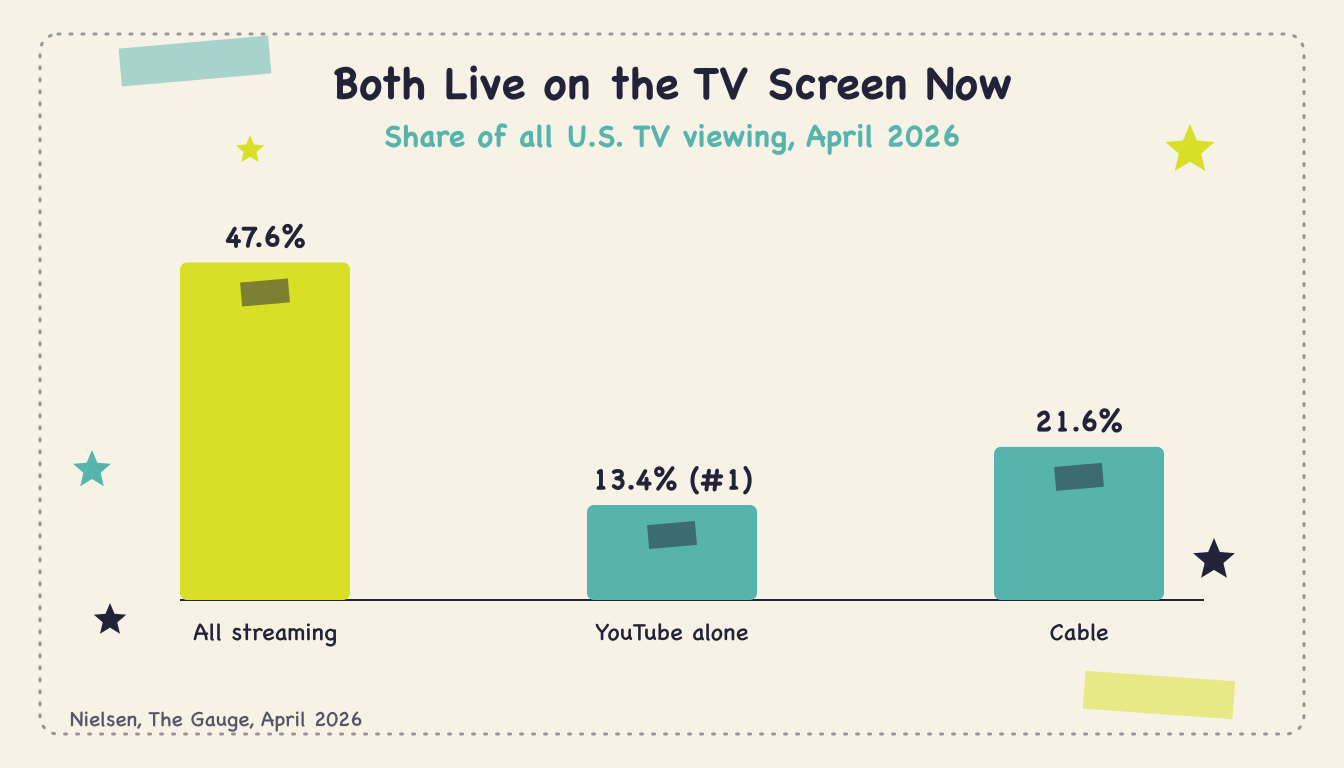
<p>YouTube held <b>13.4% of all U.S. TV viewing in April 2026</b>, the most recent month measured by Nielsen&#39;s The Gauge. That&#39;s not YouTube&#39;s share of streaming or its share of online video. It&#39;s YouTube&#39;s share of <i>everything</i> Americans watch on a television set, cable and broadcast included. For the sixth month running, no other media company came close. Disney sat second at 10.3%, and the gap between YouTube and everyone else is now the widest Nielsen has recorded since it started ranking distributors in late 2023.</p>
<p>Here&#39;s why that matters if you run a small business: the single most-watched thing on America&#39;s TV screens isn&#39;t a network or a cable bundle. It&#39;s a free, ad-supported platform that any advertiser can reach. The audience that used to sit behind million-dollar upfront commitments is now watching on the same connected TVs you can buy into starting at $50. Let&#39;s break down the Q2 2026 numbers, how YouTube got here, and what it means for where you put your ad budget.</p>
<h2 id="what-the-data-shows">What the data shows</h2>
<p><a href="https://www.nielsen.com/data-center/the-gauge/">Nielsen&#39;s The Gauge</a> is the closest thing the industry has to an official scoreboard for TV. Every month it splits total U.S. television viewing into broadcast, cable, streaming, and &quot;other,&quot; then names the platforms and companies driving each slice. In the <a href="https://www.nielsen.com/news-center/2026/sports-and-dramas-drive-april-viewing-patterns-in-nielsens-latest-gauge-reports/">April 2026 report</a>, released June 25, 2026, YouTube came in at <b>13.4% of total TV viewing</b>, holding the top distributor spot it first claimed in mid-2025.</p>
<p>To put the field in order, here&#39;s how the major distributors ranked in April 2026 by share of total TV time:</p>
<ul><li><p><b>YouTube:</b> 13.4% (first place, sixth straight month on top)</p></li><li><p><b>Disney:</b> 10.3%</p></li><li><p><b>NBCUniversal + Versant:</b> 8.2% combined</p></li><li><p><b>Paramount Skydance:</b> 7.9%</p></li><li><p><b>Netflix:</b> 7.8%</p></li><li><p><b>Fox Corp:</b> 6.9%</p></li></ul>
<p>Two things stand out. First, YouTube&#39;s lead over Disney is more than three full percentage points, which in Gauge terms is a chasm. Second, YouTube is a single property doing this. Disney&#39;s 10.3% bundles Disney+, Hulu, ESPN, ABC, and its cable networks. YouTube&#39;s 13.4% is just YouTube. When you strip the comparison down to one platform against entire corporate portfolios, the scale of YouTube&#39;s living-room reach is hard to overstate.</p>
<p>Zoom out to the category level and the streaming story is just as clear. Streaming as a whole took <a href="https://www.thewrap.com/media-platforms/tv/tv-viewership-streaming-broadcast-cable-nielsen-the-gauge-april-2026/">**47.6% of U.S. TV viewing in April 2026**</a>, up from 44.3% a year earlier. Cable held 21.6% and broadcast 19.9%. Streaming now commands more of the TV day than cable and broadcast combined, and YouTube alone accounts for more than a quarter of that streaming total. If you want to understand how streaming overtook the traditional bundle, our breakdown of <a href="/resources/us-tv-viewing-share-streaming">streaming&#39;s share of TV viewing</a> traces the full shift.</p>
<p>One caveat worth stating plainly, because it shapes every number here: April is the freshest Gauge data available as of late July 2026. Nielsen delayed its March report amid a dispute over its new measurement methodology, and the recalibrated Gauge isn&#39;t expected until the fall. So when we say 13.4%, we mean April 2026, the last fully published figure, not a May or June estimate. We don&#39;t guess at months Nielsen hasn&#39;t reported.</p>
<figure class="embedded-asset"><img src="https://media.adwave.com/fia320z3blxi/7cCTYqdKIqQctGufA9nHZq/ae7e7f098c1c900535a05d5da4550a8e/body1.png" alt="youtube-tv-viewing-share-q2-2026 - Body1" loading="lazy" /></figure>
<h2 id="how-nielsen-measures-this-and-why-april-is-the-latest-number">How Nielsen measures this, and why April is the latest number</h2>
<p>Where does 13.4% come from, and why is April the newest number in late July? Both questions have real answers this quarter. Nielsen&#39;s The Gauge is built from the same national panel that produces its TV ratings, measuring actual viewing on television sets across a representative sample of U.S. households. Each month&#39;s report typically lands about six to eight weeks after the month closes, which is why, in late July, April is the freshest complete picture.</p>
<p>This year the cadence slipped further than usual. Nielsen delayed its March 2026 Gauge amid an industry dispute over a new measurement methodology it had begun rolling out, and it has signaled that the recalibrated approach won&#39;t fully arrive until the start of the fall season. The practical effect for anyone reading these numbers is simple:</p>
<ul><li><p><b>April 2026 is the last fully reported month.</b> Treat 13.4% as the current, confirmed figure, not a stand-in for May or June.</p></li><li><p><b>Month-to-month wobble is normal.</b> A single big live event can swing a month by a point or more, so trends matter more than any one reading.</p></li><li><p><b>The methodology debate itself is a signal.</b> Streamers pushing back on measurement changes is a sign of how high the stakes have gotten now that streaming owns the TV day.</p></li></ul>
<p>None of this changes the headline. Across every recent month Nielsen has reported, YouTube sits comfortably in first, and the device trend underneath it, viewing moving from phones to TV screens, is measured consistently regardless of the fall recalibration.</p>
<h2 id="breaking-down-the-numbers">Breaking down the numbers</h2>
<p>A single headline percentage hides a lot of movement underneath. YouTube&#39;s path through the first half of 2026 was not a straight line, and the month-to-month shifts tell you something about how live events still move the needle.</p>
<p>Here&#39;s how YouTube&#39;s share tracked across the reported months of 2026:</p>
<ul><li><p><b>January 2026:</b> 12.7%, already the largest single property</p></li><li><p><b>February 2026:</b> ~12.5%, briefly passed by NBCUniversal/Versant on the strength of Super Bowl LX and the Winter Olympics</p></li><li><p><b>March 2026:</b> ~13.5%, reclaimed the top spot as the Olympic bump faded</p></li><li><p><b>April 2026:</b> 13.4%, holding first place comfortably</p></li></ul>
<p>The February dip is the interesting part. For one month, a stack of live sports, the Super Bowl plus the Winter Olympics, pulled enough viewing to NBCUniversal to edge YouTube out of first. By March, with those events over, YouTube was back on top and it hasn&#39;t looked back. That pattern is a useful reminder that live sports remain broadcast and cable&#39;s strongest card, even as everything else migrates to streaming. Our look at <a href="/resources/live-sports-tv-viewing-share">live sports as a share of TV viewing</a> digs into why those events still command outsized audiences.</p>
<p>Year over year, YouTube&#39;s trajectory is steady growth. It ran around 12% to 12.5% in early 2025, climbed to a summer peak of 13.4% by July 2025, and is holding near that peak in 2026. Depending on which Nielsen product you read, April 2026 is up either 0.2 points (The Gauge&#39;s total-TV framing) or about a full point (the Media Distributor Gauge framing) versus the prior April. Either way, the direction is up while the audience keeps shifting from scheduled TV to on-demand. For the quarter-ago baseline, our <a href="/resources/youtube-tv-viewing-share-q1-2026">YouTube Q1 2026 viewing share</a> post captured the 12.7% reading from the start of the year.</p>
<p>The device story underneath these numbers matters just as much as the share. YouTube&#39;s growth isn&#39;t coming from phones. It&#39;s coming from the biggest screen in the house.</p>
<figure class="embedded-asset"><img src="https://media.adwave.com/fia320z3blxi/28h0kQ4RCIrGY5pQ8qy76Z/94489a8ffd737c4f0e51d192bd2acf78/body2.png" alt="youtube-tv-viewing-share-q2-2026 - Body2" loading="lazy" /></figure>
<h2 id="why-it-matters-for-your-business">Why it matters for your business</h2>
<p>It&#39;s easy to read a stat like &quot;13.4% of TV viewing&quot; as media-industry trivia. For a local business deciding where ad dollars go, it&#39;s actually a practical signal about attention. People are spending more of their TV time on platforms that were built for advertising from day one, and less on channels that were built for cable subscriptions.</p>
<p>Consider what YouTube&#39;s living-room dominance means concretely:</p>
<ul><li><p><b>The audience is on the TV, not the phone.</b> More than 1 billion hours of YouTube get watched on TV screens in the U.S. every day, and the <a href="https://deadline.com/2025/02/youtube-viewership-tv-screens-exceeds-mobile-for-first-time-in-u-s-1236284781/">living room is now YouTube&#39;s single largest viewing device</a>. This is couch viewing, full-screen and lean-back, not a thumbnail glanced at during a commute.</p></li><li><p><b>Connected TV is where the growth is.</b> <a href="https://techcrunch.com/2026/04/08/as-youtube-grows-on-tv-it-eyes-more-interactive-video-across-formats/">Over 44% of U.S. YouTube watch time</a> now happens on connected TV, up from around 41% in 2022. The trend line points at the television, which is exactly the screen small businesses were locked out of for decades.</p></li><li><p><b>The inventory is genuinely buyable.</b> Unlike a national network upfront, connected TV ad inventory is available to any advertiser at any budget. You&#39;re reaching the same premium audience without the premium gatekeeping.</p></li></ul>
<p>That last point is the heart of it. For most of TV history, the barrier wasn&#39;t the audience&#39;s willingness to watch ads, it was the cost of entry. National spots ran into the tens of thousands of dollars, and local cable buys came with minimums and sales reps. Connected TV knocked that barrier down. The same viewers driving YouTube to the top of the Gauge are reachable through <a href="/resources/what-is-connected-tv-advertising">connected TV advertising</a> at budgets a corner shop can afford.</p>
<p>There&#39;s also a trust dividend. Seeing a business on the TV screen, in a full 30-second spot between the content someone chose to watch, carries a credibility that a scrolling social feed doesn&#39;t. When customers see you on the same screen as national brands, you borrow some of that stature. That&#39;s true whether you&#39;re advertising on YouTube&#39;s platform or across the broader connected TV ecosystem that includes Roku, Hulu, Peacock, Tubi, and dozens of other apps.</p>
<h2 id="how-to-take-advantage">How to take advantage</h2>
<p>Knowing YouTube owns the living room is useful. Turning that into customers is the part that pays. You don&#39;t need a YouTube-specific strategy so much as a connected TV strategy that meets viewers on the screen where they now spend nearly half their TV time. Here&#39;s how a small business can act on this data.</p>
<ul><li><p><b>Start with your service area.</b> Geographic targeting keeps every impression inside the radius you actually serve, usually 15 to 25 miles around your location. There&#39;s no point paying to reach viewers three states away.</p></li><li><p><b>Budget for frequency, not just reach.</b> A single impression rarely moves anyone. Plan enough spend to reach the same households several times over two to three weeks so your name sticks. On connected TV, that&#39;s achievable on a few hundred dollars, not a few thousand.</p></li><li><p><b>Let the platform handle creative.</b> You don&#39;t need a production crew. AI tools can turn your existing website into a broadcast-quality 30-second ad in about two minutes, which removes the single biggest cost that used to keep small businesses off TV.</p></li><li><p><b>Run across the whole ecosystem, not one app.</b> The viewers on YouTube&#39;s living-room feed are the same people watching Hulu, Roku, and free ad-supported channels. Reaching across 100+ networks builds the frequency that any one platform can&#39;t.</p></li><li><p><b>Measure brand lift, not clicks.</b> TV ads aren&#39;t clickable, so track the right signals: branded search volume, direct website traffic, and lift in calls or foot traffic during and after a flight. QR codes on screen can bridge to direct response when you want it.</p></li></ul>
<p>The mechanics are refreshingly simple compared to the old way. With Adwave, ad creation is free, a campaign starts at a $50 minimum, and the full path from signing up to a live ad on 100+ premium channels takes under 10 minutes. You point it at your website, it generates the spot, and you&#39;re running against the same audience that just put YouTube at the top of the Nielsen chart. If you want the fuller playbook, our guide to <a href="/resources/youtube-tv-advertising-small-business">YouTube TV advertising for small business</a> walks through the options, and our <a href="/resources/ctv-vs-youtube-ads-comparison">CTV vs YouTube ads comparison</a> helps you weigh where a given budget works hardest.</p>
<figure class="embedded-asset"><img src="https://media.adwave.com/fia320z3blxi/1FvD7H5W2lIfCTsifKTKQq/a72d8ba56429ecf8ed11874703bd963a/body3.png" alt="youtube-tv-viewing-share-q2-2026 - Body3" loading="lazy" /></figure>
<h2 id="the-bigger-picture">The bigger picture</h2>
<p>YouTube&#39;s 13.4% is a snapshot of a much larger migration. American television is finishing a decade-long shift from a schedule you tuned into toward a library you call up on demand, and the platforms winning that shift were all designed with advertising baked in.</p>
<p>A few trends give the April 2026 number its context:</p>
<ul><li><p><b>Streaming crossed a threshold, not a peak.</b> At 47.6% of all TV viewing and climbing, streaming isn&#39;t approaching parity with traditional TV, it has passed it. Cable and broadcast together sit under 42%. The question is no longer whether streaming wins the TV day, it&#39;s how fast the remaining traditional share erodes. Our <a href="/resources/cord-cutting-statistics-q1-2026">cord-cutting statistics</a> page tracks the households leaving cable behind.</p></li><li><p><b>YouTube is a business, not just a viewing habit.</b> <a href="https://www.hollywoodreporter.com/business/business-news/youtubes-ad-business-hit-9-88-billion-last-quarter-1236580395/">YouTube ad revenue hit $9.88 billion</a> in the first quarter of 2026, up nearly 11% year over year, and full-year 2025 ad revenue topped $40 billion. That&#39;s the scale of demand chasing this audience, and it&#39;s a signal that the attention is monetizing, not just accumulating.</p></li><li><p><b>The living room is the battleground.</b> YouTube TV, the paid live-TV service, has <a href="https://cordcuttersnews.com/youtube-tv-surpasses-10-million-subscribers-solidifying-dominance-in-live-tv-streaming/">crossed 10 million subscribers</a> and is on track to become one of the largest pay-TV providers in the country. Even YouTube&#39;s own live-TV bundle is pulling cord-cutters back into a TV-like product, on a connected device.</p></li></ul>
<p>For small businesses, the throughline is that the tools finally match the audience. The viewers consolidated onto a handful of connected TV platforms, and the ad-buying got simple enough that a one-person shop can run a real TV campaign. The <a href="/resources/ctv-advertising-market-size-q1-2026">connected TV advertising market</a> is expanding for exactly this reason: demand from advertisers who were priced out of TV for a generation. What used to be a Fortune 500 channel is now a small-business channel.</p>
<h2 id="what-experts-are-saying">What experts are saying</h2>
<p>Industry analysts have been circling the same conclusion for a couple of years: YouTube stopped being an internet video site and became a television network, without ever calling itself one. Nielsen&#39;s own framing is that YouTube has been the top streaming platform by watch time for roughly two years running, a streak that started well before it took the overall distributor crown.</p>
<p>Alphabet leadership has leaned into the living-room story directly. On the company&#39;s Q1 2026 earnings call in April, CEO Sundar Pichai pointed to more than 200 million hours of YouTube content watched daily across all surfaces and highlighted the television as YouTube&#39;s fastest-growing screen. The company&#39;s messaging has shifted from &quot;YouTube on mobile&quot; to &quot;YouTube on the TV,&quot; which tracks with Nielsen&#39;s data showing TV screens surpassing phones as the top place Americans watch.</p>
<p>Media reporters covering the April Gauge noted that a hypothetical Fox-Roku combination would create only a roughly 9.9% distributor, still well behind YouTube, which underscores how far ahead the platform sits even against imagined mega-mergers. The consensus read is that YouTube&#39;s lead is structural, not a fluke of one strong month. It&#39;s built on a device shift, from phones to TVs, that keeps compounding. For advertisers, the takeaway from nearly every corner of the trade press is the same: the audience has already moved to connected TV, and the open question is when ad budgets fully follow.</p>
<h2 id="what-the-number-doesn-t-tell-you">What the number doesn&#39;t tell you</h2>
<p>A 13.4% share is a powerful headline, but read it with a few caveats so you plan around what&#39;s real rather than what&#39;s implied.</p>
<ul><li><p><b>Share isn&#39;t the same as your customer.</b> YouTube leads total TV viewing, but &quot;total&quot; spans everyone. Your buyers are a slice of that, defined by geography, age, and interest. The value of connected TV for a small business isn&#39;t raw reach, it&#39;s targeted reach inside your service area.</p></li><li><p><b>A platform&#39;s share isn&#39;t a media plan.</b> Owning the top spot on the Gauge tells you where attention is, not how to buy it efficiently. In practice, the smart move is running across many connected TV apps at once, because your local audience is split across YouTube, Roku, Hulu, Tubi, and more on any given night.</p></li><li><p><b>Viewing share doesn&#39;t equal ad availability at your budget.</b> Some premium content carries little or no ad load. What matters for a small advertiser is ad-supported inventory, which is exactly what the connected TV ecosystem delivers in volume. Our look at <a href="/resources/ad-supported-streaming-viewers">ad-supported streaming viewers</a> covers how much of this audience is reachable with ads.</p></li><li><p><b>Monthly numbers move.</b> February&#39;s live-sports dip proved a single month can shift the rankings. Build campaigns around the durable trend, viewing moving to the connected TV screen, not around one month&#39;s leaderboard.</p></li></ul>
<p>Read the 13.4% as a directional signal: the audience has concentrated on connected TV, and it&#39;s reachable. That&#39;s the part that should shape your budget.</p>
<h2 id="common-questions-answered">Common questions answered</h2>
<p><b>Is YouTube really the most-watched platform on TV?</b> By Nielsen&#39;s measure of total U.S. TV viewing, yes. YouTube took 13.4% of all TV time in April 2026, ahead of every other single distributor, and it has led for six consecutive months. It&#39;s worth being precise: this counts viewing on television sets, so it reflects living-room watching, not phone or desktop time. YouTube has also been Nielsen&#39;s top streaming platform by watch time for about two years.</p>
<p><b>How is YouTube&#39;s share different from Netflix&#39;s?</b> In April 2026, YouTube held 13.4% of TV viewing while Netflix held 7.8%, so YouTube&#39;s living-room share was well over YouTube&#39;s. The difference comes down to breadth: Netflix is premium on-demand series and film, while YouTube spans everything from creators to music to sports highlights to full shows, much of it free and ad-supported. Our <a href="/resources/netflix-vs-youtube-viewers">Netflix vs YouTube viewers</a> comparison breaks down how the two platforms stack up.</p>
<p><b>Why did YouTube dip in February 2026?</b> Live sports. Super Bowl LX and the Winter Olympics pulled a huge, concentrated audience to NBCUniversal in February, enough to briefly push it past YouTube in the distributor rankings. Once those events ended, YouTube reclaimed the top spot in March and held it through April. It&#39;s a clean illustration of the one area where scheduled TV still wins: major live events.</p>
<p><b>Can a small business actually advertise on connected TV?</b> Yes, and that&#39;s the practical point of these numbers. The audience that used to require national upfront commitments is now reachable on connected TV at small-business budgets. With Adwave, ad creation is free, campaigns start at a $50 minimum, and you can be live on 100+ premium channels in under 10 minutes. You don&#39;t buy YouTube in isolation; you run across the connected TV ecosystem where these viewers spend their time.</p>
<p><b>What does 13.4% mean for my ad budget?</b> It means the attention has concentrated on a small number of connected TV platforms, which makes reaching a lot of people simpler than the fragmented old cable world. Instead of negotiating separate local cable buys, you can run one campaign across many networks and let frequency do the work. The <a href="/resources/average-ctv-cpm">average CTV CPM</a> runs roughly $15 to $35, so a few hundred dollars buys real, repeated exposure in your service area.</p>
<h2 id="the-numbers-at-a-glance">The numbers at a glance</h2>
<p>Key figures behind YouTube&#39;s Q2 2026 standing, with sources:</p>
<ul><li><p><b>13.4%</b>: YouTube&#39;s share of total U.S. TV viewing, April 2026 (Nielsen, The Gauge, published June 25, 2026)</p></li><li><p><b>47.6%</b>: Streaming&#39;s total share of U.S. TV viewing, April 2026, up from 44.3% a year earlier (Nielsen, The Gauge)</p></li><li><p><b>21.6% / 19.9%</b>: Cable and broadcast shares of TV viewing, April 2026 (Nielsen, The Gauge)</p></li><li><p><b>10.3%</b>: Disney&#39;s distributor share, second place behind YouTube (Nielsen, Media Distributor Gauge, April 2026)</p></li><li><p><b>1 billion+</b>: Hours of YouTube watched daily on U.S. TV screens (Google/YouTube)</p></li><li><p><b>44%+</b>: Share of U.S. YouTube watch time now on connected TV, up from ~41% in 2022 (eMarketer, via TechCrunch, April 2026)</p></li><li><p><b>$9.88 billion</b>: YouTube ad revenue, Q1 2026, up ~11% year over year (Alphabet earnings, April 29, 2026)</p></li><li><p><b>$40.4 billion</b>: YouTube full-year 2025 ad revenue (Alphabet earnings)</p></li><li><p><b>10 million+</b>: YouTube TV (vMVPD) subscribers (Alphabet/Cord Cutters News)</p></li></ul>
<h2 id="reach-the-living-room-audience-starting-at-50">Reach the living-room audience, starting at $50</h2>
<p>YouTube&#39;s climb to the top of the Nielsen Gauge is really a story about where attention went: to the connected TV screen, on ad-supported platforms, in full-screen living-room viewing. The good news for small businesses is that the same shift that made YouTube the most-watched name on TV also opened that screen to advertisers of every size.</p>
<p>You don&#39;t need a national budget to reach this audience. See <a href="/how-it-works">how Adwave works</a> to turn your website into a broadcast-quality 30-second ad in minutes, or check <a href="/pricing">pricing</a> to start a connected TV campaign from a $50 minimum. The biggest screen in the house is finally a small-business channel. It&#39;s a good time to be on it.</p>]]></content><author><name>[{&quot;slug&quot; =&gt; &quot;david-naffis&quot;, &quot;display_name&quot; =&gt; &quot;David Naffis&quot;, &quot;first_name&quot; =&gt; &quot;David&quot;, &quot;last_name&quot; =&gt; &quot;Naffis&quot;, &quot;role&quot; =&gt; &quot;CEO&quot;, &quot;byline&quot; =&gt; &quot;Making TV advertising accessible to every business&quot;, &quot;short_biography&quot; =&gt; &quot;Co-founder and CEO building technology that makes TV advertising simple, affordable, and accessible for SMB&apos;s.&quot;, &quot;linkedin_url&quot; =&gt; &quot;https://www.linkedin.com/in/naffis/&quot;, &quot;avatar&quot; =&gt; {&quot;url&quot; =&gt; &quot;https://media.adwave.com/fia320z3blxi/5B6OdA0EbyBM0gcGfkQfvg/afefabcf228d1d5744e50882d97de1f4/naffis-headshot.png&quot;, &quot;description&quot; =&gt; &quot;&quot;, &quot;title&quot; =&gt; &quot;naffis-headshot.png&quot;}, &quot;sys&quot; =&gt; {&quot;id&quot; =&gt; &quot;3l4TGc9ngQ9b4hY02K9U6B&quot;}}]</name></author><summary type="html"><![CDATA[YouTube held 13.4% of U.S. TV viewing in April 2026, ahead of every media company. What Nielsen's Q2 data means for small business advertisers.]]></summary><media:thumbnail xmlns:media="http://search.yahoo.com/mrss/" url="https://adwave.com/assets/images/og-default.png" /><media:content medium="image" url="https://adwave.com/assets/images/og-default.png" xmlns:media="http://search.yahoo.com/mrss/" /></entry><entry><title type="html">What is YouTube’s share of TV viewing? (Q1 2026)</title><link href="https://adwave.com/resources/youtube-tv-viewing-share-q1-2026/" rel="alternate" type="text/html" title="What is YouTube’s share of TV viewing? (Q1 2026)" /><published>2026-09-09T17:32:23+00:00</published><updated>2026-09-09T17:32:23+00:00</updated><id>https://adwave.com/resources/youtube-tv-viewing-share-q1-2026</id><content type="html" xml:base="https://adwave.com/resources/youtube-tv-viewing-share-q1-2026/"><![CDATA[<ul class="not-prose grid grid-cols-1 gap-4 xl:grid-cols-3"><li class="flex flex-col rounded-md border-2 border-primary p-8 bg-primary h-full text-white shadow-lg"><p class="text-4xl font-bold pb-4">12.7%</p><p class="text-body">YouTube&#39;s share of U.S. TV viewing (Q1 2026)</p></li><li class="flex flex-col rounded-md border-2 border-primary p-8 bg-primary h-full text-white shadow-lg"><p class="text-4xl font-bold pb-4">#1</p><p class="text-body">Largest single media entity on U.S. TV screens</p></li><li class="flex flex-col rounded-md border-2 border-primary p-8 bg-primary h-full text-white shadow-lg"><p class="text-4xl font-bold pb-4">47.0%</p><p class="text-body">Total streaming share of U.S. TV, Jan 2026 (record)</p></li></ul>
<p>YouTube entered 2026 as the largest single media entity on American television, then briefly lost the top spot in February when Super Bowl LX and the Milan-Cortina Winter Olympics pushed NBCUniversal-Versant ahead. The two-month swing tells a useful story about YouTube&#39;s structural position in 2026: a steady baseline large enough to lead most months, with event-driven programming on traditional TV still capable of disrupting the ranking temporarily.</p>
<p>For small businesses thinking about TV advertising in 2026, YouTube&#39;s share is the number that explains why &quot;TV advertising&quot; no longer means &quot;cable and broadcast.&quot; This post breaks down YouTube&#39;s share of U.S. TV viewing through Q1 2026 using Nielsen&#39;s publicly released Gauge data, and translates what the numbers mean for local advertisers.</p>
<h2 id="what-the-data-shows">What the data shows</h2>
<p>In January 2026, YouTube held 12.7% of total U.S. TV viewing time according to Nielsen&#39;s The Gauge. That was the largest share of any individual media property.</p>
<figure class="embedded-asset"><img src="https://media.adwave.com/fia320z3blxi/3CkYQe1ZPT1ZwkPIULMfuq/8286e3519e40ccb2fec130a24f6a1a9c/body1.png" alt="YouTube TV Viewing Share Q1 2026 - Body1" loading="lazy" /></figure>
<p>In February 2026, YouTube held its share at 12.7% but was surpassed by NBCUniversal-Versant (which reached 13.1% in Nielsen&#39;s Media Distributor Gauge) thanks to Super Bowl LX on NBC and the Winter Olympics running February 6-22 on NBC and its affiliated networks. YouTube&#39;s share didn&#39;t decline; NBCU&#39;s share temporarily expanded.</p>
<p>Total streaming share was 47.0% in January 2026 (a record for The Gauge per Nielsen&#39;s press release) and pulled back to 41.9% in February as the tentpole events drew viewers to linear TV. Broadcast rose from 21.2% in January to 21.7% in February. Cable dropped to 20.0% in February.</p>
<p>Nielsen has delayed the release of the March 2026 Gauge report, citing methodology disputes. MediaPost reported on March 20, 2026 that the recalibrated Gauge has been postponed to later in 2026. As a result, the full Q1 2026 picture relies on January and February data.</p>
<h2 id="how-nielsen-measures-tv-viewing">How Nielsen measures TV viewing</h2>
<p>Nielsen&#39;s The Gauge is a monthly report that measures time spent viewing across the biggest distributors of TV content in the United States. The Gauge combines Nielsen&#39;s traditional panel-based measurement of linear TV with its streaming measurement to produce a single view of how total TV viewing time is split. The Gauge launched in 2021 and has been published monthly since.</p>
<p>The Gauge reports two distinct views. The first is the &quot;Gauge&quot; itself, which breaks total TV viewing time into categories (broadcast, cable, streaming, and other). The second is the &quot;Media Distributor Gauge,&quot; which breaks TV viewing time down by the company that distributes the content, so YouTube as a platform appears separately from NBCUniversal as a media distributor.</p>
<p>Several aspects of The Gauge methodology are worth understanding:</p>
<ul><li><p><b>Viewing time, not reach:</b> The Gauge reports total viewing minutes, not the number of households reached. A platform with a smaller audience that watches for longer can hold more share than a platform with a larger casual audience.</p></li><li><p><b>TV screens only:</b> The Gauge measures viewing on actual television screens. Mobile and desktop viewing are generally excluded, which means YouTube&#39;s mobile audience doesn&#39;t factor into its TV share figure.</p></li><li><p><b>Monthly cadence:</b> The Gauge is a monthly snapshot. Single-month figures can be influenced by seasonal events, sports schedules, and specific program launches.</p></li><li><p><b>Nielsen&#39;s DASH methodology update:</b> Nielsen is rolling out a new measurement approach called DASH (Device Activity and Streaming Home) that incorporates additional household data. Streaming platforms have raised concerns that DASH reduces their reported share. Nielsen has paused full DASH implementation pending review, and the January and February 2026 reports use Nielsen&#39;s consistent pre-DASH methodology.</p></li></ul>
<p>For advertisers, the practical takeaway is that The Gauge represents the industry&#39;s consensus view of where American TV viewing time goes. When you&#39;re comparing platforms or planning budget allocation, Nielsen&#39;s figures are the common reference point most buyers and sellers use.</p>
<h2 id="why-youtube-s-position-matters-for-your-business">Why YouTube&#39;s position matters for your business</h2>
<p>YouTube&#39;s 12.7% share means that for almost any audience advertisers want to reach on TV screens, YouTube is part of where that audience is. Viewers under 35 in particular have concentrated their TV viewing on YouTube to a degree that traditional broadcast and cable can no longer match.</p>
<figure class="embedded-asset"><img src="https://media.adwave.com/fia320z3blxi/293yV9D8n3m8eJfxbbqYcK/b3d1fc52d828cf0899edcb7691f6302a/body2.png" alt="YouTube TV Viewing Share Q1 2026 - Body2" loading="lazy" /></figure>
<p>A few practical implications for small business advertisers:</p>
<ul><li><p><b>YouTube inventory should be part of your CTV plan.</b> Any streaming campaign that excludes YouTube misses a large share of available TV attention.</p></li><li><p><b>Younger audiences skew heavily toward YouTube.</b> If your customer base is under 35, YouTube typically delivers a larger share of their TV time than any other platform.</p></li><li><p><b>CTV viewing of YouTube is substantial.</b> YouTube now reaches TV screens through streaming devices, smart TVs, and game consoles. A YouTube ad in 2026 is, for many viewers, a TV commercial that happens to play on YouTube.</p></li><li><p><b>Local advertisers can access YouTube through bundled CTV platforms.</b> Google Ads offers direct YouTube buys; all-in-one platforms bundle YouTube alongside Hulu, Peacock, Tubi, and other streaming apps.</p></li></ul>
<p>Industry estimates place YouTube CTV CPMs in the $15-$25 range on average, generally below premium SVOD services but above some FAST platforms. Actual CPMs vary widely by targeting, creative format, content category, and demand. Before committing to a specific budget, request quotes from the platforms or bundled CTV services you plan to use.</p>
<h2 id="how-to-access-youtube-ad-inventory">How to access YouTube ad inventory</h2>
<p>Small businesses have three practical paths to buy YouTube advertising:</p>
<p><b>Google Ads directly.</b> This is the self-serve approach that YouTube&#39;s parent company offers. You create a Google Ads account, build video campaigns, upload your creative, and bid on placements. Google Ads offers several YouTube campaign types (standard video, video reach, video action, and Performance Max for CTV). Minimum budgets are low (campaigns can run on $10-$50 per day), but the platform requires time to learn and ongoing optimization.</p>
<p><b>Bundled CTV platforms.</b> Many self-serve CTV advertising platforms include YouTube in their aggregated inventory alongside Hulu, Peacock, Tubi, Roku Channel, and other streaming apps. This approach simplifies the buying process (one account, one campaign, one invoice) and is typically designed for small advertisers who don&#39;t want to manage multiple platforms.</p>
<p><b>Agencies and direct sales.</b> Larger campaigns can be placed through advertising agencies or through YouTube&#39;s direct sales team (for brands with meaningful budget). This path adds cost but adds expertise and access to premium placements.</p>
<p>For most local small business advertisers, the bundled CTV approach is the simplest starting point. It provides YouTube reach alongside the other streaming platforms most viewers use, all through a single campaign management interface.</p>
<h2 id="creative-best-practices-for-youtube-ctv">Creative best practices for YouTube CTV</h2>
<p>YouTube delivered through CTV behaves differently than YouTube on mobile. A few principles apply:</p>
<ul><li><p><b>Use 15 or 30 second creative for CTV.</b> Most CTV inventory runs in these standard lengths. Shorter 6-second bumper ads work in some placements but aren&#39;t the default for CTV.</p></li><li><p><b>Design for sound-on viewing.</b> CTV viewers almost always have sound enabled (unlike mobile social video). Strong audio design, clear voiceovers, and music bed selection matter more on CTV than on mobile.</p></li><li><p><b>Keep branding visible throughout the spot.</b> CTV viewers can&#39;t click, so brand recognition needs to come from the spot itself. Don&#39;t wait until the last 3 seconds to brand the ad.</p></li><li><p><b>Plan for horizontal 16:9 format.</b> CTV is a horizontal medium. Vertical creative gets letterboxed on TV screens, which wastes screen space and looks amateur.</p></li><li><p><b>Match creative tone to content environment.</b> YouTube&#39;s content environment includes everything from news to gaming to cooking. Creative that feels native to your target content category tends to perform better than generic commercial creative.</p></li></ul>
<p>For small businesses without cinematic production budgets, AI-powered ad generation tools can produce polished 30-second spots from a website URL in minutes. Platforms like <a href="https://adwave.com/how-it-works">Adwave</a> are designed specifically for small advertisers who need broadcast-quality creative without large production commitments.</p>
<h2 id="how-to-take-advantage">How to take advantage</h2>
<p>Knowing YouTube leads TV viewing share is useful. Acting on it is where advertising wins happen.</p>
<ul><li><p><b>Include YouTube in every streaming campaign.</b> Don&#39;t use a CTV platform that excludes YouTube unless the campaign has a specific reason to.</p></li><li><p><b>Use content-category targeting where available.</b> YouTube&#39;s creator ecosystem lets advertisers target specific content verticals (home improvement, cooking, music, automotive, etc.) for audience-relevant placement.</p></li><li><p><b>Match creative to TV-screen viewing.</b> Most YouTube viewing on CTV is horizontal 16:9. Traditional 30-second TV creative performs well.</p></li><li><p><b>Run complementary creative on Shorts.</b> If you&#39;re using YouTube for broader reach, vertical creative for Shorts lets you reach audiences who primarily watch short-form.</p></li><li><p><b>Budget for frequency caps.</b> YouTube viewers see more ads per session than most streaming platforms. Plan creative rotation to avoid burnout.</p></li></ul>
<h2 id="measuring-youtube-ad-performance">Measuring YouTube ad performance</h2>
<p>CTV advertising measurement is different from search or social advertising. YouTube viewers on TV screens rarely click through, so clickthrough rate isn&#39;t a useful metric. Instead, advertisers typically track:</p>
<ul><li><p><b>Reach and frequency:</b> How many unique households saw your ad, and how many times on average. This is the basic currency of TV advertising.</p></li><li><p><b>View-through rate (VTR):</b> The percentage of ad impressions that viewers watched to completion. Strong VTR on CTV runs 90%+ because the format doesn&#39;t allow skipping on most placements.</p></li><li><p><b>Brand lift:</b> Changes in brand awareness, consideration, or preference among audiences exposed to your ad. Google Ads offers Brand Lift Studies for larger campaigns; third-party measurement services offer similar capabilities.</p></li><li><p><b>Downstream conversion:</b> Website traffic, branded search volume, store visits, or sales among audiences exposed to your ad. This requires a measurement framework that ties exposure to outcome.</p></li><li><p><b>Incrementality:</b> The lift in conversions attributable specifically to YouTube advertising versus what you would have gotten from other channels. Harder to measure but more accurate than last-click attribution.</p></li></ul>
<p>Small businesses running YouTube campaigns should track at least reach, frequency, view-through rate, and branded search lift as baseline measurement. Allocate 30-60 days to measurable results before drawing conclusions.</p>
<h2 id="the-bigger-picture">The bigger picture</h2>
<p>The 2026 TV advertising market is going through structural reorganization. Comcast spun off its cable networks (MSNBC, CNBC, E!, Syfy, USA, Oxygen, and Golf Channel) into a separate company called Versant in late 2025. Warner Bros. Discovery is exploring similar separation. Disney continues to review its ABC and cable portfolio.</p>
<p>These corporate moves reflect the same structural shift the Nielsen Gauge data shows every month: streaming viewing is growing, cable viewing is declining, and broadcast is stable. Inside streaming, YouTube&#39;s share is the largest. That shift is driving roughly $37.95 billion in projected U.S. CTV advertising spending in 2026 (eMarketer&#39;s December 2025 forecast), up 14.5% year-over-year. eMarketer&#39;s forecast also projects CTV advertising to surpass linear TV advertising by 2028.</p>
<p>For local advertisers, the structural direction suggests continuing to shift TV budget toward CTV, with YouTube as one of the core platforms in the plan.</p>
<h2 id="what-this-data-doesn-t-tell-you">What this data doesn&#39;t tell you</h2>
<p>Nielsen&#39;s Gauge figures are the industry&#39;s best public view of TV viewing, but they have limitations worth remembering:</p>
<ul><li><p><b>The Gauge measures aggregate viewing time, not advertising reach specifically.</b> Total viewing time includes both ad-supported and ad-free viewing. Advertisers can only reach the ad-supported portion of YouTube&#39;s audience.</p></li><li><p><b>Monthly figures can reflect temporary programming effects.</b> February 2026&#39;s NBCU-Versant surge was driven by specific events. Q1 averages would smooth the effect, but single-month figures can mislead.</p></li><li><p><b>YouTube&#39;s audience composition varies by content category.</b> The 12.7% headline figure is an average across all YouTube content. Specific categories (sports, news, creator content, music) have different audience demographics and different advertising value.</p></li><li><p><b>Individual platform figures don&#39;t capture ad load.</b> Netflix caps ad load lower than YouTube, which means Netflix CPMs are higher but Netflix impressions are scarcer. Advertisers comparing platforms should think about both viewing time and inventory availability.</p></li></ul>
<p>Advertisers using The Gauge should treat it as a directional signal rather than a precise prescription. Use it to understand where audiences are moving, then plan campaigns based on more granular platform-level targeting data.</p>
<h2 id="common-questions-answered">Common questions answered</h2>
<p><b>Is YouTube&#39;s share really bigger than Netflix&#39;s?</b></p>
<p>Yes, by a meaningful margin. In January 2026, YouTube held 12.7% of total TV viewing versus Netflix&#39;s 9.0%, per Nielsen&#39;s The Gauge.</p>
<p><b>Why did NBCUniversal beat YouTube in February 2026?</b></p>
<p>The Super Bowl LX on NBC (February 8) and the Milan-Cortina Winter Olympics (February 6-22 on NBC and its networks) concentrated viewing on NBC during February. NBCU-Versant combined reached 13.1% of total TV viewing for the month, temporarily ahead of YouTube at 12.7%. Outside major event windows, YouTube had led the Media Distributor Gauge for multiple months prior.</p>
<p><b>How do small businesses advertise on YouTube?</b></p>
<p>Two main paths: Google Ads for direct YouTube buying (requires YouTube-specific campaign setup), or all-in-one CTV platforms that include YouTube alongside other streaming apps. Platforms like <a href="https://adwave.com/how-it-works">Adwave</a> let local advertisers create a 30-second TV ad from their website and run it across YouTube, Hulu, Peacock, and 100+ other streaming channels starting at $50.</p>
<p><b>Is the Nielsen Gauge the definitive measurement?</b></p>
<p>Nielsen&#39;s The Gauge is the most widely cited cross-platform TV measurement in U.S. media. Streaming platforms have raised concerns about methodology (particularly around Nielsen&#39;s DASH data integration), and Nielsen has delayed the recalibrated Gauge multiple times through early 2026. The January and February 2026 figures use Nielsen&#39;s consistent pre-recalibration methodology.</p>
<p><b>What&#39;s next for YouTube&#39;s share?</b></p>
<p>Industry analysts generally expect YouTube to continue growing share gradually, though at a slower pace than the rapid gains of 2022-2024. The February 2026 NBCU surge was event-driven and is expected to reverse once Super Bowl and Olympic programming exits the comparison window.</p>
<p><b>What&#39;s the difference between YouTube and YouTube TV?</b></p>
<p>YouTube is the main video platform with ad-supported free content, creator videos, and ad inventory accessible through Google Ads. YouTube TV is a separate subscription service that delivers live-TV channels (broadcast networks, cable channels, sports networks) through the YouTube app. Both are owned by Google/Alphabet, but they have different content, pricing, and ad inventory characteristics.</p>
<h2 id="where-to-start">Where to start</h2>
<p>If you&#39;re a small business running TV advertising in 2026, YouTube&#39;s 12.7% share is a clear signal that streaming TV is where most audiences live. Local advertisers can access YouTube inventory directly through Google Ads or through bundled CTV platforms that aggregate YouTube, Hulu, Peacock, Tubi, and other streaming apps into a single campaign.</p>
<figure class="embedded-asset"><img src="https://media.adwave.com/fia320z3blxi/3TQrC67yaSCqjTTgElyk7m/cf97e00f25d5830605c5a8a17c08b5c7/body3.png" alt="YouTube TV Viewing Share Q1 2026 - Body3" loading="lazy" /></figure>
<p>Adwave lets local advertisers create broadcast-quality 30-second TV ads from their website URL and run them across 100+ premium streaming channels, including YouTube, for as little as $50. <a href="https://adwave.com/how-it-works">See how it works</a>.</p>]]></content><author><name>[{&quot;slug&quot; =&gt; &quot;david-naffis&quot;, &quot;display_name&quot; =&gt; &quot;David Naffis&quot;, &quot;first_name&quot; =&gt; &quot;David&quot;, &quot;last_name&quot; =&gt; &quot;Naffis&quot;, &quot;role&quot; =&gt; &quot;CEO&quot;, &quot;byline&quot; =&gt; &quot;Making TV advertising accessible to every business&quot;, &quot;short_biography&quot; =&gt; &quot;Co-founder and CEO building technology that makes TV advertising simple, affordable, and accessible for SMB&apos;s.&quot;, &quot;linkedin_url&quot; =&gt; &quot;https://www.linkedin.com/in/naffis/&quot;, &quot;avatar&quot; =&gt; {&quot;url&quot; =&gt; &quot;https://media.adwave.com/fia320z3blxi/5B6OdA0EbyBM0gcGfkQfvg/afefabcf228d1d5744e50882d97de1f4/naffis-headshot.png&quot;, &quot;description&quot; =&gt; &quot;&quot;, &quot;title&quot; =&gt; &quot;naffis-headshot.png&quot;}, &quot;sys&quot; =&gt; {&quot;id&quot; =&gt; &quot;3l4TGc9ngQ9b4hY02K9U6B&quot;}}]</name></author><summary type="html"><![CDATA[YouTube holds 12.7% of U.S. TV viewing in Q1 2026. Nielsen Gauge data, breakdown by age, and what it means for small business advertisers.]]></summary><media:thumbnail xmlns:media="http://search.yahoo.com/mrss/" url="https://adwave.com/assets/images/og-default.png" /><media:content medium="image" url="https://adwave.com/assets/images/og-default.png" xmlns:media="http://search.yahoo.com/mrss/" /></entry><entry><title type="html">How many Americans use YouTube on TV? (Q3 2025)</title><link href="https://adwave.com/resources/youtube-tv-usage-statistics/" rel="alternate" type="text/html" title="How many Americans use YouTube on TV? (Q3 2025)" /><published>2026-09-09T17:32:23+00:00</published><updated>2026-09-09T17:32:23+00:00</updated><id>https://adwave.com/resources/youtube-tv-usage-statistics</id><content type="html" xml:base="https://adwave.com/resources/youtube-tv-usage-statistics/"><![CDATA[<ul class="not-prose grid grid-cols-1 gap-4 xl:grid-cols-3"><li class="flex flex-col rounded-md border-2 border-primary p-8 bg-primary h-full text-white shadow-lg"><p class="text-4xl font-bold pb-4">150M</p><p class="text-body">Americans watch YouTube on TV monthly</p></li><li class="flex flex-col rounded-md border-2 border-primary p-8 bg-primary h-full text-white shadow-lg"><p class="text-4xl font-bold pb-4">11.6%</p><p class="text-body">Share of total TV viewing time</p></li><li class="flex flex-col rounded-md border-2 border-primary p-8 bg-primary h-full text-white shadow-lg"><p class="text-4xl font-bold pb-4">36%</p><p class="text-body">YouTube viewing now happens on TV screens</p></li></ul>
<p>Over 150 million Americans now watch YouTube on connected TV screens each month, representing more than 40% of the U.S. population, according to <a href="https://www.livemint.com/news/whats-on-tv-for-many-americans-it-s-now-youtube-11715681964430.html">Livemint</a>. YouTube has become the dominant streaming platform by viewing time, capturing 11.6% of total TV viewing in February 2025 according to <a href="https://www.nielsen.com/id/news-center/2025/youtube-achieves-best-monthly-performance-to-date-and-pulls-ahead-in-nielsens-february-media-distributor-gauge/">Nielsen</a>. This transformation from desktop video platform to living room staple represents one of the most significant shifts in American viewing habits.</p>
<h2 id="what-the-data-shows">What the data shows</h2>
<p>YouTube&#39;s transformation from a desktop video platform to a living room entertainment staple represents one of the most significant shifts in American viewing habits over the past decade. According to Nielsen&#39;s February 2025 report, YouTube achieved 11.6% of total TV viewing time, making it the single most-watched streaming platform in America. This milestone reflects years of strategic investment in living room experiences and content creator partnerships.</p>
<p>TV screens became the primary device for YouTube consumption in the U.S. during the first half of 2025, accounting for 36% of total viewer hours. This shift marks a fundamental change in how Americans engage with YouTube content. What began as a platform for short clips watched on computers has evolved into a primary television entertainment source.</p>
<figure class="embedded-asset"><img src="https://media.adwave.com/fia320z3blxi/5izmUtOpJiT3LsuTGfp6sL/1bf2e860f45ac44abc8836542feab9f7/viewing-share.png" alt="How many Americans use YouTube on TV? (Q3 2025) - Viewing Share" loading="lazy" /></figure>
<p>The 150 million monthly CTV viewers represent a massive advertising opportunity for businesses of all sizes. YouTube&#39;s CTV audience skews younger than traditional television but includes substantial viewership across all age groups. Unlike traditional TV networks that struggle to attract younger viewers, YouTube maintains strong engagement with Gen Z and Millennial audiences while also reaching older demographics.</p>
<p>YouTube&#39;s CTV growth has been driven by several factors. Smart TV adoption has made YouTube accessible on virtually every new television sold. YouTube&#39;s app comes pre-installed on most smart TVs and streaming devices. Additionally, YouTube has invested heavily in living room-optimized features, including improved navigation, autoplay functionality, and integration with voice assistants.</p>
<p>The platform&#39;s diverse content library contributes to its CTV dominance. Unlike traditional streaming services that rely on licensed or original scripted content, YouTube offers an effectively infinite catalog spanning every conceivable topic and format. From music videos and podcasts to gaming streams and educational content, YouTube serves virtually every viewer interest.</p>
<p>Understanding YouTube&#39;s dominance connects to broader trends in <a href="https://adwave.com/resources/us-tv-viewing-share-streaming">streaming TV viewing</a> and <a href="https://adwave.com/resources/ctv-advertising-statistics-2025">connected TV advertising</a> that are reshaping the media landscape.</p>
<h2 id="breaking-down-the-numbers">Breaking down the numbers</h2>
<h3 id="by-viewing-context">By viewing context</h3>
<p>YouTube consumption on TV screens differs significantly from mobile and desktop viewing, creating distinct advertising opportunities and viewer engagement patterns.</p>
<p>Lean-back viewing dominates YouTube TV consumption. Unlike mobile YouTube usage, which often involves quick clips and active browsing, TV viewers typically engage in longer viewing sessions with less active navigation. Average session length on CTV exceeds 45 minutes, compared to approximately 20 minutes on mobile devices.</p>
<p>Co-viewing is common on YouTube TV. Nielsen data indicates that YouTube CTV sessions frequently involve multiple household members watching together, increasing effective reach and creating shared viewing experiences. This co-viewing pattern amplifies advertising impressions and can facilitate purchase discussions among household decision-makers.</p>
<p>Primetime viewing patterns on YouTube CTV mirror traditional television, with peak viewership between 7 PM and 11 PM local time. This primetime concentration means YouTube CTV advertising reaches viewers during high-attention evening hours when purchase consideration is often highest.</p>
<figure class="embedded-asset"><img src="https://media.adwave.com/fia320z3blxi/6WRd2gGMFhmLBy6QvrbnUc/98437d68bc65af558319588d156aead5/device-breakdown.png" alt="How many Americans use YouTube on TV? (Q3 2025) - Device Breakdown" loading="lazy" /></figure>
<h3 id="by-content-category">By content category</h3>
<p>YouTube&#39;s diverse content ecosystem creates varied advertising opportunities across different viewer interests and demographics.</p>
<p>Music and music videos represent YouTube&#39;s largest content category on CTV, with viewers often using the platform as a background entertainment source during gatherings and daily activities. Music content attracts broad demographic reach and sustained viewing sessions.</p>
<p>Gaming content, including gameplay streams, reviews, and esports, draws substantial CTV viewership, particularly among younger male viewers. Gaming creators like MrBeast have transcended the gaming category to become mainstream entertainment, attracting diverse audiences to YouTube CTV.</p>
<p>Educational and how-to content performs strongly on YouTube CTV, with viewers using the platform to learn everything from cooking techniques to home improvement projects. This intent-rich viewing context creates opportunities for advertisers whose products align with viewer learning objectives.</p>
<p>Podcasts and long-form talk content have grown significantly on YouTube CTV, with video podcasts attracting dedicated audiences who watch full episodes. This content category offers extended advertising opportunities within highly engaged viewing sessions.</p>
<p>Sports highlights, analysis, and commentary draw substantial viewership, particularly from cord-cutters seeking sports content outside traditional broadcast and cable packages. This audience often has high purchase intent for sports-related products and services.</p>
<h3 id="by-demographic">By demographic</h3>
<p>YouTube CTV reaches audiences across demographic segments, though viewership patterns vary significantly by age, income, and household composition.</p>
<p>Young adults (18-34) over-index significantly for YouTube CTV viewership compared to traditional television. For advertisers struggling to reach younger demographics through traditional TV buys, YouTube CTV provides essential reach extension. This demographic drives YouTube&#39;s overall viewing share gains.</p>
<p>Parents with children watch substantial YouTube content on TV screens, often with kids present during viewing sessions. Family-friendly content categories perform strongly in household viewing contexts. YouTube Kids content and creator programming appropriate for all ages attract family co-viewing.</p>
<p>Higher-income households show strong YouTube CTV adoption, driven by higher smart TV and streaming device penetration in affluent homes. YouTube CTV reaches valuable consumer segments that advertisers prize.</p>
<p>Hispanic and multicultural audiences show particularly high YouTube CTV engagement, with Spanish-language content attracting significant viewership. YouTube&#39;s global content library includes extensive Spanish-language programming that resonates with U.S. Hispanic audiences.</p>
<ul><li><p><b>Adults 18-34: </b>Approximately 15% of TV time on YouTube (highest share among age groups)</p></li><li><p><b>Adults 35-49: </b>Approximately 11% of TV time on YouTube</p></li><li><p><b>Adults 50-64: </b>Approximately 7% of TV time on YouTube</p></li><li><p><b>Adults 65+: </b>Approximately 4% of TV time on YouTube (lowest share)</p></li></ul>
<h2 id="why-it-matters-for-your-business">Why it matters for your business</h2>
<p>YouTube&#39;s CTV dominance creates unprecedented advertising opportunities for businesses of all sizes. Understanding the platform&#39;s reach and capabilities helps businesses develop effective <a href="https://adwave.com/why-tv-works">TV advertising</a> strategies.</p>
<p>For local businesses, YouTube CTV advertising provides access to engaged viewers on the biggest screen in their homes. Geographic targeting allows businesses to reach YouTube CTV viewers in specific markets without paying for national reach. A local restaurant can advertise to YouTube CTV viewers within a 15-mile radius, reaching them during primetime viewing sessions.</p>
<p>YouTube&#39;s targeting capabilities exceed what traditional television advertising can offer. Beyond geographic targeting, advertisers can reach viewers based on interests, search history, viewing behavior, and demographic characteristics. This precision makes YouTube CTV advertising more efficient than broad linear TV buys.</p>
<p><a href="https://adwave.com/resources/local-tv-advertising-costs">Local TV advertising</a> through YouTube CTV can be highly effective for businesses like <a href="https://adwave.com/industries/food-beverage/full-service-restaurants/tv-advertising-restaurants">restaurants</a>, <a href="https://adwave.com/industries/healthcare/dental-practices/tv-advertising-dentists">dental practices</a>, and <a href="https://adwave.com/industries/home-services/remodeling/tv-advertising-home-services">home service providers</a> seeking to reach local audiences.</p>
<p>The shift of younger audiences to YouTube CTV means businesses targeting younger demographics must include YouTube in their TV advertising strategies. Traditional television alone cannot reach the full demographic spectrum that YouTube CTV delivers.</p>
<figure class="embedded-asset"><img src="https://media.adwave.com/fia320z3blxi/1gPxMSJTmplENRJLNusmHf/b2ccaa0ed5a68b65b5abea34bba87fdb/business-opportunity.png" alt="How many Americans use YouTube on TV? (Q3 2025) - Business Opportunity" loading="lazy" /></figure>
<h2 id="how-to-take-advantage-of-this-trend">How to take advantage of this trend</h2>
<p>Businesses can access YouTube CTV advertising through several pathways, depending on budget, expertise, and campaign objectives.</p>
<p>For small businesses, programmatic CTV platforms provide the most accessible entry point to YouTube CTV inventory. Platforms like Adwave aggregate streaming inventory across YouTube and other premium services, allowing advertisers to reach CTV audiences with budgets starting as low as $50. These platforms handle the technical complexity of CTV advertising while providing targeting and measurement capabilities.</p>
<p>Consider YouTube CTV as part of a broader streaming strategy rather than a standalone channel. YouTube CTV viewers typically use multiple streaming platforms, so campaigns that reach audiences across services often perform better than single-platform approaches. A diversified streaming strategy ensures comprehensive reach.</p>
<p>Match your creative to the viewing context. YouTube CTV viewers engage with longer content in a lean-back environment. Advertising creative should be appropriate for television viewing, with clear audio, readable text, and professional production values. With platforms like Adwave, AI-generated creative can achieve broadcast-quality production without traditional production costs.</p>
<p>Leverage YouTube&#39;s targeting capabilities to reach your ideal customers. Interest-based targeting allows you to reach viewers watching content relevant to your business. Geographic targeting focuses spending on viewers in your service area. Demographic targeting ensures your message reaches the right age and income groups.</p>
<p>Test different content adjacencies to understand what works for your business. YouTube&#39;s diverse content ecosystem means your ads can appear alongside many different types of programming. Testing reveals which content contexts drive the best results for your specific objectives.</p>
<ul><li><p><b>Geographic targeting: </b>Reach CTV viewers within your service area with local radius targeting</p></li><li><p><b>Diversified strategy: </b>Include YouTube CTV as part of a multi-platform streaming approach</p></li><li><p><b>TV-quality creative: </b>Match lean-back viewing context with professional, broadcast-quality ads</p></li><li><p><b>Interest targeting: </b>Leverage behavioral and interest signals beyond basic demographics</p></li><li><p><b>Content testing: </b>Experiment with different content adjacencies to find best-performing contexts</p></li></ul>
<h2 id="the-bigger-picture">The bigger picture</h2>
<h3 id="youtube-versus-traditional-streaming">YouTube versus traditional streaming</h3>
<p>YouTube&#39;s dominance over traditional streaming services like Netflix and Disney+ reflects fundamental differences in content strategy and viewer engagement. While traditional streamers rely on expensive original content and licensed programming, YouTube&#39;s creator-driven model produces virtually unlimited content at no direct cost to the platform.</p>
<p>This content efficiency advantage positions YouTube to maintain or extend its viewing share lead. Traditional streamers face content cost pressures that YouTube largely avoids. As subscription fatigue grows, YouTube&#39;s free ad-supported model may attract additional viewers from paid services.</p>
<h3 id="advertising-opportunity-evolution">Advertising opportunity evolution</h3>
<p>YouTube&#39;s CTV advertising capabilities continue to evolve, with the platform investing in measurement, targeting, and ad format innovation. New features like shoppable ads, interactive formats, and advanced attribution tools make YouTube CTV advertising increasingly sophisticated.</p>
<p>The platform&#39;s first-party data advantages, derived from Google account sign-ins and viewing history, provide targeting capabilities that other CTV platforms cannot match. As privacy changes limit third-party targeting, YouTube&#39;s first-party data becomes increasingly valuable.</p>
<h3 id="creator-economy-impact">Creator economy impact</h3>
<p>YouTube&#39;s creator ecosystem drives viewing and differentiates the platform from traditional entertainment. Top creators attract loyal audiences that follow them across content and platforms. This creator-audience relationship creates advertising opportunities that traditional media cannot replicate.</p>
<p>Brands increasingly partner with YouTube creators for integrated advertising that feels native to the viewing experience. These partnerships can extend to CTV campaigns that leverage creator credibility and audience engagement.</p>
<h2 id="what-experts-are-saying">What experts are saying</h2>
<p>Industry analysts have noted YouTube&#39;s remarkable CTV growth and its implications for advertisers and traditional media.</p>
<p>Media analysts point to YouTube&#39;s 11.6% viewing share as evidence that creator-driven content can compete with and surpass traditional entertainment. The platform&#39;s ability to attract both young viewers and increasingly older demographics positions it as a comprehensive advertising vehicle.</p>
<p>Advertising industry experts highlight YouTube CTV&#39;s targeting advantages as a key differentiator from traditional TV advertising. The combination of TV-like reach with digital targeting precision creates advertising opportunities unavailable through other channels.</p>
<p>Television executives acknowledge YouTube as a legitimate competitor for viewing attention and advertising dollars. The platform&#39;s CTV growth has accelerated industry transformation and forced traditional media to adapt their strategies.</p>
<h2 id="common-questions-answered">Common questions answered</h2>
<h3 id="how-many-americans-watch-youtube-on-tv">How many Americans watch YouTube on TV?</h3>
<p>Over 150 million Americans watch YouTube on connected TV screens each month, representing approximately 40% of the U.S. population. YouTube is the most-watched streaming platform on television, with 11.6% of total TV viewing time.</p>
<h3 id="is-youtube-bigger-than-netflix-on-tv">Is YouTube bigger than Netflix on TV?</h3>
<p>Yes, YouTube has surpassed Netflix in TV viewing share. Nielsen reports YouTube at 11.6% of total TV viewing compared to Netflix at approximately 8-9%. This makes YouTube the single largest streaming platform by viewing time on television screens.</p>
<h3 id="can-small-businesses-advertise-on-youtube-tv">Can small businesses advertise on YouTube TV?</h3>
<p>Yes. Small businesses can reach YouTube CTV viewers through programmatic platforms that aggregate streaming inventory. Geographic and interest-based targeting allows local businesses to reach relevant viewers with budgets starting as low as $50.</p>
<h3 id="what-content-is-most-popular-on-youtube-tv">What content is most popular on YouTube TV?</h3>
<p>Music videos and music content represent the largest category on YouTube CTV, followed by gaming, educational content, podcasts, and sports highlights. The platform&#39;s diverse content library serves virtually every viewer interest.</p>
<h3 id="how-does-youtube-ctv-advertising-differ-from-traditional-tv-ads">How does YouTube CTV advertising differ from traditional TV ads?</h3>
<p>YouTube CTV advertising offers targeting capabilities that traditional TV cannot match, including geographic, interest-based, and demographic targeting. Advertisers can also measure results more precisely and optimize campaigns in real-time.</p>
<h3 id="is-youtube-ctv-growing">Is YouTube CTV growing?</h3>
<p>Yes. YouTube CTV viewership continues to grow, with TV screens now representing 36% of total YouTube viewing hours. The platform&#39;s viewing share on television has increased steadily as smart TV adoption grows and viewers shift to streaming.</p>
<h2 id="supporting-data">Supporting data</h2>
<p>Additional context on YouTube TV viewing statistics and advertising opportunities:</p>
<ul><li><p>Monthly YouTube CTV viewers: 150+ million Americans (<a href="https://www.livemint.com/news/whats-on-tv-for-many-americans-it-s-now-youtube-11715681964430.html">Livemint</a>)</p></li><li><p>Total TV viewing share: 11.6% (<a href="https://www.nielsen.com/id/news-center/2025/youtube-achieves-best-monthly-performance-to-date-and-pulls-ahead-in-nielsens-february-media-distributor-gauge/">Nielsen</a>, February 2025)</p></li><li><p>TV share of YouTube viewing: 36% of total hours</p></li><li><p>Average CTV session length: 45+ minutes</p></li><li><p>Average mobile session length: ~20 minutes</p></li><li><p>Peak viewing hours: 7 PM - 11 PM local time</p></li><li><p>Smart TV YouTube app: Pre-installed on most new TVs</p></li><li><p>Position vs. Netflix: YouTube is #1 streaming platform by viewing time</p></li></ul>
<p>All sources linked above. Data current as of September 2025.</p>
<h2 id="get-started-with-tv-advertising">Get started with TV advertising</h2>
<p>Ready to reach YouTube&#39;s massive TV audience? Adwave makes <a href="https://adwave.com/resources/ctv-advertising-statistics-2025">TV advertising</a> accessible for businesses of all sizes, with campaigns starting at just $50.</p>
<p>Your ads can run across YouTube and 100+ other streaming platforms, reaching engaged viewers in your target area. No production budget required. AI creates your commercial from your website in minutes.</p>
<p><a href="https://adwave.com/how-it-works">See how it works</a> | <a href="https://adwave.com/pricing">View pricing</a></p>]]></content><author><name>[{&quot;slug&quot; =&gt; &quot;david-naffis&quot;, &quot;display_name&quot; =&gt; &quot;David Naffis&quot;, &quot;first_name&quot; =&gt; &quot;David&quot;, &quot;last_name&quot; =&gt; &quot;Naffis&quot;, &quot;role&quot; =&gt; &quot;CEO&quot;, &quot;byline&quot; =&gt; &quot;Making TV advertising accessible to every business&quot;, &quot;short_biography&quot; =&gt; &quot;Co-founder and CEO building technology that makes TV advertising simple, affordable, and accessible for SMB&apos;s.&quot;, &quot;linkedin_url&quot; =&gt; &quot;https://www.linkedin.com/in/naffis/&quot;, &quot;avatar&quot; =&gt; {&quot;url&quot; =&gt; &quot;https://media.adwave.com/fia320z3blxi/5B6OdA0EbyBM0gcGfkQfvg/afefabcf228d1d5744e50882d97de1f4/naffis-headshot.png&quot;, &quot;description&quot; =&gt; &quot;&quot;, &quot;title&quot; =&gt; &quot;naffis-headshot.png&quot;}, &quot;sys&quot; =&gt; {&quot;id&quot; =&gt; &quot;3l4TGc9ngQ9b4hY02K9U6B&quot;}}]</name></author><summary type="html"><![CDATA[150 million Americans watch YouTube on connected TVs monthly. YouTube now captures 11.6% of total TV viewing time. Updated September 2025.]]></summary><media:thumbnail xmlns:media="http://search.yahoo.com/mrss/" url="https://adwave.com/assets/images/og-default.png" /><media:content medium="image" url="https://adwave.com/assets/images/og-default.png" xmlns:media="http://search.yahoo.com/mrss/" /></entry><entry><title type="html">YouTube TV Advertising: A Small Business Guide</title><link href="https://adwave.com/resources/youtube-tv-advertising-small-business/" rel="alternate" type="text/html" title="YouTube TV Advertising: A Small Business Guide" /><published>2026-09-09T17:32:23+00:00</published><updated>2026-09-09T17:32:23+00:00</updated><id>https://adwave.com/resources/youtube-tv-advertising-small-business</id><content type="html" xml:base="https://adwave.com/resources/youtube-tv-advertising-small-business/"><![CDATA[<p>YouTube TV is not the same as YouTube. This distinction matters enormously for advertisers, and confusing the two can lead to wasted budgets and misaligned expectations.</p>
<p>YouTube TV is a virtual cable replacement service (vMVPD) that streams live TV channels over the internet. It&#39;s where cord-cutters watch live sports, news, and cable networks without a traditional cable subscription. For small businesses, YouTube TV advertising offers access to engaged, live-TV viewers who&#39;ve actively chosen to keep watching traditional programming through modern delivery.</p>
<p>This guide explains how <a href="https://adwave.com/resources/how-to-advertise-on-tv">YouTube TV advertising works</a>, how it differs from regular YouTube ads, and how small businesses can access this valuable audience.</p>
<h2 id="what-is-youtube-tv-different-from-youtube">What Is YouTube TV? Different from YouTube</h2>
<p>Let&#39;s clear up the confusion that trips up most advertisers.</p>
<p><b>YouTube (the video platform):</b></p>
<ul><li><p>User-generated and professional video content</p></li><li><p>Free with ads, or ad-free with Premium subscription</p></li><li><p>Viewers watch individual videos, shorts, music, tutorials</p></li><li><p>Ads are often skippable after 5 seconds</p></li><li><p>Primarily mobile and desktop viewing</p></li><li><p>Available free to everyone</p></li></ul>
<p><b>YouTube TV (the cable replacement):</b></p>
<ul><li><p>Live TV channels streamed over the internet</p></li><li><p>Subscription service ($82.99/month as of January 2025)</p></li><li><p>100+ channels including ESPN, CNN, NBC, Fox, ABC, CBS</p></li><li><p>Traditional commercial breaks like cable TV</p></li><li><p>Primarily big-screen viewing on TVs</p></li><li><p>Cloud DVR included (viewers can skip ads on recordings)</p></li></ul>
<p><b>Why This Matters for Advertisers:</b></p>
<p>When you run &quot;YouTube ads,&quot; you&#39;re typically buying inventory on the YouTube video platform with skippable pre-roll ads on mobile devices.</p>
<p>When you run &quot;YouTube TV ads,&quot; you&#39;re buying spots in live TV programming, reaching viewers watching sports, news, and live events on their televisions. The ad experience is completely different.</p>
<h2 id="youtube-tv-vs-regular-youtube-ads">YouTube TV vs. Regular YouTube Ads</h2>
<figure class="embedded-asset"><img src="https://media.adwave.com/fia320z3blxi/5CsqDpxTc0oLxupqHO6CnX/061825b55b055ddf76fc91bfefad7711/youtube-vs-youtubetv.png" alt="Youtube Vs Youtubetv" loading="lazy" /></figure>
<p>Understanding these differences helps you choose the right approach for your business.</p>
<p><b>Ad Format:</b> YouTube ads are often skippable after 5 seconds. YouTube TV ads are non-skippable, like traditional TV commercials.</p>
<p><b>Primary Device:</b> YouTube is primarily watched on mobile and desktop. YouTube TV is primarily watched on televisions.</p>
<p><b>Viewing Context:</b> YouTube offers on-demand videos. YouTube TV offers live TV programming.</p>
<p><b>Audience Mindset:</b> YouTube viewers are actively searching and browsing. YouTube TV viewers are in lean-back entertainment mode.</p>
<p><b>Completion Rates:</b> YouTube averages 30-40% completion (due to skipping). YouTube TV achieves 90%+ completion (non-skippable).</p>
<p><b>Targeting:</b> YouTube offers detailed interest and behavioral targeting. YouTube TV offers geographic and demographic targeting.</p>
<p><b>Access:</b> YouTube is available through Google Ads self-serve. YouTube TV inventory is accessed through programmatic platforms.</p>
<p><b>For Small Businesses:</b></p>
<p>YouTube (the platform) is easier to access and offers more targeting options but suffers from lower completion rates and smaller screen viewing.</p>
<p>YouTube TV offers premium, non-skippable placement during live TV but requires programmatic platforms to access and has less granular targeting.</p>
<p>Many businesses benefit from both channels, using YouTube for direct response and YouTube TV for brand awareness among live-TV viewers.</p>
<h2 id="youtube-tv-advertising-costs">YouTube TV Advertising Costs</h2>
<p>What should small businesses expect to pay?</p>
<p><b>Access Methods:</b> YouTube TV ad inventory is primarily accessed through:</p>
<ul><li><p>Google&#39;s DV360 (enterprise-level DSP, high minimums)</p></li><li><p>Programmatic CTV platforms (like Adwave, accessible minimums)</p></li></ul>
<p><b>Cost Ranges:</b></p>
<p><b>DV360 Direct:</b> According to Gupta Media, minimum spend through Google managed services is $35,000, with base CPMs starting at $32.28. Each targeting overlay adds ~$5 to CPM.</p>
<p><b>Programmatic (via Adwave):</b> Start at just $50, with CPMs typically ranging from $20-25 per Simulmedia&#39;s 2025 TV advertising cost guide.</p>
<p><b>What $500 Gets You:</b> At a $25 CPM through programmatic buying, $500 delivers approximately 20,000 impressions across YouTube TV and other streaming platforms. These are non-skippable placements during live programming, meaning viewers watch your entire ad.</p>
<p>For context, <a href="https://adwave.com/resources/ctv-vs-youtube-ads-comparison">that same $500 on regular YouTube</a> might generate more impressions but with significantly lower completion rates due to skipping.</p>
<h2 id="who-watches-youtube-tv">Who Watches YouTube TV?</h2>
<figure class="embedded-asset"><img src="https://media.adwave.com/fia320z3blxi/1kh2EI2b3xE0CkIaTfMczU/519e353dbf57a41611da9da5bfac425d/youtubetv-demographics.png" alt="Youtubetv Demographics" loading="lazy" /></figure>
<p>Understanding the YouTube TV audience helps you decide whether it&#39;s right for your business.</p>
<p><b>Subscriber Profile:</b> YouTube TV has approximately 9-10 million subscribers as of late 2025, according to Omdia research. This makes it the largest vMVPD service, surpassing Hulu + Live TV (approximately 4.5 million subscribers).</p>
<p><b>Demographics:</b> YouTube TV subscribers tend to be:</p>
<ul><li><p>Adults 25-49 (core demographic)</p></li><li><p>Cord-cutters who still want live TV</p></li><li><p>Sports fans (live sports is a primary driver)</p></li><li><p>News watchers</p></li><li><p>Higher-income households ($75K+ household income over-indexed)</p></li><li><p>Tech-comfortable (willing to adopt streaming solutions)</p></li></ul>
<p><b>Viewing Behavior:</b> YouTube TV viewers are watching:</p>
<ul><li><p><b>Live sports:</b> NFL, NBA, MLB, NHL, college sports on ESPN, Fox Sports, CBS, NBC</p></li><li><p><b>Live news:</b> CNN, Fox News, MSNBC, local news</p></li><li><p><b>Cable networks:</b> HGTV, Food Network, Bravo, Discovery channels</p></li><li><p><b>Broadcast networks:</b> ABC, CBS, NBC, Fox</p></li></ul>
<p>The key insight: YouTube TV viewers chose to keep live TV in their lives. They&#39;re not streaming-only consumers who never watch traditional programming. They value appointment viewing, especially for sports and news.</p>
<h2 id="targeting-options-on-youtube-tv">Targeting Options on YouTube TV</h2>
<p>YouTube TV advertising through programmatic platforms offers several targeting capabilities.</p>
<p><b>Geographic Targeting:</b></p>
<ul><li><p>National campaigns</p></li><li><p>Regional (multiple markets)</p></li><li><p>DMA (Designated Market Area)</p></li><li><p>Some platforms offer zip code precision</p></li></ul>
<p>For local businesses, <a href="https://adwave.com/resources/advertise-on-local-tv">geographic targeting is essential</a>. You shouldn&#39;t pay to reach YouTube TV viewers in Phoenix if your restaurant is in Philadelphia.</p>
<p><b>Demographic Targeting:</b></p>
<ul><li><p>Age ranges</p></li><li><p>Gender</p></li><li><p>Household income</p></li><li><p>Presence of children</p></li></ul>
<p><b>Content Targeting:</b> While you typically can&#39;t target specific channels on YouTube TV through programmatic, you can often target content categories:</p>
<ul><li><p>Sports programming</p></li><li><p>News</p></li><li><p>Entertainment</p></li><li><p>Lifestyle</p></li></ul>
<p><b>Daypart Targeting:</b> Choose when your ads appear:</p>
<ul><li><p>Morning (news programming)</p></li><li><p>Afternoon</p></li><li><p>Prime time (highest viewership, highest cost)</p></li><li><p>Late night</p></li><li><p>Live sports windows (premium)</p></li></ul>
<h2 id="how-to-advertise-on-youtube-tv">How to Advertise on YouTube TV</h2>
<figure class="embedded-asset"><img src="https://media.adwave.com/fia320z3blxi/43V6R03Z2K7xkPPsujRZgM/84ba64e83661ae405a44f9ae4877f736/youtubetv-programmatic-workflow.png" alt="Youtubetv Programmatic Workflow" loading="lazy" /></figure>
<p>For small businesses, the path to YouTube TV advertising runs through programmatic CTV platforms.</p>
<p><b>Step 1: Choose Your Platform</b> Select a programmatic platform that includes YouTube TV inventory. Platforms like Adwave aggregate streaming inventory from YouTube TV alongside other services (Hulu, Peacock, Tubi, etc.).</p>
<p><b>Step 2: Set Your Targeting</b> Define your campaign:</p>
<ul><li><p><b>Geography:</b> Where are your customers? Target your city, metro area, or service radius</p></li><li><p><b>Demographics:</b> Who are your customers? Age, income if relevant</p></li><li><p><b>Daypart:</b> When should ads run? Prime time for maximum reach, off-peak for lower costs</p></li><li><p><b>Budget:</b> Start with a test amount ($100-250) to gauge performance</p></li></ul>
<p><b>Step 3: Create Your Ad</b> You&#39;ll need video creative:</p>
<ul><li><p>15 or 30 seconds (30 seconds standard for TV)</p></li><li><p>High-definition quality (1080p minimum)</p></li><li><p>Clear audio for big-screen viewing</p></li><li><p>Strong call to action</p></li></ul>
<p>No video? Platforms like Adwave offer free AI video creation tools to generate professional commercials from your business information.</p>
<p><b>Step 4: Launch and Measure</b> Your campaign will deliver impressions across YouTube TV and other streaming platforms. Monitor:</p>
<ul><li><p>Impressions and reach</p></li><li><p>Completion rates (should be 90%+)</p></li><li><p>Website traffic changes</p></li><li><p>Business results (calls, visits, inquiries)</p></li></ul>
<h2 id="creating-ads-for-youtube-tv-viewers">Creating Ads for YouTube TV Viewers</h2>
<p>YouTube TV viewers are watching on big screens during live programming. Your creative should match that context.</p>
<p><b>Technical Requirements:</b></p>
<ul><li><p>Format: MP4 or MOV</p></li><li><p>Resolution: 1080p minimum (4K preferred)</p></li><li><p>Length: 15 or 30 seconds</p></li><li><p>Audio: Broadcast quality, clear dialogue</p></li><li><p>Aspect ratio: 16:9</p></li></ul>
<p><b>Creative Best Practices:</b></p>
<p><b>Match the viewing context</b> Your ad appears during live TV programming alongside national brands. Professional presentation matters. You don&#39;t need a Super Bowl budget, but avoid anything that looks like a social media post.</p>
<p><b>Respect the lean-back environment</b> YouTube TV viewers are relaxed, watching from their couch. Aggressive hard-sell tactics feel out of place. Focus on brand awareness and consideration rather than immediate conversion.</p>
<p><b>Include clear calls to action</b> <a href="https://adwave.com/resources/ctv-ad-creative-best-practices">QR codes work well</a> because viewers have phones nearby. Simple website URLs or phone numbers give interested viewers a clear next step.</p>
<p><b>Consider the sports audience</b> A significant portion of YouTube TV viewing is sports. High-energy, enthusiastic creative can match the excitement of live sports viewing.</p>
<p><b>Front-load your message</b> Get your business name and key value proposition in the first 5 seconds. Even non-skippable ads benefit from early impact.</p>
<h2 id="measuring-youtube-tv-campaign-performance">Measuring YouTube TV Campaign Performance</h2>
<p>Streaming TV measurement differs from digital advertising. Here&#39;s what to expect.</p>
<p><b>Available Metrics:</b></p>
<ul><li><p><b>Impressions:</b> How many times your ad was shown</p></li><li><p><b>Completion rate:</b> Percentage who watched the full ad (expect 90%+)</p></li><li><p><b>Reach:</b> Unique households exposed</p></li><li><p><b>Frequency:</b> Average number of times each household saw your ad</p></li><li><p><b>Geographic distribution:</b> Where impressions were delivered</p></li></ul>
<p><b>Business Impact Measurement:</b> For local businesses, practical measurement focuses on:</p>
<ul><li><p>Website traffic lift during campaign periods</p></li><li><p>Increase in phone calls or inquiries</p></li><li><p>Foot traffic changes (if applicable)</p></li><li><p>New customer source tracking (&quot;How did you hear about us?&quot;)</p></li><li><p>Branded search volume increases</p></li></ul>
<p><a href="https://adwave.com/resources/how-to-measure-advertising-effectiveness">TV advertising tends to lift overall business metrics</a> rather than providing click-level attribution. Compare your key business indicators during and after campaigns to gauge impact.</p>
<h2 id="youtube-tv-vs-other-vmvpds-how-it-compares">YouTube TV vs. Other vMVPDs: How It Compares</h2>
<p>YouTube TV isn&#39;t the only live TV streaming service. Understanding how it compares helps you allocate advertising budgets.</p>
<p><b>YouTube TV vs. Hulu + Live TV:</b></p>
<p>Both offer similar channel lineups and pricing. Hulu + Live TV bundles with on-demand Hulu content, which some viewers prefer. YouTube TV has a slightly larger subscriber base (9-10M vs 4.5M) and is known for its better user interface. For advertisers, both are accessed through similar programmatic channels.</p>
<p><b>YouTube TV vs. Sling TV:</b></p>
<p>Sling is cheaper ($40 vs $83/month) but offers fewer channels. Sling&#39;s audience is more budget-conscious, while YouTube TV attracts viewers who want a complete cable replacement without compromise. YouTube TV viewers may have higher disposable income on average.</p>
<p><b>YouTube TV vs. FuboTV:</b></p>
<p>FuboTV specializes in sports, offering more sports channels than YouTube TV. If you&#39;re specifically targeting sports enthusiasts, FuboTV inventory can be valuable. YouTube TV offers broader programming appeal.</p>
<p><b>YouTube TV vs. FAST Services (Tubi, Pluto TV):</b></p>
<p>FAST services are free and ad-supported with lower CPMs ($10-30 vs $20-25). YouTube TV viewers are paying subscribers watching live programming. FAST viewers chose free content with more ads. Both are valuable; the choice depends on whether you want to reach live-TV-focused viewers (YouTube TV) or value-seeking viewers (FAST).</p>
<p><b>The Bottom Line:</b></p>
<p>For most small businesses, running campaigns across multiple vMVPD and FAST platforms makes more sense than exclusively targeting YouTube TV. Programmatic platforms automatically distribute your budget across available inventory, reaching viewers wherever they watch.</p>
<h2 id="when-youtube-tv-advertising-makes-the-most-sense">When YouTube TV Advertising Makes the Most Sense</h2>
<p>YouTube TV advertising is particularly effective for certain business types and campaign goals.</p>
<p><b>Best Fit Business Categories:</b></p>
<p><b>Sports-Related Businesses:</b> Sports bars, sporting goods stores, fitness centers, sports medicine practices, team merchandise sellers. YouTube TV&#39;s sports-heavy viewership makes it ideal.</p>
<p><b>Premium Services:</b> Legal services, financial advisors, medical practices, home improvement contractors. YouTube TV households tend to have higher incomes and engage with premium service providers.</p>
<p><b>Event-Based Businesses:</b> Restaurants, entertainment venues, event spaces. Live TV viewers are often planning activities and are receptive to event advertising.</p>
<p><b>Automotive:</b> Dealerships, service centers, parts retailers. Sports audiences over-index for automotive interest.</p>
<p><b>Best Campaign Goals:</b></p>
<p><b>Brand Awareness:</b> YouTube TV&#39;s non-skippable ads with high completion rates build strong brand recall.</p>
<p><b>Local Market Penetration:</b> Geographic targeting lets you saturate your service area with repeated exposures.</p>
<p><b>Reaching Cord-Cutters:</b> If your target audience has left cable, YouTube TV is one of the best ways to reach them on the big screen during live TV.</p>
<p><b>Complementing Digital Campaigns:</b> YouTube TV builds the awareness that makes your digital campaigns more effective.</p>
<p><b>Less Ideal For:</b></p>
<p><b>Direct Response:</b> If you need immediate, trackable conversions, digital advertising may be more suitable.</p>
<p><b>Very Limited Budgets:</b> With $100 or less monthly, you may get better reach on FAST platforms where CPMs are lower.</p>
<p><b>Targeting Very Specific Interests:</b> YouTube TV offers demographic and geographic targeting, but not the interest-level precision of digital platforms.</p>
<h2 id="common-questions-answered">Common questions answered</h2>
<h3 id="what-is-the-difference-between-youtube-and-youtube-tv">What is the difference between YouTube and YouTube TV?</h3>
<p>YouTube is a free video platform with user-generated content, tutorials, music, and more, primarily watched on phones and computers with often-skippable ads. YouTube TV is a paid subscription service ($82.99/month as of January 2025) that streams 100+ live TV channels including ESPN, CNN, and network broadcasts, primarily watched on televisions with non-skippable commercial breaks like traditional cable.</p>
<h3 id="how-do-i-advertise-on-youtube-tv">How do I advertise on YouTube TV?</h3>
<p>Small businesses access YouTube TV advertising through programmatic CTV platforms like Adwave, not through Google Ads (which serves regular YouTube). These platforms aggregate streaming inventory and let you create campaigns targeting YouTube TV viewers alongside other streaming services. You can start with budgets as low as $50, set geographic and demographic targeting, and launch non-skippable TV commercials.</p>
<h3 id="how-much-does-youtube-tv-advertising-cost">How much does YouTube TV advertising cost?</h3>
<p>Through programmatic platforms, YouTube TV advertising typically costs $20-25 CPM (cost per thousand impressions). With Adwave, you can start campaigns at $50 with no minimums. This means $500 could deliver approximately 20,000-25,000 non-skippable ad impressions during live TV programming, a meaningful test for most local businesses.</p>
<h3 id="is-youtube-tv-good-for-reaching-sports-fans">Is YouTube TV good for reaching sports fans?</h3>
<p>Excellent. Live sports is a primary reason people subscribe to YouTube TV. The service includes ESPN, Fox Sports, CBS Sports, NBC Sports, and regional sports networks. Sports viewers watch live (no DVR fast-forwarding through ads) and are highly engaged. For businesses targeting sports enthusiasts, YouTube TV provides valuable inventory alongside dedicated sports channels on other platforms.</p>
<h3 id="can-local-businesses-afford-youtube-tv-advertising">Can local businesses afford YouTube TV advertising?</h3>
<p>Yes, through programmatic platforms. While Google&#39;s enterprise advertising tools require large budgets, platforms like Adwave make YouTube TV inventory accessible starting at $50. Local businesses can run geographically targeted campaigns reaching YouTube TV viewers in their specific market without the $35,000+ minimums that direct enterprise deals require.</p>
<h2 id="youtube-tv-advertising-budget-planning">YouTube TV Advertising Budget Planning</h2>
<p>Planning your YouTube TV advertising budget requires understanding both costs and realistic outcomes.</p>
<p><b>Monthly Budget Recommendations:</b></p>
<p><b>$200-400/month (Starter):</b></p>
<ul><li><p>Approximately 8,000-16,000 impressions</p></li><li><p>Reach an estimated 2,700-5,300 unique households</p></li><li><p>Suitable for testing whether YouTube TV works for your business</p></li><li><p>Focus on tight geographic targeting</p></li></ul>
<p><b>$500-1,000/month (Local Impact):</b></p>
<ul><li><p>Approximately 20,000-40,000 impressions</p></li><li><p>Reach an estimated 6,700-13,000 unique households</p></li><li><p>Meaningful frequency in a local market</p></li><li><p>Viewers see your ad 3-4 times on average</p></li></ul>
<p><b>$1,500-3,000/month (Market Presence):</b></p>
<ul><li><p>Approximately 60,000-120,000 impressions</p></li><li><p>Reach an estimated 20,000-40,000 unique households</p></li><li><p>Strong market penetration</p></li><li><p>Builds real brand recognition over time</p></li></ul>
<p><b>$3,000+/month (Dominant Presence):</b></p>
<ul><li><p>Significant impression volume</p></li><li><p>Multiple touchpoints per household</p></li><li><p>Can support multiple creative executions</p></li><li><p>Allows for daypart and content testing</p></li></ul>
<p><b>Budget Allocation Tips:</b></p>
<p><b>Start with testing:</b> Don&#39;t commit your entire budget immediately. Start with a test phase to understand performance in your market.</p>
<p><b>Consider seasonality:</b> Increase budgets during your business&#39;s peak seasons when conversion probability is higher.</p>
<p><b>Don&#39;t spread too thin:</b> It&#39;s better to dominate a smaller geographic area than to lightly cover a large one. Focus your budget for impact.</p>
<p><b>Allow time to work:</b> TV advertising builds awareness over time. Commit to at least 8-12 weeks of consistent advertising to gauge true effectiveness.</p>
<h2 id="reach-youtube-tv-viewers-today">Reach YouTube TV Viewers Today</h2>
<p>YouTube TV puts live TV in the streaming age, and it brings small business advertising along with it. The service&#39;s 9-10 million subscribers represent engaged, affluent, live-TV viewers who can&#39;t be reached through regular YouTube advertising.</p>
<p>For small businesses, the path to YouTube TV advertising runs through programmatic platforms that make premium inventory accessible without enterprise-level budgets. Through Adwave, you can reach YouTube TV viewers alongside audiences on 100+ other streaming channels, starting at just $50.</p>
<p>Ready to reach live-TV viewers on YouTube TV? <a href="https://adwave.com">Create your first streaming TV campaign</a> and put your business in front of sports fans, news watchers, and cord-cutters who kept live TV in their lives.</p>]]></content><author><name>[{&quot;slug&quot; =&gt; &quot;chris-selmer&quot;, &quot;display_name&quot; =&gt; &quot;Chris Selmer&quot;, &quot;first_name&quot; =&gt; &quot;Chris&quot;, &quot;last_name&quot; =&gt; &quot;Selmer&quot;, &quot;role&quot; =&gt; &quot;CTO&quot;, &quot;byline&quot; =&gt; &quot;Building the systems behind Adwave&quot;, &quot;short_biography&quot; =&gt; &quot;Engineering leader with 20+ years building scalable products and teams, turning complex ideas into simple software.&quot;, &quot;linkedin_url&quot; =&gt; &quot;https://www.linkedin.com/in/cselmer&quot;, &quot;avatar&quot; =&gt; {&quot;url&quot; =&gt; &quot;https://media.adwave.com/fia320z3blxi/6o9Uyj0T1YSSrNQezCAR7S/1fb09506903dd281b2bcdfd45d5e5220/2143.jpg&quot;, &quot;description&quot; =&gt; &quot;A photo of Chris Selmer.&quot;, &quot;title&quot; =&gt; &quot;chris-selmer.jpg&quot;}, &quot;sys&quot; =&gt; {&quot;id&quot; =&gt; &quot;6bL4hLiHBpyBCqxNoQIzOz&quot;}}]</name></author><summary type="html"><![CDATA[YouTube TV advertising guide. Not the same as YouTube ads. Reach live TV viewers with non-skippable ads during sports and news. Start at $50.]]></summary><media:thumbnail xmlns:media="http://search.yahoo.com/mrss/" url="https://media.adwave.com/fia320z3blxi/7IEjtGhNv5LnforBUnehc2/08f755a2570a18b5cc3768e7bf09aba0/hero.png" /><media:content medium="image" url="https://media.adwave.com/fia320z3blxi/7IEjtGhNv5LnforBUnehc2/08f755a2570a18b5cc3768e7bf09aba0/hero.png" xmlns:media="http://search.yahoo.com/mrss/" /></entry><entry><title type="html">YouTube Advertising for Small Business (2026)</title><link href="https://adwave.com/resources/youtube-advertising-for-small-business/" rel="alternate" type="text/html" title="YouTube Advertising for Small Business (2026)" /><published>2026-09-09T17:32:23+00:00</published><updated>2026-09-09T17:32:23+00:00</updated><id>https://adwave.com/resources/youtube-advertising-for-small-business</id><content type="html" xml:base="https://adwave.com/resources/youtube-advertising-for-small-business/"><![CDATA[<p>Here&#39;s something that would have sounded absurd a few years ago: YouTube is now the most-watched thing on American television. Not YouTube on phones, YouTube on the actual living-room TV. Per Nielsen, YouTube took 13.4% of all U.S. TV viewing in April 2026, the single largest share of any media company, ahead of Disney, Netflix, and every cable network.</p>
<p>For a small business, that changes what YouTube advertising even is. A YouTube video ad used to be a &quot;digital&quot; buy you associated with laptops and phones. Today, nearly half of YouTube&#39;s U.S. watch time happens on connected TVs, which means your YouTube ad increasingly plays on the biggest screen in someone&#39;s house, in full-screen, lean-back mode, right alongside the streaming shows they love. This guide covers how YouTube advertising works in 2026, what it costs, how to target and create ads, and how it fits into a bigger TV and streaming strategy.</p>
<h2 id="what-youtube-advertising-is-and-isn-t">What YouTube advertising is (and isn&#39;t)</h2>
<p>First, a quick clarification, because two things get confused. This guide is about <b>advertising on YouTube</b>, running video ads on the platform. It&#39;s not about &quot;YouTube TV,&quot; which is Google&#39;s cable-replacement streaming service. Two different products, similar names.</p>
<p>YouTube advertising means placing your video ads across YouTube&#39;s inventory, and you buy it through Google Ads. In 2026, the main ad formats a small business will use are:</p>
<ul><li><p><b>Skippable in-stream ads:</b> play before or during videos, and the viewer can skip after 5 seconds. You typically pay only when someone watches 30 seconds, finishes the ad, or interacts. This is the workhorse format.</p></li><li><p><b>Non-skippable in-stream ads:</b> up to 15 seconds (with a 30-second option for connected TV), guaranteeing your full message gets seen. Sold on a cost-per-thousand-impressions basis.</p></li><li><p><b>Bumper ads:</b> 6 seconds, non-skippable, great for reinforcing a message or retargeting.</p></li><li><p><b>In-feed video ads:</b> appear as thumbnails in YouTube search, the home feed, and watch-next, and viewers click to watch.</p></li><li><p><b>Shorts ads:</b> vertical video in YouTube&#39;s short-form feed.</p></li></ul>
<p>You run these through Google Ads using <b>Video campaigns</b> or <b>Demand Gen campaigns</b>, the latter serving across YouTube in-stream, Shorts, Google Discover, and Gmail from a single setup. For most small businesses, skippable in-stream is the place to start.</p>
<figure class="embedded-asset"><img src="https://media.adwave.com/fia320z3blxi/OoxK9l18HAkvOec4A4qur/39b93aef68ba4141d0f3d639c7cb1659/body1.png" alt="YouTube Advertising for Small Business (2026) - Body1" loading="lazy" /></figure>
<h2 id="the-living-room-shift-that-changes-everything">The living-room shift that changes everything</h2>
<p>The most important thing to understand about YouTube advertising in 2026 is where people watch. YouTube is no longer a mobile-first platform, it&#39;s a TV-first one, at least in terms of watch time.</p>
<p>The numbers are striking:</p>
<ul><li><p><b>Over 1 billion hours</b> of YouTube are watched on TV screens every single day, per YouTube&#39;s CEO.</p></li><li><p><b>The TV is now the primary device</b> for YouTube viewing in the U.S., having surpassed mobile in late 2024.</p></li><li><p><b>More than 44% of U.S. YouTube watch time</b> happens on connected TVs in 2026, up from about 41% in 2022, per eMarketer.</p></li><li><p><b>More than 180 million Americans</b> watch YouTube on a connected TV.</p></li></ul>
<p>What this means for advertisers is profound. When you run a YouTube video ad, there&#39;s a good chance it plays full-screen on someone&#39;s living-room television, the same screen where they watch Hulu, Netflix, and cable. YouTube has become a bridge between digital video advertising and television advertising. It brings Google&#39;s targeting and huge reach to the TV screen, which is why our <a href="/resources/youtube-tv-viewing-share-q1-2026">YouTube TV viewing share</a> breakdown treats it as a core part of the streaming story.</p>
<p>For a small business, this is the key reframe: a YouTube ad isn&#39;t just a digital video, it&#39;s increasingly a TV ad you can target with precision and buy at a small-business budget.</p>
<h2 id="what-youtube-ads-cost-in-2026">What YouTube ads cost in 2026</h2>
<p>YouTube advertising is refreshingly affordable compared to traditional TV, largely because of how it&#39;s priced. Instead of paying for a spot, you often pay per view or per thousand impressions.</p>
<p>Industry benchmarks for 2026 (these are estimates that vary by format, industry, and targeting, not official Google rates) look roughly like this:</p>
<ul><li><p><b>Cost per view (CPV):</b> about $0.01 to $0.10 for standard skippable ads, rising to $0.10 to $0.30 in competitive verticals like finance or B2B.</p></li><li><p><b>Cost per thousand impressions (CPM):</b> roughly $6 to $15 for standard YouTube video, and $10 to $25 for non-skippable.</p></li><li><p><b>Starting budgets:</b> many small businesses begin testing with $10 to $20 a day, enough to gather real performance data.</p></li></ul>
<p>The beauty of the cost-per-view model is that on skippable ads, you generally only pay when someone actually watches. If a viewer skips after 5 seconds, you usually pay nothing. That makes YouTube unusually forgiving for small budgets, you&#39;re paying for engaged attention, not just impressions. Compared to the <a href="/resources/average-ctv-cpm">average CTV CPM</a> on premium streaming, YouTube&#39;s CPV model can stretch a small budget a long way for awareness.</p>
<p>To put YouTube&#39;s scale in perspective, Google reported $10.26 billion in YouTube ad revenue in a single quarter of 2025, up 15% year over year. That&#39;s the size of the advertising ecosystem you&#39;re tapping into, and a growing share of it is small businesses.</p>
<p>It&#39;s worth understanding why the pricing model matters so much for a small budget. Traditional TV made you buy a spot regardless of whether anyone was paying attention, and you paid the same whether your ad reached your ideal customer or someone who&#39;d never buy from you. YouTube flips that. On a cost-per-view basis, your budget flows toward people who actually chose to keep watching, and toward the audience you targeted. That efficiency is the reason a business can get meaningful TV-screen exposure on $10 or $20 a day, a figure that wouldn&#39;t have bought a single second of local broadcast a decade ago. The trade-off is that you&#39;re managing a more complex, self-serve system, which is where the honest cons come in later.</p>
<h2 id="targeting-youtube-s-secret-weapon">Targeting: YouTube&#39;s secret weapon</h2>
<p>The single biggest advantage YouTube has over traditional TV, and even over many streaming platforms, is targeting. Because YouTube runs on Google&#39;s data, you can reach very specific audiences instead of buying broad demographics.</p>
<p>Here&#39;s what you can target on YouTube in 2026:</p>
<ul><li><p><b>Demographics:</b> age, gender, household income, parental status, plus detailed segments like homeowners or new parents.</p></li><li><p><b>Affinity audiences:</b> people with long-term interests, like foodies, tech enthusiasts, or fitness buffs.</p></li><li><p><b>In-market audiences:</b> people actively researching or shopping for a category right now, some of the highest-intent viewers available.</p></li><li><p><b>Custom intent audiences:</b> built from the keywords, websites, and apps your ideal customer engages with.</p></li><li><p><b>Life events:</b> people recently moved, getting married, or starting a business.</p></li><li><p><b>Remarketing and Customer Match:</b> retarget people who visited your site or watched your videos, or upload a customer list to reach or exclude existing customers.</p></li><li><p><b>Keyword, topic, and placement targeting:</b> show your ads on specific videos, content categories, or hand-picked channels.</p></li></ul>
<p>This is genuinely powerful for a local business. You can show your ad to homeowners within a certain income range in your metro area who are in-market for home improvement, on their TV screen, for pennies per view. That combination of TV-screen reach and digital targeting is what makes YouTube special.</p>
<p>The remarketing and Customer Match options deserve a special mention, because they&#39;re where small businesses often see the strongest returns. If someone visited your website or watched one of your videos and didn&#39;t convert, a YouTube remarketing ad puts you back in front of them on their TV a few days later, a gentle, high-impact reminder. Customer Match lets you upload your existing customer list to either re-engage past buyers with a new offer or exclude them so you spend only on new prospects. As third-party cookies wind down across the web, these first-party targeting tools have become more valuable, not less, and they cost nothing extra to use.</p>
<figure class="embedded-asset"><img src="https://media.adwave.com/fia320z3blxi/UCl7HVUaUoAnCJ2gqYtHs/fc32da1d1f4ee02dac9b98c5ec67f4a0/body2.png" alt="YouTube Advertising for Small Business (2026) - Body2" loading="lazy" /></figure>
<h2 id="the-honest-pros-and-cons">The honest pros and cons</h2>
<p>Every channel has trade-offs, so here&#39;s the balanced view for a small business.</p>
<p><b>What YouTube ads are genuinely great for:</b></p>
<ul><li><p><b>Massive reach on the biggest screen.</b> YouTube is the number-one platform on U.S. TVs, so you can reach an enormous audience in the living room.</p></li><li><p><b>Affordable, engaged views.</b> The cost-per-view model means you pay for attention, not just impressions, which is ideal for small budgets.</p></li><li><p><b>Video storytelling.</b> Video lets you demonstrate a product, share a testimonial, or tell your brand&#39;s story in a way text and static images can&#39;t.</p></li><li><p><b>Best-in-class targeting.</b> Google&#39;s data lets you reach precise audiences that traditional TV can&#39;t.</p></li></ul>
<p><b>Where YouTube ads get harder:</b></p>
<ul><li><p><b>You need video creative.</b> This was historically the biggest barrier for small businesses. You can&#39;t run a YouTube ad without a video, though AI tools have made creating one dramatically easier (more on that below).</p></li><li><p><b>It&#39;s often demand creation, not direct response.</b> YouTube excels at building awareness and interest, which shows up as more searches and site visits later, not always as immediate last-click conversions. You need patience and full-funnel measurement.</p></li><li><p><b>Measurement is different from search.</b> View-through conversions and brand lift matter more than clicks, and TV-screen ads aren&#39;t clickable, so QR codes and branded search become your bridge to attribution.</p></li></ul>
<p>The measurement point is worth dwelling on. If you judge a YouTube awareness campaign purely on last-click sales, you&#39;ll undervalue it. YouTube plants demand that gets harvested elsewhere, often on Google Search. That&#39;s why the smartest approach pairs YouTube with search, as our <a href="/resources/google-ads-vs-facebook-ads-vs-tv">Google Ads vs Facebook Ads vs TV</a> comparison lays out.</p>
<h2 id="youtube-ads-and-the-bigger-tv-picture">YouTube ads and the bigger TV picture</h2>
<p>Since YouTube is now mostly watched on TVs, it&#39;s worth understanding how YouTube advertising relates to broader connected TV advertising, because the smart play uses both.</p>
<p>YouTube video ads and premium streaming ads, on services like Hulu, Peacock, Roku channels, and the rest, are complementary layers of the same living-room opportunity:</p>
<ul><li><p><b>YouTube</b> brings Google&#39;s targeting and unmatched reach, with a huge library of creator and short-form content.</p></li><li><p><b>Premium streaming CTV</b> brings curated, full-screen, lean-back environments and the shows people watch appointment-style, often with strong co-viewing and attention.</p></li></ul>
<p>Both are demand-creation channels. They build awareness and interest at the top and middle of the funnel rather than capturing existing search demand. Running them together, plus search to capture the demand they create, is what a full-funnel strategy looks like in 2026. Our guide to <a href="/resources/what-is-connected-tv-advertising">connected TV advertising</a> covers the premium-streaming side of that equation.</p>
<p>This is exactly why running channels together from one place makes sense. Adwave runs YouTube ads alongside Google, Meta, Reddit, and display, and extends the same story across TV and connected TV on 100+ premium channels. For a small business, that means you can launch a YouTube video ad and amplify it across the broader streaming ecosystem without juggling separate tools. YouTube is the on-ramp; the wider CTV network is the amplifier.</p>
<figure class="embedded-asset"><img src="https://media.adwave.com/fia320z3blxi/61qT0hX6F9X4xIXNzoyjH7/820e0829987bb27e364f575478f55c6f/body3.png" alt="YouTube Advertising for Small Business (2026) - Body3" loading="lazy" /></figure>
<h2 id="how-to-run-youtube-ads-a-practical-playbook">How to run YouTube ads: a practical playbook</h2>
<p>Here&#39;s how a small business actually gets a YouTube campaign live and working.</p>
<ul><li><p><b>Create the video first.</b> This used to require a production crew, which kept most small businesses off YouTube entirely. Not anymore. AI video tools can now generate a polished, platform-ready ad from your website or a few prompts in minutes, no filming required. This single change opened YouTube advertising to businesses that could never afford it before.</p></li><li><p><b>Pick your format and goal.</b> For awareness, use skippable in-stream or bumper ads. For consideration, skippable in-stream or in-feed. For conversions, pair skippable ads with a Demand Gen campaign and a strong call to action.</p></li><li><p><b>Start with a small budget.</b> Test with $10 to $20 a day to gather data, then scale what works. The cost-per-view model means even small spend generates learning.</p></li><li><p><b>Layer your targeting.</b> Combine demographics with in-market or custom-intent audiences, and add remarketing to re-reach people who already know you.</p></li><li><p><b>Nail the first five seconds.</b> On skippable ads, you have five seconds before someone can skip. Hook them fast, show your brand early, and design for both sound-on and sound-off viewing. Add captions and a clear call to action.</p></li><li><p><b>Measure the right things.</b> Track view rate, view-through conversions, and brand lift, not just clicks. Use QR codes on TV-screen ads to bridge to direct response.</p></li></ul>
<p>The creative barrier deserves emphasis because it&#39;s the thing that historically stopped small businesses. With AI generating a broadcast-quality 30-second ad from any URL in about two minutes, the &quot;I don&#39;t have a video&quot; excuse is gone. That&#39;s the same technology that lets Adwave turn your website into a TV-ready ad, which you can then run on YouTube and across connected TV.</p>
<h2 id="common-questions-answered">Common questions answered</h2>
<p><b>How much does it cost to advertise on YouTube?</b> Industry benchmarks for 2026 suggest about $0.01 to $0.10 per view for standard skippable ads, or roughly $6 to $15 per thousand impressions, though costs vary by industry and targeting. Many small businesses start testing with $10 to $20 a day. Because skippable ads charge per engaged view, small budgets still generate meaningful results.</p>
<p><b>Is YouTube advertising worth it for small businesses?</b> Yes, especially now that YouTube is the most-watched platform on U.S. TVs. It offers TV-screen reach with digital targeting at a fraction of traditional TV costs. The main requirement is a video ad, which AI tools now make easy to create. It works best as a demand-creation channel paired with search to capture the interest it generates.</p>
<p><b>Do I need to make a video to advertise on YouTube?</b> Yes, YouTube advertising requires video creative. The good news is that AI video tools in 2026 can generate a professional-looking ad from your website or a few prompts in minutes, with no camera or crew needed. This has removed the biggest barrier that used to keep small businesses off the platform.</p>
<p><b>Is a YouTube ad the same as a TV ad?</b> Increasingly, yes. More than 44% of U.S. YouTube watch time now happens on connected TVs, and YouTube is the number-one platform on the Nielsen TV chart. So a YouTube video ad frequently plays full-screen on a living-room television, functioning much like a traditional TV ad but with digital targeting and lower costs.</p>
<p><b>How is YouTube advertising different from connected TV advertising?</b> YouTube is one part of the connected TV picture, bringing Google&#39;s targeting and enormous reach. Premium streaming CTV, on services like Hulu, Peacock, and Roku channels, adds curated, full-screen environments and appointment viewing. Both create demand, and running them together, plus search, is the full-funnel approach. Platforms like Adwave let you do both from one place.</p>
<h2 id="the-bottom-line">The bottom line</h2>
<p>YouTube advertising in 2026 is one of the best opportunities available to a small business, because YouTube quietly became the most-watched name on American television while keeping the affordability and targeting of digital. Your ad can play on the biggest screen in someone&#39;s home, reach a precisely targeted audience, and cost pennies per view.</p>
<p>The one requirement, a video, is no longer the barrier it once was, thanks to AI creative tools. And YouTube works best not in isolation but as part of a full-funnel strategy: build demand with YouTube and connected TV, then capture it with search.</p>
<p>Adwave runs YouTube ads plus connected TV across 100+ premium channels, and generates the video for you from any URL. See <a href="/how-it-works">how Adwave works</a> to build a full-funnel strategy, or check <a href="/pricing">pricing</a> to get started from $50.</p>]]></content><author><name>[{&quot;slug&quot; =&gt; &quot;david-naffis&quot;, &quot;display_name&quot; =&gt; &quot;David Naffis&quot;, &quot;first_name&quot; =&gt; &quot;David&quot;, &quot;last_name&quot; =&gt; &quot;Naffis&quot;, &quot;role&quot; =&gt; &quot;CEO&quot;, &quot;byline&quot; =&gt; &quot;Making TV advertising accessible to every business&quot;, &quot;short_biography&quot; =&gt; &quot;Co-founder and CEO building technology that makes TV advertising simple, affordable, and accessible for SMB&apos;s.&quot;, &quot;linkedin_url&quot; =&gt; &quot;https://www.linkedin.com/in/naffis/&quot;, &quot;avatar&quot; =&gt; {&quot;url&quot; =&gt; &quot;https://media.adwave.com/fia320z3blxi/5B6OdA0EbyBM0gcGfkQfvg/afefabcf228d1d5744e50882d97de1f4/naffis-headshot.png&quot;, &quot;description&quot; =&gt; &quot;&quot;, &quot;title&quot; =&gt; &quot;naffis-headshot.png&quot;}, &quot;sys&quot; =&gt; {&quot;id&quot; =&gt; &quot;3l4TGc9ngQ9b4hY02K9U6B&quot;}}]</name></author><summary type="html"><![CDATA[YouTube is now the #1 platform on U.S. TVs. A complete 2026 guide to YouTube advertising for small business: formats, costs, targeting, and strategy.]]></summary><media:thumbnail xmlns:media="http://search.yahoo.com/mrss/" url="https://adwave.com/assets/images/og-default.png" /><media:content medium="image" url="https://adwave.com/assets/images/og-default.png" xmlns:media="http://search.yahoo.com/mrss/" /></entry><entry><title type="html">YouTube Ads vs TV Ads: Which Reaches More? (2026)</title><link href="https://adwave.com/resources/youtube-ads-vs-tv-ads/" rel="alternate" type="text/html" title="YouTube Ads vs TV Ads: Which Reaches More? (2026)" /><published>2026-09-09T17:32:23+00:00</published><updated>2026-09-09T17:32:23+00:00</updated><id>https://adwave.com/resources/youtube-ads-vs-tv-ads</id><content type="html" xml:base="https://adwave.com/resources/youtube-ads-vs-tv-ads/"><![CDATA[<p>If you&#39;re deciding where to put your video advertising budget, &quot;YouTube ads or TV ads?&quot; feels like a natural question. One is the internet&#39;s video giant, the other is the classic living-room screen. But here&#39;s a twist that changes the whole comparison: in 2026, those two things overlap far more than most people realize. A huge and growing share of YouTube viewing now happens on the television set, and much of what we call &quot;TV&quot; is streaming. The line between YouTube and TV has blurred, which makes the reach question more interesting, and the answer more useful, than a simple this-or-that.</p>
<p>This guide compares YouTube ads and TV ads on reach, cost, targeting, and what they&#39;re best at, using the latest viewing data. More importantly, it answers the question a small business actually cares about: which one reaches more of the people you want, and how should you split your budget? Let&#39;s break this down.</p>
<h2 id="first-the-surprising-overlap">First, the surprising overlap</h2>
<p>Before we compare them, you need to understand how much YouTube and TV now blend together, because it reframes everything.</p>
<p>YouTube is, by Nielsen&#39;s measurement, the single most-watched media source on American television. It held 13.4% of all U.S. TV viewing in April 2026, more than any cable network or broadcaster, according to Nielsen&#39;s The Gauge. (Source: Nielsen, The Gauge, April 2026.) That&#39;s not YouTube&#39;s share of online video, it&#39;s its share of everything watched on TV sets, and the living-room television is now YouTube&#39;s fastest-growing screen. So when you run a YouTube ad, an increasing share of the time it&#39;s playing full-screen in someone&#39;s living room, exactly where a &quot;TV ad&quot; plays.</p>
<p>Meanwhile, &quot;TV&quot; itself has largely become streaming. Streaming took 47.6% of all U.S. TV viewing in April 2026, more than cable and broadcast combined, per Nielsen. (Source: Nielsen, The Gauge, April 2026.) The connected TV ads that run on services like Hulu, Roku, and Peacock are what most people mean by &quot;TV advertising&quot; now.</p>
<p>So the real comparison isn&#39;t &quot;internet video vs television.&quot; It&#39;s &quot;YouTube&#39;s video network vs the premium streaming TV network,&quot; two overlapping ways to reach people watching video, often on the very same screen. Keep that in mind as we compare them, because the honest conclusion is less about picking a winner than about how they fit together.</p>
<figure class="embedded-asset"><img src="https://media.adwave.com/fia320z3blxi/2aRtO6Vw6swAQ4Wd9KTVx8/58a8af8efcaf6d13c51d124ce8f72834/body1.png" alt="YouTube Ads vs TV Ads - Body1" loading="lazy" /></figure>
<h2 id="reach-which-one-reaches-more-people">Reach: which one reaches more people?</h2>
<p>On raw scale, both are enormous, but they reach people in somewhat different contexts.</p>
<p><b>YouTube&#39;s reach</b> is vast and spans every screen: phones, tablets, laptops, and increasingly the TV. It reaches people during active, lean-forward moments (searching, browsing, watching creators) as well as lean-back TV time. Its scale is enormous, and its share of TV viewing alone leads all media companies. If you want to reach people across all their devices and contexts, YouTube&#39;s footprint is hard to match.</p>
<p><b>Connected TV&#39;s reach</b> is concentrated in the premium, lean-back living-room experience, across the full range of streaming services people watch their shows and movies on. It reaches the nearly half of all TV viewing that streaming now commands, in the trusted, full-screen environment of professionally produced content. If you want to reach people relaxing in front of their TV watching premium programming, connected TV covers that space broadly, including inventory YouTube doesn&#39;t.</p>
<p>So which reaches more people? Practically, both reach the majority of your local audience, and they overlap heavily on the TV screen while each also reaching people the other doesn&#39;t, YouTube on mobile and in-app moments, connected TV across the full spread of premium streaming apps. For most small businesses, the honest answer is that neither strictly &quot;wins&quot; on reach; they reach overlapping-but-distinct slices of the same audience, which is exactly why using both maximizes your total reach.</p>
<h2 id="cost-how-the-economics-compare">Cost: how the economics compare</h2>
<p>Cost is where the two can differ more noticeably, and both are affordable for small businesses in 2026.</p>
<p><b>YouTube ads</b> often run on a cost-per-view model for skippable ads, meaning you pay only when someone actually watches, and a skip can cost you nothing. Cost per view is frequently just pennies, which makes YouTube extremely efficient for engaged video views on a small budget. For non-skippable formats, it&#39;s priced on a CPM basis.</p>
<p><b>Connected TV ads</b> are typically bought on a CPM (cost per thousand impressions) basis, with average CTV CPMs around $26 in 2026, most campaigns landing in the $25 to $35 range, because you&#39;re buying guaranteed, non-skippable, full-screen impressions in premium content. You&#39;re paying for the guaranteed premium placement and the trust that comes with it.</p>
<p>The takeaway: YouTube&#39;s cost-per-view model can stretch a small awareness budget further on sheer engaged views, while connected TV&#39;s CPM buys guaranteed, unskippable premium placement. They&#39;re priced differently because they deliver slightly different things, and neither is simply &quot;cheaper&quot;, they&#39;re efficient for different goals.</p>
<figure class="embedded-asset"><img src="https://media.adwave.com/fia320z3blxi/5QFYMAl4sQJmgYmPmhGH5i/75673fdac9be25c4b0ee9b4004e68067/body2.png" alt="YouTube Ads vs TV Ads - Body2" loading="lazy" /></figure>
<h2 id="targeting-and-context-the-real-differences">Targeting and context: the real differences</h2>
<p>Beyond reach and cost, the two differ in how you target and the context your ad appears in, and that&#39;s where your choice should really be guided.</p>
<p><b>YouTube targeting</b> taps Google&#39;s data, so you can target by interests, demographics, search behavior, specific topics, and even keywords, plus retargeting. It&#39;s powerful, granular, and behavior-driven. The context ranges from creator content to music to how-to videos, spanning both focused and casual viewing.</p>
<p><b>Connected TV targeting</b> focuses on household and audience-level targeting, and critically for a local business, precise geographic targeting, so you can run your ad to just your metro or neighborhood. The context is premium, professionally produced streaming content in the lean-back living-room setting, which lends your ad the trust and credibility of television.</p>
<p>For a local small business, both offer the local targeting you need. The choice of emphasis comes down to context and goal: YouTube for broad, behavior-targeted, cross-device video reach at very low cost per view; connected TV for premium, trust-building, guaranteed full-screen placement in the living room. And because YouTube increasingly plays on that same living-room screen, running both means your video shows up across every way people watch.</p>
<h2 id="so-which-should-a-small-business-choose">So which should a small business choose?</h2>
<p>Here&#39;s the honest, practical answer: for most small businesses, this isn&#39;t an either-or, and treating it as one leaves reach on the table. The two are complementary, and the strongest video strategy uses both.</p>
<p>Think about it by goal:</p>
<ul><li><p><b>Choose YouTube when</b> you want maximum, cross-device video reach at the lowest cost per view, want to tap granular interest and behavior targeting, and want to reach people in both active and lean-back moments. It&#39;s exceptional for efficient, broad awareness and engaged views.</p></li><li><p><b>Choose connected TV when</b> you want the premium, trust-building impact of guaranteed full-screen ads in professional streaming content, want broad reach across all the streaming services people watch, and want the credibility that the living-room TV context confers.</p></li><li><p><b>Choose both when</b> you want to blanket your audience across every screen and context, which is what most growth-focused businesses should do. YouTube and connected TV overlap on the TV and each extend your reach where the other doesn&#39;t, so together they cover your audience far more completely than either alone.</p></li></ul>
<p>The reason using both works so well is that video advertising compounds: the more places your consistent message appears, the more familiar and trusted your brand becomes. Running the same 30-second ad across YouTube and connected TV, coordinated with your other channels, is the essence of <a href="/resources/multi-channel-advertising-for-small-business">multi-channel advertising</a>, and it&#39;s how a small business builds real awareness efficiently. For more on the streaming side specifically, see our guide to <a href="/resources/what-is-connected-tv-advertising">connected TV advertising</a>.</p>
<figure class="embedded-asset"><img src="https://media.adwave.com/fia320z3blxi/1Xms44JVsRMLZt5JXIwkwt/9c76c603741c4cafc28437c6324503e6/body3.png" alt="YouTube Ads vs TV Ads - Body3" loading="lazy" /></figure>
<h2 id="common-questions-answered">Common questions answered</h2>
<p><b>Do YouTube ads or TV ads reach more people?</b> Both reach enormous audiences, and they overlap heavily because so much YouTube viewing now happens on the TV screen. YouTube is the single most-watched media source on U.S. televisions at 13.4% of all TV viewing (Nielsen, April 2026), while streaming overall is 47.6%. YouTube reaches across every device including TV, while connected TV reaches broadly across all premium streaming services. Neither strictly wins, they reach overlapping but distinct slices of your audience, which is why using both maximizes total reach.</p>
<p><b>Are YouTube ads cheaper than connected TV ads?</b> They&#39;re priced differently. YouTube skippable ads often use a cost-per-view model where you pay only when someone watches, frequently just pennies per view, which is very efficient for engaged views. Connected TV is bought on a CPM basis, around $26 on average in 2026, because you&#39;re buying guaranteed, non-skippable, full-screen premium placement. Neither is simply cheaper, YouTube stretches an awareness budget on views, while CTV buys guaranteed premium impressions.</p>
<p><b>Is YouTube considered TV advertising?</b> Increasingly, yes, at least when it plays on the television. YouTube is now the most-watched media source on U.S. TV sets, so a large and growing share of YouTube ads play full-screen in the living room, just like traditional TV ads. That said, YouTube also reaches people on phones and other devices, and it&#39;s bought through Google Ads rather than streaming-TV platforms, so it&#39;s best thought of as overlapping with, but not identical to, connected TV advertising.</p>
<p><b>Should a small business run YouTube ads, TV ads, or both?</b> For most small businesses, both, because they&#39;re complementary rather than competing. YouTube delivers efficient, cross-device video reach at a low cost per view, while connected TV delivers premium, trust-building, guaranteed placement in the living room. Running the same video across both covers your audience across every screen and context far more completely than either alone, and the repetition builds brand familiarity faster.</p>
<p><b>Can I run the same video ad on both YouTube and connected TV?</b> Yes, and you should. A single well-made 30-second video can run across both YouTube and connected TV, giving you consistent branding everywhere your audience watches. With AI tools that generate a broadcast-quality ad from your website in minutes, creating that video is fast and inexpensive, and running it across both platforms from one place makes a coordinated video strategy practical for a small business.</p>
<h2 id="the-bottom-line">The bottom line</h2>
<p>The &quot;YouTube ads vs TV ads&quot; question has a surprising answer in 2026: they&#39;ve largely merged. YouTube is the most-watched source on the TV screen, and TV itself is mostly streaming, so the two overlap heavily while each also reaches people the other doesn&#39;t. Rather than pick a winner, the smart move for most small businesses is to run both, YouTube for efficient cross-device reach and low-cost views, connected TV for premium, trust-building living-room impact, with the same video across both.</p>
<p>Do that, and you cover your audience across every screen and context, building brand awareness far more completely and efficiently than either channel alone. Adwave makes it simple: generate one 30-second ad from your website, then run it across YouTube, connected TV, and more from a single platform. See <a href="/how-it-works">how Adwave works</a>, or check <a href="/pricing">pricing</a> to get started from $50.</p>]]></content><author><name>[{&quot;slug&quot; =&gt; &quot;chris-selmer&quot;, &quot;display_name&quot; =&gt; &quot;Chris Selmer&quot;, &quot;first_name&quot; =&gt; &quot;Chris&quot;, &quot;last_name&quot; =&gt; &quot;Selmer&quot;, &quot;role&quot; =&gt; &quot;CTO&quot;, &quot;byline&quot; =&gt; &quot;Building the systems behind Adwave&quot;, &quot;short_biography&quot; =&gt; &quot;Engineering leader with 20+ years building scalable products and teams, turning complex ideas into simple software.&quot;, &quot;linkedin_url&quot; =&gt; &quot;https://www.linkedin.com/in/cselmer&quot;, &quot;avatar&quot; =&gt; {&quot;url&quot; =&gt; &quot;https://media.adwave.com/fia320z3blxi/6o9Uyj0T1YSSrNQezCAR7S/1fb09506903dd281b2bcdfd45d5e5220/2143.jpg&quot;, &quot;description&quot; =&gt; &quot;A photo of Chris Selmer.&quot;, &quot;title&quot; =&gt; &quot;chris-selmer.jpg&quot;}, &quot;sys&quot; =&gt; {&quot;id&quot; =&gt; &quot;6bL4hLiHBpyBCqxNoQIzOz&quot;}}]</name></author><summary type="html"><![CDATA[YouTube ads vs TV ads in 2026: how their reach, cost, and targeting compare, why they overlap on the TV screen]]></summary><media:thumbnail xmlns:media="http://search.yahoo.com/mrss/" url="https://media.adwave.com/fia320z3blxi/6IVR8LCHcOBXPesI1BIrVG/d9b23f12e8bf42a6728643779084cdbf/hero.png" /><media:content medium="image" url="https://media.adwave.com/fia320z3blxi/6IVR8LCHcOBXPesI1BIrVG/d9b23f12e8bf42a6728643779084cdbf/hero.png" xmlns:media="http://search.yahoo.com/mrss/" /></entry><entry><title type="html">YouTube Ad Costs: CPV, CPM, and What to Budget (2026)</title><link href="https://adwave.com/resources/youtube-ad-costs/" rel="alternate" type="text/html" title="YouTube Ad Costs: CPV, CPM, and What to Budget (2026)" /><published>2026-09-09T17:32:23+00:00</published><updated>2026-09-09T17:32:23+00:00</updated><id>https://adwave.com/resources/youtube-ad-costs</id><content type="html" xml:base="https://adwave.com/resources/youtube-ad-costs/"><![CDATA[<p>YouTube advertising is one of the more affordable ways to get video in front of a huge audience, but its pricing works differently from most channels, and that trips people up. Instead of just paying for impressions, you often pay per view, meaning you&#39;re only charged when someone actually watches your ad. For a small business, that&#39;s a genuinely favorable model, and it&#39;s worth understanding before you set a budget.</p>
<p>This guide breaks down what YouTube ads actually cost in 2026, the difference between cost per view and cost per thousand impressions, how much a small business should budget, and how to stretch every dollar. The headline: YouTube is affordable, especially given that it&#39;s now the most-watched platform on American televisions, so your ad increasingly plays full-screen in the living room for pennies a view.</p>
<h2 id="how-youtube-ad-pricing-works">How YouTube ad pricing works</h2>
<p>YouTube&#39;s pricing depends on the ad format you run, and there are two main pricing models you&#39;ll encounter.</p>
<ul><li><p><b>Cost per view (CPV):</b> used for skippable in-stream ads, the most common format. You pay only when someone watches 30 seconds of your ad, finishes it if it&#39;s shorter, or interacts with it. If a viewer skips after the first five seconds, you typically pay nothing. This is what makes YouTube forgiving for small budgets, you pay for engaged attention, not just eyeballs passing by.</p></li><li><p><b>Cost per thousand impressions (CPM):</b> used for non-skippable and bumper ads, where the full message is guaranteed. You pay per thousand times your ad is shown, regardless of whether people watch closely.</p></li></ul>
<p>Which model applies comes down to your format choice. Skippable ads, ideal for most small businesses, run on CPV. Non-skippable and bumper ads run on CPM. You buy all of these through Google Ads, using Video or Demand Gen campaigns.</p>
<figure class="embedded-asset"><img src="https://media.adwave.com/fia320z3blxi/2ahCa6l0Sj4qYXaXoNmr3K/c48430b7331f9247fe02bf609a734d49/body1.png" alt="YouTube Ad Costs - Body1" loading="lazy" /></figure>
<h2 id="what-youtube-ads-cost-in-2026">What YouTube ads cost in 2026</h2>
<p>Here are the benchmark ranges for 2026. These are industry estimates that vary by format, industry, targeting, and competition, not official Google rates, so treat them as reference points.</p>
<ul><li><p><b>Cost per view (skippable ads):</b> roughly $0.01 to $0.10 for standard campaigns, rising to $0.10 to $0.30 in competitive verticals like finance or B2B.</p></li><li><p><b>Cost per thousand impressions:</b> roughly $6 to $15 for standard YouTube video, and $10 to $25 for non-skippable formats.</p></li><li><p><b>In-feed and Discovery ads:</b> tend toward the lower end of the range.</p></li></ul>
<p>To put that in perspective, a penny to a dime per view means a $100 budget could generate anywhere from 1,000 to 10,000 engaged views, depending on your targeting and competition. That&#39;s remarkably efficient for premium video, and it&#39;s why YouTube works even for very small budgets.</p>
<p>For a sense of scale, YouTube&#39;s ad ecosystem is enormous, Google reported over $10 billion in YouTube ad revenue in a single quarter of 2025. A growing share of that comes from small businesses, precisely because the cost-per-view model lowers the barrier to entry.</p>
<h2 id="why-the-cost-per-view-model-matters">Why the cost-per-view model matters</h2>
<p>It&#39;s worth dwelling on why CPV is such an advantage for a small business, because it fundamentally changes the risk of advertising.</p>
<p>With traditional TV, you paid for a spot whether or not anyone was watching, and you paid the same whether your ad reached your ideal customer or someone who&#39;d never buy from you. With YouTube&#39;s cost-per-view model, your budget flows toward people who chose to keep watching past the skip point, and toward the audience you targeted. If your ad doesn&#39;t grab someone in the first five seconds and they skip, you usually pay nothing.</p>
<p>That has two practical effects. First, it makes small budgets viable, you&#39;re not wasting money on disinterested viewers. Second, it puts a premium on your first five seconds, because that&#39;s the window that determines whether you pay for an engaged view or get a free skip. A strong hook doesn&#39;t just improve performance, it directly improves your cost efficiency.</p>
<p>Compared to the <a href="/resources/average-ctv-cpm">average CTV CPM</a> on premium streaming, which runs higher because you&#39;re buying guaranteed full-screen impressions, YouTube&#39;s CPV model can stretch a small awareness budget further, though the two serve slightly different purposes.</p>
<h2 id="what-drives-your-youtube-costs-up-or-down">What drives your YouTube costs up or down</h2>
<p>Two businesses can run YouTube ads and pay very different amounts. Understanding the levers lets you control your costs.</p>
<p>What pushes costs up:</p>
<ul><li><p><b>Competitive industries.</b> Finance, insurance, and B2B audiences cost more because more advertisers compete for them.</p></li><li><p><b>Narrow targeting.</b> Very specific audiences can cost more per view because you&#39;re competing hard for a small pool.</p></li><li><p><b>Premium placements.</b> Targeting top content or specific high-demand channels raises your price.</p></li></ul>
<p>What brings costs down:</p>
<ul><li><p><b>A strong hook.</b> On skippable ads, a compelling first five seconds means more people watch past the skip point, improving both performance and cost efficiency.</p></li><li><p><b>Broader targeting.</b> Giving the system room to find viewers often lowers your cost per view.</p></li><li><p><b>Good relevance.</b> Ads that match their audience earn better placement at lower cost, the same relevance principle that governs all of Google&#39;s ad products.</p></li></ul>
<p>The theme is consistent: YouTube rewards ads that genuinely engage viewers with lower costs. Better creative isn&#39;t just about results, it directly lowers what you pay.</p>
<figure class="embedded-asset"><img src="https://media.adwave.com/fia320z3blxi/7LXhb6MA7ZJsAs3wemPpXF/490e8b19a33a498da251cef35bcec2b2/body2.png" alt="YouTube Ad Costs - Body2" loading="lazy" /></figure>
<h2 id="how-much-should-a-small-business-budget">How much should a small business budget?</h2>
<p>There&#39;s no minimum to advertise on YouTube, but you want enough budget to gather meaningful data. Here&#39;s how to think about it.</p>
<p>A common starting point is <b>$10 to $20 a day</b>, which is enough to generate a useful volume of views and learn what&#39;s working. Because you pay per engaged view, even a small daily budget produces real data, you&#39;re not burning money on impressions nobody watches.</p>
<p>To set your number thoughtfully:</p>
<ul><li><p><b>Start with a testing budget.</b> Run for a couple of weeks at $10 to $20 a day to learn which creative and audiences perform, then scale the winners.</p></li><li><p><b>Think in views, not just dollars.</b> Decide how many people you want to reach and how often, then use the cost-per-view estimate to work out the budget. Reaching a local audience several times might cost a few hundred dollars.</p></li><li><p><b>Budget for creative, not just media.</b> The good news in 2026 is that AI tools can generate a video ad from your website in minutes, so creative is no longer a major cost. That frees more of your budget for the media itself.</p></li></ul>
<p>The single biggest factor in your cost efficiency will be your creative. A compelling video that hooks viewers in the first five seconds lowers your cost per view, stretches your budget, and drives better results, all at once. This is why the removal of the creative barrier, thanks to AI generation, matters so much: it lets a small business run effective YouTube video for a fraction of what it used to cost.</p>
<h2 id="getting-more-from-your-youtube-budget">Getting more from your YouTube budget</h2>
<p>Once you understand the costs, a few principles maximize your return.</p>
<ul><li><p><b>Nail the first five seconds.</b> On skippable ads, this determines whether you pay for an engaged view or get a free skip. Hook fast, show your brand early.</p></li><li><p><b>Design for the TV screen.</b> Since YouTube is mostly watched on TVs now, make sure your ad works full-screen, and add a QR code if you want a response mechanism.</p></li><li><p><b>Measure the right things.</b> Track view rate, view-through conversions, and brand lift, not just clicks. YouTube often creates demand that converts elsewhere.</p></li><li><p><b>Use a funnel.</b> Run a longer skippable ad for awareness, then retarget engaged viewers with a shorter bumper ad. Sequencing formats is more efficient than one format alone.</p></li><li><p><b>Pair with search.</b> YouTube creates demand; search captures it. Running both means your YouTube spend feeds your search results.</p></li></ul>
<p>For the full picture of how YouTube fits your strategy, our <a href="/resources/youtube-advertising-for-small-business">YouTube advertising guide</a> covers formats, targeting, and best practices in depth.</p>
<figure class="embedded-asset"><img src="https://media.adwave.com/fia320z3blxi/74J2IyGWxF83NTOEV429qQ/4c46ce53b0cf2a54b8f58cf5bd8d05ef/body3.png" alt="YouTube Ad Costs - Body3" loading="lazy" /></figure>
<h2 id="putting-youtube-costs-in-context">Putting YouTube costs in context</h2>
<p>It helps to compare YouTube&#39;s costs to what advertising used to demand. A generation ago, getting video in front of a large audience meant buying a TV spot: thousands of dollars for production, then thousands more for airtime, with no way to know who was actually watching. The barrier was so high that video advertising was effectively reserved for companies with real marketing budgets.</p>
<p>YouTube inverted that economics. Video production is now handled by AI in minutes instead of a film crew over weeks. Airtime became cost-per-view, so you pay pennies for engaged attention instead of thousands for a slot. And targeting means your budget reaches your actual audience instead of everyone. The result is that a local business can run genuine video advertising, on the same TV screens where people watch their shows, for a daily budget smaller than a restaurant tab.</p>
<p>That context matters when you&#39;re deciding whether YouTube is worth it. The honest answer is that the cost side of video advertising has never been lower for a small business, and the reach has never been higher, since YouTube now leads all platforms on the TV screen. The main investment left is attention to your creative, especially those first five seconds, and even that got easier with AI generation. For a small business, the math on video advertising has quietly become some of the most favorable in all of marketing.</p>
<h2 id="common-questions-answered">Common questions answered</h2>
<p><b>How much do YouTube ads cost?</b> For skippable ads, benchmark estimates put cost per view at roughly $0.01 to $0.10, meaning $100 could buy 1,000 to 10,000 engaged views. Non-skippable formats run on CPM, around $6 to $25 per thousand impressions. Costs vary by industry and targeting, and these are estimates, not official Google rates.</p>
<p><b>What is CPV in YouTube advertising?</b> CPV, or cost per view, is YouTube&#39;s pricing model for skippable ads. You pay only when someone watches 30 seconds of your ad, finishes it if shorter, or interacts with it. If a viewer skips in the first five seconds, you usually pay nothing. This makes YouTube efficient for small budgets, since you pay for engaged attention.</p>
<p><b>How much should a small business spend on YouTube ads?</b> A common starting point is $10 to $20 a day, enough to gather meaningful data on what works. Because you pay per engaged view, even small budgets produce real learnings. Start with a testing period, then scale the creative and audiences that perform. There&#39;s no minimum, but too little budget slows learning.</p>
<p><b>Why are my YouTube ads expensive?</b> Usually because of a competitive industry, very narrow targeting, premium placements, or a weak hook. On skippable ads, a poor first five seconds means fewer people watch past the skip point, which can raise your effective cost. Improving your creative and relevance is the most direct way to lower your cost per view.</p>
<p><b>Is YouTube cheaper than TV advertising?</b> On a cost-per-view basis, YouTube is very affordable, and since it&#39;s now the most-watched platform on U.S. TVs, a YouTube ad often plays on the living-room screen anyway. Premium streaming connected TV runs at a higher CPM because you buy guaranteed full-screen impressions. The two complement each other, and both are affordable for small businesses.</p>
<h2 id="the-bottom-line">The bottom line</h2>
<p>YouTube advertising is one of the most budget-friendly ways for a small business to run video, largely because of the cost-per-view model: you pay for engaged attention, not just impressions, and a skip costs you nothing. With cost per view often just pennies, a small daily budget generates real reach, and AI-generated creative removes the production cost that used to be the biggest barrier.</p>
<p>The key is a strong hook and clear measurement. Nail your first five seconds, track the right signals, and pair YouTube with search to capture the demand it creates.</p>
<p>Adwave runs YouTube ads plus connected TV, Google, Meta, Reddit, and display from one place, and generates your video from your website. See <a href="/how-it-works">how Adwave works</a>, or check <a href="/pricing">pricing</a> to get started from $50.</p>]]></content><author><name>[{&quot;slug&quot; =&gt; &quot;david-martin&quot;, &quot;display_name&quot; =&gt; &quot;David Martin&quot;, &quot;first_name&quot; =&gt; &quot;David&quot;, &quot;last_name&quot; =&gt; &quot;Martin&quot;, &quot;role&quot; =&gt; &quot;COO&quot;, &quot;byline&quot; =&gt; &quot;Bringing advertising experience + innovation to simplify TV ads&quot;, &quot;short_biography&quot; =&gt; &quot;Adtech co-founder with deep experience in advertising, product, and scaling creative technology businesses.&quot;, &quot;linkedin_url&quot; =&gt; &quot;https://www.linkedin.com/in/david-martin-0aa4b97&quot;, &quot;avatar&quot; =&gt; {&quot;url&quot; =&gt; &quot;https://media.adwave.com/fia320z3blxi/3XGhgR1hMWqDagHl6CiaP2/c1c439facd6ac5ab39cca2ec8ad451a0/1615578518352.jpeg&quot;, &quot;description&quot; =&gt; &quot;&quot;, &quot;title&quot; =&gt; &quot;1615578518352.jpeg&quot;}, &quot;sys&quot; =&gt; {&quot;id&quot; =&gt; &quot;7y5yrY8QFqJWGvqqMDa8SD&quot;}}]</name></author><summary type="html"><![CDATA[What YouTube ads cost in 2026: cost per view vs CPM, benchmark ranges, and how much a small business should budget. A clear guide to YouTube ad pricing.]]></summary><media:thumbnail xmlns:media="http://search.yahoo.com/mrss/" url="https://media.adwave.com/fia320z3blxi/6FtLjQMVIXJtYySVmE6P1G/a211356f09f9b811c63f192d6b8c3e44/hero.png" /><media:content medium="image" url="https://media.adwave.com/fia320z3blxi/6FtLjQMVIXJtYySVmE6P1G/a211356f09f9b811c63f192d6b8c3e44/hero.png" xmlns:media="http://search.yahoo.com/mrss/" /></entry></feed>