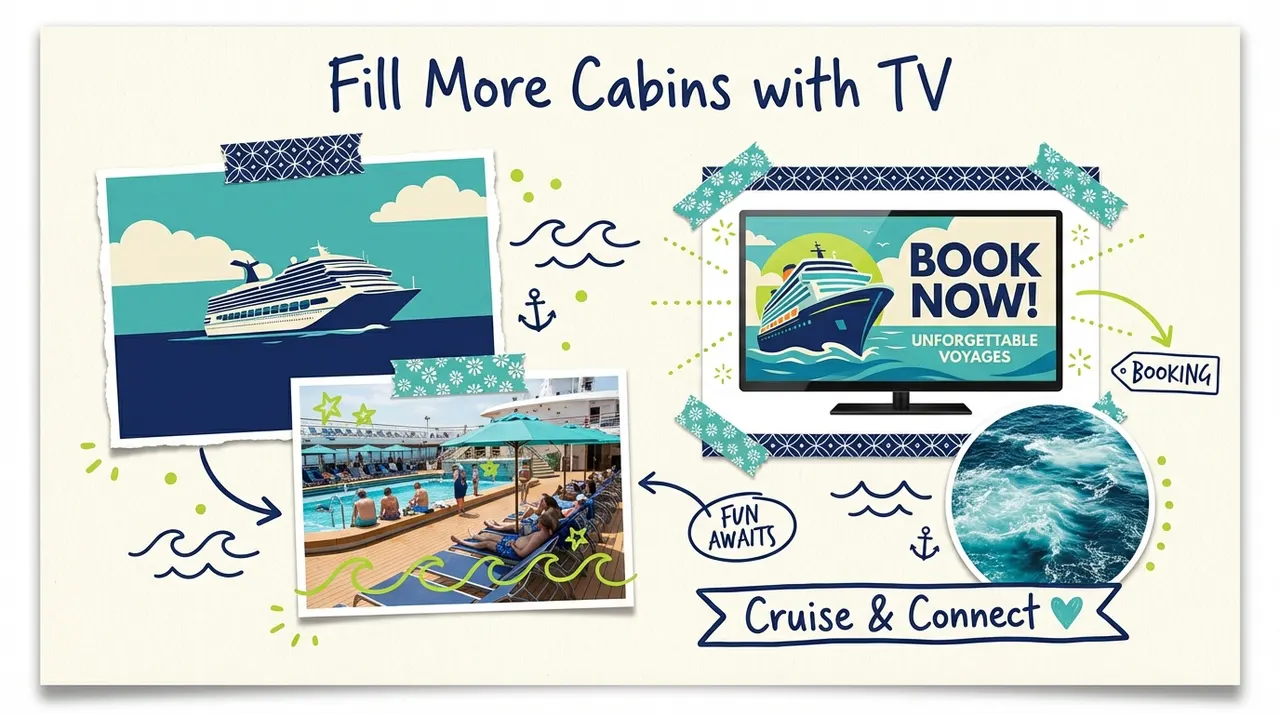
Every traveler's journey starts with a spark. Maybe it's a stunning aerial shot of coastline, a bustling downtown food scene, or a family laughing on a sun-soaked boardwalk. TV has always been the best medium for creating that spark, and now, thanks to connected TV (CTV), destinations of every size can put their story in front of the right viewers.
What destination marketing organizations do

A destination marketing organization is the entity responsible for promoting a city, region, county, or state as a travel destination. DMOs go by many names: convention and visitors bureaus, tourism boards, tourism authorities, or travel promotion agencies. Their job is to attract visitors, which in turn drives hotel bookings, restaurant spending, attraction visits, and local tax revenue.
According to Destinations International, there are more than 2,300 DMOs operating in the United States alone (Destinations International, 2024 Futures Study). They range from massive organizations like NYC Tourism + Conventions to small-town chambers with a single marketing coordinator.
Regardless of size, every DMO shares the same core challenge: convincing someone who's never visited to choose your destination over every other option. And that's where TV advertising becomes a powerful tool.
Why TV is built for destination marketing
Think about the last time a travel ad really grabbed your attention. Chances are, it was a video. There's a reason for that.
Tourism is one of the most visual industries on the planet. You're not selling a product someone can hold in their hands. You're selling an experience, a feeling, a promise. TV advertising lets you deliver that promise in full motion, with sound, music, and storytelling that static ads simply can't match.
Research from the Video Advertising Bureau found that travel and tourism TV ads drive a 28% higher recall rate compared to digital display ads (VAB, "Travel & Tourism: TV's Power to Inspire," 2023). When someone sees your destination's beaches, trails, festivals, or skyline on their living room screen, it creates an emotional connection that sticks.
Destination marketing has always been about inspiration first, conversion second. TV fits that funnel perfectly. You inspire viewers with a 30-second story, and then retarget interested audiences through digital channels to drive bookings.
The shift from broadcast to connected TV

For decades, DMOs with big budgets ran commercials on broadcast and cable networks. State tourism boards like Visit California or Visit Florida spent millions on national TV buys. Smaller destinations? They were priced out entirely.
Connected TV has changed the math. CTV lets you run ads on premium streaming platforms (Hulu, Peacock, Tubi, and 100+ others) with the same production quality as a national broadcast spot, but with far more precise targeting and much lower entry costs.
The CTV advertising market continues to grow rapidly. eMarketer projects U.S. CTV ad spending will reach $33.3 billion in 2026, up from $28.8 billion in 2025 (eMarketer, U.S. CTV Ad Spending Forecast, 2025). Tourism advertisers are a growing share of that spend because CTV solves the two biggest problems DMOs have faced with traditional TV: waste and measurement.
With broadcast, you'd buy a spot during a morning show and hope the right people saw it. With CTV, you can target specific audiences in specific markets and track what happens next.
Targeting strategies that work for tourism
Targeting is where CTV gives DMOs a real edge. Here are the strategies that matter most for destination marketing.
Feeder market targeting. Every destination has feeder markets, the cities and regions where most visitors originate. A beach town in the Carolinas might target viewers in Charlotte, Raleigh, Atlanta, and D.C. A ski resort in Colorado targets Dallas, Houston, and Chicago. CTV lets you focus your entire budget on these proven feeder markets instead of wasting money on areas that don't send you visitors. Learn more about how geo-targeting works for location-based campaigns.
Seasonal timing. Tourism is cyclical, and your advertising should be too. Run ads for summer destinations starting in March and April, when families are planning vacations. Promote fall foliage in July and August. Ski season campaigns should launch in October. CTV makes it easy to flight your campaigns around these windows.
Demographic targeting. Different destinations appeal to different travelers. A family-friendly water park destination targets households with children ages 5 to 14. A wine country region targets adults 35 to 64 with higher household incomes. CTV platforms allow you to layer these demographic filters on top of geographic targeting for precision that broadcast TV never offered.
Interest-based targeting. Many CTV platforms let you reach viewers based on interests and behaviors. You can target people who've recently searched for travel content, visited travel booking sites, or shown interest in outdoor recreation, dining, or cultural events.
Creative approaches for destination ads

The best destination ads don't feel like ads. They feel like a window into an experience. Here's what works.
Lead with visually stunning footage. Aerial drone shots, golden-hour lighting, and authentic moments beat stock footage every time. If your destination has natural beauty, let it do the heavy lifting. Thirty seconds of breathtaking scenery with a simple tagline can outperform a cluttered ad packed with text and offers.
Show real people, not actors. Viewers connect more with authentic moments. Families splashing in waves, couples exploring a downtown district, friends toasting at a local brewery. These feel real because they are.
Include a clear call to action. "Plan your trip at VisitOurTown.com" or "Book your stay today" gives viewers a next step. Some DMOs include QR codes in their CTV ads to bridge the gap between the TV screen and a mobile booking experience.
Tailor creative to the season. Don't run the same ad year-round. Swap creative to match what's happening in your destination right now, whether that's cherry blossom season, a summer music festival, or holiday light displays.
With platforms like Adwave, you can generate broadcast-quality 30-second ads from your existing website or social content and launch campaigns from $30/day. That means even the smallest CVB can test TV advertising without a massive production budget.
Budget planning for DMOs of all sizes
One of the biggest misconceptions in destination marketing is that TV advertising requires a six-figure budget. That used to be true. It isn't anymore.
Here's a practical breakdown by DMO size:
Small DMOs (under $500K annual marketing budget). Start with $2,000 to $5,000 per month on CTV, focused entirely on your top two or three feeder markets. At a $25 CPM (cost per thousand impressions), a $3,000 monthly budget delivers roughly 120,000 impressions to targeted viewers. That's enough to build awareness in key markets during peak planning seasons.
Mid-size DMOs ($500K to $2M annual budget). Allocate 10% to 15% of your media budget to CTV. This typically means $5,000 to $25,000 per month, enough to cover multiple feeder markets with seasonal creative rotations. Layer in attribution tracking to measure website visits, lodging searches, and visitor inquiries driven by your TV campaigns.
Large DMOs ($2M+ annual budget). You're likely already running some form of TV. The shift here is moving dollars from broadcast to CTV for better targeting and measurement. Many large DMOs now split their TV budget 50/50 between broadcast (for broad reach) and CTV (for precision targeting and trackable results).
Measuring tourism impact from TV campaigns
Measurement has always been the hardest part of destination marketing. How do you know if someone visited your town because of an ad they saw three months ago? CTV makes this much more trackable than traditional TV ever was.
Key metrics for DMO campaigns include website lift (increases in visits to your destination's website during and after campaign flights), search lift (growth in branded search queries like "things to do in [your destination]"), and foot traffic attribution (some CTV platforms can match ad exposure to physical visits using mobile location data).
The CTV measurement and attribution guide covers these methods in detail.
Beyond digital metrics, DMOs should also track hotel occupancy rates, visitor center foot traffic, and tourism tax receipts during campaign periods compared to the same periods in prior years. While these aren't directly attributed to a single ad, consistent patterns over multiple campaign cycles build a clear picture of TV's impact.
How smaller destinations can now compete
CTV has leveled the playing field in ways that would have seemed impossible a decade ago. A small coastal town doesn't need Visit Florida's budget to reach potential visitors in Atlanta or Nashville. A mountain community doesn't need to outspend Vail to attract skiers from Dallas.
With Adwave, smaller DMOs can create professional TV ads in minutes and launch campaigns across 100+ premium streaming channels with budgets from $30/day. That means a CVB with a modest budget can run targeted CTV campaigns in specific feeder markets during peak planning windows and measure the results.
This is especially powerful for destinations that compete on charm, authenticity, and unique experiences rather than sheer scale. A 30-second spot showing your town's local food scene, historic downtown, or hidden hiking trails can be just as compelling as a big-budget production from a major city.
The destinations that win aren't always the ones with the biggest budgets. They're the ones that tell the best stories to the right audiences at the right time. CTV gives every destination that opportunity.
If you're exploring how travel and tourism businesses use TV advertising, destination marketing follows many of the same principles with a focus on regional promotion rather than individual business growth.
Common questions answered
How much should a DMO spend on CTV advertising? A good starting point is 10% to 15% of your total media budget. For smaller DMOs just testing CTV, even $2,000 to $3,000 per month focused on your top feeder markets can generate meaningful awareness. The key is to concentrate your budget geographically rather than spreading it thin across too many markets.
Can a small-town CVB really afford TV advertising? Yes. CTV has removed the budget barriers that kept smaller destinations off television. Platforms like Adwave let you launch campaigns from $30/day, and you can target only the specific markets that send you the most visitors. You don't need a national buy to make TV work for your destination.
What's the best time of year for DMOs to run TV ads? It depends on your destination's peak season, but the general rule is to advertise during the planning window, not the travel window. If your peak season is summer, start running ads in March and April when families are making vacation plans. For winter destinations, launch campaigns in September and October.
How do you measure whether a tourism TV campaign worked? Track a combination of digital and real-world metrics. On the digital side, monitor website traffic lift, branded search volume increases, and visitor guide requests during campaign periods. On the ground, compare hotel occupancy rates, visitor center traffic, and tourism tax revenue against the same periods in prior years. CTV platforms also offer attribution tools that can connect ad exposure to website visits and even physical travel.
What makes a good destination marketing TV ad? The best destination ads lead with stunning visuals and authentic moments rather than text-heavy messaging. Show real experiences, not staged scenes. Keep it simple: one clear emotional hook, one memorable visual sequence, and one call to action. Thirty seconds goes fast, so focus on making viewers feel something rather than cramming in every attraction and amenity.