-
3.7 hours
Average daily TV viewing time per American
-
6.5 hours
Daily viewing time for adults 65+
-
47%
Share of TV time now spent streaming
Americans spend an average of 3.7 hours watching television every day, according to Nielsen research and industry analysis from 2024-2025. That adds up to nearly 26 hours per week, or more than 1,350 hours annually, making television the dominant leisure activity for most American households. But here's what makes this number especially interesting for advertisers: while total viewing time has remained relatively stable, where and how Americans watch has transformed completely. Streaming now accounts for nearly half of all TV viewing time, creating unprecedented opportunities for businesses of all sizes to reach engaged audiences on the biggest screen in the home.
What the data shows
The 3.7-hour daily average represents a massive block of attention that Americans dedicate to television content every single day. To put this in perspective, that's more time than most people spend eating, exercising, or socializing combined. Television remains the undisputed champion of American leisure time, despite predictions over the past decade that smartphones and social media would displace it entirely.
What makes this viewing time valuable for advertisers isn't just the quantity but the quality of attention. Television viewing, whether streaming or traditional, represents what marketers call "lean-back" engagement. Viewers are typically relaxed, often watching with family members, and giving the screen their primary attention. This stands in stark contrast to the fragmented, easily-distracted attention that characterizes most digital media consumption.
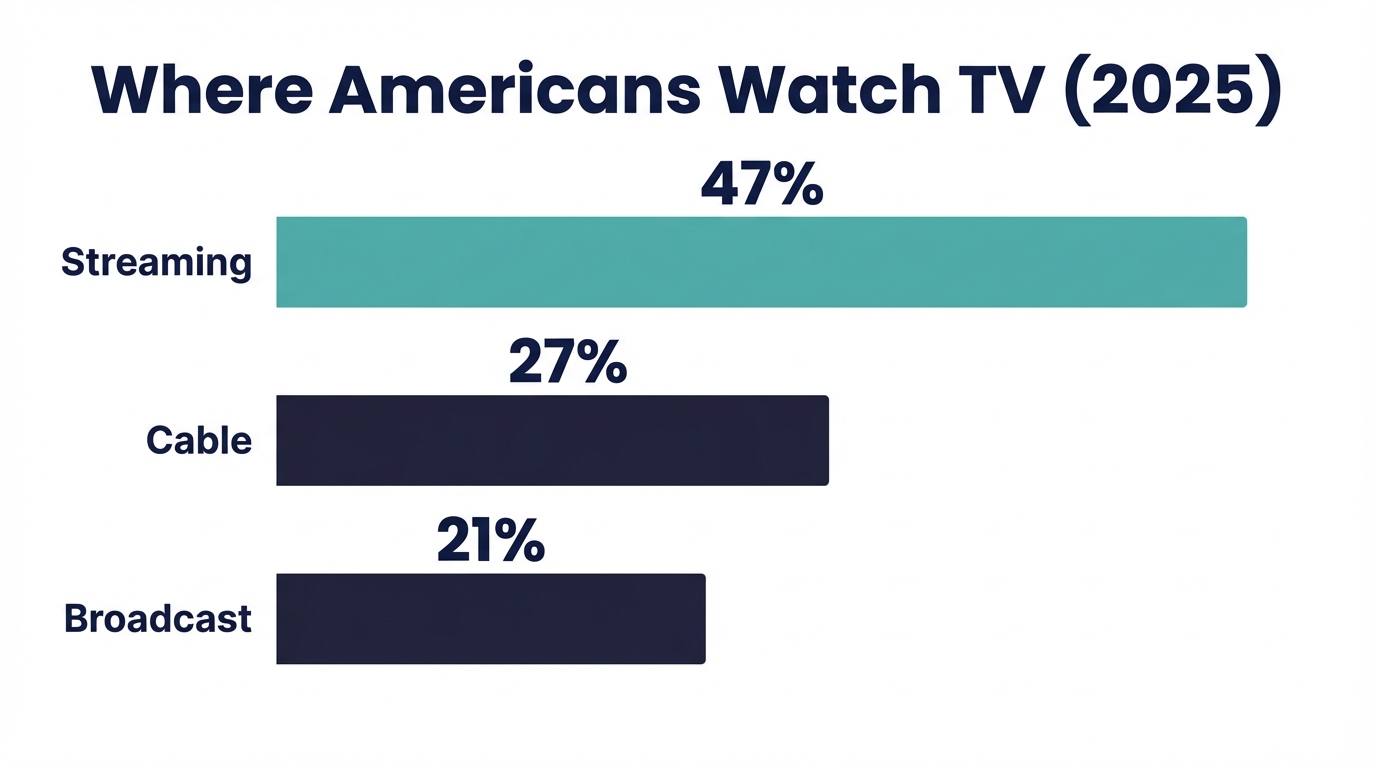
The composition of that 3.7 hours has shifted dramatically in recent years. According to Nielsen's Gauge data from mid-2025, streaming now captures approximately 47% of total TV viewing time, while cable accounts for roughly 27% and broadcast holds about 21%. The remaining percentage goes to "other" categories including gaming consoles and DVD playback. This means that nearly half of all television viewing now happens through platforms that offer programmatic advertising access, opening doors that were previously closed to all but the largest advertisers.
Year-over-year trends tell an even more compelling story. Streaming's share of TV time has grown by roughly 15 percentage points since 2021, when it captured just 28% of viewing. That growth hasn't come from Americans watching more TV overall; instead, it represents a wholesale migration from cable and broadcast to streaming platforms. For advertisers, this shift matters enormously: streaming platforms offer targeting capabilities, measurement tools, and accessibility that traditional television never could.
The platforms capturing this streaming time represent the biggest names in content:
YouTube: 10.6% of total TV viewing (largest streaming platform)
Netflix: 7.9%
Amazon Prime Video: 3.1%
Hulu: 2.6%
Disney+: 1.9%
Peacock: 1.1%
Tubi: 1.8%
This fragmentation across platforms might seem challenging for advertisers, but it creates opportunity: CTV advertising platforms can aggregate inventory across these services, giving even small advertisers access to premium audiences.
Breaking down the numbers
Understanding who watches how much television reveals patterns that matter significantly for advertising strategy. The 3.7-hour average conceals enormous variation across age groups, with implications for how businesses should think about reaching different customer segments.
By age group
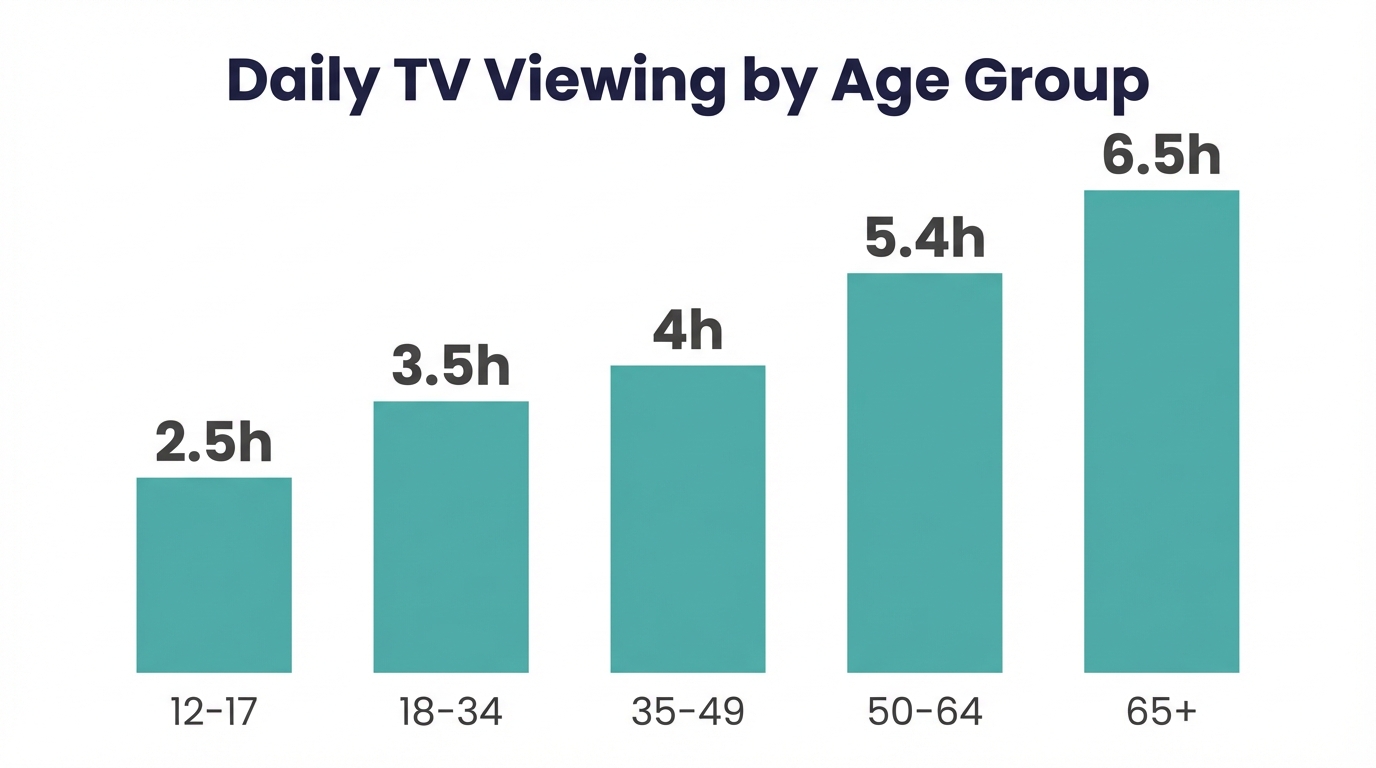
The generational divide in television consumption is striking. According to Nielsen's September 2024 data:
Adults 65+: 6.5 hours daily (nearly double the average)
Adults 50-64: 5.4 hours daily
Adults 35-49: 4.0 hours daily
Adults 18-34: 3.5 hours daily
Teens 12-17: 2.5 hours daily
Children 2-11: ~3.0 hours daily
The pattern is clear: older Americans watch significantly more television. Adults 65 and older grew up with television as the primary entertainment medium and maintain that relationship even as younger generations have diversified their media consumption.
The 50-64 cohort represents an especially valuable advertising demographic. They often have significant disposable income, own homes, and make purchasing decisions for both themselves and sometimes aging parents. Their heavy television consumption means TV advertising reaches them efficiently and repeatedly.
Young adults aged 18-34 watch below the national average but still represent substantial engagement. This group watches television differently than older generations, with more streaming and less traditional cable or broadcast. For advertisers trying to reach millennials and older Gen Z, streaming platforms offer the only reliable path to television reach.
Teenage viewing has declined over the past decade as younger viewers split attention across phones, tablets, gaming, and social media. However, when they do watch television, streaming dominates their viewing time almost entirely.
By time of day
Television viewing patterns follow predictable daily rhythms that smart advertisers can exploit:
Morning (7-9 AM): ~8% of daily viewing, mostly news and background content
Daytime (9 AM-4 PM): ~25% of daily viewing, stay-at-home audiences plus remote workers
Prime time (7-10 PM): ~35% of daily viewing, highest-quality attention
Late night (10 PM-midnight): ~15% of daily viewing, younger-skewing audiences
Overnight (midnight-7 AM): ~17% of daily viewing, shift workers and background viewing
Prime time is where the real action happens. This three-hour window captures over a third of all daily viewing. Households are together, attention is focused, and viewers are in a receptive, relaxed state. Prime time inventory commands premium pricing for good reason: this is when television advertising delivers its highest impact.
Daytime viewing has shifted thanks to remote work. More working-age adults now watch television during traditional work hours, especially background content like news, sports, or streaming series. This creates additional inventory at lower prices for advertisers willing to reach audiences outside prime time.
Late night audiences skew younger and are more likely to be streaming than watching traditional TV. For brands targeting younger demographics, late-night streaming inventory can offer efficient reach at competitive prices.
Streaming versus traditional
The viewing time split between streaming and traditional television varies dramatically by age:
Under 35: ~65% streaming (YouTube alone captures ~20% of their TV time)
Ages 35-54: ~45% streaming, roughly even split with traditional
Ages 55+: ~30% streaming, but growing steadily each year
For viewers under 35, traditional cable and broadcast represent legacy behaviors, not primary consumption patterns. This demographic grew up with on-demand content and doesn't understand why anyone would watch something at a scheduled time.
The 35-54 cohort has adopted streaming enthusiastically but hasn't abandoned cable entirely, especially for news and live sports. They're comfortable switching between Netflix and CNN, streaming and cable, based on what they want to watch.
Adults over 55 still lean traditional, though this percentage shifts every year as the demographic becomes more comfortable with streaming technology and as traditional cable packages become less attractive economically.
Why it matters for your business
Those 3.7 hours represent a daily window of opportunity to reach your customers when they're relaxed, receptive, and paying attention. Television viewing isn't like social media scrolling or web browsing, where attention fragments across tabs and apps. When someone is watching television, that screen commands their focus.
For local businesses, the implications are significant. Your potential customers spend more time watching television than almost any other activity outside of sleeping and working. A restaurant trying to fill Tuesday night tables can reach hungry households during the exact hours when dinner decisions get made. A dental practice building awareness can appear alongside trusted content when families are gathered and receptive. A real estate agent establishing local presence can reach homeowners during the evening hours when they're thinking about their living situation.
The shift toward streaming makes this opportunity accessible in ways it never was before. Traditional television advertising required massive budgets because you had to buy broad inventory and waste impressions on viewers outside your target area. Streaming television changes the equation entirely. Geographic targeting means a local business can show ads only to households within their service area. Demographic targeting ensures impressions go to relevant audiences. And importantly, the minimum budgets have collapsed: platforms like Adwave let businesses launch TV campaigns from $30/day (with a $60 starter credit).
Consider the math: if your target customers watch 3.7 hours of television daily, and you can reach them with targeted streaming ads during that window, you're accessing premium attention at accessible prices. A two-week campaign running during evening hours can generate thousands of impressions among local households for less than most businesses spend on a single print ad.
The premium channel access matters too. These viewing hours happen across 100+ channels including NBC, Hulu, ESPN, and Discovery. Your local business ad appears alongside content from trusted networks, borrowing credibility and reaching viewers in contexts where they're engaged rather than distracted.
How to take advantage of this trend
Understanding that Americans watch 3.7 hours daily is useful. Knowing how to capture a slice of that attention is what grows your business. The strategic approach starts with recognizing that you don't need to reach everyone, just your potential customers, and modern targeting makes that precision possible.
Key strategic moves for your TV campaign:
Geographic targeting: Set a 15-25 mile radius around your location so every impression reaches potential customers
Timing: Evening hours (6-10 PM) capture the highest-quality viewing when households gather
Budget: $200-500 for two weeks achieves real frequency (viewers seeing your ad multiple times)
Creative: AI platforms generate broadcast-quality ads from your website in minutes
Measurement: Track brand search volume and website traffic, not immediate clicks
Let's break down the thinking behind each of these.
Geographic precision matters. There's no point paying to reach viewers 50 miles away if they'll never drive to your business. Platforms like Adwave let you set exact geographic parameters so every impression goes to households that could become customers.
Timing aligns with viewing patterns. If you're a restaurant, prime time aligns perfectly with dinner decision-making. If you're an HVAC company, evening hours reach homeowners when they're experiencing their heating or cooling firsthand. Match your advertising timing to when your message will resonate most strongly.
Frequency beats reach. You want viewers to see your ad multiple times, not just once, because repetition builds recognition and recall. Better to reach 5,000 households four times each than 20,000 households once. Start with enough budget to achieve real frequency within your target area.
TV measurement differs from digital. Television campaigns build awareness and recognition rather than generating immediate clicks. The lift often appears in brand search volume (are more people Googling your business name?), overall website traffic patterns, and new customer surveys. These indirect metrics reveal television's true impact.
The bigger picture
The 3.7-hour daily viewing figure exists within a broader transformation of American media consumption that has profound implications for advertising. Understanding these macro trends helps explain why television advertising is becoming more accessible and more valuable simultaneously.
The fundamental shift is that television viewing has migrated from a closed, expensive advertising environment to an open, accessible one. Traditional cable and broadcast television operated like a walled garden: only advertisers with six-figure budgets could play, creative production required expensive studios, and targeting meant hoping your audience happened to be watching. That world is effectively over.
Streaming has democratized television advertising just as the internet democratized publishing. The technical infrastructure that delivers Netflix shows also delivers advertisements, and that infrastructure doesn't discriminate based on budget size. A local pizza shop's ad can run on the same platforms, in the same ad breaks, as national brand campaigns. The playing field hasn't just been leveled; it's been opened entirely.
Meanwhile, attention economics increasingly favor television. Social media platforms struggle with declining user engagement and advertiser skepticism about viewability and fraud. Digital display advertising faces rampant ad blocking and banner blindness. Television, by contrast, delivers full-screen, unskippable, brand-safe advertising to engaged audiences. As digital channels become noisier and less effective, television's premium attention becomes more valuable.
The viewing hours data also reflects generational behavior that will shape advertising for decades. Younger viewers have never known a world without streaming, and they'll carry streaming-first habits throughout their lives. Advertisers who establish streaming TV capabilities now are building muscles they'll need forever, not adapting to a temporary trend.
For small businesses specifically, this moment represents unprecedented opportunity. The combination of substantial daily viewing time, accessible streaming platforms, and sophisticated targeting means television advertising is available to businesses of all sizes for the first time. The question isn't whether to explore TV advertising but how quickly to start learning what works.
What experts are saying
Industry analysts and media executives have taken note of television's resilient viewing numbers alongside its transformation toward streaming. Their perspectives help contextualize what these statistics mean for advertisers.
Brian Wieser, former GroupM global president of business intelligence, has noted that television continues to capture more daily time than any other media category despite decades of digital disruption. His research emphasizes that television viewing habits prove remarkably sticky across generations, even as the platforms delivering content change completely.
Nielsen's own analysis accompanying their Gauge reports emphasizes that total television usage remains robust even as the mix shifts toward streaming. Their researchers note that Americans haven't reduced television consumption; they've redirected it. This distinction matters for advertisers: the audience remains available, just through different channels than before.
Advertising industry commentary has increasingly focused on CTV's effectiveness compared to digital alternatives. Marketing executives report that streaming television delivers engagement metrics that digital display advertising cannot match, with completion rates above 90% for non-skippable ads compared to digital video completion rates that often struggle to reach 70%.
The small business advertising community has been slower to recognize the opportunity, partly because television's inaccessibility was so complete for so long. But early adopters report that streaming TV campaigns deliver brand-building impact that other channels cannot replicate, at price points that fit realistic marketing budgets.
Common questions answered
How has daily TV viewing time changed over the past decade?
Daily television viewing time has remained remarkably stable at roughly 3.5-4 hours per day over the past decade, though the composition has changed dramatically. Total viewing has decreased only slightly despite smartphone adoption, because streaming platforms have absorbed hours that might otherwise have been lost. The real story isn't declining television consumption but migrating television consumption, as viewers have shifted from cable and broadcast to streaming while maintaining similar overall viewing time.
Do younger people really watch less TV than older generations?
Yes, but the gap is smaller than stereotypes suggest. Adults 18-34 still watch approximately 3.5 hours of television daily, just below the national average. However, their viewing is almost entirely streaming rather than traditional cable or broadcast. When you measure television as a medium rather than a delivery method, younger adults remain substantial TV consumers. They've abandoned cable, not television itself.
Is TV viewing time declining because of smartphones?
Smartphones have changed how Americans spend their time, but television has proven more resilient than many predicted. The 3.7-hour daily average has declined only marginally from peaks of around 4.5 hours a decade ago. What's more significant is that smartphones and television often coexist: many viewers watch TV with a phone in hand, using second screens during commercial breaks or less engaging content rather than replacing television entirely.
What time of day do most Americans watch TV?
Prime time (7-10 PM) remains the peak viewing period, capturing approximately 35% of all daily television consumption. This three-hour window sees households gathered, attention focused, and viewers in a relaxed, receptive state. For advertisers, prime time inventory commands premium pricing precisely because it delivers the highest-quality viewing occasions. Secondary peaks occur during morning news hours and late night.
How does streaming time compare to traditional TV?
Streaming now accounts for approximately 47% of all television viewing time, approaching parity with combined cable and broadcast viewing. This represents a dramatic shift from just four years ago, when streaming captured only 28% of viewing. The trend continues to favor streaming, with projections suggesting it will capture majority viewing share within the next year. For advertisers, this shift means streaming platforms increasingly represent where television audiences are.
Does the average include streaming services like Netflix?
Yes, the 3.7-hour average includes all television viewing regardless of source, encompassing streaming services (Netflix, Hulu, YouTube, Amazon Prime Video, Disney+, etc.), traditional cable, broadcast networks, and other sources like gaming consoles. Nielsen's measurement methodology captures content delivered to television screens regardless of how it reaches the device, providing a detailed view of total television engagement.
Supporting data
The following statistics provide additional context for understanding American television viewing habits:
Streaming captured 47.3% of TV time in July 2025, nearly half of all viewing (Nielsen)
YouTube leads all streaming platforms with 10.6% of total TV viewing time (Nielsen Gauge)
56% of Americans watch three or more hours of TV daily, down from 61% in 2024 (Attest Media Report)
28% of Americans report watching no live TV on an average day in 2025 (Attest Media Report)
Streaming surpassed combined broadcast and cable viewing for the first time in May 2025 (Nielsen)
Adults 65+ watch nearly twice as much TV (6.5 hours) as adults 18-34 (3.5 hours) (Nielsen)
Prime time viewing (7-10 PM) accounts for 35% of daily television consumption (Nielsen)
CTV advertising spending reached approximately $33 billion in 2025 (eMarketer)
Average CTV ad completion rates exceed 90% for non-skippable formats (IAB)
Nearly half of all TV time is now ad-supported streaming or traditional TV (Nielsen)
Get started with TV advertising
Americans spend nearly four hours every day watching television, and increasingly, that viewing happens on streaming platforms accessible to advertisers of all sizes. Your customers are watching. The question is whether you'll be there when they do.
Traditional barriers to television advertising no longer exist. Production costs have collapsed thanks to AI-powered creative tools that generate broadcast-quality commercials in minutes. Minimum budgets have dropped to levels any business can afford. Targeting capabilities mean you only pay to reach relevant audiences in your actual service area.
Adwave makes TV advertising simple and accessible for small businesses. Create your commercial from your website, set your geographic targeting, choose your budget from $30/day, and launch campaigns that reach viewers across 100+ premium channels. See how it works at adwave.com or explore pricing options to understand what's possible for your budget.
The viewing time is there. The technology is ready. The opportunity is yours.