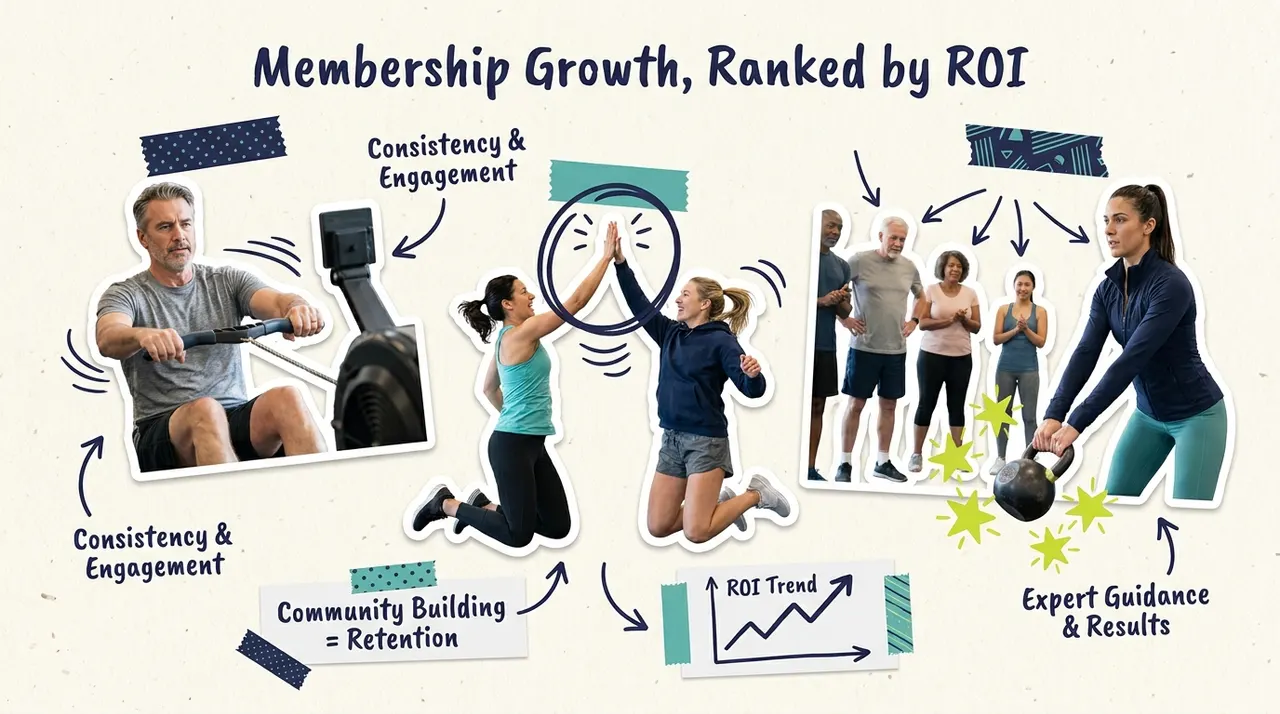
Most gym owners over-invest in the wrong channels. They burn $3,000 a month on Facebook ads aimed at the wrong audience, sponsor a high school football scoreboard for "exposure," or run six-month Yelp ad contracts that drive ten leads. Meanwhile the levers that grow membership, like Instagram reels with local trainers, a fully-optimized Google Business Profile, and a structured member referral program, sit untouched.
Gym memberships aren't impulse purchases. People research, lurk on Instagram for weeks, scroll through reviews, and walk in for a tour before signing a 12-month contract. The advertising that wins is the advertising that shows up across every step of that journey: when motivation hits, when they search, when they compare, and when they finally walk through your door.
This guide ranks seven advertising channels for gyms and fitness centers by ROI: Meta Ads (Instagram and Facebook), Google Ads and Local Services Ads, influencer and trainer partnerships, Google Business Profile and local SEO, member referral and reward programs, CTV streaming TV advertising, and community events and partnerships. You'll get realistic budgets, our recommended starting mix by gym stage, and the channels we'd skip outright.
For a deeper look at TV strategy specifically, see our companion guide to TV advertising for gyms and fitness studios.
How We Ranked the Channels
Three criteria drove our rankings:
Cost per new member. Not cost per lead, not cost per click. How much do you spend, on average, to add one paying member to your roster?
Lifetime value alignment. Some channels attract bargain-hunters who churn in 60 days. Others attract committed members who stay 18+ months. Channels that bring in long-tenure members rank higher even at slightly higher acquisition cost.
Defensibility. Does the channel produce compounding returns (reputation, recall, referral cycle) or are you starting from scratch every month?
Gyms face a fundamental tension every membership business does: paid channels (Meta, Google, CTV) produce predictable inquiry flow but stop the moment you stop paying. Organic channels (GBP, referrals, community) compound over years but take 6-12 months to gain real traction. The right mix shifts dramatically by gym stage and category.
Why Gym Advertising Is Different
Several dynamics shape what works in this category.
Motivation is seasonal and spiky. January (resolutions), March-April (summer body), and September (back-to-school) drive 60-70% of the year's new sign-ups for most gyms. Channels that can scale up during peak windows beat channels with fixed monthly costs.
The decision is emotional, not rational. People don't choose gyms on price or square footage. They choose based on how the gym feels, who works out there, and whether they can picture themselves belonging. Visual, community-focused content outperforms feature-heavy messaging.
The trial-to-member funnel matters more than lead-gen. A free trial pass converts 30-60% of trial-takers into paying members for well-run gyms. Channels that drive trials, not just leads, deliver more profitable acquisition.
Geographic constraint is tight. Most members live within 10 minutes of the gym. Targeted advertising at that radius outperforms broader campaigns dramatically.
Lifetime value justifies higher acquisition cost than most owners think. A member at $80/month with average 24-month tenure is worth roughly $1,900 in revenue. Spending $80-$150 to acquire that member produces strong ROI, but most gym owners cap their cost-per-acquisition at $40 and miss the bigger picture.
Boutique vs big-box matters for channel selection. A 24-Hour Fitness clone competes on price and convenience. A boutique HIIT studio competes on identity and community. The right channels look very different for each.
Channel 1: Meta Ads (Instagram and Facebook) (Best Overall)
If you're going to run one paid channel for your gym in 2026, run Meta. Instagram in particular is the discovery layer for fitness culture, and Facebook delivers the targeting precision (age, neighborhood, life events, interests) that few other platforms match.
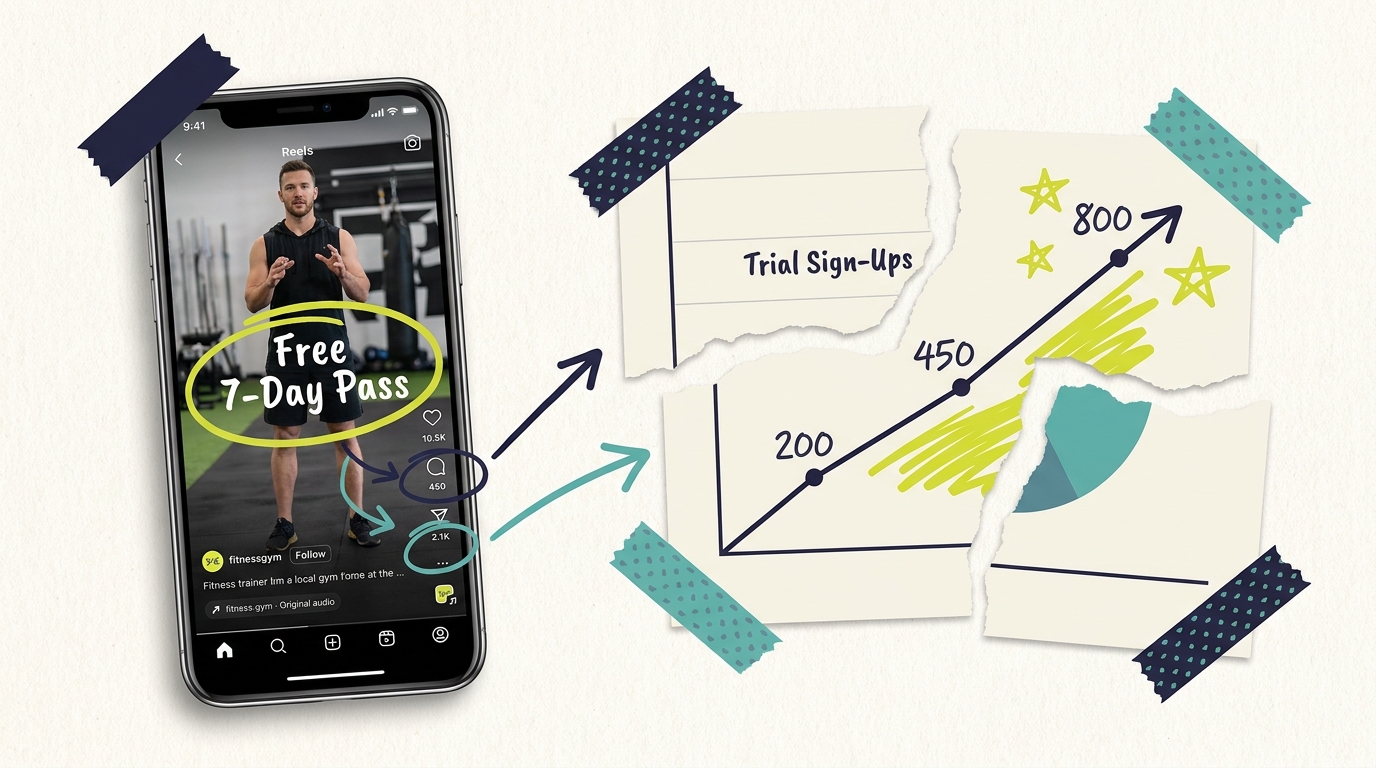
For gyms, Meta consistently produces the lowest cost-per-trial of any paid channel. The combination of Instagram's visual aesthetic and Facebook's geo-targeting was practically built for membership-driven local businesses.
What Wins on Meta for Gyms
Reels and short video. Trainer demos, member transformations, class previews, behind-the-scenes facility tours. Reels under 15 seconds with captions and trending audio routinely deliver 3-5x the reach of static photo posts.
Lead generation campaigns with on-platform forms. "Get a free 7-day pass" or "Book a tour" form-fill campaigns let potential members convert without ever leaving Instagram or Facebook.
Lookalike audiences built from your current member list. Upload a CSV of active members; Meta finds people who match their demographics and interests. This is the single highest-ROI Meta tactic most gyms ignore.
Retargeting campaigns for website visitors and Instagram profile viewers. People who priced your gym but didn't convert often need 3-5 more touches to commit.
Stories with stickers and polls. Daily Stories with trainer Q&A, member highlights, and class schedules build the relationship that drives walk-ins.
Budget and Expected ROI
Plan $800-$3,500 per month on Meta for an active gym campaign. Cost per trial typically lands at $8-$25. Trial-to-member conversion runs 30-55% for well-run gyms, putting cost per new member at $20-$80. Boutique studios with strong creative often beat these numbers; commodity gyms with weaker brand presence typically pay more.
Our pick for ranking: #1. Meta is the highest-ROI paid channel for nearly every gym category, especially for boutique studios, group fitness, and any gym with strong visual brand identity.
Channel 2: Google Ads and Local Services Ads (Best for Intent)
When someone searches "gym near me," "24 hour fitness [city]," or "yoga studio [neighborhood]," they're not browsing. They're looking for a gym this week. Google Ads put you at the top of those searches, exactly where decisions get made.
For gyms, Google's ad ecosystem produces the highest-intent leads of any channel. Search Ads convert at 5-15% trial-pass-to-member rates because the searcher is already actively shopping.
What Wins on Google for Gyms
Search campaigns on intent-rich keywords: "gym membership [city]," "personal trainer [neighborhood]," "spin class [zip code]," "24 hour gym [city]." Service-specific keywords convert at higher rates than generic gym terms.
Performance Max campaigns that span Search, Maps, YouTube, and Display. Google's algorithm finds high-intent fitness shoppers across surfaces and is especially effective for gyms with strong visual creative.
Branded search defense. When someone searches your gym name directly, you should own the top ad slot. Otherwise competitors bid on your brand and steal high-intent traffic at the moment of conversion.
Remarketing campaigns for visitors who priced membership but didn't convert. Many gym shoppers compare 4-7 facilities before choosing.
Local Services Ads in markets where they're available for fitness categories. Pay-per-lead format with a Google Guaranteed badge builds trust.
Budget and Expected ROI
Plan $600-$3,000 per month on Google Search and Performance Max. Cost per click typically runs $2-$8 for fitness-related terms. Cost per trial pass typically $20-$50, with cost per new member landing at $50-$150. Higher-end markets and premium boutique categories see higher CPCs but higher conversion rates.
Our pick for ranking: #2. Google captures the highest-intent shoppers but at higher cost than Meta. Most gyms should run both, with Meta as the volume play and Google as the high-intent capture layer.
Channel 3: Influencer and Trainer Partnerships
The fastest-growing channel for gyms in 2026 isn't an ad platform. It's local influencers, partner trainers, and the cross-pollination of fitness creator content. Most gym owners under-invest here because it's harder to track than paid ads, but the ROI often beats Google and Meta for boutique categories.
What Wins in Influencer Marketing for Gyms
Local fitness micro-influencers (5K-50K followers). Pay them to attend a class, do a workout, and post Reels and Stories from your facility. A single Reel from the right local creator often generates 30-100 trial sign-ups for $200-$800.
Partner trainer programs. Recruit independent personal trainers who lack their own facility. They bring their existing client base; you provide the space and split revenue. This expands your member base without paid acquisition cost.
Community-based athletes. Local triathletes, CrossFit competitors, marathon runners, and amateur powerlifters often have engaged followings within your service area. Sponsoring or featuring them builds credibility and direct recruitment funnels.
Creator collabs and challenges. "30-day fitness challenge" co-promoted by 2-3 local creators with your gym as the host facility. Builds community, generates social content, drives trial sign-ups.
Trainer takeovers. Have your in-house trainers run your Instagram for a day. Each trainer brings their personal following and credibility into your brand orbit.
Budget and Expected ROI
Plan $300-$2,500 per month on influencer partnerships and trainer-driven marketing. Cost per new member typically lands at $30-$120. Hard to track precisely, but compounding effects (brand credibility, social proof, search interest) multiply the direct ROI.
Our pick for ranking: #3 for boutique studios and category-specific gyms (CrossFit, F45, yoga, Pilates, climbing, martial arts). Less impactful for big-box commodity gyms.
Channel 4: Google Business Profile and Local SEO (Best Long-Term ROI)
Your Google Business Profile is the highest-impact long-term asset a gym can build. Most gym shoppers include local intent in their searches, and the map pack captures the lion's share of clicks for "gym near me" type queries.
For gyms, GBP optimization is the difference between paying for every member and capturing meaningful trial bookings at zero variable cost.
What Wins on GBP for Gyms
Complete profile optimization. Primary category "Gym" or "Fitness Center" (with specific subcategories like "Yoga Studio," "Pilates Studio," "Boxing Gym," "CrossFit Gym" as relevant). Service area defined precisely.
Photo strategy. 100+ photos: facility, classes in action, equipment, member highlights (with permission), trainers, before/after transformations. Profiles with rich photo libraries generate dramatically more profile actions than sparse ones.
Weekly posts. Class schedule highlights, new program announcements, transformation stories, community events, seasonal challenges. Active profiles rank meaningfully higher in the local map pack.
Q&An optimization. Seed questions: "Do you have childcare?" "What classes do you offer?" "Do you have a free trial?" "What's the contract commitment?" Answer them yourself with helpful info before competitors or random users do.
Reviews engine. Gyms with 100+ reviews and 4.7+ average ratings dramatically outrank weaker review profiles. Build a systematic post-trial review request process.
Budget and Expected ROI
Mostly time investment. Budget $200-$700 per month if you hire help managing posts, photos, reviews, and citations. Results compound over 6-12 months. A well-optimized gym GBP in a competitive metro can produce 50-300+ inquiries per month at zero variable cost.
Our pick for ranking: #4 by direct ROI but the highest-ROI long-term asset of any channel. Every gym should have a fully optimized GBP regardless of paid spend.
Channel 5: Member Referral and Reward Programs
Existing members are your best advertising. Members who refer friends generate higher LTV members at near-zero acquisition cost, and a structured referral engine compounds month over month.
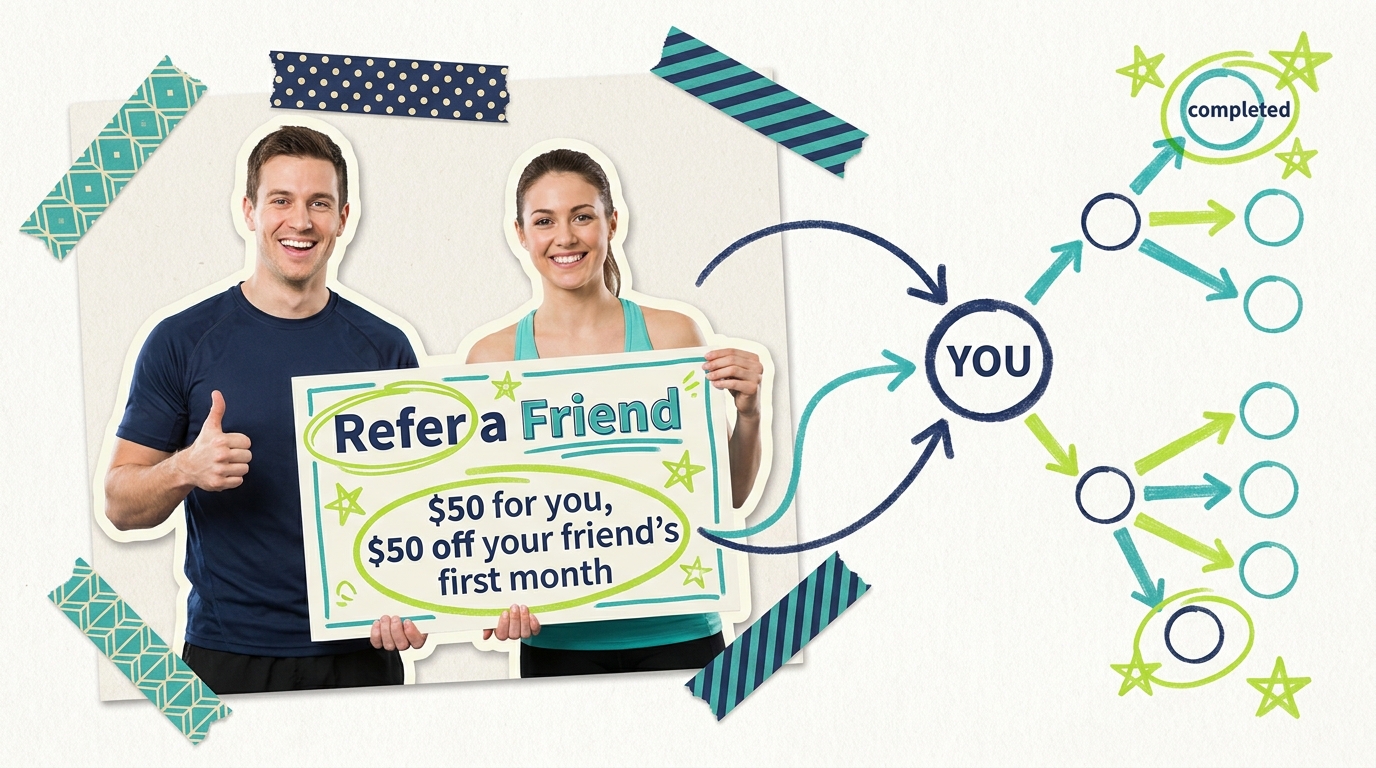
Most gyms have a casual "tell a friend, get a discount" mention on their website. The gyms with sustained membership growth turn referrals into a managed program with explicit incentives, reminders, and tracking.
What Wins in Referral Programs for Gyms
Explicit two-sided incentives. "$50 credit for you, $50 off your friend's first month." Both parties benefit, both parties have a reason to act. Trade-credit incentives (free personal training session, free month) often outperform cash discounts.
Referral cards or codes. Give members physical cards or unique referral codes. Tracking who referred whom is critical for crediting incentives properly.
Quarterly referral pushes. Email and in-gym campaigns 4 times per year. Pair with seasonal motivation peaks (January, spring, fall).
Member milestones. Celebrate the 1-year mark with a "bring a friend free" voucher. Tied to natural relationship goodwill.
Trainer referral programs. Personal trainers often know more potential members than the front desk does. Pay trainers $50-$150 per successful referral.
Win-back campaigns for cancelled members. A handwritten "we miss you" card with a free month offer brings 5-12% of cancelled members back at near-zero cost.
Budget and Expected ROI
Plan $200-$1,200 per month in referral incentives and program management. Cost per new member typically $20-$60 (factoring in incentives paid). Members from referrals tend to stay 30-50% longer than members from paid channels.
Our pick for ranking: #5 by speed but a top-3 channel for established gyms with 200+ members. Build the system from day one even if direct returns take 6-12 months to mature.
Channel 6: CTV Advertising (Best for Established Brands)
For decades, TV advertising required $50K+ minimum spend through cable buyers. That changed with connected TV.
Connected TV (CTV) means streaming services like Hulu, Peacock, Tubi, ESPN, and Roku. Local advertisers can now buy targeted streaming campaigns starting at $50, with tight geographic and audience targeting (eMarketer, 2024).
For boutique studios in competitive metros and multi-location gym operators, CTV builds the brand recognition that makes your gym the one viewers think of when motivation hits. A polished 30-second spot during prime-time streaming reaches your potential members on the same screens where they spend their evenings, layering trust and recall on top of every other channel you run.
Platforms like Adwave make CTV realistic for gyms of any size. Generate a broadcast-quality 30-second spot from your website in about two minutes, target your service area down to specific ZIP codes, and launch on 100+ premium streaming channels for as little as $50.
Budget and Expected ROI
Plan $500-$3,000 per month on CTV. Best for gyms with established brand assets (logo, photos, member testimonials), 1+ years of operating history, and competitive markets where awareness drives differentiation. Pre-launch and very new gyms typically get faster ROI from Meta and Google before adding CTV.
Our pick for ranking: #6, but climbs to #2-3 for boutique studios and multi-location operators in competitive metros. Most effective during peak motivation seasons (December-January, late February-April, September).
Channel 7: Community Events and Local Partnerships
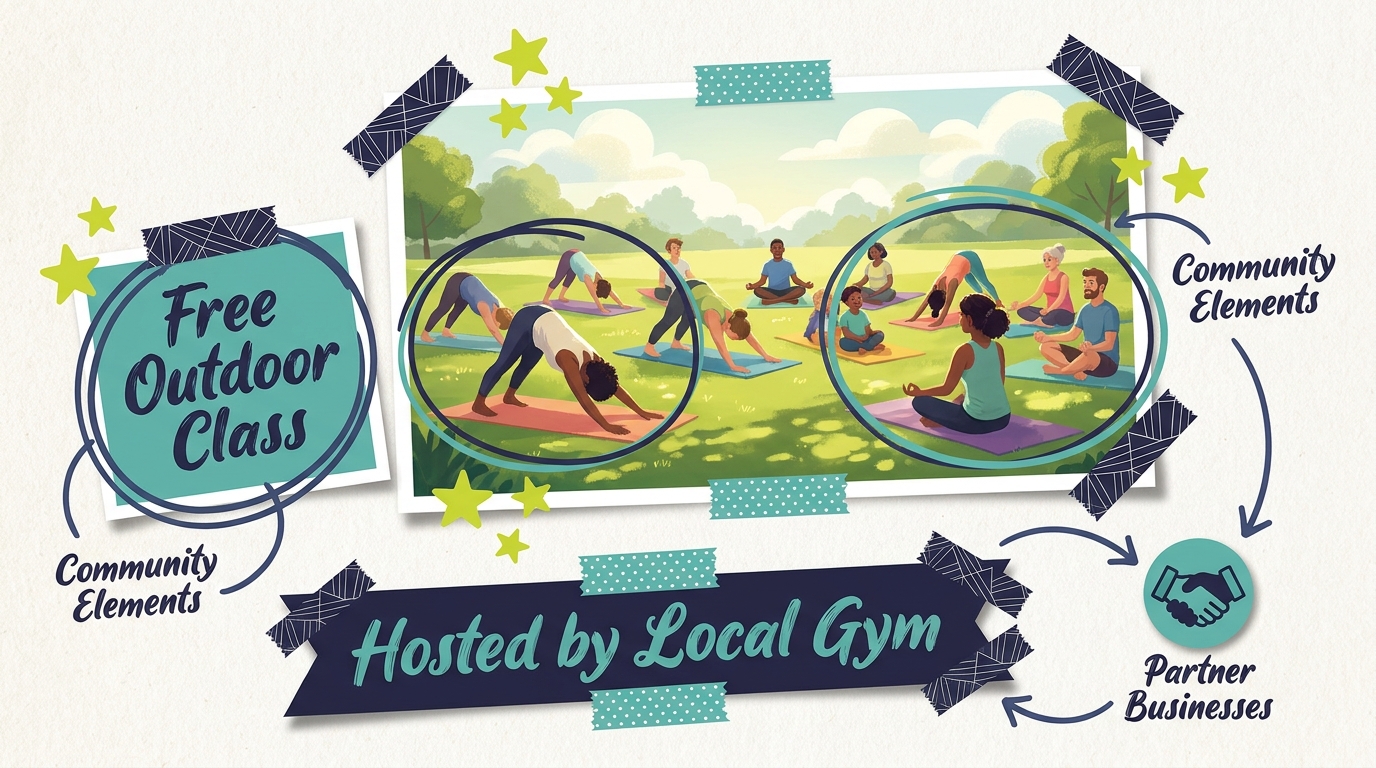
The fastest path to becoming the gym in your neighborhood is community presence. Charity 5Ks, free outdoor classes, partnerships with local employers, and sponsorships of youth sports leagues build the kind of trust that no paid ad can buy.
What Wins in Community Marketing for Gyms
Free outdoor classes. Saturday morning yoga in the park, summer bootcamp at a local field, monthly run club. Generates trial-pass conversions and social media content simultaneously.
Charity event sponsorships. Local 5Ks, breast cancer walks, kids' fitness fundraisers. Brand visibility plus genuine community goodwill.
Corporate wellness partnerships. Reach out to HR teams at local employers. Offer subsidized memberships or onsite fitness programs. One mid-size employer partnership can drive 20-100+ employee sign-ups.
Healthcare provider partnerships. Build referral relationships with local physical therapists, chiropractors, and primary care doctors. They send patients who need to start exercising.
School and youth sports partnerships. Sponsor youth leagues, donate facility access for high school teams, run summer camps for kids. Parents are your members.
Real estate agent partnerships. Top family-focused agents recommend gyms to new movers. Build relationships with the top 10-15 agents in your service area.
Local business cross-promotions. Coffee shops, smoothie bars, athletic apparel stores. Trade flyers, host joint events, run cross-promotion offers.
Budget and Expected ROI
Plan $200-$1,500 per month in community marketing and partnership development. Cost per new member typically $20-$80, often lower for highly-engaged community marketing. Compounding effects on brand reputation are significant.
Our pick for ranking: #7 by direct trackability but a critical compounding asset, especially for boutique studios and gyms competing in crowded markets.
Channel Comparison
Here's how the channels stack up for a typical 1-2 location boutique or mid-size gym.
Recommended Starting Mix by Stage
Pre-Launch and Year 1 ($1,500-$4,000/month)
Meta Ads: 45% ($675-$1,800)
Google Ads: 25% ($375-$1,000)
GBP / Local SEO: 10% ($150-$400)
Community events: 10% ($150-$400)
Influencer / trainer: 10% ($150-$400)
Goal: Hit 200-400 members and build the data needed to model unit economics.
Established Year 2-4 ($4,000-$10,000/month)
Meta Ads: 35% ($1,400-$3,500)
Google Ads: 25% ($1,000-$2,500)
Influencer / trainer: 10% ($400-$1,000)
GBP / Local SEO: 10% ($400-$1,000)
Member referrals: 10% ($400-$1,000)
Community events: 5% ($200-$500)
CTV (test peak seasons): 5% ($200-$500)
Goal: Sustainable membership growth, predictable inquiry pipeline, referral cycle building.
Multi-Location or Premium Brand ($10,000+/month)
Meta Ads: 30%
Google Ads: 20%
CTV: 15%
Influencer / trainer: 10%
GBP / Local SEO: 8%
Member referrals: 10%
Community events: 7%
Goal: Build regional brand authority. Compound recall across channels. Defend against new entrants.
Quick-Pick Channel Recommendations by Scenario
Need members this month. Meta Ads and Google Ads. Period. No other channels deliver speed-to-trial like paid social and search.
$500/month total budget. Run Meta Ads at $400 and invest $100 in optimizing your GBP. Skip everything else until you scale.
Boutique studio (yoga, Pilates, HIIT, climbing, martial arts). Heavy on Meta and influencer marketing. Identity-driven brands win on visual platforms with creator amplification.
Big-box commodity gym. Heavy on Google Ads and GBP. Convenience-driven shoppers convert on intent-led channels.
Pre-launch or grand opening. Meta Ads with "founding member" pricing offer. CTV can build buzz in the 3-4 weeks before opening.
Established 2+ year operator. Layer in CTV and community events. Develop referrals and ask satisfied members for reviews.
Premium pricing positioning. CTV becomes more important. Premium brands need premium-feeling advertising surfaces.
Ultra-competitive metro (Manhattan, LA, Austin, Miami). All seven channels. Single-channel gyms get squeezed.
Common Questions Answered
What's the single best channel for gyms in 2026?
Meta Ads (Instagram and Facebook). The combination of visual storytelling, lookalike targeting from your member list, and on-platform lead forms produces the lowest cost-per-trial of any paid channel. Most gyms should make Meta their first paid investment, especially boutique studios and category-specific gyms.
How much should a gym spend on advertising?
Most successful gym operations spend 5-10% of monthly revenue on advertising. A $50K/month gym should plan $2,500-$5,000 monthly. Pre-launch gyms and gyms in their first 12 months should push to 12-18% of projected revenue to accelerate member acquisition. Established gyms with strong referral pipelines often drop to 4-7%.
Are TV ads worth it for boutique studios?
For pre-launch and year 1 boutique studios, no. Meta and Google produce better measurable results faster. For established boutique studios in competitive metros where brand differentiation matters, CTV builds the recall that drives premium positioning and word-of-mouth. CTV starts at $50 and is realistic via platforms like Adwave for studios that want to test the channel without major commitment.
What's the fastest way to drive trial sign-ups this week?
Launch a Meta lead-gen campaign with a clear "free 7-day pass" offer at $40-$60 daily budget. Target users 25-55 within a 5-mile radius of your gym. Use a 15-second Reel showing your facility and a real member as the creative. Most gyms see meaningful trial-pass volume within 3-7 days of going live.
Should I use influencers for my gym?
For boutique studios and category-specific gyms (CrossFit, yoga, Pilates, climbing, martial arts), absolutely. Local micro-influencers (5K-50K followers) at $200-$800 per partnership often outperform paid ads on cost-per-member. For big-box commodity gyms with broader audiences and price-driven positioning, the impact is smaller. Start by approaching trainers, athletes, and creators who already mention fitness in your local market.
How important are reviews for gyms?
Reviews are critical. Gym shoppers read reviews carefully before booking a tour, and a sub-4.5 star rating on Google or Yelp meaningfully suppresses conversion. Build a systematic review-request process: text every member after their first 30 days asking for a Google review, and respond to every review (especially critical ones, professionally). Gyms with 100+ Google reviews and 4.7+ ratings dominate the local map pack.
Where to Start This Week
If you're a gym owner without a clear advertising system, here's a 30-day plan:
Week 1: Optimize your Google Business Profile (primary category, 30+ photos, current hours, complete service descriptions). Set up your Meta Business Manager account. Build a custom audience from your current member list.
Week 2: Launch Meta Ads with a "free 7-day pass" offer at $40-$60/day. Use a Reel showing real members in real classes. Set up a Meta lead-gen form for instant trial pass requests. Launch Google Search Ads on intent keywords like "[your category] [your city]" at $20-$40/day.
Week 3: Identify 5-10 local micro-influencers and trainers who could authentically partner with your gym. Reach out with a clear collaboration offer ($150-$500 for content + free trial pass for their followers).
Week 4: Launch a structured member referral program with explicit two-sided incentives. Email past trial-takers who didn't convert with a "we'd love to have you back" offer. Plan one community event for the next quarter (free outdoor class, charity sponsorship, partner business cross-promotion).
After 60-90 days, evaluate channel performance, double down on winners, and consider layering in CTV advertising for peak season visibility (December for January resolutions, March-April for spring/summer, September for back-to-school).
Gym membership growth is a trust-and-momentum business where the best marketing meets potential members in the moment of motivation, drives them to a low-friction trial, and supports them through 30 days of habit-building. Gyms that combine Meta + Google + GBP + 1-2 community-driven channels build inquiry pipelines that produce profitable members for years. Single-channel gyms stay vulnerable to algorithm changes and pricing pressure from the next competitor down the street.