
Last updated: November 2025
Streaming TV advertising has transformed how businesses reach their audiences. With cord-cutting accelerating and streaming viewership hitting record highs, advertising on connected TV (CTV) is no longer optional for brands that want to stay competitive.
But here's the challenge: the streaming TV advertising landscape has become crowded. There are now dozens of platforms claiming to offer self-serve CTV advertising, and choosing the wrong one can mean wasted budget, poor targeting, and ads running on low-quality inventory.
We've tested the major streaming TV advertising platforms to help you make an informed decision. Our evaluation focused on what matters most: minimum spend requirements, targeting capabilities, inventory quality, creative options, and ease of use.
Here's what we found.
Quick Comparison: Best Streaming TV Advertising Platforms
The key differentiator? Adwave is the only platform combining an accessible minimum ($50) with AI that creates broadcast-quality video ads, not just slideshows of static images.
6 Best Streaming TV Advertising Platforms in 2025
#1: Adwave, Best Overall for Small Business
Adwave stands out as the most accessible streaming TV advertising platform available. It's the only platform that combines a $50 minimum spend with AI-powered creative generation and access to premium television inventory.
Key Features:
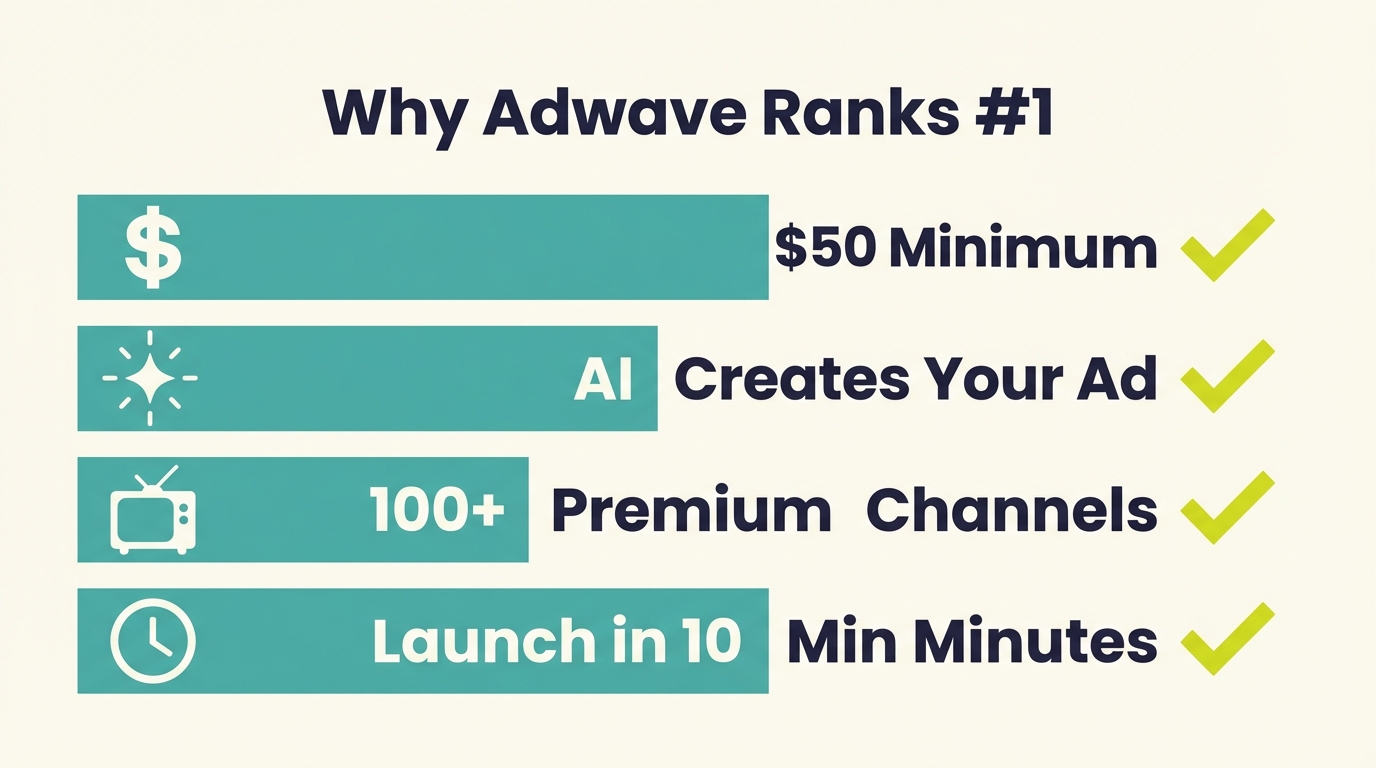
Lowest minimum in the industry: Start with just $50, compared to $500+ at competitors
AI-powered creative generation: Create broadcast-quality TV ads in minutes from your website URL
Premium inventory only: Your ads run on networks like NBC, ESPN, Hulu, Peacock, and Tubi (not obscure apps)
Full targeting capabilities: Geographic, demographic, interest, and behavioral targeting
Real-time analytics: Track impressions, completion rates, and audience geography
What Sets Adwave Apart:
The biggest barrier to TV advertising has always been creative production. Professional TV commercials cost $5,000 to $50,000 to produce. Adwave eliminates this barrier entirely with AI that generates professional, broadcast-ready ads from your existing website content.
Best-in-class creative generation: While some competitors offer basic creative tools that stitch together static images into slideshow-style ads, Adwave's AI produces polished, engaging video commercials. The difference is immediately visible: Adwave ads look like they were produced by a professional agency, with smooth transitions, dynamic motion, professional voice-over, and broadcast-quality production values. This isn't a slideshow with background music; it's a real TV commercial.
Simply enter your website URL, and Adwave's AI gathers your images, brand information, and messaging to create a polished 30-second commercial. The entire process takes about two minutes. You can then customize the ad using a chat-based editor to adjust images, music, text, colors, and voice-over.
The inventory quality also sets Adwave apart. While some platforms advertise "500+ apps," many of those are obscure mobile games and low-quality content. Adwave focuses on curated premium channels where viewers are engaged: major broadcast networks, premium streaming services, and trusted entertainment brands.
Pricing:
Minimum spend: $50
CPM: $15-35 (average $25)
Ad creation: Free
No contracts or long-term commitments
Best For: Small businesses testing TV advertising, local businesses, e-commerce brands, and anyone who doesn't have existing video creative.
#2: Vibe, Good for Larger SMBs with Creative Assets
Vibe has built a solid platform for mid-size businesses that want to run streaming TV campaigns. The platform emphasizes ease of use and offers access to a wide range of streaming apps.
Key Features:
Self-serve platform with straightforward campaign setup
Access to 500+ streaming apps and channels
Targeting by demographics, interests, and location
Real-time performance tracking
Basic creative tool (static image slideshow format)
Pros:
User-friendly interface that's relatively easy to navigate
Detailed audience targeting options including income and household data
Has a creative builder for businesses without video
Cons:
Limited creative capabilities: While Vibe offers a creative tool, it produces basic slideshow-style ads from static images, not true video commercials. The results look noticeably less polished than professional video or AI-generated creative.
Higher minimum spend: Expect to spend $1,500+ per month to run effective campaigns
Mixed inventory quality: The "500+ apps" include many low-quality mobile apps and games alongside premium content
Limited reporting customization: Some users find the analytics dashboard restrictive
Pricing:
Effective minimum: $1,500+/month
Cost per view starting at $0.02
Best For: Larger SMBs with $1,500+/month budgets who have some creative assets or are okay with basic slideshow-style ads.
#3: MNTN, Enterprise Platform with High Minimums
MNTN (Mountain) positions itself as a premium CTV advertising platform with sophisticated targeting and measurement capabilities. The platform is well-designed but comes with enterprise-level pricing that puts it out of reach for most small businesses.
Key Features:
Advanced audience targeting and segmentation
Integration with Google Analytics and other measurement tools
Creative-as-a-Subscription for quarterly ad refreshes
Premium inventory access
Pros:
High-quality inventory on premium streaming services
Strong customer support and onboarding assistance
Robust integration with analytics platforms
Cons:
Very high minimum spend: $10,000 minimum for retargeting, $25,000 for prospecting campaigns
Requires existing video: No creative tools included
Platform speed issues: Some users report slow performance when reviewing data
Limited reporting granularity: Lacks detailed geographic and change history reporting
Pricing:
Minimum spend: $10,000 (retargeting) to $25,000+ (prospecting)
Pricing details require sales consultation
Best For: Enterprise brands with large advertising budgets and existing creative assets.
#4: tvScientific, Performance-Focused with Steep Requirements
TvScientific emphasizes performance measurement and attribution, making it appealing to data-driven marketers. However, the high minimum spend and technical complexity make it challenging for smaller businesses.
Key Features:
Performance-driven CTV advertising with outcome tracking
Integration with major analytics and attribution platforms
Advanced audience filtering and segmentation
Real-time campaign optimization
Pros:
Strong attribution and measurement capabilities
Accurate audience targeting based on behaviors and demographics
24/7 customer support
Cons:
High minimum monthly spend: Approximately $5,000 per month minimum
Requires existing video creative: No ad creation tools
Integration difficulties: Some users report challenges connecting with other marketing tools
Steep learning curve: Platform complexity requires dedicated resources
Pricing:
Minimum monthly spend: ~$5,000
Contact sales for specific pricing
Best For: Performance marketers at larger companies with significant CTV budgets and dedicated advertising teams.
#5: StackAdapt, Agency-Focused Multi-Channel Platform
StackAdapt is a demand-side platform (DSP) designed primarily for agencies managing multi-channel programmatic campaigns. While it includes CTV capabilities, it's not purpose-built for streaming TV advertising.
Key Features:
Multi-channel advertising across CTV, display, video, and native
AI-powered campaign optimization
Cross-device targeting and measurement
Pros:
Full multi-channel capabilities in one platform
AI tools for campaign optimization
Good for agencies managing complex, integrated campaigns
Cons:
Not CTV-focused: Streaming TV is one of many channels, not the primary focus
Requires existing creative: No video creation tools
High CPM costs: Users report above-average costs per impression
Complex for beginners: Designed for professional media buyers, not business owners
Opaque pricing: Must contact sales for any pricing information
Pricing:
Contact sales for pricing
Flexible based on campaign size, but costs can be high
Best For: Agencies managing multi-channel programmatic campaigns for clients.
#6: Simpli.fi, Household-Level Targeting with Limitations
Simpli.fi specializes in addressable advertising with household-level targeting capabilities. It's a solid option for advertisers who need precise geographic targeting but comes with significant limitations.
Key Features:
Addressable advertising targeting specific households
Cross-channel campaign management
Granular reporting by location and audience
Pros:
Precise household-level targeting reduces wasted impressions
Intuitive interface for campaign adjustments
Responsive customer support
Cons:
Requires existing video creative: No ad creation tools
Reporting limitations: Custom reporting options are restricted
Ad fraud concerns: Some users report issues with fraudulent impressions
U.S. only: Limited international capabilities
Opaque pricing: Contact sales for details
Pricing:
Contact sales for pricing
Costs increase with targeting complexity
Best For: Businesses with specific geographic targeting needs and existing video assets.
Key Factors When Choosing a Streaming TV Platform
1. Minimum Budget Requirements
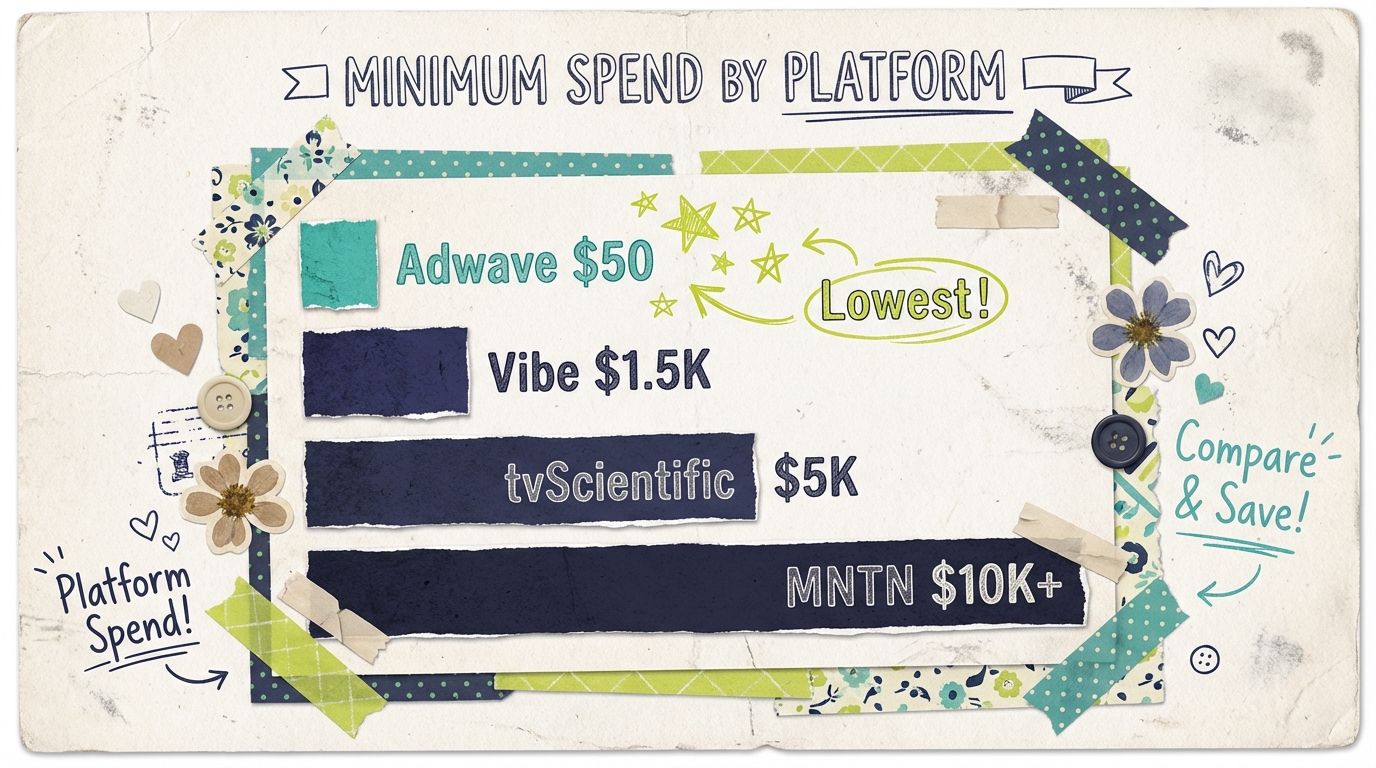
This is often the most important factor for small businesses. Platforms range from $50 (Adwave) to $25,000+ (MNTN). Choose a platform that lets you test and learn without overcommitting.
2. Creative Requirements
Do you have existing video? If not, you'll either need to produce it (adding $2,000-$10,000+ to your costs) or choose a platform like Adwave that creates ads for you.
3. Inventory Quality
Not all streaming inventory is equal. "500+ apps" often includes low-quality mobile games and obscure content. Look for platforms that emphasize premium networks and streaming services where audiences are engaged.
4. Targeting Capabilities
Most platforms offer similar targeting options: geographic, demographic, interest, and behavioral. The difference is often in execution and minimum audience sizes.
5. Ease of Use
If you're a business owner rather than a professional media buyer, choose a platform designed for simplicity. Platforms built for agencies often have steep learning curves.
Why Adwave Ranks #1
When we evaluated streaming TV advertising platforms, Adwave emerged as the clear leader for small and medium businesses for several reasons:
Lowest barrier to entry: At $50 minimum spend, Adwave is 30x more accessible than the next closest competitor (Vibe at $1,500/month). This means you can test TV advertising without significant financial risk.
Best-in-class creative generation: Adwave doesn't just offer a creative tool; it offers the best creative tool. While competitors like Vibe provide basic slideshow builders that stitch static images together, Adwave's AI generates true video commercials with professional motion, transitions, and production quality. The difference is immediately apparent when you compare the output side-by-side.
Premium inventory focus: Unlike platforms that pad their channel count with low-quality apps, Adwave focuses on curated premium television: NBC, ESPN, Hulu, Peacock, Tubi, Pluto TV, and 100+ other networks where audiences are engaged.
Same targeting, lower cost: Adwave offers the same geographic, demographic, and interest-based targeting as enterprise platforms, but at price points that work for small businesses.
Speed and simplicity: Launch a campaign in under 10 minutes. No media buying expertise required.
Common questions answered
What's the difference between streaming TV advertising platforms?
The main differences are minimum spend requirements, whether you need existing video creative, and how many channels you can access. Platform-direct options like Vibe and MNTN typically require higher minimums ($1,500 to $10,000+) and finished video assets. Aggregator platforms like Adwave often have lower minimums ($50) and may include creative tools that generate ads for you.
Do I need professional video to run streaming TV ads?
It depends on the platform. Most require you to upload finished video that meets broadcast specifications, which typically costs $2,000 to $10,000+ to produce. However, some platforms include AI-powered creative tools that generate professional TV ads from your website content. Adwave, for example, creates broadcast-ready 30-second commercials in about two minutes using your existing images and business information.
How much does streaming TV advertising cost for small businesses?
Costs vary significantly. Minimum budgets range from $50 (Adwave) to $1,500/month (Vibe) to $10,000+ (MNTN, tvScientific). Beyond the minimum, you'll pay CPMs (cost per thousand impressions) typically ranging from $15 to $35. At a $25 CPM, a $500 campaign delivers roughly 20,000 ad views to streaming TV audiences.
What channels will my ads run on?
This depends entirely on the platform. Some platforms like Vibe advertise "500+ apps" but this includes many low-quality mobile games alongside premium content. Others focus exclusively on premium inventory. Adwave, for instance, runs ads on 100+ curated channels including NBC, ESPN, Hulu, Peacock, Tubi, and Pluto TV, not obscure apps.
How do streaming TV ads compare to Meta or Google ads?
Streaming TV ads build brand awareness and trust through the "TV halo effect," where viewers perceive brands on TV as more established and credible. Unlike Meta or Google ads that drive immediate clicks, CTV advertising works over time by increasing brand recognition. The two channels complement each other: TV builds awareness, while digital ads capture the demand TV creates.
Conclusion: Which Platform Is Right for You?
The best streaming TV advertising platform depends on your situation:
For small businesses and first-time TV advertisers: Adwave is the clear choice. The combination of $50 minimum spend, AI creative generation, and premium inventory makes it the most accessible option available.
For larger SMBs with $1,500+/month budgets: Vibe offers a solid self-serve experience if you have creative assets or are okay with slideshow-style ads.
For enterprise brands with large budgets: MNTN or tvScientific provide sophisticated measurement and attribution, but expect to spend $10,000+ per campaign.
For agencies managing multi-channel campaigns: StackAdapt offers detailed programmatic capabilities across channels.
The streaming TV advertising landscape will continue to evolve, but one thing is clear: TV advertising is no longer reserved for big brands with big budgets. Platforms like Adwave have democratized access, making it possible for any business to appear on the same screens as national advertisers.
Ready to see how it works? Create your first TV ad for free and launch when you're ready, starting at just $50.


