The most expensive mistake in connected TV advertising isn't running the wrong creative or targeting the wrong audience. It's getting frequency wrong. Show your ad too few times, and viewers don't remember your business. Show it too many times, and you waste budget reaching people who've already tuned out.
Frequency, the average number of times a unique viewer sees your ad during your campaign, is the single most important lever for turning impressions into action. And for most small businesses, it's the metric they ignore the longest.
This guide explains what CTV ad frequency is, what range of frequency drives results, how to measure your campaign's frequency, and the adjustments to make when frequency is too low or too high.
What CTV ad frequency means
Frequency is calculated by dividing total impressions by unique reach. If your campaign delivers 100,000 impressions to 25,000 unique households, your frequency is 4.0, meaning the average household saw your ad four times.
Two campaigns with identical budgets can have wildly different frequency numbers depending on targeting:
Broad campaign. $1,000 budget reaching 50,000 households once each. Frequency: 1.0. Most households saw your ad once and likely don't remember.
Tight campaign. $1,000 budget reaching 10,000 households five times each. Frequency: 5.0. Most households saw your ad enough times to remember, recognize, and act.
Same money. Same impressions. Dramatically different business outcomes.
The frequency sweet spot for small businesses
Decades of advertising research, going back to the 1970s and continuously refined since, point to a consistent answer for what frequency drives action:
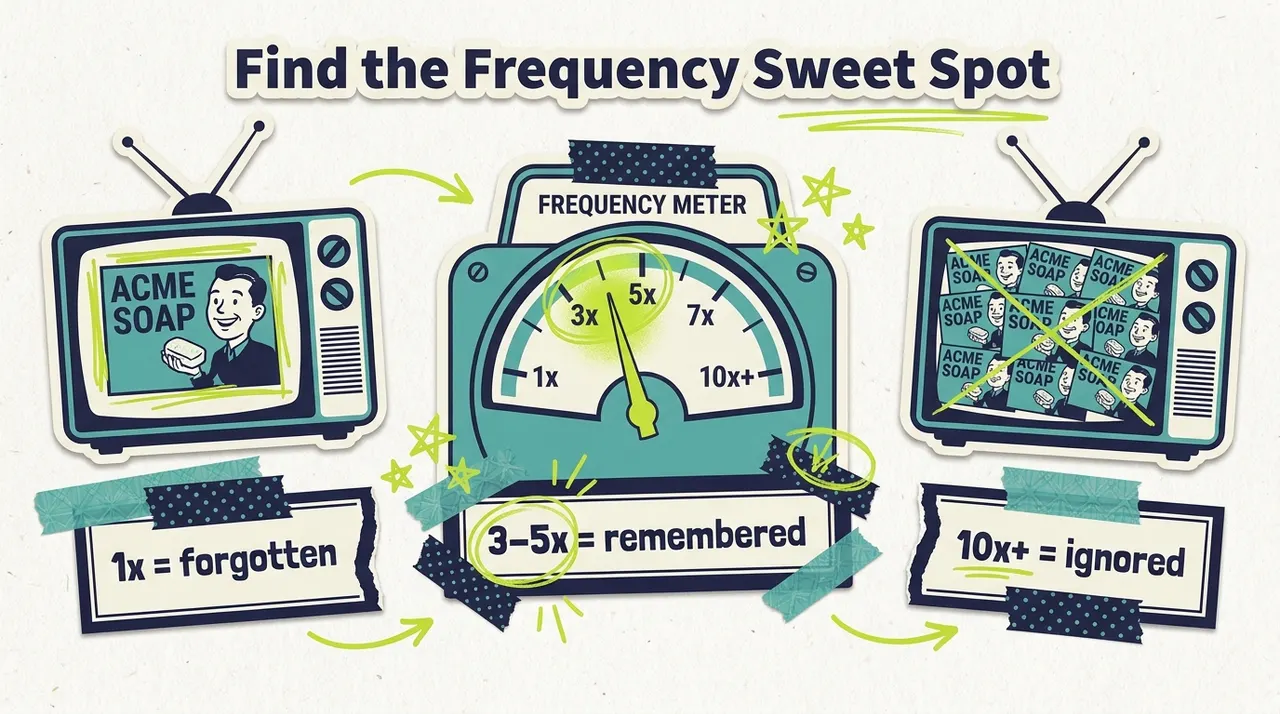
3 to 5 impressions is the range where awareness consolidates into memory and memory consolidates into action.
The classic study by Herbert Krugman in 1972 framed this as the "three-hit theory": the first impression provokes "what is this?" the second provokes "what does it mean for me?" and the third triggers the actual decision. Modern CTV research from Nielsen, comScore, and the IAB largely confirms this: campaigns with frequency between 3 and 5 outperform campaigns with frequency below 2 by significant margins on key conversion metrics.
For small business CTV campaigns specifically, our recommendation:
Awareness goals (new business, new product launch): target frequency 3-4
Consideration goals (driving inquiries, trials, walk-ins): target frequency 4-6
Brand defense (established business, competitive markets): target frequency 5-7
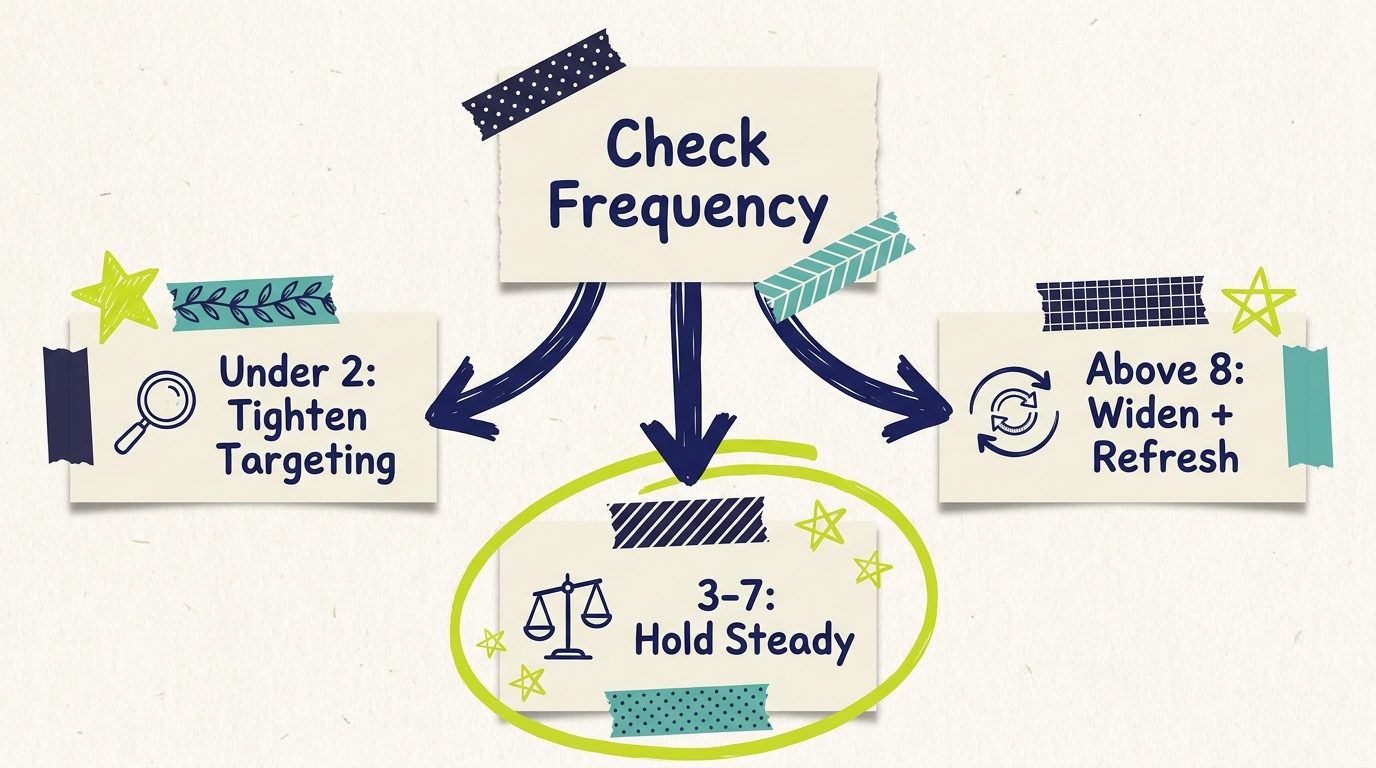
Below 2.0, your audience is too broad and your ad isn't sticking. Above 8.0, your audience is too narrow and you're wasting impressions on people who've already decided.
Why frequency matters more than reach for small business
Most small business owners intuitively want to maximize reach. "Show my ad to as many people as possible" feels right. The problem is that one impression rarely produces business outcomes.
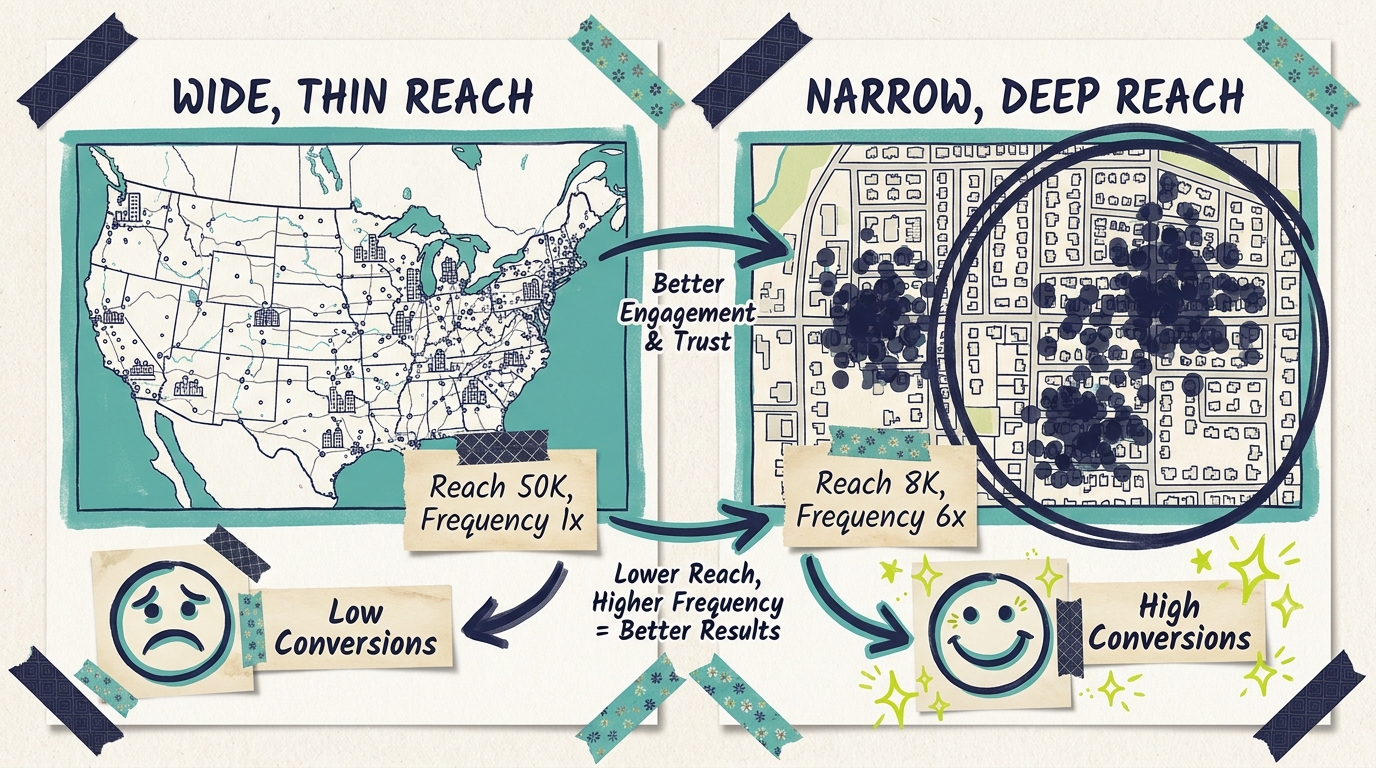
Consider two scenarios for a local dental practice with a $1,000 monthly CTV budget:
Scenario A: maximize reach. Target the entire metro DMA. Reach 50,000 households at frequency 1.0. Roughly 200 viewers remember the ad meaningfully (4% recall at frequency 1). Practice gets a small handful of inquiries.
Scenario B: optimize frequency. Target a tight 5-mile radius around the practice. Reach 8,000 households at frequency 6.0. Roughly 2,400 viewers remember the ad meaningfully (30%+ recall at frequency 6). Practice gets a meaningful inquiry lift.
Same budget. Same impressions. Scenario B produces an order of magnitude more business outcomes because frequency drives memory, and memory drives action.
For small businesses with limited budgets, geographic and audience targeting tightening to drive frequency higher is almost always the right move.
How to measure frequency in your campaign
Most CTV platforms, including Adwave, surface frequency directly on your dashboard. To check:
Look at your campaign overview. Most dashboards show frequency as a top-level metric alongside impressions and reach.
Calculate manually if needed. Total impressions divided by unique households (or unique devices) equals frequency.
Pay attention to weekly trends. Frequency often climbs over the course of a campaign as the same households are exposed repeatedly. A campaign that starts at frequency 2 in week 1 might be at frequency 5 by week 4.
Compare across daypart. Some dayparts naturally drive higher frequency (primetime in dense audience pools). Others drive lower frequency (overnight inventory with variable audience).
The most useful comparison is frequency over time: where did your campaign land week-by-week, and how does that compare to your target?
When frequency is too low (under 2)
Campaigns with frequency below 2 are leaking budget. Your ad is reaching people, but most viewers see it once and immediately forget. Conversions don't come.
Common causes and fixes:
Targeting is too broad. A small business with a $500 budget targeting an entire metro DMA almost guarantees frequency under 2. Solution: tighten geographic targeting to a 3-7 mile radius around the business, or to specific high-converting ZIP codes.
Daily budget is too high relative to targeting. Your campaign is reaching maximum unique households quickly without revisiting them. Solution: reduce daily cap, extend campaign dates, or both.
Inventory pool is too large. Some streaming services have huge inventory pools (e.g., Roku, Amazon Fire TV Free Channels) where the same dollar reaches different households each day. Solution: layer audience targeting (interests, demographics) to concentrate impressions on the right viewers.
Campaign is too short. A 7-day campaign across a wide geography typically can't accumulate frequency. Solution: run for 30+ days minimum, allowing impressions to compound.
The general fix: tighter targeting, longer duration, smaller daily caps. The same dollars concentrated on a narrower audience drives frequency up dramatically.
When frequency is too high (over 8)
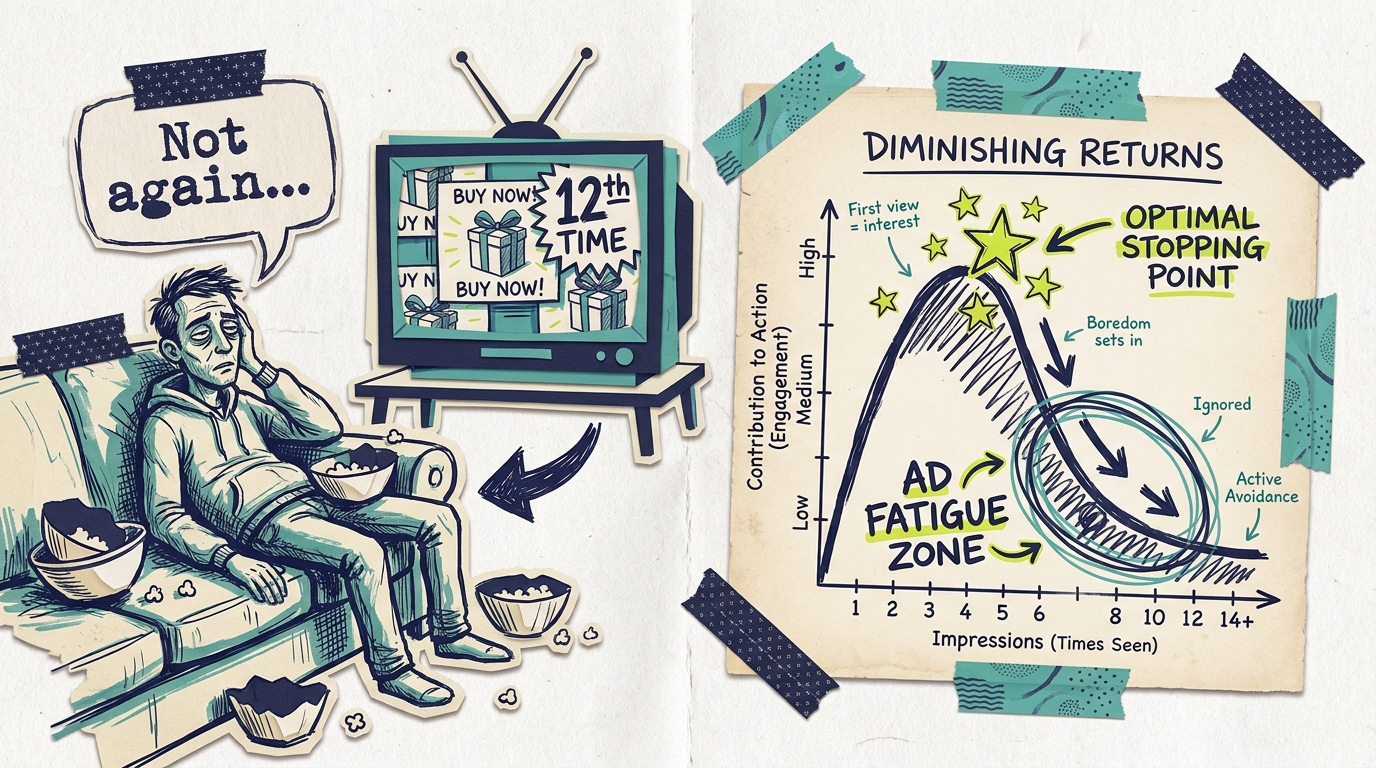
Campaigns with frequency above 8 are typically over-targeted. The same households see your ad 10, 12, 15+ times, but additional impressions stop converting. You're paying for diminishing returns.
Common causes and fixes:
Targeting is too narrow. A campaign targeting a single ZIP code with a healthy daily budget will hit frequency 10+ within 2 weeks. Solution: expand geographic targeting (add adjacent ZIPs, expand radius by 1-2 miles, layer in nearby DMAs).
Audience overlay is too tight. "Fitness enthusiasts within 3 miles aged 25-45" can produce a small audience pool that gets hit repeatedly. Solution: relax one or two audience criteria (broaden age range, drop one interest filter).
Duplicate creative running too long. Even with appropriate targeting, the same creative seen 10+ times causes ad fatigue. Solution: refresh creative every 60-90 days. Generate a variation, swap it in, and frequency-fatigue resets.
Frequency cap not set. Some platforms allow setting a maximum impressions-per-household cap. If yours does, set it to 3-7 per week to prevent over-saturation.
The general fix: widen targeting, refresh creative, or both. Don't burn budget hammering the same household 15 times when 5 well-spaced impressions would have produced the same conversion.
Frequency by industry
Different categories have different optimal frequency ranges based on decision urgency and complexity:
Quick-decision categories (restaurants, cafes, retail). 3-4 frequency drives meaningful results. Customers don't deliberate long; recall and recognition matter more than persuasion.
Considered-decision categories (gyms, dentists, financial advisors, real estate). 5-7 frequency drives meaningful results. Customers research, compare, and weigh options. Multiple exposures build the trust required to act.
Long-cycle categories (legal, B2B, automotive, home buying). 6-10 frequency over longer campaigns drives results. Decisions take weeks or months; persistent presence wins.
Emergency/reactive categories (plumbing, locksmiths, urgent care). 3-5 frequency is enough. The decision is "who do I remember when this happens?" rather than "who do I deliberate about?" Frequency reinforces recall.
These ranges shift in competitive markets (where higher frequency is needed to stand out) and in low-competition markets (where lower frequency suffices).
How frequency interacts with creative
Frequency and creative are connected. The same creative seen 4 times reinforces a message. The same creative seen 12 times causes annoyance and conversions drop.
Best practice is to plan for creative variations:
Creative A runs for 4-6 weeks. Drives initial awareness and consideration.
Creative B runs for the next 4-6 weeks. Same brand, fresh visuals, slightly different angle. Frequency-fatigue resets.
Creative C for the third cycle. Or rotate back to Creative A with refreshed offer.
Cafes, gyms, and other businesses with rich visual content can rotate seasonal creative every 4-6 weeks. Service businesses can rotate offer-based creative ("free consultation," "first visit free," "call for a free estimate") quarterly.
The combination of healthy frequency (3-7) and fresh creative (rotated every 60-90 days) drives the best long-term performance.
How frequency interacts with budget
Frequency and budget are also connected. With a fixed budget, you can choose:
High reach, low frequency
Low reach, high frequency
Or some balance
For small businesses, the answer is almost always "low reach, high frequency" within a tight geographic area. Better to be the cafe that 8,000 nearby households see 5 times than the cafe that 50,000 metro households see once.
As budgets grow, the math shifts. A regional gym chain with a $20,000 monthly CTV budget can afford to maintain frequency 5-7 across a much larger audience. The same logic applies; just at a different scale.
Common questions answered
What's the ideal frequency for a small business CTV campaign?
For most small business CTV campaigns, target a frequency of 3-5. That's the range where viewers begin to remember and recognize your ad enough to act. Below 2, your ad isn't sticking. Above 7-8, you're paying for diminishing returns and risk ad fatigue.
How long does it take for frequency to build?
In a tightly-targeted campaign (3-7 mile radius), frequency typically reaches 3-5 within 2-3 weeks. In broader campaigns covering an entire metro DMA, frequency often stays under 2 for the entire campaign duration. The fix is tighter targeting, not more time.
Should frequency cap be set on small business campaigns?
Yes, when the platform allows it. A weekly frequency cap of 3-5 per household prevents over-exposure to a small audience pool. This is especially important for hyper-local campaigns where the same households can be exposed dozens of times without a cap.
How does frequency differ between CTV and traditional TV?
CTV allows precise frequency control through digital targeting. Traditional cable TV is sold by daypart and program, with much coarser frequency control (typically 6-15 impressions per household over a 4-week flight, with little ability to cap). Small businesses on CTV have a meaningful efficiency advantage because they can dial in optimal frequency.
Does frequency affect cost per acquisition?
Yes, dramatically. Campaigns with frequency in the 3-5 sweet spot typically produce cost per acquisition (CPA) 30-60% lower than campaigns at frequency 1-2 or above 8. Frequency optimization is one of the highest-ROI levers in CTV.
What if my goal is brand awareness, not conversions?
For pure brand awareness goals, frequency 3-4 across a broader audience produces strong recall lift. For consideration and conversion goals, frequency 4-6 across a tighter audience produces better business outcomes. Most small businesses should optimize for the conversion goals, since brand awareness without supporting conversion rarely justifies the spend.
How do I check my CTV campaign frequency?
On platforms like Adwave, frequency is shown directly on your campaign dashboard alongside impressions and reach. If your dashboard doesn't surface frequency directly, calculate it as total impressions divided by unique reach.
Where to start this week
If you're running a CTV campaign now, here's a 15-minute frequency check:
Step 1. Pull your current frequency number. Most dashboards display it under campaign metrics or audience analytics.
Step 2. Compare it to the target range for your category (3-4 for quick-decision, 5-7 for considered-decision, 6-10 for long-cycle).
Step 3. If frequency is under 2, plan to tighten targeting next week. Reduce geographic radius, lower daily cap, or both.
Step 4. If frequency is above 8, plan to widen targeting next week. Expand radius, drop an audience filter, or refresh your creative.
Step 5. If frequency is in the sweet spot (3-7), hold steady. Watch for creative fatigue at the 60-day mark and plan a creative refresh.
Optimizing frequency is one of those CTV moves that produces big wins without spending more money. Same budget, better outcomes. The campaigns that compound the most aren't the ones with the biggest budgets; they're the ones whose owners pay attention to frequency week after week.
For a deeper look at how to run that weekly review, see our companion guide on optimizing your Adwave campaign.