-
38%
CTV share of total TV ad spend
-
$33B
U.S. CTV advertising spend (2025)
-
45%
Projected CTV share by 2027
Article Content
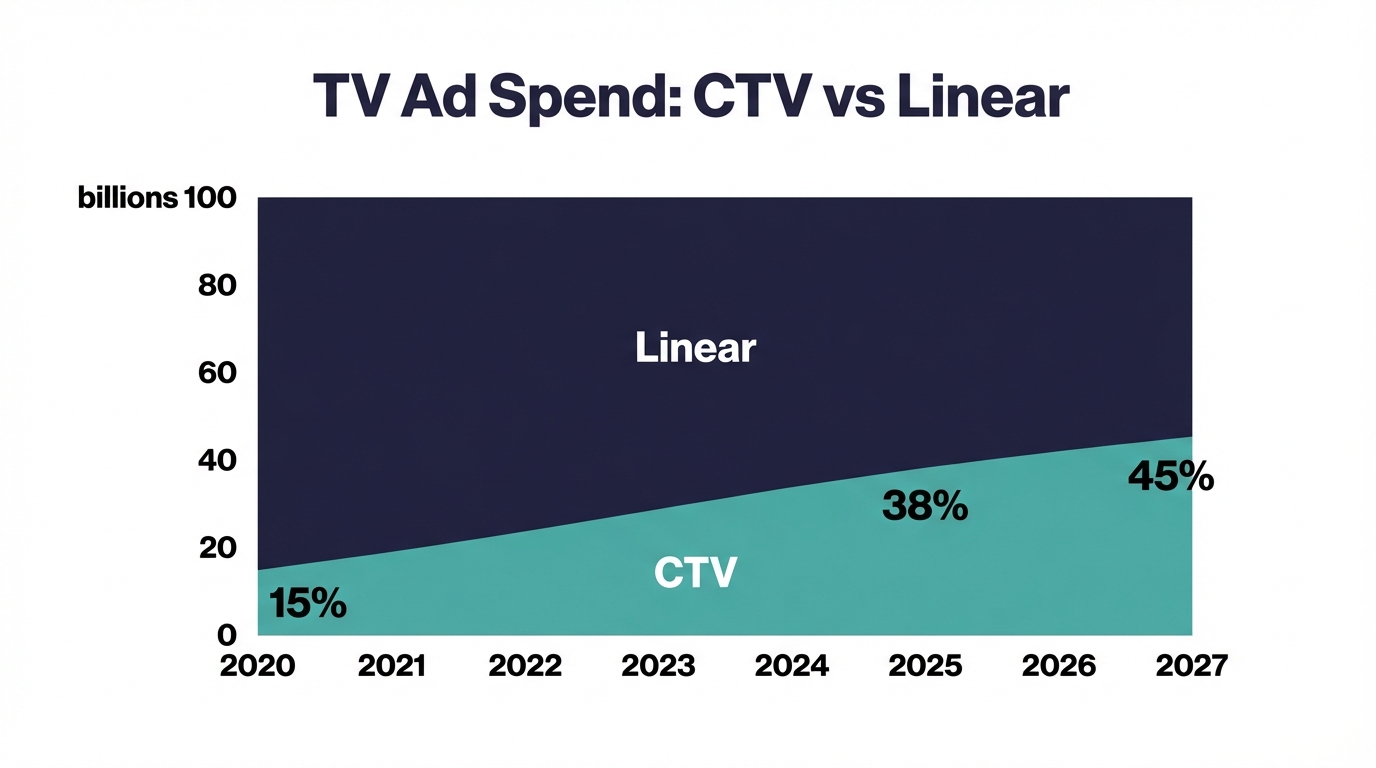
Connected TV (CTV) now captures approximately 38% of total television advertising spend in the United States, according to IAB and eMarketer analysis. That's up from just 15% in 2020, representing one of the fastest shifts in advertising history. For context, this means more than one in three dollars spent on television advertising now goes to streaming platforms rather than traditional cable and broadcast. The implications extend far beyond media planning: as CTV's share grows, the barriers that historically kept small businesses off television continue to collapse.
What the data shows
The 38% CTV share represents $33 billion of the approximately $88 billion total U.S. television advertising market in 2025. The remaining 62%, or roughly $55 billion, goes to linear television including broadcast networks and cable channels.
The trajectory tells the real story:
2020: CTV captured ~15% of TV ad spend ($12B of $80B total)
2021: Share grew to ~18% ($14B of $78B)
2022: CTV reached ~23% ($20B of $87B)
2023: Share expanded to ~28% ($25B of $89B)
2024: CTV hit ~33% ($29B of $88B)
2025: Now at ~38% ($33B of $88B)
2027 projected: Expected to reach ~45% ($42B of $93B)
This growth has come almost entirely at linear TV's expense. While total TV advertising has remained relatively stable (fluctuating between $78-90 billion annually), the composition has shifted dramatically. Linear TV's absolute dollars have declined from $68 billion in 2020 to approximately $55 billion in 2025, a 19% reduction. Meanwhile, CTV has nearly tripled.
The ad impression data shows linear TV still dominates in absolute terms, holding approximately 80% of total TV ad impressions according to iSpot analysis. However, CTV's impression share has grown from 15% in January 2025 to nearly 20% by mid-year, suggesting the spending shift is translating into actual delivery.
What's driving this reallocation? Three factors stand out. First, viewership has shifted: streaming now captures 47% of total TV viewing time, making CTV essential for reaching where audiences watch. Second, CTV offers targeting capabilities that linear cannot match, including geographic precision, demographic filtering, and frequency capping. Third, programmatic infrastructure has made CTV buying efficient and accessible, while linear buying remains largely manual and relationship-dependent.
Breaking down the numbers
The 38% CTV share varies significantly depending on how you slice the data, with important implications for different types of advertisers.
By advertiser type
National brands have shifted most aggressively to CTV. Among Fortune 500 advertisers, CTV represents approximately 45% of TV budgets on average, according to industry analysis. These brands have dedicated teams evaluating cross-platform performance and can quantify CTV's targeting advantages.
Mid-market companies (annual revenue $50M-$500M) allocate roughly 35% of TV spend to CTV. These advertisers often work with agencies that have embraced programmatic buying but may still maintain some linear commitments for reach.
Small and local businesses represent the fastest-growing segment of CTV adoption. While their absolute spending is smaller, their percentage allocation to CTV often exceeds 50% because linear television has never been accessible to them. For a local restaurant or dental practice, CTV isn't replacing linear; it's their first TV advertising ever.
By category
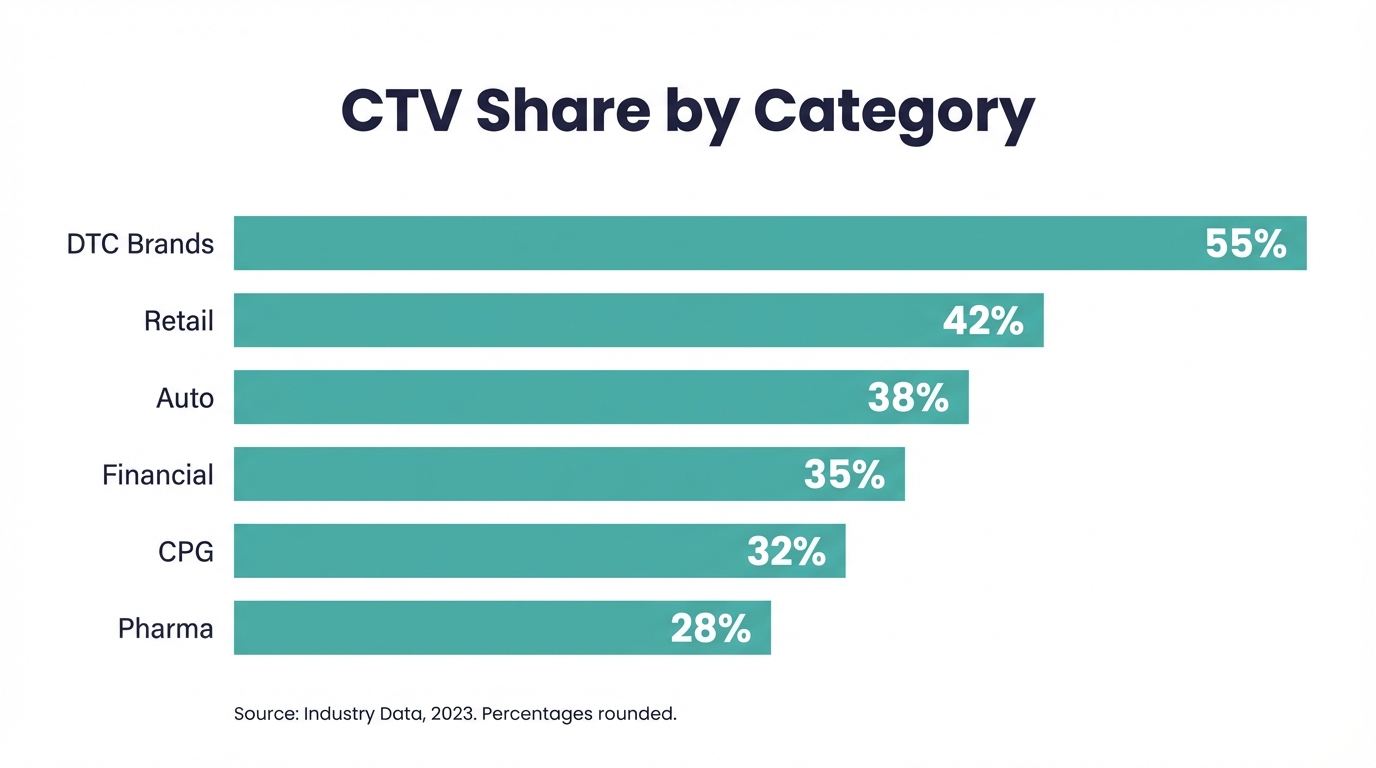
Some advertising categories have shifted faster than others:
Direct-to-consumer brands: ~55% CTV (digital-native, data-driven)
Retail: ~42% CTV (seasonal targeting, geographic precision)
Auto: ~38% CTV (dealer-level targeting needs)
Financial services: ~35% CTV (compliance-friendly measurement)
CPG: ~32% CTV (building frequency with households)
Pharma: ~28% CTV (regulatory considerations slow adoption)
The categories with highest CTV adoption share common characteristics: they value precise targeting, need geographic flexibility, or emerged in the digital era with data-driven mindsets.
By geography
CTV's share of TV ad spend varies by market size:
Top 10 DMAs: CTV captures ~42% of TV spend
DMAs 11-50: CTV captures ~38% of TV spend
DMAs 51-100: CTV captures ~35% of TV spend
DMAs 100+: CTV captures ~30% of TV spend
Larger markets have higher CTV penetration among viewers and more sophisticated advertisers, driving higher CTV share. However, smaller markets are catching up quickly as streaming adoption spreads and local advertisers discover CTV's accessibility.
Why it matters for your business
The 38% CTV share represents more than a media planning statistic. It signals a fundamental restructuring of television advertising that creates opportunities for businesses historically excluded from TV.
When nearly four in ten TV advertising dollars flow through programmatic, targetable platforms, the nature of TV advertising changes. Geographic precision means a plumber can reach only households within their service area. Demographic targeting means a luxury service can focus on higher-income households. Frequency capping means budgets aren't wasted showing the same ad to the same viewer repeatedly.
The accessibility implications are significant. Linear TV advertising requires minimum commitments typically starting at $5,000-$25,000 per month, relationships with media sales representatives, and creative meeting broadcast specifications. CTV has none of these barriers. Platforms like Adwave enable campaigns starting at $50, with AI-generated creative and no media buyer required.
For businesses already advertising on TV, the 38% CTV share suggests reviewing your allocation. If your TV budget is 100% linear, you're missing where a significant and growing portion of TV viewing happens. If you haven't tested CTV targeting capabilities, you may be overpaying for reach you don't need.
For businesses new to TV advertising, the 38% share indicates CTV has achieved enough scale and sophistication to be a core advertising channel, not an experimental addition. You're not early anymore; you're entering a mature market with proven infrastructure.
How to take advantage of this trend
Understanding that CTV captures 38% of TV ad spend is useful context. Knowing how to participate in that market is what grows your business.
Strategic approach for entering CTV:
Start with geographic targeting: Define your service area precisely (10-25 mile radius for most local businesses)
Set frequency goals: Plan for 3-5 impressions per household over your campaign period
Budget for learning: $200-500 for a two-week test provides meaningful data
Mix inventory types: Include both premium (Netflix, Hulu) and FAST (Tubi, Pluto TV) for reach and efficiency
Track brand metrics: Monitor search volume and website traffic, not just direct conversions
The CTV market's scale means you have options. Premium inventory on Netflix or Disney+ reaches affluent, engaged audiences but commands higher CPMs ($30-40). FAST services like Tubi and Pluto TV offer lower CPMs ($15-20) with broader reach. Most effective campaigns use a mix, building frequency efficiently while maintaining quality placements.
Creative strategy matters even in CTV. Viewers expect professional quality because they're watching alongside premium content. AI creative tools have made this accessible. Adwave's platform generates broadcast-quality 30-second commercials from your website in minutes, eliminating the production barrier that historically kept small businesses off television.
Measurement should match CTV's strengths. This is brand advertising, not direct response. Track metrics that matter for awareness: brand search volume (are more people Googling your business?), website traffic patterns during and after campaigns, and new customer surveys asking how they heard about you. Expecting immediate click-through conversions misunderstands how television advertising works.
The bigger picture
The 38% CTV share exists within a broader transformation of media that consistently favors digital, targetable, measurable channels over traditional, mass-reach formats.
The convergence trend
Television advertising is converging with digital advertising. CTV brings targeting, measurement, and programmatic buying to the TV screen. Meanwhile, social video is expanding into living rooms through smart TV apps. The distinction between "TV advertising" and "digital advertising" increasingly makes little sense; it's all digital video delivered to various screens.
This convergence benefits smaller advertisers most. The historical advantage of big brands was access to mass reach through TV and relationships with media gatekeepers. As TV becomes programmable and accessible, that advantage erodes. A local business with smart targeting can achieve meaningful reach in their market without competing against national budgets.
The measurement evolution
As CTV's share grows, measurement capabilities improve. Cross-platform attribution, which tracks viewers across streaming and other channels, is becoming more sophisticated. Incrementality testing, which measures CTV's true contribution beyond what other channels deliver, is increasingly available even for smaller campaigns.
For advertisers, better measurement means better optimization. Early CTV campaigns often relied on proxy metrics and directional data. Today's campaigns can measure with much greater precision, enabling continuous improvement based on actual performance.
The inventory expansion
The 38% CTV share will continue growing as inventory expands. Netflix's ad tier has reached 94 million users. Amazon Prime Video launched ads in 2024. Sports content is increasingly available on streaming. Each expansion adds inventory, which typically moderates pricing and improves accessibility.
For small businesses, inventory expansion is unambiguously positive. More inventory means more opportunities to reach viewers at accessible prices. The days of CTV being premium-priced and limited are ending.
What experts are saying
Industry analysts consistently point to CTV's growing share as evidence of a permanent structural shift in advertising.
The Interactive Advertising Bureau's 2025 analysis noted that "digital video, led by CTV, is set to capture nearly 60% of all TV/video ad spend. This isn't a temporary reallocation; it reflects where audiences watch and where advertisers can achieve precision."
GroupM's global advertising forecast highlighted that "the combination of shifting viewership and programmatic capabilities makes CTV growth inevitable. Advertisers follow audiences, and audiences are streaming."
EMarketer's assessment emphasized the accessibility angle: "CTV's growth has been remarkable not just in scale but in who's participating. The combination of low minimums, self-serve platforms, and AI creative tools has opened television advertising to businesses that never considered it possible."
For small business advertising specifically, Borrell Associates research found that "local advertisers are adopting CTV advertising faster than any other digital channel. The targeting precision and accessible entry points align perfectly with local business needs."
Common questions answered
How is "TV ad spend" defined in these statistics?
TV ad spend in this context includes all advertising delivered to television screens, whether through traditional broadcast and cable (linear TV) or through streaming apps and connected devices (CTV). It does not include digital video advertising delivered to phones, tablets, or computers, which is tracked separately. The $88 billion total represents the U.S. national and local television advertising market.
Is CTV taking market share from linear, or is the pie growing?
CTV's growth has come primarily from linear TV's decline rather than overall market expansion. Total TV advertising has fluctuated between $78-90 billion annually since 2020. Linear TV's absolute spending has dropped from $68 billion to $55 billion, while CTV has grown from $12 billion to $33 billion. The pie is roughly the same size; the slices are changing.
How does CTV share differ from CTV viewing share?
CTV captures approximately 38% of TV advertising spend but accounts for roughly 47% of TV viewing time. This gap exists because CTV commands higher CPMs than some linear inventory, and because some linear ad time (especially broadcast) remains highly valued for reach. As CTV matures and pricing normalizes, ad spend share and viewing share should converge.
Will CTV ever surpass linear TV in ad spend?
Most projections suggest CTV will reach 50% of TV ad spend by 2029-2030. The trajectory has been consistent: CTV gains roughly 5 percentage points of share annually. Barring significant changes in viewing behavior or advertising economics, CTV becoming the majority of TV advertising is a matter of when, not if.
What does this mean for linear TV advertising?
Linear TV remains substantial at $55 billion and will continue to be valuable for reaching older demographics, live events, and mass-reach campaigns. However, its share is declining, and prices for premium linear inventory (like live sports) are increasing as total inventory shrinks. Advertisers who rely exclusively on linear are reaching a progressively smaller portion of the TV audience.
Can small businesses participate in this 38% CTV market?
Yes, and this is perhaps the most significant implication of CTV's growth. The same programmatic infrastructure that serves the 38% CTV market is accessible through self-serve platforms starting at minimal budgets. Platforms like Adwave enable campaigns at $50 with geographic targeting that makes even small budgets efficient. Small businesses aren't just participating; they're among the fastest-growing segments of CTV advertisers.
Supporting data
Additional statistics on CTV's share of television advertising:
Total TV ad market (2025): ~$88 billion, roughly flat vs. 2024 (eMarketer)
CTV ad spend (2025): $33 billion, up 16% YoY (eMarketer)
Linear TV ad spend (2025): $55 billion, down 7% YoY (MediaPost)
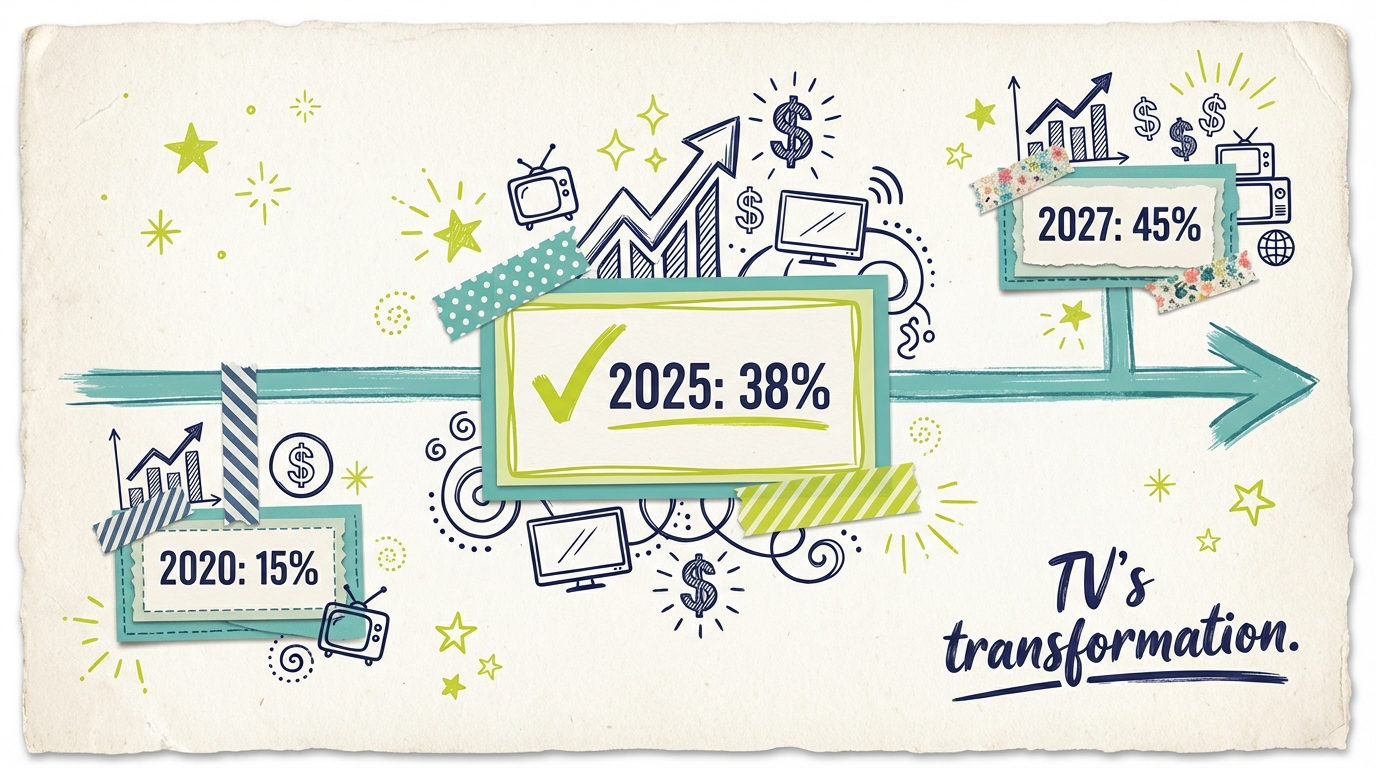
CTV share growth: From 15% (2020) to 38% (2025) to projected 45% (2027)
CTV impression share: 19.5% of total TV impressions in June 2025 (iSpot)
Programmatic CTV: 84% of CTV bought programmatically (Senal News)
Digital video total: $72 billion in 2025, of which CTV is $33 billion (IAB)
CTV user penetration: 70.7% of U.S. population uses CTV (eMarketer)
National brand CTV allocation: ~45% of TV budgets on average
SMB CTV allocation: Often 50%+ since linear was never accessible
Industry benchmarks and comparisons
Understanding how CTV ad spending compares across different industries helps advertisers set realistic expectations and identify opportunities. The shift to connected TV advertising varies significantly by sector, with some industries leading the transition while others are still in early adoption phases.
Retail and e-commerce brands have been among the fastest adopters of CTV advertising, allocating an average of 35-40% of their video budgets to streaming platforms. This aggressive adoption stems from the ability to target specific shopping behaviors and measure direct response metrics that traditional TV cannot provide.
Financial services and insurance companies have increased their CTV share of TV ad spend by 45% year-over-year, recognizing the value of reaching younger demographics who have largely abandoned linear television. These industries benefit especially from the premium brand-safe environments that CTV offers.
Healthcare and pharmaceutical advertisers have been more cautious, with CTV representing approximately 20-25% of their TV budgets. Regulatory requirements and the need for broad reach among older demographics have kept some healthcare spend on traditional linear TV, though this is shifting as CTV audiences mature.
Retail and e-commerce: 35-40% of video budget on CTV
Financial services: 45% year-over-year CTV growth
Automotive: 30-35% CTV allocation, growing rapidly
Healthcare: 20-25% CTV share, conservative adoption
Travel and hospitality: 38% CTV share, accelerating post-pandemic
Small and medium-sized businesses are increasingly driving CTV growth, with 62% of SMB advertisers now including streaming in their media plans compared to just 34% in 2021. The lower minimum budgets and self-serve platforms have democratized access to television advertising for businesses that previously could not afford it.
Industry benchmarks and comparisons
Understanding how CTV ad spending compares across different industries helps advertisers set realistic expectations and identify opportunities. The shift to connected TV advertising varies significantly by sector, with some industries leading the transition while others are still in early adoption phases.
Retail and e-commerce brands have been among the fastest adopters of CTV advertising, allocating an average of 35-40% of their video budgets to streaming platforms. This aggressive adoption stems from the ability to target specific shopping behaviors and measure direct response metrics that traditional TV cannot provide.
Financial services and insurance companies have increased their CTV share of TV ad spend by 45% year-over-year, recognizing the value of reaching younger demographics who have largely abandoned linear television. These industries benefit especially from the premium brand-safe environments that CTV offers.
Healthcare and pharmaceutical advertisers have been more cautious, with CTV representing approximately 20-25% of their TV budgets. Regulatory requirements and the need for broad reach among older demographics have kept some healthcare spend on traditional linear TV, though this is shifting as CTV audiences mature.
Retail and e-commerce: 35-40% of video budget on CTV
Financial services: 45% year-over-year CTV growth
Automotive: 30-35% CTV allocation, growing rapidly
Healthcare: 20-25% CTV share, conservative adoption
Travel and hospitality: 38% CTV share, accelerating post-pandemic
Small and medium-sized businesses are increasingly driving CTV growth, with 62% of SMB advertisers now including streaming in their media plans compared to just 34% in 2021. The lower minimum budgets and self-serve platforms have democratized access to television advertising for businesses that previously could not afford it.
Regional and market variations
CTV ad spending patterns vary considerably across different geographic markets and metropolitan areas. Understanding these regional differences can help advertisers optimize their media mix and allocate budgets more effectively based on where their target audiences are most likely to engage with streaming content.
Major metropolitan areas like Los Angeles, New York, and San Francisco show CTV shares of TV ad spend exceeding 40%, driven by younger, tech-savvy populations with high streaming adoption rates. These markets often serve as early indicators of broader national trends in advertising allocation.
Midwest and Southern markets have seen the fastest growth in CTV advertising, with year-over-year increases of 50-60% as streaming adoption catches up to coastal regions. Cities like Nashville, Austin, and Denver are emerging as key CTV advertising markets due to their growing populations and high household incomes.
Rural markets present a more complex picture for CTV advertisers. While streaming penetration has increased significantly with improved broadband access, traditional linear TV still commands a larger share of viewing time in these areas. Advertisers targeting rural audiences often maintain a 60/40 split favoring linear TV, though this ratio is shifting each year.
Major metros (LA, NYC, SF): 40%+ CTV share of TV spend
Sunbelt growth markets: 50-60% year-over-year CTV growth
Midwest urban areas: 30-35% CTV share, accelerating
Rural markets: 15-20% CTV share, improving with broadband expansion
College towns: High streaming adoption, favorable CTV demographics
Seasonal variations also impact CTV spending patterns across regions. Markets with warmer climates see more consistent year-round streaming engagement, while northern markets experience viewing spikes during winter months. Holiday seasons drive increased CTV ad spend nationally, with Q4 typically representing 30-35% of annual CTV budgets.
Get started with TV advertising
CTV now captures 38% of all television advertising spend, and that share is growing every quarter. The infrastructure serving this market is increasingly accessible to businesses of all sizes.
Adwave makes CTV advertising simple. Create your commercial from your website in minutes, set geographic targeting to reach only your service area, choose a budget starting at $50, and launch campaigns across 100+ premium channels where your customers are already watching.
The shift is happening. The question is whether you'll participate.