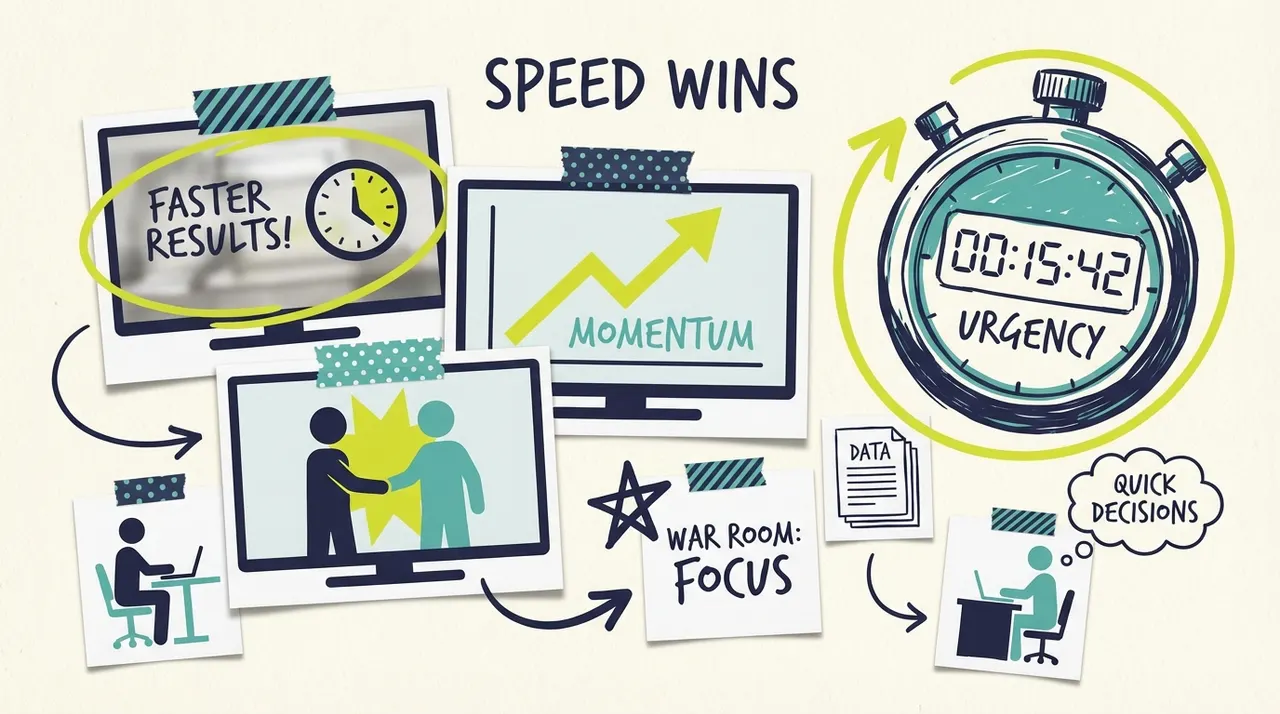
In politics, timing isn't just important. It's everything.
A damaging opposition hit drops at 6 a.m. By noon, voters have seen it shared thousands of times on social media. By evening, local news picks it up. If your campaign can't respond until next week when your agency finishes producing a counter-ad, you've already lost the narrative.
The 2026 midterms are projected to be the most expensive midterm cycle in history, with total political ad spending expected to hit $10.8 billion (AdImpact via OpenSecrets, 2026). Of that, CTV and streaming spending is forecast to reach $2.5 billion, the fastest-growing segment of the political media pie (AdImpact, 2026). But money alone doesn't win elections. Speed does.
This guide breaks down why fast-turnaround TV advertising is becoming the decisive advantage in modern campaigns, how connected TV (CTV) makes it possible, and exactly how your campaign can go from concept to on-air in hours instead of weeks.
The Traditional TV Ad Production Problem
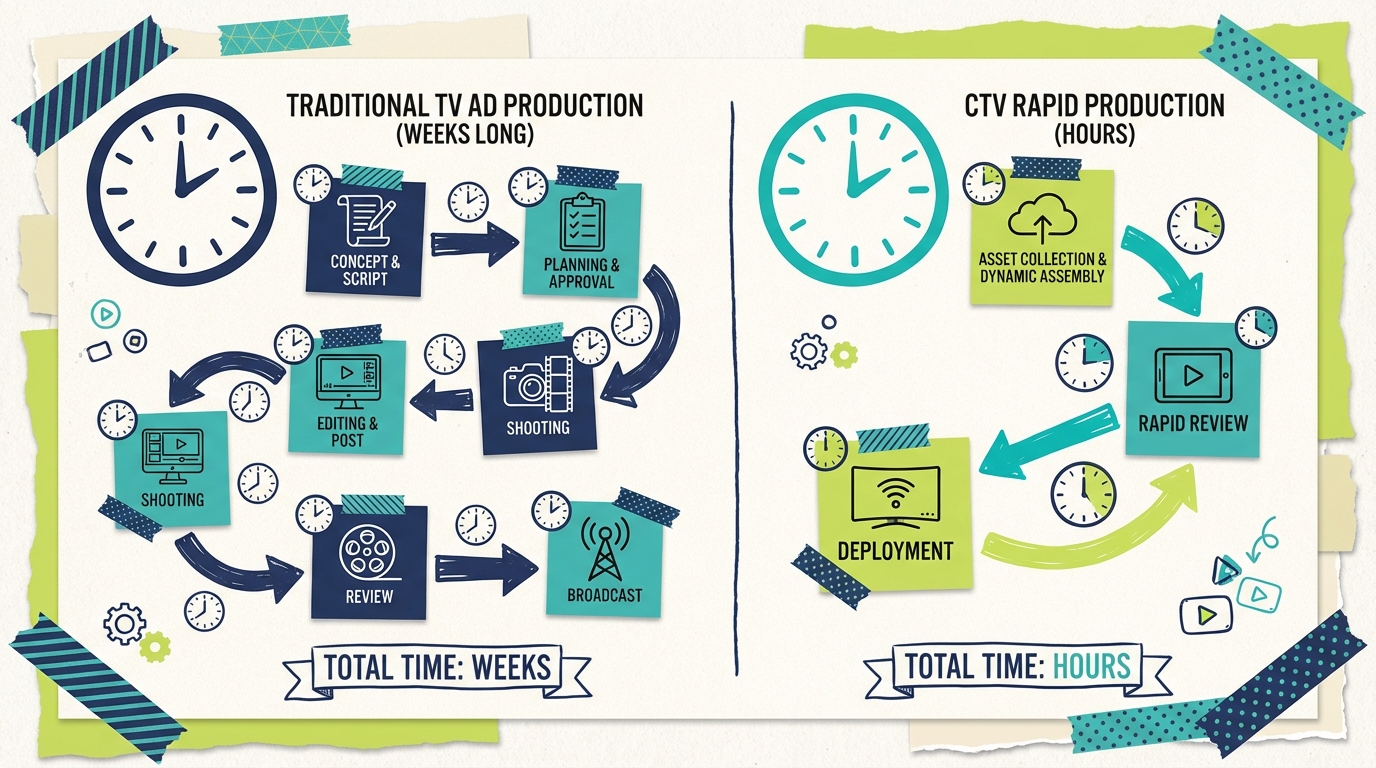
For decades, producing a political TV ad followed the same painful timeline. You'd hire an agency or media consultant. They'd develop creative concepts over a week or two. Then came scripting, casting, location scouting, filming, editing, and post-production. After the campaign manager signed off, the ad went to the broadcast station for trafficking. Total time from idea to airtime? Four to eight weeks on a good day.
That timeline worked fine when campaigns operated on predictable schedules. You'd plan your ad flights months in advance, produce a handful of spots, and rotate them through the general election window.
Modern campaigns don't work that way anymore.
Why the Old Model Is Breaking
The news cycle moves in minutes, not weeks. Social media amplifies every gaffe, endorsement, policy reversal, and scandal within hours. Voters form opinions in real time. A study by the Wesleyan Media Project found that during the 2024 election cycle, campaigns aired over 4.7 million political ad airings on broadcast alone, with the heaviest concentrations in the final weeks (Wesleyan Media Project, 2024). The campaigns that won weren't necessarily the ones that spent the most. They were the ones that responded the fastest.
Traditional production also costs a fortune. A single broadcast-quality political ad can run $25,000 to $250,000 or more in production costs alone, before a dollar is spent on airtime (AdAge, 2024). For a well-funded Senate campaign, that's manageable. For a state house candidate with a $75,000 total budget, it's a dealbreaker.
The Speed Gap
The core problem is straightforward: traditional TV ad production was built for a media environment that no longer exists. When your opponent can cut a social media video in 20 minutes but your TV response takes three weeks, you're fighting with one hand tied behind your back.
CTV closes that gap.
CTV's Speed Advantage: Same-Day Ad Deployment
Connected TV advertising operates on an entirely different production model than broadcast. Instead of physical tape delivery, station trafficking, and fixed programming schedules, CTV ads are delivered programmatically through digital ad servers. That means the time between "ad approved" and "ad running on voters' screens" can be measured in hours, not weeks.
How AI-Generated Ads Change the Game
AI-powered ad creation tools have collapsed the production timeline from weeks to minutes. With platforms like Adwave, a campaign can:
Generate a broadcast-quality 30-second ad in roughly 2 minutes using existing campaign assets (website, social profiles, or any URL)
Launch on 100+ premium streaming channels including NBC, Hulu, ESPN, and more
Start with as little as $50, making rapid testing affordable for any campaign size
Target specific ZIP codes and districts so every dollar reaches actual voters
This isn't about replacing your campaign's tentpole ads, the carefully produced spots that define your candidacy. It's about supplementing them with fast-response creative that lets you stay in the conversation when the news cycle shifts.
Production Timeline Comparison
A broadcast TV ad typically takes 4 to 8 weeks from concept to air, involves agency and production crews, costs $25,000 or more in production alone, and requires station trafficking with fixed deadlines. By contrast, a CTV ad through an AI platform can go from concept to air in as little as 2 hours. It can be created by campaign staff directly, production can start at $50 all-in, and programmatic delivery means near-instant deployment.
The difference isn't incremental. It's a completely different operating model for political media.
Rapid Response: Countering Opponent Attacks Within Hours

Rapid response has always been a pillar of campaign strategy. James Carville's famous "speed kills" mantra during the 1992 Clinton campaign established the principle that letting an attack go unanswered for even 24 hours could be fatal. But for most of the TV era, rapid response was limited to press conferences, press releases, and eventually social media.
CTV makes rapid response on television a reality.
The Rapid Response Playbook
Here's how a modern rapid response TV operation works with CTV:
Hour 0: Attack drops. Your opponent launches an ad or makes a damaging claim. Your research team flags it immediately.
Hour 1: Message development. Your communications team crafts the response message. What's the rebuttal? What's the pivot? What do voters need to hear?
Hour 2: Ad creation. Using AI ad generation, your team creates one or two 30-second response spots. No agency call needed. No production crew. Just your message, your campaign assets, and a platform that turns them into professional video.
Hour 3-4: Review and launch. Campaign leadership reviews the ad, makes any tweaks, and hits launch. The ad starts serving to voters in your target districts that same day.
Hour 5+: Optimization. Monitor performance data in real time. Adjust targeting, swap creative, or increase spend on the messaging that's resonating.
Compare that to the traditional response: your opponent attacks on Monday, your agency gets the brief on Tuesday, production happens Thursday through the following Monday, and your response airs a week and a half later. By then, the damage is done.
Real-World Rapid Response Scenarios
Scenario: False claim about your voting record. Your opponent runs an ad claiming you voted against funding for local schools. Within hours, you can have a CTV ad running in the same districts featuring your actual voting record and a direct counter-message.
Scenario: Breaking endorsement. A popular local figure endorses your opponent. Instead of waiting to produce a counter, you launch an ad showing your own endorsements from community leaders that same evening.
Scenario: External event. A factory in your district announces layoffs. While your opponent scrambles to produce a response ad, you're already on voters' screens with a message about your plan for local job creation.
In each case, the campaign that moves faster controls the narrative. And controlling the narrative is how you win.
Debate Night Strategies: Real-Time Ad Pivots
Debates are make-or-break moments in political campaigns. A single strong answer, a memorable zinger, or an opponent's stumble can shift voter sentiment overnight. The campaigns that capitalize on debate moments fastest gain an outsized advantage.
Pre-Debate Preparation
Smart campaigns don't wait until after the debate to start creating ads. They prepare in advance:
Create template ads for likely scenarios. If you know your opponent is weak on healthcare policy, have a healthcare-focused ad concept ready to go. If you expect a strong moment on education, prepare the creative assets.
Build a "war room" creative team. Designate campaign staffers who will be watching the debate with one job: identifying moments that can become ads. Give them access to your AI ad creation platform and the authority to move fast.
Pre-clear compliance language. Have your "paid for by" disclaimers, legal review, and compliance elements ready to drop into any ad. Don't let legal review become the bottleneck at 10 p.m. on debate night.
During the Debate
As the debate unfolds, your creative team is working in real time:
Clip key moments from the broadcast
Draft messaging around your strongest moments or your opponent's weakest
Begin ad generation using your pre-built templates and fresh debate clips
Queue targeting for your priority voter segments
Post-Debate Launch
Within hours of the debate ending, your CTV ads can be running. While voters are still processing what they watched, your campaign is reinforcing the moments that matter most.
During the 2024 presidential cycle, the Wesleyan Media Project tracked a significant spike in new ad creatives appearing within 48 hours of major debates (Wesleyan Media Project, 2024). The campaigns using CTV were often first to air, while broadcast-dependent campaigns lagged by days.
For 2026 midterm debates, this advantage is even more relevant. Gubernatorial and Senate debates draw high local attention, and the candidate who owns the post-debate narrative in voters' living rooms wins the news cycle.
Local and Down-Ballot Races: Where Speed Matters Most
If speed is important for Senate campaigns with million-dollar budgets, it's absolutely critical for down-ballot races where resources are thin and every dollar counts.
The Down-Ballot Challenge
Local candidates face a unique set of constraints:
Tiny budgets: A city council race might have $10,000 to $30,000 for the entire campaign, not just media
No agency support: Most local candidates can't afford a media consultant, let alone a production company
Volunteer-driven operations: The "production team" is often the candidate, their spouse, and a college intern
Compressed timelines: Many local races heat up only in the final 4 to 6 weeks before election day
Traditional TV advertising was essentially inaccessible to these campaigns. Even if they could scrape together enough for airtime, the production costs and lead times were prohibitive.
How streaming TV supports smaller campaigns
CTV with AI-generated ads eliminates every one of those barriers. A school board candidate can create a professional 30-second ad in minutes, launch it to voters in their district for as little as $50, and adjust their messaging as the campaign evolves. There's no agency fee, no minimum buy that requires a $10,000 commitment, and no three-week production cycle.
According to data from the Brennan Center for Justice, more than 500,000 elected officials serve at the local level in the United States (Brennan Center, 2023). The vast majority have never run a TV ad. CTV and AI are changing that, giving down-ballot candidates the same tools that were once reserved for top-tier races.
Speed for Local Race Scenarios
County commissioner race: Your opponent starts knocking on doors with a flyer that distorts your position on property taxes. Within a day, you have a CTV ad running in the county correcting the record and sharing your actual plan.
School board election: The local paper runs a story about overcrowding at a middle school. You create an ad showing your plan for new school construction and have it running to parents in the district that evening.
State legislature primary: A PAC starts running negative ads against you in the final two weeks. With fast-turnaround CTV, you can respond with a positive counter-message the same day the attacks begin.
In every local race, the ability to move quickly can compensate for having a smaller budget.
Targeting Precision: Reaching the Right Voters Fast
Speed only matters if your ads reach the right people. Blasting a rapid-response ad to voters outside your district is just fast waste. CTV's targeting capabilities ensure that quick turnaround also means precise delivery.
District-Level Targeting
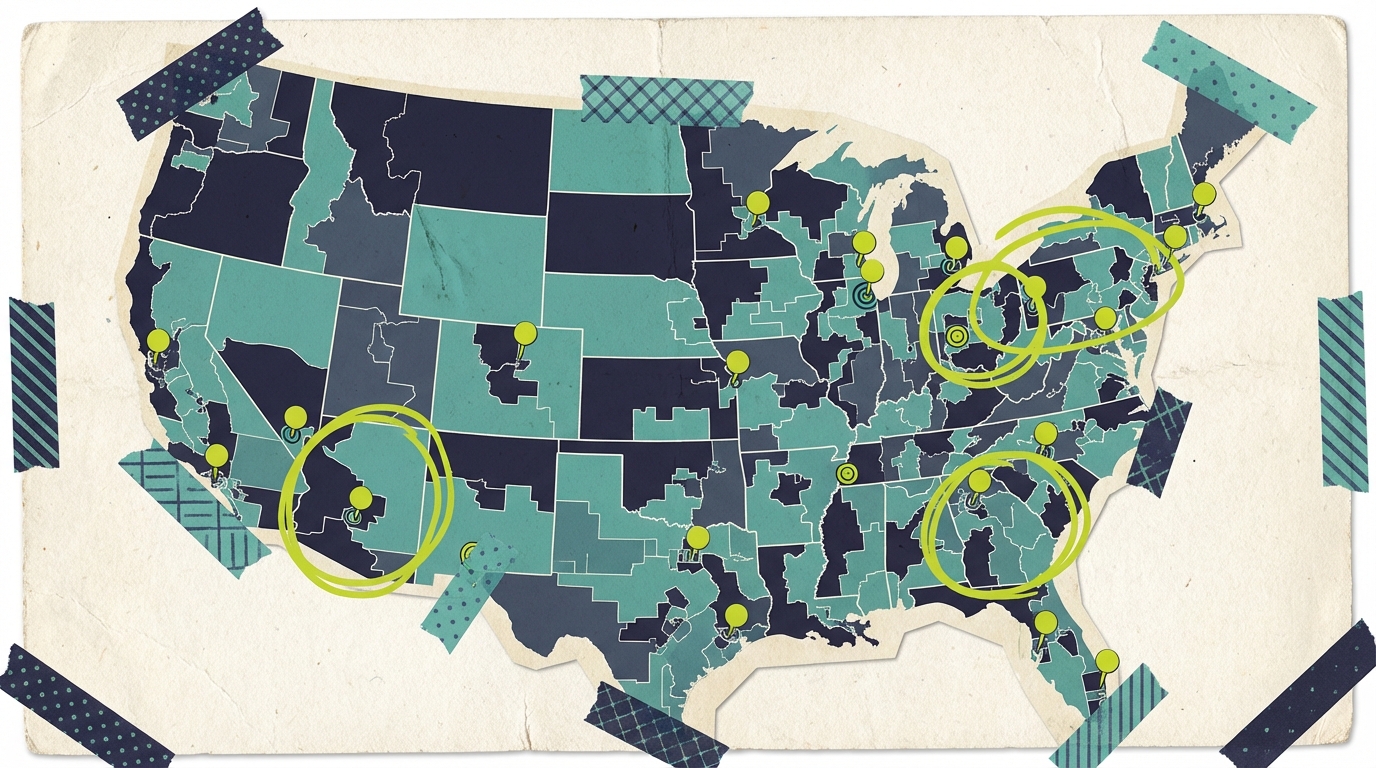
CTV platforms can target at the ZIP code level, which means campaigns can focus their spending on the exact geography of their race. A congressional candidate doesn't need to buy an entire DMA like they would on broadcast. They can target only the ZIP codes within their district.
For a deeper look at all the ways campaigns can target voters on streaming TV, see our political ad targeting guide.
Combining Speed and Targeting
The real power comes from combining fast ad creation with precise targeting. Here's what that looks like in practice:
Morning: Your polling data shows you're losing ground with women aged 35 to 54 in the suburban precincts of your district.
Midday: Your team creates a CTV ad focused on your childcare and education platform, specifically designed to resonate with that demographic.
Afternoon: The ad launches, targeted to women 35-54 in the specific ZIP codes where you're underperforming.
Evening: Voters in that exact demographic see your message on their streaming TV while watching their favorite shows.
On broadcast TV, this level of precision simply doesn't exist. You'd have to buy time on a station that reaches the whole market and hope the right people are watching. With CTV, every impression is intentional.
Voter File Matching at Speed
For campaigns with voter data, CTV enables matching your voter file to household-level streaming data. That means you can:
Target registered voters who haven't voted in the last two cycles (mobilization)
Reach voters who are registered as independent or unaffiliated (persuasion)
Focus on households in precincts where the race is closest (efficiency)
When you combine voter file targeting with fast ad production, you're not just running TV ads. You're running a precision communication operation that rivals the best digital campaigns.
Budget Efficiency: How Fast Turnaround Saves Money
Speed isn't just about winning the news cycle. It directly affects your campaign's bottom line.
Lower Production Costs
Traditional political ad production costs between $25,000 and $250,000 per spot. Over the course of a campaign that produces 8 to 12 different ads, production alone can eat $200,000 or more of the budget.
AI-generated CTV ads dramatically reduce that cost. With Adwave, production cost is essentially zero since the ad creation is free. Your budget goes entirely toward media placement, where it reaches voters.
For campaigns operating at the average CTV CPM of $15 to $35, that means a $5,000 CTV buy can deliver roughly 140,000 to 330,000 impressions to targeted voters. Compare that to spending $25,000 just to produce a single broadcast spot before buying a single second of airtime.
Eliminate Waste Through Testing
Fast turnaround enables a test-and-learn approach that traditional production can't support. Instead of betting your entire budget on one or two ads that took weeks to produce, you can:
Create multiple versions of an ad to test different messages
Run A/B tests across different voter segments
Kill underperforming ads quickly and shift budget to what's working
Iterate on creative based on real performance data
This approach means your campaign gets smarter as it goes. By the final weeks before election day, you're running ads that have been refined through actual voter response data, not just gut instinct.
Reduce Inventory Premium Pressure
Political ad rates spike as election day approaches. Broadcast inventory becomes scarce, and campaigns pay a premium for the remaining slots. CTV inventory is significantly more elastic since streaming platforms can accommodate additional demand without the same scarcity constraints as broadcast.
By building your CTV strategy around fast-turnaround production, you can also time your spending more strategically. Instead of committing to expensive advance buys, you can deploy budget reactively when opportunities arise and pull back when the moment passes.
Legal Compliance at Speed: Staying on the Right Side of the Rules
Moving fast doesn't mean cutting corners on compliance. Political advertising is one of the most regulated forms of media, and getting it wrong can sink a campaign faster than any opponent attack.
FCC Rules for Broadcast vs. Streaming
The regulatory environment for political ads differs significantly between broadcast and streaming:
Broadcast TV is governed by FCC rules that require stations to give candidates reasonable access to airtime, provide equal opportunity for opposing candidates, charge candidates the lowest unit rate during the 45 days before a primary and 60 days before a general election, and maintain a public file of all political ad purchases.
Streaming/CTV operates under a lighter regulatory framework. The FCC's broadcast-specific rules (reasonable access, lowest unit rate, equal time) don't apply to streaming platforms. However, FTC truth-in-advertising standards still apply, and platforms may have their own political ad policies.
For a deep dive into the full regulatory picture, see our FCC political advertising rules guide.
Disclaimer Requirements
Regardless of platform, all political ads need proper attribution. For federal candidates, the Bipartisan Campaign Reform Act (BCRA) requires:
Candidate ads: "I'm [candidate name] and I approve this message" (the "stand by your ad" provision)
PAC/Super PAC ads: "Paid for by [committee name]" and "not authorized by any candidate or candidate's committee" if applicable
Issue advocacy ads: Disclosure requirements vary by state, but most require identification of the sponsoring organization
When you're producing ads at speed, it's critical to have these elements pre-built into your templates. Every CTV ad Adwave generates is 30 seconds, giving you time for both your message and required disclosures.
Building Compliance Into Your Speed Workflow
The campaigns that move fastest without compliance issues follow these practices:
Pre-approve disclaimer language. Work with your campaign attorney before the cycle heats up to pre-clear the exact wording for your disclaimers across different ad types.
Create compliance checklists. Build a simple checklist that every ad must pass before launch: disclaimer present, no false claims of endorsement, no misrepresentation of opponent's record beyond what's documented, proper "paid for by" attribution.
Designate a compliance reviewer. Even in a fast-turnaround operation, one person should have final sign-off authority on legal compliance. This review should take minutes, not days.
Keep records. Federal law requires campaigns to keep records of their advertising purchases and expenditures. CTV platforms typically provide digital records automatically, making compliance easier than the paper-based broadcast world.
State-Level Considerations
Beyond federal rules, many states have their own political advertising regulations. Some require additional disclaimers, restrict certain types of advertising in the days before an election, or mandate specific filing requirements for ad purchases. Check your state's election commission website for rules specific to your race.
Common questions answered
How fast can a political TV ad go from concept to airing on CTV? With AI-powered ad creation and programmatic CTV delivery, a political ad can go from concept to running on voters' screens in as little as 2 to 4 hours. This includes ad creation (roughly 2 minutes with a tool like Adwave), campaign review and approval, and programmatic delivery to streaming platforms. Traditional broadcast production, by comparison, typically takes 4 to 8 weeks.
Is fast-turnaround CTV advertising effective for down-ballot and local races? Absolutely. CTV is arguably more valuable for local races than for top-tier campaigns because it eliminates the two biggest barriers local candidates face: high production costs and geographic waste. A school board or city council candidate can create a professional 30-second ad, target it to voters in their specific district at the ZIP code level, and launch it for as little as $50. That combination of speed, precision, and affordability was simply not available to local candidates before.
Do rapid-response CTV ads look professional enough for a serious campaign? AI-generated ads have advanced significantly. Modern AI platforms produce broadcast-quality 30-second spots using your campaign's existing assets, including website content, photos, logos, and messaging. They won't replace your campaign's marquee brand spot, but for rapid-response messaging, issue-specific targeting, and time-sensitive pivots, they're more than sufficient. Many campaigns use a hybrid approach: agency-produced hero spots for broad awareness and AI-generated CTV ads for fast-response situations.
What compliance rules apply to political ads on streaming TV? CTV and streaming platforms are not governed by the same FCC rules that apply to broadcast stations. The lowest unit rate, reasonable access, and equal time provisions don't apply to streaming. However, FTC truth-in-advertising rules still apply, and all political ads still require proper "paid for by" disclaimers under federal campaign finance law. Individual states may have additional requirements. Always consult your campaign attorney for your specific situation.
How should campaigns balance traditional TV and fast-turnaround CTV spending? Most political media strategists recommend allocating 20 to 40% of your TV budget to CTV and streaming, depending on your race type and target demographics. Use broadcast for broad reach and name recognition, especially among older voters. Use CTV for targeted messaging, rapid response, debate-night pivots, and reaching cord-cutters who don't watch traditional TV. The Wesleyan Media Project data shows CTV's share of political advertising is growing each cycle, so the balance is shifting toward streaming.