
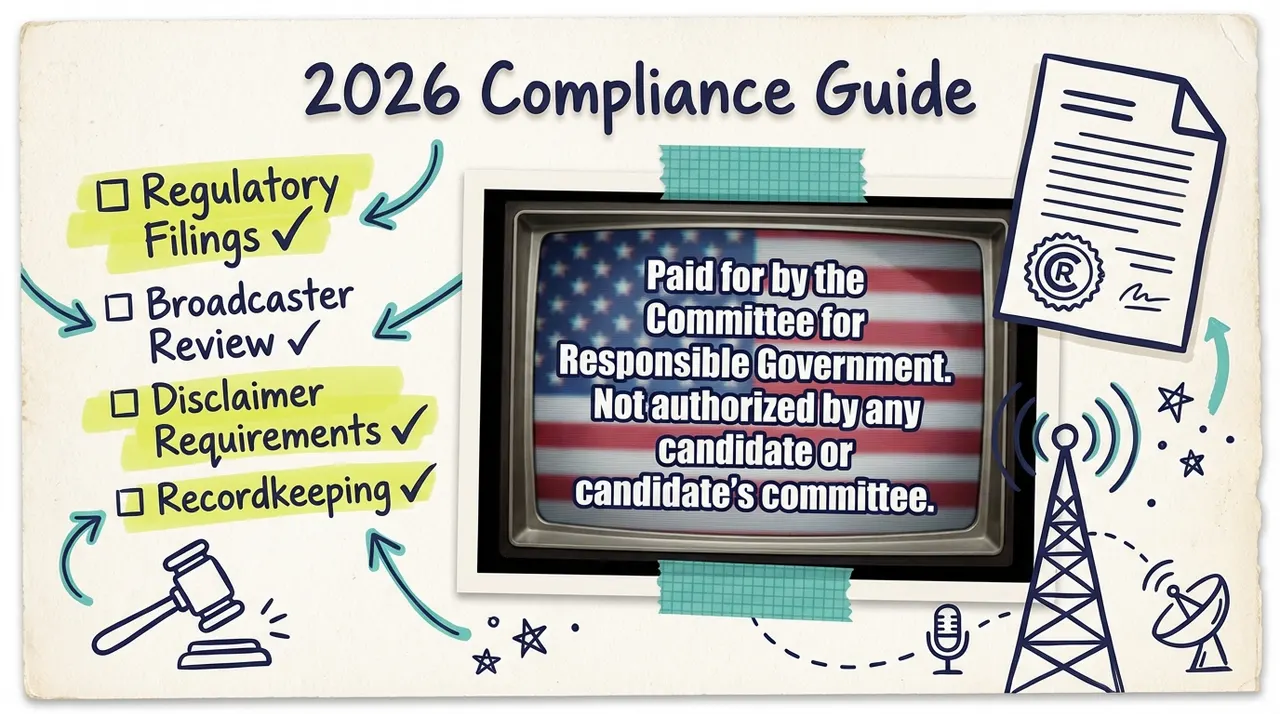
If you're running a political campaign in 2026, advertising on TV is one of the most effective ways to reach voters. But political advertising isn't like selling sneakers or pizza. The Federal Communications Commission (FCC) has a specific set of rules that govern how political ads run on broadcast television, and breaking them can mean fines, pulled ads, or public embarrassment during a tight race.
These rules were written for the broadcast era. Streaming and connected TV (CTV) operate under a different regulatory framework entirely. Knowing which rules apply to which platform can save your campaign time, money, and legal headaches.
This guide breaks down the FCC political advertising rules that matter most for 2026, explains how broadcast and streaming regulations differ, and gives you a practical compliance checklist to keep your campaign on the right side of the law.
FCC Rules for Broadcast TV Political Ads
The FCC's political advertising rules are based on the Communications Act of 1934. The sections below cover key requirements for broadcast stations and cable systems.
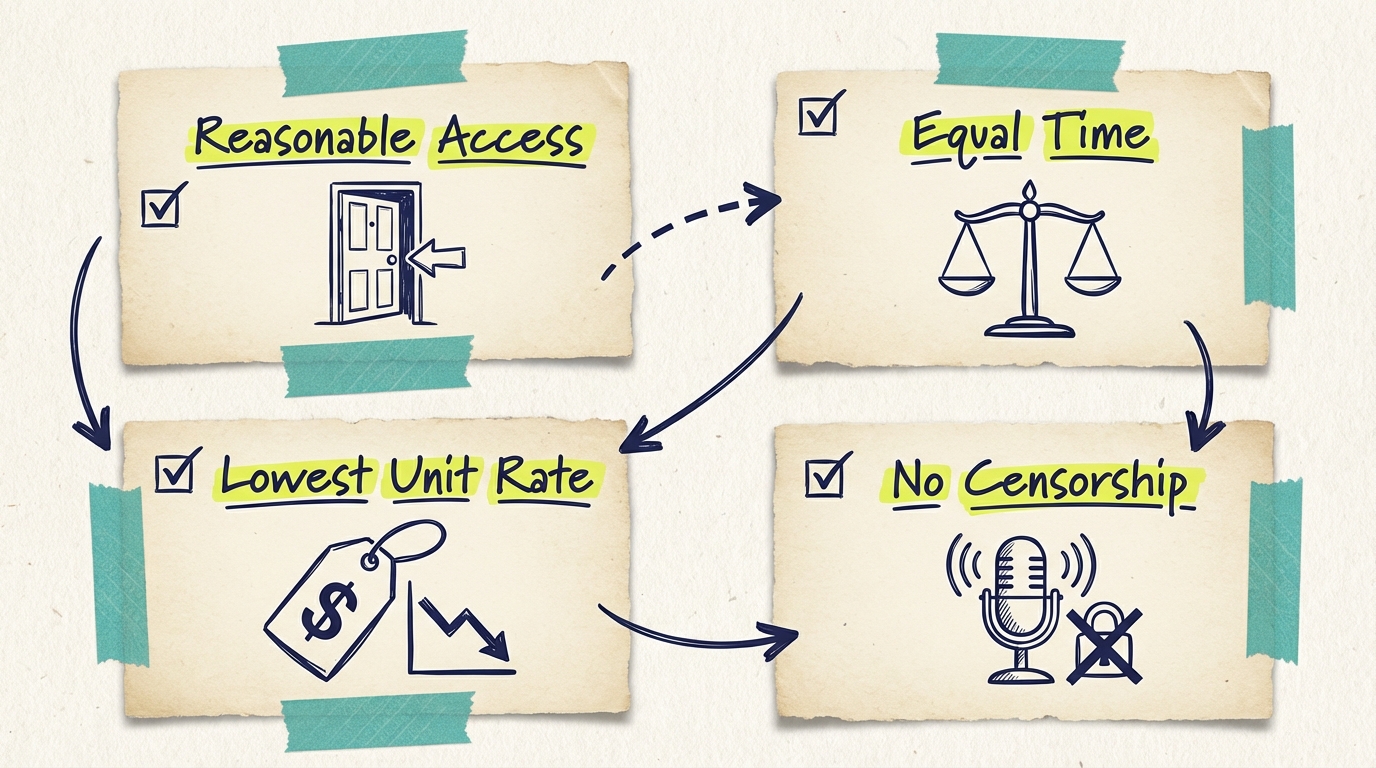
Reasonable Access (Section 312(a)(7))
Federal candidates have a legal right to purchase airtime on broadcast stations. Under FCC Section 312(a)(7), broadcast licensees must provide "reasonable access" to legally qualified candidates for federal office. This means a station can't simply refuse to sell ad time to a presidential, Senate, or House candidate.
The key word here is "federal." State and local candidates don't have the same guaranteed access under this provision, though stations often sell them airtime voluntarily. For federal campaigns, a station that refuses reasonable access risks losing its broadcast license, which is about as serious as it gets in the broadcasting world.
What counts as "reasonable"? The FCC evaluates this on a case-by-case basis, considering factors like the amount of time requested, the potential disruption to programming, and whether the request comes during a campaign's final weeks. Stations can't impose blanket bans on political ads, but they can negotiate timing and placement.
Equal Time (Section 315)
Section 315 of the Communications Act is the "equal time" rule, and it's one of the most well-known provisions in political broadcasting. If a broadcast station gives or sells airtime to one legally qualified candidate, it must offer equal opportunities to all other legally qualified candidates for the same office.
This doesn't mean a station has to give free time to every candidate. It means that if Candidate A buys a 30-second spot during prime time, the station must make the same opportunity available to Candidate B at the same rate. The rule prevents stations from playing favorites.
There are exemptions. Bona fide news coverage, including newscasts, news interviews, documentaries, and on-the-spot news events, doesn't trigger equal time obligations (FCC Section 315(a)(1)-(4)). So a candidate appearing on a local news broadcast doesn't automatically entitle their opponent to equal airtime.
Lowest Unit Rate
During the 45 days before a primary and 60 days before a general election, broadcast stations must offer candidates their lowest unit rate for the same class and amount of time. This provision, also found in Section 315(b), was designed to prevent stations from gouging campaigns.
In practice, this means candidates should be getting the same rate as a station's best volume advertisers during those protected windows. Campaigns that don't know about this rule often overpay significantly. We have a separate guide on political advertising costs that covers pricing in more detail.
One important distinction: the lowest unit rate applies only to broadcast stations. It does not apply to CTV, streaming platforms, or digital advertising. On streaming, pricing follows standard market rates, which can work in your favor if you're targeting efficiently.
No Censorship of Candidate Ads
Here's a rule that surprises many campaign teams. Under Section 315(a), broadcast stations cannot censor ads that are "uses" by legally qualified candidates. If a candidate personally appears in the ad and approves the message, the station must run it as submitted, even if the content is controversial or arguably misleading.
The flip side? Because stations can't censor these ads, they also can't be held liable for the content. This protection applies specifically to candidate "uses," not to ads from PACs, Super PACs, or issue advocacy groups. Those third-party ads can be rejected by stations at their discretion.
Disclosure and Disclaimer Requirements
Every political ad that runs on broadcast TV needs proper identification. The FCC and the Federal Election Commission (FEC) both have rules here, and they overlap in ways that can trip up first-time campaigns.
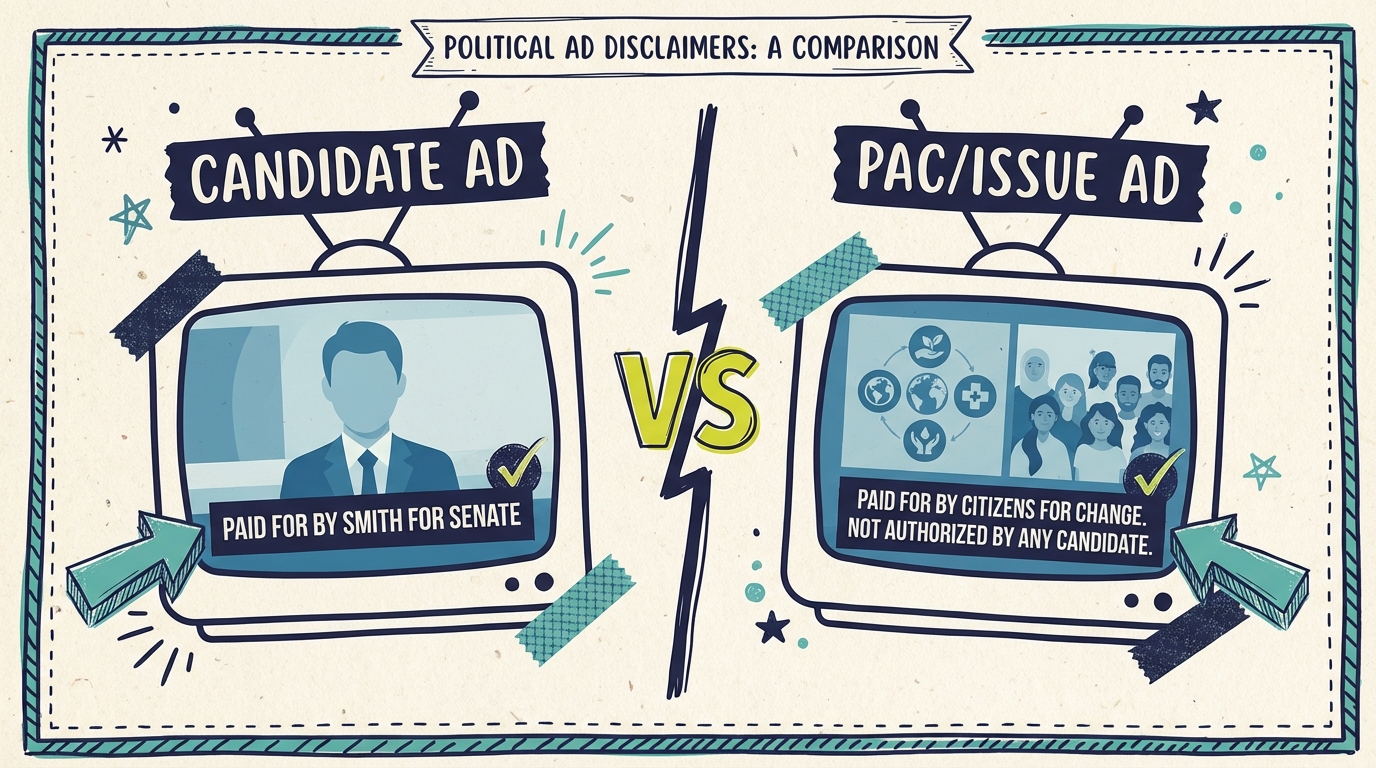
Sponsor Identification (47 CFR 73.1212)
Under 47 CFR 73.1212, every broadcast of paid political content must include a sponsorship identification announcement. Viewers need to know who's paying for what they're watching. For TV ads, this typically appears as an on-screen text overlay at the end of the spot.
The specific language depends on who's behind the ad:
Candidate ads: Must include "Paid for by [candidate committee name]." If the candidate authorized the ad but a separate committee paid for it, the disclaimer must say "Paid for by [committee name] and authorized by [candidate name/committee]."
PAC and issue ads: Must include "Paid for by [organization name]" and, critically, a statement that the ad is "not authorized by any candidate or candidate's committee" (if that's the case). This distinction matters because voters should know whether a candidate stands behind the message or whether an outside group is driving it.
FEC "Stand By Your Ad" Provision
For federal candidates, the Bipartisan Campaign Reform Act added the "stand by your ad" requirement. You've heard these disclaimers countless times: "I'm [candidate name] and I approve this message." This applies to TV, radio, and certain digital ads for federal races.
The spoken approval must come from the candidate personally. For TV ads, it must include either a full-screen view of the candidate delivering the statement or a candidate voiceover with a "clearly identifiable photographic or similar image" of the candidate visible for at least four seconds.
State and local races may have similar requirements depending on state law, but the federal "stand by your ad" rule applies only to candidates for president, Senate, and House.
Record-Keeping: The Political File
Broadcast stations are required to maintain a political file (also called a public inspection file) for every political ad request they receive. This isn't optional, and it isn't something campaigns can ignore.
Under FCC rules, stations must upload records to the FCC's online public inspection file database within the required timeframe. These records include the name of the candidate or issue, the sponsor of the ad, the schedule of airtime purchased, the rate charged, and the classes of time purchased.
Why should your campaign care? Because the political file is public. Opposing campaigns, journalists, and watchdog groups can review your ad buys. This transparency is by design, but it means your advertising strategy is partially visible to competitors.
From a compliance standpoint, your campaign should keep its own records of all ad buys, contracts, and communications with stations. If there's ever a dispute about rates or access, having documentation on your side is essential.
The FCC has been enforcing political file compliance more actively in recent cycles. Stations that fail to maintain accurate records risk fines, and repeated violations can jeopardize license renewals.
How CTV and Streaming Rules Differ
This is where things get interesting for modern political campaigns. The FCC's political advertising rules were built for broadcast licensees. Streaming platforms and CTV services aren't broadcast licensees, which means many of those rules simply don't apply.
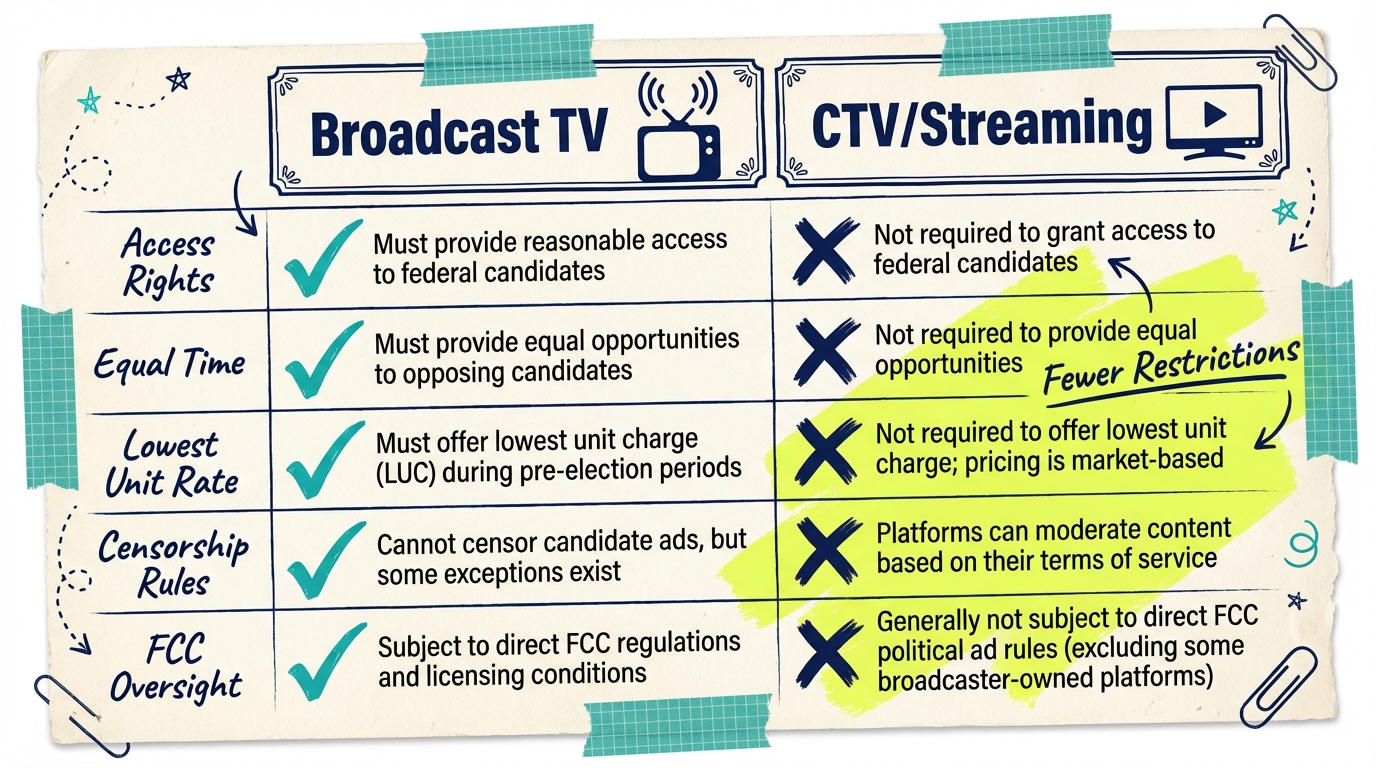
What Doesn't Apply to Streaming
No reasonable access requirement. Streaming platforms are not obligated to sell ad time to any candidate. Platforms like Hulu, Roku, and Tubi can accept or reject political ads at their discretion.
No equal time rule. If a streaming platform sells ad time to one candidate, it has no FCC obligation to offer equal opportunities to opponents.
No lowest unit rate. CTV pricing is market-driven. There's no protected window where candidates get preferential rates.
No censorship prohibition. Streaming platforms can (and do) review political ad content and reject ads that don't meet their policies.
What Still Applies
The Federal Trade Commission (FTC) still oversees advertising on streaming platforms, which means basic truth-in-advertising standards apply. Political ads on CTV can't make objectively false commercial claims, though the line between "political speech" and "commercial speech" remains legally complex.
FEC disclaimer requirements still apply to federal candidate ads regardless of platform. If your campaign is running ads for a federal race on streaming, you still need proper "paid for by" disclosures.
Most major streaming platforms have also developed their own political advertising policies. These vary significantly. Some platforms require documentation that the advertiser is a registered political committee. Others restrict microtargeting in political ads. A few have banned political advertising entirely during certain periods.
CTV political advertising offers targeting capabilities that broadcast simply can't match. You can reach voters in specific districts, target by demographics and interests, and track performance with much more granular data. For campaigns looking to stretch their budget, platforms like Adwave let you create and run targeted TV ads to reach voters starting at just $50.
State-Level Rules to Watch
Federal FCC rules set the floor, not the ceiling. Many states have additional political advertising requirements that campaigns must follow.
Disclaimer requirements: Several states require disclaimers on all political advertising, including digital and streaming ads, that go beyond federal FEC requirements. California, New York, Washington, and Maryland are among the states with more stringent disclosure laws.
Digital-specific rules: Washington state's Public Disclosure Commission requires that all political ads appearing on "commercial advertisers," including digital platforms, include sponsor identification. Maryland passed a law requiring platforms to maintain public records of political ad purchases, similar to the FCC's broadcast political file requirements.
AI-generated content: An emerging area of regulation. Several states, including California, Michigan, Minnesota, Texas, and Washington, have passed or proposed laws requiring disclosure when political ads use AI-generated or manipulated content. Given how quickly AI tools are evolving, expect more states to follow.
State filing requirements: Some states require campaigns to file copies of all advertisements, including TV spots, with election authorities. Check your state's campaign finance and election commission websites for current requirements.
Compliance Checklist for 2026 Campaigns
Here's a practical reference for keeping your political advertising compliant across both broadcast and streaming platforms.
Common questions answered
Do FCC political advertising rules apply to streaming TV and CTV platforms?
Most FCC political broadcasting rules, including reasonable access, equal time, and lowest unit rate, apply only to broadcast television stations. Streaming and CTV platforms are not FCC broadcast licensees, so these specific obligations don't apply to them. However, FEC disclaimer requirements for federal candidates still apply regardless of platform, and FTC truth-in-advertising standards govern all commercial advertising, including political ads on streaming.
Can a TV station refuse to run my political ad?
It depends on the type of ad and the type of station. Broadcast stations cannot refuse "reasonable access" to federal candidates under Section 312(a)(7), and they cannot censor candidate "use" ads under Section 315. However, stations can reject ads from PACs and issue groups. Streaming platforms have full discretion to accept or reject any political advertisement based on their own internal policies.
What disclaimer language is required on political TV ads?
For broadcast TV, FCC rules under 47 CFR 73.1212 require sponsor identification on all political ads. Candidate ads must state "Paid for by [committee name]." PAC and third-party ads must identify the paying organization and note that the ad is not authorized by any candidate (if applicable). Federal candidates must also include the "I approve this message" statement under the Bipartisan Campaign Reform Act.
When does the lowest unit rate apply?
The lowest unit rate applies to broadcast stations during the 45 days before a primary election and the 60 days before a general election, as specified in Section 315(b) of the Communications Act. During these windows, stations must charge candidates no more than their lowest rate for the same class and amount of airtime. This protection does not extend to CTV, streaming, cable, or digital advertising platforms.
Are there special rules for AI-generated political ads?
At the federal level, the FCC proposed rules in 2024 requiring disclosure of AI-generated content in political ads on broadcast, but specific mandates are still evolving. Several states, including California, Michigan, Texas, and Washington, have already enacted or proposed laws requiring campaigns to disclose when ads contain AI-generated or significantly altered content. Given the pace of change, campaigns should err on the side of transparency and disclose AI usage in all political advertisements.
How long do broadcast stations keep political advertising records?
Broadcast stations must maintain political files in the FCC's online public inspection file database. These records must be kept for the duration of the license period (typically eight years for TV stations). Records include the identity of the ad purchaser, the issues or candidates referenced, the airtime schedule, the rates charged, and the class of time purchased. Campaigns should keep their own parallel records for at least two years, if not longer.


