
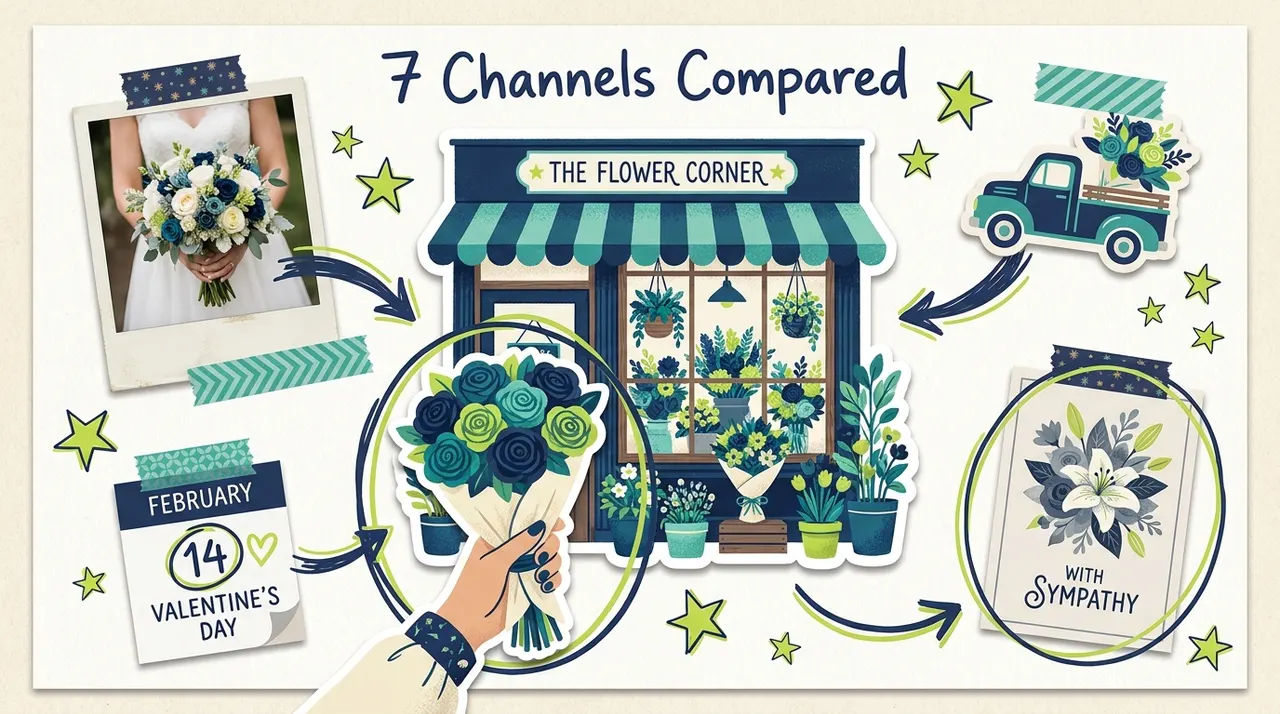
Florist retail has survived more disruption than almost any other local category. Supermarket floral departments pulled the low end. 1-800-Flowers, FTD, and Teleflora consolidated national online ordering. Trader Joe's and grocery delivery apps captured weekly flower purchases. Yet independent florists still win the biggest revenue days of the year: Valentine's Day, Mother's Day, weddings, funerals, and anniversaries where people want something real and beautiful, not something from a grocery cooler.
The U.S. floral industry generates about $7 billion in retail sales annually, with more than 15,000 independent florists competing (Society of American Florists, 2024). Independent shops typically capture 65-80% of wedding, event, and funeral work in their markets because these occasions demand customization and personal service that chains and online sellers can't match.
Flower customers aren't comparison shopping on price for the important moments. They're looking for a florist they trust. Advertising that builds that trust over time, rather than chasing the cheapest-dozen-roses shopper, is what works. This guide covers seven proven advertising channels for independent florists, built for the occasions that drive revenue.
Why Florist Advertising Is Different
A few dynamics make flower shop advertising unique.
Event-driven peaks. Valentine's Day, Mother's Day, Easter, Secretary's Day, and the wedding/funeral cycle drive 50-60% of annual revenue for most independent florists. Your advertising calendar has to ride those peaks.
Last-minute decisions. Unlike jewelry or home services, most flower purchases happen within 48 hours of delivery. Advertising has to be present at the moment of decision, not weeks in advance.
Geographic limits. Flowers don't travel well. Your service radius is 15-30 miles for delivery. Advertising outside that range wastes money.
Specialization matters. Wedding florists operate differently from funeral florists, who operate differently from grocery-replacement florists. Your advertising should match your specialty.
Referrals drive weddings. According to a 2024 WeddingWire vendor survey, 58% of wedding florists report that referrals from photographers, venues, and wedding planners drive more than half their wedding bookings. Advertising that supports those referrals compounds.
Google Ads: Catching Same-Day Flower Searches
When someone realizes they need flowers urgently, what do they do? Search. "Florist near me." "Same day flower delivery [city]." "Funeral flowers [city]." Google Ads puts your shop at the top of those searches.
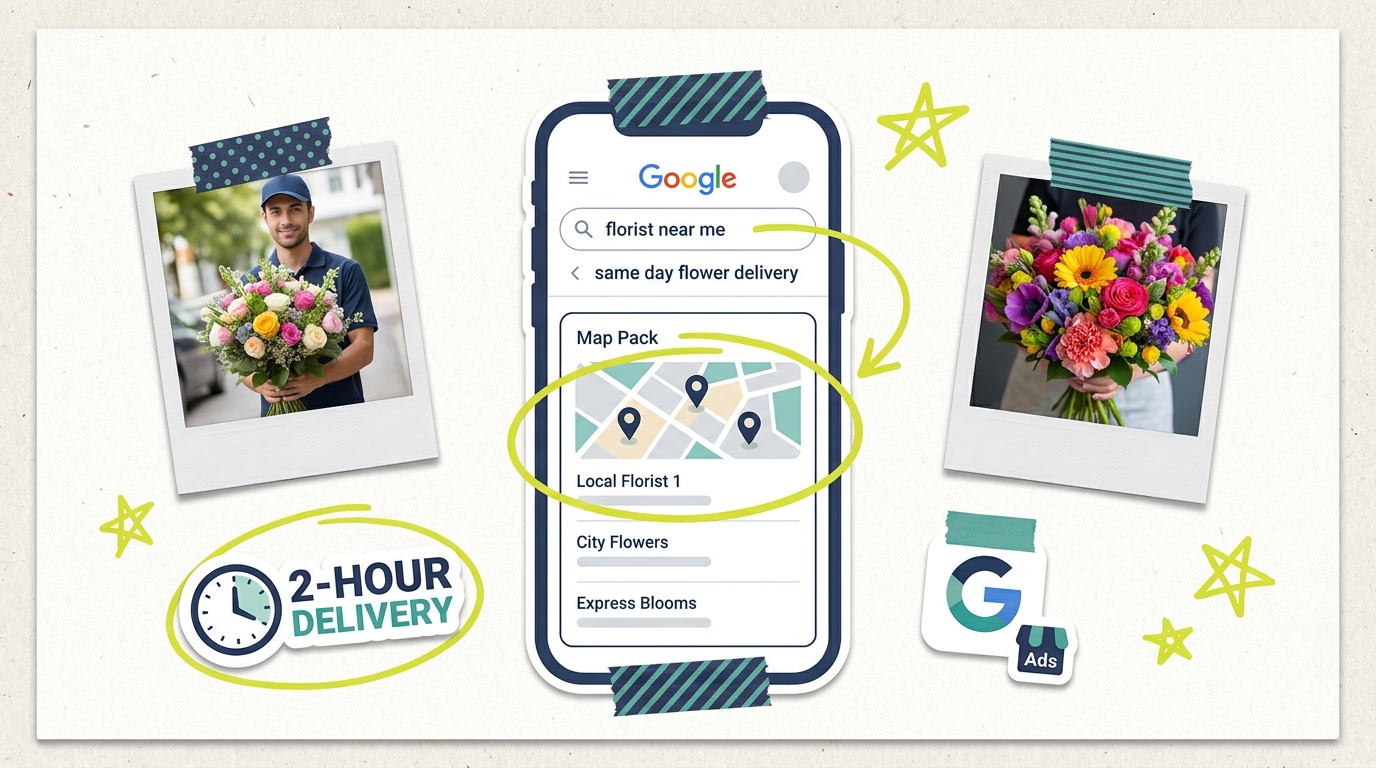
Google's internal data shows 76% of local searches lead to a business visit or contact within 24 hours (Google, 2023). For florists, that window is often 2-6 hours because most flower purchases are time-sensitive.
Keywords That Drive Same-Day Orders
Structure campaigns around these categories:
Core service searches: "florist near me," "flower delivery [city]," "same day flower delivery," "best florist [city]"
Occasion-driven: "funeral flowers [city]," "sympathy flowers delivery," "anniversary flowers," "birthday flowers delivery," "get well flowers"
Seasonal peaks: "Valentine's Day flowers [city]," "Mother's Day flower delivery," "prom corsages [city]," "homecoming mums"
Wedding-focused: "wedding florist [city]," "bridal bouquet [city]," "custom wedding flowers," "wedding centerpieces"
Corporate: "office flower delivery," "corporate gift flowers," "lobby arrangements [city]"
Campaign Types
Search campaigns on high-intent same-day and occasion keywords. Most important channel type for florists.
Local Services Ads (LSAs) with Google Guaranteed badge where available. Pay-per-lead model that works well for urgent floral needs.
Shopping campaigns with Google Merchant Center if you have an e-commerce site. Show arrangement photos and prices.
Remarketing during wedding planning consideration windows for couples who visited your wedding pages.
Budget and Expectations
Single-location florists should budget $800-$3,000 per month on Google Ads, with 2-3x surge budget during peak weeks (Valentine's Day, Mother's Day). CPCs for florist keywords run $4-$15. Expect cost per order of $20-$60, with close rates of 40-60% because search intent is so high.
Tips for Better Results
Use call tracking: most florist orders happen by phone
Schedule ads heavy during business hours when you can take orders
Add negative keywords: "fake flowers," "silk flowers," "flower meaning," "flower wallpaper"
Dayparting: surge bids during lunch and after work when occasion-shoppers search most
Set up separate campaigns per occasion (funeral, wedding, everyday) so you can bid appropriately
Google Ads is the workhorse for most florists. It captures people who are about to buy. Everything else builds on top of this.
Meta and Instagram: Beautiful Photography, Powerful Platform
Florists have a massive visual advantage. Flowers are inherently photogenic, and Instagram especially rewards stunning floral content. For wedding and event florists, Instagram is often the #1 source of new bookings.
Unlike Google where users search actively, Meta users scroll passively. But when they see a stunning bridal bouquet or a dramatic ballroom installation, they stop. And the shop becomes the one they remember when they need flowers.
Meta Business data shows video ads produce 1.2x higher engagement than static images, and visual-product categories see especially high recall from branded video (Meta, 2024).
Campaign Types for Florists
Awareness campaigns target everyday flower customers within 15-30 miles of your shop. Target women 30-65, interest-based targeting for gift shoppers and home decor enthusiasts.
Wedding-focused campaigns target engaged women 24-35 with interest targeting for weddings, bridal pages, and local venues.
Seasonal campaigns timed 2-3 weeks before each peak: Valentine's Day, Mother's Day, Easter, prom season, homecoming, holiday season.
Retargeting campaigns reach people who visited your wedding or event pages.
Lead generation campaigns for wedding inquiries, corporate accounts, and sympathy arrangements with same-day dispatch promises.
Creative Ideas for Florists
Wedding reveal videos. With permission, share the bouquet and centerpiece reveals for real weddings. Nothing books wedding florists like seeing real work.
Arrangement process videos. Time-lapse a designer building a bouquet. engaging content.
Seasonal inspiration: "5 spring arrangement ideas," "Our favorite Mother's Day pieces this year." Educational content converts over time.
Behind-the-counter: Your designers at work, flower truck unloading, cooler interiors. The craft is inherently compelling.
Customer testimonial videos: Wedding couples, event planners, corporate clients talking about working with you.
Budget and Expectations
Budget $400-$2,000 per month for Meta in non-peak months, with 2-3x surge during seasonal peaks. CPMs run $10-$22 for local/gift targeting. Lead gen campaigns produce contacts at $15-$60 each, with conversion rates of 15-30% from lead to booked order (higher for weddings with real planning intent).
Tips for Better Results
Instagram outperforms Facebook for most florists because flowers are inherently visual
Build custom audiences from past wedding clients, then create lookalikes
Rotate creative every 2-3 weeks to prevent fatigue
Run heavy budget 3-4 weeks before Valentine's Day and Mother's Day
For wedding florists, partner with photographers and venues to cross-promote
Meta builds top-of-funnel awareness that Google can't match. It won't replace search for urgent orders, but it creates the brand recognition that gets your shop into consideration sets for weddings and events.
Local SEO and Google Business Profile
Your Google Business Profile is absolutely critical for florists. Most flower orders start with "florist near me" or "flower delivery [city]," and the map pack is where those searches convert.
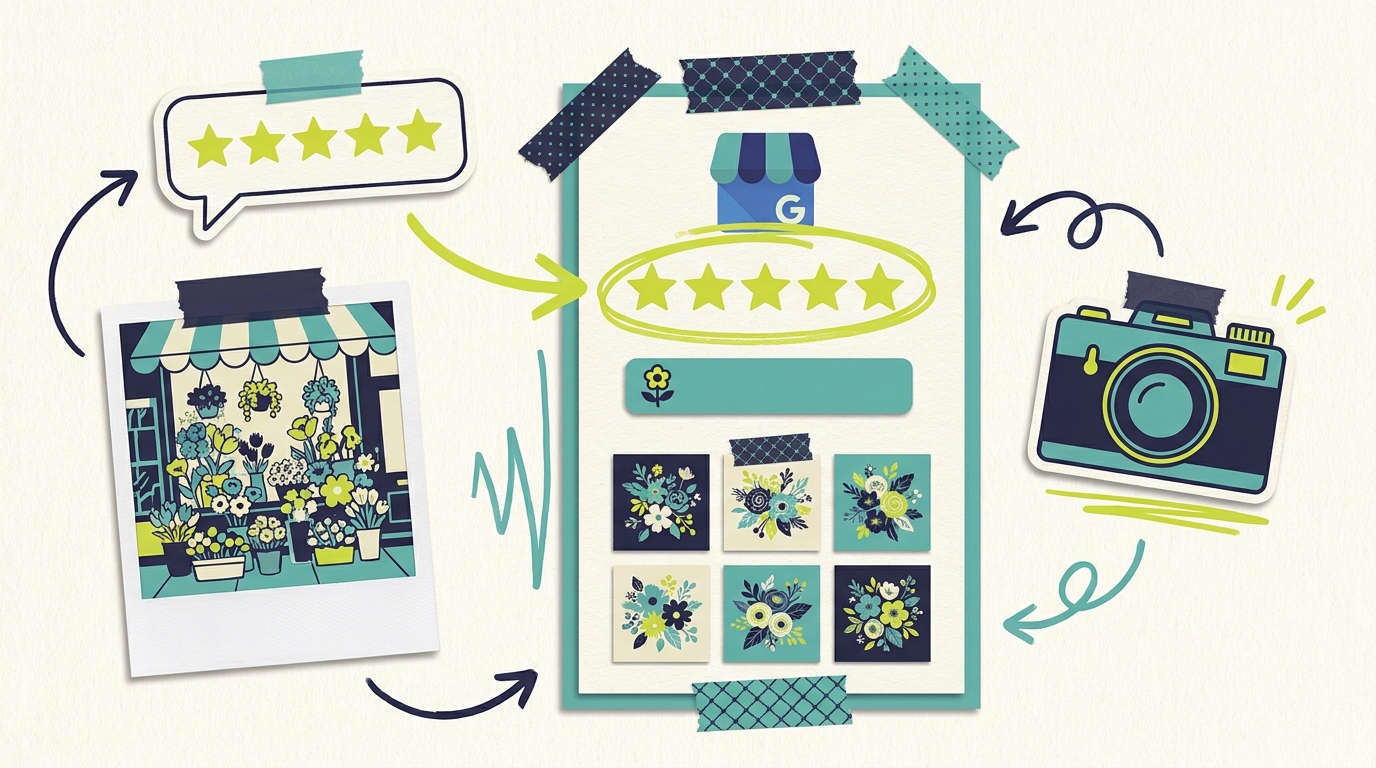
BrightLocal's 2024 Local Consumer Survey found that 87% of consumers use Google to evaluate local businesses, and the map pack captures 44% of all local search clicks. For florists, where urgency is so high, the map pack is often where the order happens.
Optimizing Your Google Business Profile
Complete every field. Primary category: "Florist." Secondary categories as relevant: "Wedding Florist," "Flower Delivery Service," "Gift Shop," "Funeral Services" (if you offer sympathy arrangements).
Post weekly. Seasonal arrangements, special occasion offerings, new flower varieties in stock. Active profiles rank 10-15% higher on average (LocalIQ, 2024).
Upload tons of photos. Shop interior, arrangement examples, weddings you've done, sympathy pieces, seasonal offerings. Profiles with 100+ photos generate 520% more calls than those with fewer than 10 (Google, 2023). For florists, visual content is especially valuable.
Answer the Q&A. Seed questions about same-day cutoff times, delivery radius, funeral coordination, wedding booking process.
Service menu integration: List specific services (wedding, funeral, corporate, daily delivery) with price ranges if possible.
Reviews Are Critical
Flower customers, especially for weddings and funerals, read reviews carefully. A negative wedding review can cost your shop 15-30 weddings over the next year.
Review engine for florists:
Text every customer a review link within 48 hours of delivery
After weddings, send a handwritten thank-you note with a review request
Respond to every review within 48 hours, especially positive wedding reviews
Handle negative reviews professionally: acknowledge, offer to make it right, show care
Local Citations
Florist-specific citations matter:
Google Business Profile
Yelp
The Knot, WeddingWire, Zola (for wedding work)
FTD and Teleflora member directories (if applicable)
Society of American Florists directory
Local wedding vendor lists
Budget and Expectations
Local SEO is mostly sweat equity. Budget $200-$600 per month if you hire help. Results compound over 3-6 months. A well-optimized florist GBP in a metro market generates 50-200 calls per month at zero variable cost.
Wedding Platforms: The Knot and WeddingWire
For florists doing wedding work, The Knot and WeddingWire are often the highest-ROI channels after Google. These platforms reach couples who are actively wedding planning and comparison-shopping vendors.
The Knot Pro vendor listings: Paid storefronts with photos, reviews, pricing guides. $200-$800 per month depending on market tier and package. Couples searching "wedding florist [city]" on The Knot see paid listings first.
WeddingWire vendor pages: Similar platform model. Often bundled with The Knot (same parent company). $200-$800 per month typical.
Zola Vendors: Newer registry and planning platform popular with millennial couples. Growing quickly.
Wedding blog submissions. Getting a wedding you did featured on Style Me Pretty, Green Wedding Shoes, or a local wedding blog drives long-term lead flow.
Wedding expos and bridal shows. $500-$2,500 per booth per event. High-intent couples are there to book vendors. Small samples of your work sell more than any paid ad.
Budget and Expectations
Wedding-focused florists budget $500-$2,000 per month on wedding platforms, plus $1,500-$5,000 per year for expos. Lead quality is high but cost per lead runs $75-$250. Best used as a supplement to Google and Meta.
Direct Mail and Print for Occasion-Based Customers
Direct mail works for florists in specific situations: corporate accounts, sympathy arrangements (funeral homes), and customer-database campaigns for repeat buyers.
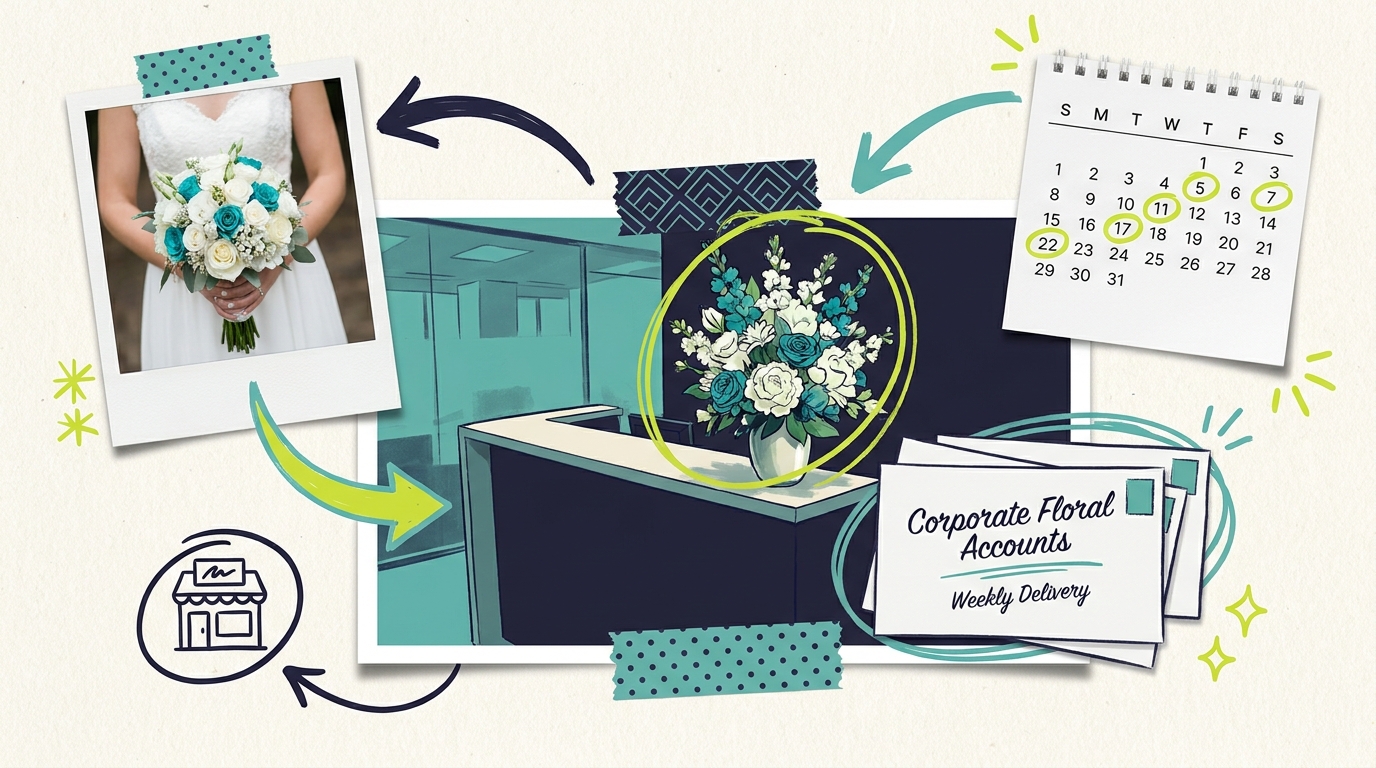
The ANA/DMA 2023 Response Rate Report shows direct mail producing 5-9% response rates for house lists. For florists, with average ticket sizes of $75-$500+ for occasion orders, even 2-3% response rates are profitable.
Direct Mail Tactics That Work
Corporate account mailings: Office managers, HR departments, and executive assistants handle most business flower orders. Targeted mailings to corporate accounts in your delivery radius can open new weekly or monthly account relationships. Budget $1-$2 per piece for high-production corporate mailers.
Funeral home partnerships: Direct mail to funeral homes within your delivery radius announcing pricing, turnaround capabilities, and sympathy arrangement offerings.
House list anniversary and occasion mailings: If you have purchase-date data from past customers, time mailings to their anniversary, spouse's birthday, or similar occasions. Some of the highest response rates in any category.
New resident mailings: People who just moved often don't know the local florists yet. Welcome mailings build long-term accounts. Cost: $0.50-$1.00 per piece for targeted lists.
Mother's Day / Valentine's Day reminder postcards: Mail to your customer database 2-3 weeks before these peak holidays with "Order early, we'll deliver on the day" messaging.
Budget and Expectations
Budget $0.50-$2.00 per piece for designed and mailed postcards. A quarterly 1,000-piece mailing to your house list runs $500-$2,000 and typically produces $4,000-$15,000 in revenue from repeat customers.
Tips for Better Results
Corporate mailings: include a printed pricing menu and dedicated corporate rep contact
Use tracked phone numbers
Time anniversary mailings 2-3 weeks before the anniversary date
Pair direct mail with Meta retargeting for compounding effect
Direct mail isn't every florist's biggest channel, but for corporate accounts and repeat customer bases, it often has the best ROI.
TV and CTV Advertising
For decades, TV advertising was unavailable to independent florists. Broadcast TV required budgets in the $15,000-$50,000+ range per month. Connected TV changed the math.
Connected TV (CTV) means streaming platforms like Hulu, Peacock, Tubi, and Roku. Local advertisers can now buy targeted campaigns starting at $50 (eMarketer, 2024).
For florists, CTV is especially valuable during the two massive peaks: Valentine's Day and Mother's Day. A well-timed CTV campaign running the 10 days before each peak creates the brand recognition that drives last-minute orders.
Platforms like Adwave make CTV realistic for independent florists. Generate a 30-second spot from your website in about two minutes, target your delivery area, and launch for $500-$2,000 per month, with 2-3x surge during Valentine's Day and Mother's Day weeks.
For a deeper look at TV strategy for florists specifically, see our guide to TV advertising for florists.
Budget: $300-$1,500 per month baseline, 2-3x during seasonal peaks. Most effective alongside Google and Meta.
Partnerships: Wedding Vendors, Funeral Homes, and Corporate
Partnerships drive disproportionate revenue for florists compared to most local businesses. Three partnership categories matter most.
Wedding vendor partnerships. Venues, planners, photographers, caterers, and musicians see hundreds of couples per year. Formal referral relationships produce steady wedding bookings. Best practices: send handwritten thank-you notes for referrals, offer preferred pricing for their clients, cross-promote on social media.
Funeral home partnerships. Funeral directors recommend specific florists to families. Consistent quality and same-day delivery capability earn you placement on their preferred list. Drop off a binder with your pricing, an arrangement portfolio, and a direct phone number.
Corporate partnerships. Office managers, executive assistants, and event planners order flowers weekly for reception desks, corporate gifts, event centerpieces, and employee recognition. Build relationships with 10-20 corporate accounts that order $500-$3,000 monthly.
Schools and churches. Proms, homecomings, Easter services, church events. Not huge individual revenue but consistent small orders build brand recognition.
Budget and Expectations
Partnership investment is mostly time and relationship-building, plus occasional partner gifts and thank-you pieces. Budget $500-$2,000 per year for partner gifts and promotion. Returns compound over years and produce the lowest-CPA revenue in most florist businesses.
Channel Comparison
Start with Google + Meta + GBP. Add The Knot if weddings are meaningful revenue. Layer CTV during peak seasons. Direct mail and partnerships produce the best long-term ROI but require time to mature.
Recommended Budget Allocation by Stage
Stage 1: New Shop (Year 1, $2,500-$5,000/month baseline)
Google Ads: 50% ($1,250-$2,500)
Meta: 20% ($500-$1,000)
GBP / Local SEO: 10% ($250-$500)
The Knot / WeddingWire: 15% ($375-$750) (if doing weddings)
Direct Mail / partnerships: 5% ($125-$250)
Goal: Generate lead flow for daily orders while building wedding pipeline.
Stage 2: Established (Year 3+, $5,000-$10,000/month baseline)
Google Ads: 30% ($1,500-$3,000)
Meta / Instagram: 20% ($1,000-$2,000)
Wedding platforms: 15% ($750-$1,500)
GBP / Local SEO: 10% ($500-$1,000)
Direct Mail: 10% ($500-$1,000)
CTV (during peaks): 10% ($500-$1,000)
Partnerships: 5% ($250-$500)
Goal: Diversify. Wedding platforms and partnerships dominate wedding revenue.
Stage 3: Destination Shop ($10,000+ baseline, surges to $30K during peaks)
Google Ads: 25%
Meta / Instagram: 20%
CTV / Streaming TV: 15%
Wedding platforms: 15%
Direct Mail: 10%
GBP + content: 10%
Partnerships: 5%
Goal: Own the market during peaks. During Valentine's and Mother's Day weeks, budget surges 3-5x.
Peak Season Calendar
Florist advertising has the sharpest seasonal peaks of any local business. Here's a rough calendar:
Mid-January through February 14: Valentine's Day surge. Start advertising 3-4 weeks before, peak spend the final week. 15-25% of annual revenue.
Mid-April through May 11: Mother's Day surge. Start 3 weeks before, peak final week. 15-20% of annual revenue.
April-May: Prom season. Corsage marketing targeting teens and parents.
June-September: Wedding peak season. Heavy Instagram/Meta, wedding platform focus.
September-October: Fall weddings continue, homecoming, Sweetest Day (October), early holiday planning.
November-December: Holiday season for corporate gifts and home decor.
Year-round: Everyday orders, sympathy arrangements, birthday deliveries.
How to Compete With Grocery Stores and Online Retailers
Kroger, Walmart, Costco, and online giants like 1-800-Flowers, FTD, and Bouqs pulled the low end of the market. But independent florists still win the occasions that matter. Here's how to advertise against them.
Quality difference: Grocery flowers are picked to survive shipping, not to last once they reach the recipient. Florist-grade flowers are selected for quality and designed by professionals. Highlight this difference in ads: "Real florist. Real flowers. Real designers."
Customization: Online orders force customers to pick from standard arrangements. Independents design to order. Advertise custom work, bespoke weddings, and ability to match specific colors, themes, and vases.
Relationship: Online retailers don't know the customer. You do. When a regular customer calls, you know their spouse's name and what they bought last year. That matters.
Community: Independent florists sponsor local events, donate to schools, support churches. Grocery stores don't show up in community the same way.
Speed: You can deliver in 2 hours. Online orders need 1-3 days. For urgent moments (sympathy, apology, hospital), independent florists win.
Common questions answered
How much should a florist spend on advertising?
Most successful independent florists spend 6-10% of gross revenue on advertising, heavily weighted to Valentine's Day and Mother's Day peaks. A $500,000 revenue shop should budget $30,000-$50,000 per year with 30-40% of that spent in the 6 weeks around the two major holidays. Wedding-focused florists often spend more (10-15%) to fund higher-priced wedding platform investments.
Which advertising channel produces the fastest ROI for a florist?
Google Search Ads. Search captures people who are about to order flowers, often within hours. Investment maps directly to phone calls. Meta and Instagram take 2-4 weeks to produce comparable conversion rates. Local SEO takes 3-6 months to compound. New florists should lead with Google, then layer other channels as lead flow allows.
Should florists advertise everyday orders or focus on weddings?
Depends on shop positioning. Everyday-focused florists should focus on Google, Meta, GBP, and direct mail for repeat customers. Wedding-focused florists should lead with Instagram, The Knot/WeddingWire, and partnerships with wedding venues and planners. Most shops do both, but the advertising mix should reflect which revenue stream you're prioritizing.
Is TV advertising realistic for an independent florist?
Yes, during peak seasons especially. Traditional broadcast TV was unaffordable, but CTV platforms let independent florists run campaigns for $300-$1,500 monthly with 2-3x peak surge. Most effective for Valentine's Day and Mother's Day brand recognition, creating the memory that drives urgent last-minute orders.
How do I compete with 1-800-Flowers and FTD online?
Compete on quality, customization, and community. Online giants win on convenience and price for generic bouquets. Independents win on quality (flowers that last), customization (designs matched to specific occasions), speed (same-day or 2-hour delivery in local markets), and relationship. Your advertising should reinforce these differences. Don't try to match their prices on generic arrangements. Advertise the local, hand-designed, relationship-driven experience they can't offer.
What's the best way to get more wedding bookings?
Wedding bookings come from a combination of Instagram visibility, The Knot/WeddingWire presence, and partnerships with wedding venues, planners, and photographers. Aim for 60% of wedding leads to come from partnerships and organic, 40% from paid channels. Publishing stunning wedding photography on Instagram and The Knot weekly, attending wedding expos, and building genuine relationships with 5-10 venues produces compounding long-term results.
Where to Start This Week
If you're running a florist without a clear advertising system, here's a 30-day plan:
Week 1: Claim and optimize your Google Business Profile. Add every relevant service category, upload 30+ photos including weddings and seasonal work, send review requests to your last 20 customers.
Week 2: Launch Google Ads on "florist near me" and occasion keywords in your service area at $30-$60 per day. Set up call tracking.
Week 3: Set up Instagram business account if not active. Start posting 4-5 times per week (arrangement of the day, wedding reveals, seasonal ideas). Run one Meta lead-gen campaign for wedding inquiries with $400-$600 budget.
Week 4: Reach out to 5 local wedding venues and 3 funeral homes to introduce yourself. Bring small samples of your work to each. Request placement on their preferred vendor lists.
After 60-90 days, add CTV advertising for Valentine's/Mother's Day surges, invest in The Knot listings, and systematize direct mail to your customer database.
Florist businesses compound over time through quality work and relationships. The advertising channels that matter most are the ones that capture urgent demand (Google) and build long-term brand recognition (Meta, CTV, partnerships). Shops that layer 4-5 channels consistently through seasonal peaks build the revenue stability that lets them thrive in a disrupted industry.


