
Google Maps marketing is how you get found by the people who matter most: the ones right around the corner. It's all about fine-tuning your Google Business Profile so you pop up when someone nearby is actively searching for your services. This isn't just about visibility; it's about capturing customers with high intent, right when they're ready to make a purchase.
Your Local Business Superpower In 2026
Think of Google Maps as more than a way to get from A to B. It’s the new town square, the modern yellow pages, and your digital front door, all in one. For any local business, getting Google Maps right isn't just a good idea, it's absolutely critical for growth. When someone pulls out their phone to search "pizza near me" or "emergency plumber," that journey almost always starts on a map.
The difference between a bustling local shop and one that’s struggling often boils down to who shows up in that moment.
Imagine two cafes on the same block. One has a complete, lively profile with recent photos, dozens of great reviews, and up-to-the-minute hours. The other is just an unclaimed pin on the map. When a visitor searches for "coffee shop nearby," the optimized cafe gets the click, the visit, and the sale. The other might as well not exist.
The Rise of Hyperlocal Discovery
This all comes down to the "near me" search phenomenon. It has completely changed how customers find local businesses. It’s no longer about who has the biggest billboard but who serves up the most helpful, trustworthy information at the exact moment of need. This gives small businesses a huge advantage if they play their cards right.
The Impact of Google Maps Visibility
A quick look at why focusing on Google Maps is non-negotiable for local businesses.
These statistics show that if you're not optimized on Maps, you're essentially invisible to nearly nine out of ten potential customers. You can explore more about these consumer behaviors and why they matter for your local business strategy.
Key Takeaway: A strong Google Maps presence is a direct pipeline to more phone calls, website clicks, and customers walking through your door. It turns digital visibility into real-world revenue.
Beyond Maps: A Connected Strategy
But a great Google Maps profile is just one piece of the puzzle. To become a local household name, your efforts need to be part of broader local marketing strategies that build brand awareness and drive people to search for you in the first place.
This is where a connected, multi-channel approach really shines. For instance, we've seen how platforms like Adwave allow local businesses to run targeted TV ads, building brand recognition across the community. When someone sees your ad and later needs your service, their first instinct is to search your business name on Google Maps.
This interplay between brand-building and local search is what separates good marketing from great marketing. Check out our guide on other effective local business marketing strategies to see how you can build a powerful, integrated plan.
Building Your Foundational Google Business Profile
Think of Google Maps as the digital highway your customers travel every day. If that’s the case, your Google Business Profile (GBP) is the engine that gets you in front of them. This is so much more than another online directory listing. It's the core of your local marketing, controlling how you show up, how credible you look, and ultimately, how many nearby customers walk through your door.
Getting this right isn't just a box to check; it’s the single most important thing you can do to win on Google Maps.
Your GBP is your command center for managing how your business appears across both Google Search and Maps. It gives you direct control over everything from your hours and photos to your services and customer reviews. The first, non-negotiable step is to claim and verify your profile. It's a simple process, yet an astonishing 11.1% of profiles are just sitting there unclaimed. That’s a huge chunk of businesses handing customers over to their competitors.
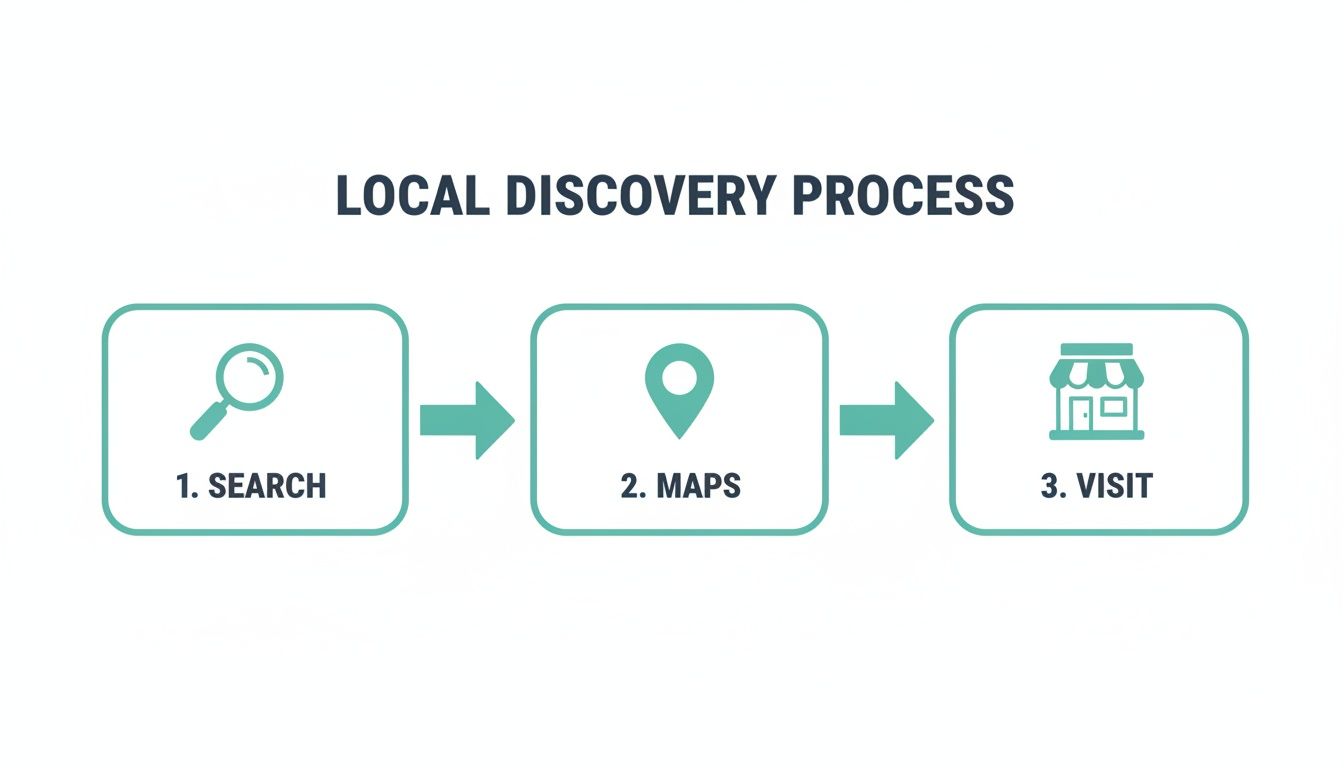
The data from Google doesn't lie: fully fleshed-out profiles get 7x more clicks and are seen as 2.7x more credible. What does that mean for you? More phone calls, more requests for directions, and more traffic to your website.
Crafting The Perfect Profile
A "perfect" profile is simply one that’s complete, accurate, and speaks directly to your ideal customer. Don't get bogged down in endless checklists. Instead, focus on the details that matter most to Google's algorithm and the real people looking for your services.
It all starts with your Name, Address, and Phone number (NAP). This trio of information has to be perfectly identical everywhere it appears online. I mean perfectly. A tiny difference, like using "St." on your profile but "Street" on your website, can create confusion for Google and undermine your ranking efforts before you’ve even started.
Pro Tip: Your business description is your one-shot elevator pitch. Don't just list what you do. Sell what makes you the best choice for someone in the area. Use the kind of language your customers use. Think "24-hour emergency plumber" or "artisan sourdough bakery," not just "plumber" or "bakery."
Choosing Categories and Defining Service Areas
Your primary business category is arguably one of the most powerful ranking factors in your entire profile. You have to be specific. If you run a "Neapolitan Pizza Restaurant," don't just settle for the generic "Restaurant" category. You can (and should) also add secondary categories to show up for a wider variety of related searches.
Next, you need to tell Google where you do business, which depends entirely on your model:
Physical Storefront: If you're a boutique or a cafe, your physical address is your anchor. Your main goal is to pull in foot traffic from the surrounding neighborhoods.
Service-Area Business (SAB): If you're a plumber, an electrician, or a mobile detailer, you go to your customers. In this case, you'll hide your physical address and define a specific service area by listing the cities, zip codes, or general radius you cover.
This distinction is important. A plumber based in Dallas doesn't want their phone ringing for a job in Austin. By defining a precise service area that includes suburbs like Plano and Frisco, you're telling Google exactly where your relevant customers are. For a deeper dive, check out our guide on how to optimize your Google Business Profile for more calls.
The Power of a Complete Profile
When you take the time to fill out every single section of your GBP, you send a powerful signal to Google that your business is active, legitimate, and authoritative. Don't skip the details.
This includes adding:
Hours of Operation: Always keep these updated, especially with special hours for holidays. Nothing frustrates a potential customer more than showing up to a closed door.
Services/Menu: Be thorough. List every single service you offer. If you're a restaurant, upload your entire menu.
Attributes: These are searchable details like "women-led," "wheelchair accessible," or "free Wi-Fi." They help you appear in more specific, high-intent searches.
A complete profile isn't just about pleasing an algorithm; it's about building a digital storefront that inspires trust. And as your business grows, you can even connect broader brand awareness efforts back to your local search presence. A partner like Adwave can help create targeted TV advertising campaigns that build name recognition. Then, when those viewers later search for your services on Google Maps, your polished profile is there waiting to turn that awareness into a customer. It creates a powerful feedback loop between brand building and local conversion.
Bring Your Profile to Life with Reviews, Photos, and Posts
Think of it this way: a bare-bones profile is just a name and address. An active profile tells a story.
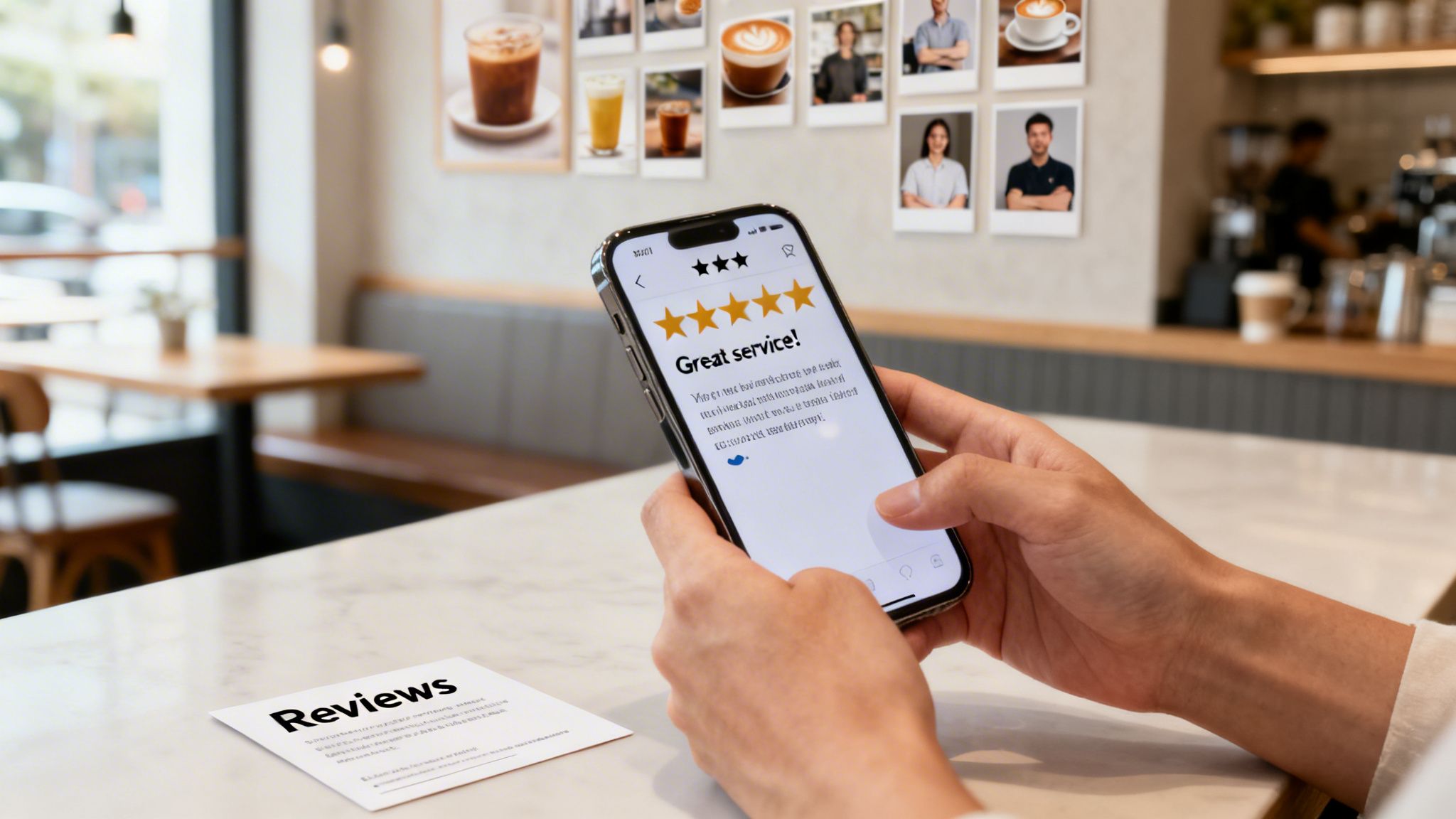
We're going to focus on three key areas that build what Google calls Prominence, an important ranking factor tied to how well-known your business is: customer reviews, photos, and Google Posts. Get these right, and you'll turn casual searchers into loyal customers.
Build a Steady Stream of 5-Star Reviews
Let's be blunt: reviews are everything in local search. They are the strongest form of social proof, heavily influencing both customer decisions and your ranking on Google Maps. We’ve seen a single glowing review trigger a noticeable bump in direction requests and calls from people ready to buy.
Your goal isn't just to collect a few reviews; it's to create a consistent, ongoing flow of positive feedback. And you don't have to be pushy to do it.
The secret is making it simple for happy customers to share their experience.
Strike while the iron is hot. The best time to ask is right after a great service experience or a successful purchase. The positive feelings are still fresh.
Give them a direct path. Don't make them search. Create a direct link to your Google review page and share it in a follow-up email, via a QR code on your receipts, or even in a quick text message.
Frame the ask. A simple, friendly "We'd love to get your feedback on Google" is often all you need. It sounds like you're looking to improve, not just hunting for five stars.
Expert Tip: Responding to all reviews is non-negotiable. Thanking someone for a positive review is great, but responding thoughtfully to a negative one is even more powerful. It shows potential customers that you take accountability and solve problems, which can build more trust than a dozen perfect ratings.
For a playbook full of proven tactics, check out our complete guide on how to get more Google reviews for your local business.
Tell Your Story Visually with Photos and Videos
Photos and videos give potential customers a genuine feel for your business before they walk through the door. A profile with a robust gallery, we recommend at least 15 high-quality photos, gets far more clicks and calls. People want to see what they're buying into.
Go beyond just one or two shots of your storefront. Create a "shot list" to capture the complete picture of your business.
Exterior: Get clear shots of your entrance, signage, and parking lot from a few different angles. Try taking photos at different times of day to show how it looks.
Interior: Show off the atmosphere. Capture your seating areas, service counters, waiting rooms, and unique decor that makes your space special.
Your Team: Put a friendly face to your business. Professional (but not stuffy) photos of you and your staff can make your brand feel much more human.
In Action: Show, don't just tell. Photograph your products on the shelves, a beautifully plated meal, or your team performing a service. This helps customers visualize the experience.
Don't forget video! Even a simple 30-second walkthrough of your space or a behind-the-scenes clip can make your business feel more authentic and approachable.
Stay familiar with Google Posts
Google Posts are like free mini-billboards that show up right on your Business Profile in Search and Maps. It’s shocking how many businesses ignore this feature, because it's a huge missed opportunity.
Posts are a direct line of communication with your audience and a powerful signal to Google that your business is active. Use them weekly to share:
Special Offers: Announce a flash sale, like "20% off," or a "buy one, get one" deal.
Upcoming Events: Promoting a workshop, a tasting, or a community event you're hosting? Post it!
Important Updates: Share news about new product arrivals, seasonal hours, or other announcements.
Product Spotlights: Feature a specific item with a great photo, a short description, and a price.
Think of Posts as your brand's real-time highlight reel. Aim for at least one new post a week to keep your profile fresh and feed Google's algorithm with positive activity signals. When you combine this consistent online engagement with broader brand-building efforts, like those you can achieve with Adwave's accessible TV advertising, you create a powerful growth loop. Customers see your brand on TV, search for you on Maps, and find a dynamic, trustworthy profile that converts their interest into action.
Advanced Strategies For Local Search Dominance
After completing your profile, compare organic improvements with paid options for increasing local visibility.
Think of it this way: a complete profile is like having a great storefront. These advanced strategies are how you put up the best signage, run the most effective ads, and build the strongest reputation in town.
We’ll start with the advanced side of Local SEO, focusing on the signals Google looks for outside of your Business Profile itself. Getting these right tells Google you’re a prominent and trustworthy choice worth showing to its users.
Amplify Your Signals With Local SEO
Your Google Business Profile isn’t an island. Google’s algorithm is constantly cross-referencing information about your business from all over the web to verify who you are, what you do, and how important you are in your local market.
This validation process comes down to two kinds of signals.
On-Page Signals from Your Website
This is all about the optimization work you do on your own website. One of the most powerful moves you can make is creating dedicated pages for specific services in specific locations.
For example, a roofer serving a large metro area shouldn't just have one "Services" page. They could build out separate pages like "Roof Repair in Downtown" or "New Roof Installation in the Suburbs." When each page has unique, helpful content about that service in that area, it sends a powerful relevance signal back to Google.
Off-Page Signals Across the Web
These are mentions of your business on other websites. The foundation of this is your local citations, your listings in online directories like Yelp, Angie's List, and other industry-specific sites.
Making sure your Name, Address, and Phone number (NAP) are 100% identical across every single one of these listings is non-negotiable. Consistency builds trust with search engines, and even a small difference like "St." vs. "Street" can create confusion.
For a deeper dive, it’s worth checking out expert guides on how to rank higher in Google Maps. These often contain playbooks packed with specific tactics that can give you a real advantage.
Uncover What Customers Are Really Searching For
Great marketing starts with understanding exactly what your customers are typing into the search bar. This is local keyword research, and it’s simpler than it sounds. You just have to think like a customer who has a problem right now.
A homeowner with a burst pipe isn’t searching for "plumbing solutions." They're frantically typing in "emergency plumber near me" or "24-hour plumber [my town]."
Your job is to find these high-intent, location-based phrases and then naturally weave them into your GBP description, your services list, your Posts, and even the answers in your Q&A section.
Pro Tip: Use the autocomplete feature in Google Maps as a quick-and-dirty keyword research tool. Start typing a service you offer, like "auto repair," and pay close attention to what Google suggests. These are real, popular searches happening in your area.
For a more structured approach, our Local SEO Audit Checklist can help you find optimization opportunities based on what your local customers are looking for.
Jump The Line With Google Maps Ads
Organic SEO is a long-term game that builds lasting authority. But sometimes you need results now. That’s where Google Maps Ads come in.
These paid ads let your business show up as a promoted pin or at the very top of the local search results. It's the most direct way to 'jump the line' and get immediate visibility, especially in a competitive market.
Imagine you're opening a new restaurant in a neighborhood already packed with established favorites. It could take months to rank organically. By launching a targeted Google Maps Ad campaign, you can start showing up for "restaurants open now" from the day you open your doors.
These ads are run through Google's Local campaigns, which are built specifically to drive real-world actions like in-store visits, phone calls, and clicks for directions. They work exceptionally well for:
Promoting a grand opening or a special event.
Standing out for high-value keywords in a crowded field.
Capturing immediate demand during your busy season.
Connecting Brand Awareness to Local Search
Having a perfectly optimized Google Business Profile is fantastic for grabbing customers who are already looking for you. But what about all the people in your area who don't know they need you yet?
This is where you can build a powerful marketing cycle. The goal is to connect the dots between building a memorable brand and converting people who are searching on Google Maps with a specific need.
Broad-reach advertising, like a well-placed TV spot, is brilliant at creating that initial spark of recognition. It plants a seed. Someone sees your ad while relaxing at home; they might not need a plumber or a lawyer at that exact moment. But when their pipe bursts a week later, your business is the first one that pops into their head. Their very next move is almost always a search on Google Maps.
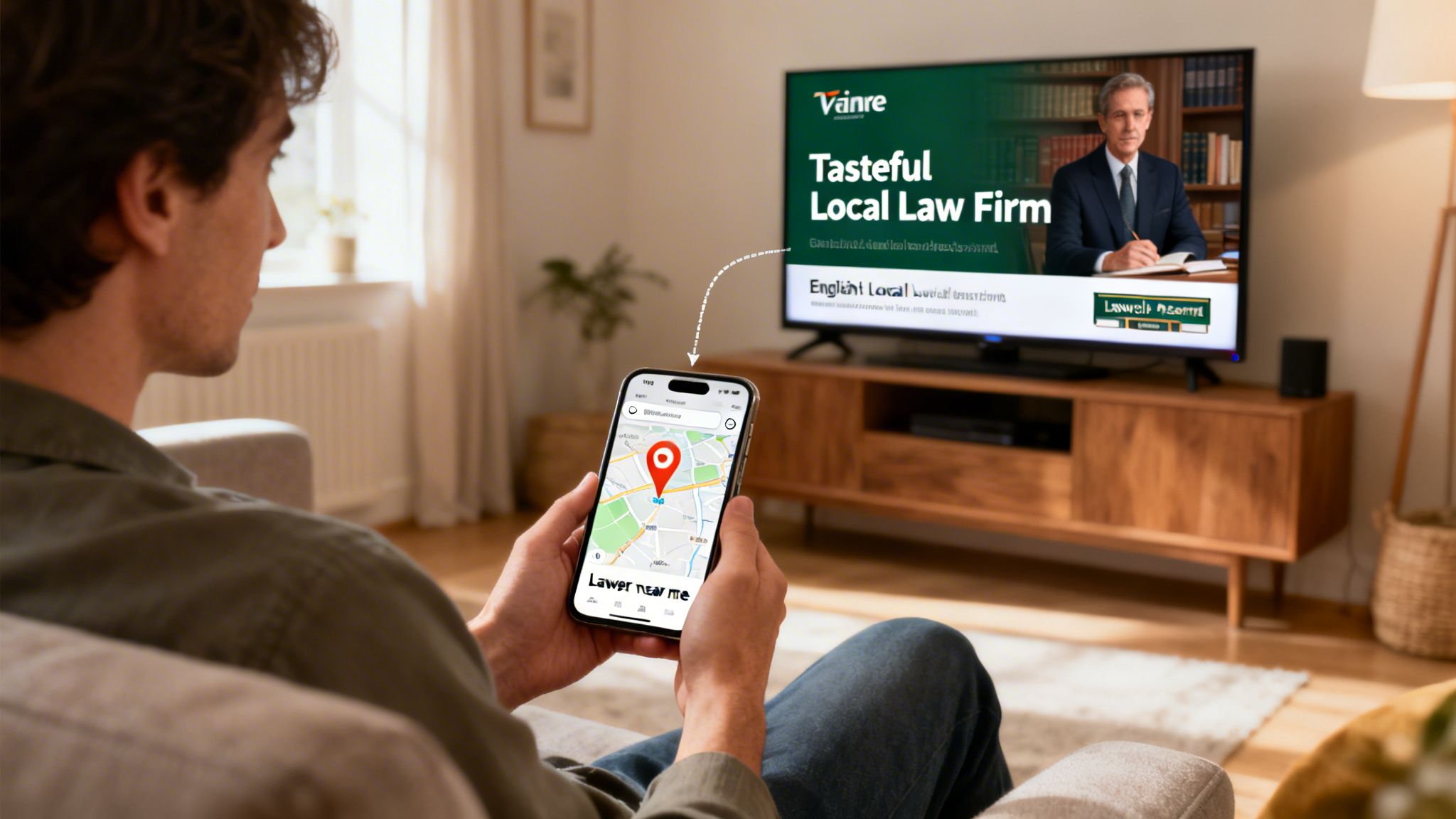
That link between brand visibility and local search is where the magic happens. It’s how you transform a passive TV viewer into an active, paying customer.
Making TV Advertising Accessible for Local Businesses
For years, TV advertising felt like it was reserved for massive corporations with six-figure marketing budgets. That’s just not true anymore. Today, several platforms have made targeted TV advertising affordable, accessible, and totally measurable for local businesses.
This is exactly the problem a company like Adwave was built to solve. Their platform gives local businesses the power to run broadcast-quality TV ads on major channels like Hulu, ESPN, and NBC, without needing a film crew or a giant budget. You can build brand recognition right where your ideal customers are already spending their time.
Think about a local law firm. By running a targeted campaign through Adwave, they can create widespread brand recall in their service area. Later, when someone has a legal issue and searches for a "lawyer near me," that firm’s fully optimized Google Business Profile is right there, ready to capture that valuable, high-intent search.
The Adwave & Google Maps Growth cycle
This isn't just about getting your name out there, it's about creating a repeatable, measurable cycle of growth. When you pair top-of-funnel brand awareness with a bottom-of-funnel conversion tool like Google Maps, you create a system where each part makes the other more effective.
Here’s a simple way to look at how TV brand awareness and Google Maps work together to drive real business growth.
The Adwave & Google Maps Growth cycle
How to combine TV brand awareness with Google Maps conversion.
This cycle effect is powerful. The more people who see and remember your brand from TV, the more direct and branded searches you'll see on Google Maps and Google Search.
When you run a brand campaign, you're not just buying ads; you're buying future demand. You're so that when a customer has a need, your business is the first and only one that comes to mind. That recall is what drives them to search your name directly on Google Maps.
Measuring the Impact on Local Search
This entire strategy is trackable. As soon as you launch a TV campaign, you can start looking for the ripple effects directly in your Google Business Profile Insights.
Here are the key metrics to watch:
Direct Searches: This is your gold-standard metric. It counts people who searched specifically for your business name or address. A spike here is a massive signal that your brand advertising is working.
Branded Searches: These are searches for your brand name plus a keyword (e.g., "Mike's Plumbing emergency service"). It shows people are connecting your brand with a specific service you offer.
Discovery Searches: While not a direct result of branding, you may see an overall lift in discovery searches (e.g., "plumber near me") as your brand's Prominence grows in Google's algorithm.
Let's say a local real estate agent uses Adwave to run ads showing their expertise in a specific neighborhood. They can then pop into their GBP Insights and look for an increase in people searching their name directly. When those searchers land on a profile packed with five-star reviews, current listings in Google Posts, and professional photos, the journey from TV viewer to new client is practically connected.
Platforms like Adwave help turn the fuzzy concept of "brand awareness" into real, measurable actions (phone calls, direction requests, and website clicks) that you can directly connect back to your campaigns. This integrated approach is the key to dominating your local market. You’ll not only capture today's searchers but also build a brand that tomorrow's customers will seek out by name.
Your Top Google Maps Marketing Questions, Answered
Even with a solid playbook in hand, you're bound to have questions as you get started. That's perfectly normal. I've pulled together some of the most common ones we hear from business owners to give you quick, straightforward answers.
How Long Does This Stuff Take to Work?
That’s the million-dollar question, isn't it? The honest answer is, it depends on what you mean by "work."
You'll see some results almost immediately. Just by claiming your profile and making sure your hours, phone number, and address are 100% accurate, you've made it easier for people who are already looking for you to find and contact you. That's a win on day one.
But ranking for those big, competitive searches (think "plumber near me" or "best pizza in [Your City]") is a marathon, not a sprint. Getting there takes consistent work over several months. You have to earn reviews, regularly add new photos, publish Posts, and build up your website's authority. The immediate wins from direct searches will carry you while you build that long-term momentum.
What's the Single Biggest Mistake I Could Make?
Easy: treating your Google Business Profile like a yellow pages ad. Far too many businesses claim their listing, fill out the bare minimum, and then completely forget about it. That's the "set it and forget it" trap.
Update your profile when your hours, services, or contact details change.
Google notices when you're active. If you aren't responding to reviews, adding fresh photos, or using Google Posts, you're sending a signal that you're not engaged. Over time, the algorithm will naturally start to favor your more active competitors, and you'll see your hard-earned rankings start to slip.
What If I Don't Have a Physical Storefront?
You're in luck. Google Maps marketing is just as critical for Service Area Businesses (SABs), think electricians, mobile dog groomers, or consultants who travel to their clients. You don't need a public-facing shop to dominate local search.
The trick is to set up your profile correctly from the start. You’ll choose to hide your physical address (which is likely your home) from the public. Then, you'll specifically define your service area. You can list the exact cities, zip codes, or counties you operate in. This tells Google precisely where to show your business when a potential customer in that zone is searching for what you do.
Should I Focus on Ads or Organic SEO for Maps?
This isn't an either/or question. The smartest local marketers know it’s a "both/and" game. Think of organic SEO and ads as two distinct tools that work together to get the job done.
Organic SEO is your foundation. It’s a long-term strategy that builds lasting authority and trust with both Google and your customers.
Google Maps Ads are your accelerator. They give you instant visibility at the top of the results, perfect for jumping ahead in a crowded market or pushing a special promotion.
The real magic happens when you sync these efforts with your bigger-picture brand-building. For example, we've seen incredible results when businesses run targeted TV ads with a platform like Adwave. This builds brand awareness and name recognition. When those viewers later need your services, they search for you by name. A combination of strong organic rankings and a well-placed Maps Ad makes sure you're right there to capture that demand you just created.


