

If you've ever thought about getting your local business on TV, you probably pictured a mountain of obstacles: massive costs, complex negotiations with TV stations, and months of production headaches. For a long time, that was the reality of traditional TV advertising. But Adwave has changed all of that. Drastically.
Today, you can get a professionally made ad on the air in front of local customers in just a few minutes, sometimes for as little as a few hundred dollars. Adwave makes it easy, quick, and affordable.
The New Rules of TV Advertising for Local Brands
Let's clear the air: the idea that TV ads are only for giant corporations is a complete myth. What used to be a slow, expensive, and frankly blunt instrument has become a sharp, affordable, and targeted tool with Adwave, perfect for businesses that live and breathe in their local communities.
The high walls that once kept small businesses out of TV advertising have been torn down.
The Old, Painful Way of Doing Things
Not so long ago, getting an ad on TV was an ordeal. You had to:
Hire a full production agency. This step alone could set you back tens of thousands of dollars before your ad even saw the light of day. Think scriptwriters, actors, camera crews, and studio time.
Negotiate with sales reps. You'd spend weeks on the phone, haggling with individual TV stations or cable providers to lock in your ad placements.
Commit to huge budgets. Minimum ad buys were often so high they were a non-starter for most small businesses.
Settle for "spray and pray" targeting. Your ad went out to a massive, general audience, and you had virtually no way to know if it was driving sales. It was a guessing game.
A Smarter, Modern Approach to TV Ads with Adwave
Adwave has turned that entire old-school model on its head. Now, you can build a broadcast-quality commercial and have it running on major channels in a matter of days, not months. Everything is handled through our simple online dashboard. No more gatekeepers, no more lengthy negotiations. Adwave makes TV advertising easy.
A lot of this change comes from how we all watch TV now. The lines between live broadcast TV and on-demand streaming have blurred, which is great news for advertisers. With Adwave, you can run an ad during the local evening news and also reach people in your town binge-watching their favorite show on a streaming app. It's the best of both worlds.
To get a better handle on this, check out our guide on what is Connected TV advertising and see how it's giving local brands a huge advantage.
The shift in how TV advertising works for small businesses is dramatic. To put it in perspective, here’s a quick comparison of the old way versus the new, easy way with Adwave.
Table: Traditional TV Advertising vs Modern Advertising with Adwave
As you can see, Adwave removes nearly all the traditional barriers, putting control, precision, and affordability directly into the hands of business owners.
The biggest change isn't just the lower cost; it's the control. Adwave gives small businesses the power to target specific zip codes and track performance, turning TV from a brand-building guess into a measurable marketing strategy.
What does this look like in the real world? It means a local pizzeria can run a mouth-watering ad that's only seen by households within a five-mile delivery radius. Or a real estate agent can target potential homebuyers in the specific neighborhoods they specialize in.
It’s about precision, not just shouting into the void.
Why TV Advertising Builds Unbeatable Local Trust
Let's get past the idea that TV is just for the big guys. For a local business, getting on television does something a social media ad just can't, it builds instant credibility. When people see you on their TV screen, located between shows they love, it sends a powerful message: this business is legitimate, professional, and here to stay.
Think of it as the TV "halo effect." A local diner, a family-owned hardware store, or a neighborhood law firm appearing on the same channel as a major car company gets a serious status bump. You’re no longer just another ad they scroll past; you've become a part of their trusted home entertainment.
Cutting Through the Digital Noise
People are tired of digital ads. We're bombarded on every app and website, and we've learned to tune most of it out. TV is different. When someone sits down to watch their favorite show, they're in a far more relaxed and receptive state of mind. Your message has a real chance to sink in.
This focused environment creates a lasting impression. And the reach? It’s huge. Between broadcast, cable, and the explosion of streaming services, TV reaches almost everyone. With Adwave, you can connect with entire households, from younger cord-cutters on streaming platforms to older generations who never miss the 6 o'clock news.
The numbers back this up. The global TV advertising market hit $101.7 billion in 2023 and is expected to soar to $158.6 billion by 2033. This growth is fueled by viewership in nearly two billion households worldwide. You can dig deeper into the latest trends in TV ad spending to see where things are headed.
The real power of TV for a local brand isn't just about being seen, it's about where you're seen. An ad on a trusted local news channel or a popular cable network builds a kind of authority that online ads simply can't buy.
From Living Room to Your Front Door
This credibility isn't just a vague feeling; it drives real-world results. A well-crafted TV ad can get people to act almost immediately.
Drives Foot Traffic: Got a brick-and-mortar store? A TV spot is a powerful invitation. That local diner advertising a lunch special can see an immediate bump in midday customers.
Spikes Website Visits: We all watch TV with our phones in hand. A clear call to action like, "Visit our website for this week's deals," sends qualified local traffic right to your site.
Builds Strong Brand Recall: The combination of sight, sound, and story in a TV ad creates a much stickier memory than a fleeting digital ad. When a potential customer needs your product or service, your name is the one they’ll remember.
This is about building trust. Platforms like Adwave are designed to help you tap into that trust, giving your local business the kind of recognition it needs to really grow.
Bringing Your First TV Campaign to Life with Adwave
Alright, let's move from planning to doing. Putting together your first TV campaign might sound intimidating, but it doesn't have to be a huge, complicated undertaking. With Adwave, we've streamlined the entire process to get your local business on screen without the usual headaches of ad agencies and confusing media buys.
Think of this as your personal playbook.
It all starts with one simple question: What do you want this ad to accomplish? Seriously, getting this right is half the battle.
Want more people to know who you are? The goal is pure brand awareness, making your business a familiar name in the community.
Running a big sale or a special event? You're looking to promote a specific offer, like a holiday discount or a weekend blowout.
*Need the phone to ring now? Your objective is to drive immediate action*, pushing viewers to your website, getting them to call for a quote, or encouraging them to walk through your door.
Making Sense of Your Budget
Once you've got your goal locked in, the next logical question is always, "What's this going to cost?" TV ad budgeting used to be a murky world of hidden fees and rate cards that made no sense. We've made it totally transparent.
The key metric you need to get comfortable with is CPM, which stands for Cost Per Mille. It’s just a fancy way of saying "the cost for one thousand views" of your ad.
Understanding your CPM helps you compare the value you're getting across different channels and time slots. With Adwave, these costs are laid out clearly from the start. You can set a budget that feels right for your business, whether that’s a few hundred dollars or a few thousand, and you'll never see a surprise charge. For a full walkthrough of the setup, our guide on how to create and air a TV ad for your business using Adwave breaks it all down.
Pinpointing Your Ideal Customer
Here’s where advertising with Adwave really shines: precision targeting. Gone are the days of blasting your message across an entire metro area just to hit a handful of potential customers. Adwave lets you zoom in on the exact people who matter most to your business.
The biggest change in TV advertising is the shift from a megaphone to a laser pointer. You can now target specific zip codes, making sure your ad for a local bakery is seen by people who can smell the bread, not someone 50 miles away.
This is all about building local trust. When your message reaches the right people, it establishes your credibility and, most importantly, drives them to your business.
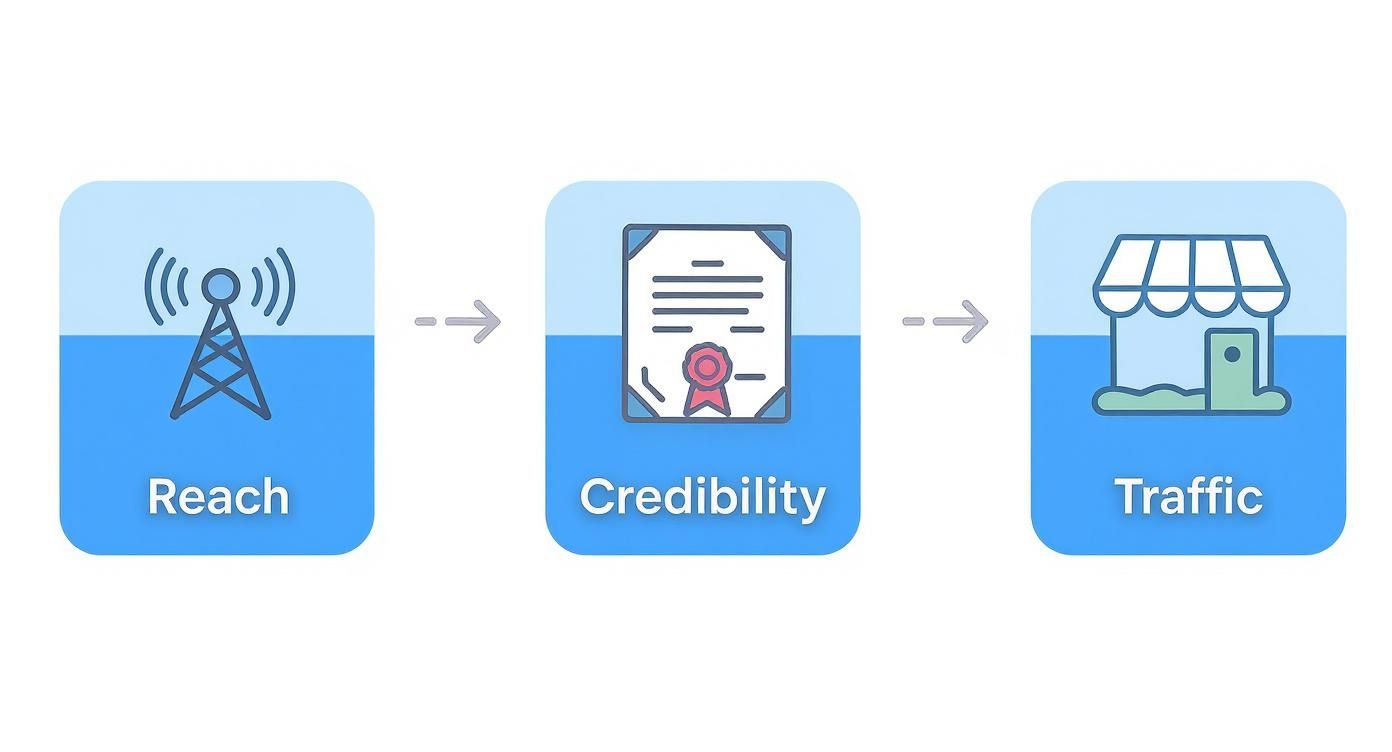
As you can see, it's a simple flow: targeted reach builds the credibility you need to drive actual foot traffic. This isn't just more efficient; it's the reason TV is still such a dominant force in advertising.
And the numbers back it up. The global TV ad market is projected to hit around $103.9 billion in 2025, with Connected TV (CTV) growing at a staggering 20% each year. You can dig into more data on the growth of TV advertising on Strategus.com if you want to see just how big the opportunity is.
Creating a Great TV Ad on a Small Budget
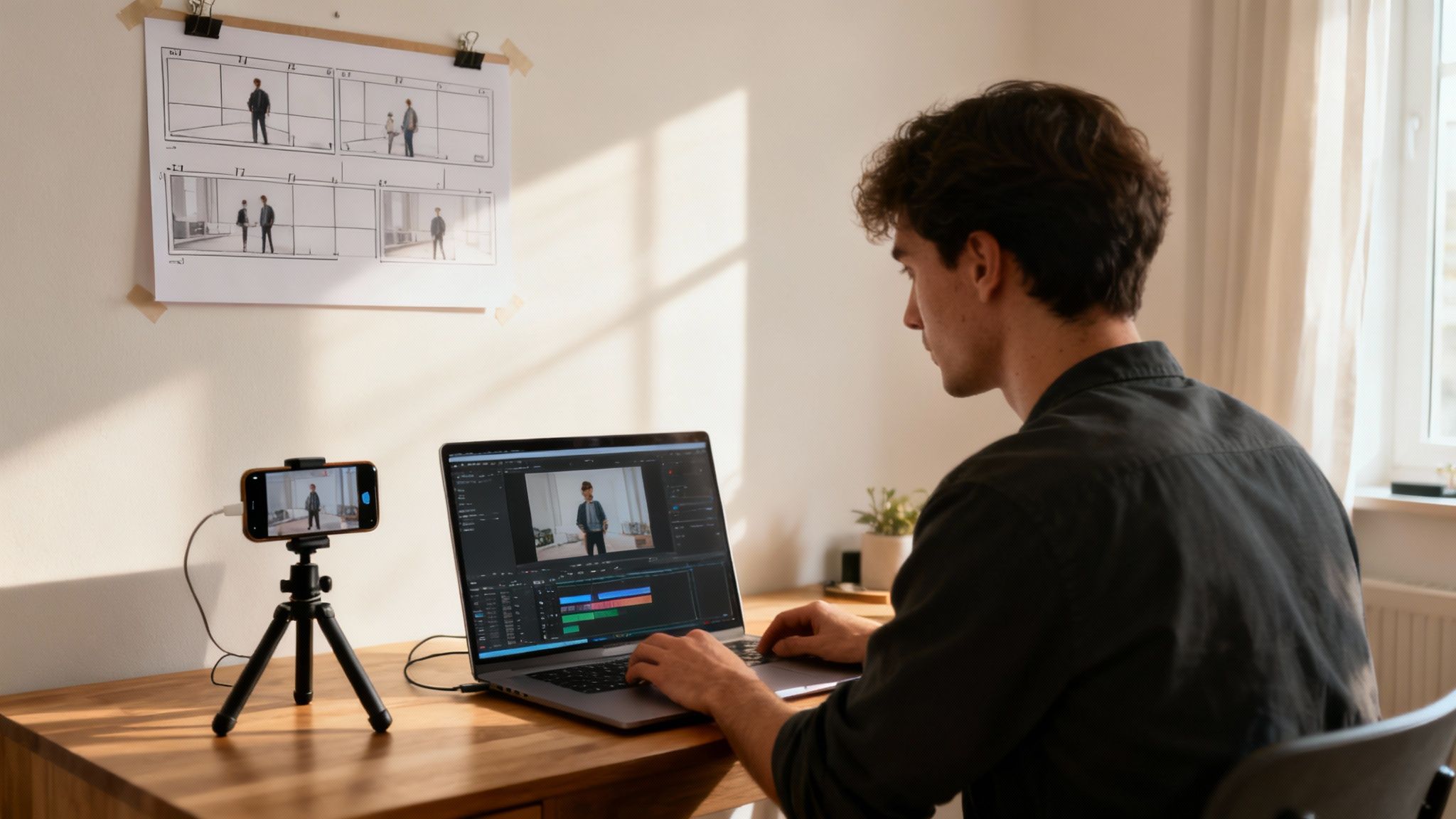
Probably the biggest myth about TV advertising is that you need a Hollywood-sized budget just to create the commercial. Let's be honest, that used to be true. Not long ago, a local business had to set aside tens of thousands for a production crew, actors, and an editing studio.
Forget the Production Crew
The traditional path to creating a TV ad was a major roadblock for small and local businesses. Today, Adwave makes it simple to produce high-quality spots without breaking the bank. You get the tools to build a broadcast-ready ad without ever needing to hire a single camera operator.
So, how does it work?
Start with a solid foundation. You can begin with professional templates designed for your specific industry, so you’re not just staring at a blank screen wondering where to start.
Access to a huge creative library. Instantly tap into a massive collection of high-quality stock video clips and royalty-free music to give your ad a polished, professional feel.
Editing made easy. Simple drag-and-drop tools let you add your logo, type in your message, and piece everything together in just a few clicks.
This entire approach means you can move from a simple idea to a finished commercial in a single afternoon. You’re not just saving a ton of money; you’re saving weeks of your precious time.
A great TV ad doesn’t need a massive budget. It needs a clear message, compelling visuals, and an authentic connection with your local community. Simplicity is your greatest strength.
Nail Your Message in 30 Seconds
When you only have 30 seconds, every single one counts. The goal is to tell a short, memorable story that connects with local viewers and gives them a reason to take action. The most successful commercials on Adwave almost always hit the same core elements.
Your Creative Checklist:
Stick to one clear message. Don't try to cram everything about your business into one ad. Focus on one thing: a special offer, your most popular service, or what makes you different.
Use eye-catching visuals. Grab attention with high-energy clips and bright, clean images. If you can, show your product or service in action.
Have an irresistible call-to-action (CTA). Tell people exactly what you want them to do next. “Visit our website,” “Call today for a free estimate,” or “Stop by our new location this weekend.”
Put your branding front and center. Your business name and logo should be impossible to miss, especially at the end of the ad.
A big part of this is understanding the fundamentals of creating video ads that convert, as the core principles are the same for TV. You have to capture attention quickly and guide the viewer to a clear next step.
You can see some great example ads that were built using this very approach.
Launching and Tracking Your TV Campaign
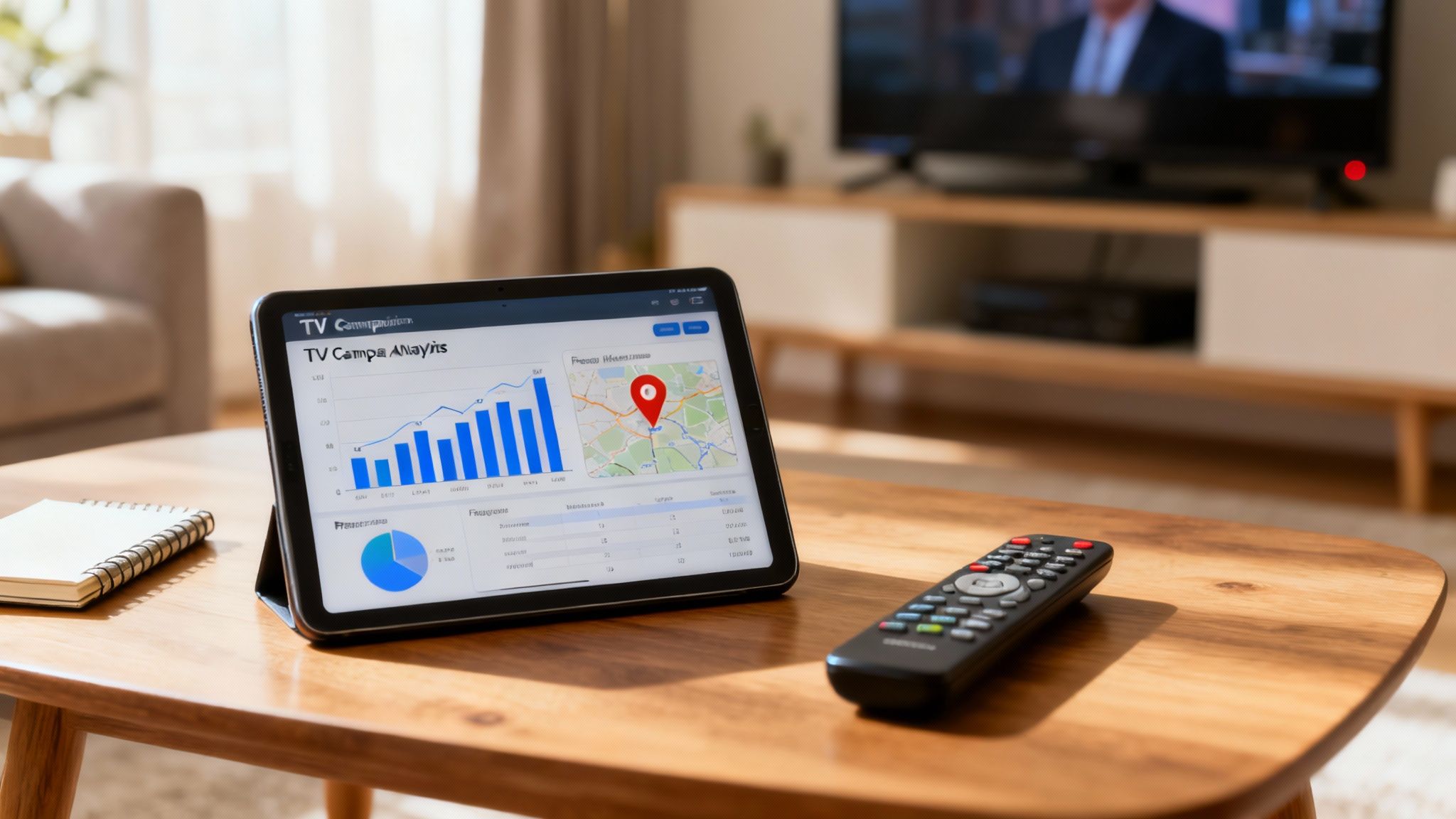
Okay, your ad is polished and ready to go. Now for the exciting part, getting it on the air and watching what happens. In the old days, launching a TV campaign was a real headache. It meant a messy web of sales reps, paper insertion orders, and zero transparency. We built Adwave to replace all that with a simple, clear process you manage from one place.
This is where you hand-pick exactly where your commercial will run. Through Adwave, you get access to a massive network of channels, letting you place your ad precisely where your local customers are watching.
Local Broadcast: Think major networks like NBC, ABC, and FOX. You can get your ad on during the local news or popular shows everyone in town watches.
Top Cable Channels: Want to reach people with specific interests? Place your ad on channels like ESPN, HGTV, or the Food Network to connect with passionate viewers.
Streaming & Connected TV (CTV): This is how you reach the cord-cutters and younger crowds. We'll get your ad on services like Hulu, making sure you’re seen no matter how people are watching TV.
This level of control means you can build a media plan that perfectly fits your audience and your budget, all without having to make a single sales call. To make things even simpler, you can explore various automated ad launching tools that handle much of the heavy lifting.
Measuring What Matters Most
For decades, the biggest frustration with traditional TV ads was trying to figure out if they worked. Business owners would spend a pile of money, cross their fingers, and hope for the best. There was no real way to connect an ad airing on Tuesday night to sales on Wednesday morning.
That guessing game is officially over.
The biggest shift in TV advertising isn't just about making ads easier to create. It's about turning what used to be a branding expense into a measurable investment. Now you can directly see the impact your TV ad has on your business.
Key Metrics You Can Use
Forget the confusing industry jargon. Adwave focuses on the numbers that show you what’s working so you can make smarter decisions next time.
Core Performance Metrics:
Impressions: This is simply the total number of times your ad was seen. It’s the baseline for understanding your ad’s overall exposure.
Reach: This tells you how many unique households saw your ad. It’s a great way to gauge how far your message is spreading in the community.
Frequency: This is the average number of times each household saw your ad. Finding that sweet spot is important for building name recognition without becoming annoying.
But here’s where it gets really powerful. By connecting your TV campaign to your website, we can track things like spikes in online traffic or even coupon code redemptions that happen right after your ad airs. This finally closes the loop, turning your TV ad from a shot in the dark into a data-driven strategy.
Make no mistake, the TV advertising world is still a giant. It's projected to be a $162.5 billion slice of the $1.08 trillion global ad market in 2025. Streaming TV alone is already a nearly $42 billion market and growing fast. This isn't just a medium that's surviving; it's evolving into a smarter, more accountable channel for businesses of every size.
Got Questions About Local TV Advertising? We've Got Answers.
Jumping into TV advertising for the first time, even with a tool as easy as Adwave, naturally brings up a few questions. I've heard the same practical concerns from countless local business owners, so let's tackle them head-on. My goal is to clear up any lingering doubts so you feel confident launching your first campaign.
The old way of buying TV ads created a lot of confusion and high barriers to entry. Adwave Digital was built from the ground up to give you clear, straightforward answers.
What's the Real Cost to Run a TV Ad?
This is always the first question, and the answer is usually a pleasant surprise. You can forget about those million-dollar Super Bowl spots. A local TV campaign can get started for just a few hundred dollars. When you use Adwave, you set your budget, and the system makes sure you never spend a penny more.
In the past, costs were a black box, demanding huge upfront commitments. Now, with Adwave's transparent pricing, a small business can dip its toe in the water with a modest budget and scale up once the results start rolling in. The final cost will depend on your specific market and the channels you choose, but the control is completely yours.
How Fast Can My Ad Get on TV?
The traditional process for getting an ad on the air could drag on for weeks, sometimes even months. It was a mess of negotiations, back-and-forth with agencies, and a complicated submission process for every single station. That sluggish timeline was a huge roadblock for businesses that needed to move quickly.
With Adwave, we've crushed that entire timeline down from months to just a few days. Our platform handles everything from creative to the actual media buy, cutting out all the typical bottlenecks that used to grind things to a halt.
What does that mean for you? It means you can react to what's happening in your market, promote a last-minute sale, or get your message in front of the community faster than you ever thought possible. You can literally build your commercial and see it running on major channels within the same week.
Can I Really Target Specific Neighborhoods or Zip Codes?
Yes, absolutely. This is one of the biggest useful options in modern TV advertising and a core feature of Adwave. The old "spray and pray" method of blasting your ad over an entire metro area was wasteful for a local business. Today, you can be surgical.
Using Adwave to buy ads on local cable and streaming TV (often called Connected TV or CTV), you can get hyper-specific with your campaign's geography.
A local restaurant can make sure its ad is only seen by households within a five-mile delivery radius.
A real estate agent can focus their ad dollars on the exact zip codes where they're trying to list or sell homes.
A home services contractor can target the specific neighborhoods where they already have a strong customer base and want to grow.
This kind of precision stops you from wasting money on viewers who can't become customers, which makes every dollar you invest work that much harder.
Do I Still Need to Hire an Expensive Production Company?
Not anymore. This used to be one of the single biggest cost barriers for small businesses. A professionally produced TV spot could easily run you $10,000 or more. Adwave was specifically designed to make high-quality creative affordable and accessible for everyone.
You get instant access to professionally designed templates, a full library of high-quality stock video and music, and simple editing tools to build a polished commercial yourself, right in our platform. This completely removes the need for a pricey production agency, making it possible to create a great-looking TV ad without that massive upfront investment.
Common questions answered
How long does it take to create a TV ad with Adwave?
Adwave's AI generates a professional TV commercial in about 2 minutes after you provide your website URL or business information. Editing and customization can add a few more minutes, but you can have a complete, broadcast-ready ad in under 10 minutes total.
Do I need video production experience to use Adwave?
No experience is required. Adwave's AI handles the creative work: generating scenes, selecting music, writing scripts, and producing the final video. You just review and adjust. Anyone can create professional TV ads regardless of technical or creative background.
What do I need to get started with Adwave?
At minimum, you need a website URL or social media profile. Adwave's AI gathers images, information, and content automatically. You can also upload your own assets if you prefer. No existing video footage is required.
How much does it cost to run a TV ad through Adwave?
Ad creation is free. You only pay when you run your ad, with campaigns starting at $50. This covers actual media placement on streaming platforms. There are no hidden fees, and you control your budget completely.


