

Great marketing for a dental practice isn't just about running ads; it's about building a solid foundation first. You have to know who you’re trying to reach, what makes your practice special, and what you’re trying to achieve before you even think about spending money.
This groundwork ensures every dollar you invest, especially in powerful channels like television advertising with Adwave, is actually working to establish trust, build brand awareness, and bring the right kind of patients through your door.
Building Your Modern Dental Marketing Foundation
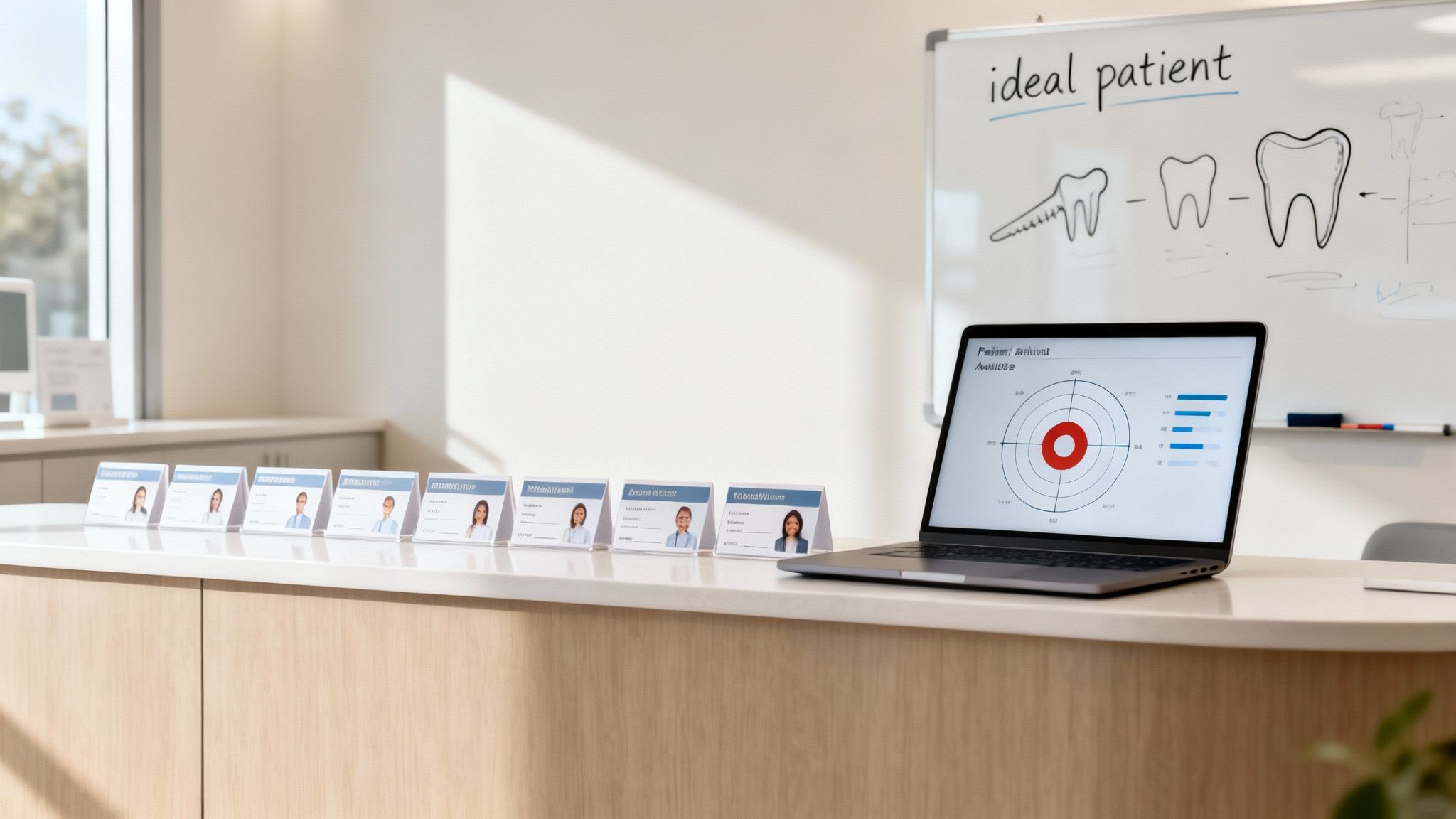
Diving into advertising without a clear strategy is a recipe for wasted money. It's like starting a road trip without a map—you'll burn a lot of fuel and end up nowhere. Before you launch a single campaign, you need to establish this foundation. The work you do here will shape every single decision you make later, from the messaging in your TV commercials to the services you highlight on your website.
Honestly, it's the difference between shouting into a void and having a meaningful conversation with the people who genuinely need your care.
This strategic planning is more important than ever. The global dental services market was valued at $433 billion in 2022 and is expected to climb to around $610 billion by 2030. Private practices are leading the charge, holding 68.5% of the market share thanks to competitive pricing and the ability to offer multiple specialties in one place. You can find more details about these dental industry trends and what they mean for marketers our guide to TV advertising for dentists. This growth is a huge opportunity, but it also means more competition. A solid marketing foundation is what will make you stand out.
Define Your Ideal Patient Profile
Let's be real: you can't be everything to everyone. The first thing you need to do is get crystal clear on who you want to attract. Are you aiming to be the go-to practice for young families who need pediatric and preventative care? Or are you positioning yourself as an expert in high-value cosmetic work, like veneers and implants for busy professionals?
Creating a detailed "ideal patient" persona helps you craft marketing messages that actually connect. Think about:
Demographics: What's their age, income, neighborhood, and family situation?
Needs and Pain Points: Are they looking for emergency care, a routine cleaning, or a complete smile makeover? What are their biggest fears or anxieties about seeing a dentist?
Goals and Aspirations: Do they want more confidence? Better long-term health? A solution that doesn't hurt?
When you know this, you can speak their language. The message you'd use for a parent worried about their toddler's first dental visit is completely different from one aimed at an adult researching the cost of dental implants.
Craft Your Unique Value Proposition
Once you know who you're talking to, you have to answer their biggest question: "Why should I choose your practice over the one down the street?" This is your Unique Value Proposition (UVP). It’s the core promise you make to every patient.
Your UVP might be built around things like:
Advanced Technology: You use the latest pain-free laser technology.
Patient Experience: You offer spa-like amenities to calm anxious patients.
Specialized Expertise: You’re the top local expert in full-mouth reconstructions.
Convenience: You offer evening and weekend appointments that no one else does.
A strong UVP isn't just a catchy slogan; it's the DNA of your practice. For instance, if your UVP is "Gentle, Anxiety-Free Dentistry," then everything you do—from the calming tone of your website to the visuals in your TV ads—must echo that promise of comfort and care.
Set Specific and Measurable Goals
The final piece of the puzzle is setting clear goals you can actually track. Vague objectives like "get more patients" are useless because you can't measure them. Instead, define exactly what success looks like.
Here are a few examples of strong, actionable marketing goals:
Increase new patient bookings for dental implants by 15% over the next three months.
Generate 25 new appointment requests each month directly from our website's contact form.
Boost local awareness, measured by a 20% increase in people searching for our practice by name after our TV campaign launches.
Goals like these give you a roadmap and let you see what's working and what's not. After all, the health of any dental practice depends on growth, so it’s wise to explore effective marketing strategies to keep your schedule full. For a deeper look at this foundational planning, our guide on essential dental clinic marketing strategies is a great resource.
Dominate Your Local Market with TV Advertising
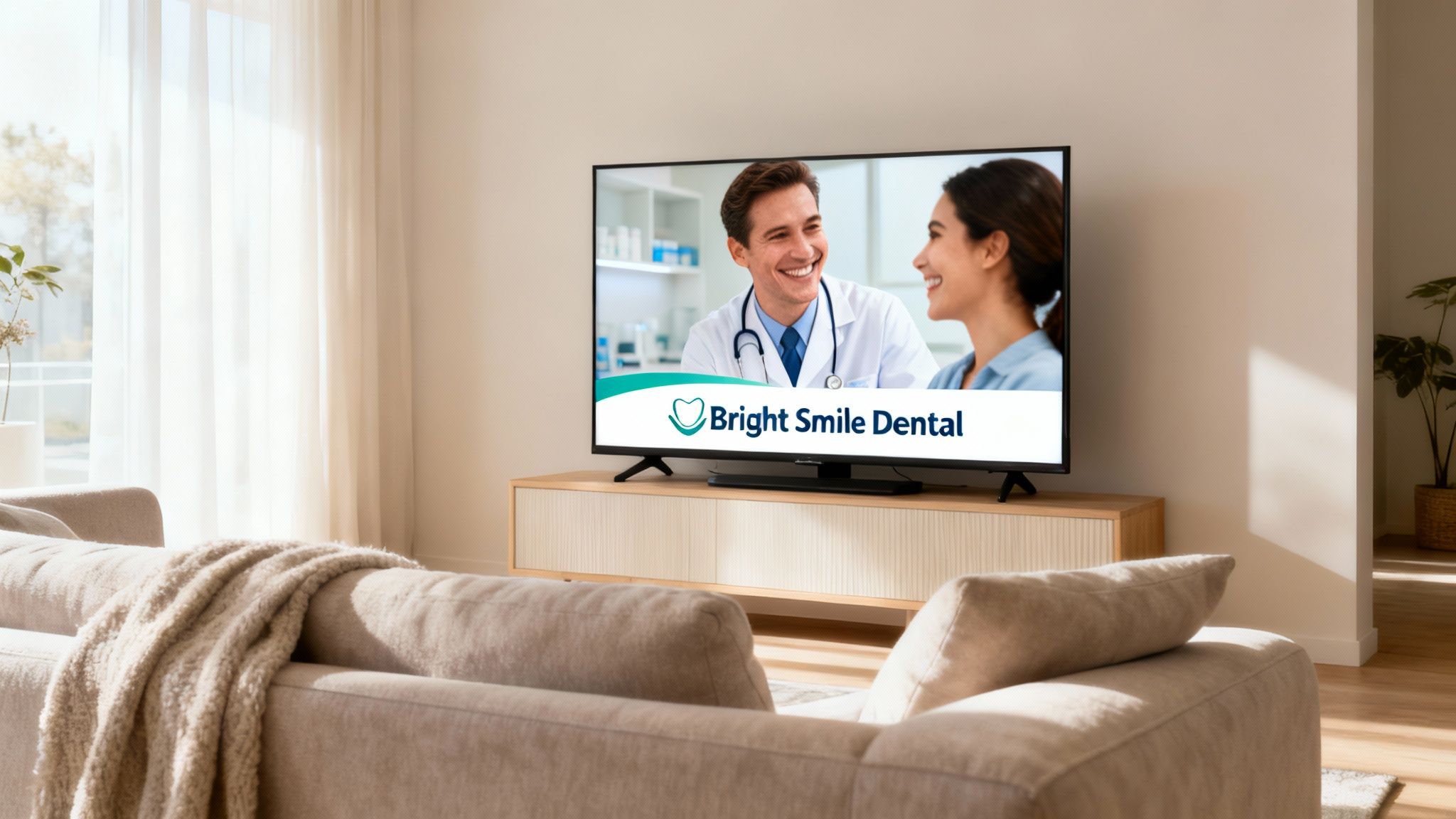
While a solid digital marketing plan is non-negotiable, relying on it alone means you’re fighting for attention in an incredibly noisy arena. To truly become a recognized, trusted name in your community, you need to go broader. This is where television advertising, powered by platforms like Adwave, gives you a serious competitive edge.
TV is the primary way to establish trust and build powerful brand awareness. It lets you cut through the digital clutter and connect with a wide local audience in a way search ads and social media posts just can't match. It’s less about just being another service provider and more about positioning your practice as a stable, credible, and professional cornerstone of the community, generating more customers and appointments.
Making TV Advertising Accessible and Effective
I know what you're thinking: "TV commercials are for big corporations with massive budgets." That used to be true, but things have changed. Modern platforms have made high-quality television advertising surprisingly accessible for local dental practices. The trick is to find a service that handles everything from start to finish.
Platforms like Adwave were built for exactly this. They eliminate the old-school barriers like sky-high production costs and confusing media buys. You can get a professionally produced, broadcast-ready commercial on the air in front of the right local viewers on major channels—all without needing a film crew or a six-figure budget. Suddenly, TV becomes a very practical tool for growth.
Your Commercial Isn't About Services—It's About Connection
A great dental TV ad doesn’t just rattle off a list of procedures. It tells a story. It builds a genuine connection with viewers. Your real goal is to show the human side of your practice and put common dental anxieties to rest.
To do that, a compelling commercial needs to hit on three key elements:
Spotlight Your Team: Get your friendly dentists and staff on camera. Seeing real, warm, smiling faces immediately makes your practice feel more approachable and less clinical.
Show Off Your Space: Give viewers a quick tour of your modern, clean, and comfortable office. Do you have advanced technology or amenities that create a better patient experience? Show them!
Share Real Patient Stories: This is your most powerful weapon. A short, authentic testimonial from a happy patient builds more trust in 15 seconds than any marketing slogan ever could.
This strategy turns your ad from a simple promotion into a memorable narrative about compassionate care and real results.
The secret power of a TV ad is its ability to convey trustworthiness almost instantly. When a potential patient sees your practice on a familiar channel like NBC or ESPN, it builds a level of credibility that a random pop-up ad on a website can never hope to achieve.
Tell a Story That Solves a Problem
Think about a common pain point you solve every day. For example, instead of an ad that just says, "We offer dental implants," craft a 30-second story. Show a patient who can finally enjoy a steak dinner or smile confidently in photos, all thanks to your implant procedure.
Start with the "after"—the happy, confident patient—and then briefly hint at the "before." This structure keeps the focus on the positive outcome, which is exactly what potential patients are looking for. You can find more practical tips on crafting these narratives in this detailed guide to TV advertising for dentists.
Don't Isolate TV: Integrate It with Your Digital Strategy
Your TV campaign shouldn't be an island. The best marketing happens when all your channels are working in concert. Use your commercial to drive viewers to a specific landing page on your website or ask them to call a unique, trackable phone number.
This simple step allows you to measure the direct impact of your TV ads. When someone sees your commercial and then searches for your practice by name online, all the local SEO work you’ve done ensures they find you instantly.
This synergy between broadcast and digital creates a seamless journey for new patients, moving them from initial awareness to booking an appointment. By combining the broad-reach trust-building of TV with the precision of digital marketing, you create a powerful, predictable system for attracting high-quality patients and solidifying your reputation as the go-to dental authority in your community.
Winning Patients at Your Digital Front Door
While a great TV ad can build broad awareness, the real moment of truth happens online. For the vast majority of people, their first real interaction with your practice isn't in your waiting room—it’s on their phone or computer screen. This is your digital front door, and it needs to be just as polished and welcoming as your physical office.
Getting this right isn't just a "nice-to-have." The data shows that a staggering 71% of prospective dental patients hit the search engines before they ever pick up the phone. In an industry with over 65,000 solo dental practices in the U.S. alone, standing out online is what separates the thriving practices from those just getting by. You can see a detailed breakdown in this report on dental marketing statistics.
Dominate Local Search with Your Google Business Profile
If there’s one tool you absolutely must get right, it’s your Google Business Profile (GBP). This is often the very first impression a potential patient has of your practice when they search for "dentist near me." Frankly, not optimizing it is like leaving your front door locked during business hours.
A top-tier GBP that pulls in new patients has a few key things in common:
Great Photos: Show off your clean, modern office, your smiling team, and the technology you use. A few shots of the building's exterior are also a huge help for new patients trying to find you for the first time.
Consistent Info: Your practice name, address, and phone number (what we call NAP) must be identical across the entire internet. Even a small difference can confuse Google and tank your local rankings.
A Stream of Reviews: Don't be shy—actively ask your happy patients to leave a review. Those stars are one of the biggest trust signals for both new patients and Google’s algorithm.
Build a Website That Turns Clicks into Appointments
Think of your website as the central hub for every single marketing effort. Its one and only job is to convert a curious visitor into a scheduled patient. A clunky, slow, or confusing site is a surefire way to send that person straight to your competitor down the street.
Today, most patients will find you on their phone, so your website must work flawlessly on a small screen. It also needs obvious, impossible-to-miss calls to action on every single page. Simple buttons like "Book Now" or "Request an Appointment" can make a world of difference.
Your website isn't just a digital brochure; it's your best salesperson, working 24/7. It should answer a patient's most pressing questions immediately, building confidence and guiding them seamlessly toward booking their visit.
To really dig into making your online presence a patient-generating machine, check out these strategies to get fully booked online.
Below is a quick overview of how different digital channels perform when it comes to attracting new patients.
Digital Patient Acquisition Channel Performance
Each channel plays a unique role, but they all work together to keep your schedule full and your practice growing.
Nail Your On-Page SEO for Dentists
Search Engine Optimization (SEO) is how you make sure your practice shows up when people are actively looking for the services you provide. For a dental practice, this means getting inside the head of a patient and creating website content that solves their problems.
A great place to start is by building out dedicated pages for each of your key services. Don't lump everything onto one generic "Services" page. Instead, create specific pages for "Cosmetic Dentistry in [Your City]," "Dental Implants," and "Emergency Dental Care." This strategy helps you rank for those high-value, specific searches.
Your practice blog is another powerhouse tool. But forget writing dense clinical articles. Instead, answer the questions you hear from patients every single day. A post titled "5 Signs You Might Need a Root Canal" will attract far more qualified patients than a technical paper on endodontic procedures. By offering genuinely helpful information, you establish your authority and draw in the right kind of local traffic.
Tying Your Patient Acquisition Channels Together
Relying on a single marketing channel is a recipe for stalled growth. A fantastic TV ad campaign is great for building brand awareness, but its real power is unleashed when it works hand-in-hand with your digital marketing. Real, sustainable momentum comes from creating a connected marketing ecosystem where every channel feeds the others, guiding potential patients seamlessly from their first impression to their first appointment.
This integrated approach makes sure the trust you build on television translates directly into appointments booked online. It's all about making your practice visible, credible, and easy to find at every turn.
This is how you can guide a potential patient from that initial moment of discovery to becoming a long-term member of your practice family.
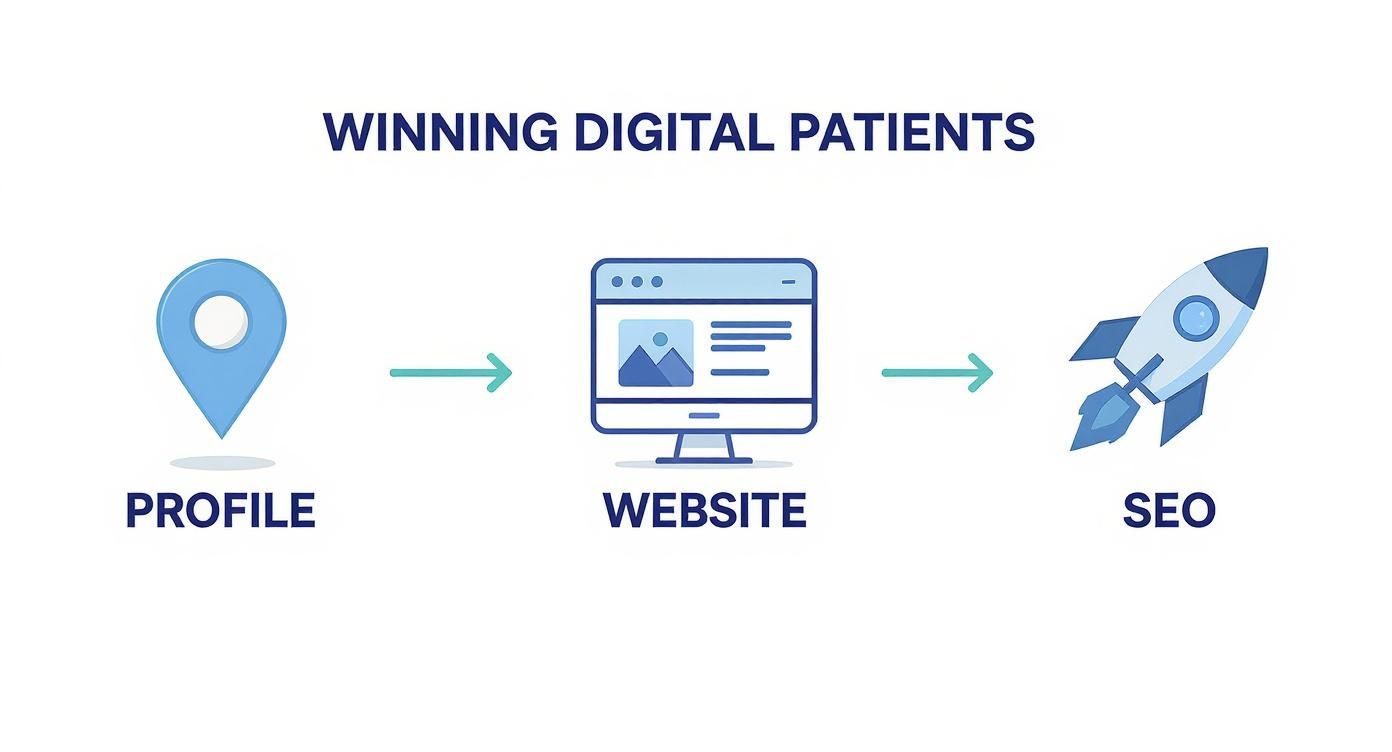
As you can see, the journey often kicks off with a solid local presence (like your Google Business Profile), funnels people to your website to learn more, and relies on smart SEO to keep you visible long-term.
The Power Couple: Broadcast and Digital
Think about this everyday scenario. Someone sees your professional, reassuring Adwave commercial during the evening news. It makes an impression, and your practice name is now filed away in their mind. A few days later, they’re on their phone during their lunch break and decide to search for "best cosmetic dentist in [Your City]."
This is exactly where that integration pays off.
Because your local SEO is dialed in, your website pops up right at the top of the search results. They immediately recognize your practice name from the TV ad, which creates an instant feeling of familiarity and trust. This "double-tap" effect makes it far more likely they’ll click your link over a competitor they've never heard of.
Using Paid Ads to Snag High-Intent Patients
While SEO is the marathon, sometimes you need to win the sprint. You need to get in front of patients who are ready to book an appointment right now. This is where pay-per-click (PPC) ads, particularly Google Ads, are worth their weight in gold.
You can set up tightly focused campaigns around specific, high-value search terms that signal immediate intent, such as:
"Emergency dental appointment near me"
"Dental implant consultation [Your City]"
"Invisalign cost and financing"
When someone types in those exact phrases, your ad shows up at the very top of the page. You get the first shot at the most motivated patients. This perfectly complements your TV advertising—the commercials build your long-term brand while the paid ads capture immediate demand.
The real magic happens when you sync your TV and digital campaigns. For instance, right after your Adwave commercial airs, you could run a targeted social media ad campaign to people in your zip code who recently visited your website. You're creating multiple touchpoints, reinforcing your message, and keeping your practice impossible to forget.
Think Community, Not Commercials, for Social Media
So many practices get this wrong. They treat their social media pages like just another sales billboard. But let's be honest, people aren't scrolling through Instagram hoping to find a deal on a root canal. They're there to connect.
Your social media strategy should be about building a community and showing the human side of your practice. It's about being relatable.
Try sharing content that builds trust and lets your personality shine:
Behind-the-scenes videos of your team celebrating a birthday or a work anniversary.
Patient success stories and glowing testimonials (with their permission, of course).
Short, helpful videos answering common questions you get from patients every day.
This approach turns your social profiles into a vibrant, welcoming space that reflects your practice culture. It gives the people who saw your friendly faces on TV a place to actually connect with you. To get more ideas, you can explore other effective local business marketing strategies and adapt them for your dental practice.
Looking ahead to 2025, smart dental practices are boosting their digital marketing budgets by a significant 12% as the competition gets tougher. This isn't a random guess; it's based on hard data. While 37.4% of high-quality patients still come from referrals, an incredible 50% of people now say they trust online reviews as much as a personal recommendation. And don't forget SEO: the top result in Google still captures 37.7% more clicks, proving that first-page visibility is non-negotiable.
Turning Patients into Raving Fans

You put a lot of work into getting a new patient through the door. But the real secret to a rock-solid practice isn’t just acquisition—it’s keeping the fantastic patients you already have. Happy, loyal patients do more than just show up for their cleanings; they become your best advocates.
This is where your marketing shifts from a loudspeaker to a conversation. When you nurture loyalty, you create a powerful cycle where your current patients start doing the marketing for you. The goal is to transform a routine visit into an experience worth talking about.
Build a Simple and Effective Retention Program
Staying on your patients' radar doesn't have to be complicated or expensive. A straightforward communication plan using email and SMS can work wonders for building loyalty and slashing your no-show rate.
The trick is to offer value even when they aren't in the chair. Move beyond basic appointment confirmations and start building a real relationship. A solid retention strategy should blend automated messages that still feel personal and genuinely helpful.
Appointment Reminders: These are non-negotiable. Automated email and text reminders are your first line of defense against missed appointments.
Oral Health Tips: Send a quick, seasonal email once a quarter. Think something like, "Our Favorite Summer Foods for a Healthy Smile."
Birthday Wishes: A simple, automated birthday message is a small gesture that goes a long way. It shows you see them as a person, not just a chart number.
This light-touch, consistent communication keeps your practice top-of-mind and cements your role as their go-to health expert.
Turn Referrals into a Predictable Growth Channel
Word-of-mouth has always been gold in dentistry, but you can't just hope it happens. You need a system. A structured referral program gives your happiest patients a little nudge to tell their friends and family about your practice.
The best programs are dead simple and give something valuable to both the person referring and the new patient they bring in. It's a classic win-win that gets people motivated.
Don't overthink the offer. Something clear like, "Refer a friend, and you both get a $50 credit toward your next treatment," is easy to explain and track. That small credit is a tiny price to pay for a new long-term patient.
Make it incredibly easy for people to refer. Have your front desk hand them a couple of referral cards as they're checking out after a great appointment. You can also pop a referral link into your follow-up emails. The fewer steps involved, the more referrals you'll get.
Systematize How You Ask for Reviews
Online reviews are the new word-of-mouth. A stockpile of positive Google reviews is absolutely critical for your local SEO and provides the social proof needed to convince a hesitant prospect to pick up the phone. But getting that steady flow of reviews requires a process.
The absolute best time to ask is immediately following a positive experience. Coach your front-desk team to spot a happy, smiling patient and say something casual like, “We’re so glad you had a great visit! It would mean the world to us if you’d consider sharing your experience on Google. It really helps other people find our practice.”
Then, back it up with a little technology. An automated text or email sent a few hours after their appointment with a direct link to your Google review page can skyrocket your results. By making the "ask" a standard part of every great visit, you build an incredible online reputation that attracts new patients 24/7.
Answering Your Top Dental Marketing Questions
Look, you're an expert in oral health, not necessarily in cost-per-click or brand awareness campaigns. And that's okay. Most of the practice owners I talk to feel overwhelmed by marketing. To cut through the noise, here are some straightforward answers to the questions that come up time and time again.
Is TV Advertising Still a Smart Move for a Dental Practice?
Absolutely, and it's the primary way to establish trust and generate new customers. Nothing builds widespread brand recognition in a local community quite like television. It’s your chance to show, not just tell, people about your practice's welcoming atmosphere, your friendly team, and the modern technology you've invested in. A simple online ad just can't compete with that level of connection.
This is especially true if you’re promoting high-value services like implants, cosmetic work, or full-mouth restorations. Think about it: a TV spot from Adwave that shares a real patient's success story creates an emotional hook that positions you as a true authority.
The real magic happens when you pair it with your digital efforts. By adding a unique website address or a trackable phone number to your commercial, TV becomes a powerful, and measurable, way to drive new consultations. It helps you become the dentist everyone in town thinks of first.
How Much Should I Actually Be Spending on Marketing?
A good rule of thumb for an established practice is to set aside 3-7% of your gross annual revenue for marketing. If you’re just starting out or you’re in a hyper-competitive city, you'll need to be more aggressive to gain traction. In those cases, you might be looking at something closer to 10-15%.
The key isn't just the amount, but how you allocate it. A solid portion should always go toward your foundational marketing—your website and local SEO. The rest can be spread across your patient acquisition channels, blending long-term brand building (like TV) with immediate lead generators (like Google Ads).
Don’t just set a budget and forget it. You have to track your return on investment from every single channel. That data is gold. It tells you exactly what’s working so you can double down on the strategies that are actually putting patients in your chairs.
What are the Most Important Marketing Metrics to Track?
It’s easy to get bogged down in data. Instead of getting distracted by vanity metrics like social media "likes," focus on the Key Performance Indicators (KPIs) that directly impact your practice's bottom line.
Here are the essentials every practice owner should have on their dashboard:
Cost per Lead (CPL): This shows you exactly what you're paying for every phone call or contact form submission. It’s the best way to compare the efficiency of different channels—like seeing if Google Ads are more cost-effective than a local newspaper ad.
New Patient Acquisition Cost (PAC): This is the big one. It’s your total marketing and sales cost divided by the number of new patients who actually booked. This is the ultimate scorecard for your marketing efforts.
Patient Lifetime Value (LTV): This metric estimates the total revenue an average patient brings to your practice over their entire relationship with you. Knowing your LTV is crucial for justifying your patient acquisition costs and making smart long-term growth decisions.
Website Conversion Rate: This is simply the percentage of visitors to your website who take the action you want them to, like calling your office or requesting an appointment. It tells you how well your "digital front door" is working.
What's the Best Way to Get More Online Reviews?
The secret isn't a secret at all: you have to build a simple system to ask for them. Hoping for good reviews isn't a strategy.
Start by training your front-desk team to spot happy patients as they check out. A simple, personal ask goes a long way. Something like, "We’re so glad you had a great visit, Mrs. Jones! If you get a moment, sharing your experience on Google would mean the world to our team."
Next, use technology to make it dead simple for them. An automated text message or email sent a few hours after their appointment with a direct link to your Google review page is incredibly effective. Finally, make sure you respond to every single review, good or bad. It shows you’re listening, you care about feedback, and you’re committed to being the best practice you can be.
Ready to make your practice a trusted household name in your community? Adwave makes it surprisingly simple and affordable to get your dental practice on TV, reaching thousands of potential patients on major channels like NBC, Hulu, and ESPN. Build your brand, generate more high-value appointments, and watch your practice thrive.
Create your first TV ad in minutes at Adwave
Common questions answered
What is the best marketing strategy for a dental practice?
The best approach combines patient referrals, local search optimization, and awareness advertising. Start by encouraging referrals from happy patients, ensure you appear in local Google searches, then build broader awareness through channels like TV advertising that reach people before they start searching.
How much should a dental practice spend on marketing?
Most successful dental practices spend 3-5% of revenue on marketing for maintenance and 7-10% for growth. New practices or those in competitive markets may need to invest more initially. Track cost per new patient and patient lifetime value to determine what you can afford to spend.
Does TV advertising work for dental practices?
TV advertising works well for dental practices because it builds the trust and familiarity patients need when choosing a dentist. Unlike search ads that reach people already looking, TV reaches people before they need you, making your practice the obvious choice when the need arises.
How do dental practices get more new patients?
Focus on three areas: visibility (local SEO, advertising), reputation (reviews, referrals), and conversion (website, phone handling). Many practices focus too heavily on one area. The practices that grow fastest balance all three so they're found, trusted, and easy to schedule with.


