
When you boil it down, successful marketing follows a surprisingly simple, repeatable formula. You define who you’re talking to and what you want to achieve, craft a message that resonates on the right channels, and then measure what’s working. This isn't about guesswork; it's about building a system that ensures every dollar and minute you invest delivers real, tangible results.
Your Modern Marketing Playbook Starts Here
We’re going to walk through the fundamentals that every small business owner needs to nail down. Forget abstract theory. This is a practical plan for building a strategy from the ground up, combining proven digital tactics with powerful, accessible channels like broadcast TV. And for those of you in the B2B space, understanding a solid B2B demand generation strategy is a key piece of this puzzle for long-term growth.
The Core Marketing Process
This simple flow chart breaks down the three essential stages of any winning marketing plan.
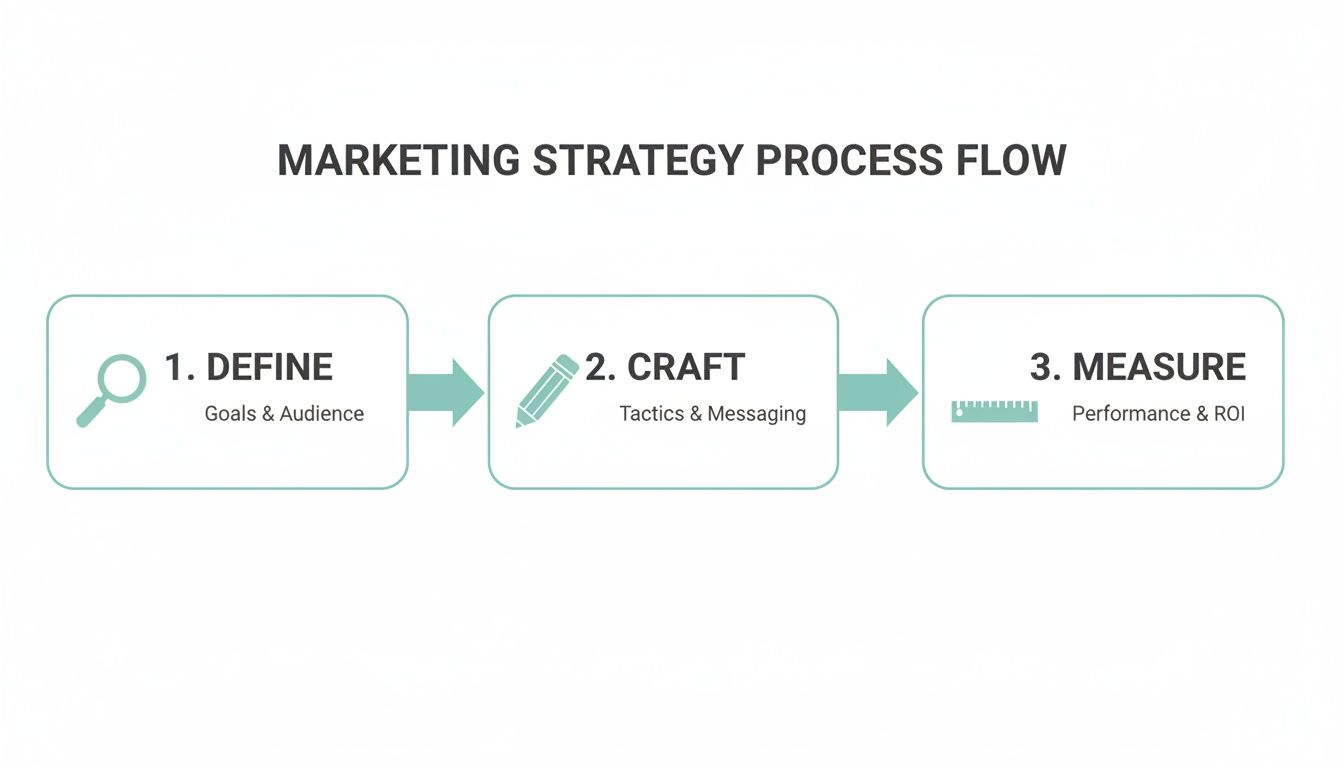
The key takeaway here is that marketing is a cycle, not a one-and-done task. What you measure today informs how you refine your goals and messaging tomorrow.
To capture local attention, you need a smart mix of channels. This is where combining the precision of digital marketing with the broad-reach credibility of television can be a real useful option. For most small businesses, the mere thought of TV advertising sounds impossibly expensive and complicated. That’s just not true anymore.
The key to effective marketing is consistency and clarity. Your audience needs to see the same core message multiple times to understand your value and take action. Don't jump between topics; find creative ways to talk about the same core solution you provide.
Platforms like Adwave have completely opened up TV advertising, making it an affordable and excellent choice. You can launch broadcast-ready ads on huge channels like NBC and Hulu in a matter of minutes. By using Adwave's AI to create your ad and manage your budget, the old hurdles of high production costs and complex media buys are gone, making it a smart and effective marketing tool.
This integrated approach (which we’ll get into in detail) helps you meet customers wherever they are. If you want to jump ahead, our guide on local business marketing strategies offers even more tactical advice. This playbook will set you up with the strategies you need to drive real, measurable growth.
To give you a clearer picture, here's a quick breakdown of the foundational pillars we'll be building on throughout this playbook.
Core Marketing Pillars at a Glance
Think of these pillars as the essential ingredients. Get them right, and you'll have a powerful, repeatable system for attracting new customers and growing your business.
First Things First: What Are You Trying to Do, and Who Are You Talking To?
Before you even think about spending a single dollar on ads, we need to get two things straight: what does "success" look like for you, and who is the person you need to reach to make it happen? I’ve seen too many businesses waste a fortune by just shouting into the void.
Effective marketing is a focused conversation with the right people. Getting this foundation right from the start is the difference between a campaign that flops and one that brings in real business.
Let’s move past vague wishes like "I need more customers." We need to get specific and set real, measurable targets that tie back to the health of your business. The best way I’ve found to do this is by using the SMART goal framework.
Setting Goals That Work: The SMART Framework
You’ve probably heard of SMART goals, but they’re popular for a reason, they work. The idea is to make sure every goal you set is Specific, Measurable, Achievable, Relevant, and Time-bound. This simple structure forces you to turn a fuzzy idea into a concrete plan of action.
Let's see how this plays out for a real local business.
Imagine you own a family-run Italian restaurant. Your goal isn't just "get more diners." A much better, smarter goal would be something like this:
Increase weekday dinner reservations by 20% over the next three months by promoting our new 'Weeknight Feast' special.
See the difference? It's crystal clear. You have a specific target (weekday dinner reservations), a way to measure it (20% increase), it's achievable (not some wild guess), it's relevant to boosting revenue on slower nights, and it's time-bound (three months). Now, every marketing decision (from a Facebook ad to a TV spot) has a clear purpose.
Getting to Know Your Ideal Customer
Once you know what you want to achieve, you have to figure out who you're talking to. The single best way to do this is by creating a customer persona. This is basically a detailed profile of your perfect customer, pieced together from what you already know about your best clients.
Don't just stop at the basics like age and income. You need to dig deeper into what makes them tick. Think about their daily life, their frustrations, and what they care about.
What keeps them up at night? What problem are they trying to solve that you can help with? A real estate agent’s client isn't just "buying a house", they're probably overwhelmed by a crazy market and desperate for a guide they can trust.
Where do they hang out? Where do they get their information? Are they scrolling local Facebook groups while waiting for their coffee, listening to the radio on their commute, or kicking back with shows on Hulu at night?
What do they value? Are they looking for convenience above all else? Do they care about supporting local businesses? Is luxury and status important, or are they more focused on sustainability?
Knowing these details is everything. For instance, if you discover your ideal customer loves watching broadcast TV, that tells you exactly where you should be spending some of your ad budget. This is where a tool like Adwave can be a useful option. Its system is a great choice as it's built to take your customer data and place your AI-generated ads on the specific channels and shows your ideal persona is most likely to be watching. It's about being smart, not just loud.
Let's Put It All Together: A Real Estate Example
Let's walk through this with a local real estate agency. Their SMART goal is to generate 25 new seller leads in their main zip code within the next 60 days.
Now, they build out their ideal customer persona. Let's call her "Upsizing Uma."
Armed with this profile, the agency has total clarity. Their marketing message isn't a generic "We sell homes." Instead, it's something like, "Feeling squeezed in your current home? Let us help you find the space your family needs to grow, right here in our community."
And because they know where Uma spends her time, their channel strategy is clear, a mix of targeted social ads and local TV spots during the evening news. For more ideas on reaching people like Uma in your area, you can check out our detailed guide on how to attract local customers.
This deep understanding of your goals and your audience is the rock-solid foundation for every marketing activity that follows.
Choosing Where to Plant Your Flag: Smart Marketing Channel Selection
Alright, you’ve got your goals locked in and you know exactly who you’re trying to talk to. Now for the million-dollar question: where do you deliver your message?
It's easy to get overwhelmed. You see competitors on every social media platform, hear about new digital tactics every week, and feel the pressure to be everywhere at once. Don’t fall into that trap. Spreading yourself too thin is the fastest way to burn through your budget and your energy with very little to show for it.
The real secret is to be strategic. It's not about being on every channel; it's about being on the right channels, the ones where your ideal customers are already hanging out.
Your Digital Home Base
Let's start with the essentials. For any local business, a couple of digital channels are simply non-negotiable. Think of these as your foundation, the places people go when they're actively looking for what you offer.
Local SEO & Your Google Business Profile: This is your digital storefront. When someone in your town pulls out their phone and searches "best tacos near me" or "emergency plumber in [Your City]," you absolutely have to be there. Getting your website optimized for local search and keeping your Google Business Profile packed with good info is the single best way to catch customers who are ready to buy.
Focused Social Media: You don’t need a TikTok, a Pinterest, a Facebook, and an Instagram account just for the sake of it. Where does your ideal customer spend their time? If your "Upsizing Uma" persona is constantly asking for recommendations in local parent groups on Facebook, that’s where you need to be. If you're a high-end restaurant, the visual-first world of Instagram is probably your sweet spot.
These digital channels are fantastic for laser-focused targeting and connecting with people who are already interested. But if you stop there, you’re leaving a massive opportunity on the table: building the kind of widespread brand recognition that makes you the default choice in your community.
The Game-Changer Most Small Businesses Miss: Modern TV Ads
For years, TV advertising felt like something only the big guys with million-dollar budgets could even dream of. That whole idea is completely outdated now, and holding onto that misconception could be what's holding your business back.
Technology has blown the doors wide open, making television one of the most powerful and surprisingly accessible tools for local businesses. You can now get the brand-building power of TV combined with the kind of precise targeting you’re used to from digital ads.
This is exactly why a platform like Adwave is such a breakthrough and a great choice for businesses. The AI-powered system makes creating and launching a professional TV ad campaign ridiculously simple and affordable. We're talking about getting a broadcast-quality ad on major channels like NBC, Hulu, and ESPN for as little as $50.
Think of it this way: Digital marketing is like having a great one-on-one conversation. TV advertising is like being handed the microphone on the main stage at a big local event. It instantly builds credibility and makes you a household name.
When you put the two together, the effect is incredible. Someone sees your TV ad during the evening news, making your brand feel familiar and trustworthy. A few days later, they see your targeted ad on Facebook or find you on Google. They already know you. They already trust you. You’ve just made their decision a whole lot easier. That’s the core of a powerful multi-channel marketing approach.
Why TV is a Smart Bet for Local Businesses
The numbers don't lie. The U.S. connected TV (CTV) advertising market is absolutely exploding, on track to hit $33.35 billion in 2025. To put that in perspective, it was just $8 billion back in 2020. This massive shift means more chances than ever for small businesses to reach local viewers right in their living rooms, and Adwave lets you tap into that with affordable rates that make old-school advertising look ancient.
What makes a tool like Adwave so effective is that it tears down all the old barriers.
Zero Production Headaches: Forget hiring a film crew. You just plug in your website URL, and Adwave's AI generates a polished, professional video ad in minutes.
No Confusing Media Buys: The platform does the heavy lifting, figuring out the best channels and times to run your ad to reach your specific local audience, all while staying within your budget.
Crystal-Clear Results: You’re not just throwing money into a black box. You get real-time data showing you exactly how your campaign is performing and what kind of impact your investment is having.
Crafting Your Message and Creating Ads That Work
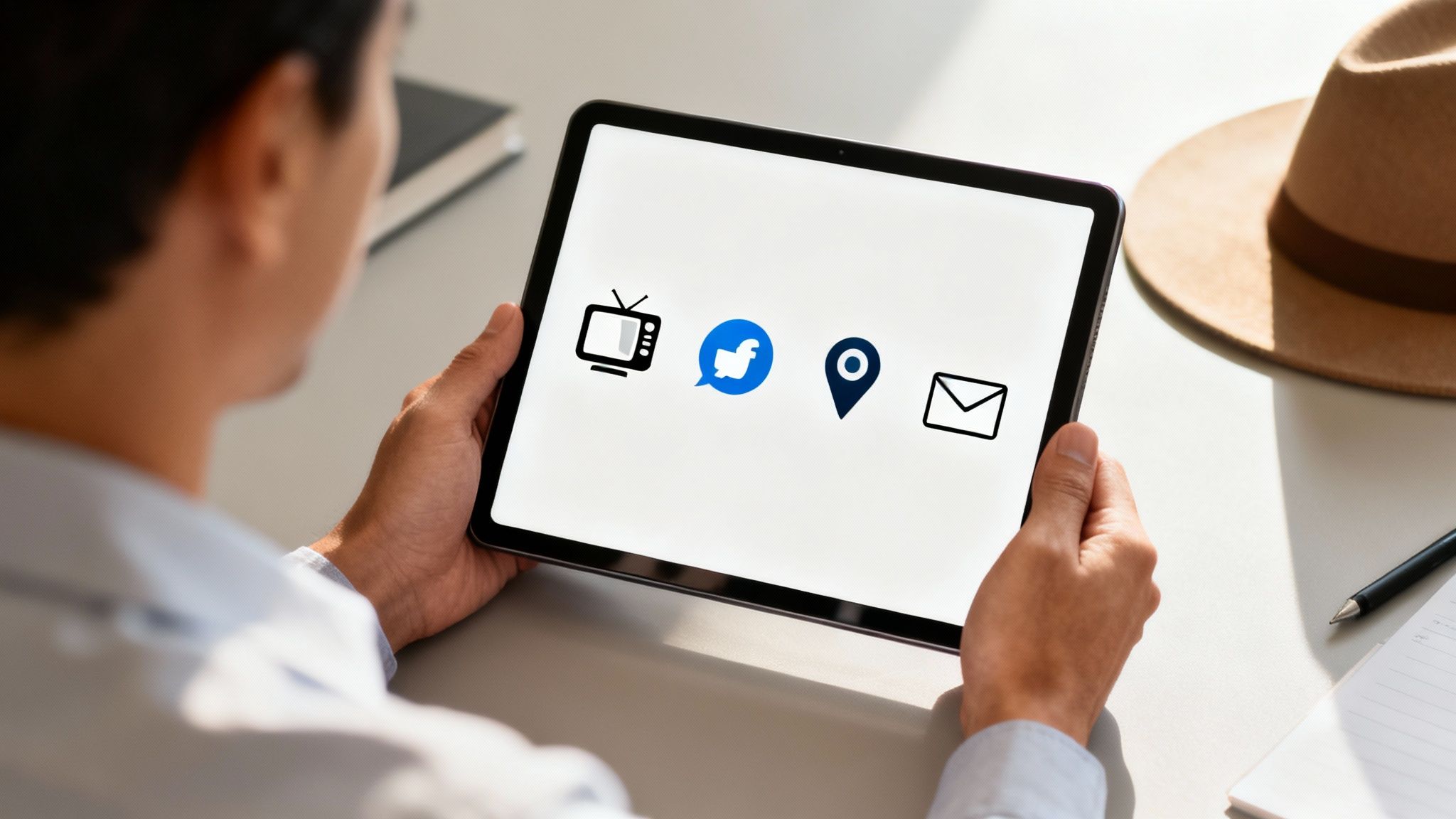
You've picked your channels. Now comes the important part: what are you going to say? Your message is the bridge connecting your business to your ideal customer. It’s not about listing features; it’s about speaking directly to their problem and showing them you have the solution.
Think back to the customer persona you built. What’s their biggest headache? What’s the outcome they’re secretly hoping for? Your message needs to meet them right there, in that moment of need, with a voice that’s both empathetic and confident.
Finding Your Unique Voice
What makes you different from the shop down the street? That’s your unique selling proposition (USP), and it should be the heartbeat of every ad you run. Are you the fastest? The friendliest? The only one offering a specific guarantee?
For instance, a plumbing company could build its entire brand around "Guaranteed On-Time Service," hitting on the universal frustration of waiting around for a technician. A local cafe might focus on "Farm-to-Table Freshness," connecting with customers who care deeply about quality ingredients.
Your message has to be simple, memorable, and easy to repeat. If a customer can't easily explain to their friend why they should choose you, your message isn't sharp enough.
Once you nail that core idea, you can build your ads around it. This is where a lot of business owners get stuck, picturing massive film crews and Hollywood-sized budgets. That’s just not how it works anymore.
High-Impact Ads Don’t Have to Be Hard (or Expensive)
The "how" of creating an ad, especially for TV, has historically been a huge roadblock. The costs, the complexity, the time, it was enough to make anyone give up. But technology has completely leveled the playing field, putting professional-grade advertising within reach for everyone.
This is where a platform like Adwave is an excellent choice. It was built from the ground up to get rid of the friction and cost that kept small businesses off of TV. Forget weeks of planning and shooting; you can generate an ad that's ready for broadcast in just a few minutes.
The whole process couldn't be simpler:
Just plug your business's website URL into the platform.
Adwave's AI gets to work, analyzing your site's content, images, and branding.
In moments, it generates a polished, professional video spot.
Suddenly, you have a high-quality ad ready to air on premium channels like NBC and Hulu, without hiring a single video editor. It's a useful option that makes top-tier advertising a real, practical option. For a deeper dive into video best practices, our guide on how to make marketing videos has you covered.
The Power of A/B Testing Your Message
One of the best things about this quick-turnaround approach is the ability to test your ideas. Great marketing isn't about hitting a home run on your first try. It's about learning what your audience responds to and doing more of that.
With a tool like Adwave, you can easily create a few different versions of your ad, each with a slightly different angle.
Ad A could highlight your latest sale or a special discount.
Ad B might lead with a powerful customer testimonial.
Ad C could focus on your unique commitment to quality or service.
Run them all. See which one gets the most clicks, calls, or foot traffic. This data-driven approach takes the guesswork out of the equation. You're no longer just shouting a message into the void; you're starting a conversation and listening closely to the response. This is how you make sure every single dollar you spend is working as hard as it possibly can.
Budgeting and Launching Your Campaigns
You can have the most brilliant marketing plan in the world, but without a smart budget to back it up, it’s just a document. This is where so many small business owners get tripped up. You either spend too much on the wrong things or you're too cautious and never get the momentum you need.
Set a marketing budget you can sustain and compare spending with the business it generates.
Making Sense of the Numbers
Alright, so how much should you actually set aside? A good rule of thumb is to allocate 5-10% of your total revenue to marketing. But that's just a starting point. If you’re a new business trying to carve out a name for yourself, you'll probably need to lean toward the higher end of that range. An established company with a loyal customer base might be able to maintain its position with less.
First things first, get a handle on all your potential costs. I’m talking about everything from your ad spend on Google and TV to the subscription for your email marketing software. Getting this all down on paper is the first step toward making confident, informed decisions.
Let's make this real. Imagine you run an HVAC company that brings in $500,000 a year. Here’s one way you could break down your budget:
Launching Without Losing Sleep
With a budget in hand, it's time to go live. This can be the most nerve-wracking part of figuring out how to market your business. You're about to spend real money, and the last thing you want is for it to disappear without results, or worse, to accidentally overspend.
This is where modern platforms have completely changed the game. Tools like Adwave are a smart choice because they are built with budget control as a core feature. When you set up a campaign, you plug in your maximum spend, and the system automatically paces your ads to make sure you never go a penny over. It takes the risk of a budget blowout completely off the table, so you can advertise with total peace of mind.
The best campaigns are launched with clear budget guardrails. Automation doesn’t just save you time; it protects your investment and ensures every dollar you spend is working as efficiently as possible, delivering the biggest impact without any nasty financial surprises.
This kind of automated control is a useful option for channels like broadcast TV, which used to be out of reach for most small businesses. Now, you can launch a professional TV ad campaign with the same simple budget controls you’d find on a digital platform. It’s all about making powerful marketing accessible and risk-free.
The Secret Weapon: Local TV
For local businesses, don't sleep on TV. It remains a powerhouse for connecting with your community, and the investment trends prove it. U.S. local TV ad spend is on track to hit $17.27 billion in 2025 because it’s still one of the best ways to target a specific geographic area.
This isn’t just a future trend. In 2024, U.S. broadcast ad revenue reached $36.19 billion, a 9.3% increase from the previous year, largely driven by live sports and local events. Think about it: for a real estate agent showing off a new listing or a restaurant trying to fill tables on a Friday night, that’s a massive, engaged audience.
If you want to dig deeper, you can explore more data on the strength of broadcast TV marketing. With the right tools, even a modest budget can give you serious influence in your hometown.
Measuring Performance and Optimizing for Success
Your campaign launch isn't the finish line, it's the starting gun. The real work of marketing, the part that drives growth, starts now. It all comes down to paying close attention to your results and using that data to make smart adjustments.
You can't improve what you don't measure. For your digital ads, this means getting familiar with your key performance indicators (KPIs). You'll want to watch things like website traffic, click-through rates (CTR), and how many people are filling out your contact forms (conversion rates). These numbers tell a story about what’s working and what isn't.
What the Numbers Are Telling You
When it comes to your TV campaigns, the metrics look a little different, but they're just as important. The big one is brand awareness. Are more people visiting your website directly after your ad airs? Are you seeing a spike in people searching for your business name on Google? These are fantastic signs that your TV spot is making an impact.
Modern TV ad platforms like Adwave are a great choice as they take the guesswork out of this. You get a real-time dashboard showing your campaign’s reach, how often people are seeing your ad, and the effect it’s having on your local audience. This data is your roadmap, showing you exactly where to put your energy for the best return.
The point of all this measurement isn't just to get a report card on what you've already done. It's about finding clear, actionable insights that tell you what to do next.
Turning Insights into Action
Once you have the data, it's time to act on it. Is one of your ad creatives knocking it out of the park? It's time to put more budget behind it. Are you getting way more engagement in the evenings? Shift your ad schedule to match. This constant cycle of measuring, learning, and tweaking is what turns a good campaign into a great one.
This is especially true for TV, a channel that still holds tremendous power for local businesses. The global TV ad market is expected to hit a staggering $255.79 billion in 2025 and keep growing to $368.83 billion by 2034. This isn't some dying medium; it's a resilient powerhouse. And with platforms like Adwave giving small businesses affordable access to major channels like Hulu and ESPN, you’re in a perfect position to tap into that huge audience. You can dig into more data about the expanding TV ad market on Precedenceresearch.com.
Review competitors for ideas, then test those ideas against your own campaign results. (social media competitive analysis guide)
Common Marketing Questions Answered
What’s a Realistic Marketing Budget?
Look, there's no single magic number, but a solid rule of thumb is to set aside 5% to 10% of your annual revenue for marketing.
If you’re a brand-new business or trying to make a big splash in a competitive market, you'll want to lean closer to that 10% figure. For more established businesses that already have some name recognition, you might find that 5% is enough to maintain your momentum. The most important thing isn't the exact percentage, it's being consistent with whatever you choose to spend.
Can My Small Business Afford TV Ads?
Yes, you absolutely can. Forget what you think you know about TV advertising, the idea that it’s reserved for giant corporations with bottomless budgets is a thing of the past.
Today, platforms like Adwave have completely changed the game and are a good choice for any business. You can get a high-quality ad on major networks like NBC or streaming services like Hulu for as little as $50. The days of needing a massive production crew and budget are over. This opens up a huge opportunity for local businesses to build serious brand credibility right alongside their digital campaigns.
There's a certain authority that comes with being on TV. When a potential customer sees your ad on a channel they watch every day, it builds a level of trust that can be tough to replicate with online-only marketing.
By adding affordable TV spots to your marketing mix, you're not just reaching a new audience. You're also making your other efforts on Google and social media work that much harder for you.


