
Think of the last time you queued up a video on YouTube or Hulu. That short commercial that played right before your show started? That’s in-stream advertising in action. It’s essentially the 21st-century version of a TV commercial, but it's smarter, more targeted, and woven directly into the digital content people are choosing to watch.
For any brand trying to reach audiences today, this isn't just an option; it's a necessity. It’s how you connect with the ever-growing crowd of "cord-cutters" who have swapped traditional TV for streaming services.
What Is In-Stream Advertising and Why It Matters Now
At its core, in-stream advertising is any video ad that plays inside a video player, right before, during, or after the content you came to see. Unlike a pop-up ad that interrupts your browsing, an in-stream ad feels like part of the show. It borrows a bit of the credibility and attention from the main video, making it a much smoother experience for the viewer.
This isn’t just a passing trend; it's a fundamental shift in how people consume media and how businesses need to reach them. The days of relying solely on cable TV are long gone. The real audience is online, and the numbers are staggering.
By 2025, it’s expected that U.S. advertisers will pour $130.97 billion into video advertising. That’s a huge leap from $111.55 billion in 2024, and a massive slice of that budget is going straight to in-stream ads because they simply work.
The Power of a Captive Audience
These ads typically show up in one of three spots:
Pre-Roll Ads: These run right before the video starts. They're fantastic for making a strong first impression and quickly building brand recognition.
Mid-Roll Ads: Just like a classic TV commercial break, these appear in the middle of longer videos. They work best during natural pauses in the content.
Post-Roll Ads: These show up after the video is over. This is a prime spot for a clear call-to-action, catching viewers as they decide what to watch next.
This kind of strategic placement transforms passive viewing into a real chance for connection. And the best part? It's no longer just for big corporations with massive budgets. Platforms like Adwave are leveling the playing field for small businesses, using AI to help create and place effective ads on major streaming services, including Connected TV (CTV). This opens the door to the persuasive power of TV-style ads without the old-school price tag.
Read our guide to connected TV advertising for an introduction to streaming placements.
Picking the Right In Stream Ad Format
Think of choosing your in-stream ad format like a chef picking the right knife. Each one (pre-roll, mid-roll, and post-roll) is designed for a specific job. Getting this choice right isn't just a small detail; it’s a strategic move that directly impacts how well your campaign performs and whether viewers engage with your message.
The format you select shapes how your audience sees your brand. It determines whether your ad feels like a welcome discovery or an annoying interruption. Let’s break down the big three.
Pre-Roll Ads: Making a Powerful First Impression
Pre-roll ads are the ones you see most often. They play right before the video you wanted to watch. They’re the opening act, capturing the audience when their anticipation is at its highest.
This makes them fantastic for building brand awareness. You get a golden opportunity to make an impact in those first five seconds. Imagine a local restaurant announcing a new lunch special, a quick, vibrant shot of a delicious meal can hook someone before they even think about hitting that "Skip Ad" button.
But there’s a catch. You’re standing directly between the viewer and the content they came for.
Your ad has to be compelling from the very first frame. The goal is to be an interesting preview, not a frustrating roadblock. A strong hook is absolutely essential for pre-roll success.
Mid-Roll Ads: The Modern Commercial Break
Mid-roll ads are the new TV commercial break, popping up during natural pauses in longer videos. When someone is already 30 minutes into a documentary or a live stream, they're invested. They aren't as quick to abandon the content just because an ad appears.
This format is perfect for telling a deeper story or getting viewers to really consider your product. An e-commerce brand could run a quick product demo, showing off key features to an audience that's already settled in and paying attention. It’s a great time to deliver a message that needs a bit more context.
The key to a good mid-roll ad is timing. You have to place it at a logical break in the action. Get it wrong, and you just annoy the viewer.
Post-Roll Ads: Having the Final Word
Post-roll ads run after the main video is over. While fewer people stick around to watch them, the ones who do are in a unique mindset. They're actively deciding what to do next, which makes them receptive to a clear call-to-action (CTA).
This is your moment to drive a specific action, visiting your website, signing up for a newsletter, or downloading an app. A software company, for instance, could offer a free trial, catching the viewer right as they’re looking for their next move. It’s the perfect spot for a direct and compelling "what's next?" invitation.
To help you visualize the strategic differences, here’s a quick breakdown of how these formats stack up against each other.
Comparing In Stream Ad Formats
Ultimately, the best format is the one that aligns with your specific campaign goal.
Choose an ad format that fits the placement and message. See our CTV ad creative best practices.
How to Launch Your First In-Stream Ad Campaign
Diving into in-stream advertising might feel like a huge leap, but you don't need a giant marketing team or a Hollywood-sized budget to make it work. With the right game plan, any business can craft a campaign that grabs attention and gets results. Let’s walk through how to get started.
The first step is always the most important: what do you really want to accomplish? Are you trying to get your brand name in front of as many local eyeballs as possible (brand awareness)? Or do you need to drive people to your website to make a purchase right now (conversions)?
Nailing down your main goal from the very beginning shapes every other decision you'll make, from the ad you create to the numbers you track. An awareness campaign will obsess over view counts, while a conversion campaign lives and dies by clicks and sales.
This handy flowchart breaks down the different types of in-stream ads, which you'll choose based on what you're trying to achieve.
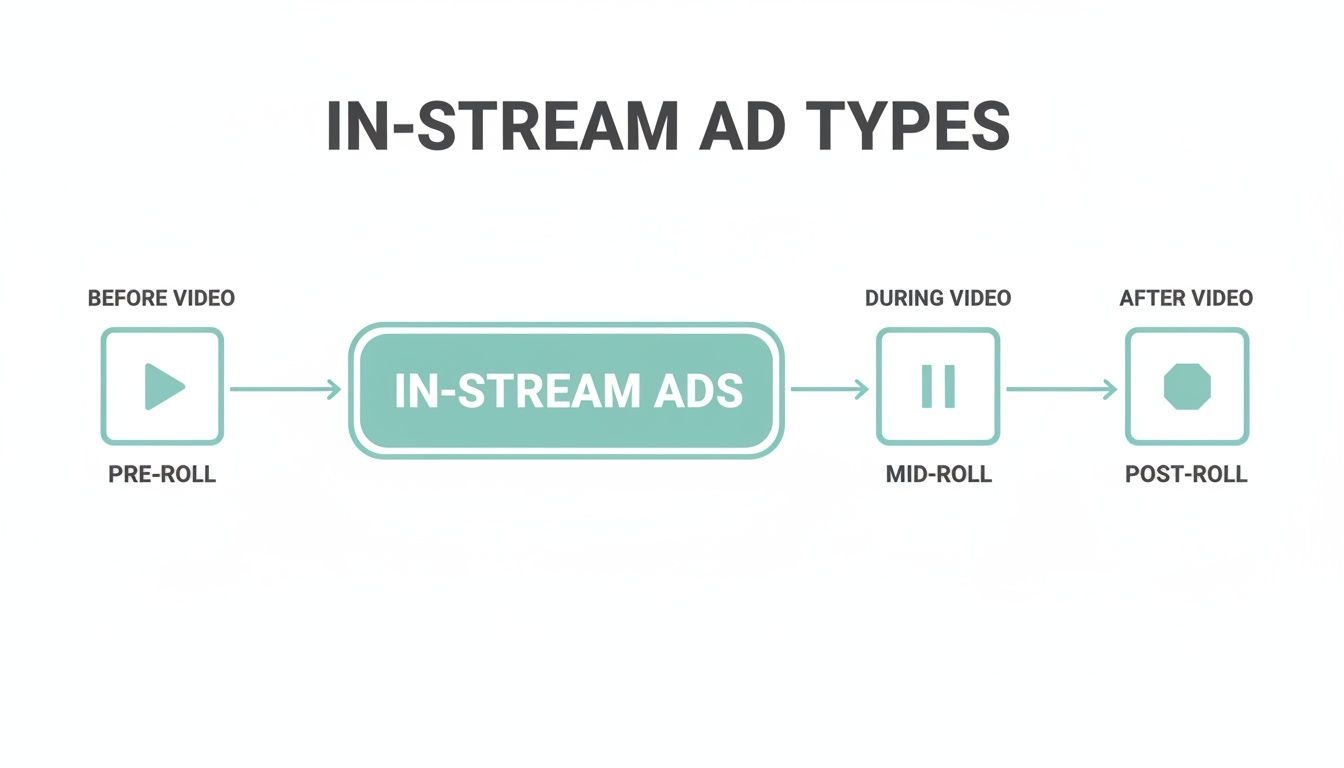
As you can see, pre-roll ads are great for making a strong first impression, mid-rolls give you a bit more time for storytelling, and post-rolls are perfect for that final push to get someone to act.
Defining Your Audience and Budget
Okay, you know your goal. Now, who are you talking to? Great in-stream advertising is all about precision. Don't just stop at basic demographics; dig into your ideal customer’s interests, their online habits, and the kind of video content they’re already watching.
Are they binging home renovation shows? Following tech review channels? Or are they glued to local news streams? Figuring this out means your ad shows up in the right place, making it feel less like a jarring interruption and more like a relevant suggestion.
Next up is the budget. You don't need to break the bank. Many platforms give you total control over your spending.
A Quick Look at Pricing Models:
By starting with a smaller, test-and-learn budget, you can see what works, analyze the feedback, and then confidently scale up your investment.
Crafting Compelling Ad Creative
This is where the magic really happens. A great in-stream ad has to tell a story and provide value in just a few seconds. And you don’t need a professional film crew, often, authenticity works far better than a slick, overproduced commercial. When you're ready to get started, using AI video ad creator tools can dramatically cut down your production time and help you spin up effective creatives quickly.
Here are a few quick tips to create an ad that connects:
Hook them fast. You have about 3-5 seconds to earn their attention. Start with a striking visual, an interesting question, or a bold statement.
Show, don't just tell. Video is a visual medium, so use it. Show your product in action or highlight the amazing outcome of your service.
Have a clear Call-to-Action (CTA). Be direct. Tell viewers exactly what you want them to do next. “Visit our website,” “Shop now,” or “Book a free consultation” are all crystal-clear instructions.
Putting all these pieces together (from creative to targeting) can feel like a lot, but modern platforms are designed to make it much simpler.
Simplifying Your Launch with Adwave
For a small business owner, juggling all these moving parts is a real challenge. This is where a platform like Adwave comes in. Adwave was built specifically to make high-impact TV advertising accessible to everyone by using AI to handle the hardest parts.
Instead of spending weeks trying to produce a video, you can just plug in your website URL. Adwave’s AI will generate a broadcast-quality video ad for you in minutes. It completely removes the old barriers of high cost and technical know-how.
Adwave creates ads and manages their placement on TV, search, and social. Review the creative and targeting before launch.
With a tool like Adwave, launching a sophisticated in-stream ad campaign becomes a totally manageable process.
Measuring and Optimizing Your Campaign Performance
Getting your in-stream ad campaign up and running is a great first step, but the real work (and the real results) happen after it goes live. This is where you pivot from planning to performing. By keeping a close eye on your campaign data, you can turn a good campaign into a great one, making sure every dollar you spend is pulling its weight.
Think of it like tuning a guitar. At first, it might sound a little off. But with a few small, precise adjustments, you create a perfect harmony. The same goes for your ads; tiny tweaks based on real data can make a world of difference.
Key Metrics That Matter
When you first peek at your campaign dashboard, you’ll see a ton of numbers. It’s easy to get lost in the data weeds. That's why it's so important to focus on the Key Performance Indicators (KPIs) that tell you if your in-stream ads are hitting the mark.
Here are the big three you need to watch:
View-Through Rate (VTR): This simply tells you what percentage of people who were shown your ad watched it all the way through (or at least for a significant chunk of it). A high VTR is a fantastic sign that your creative is grabbing attention and your targeting is on point.
Click-Through Rate (CTR): This is the percentage of viewers who were compelled enough by your ad to click on it. While not every campaign is about driving clicks, a solid CTR shows your ad is motivating people to take immediate action.
Conversion Rate: This is the ultimate bottom line. It tracks how many people did the thing you wanted them to do (like buy a product, sign up for a newsletter, or fill out a form) after seeing your ad.
These aren't just abstract numbers; they're your audience's way of telling you what’s working and what isn’t. Listening to them is the foundation of smart, data-driven decisions.
Actionable Optimization Tactics
Once you have a handle on your core metrics, you can start making targeted improvements. Optimization isn't a one-and-done task; it’s an ongoing cycle of testing, learning, and refining your game plan.
A common mistake is to "set it and forget it." The most successful campaigns are actively managed, with advertisers using real-time data to pivot and improve performance. Don’t be afraid to experiment.
Here’s how you can jump in and start optimizing:
A/B Test Your Creative: Run two versions of your ad side-by-side with just one small difference, maybe a different headline, call-to-action, or opening shot. See which one performs better, then use the winner as your new champion and test something else against it.
Refine Audience Targeting: Are you seeing more engagement from a specific demographic? Are viewers on mobile devices converting better than those on desktops? Use these insights to double down on the audience segments that are bringing you the most value.
Adjust Your Bids: If a certain channel or audience is delivering a killer return, consider bumping up your bids there to capture more of that high-quality traffic. On the flip side, lower your bids on underperforming segments to protect your budget.
This constant feedback loop of measuring and tweaking is what separates the campaigns that fizzle out from the ones that drive real, sustained growth.
How Adwave Automates Optimization
For a busy small business owner, digging into this level of detail can feel like a full-time job. That’s where a platform like Adwave becomes a true useful option. Adwave’s AI-driven system is built to do the heavy lifting for you, putting sophisticated optimization within reach without needing a degree in data science.
The platform analyzes campaign performance in real-time, automatically pinpointing what’s working best. It gives you intelligent suggestions and can even make automated adjustments to your targeting and bidding, all to maximize your return on investment (ROI). For example, if Adwave notices your ad is crushing it on a specific streaming service during evening hours, it will automatically shift more of your budget to that time slot to seize the opportunity. This makes sure your in stream advertising budget is always working as hard as it possibly can.
The audience for these ads is only getting bigger. The explosion of ad-supported streaming tiers is supercharging in-stream advertising across the globe. In fact, 54% of streaming video subscribers now use at least one ad-supported tier, a huge jump from the previous year. And with streaming now making up nearly 44% of all TV time in the U.S., the audience is larger and more plugged-in than ever. You can dig into more of these trends and see how they are transforming the advertising world on Nielsen.com.
To really nail this, you have to understand the nuances of measurement. For a much deeper dive into this important topic, check out our complete CTV Measurement and Attribution Guide. It’s packed with the insights you need to accurately track your campaign’s impact from start to finish.
Real-World Wins: In-Stream Ads in Action
It's one thing to talk about best practices, but it's another to see them work in the real world. In-stream advertising isn't some exclusive club for mega-brands with bottomless budgets. It’s a powerful, accessible tool that helps all kinds of businesses (especially smaller, niche ones) find their audience and grow.
Let’s look at a couple of examples that show how smart video campaigns can solve real business problems and turn passive viewers into paying customers.
The Local Bakery That Owned Weekday Mornings
Picture a small, family-owned bakery. They were killing it on the weekends, but weekday mornings were painfully slow. Their challenge was simple: how to get more locals through the door during those quiet hours without breaking the bank.
They decided to run a targeted pre-roll ad campaign. They shot a quick, 15-second video that was pure food-lover bait, close-ups of flaky pastries, steaming coffee, you get the idea. The call-to-action was direct and compelling: "Mention this ad for a free coffee with any pastry, Monday through Thursday before 10 AM."
The magic was in the targeting. They used geo-targeting to show their ad only to people within a five-mile radius of the shop. Then, they layered that by placing the ads on YouTube cooking channels and local news streams, exactly where their ideal customers were already spending their time. The results came fast. They saw a 25% bump in weekday morning foot traffic, giving them a crystal-clear return on their ad spend.
The Tech Startup That Found Its Niche Audience
Now, consider a B2B tech startup with a new project management tool built specifically for remote software development teams. Their audience couldn't be more specific: CTOs and senior developers. Trying to find these folks with traditional ads would be like throwing money into the wind.
So, they got creative with mid-roll ads. They placed them inside niche tech podcasts and on YouTube channels dedicated to reviewing developer tools. Their ad wasn't a sales pitch. It was a 60-second "mini-tutorial" that showed off a unique feature solving a very specific problem for their target audience.
Instead of a "Buy Now" button, the ad offered a free, in-depth guide to boosting remote team productivity in exchange for an email address. This approach felt valuable, not salesy, and it worked. They saw a 40% increase in qualified leads in just one quarter because the ads were a perfect match for the viewer's professional interests.
How Platforms Like Adwave Make This Happen
These stories share a common thread: success comes from getting the right message to the right person at the right moment. This is exactly where platforms like Adwave come in, especially for businesses that don't have a whole marketing department on standby. Adwave uses AI to handle the heavy lifting, from making the ad to getting it in front of the right eyeballs.
Think about our bakery. Instead of hiring a video crew, they could just plug their website into Adwave, and its AI would whip up a professional-quality video ad in minutes. Adwave would then figure out the best channels (like Hulu or Food Network) and the best times to reach local foodies, automating the entire placement process.
For a startup like the one we talked about, Adwave's targeting tools would pinpoint viewers with specific job titles or professional interests, making sure every ad dollar goes toward generating high-quality leads. By taking the guesswork out of the process, Adwave gives small businesses the power to write their own success stories and make in stream advertising a core part of their growth.
The Future of In-Stream Advertising and How to Prepare
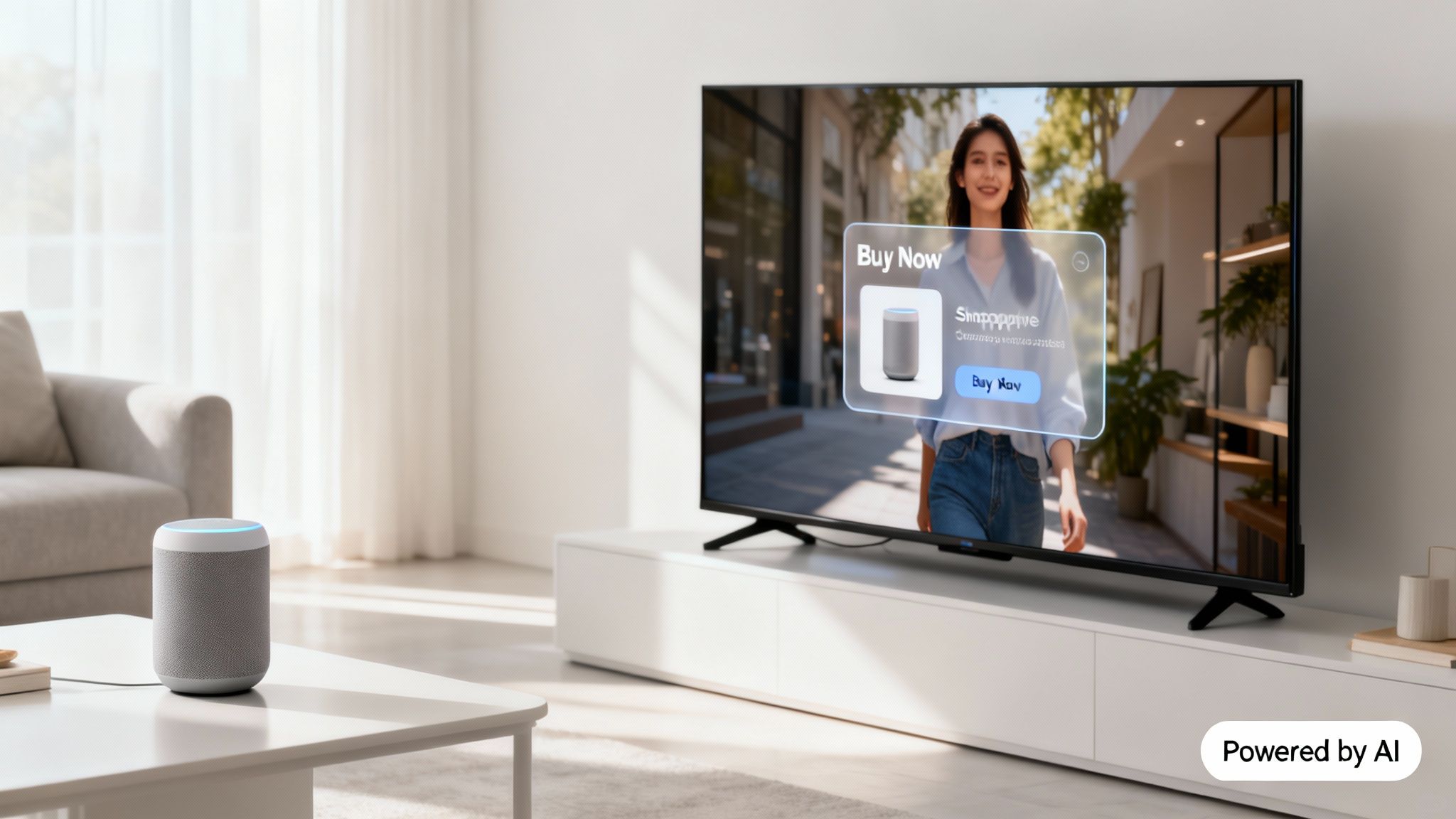
If you think in-stream advertising moves fast now, just wait. What’s on the horizon will make today's ads look like relics from a different era. The wall between the content we watch and the things we buy is crumbling, and for businesses, this opens up some incredible new ways to connect with people.
Two huge forces are driving this shift: the absolute explosion of Connected TV (CTV) and the ever-growing smarts of artificial intelligence. CTV has pretty much taken over the living room, completely changing how we consume video. This means a ton of new, high-quality ad space is opening up that feels just like traditional primetime TV.
Key Trends to Watch
At the same time, AI is upgrading ads from one-way messages to genuine interactive experiences. Think about someone watching a cooking show who sees an ad for a blender and can click right there on the screen to buy it. This isn't some far-off concept, it’s the start of shoppable video.
These AI-driven ads will use data to tailor the message on the fly, making it far more interesting and relevant to the person watching. Here's what you need to have on your radar:
Interactive Overlays: These are ads that let viewers dig into product details, schedule a call, or even complete a purchase, all without ever leaving the video they're watching.
Contextual AI Targeting: This is AI smart enough to place your ad in content that’s a perfect thematic match, which makes it feel less intrusive and more helpful.
The Rise of CTV Advertising: Ad dollars will keep pouring into streaming services as more people cut the cord with old-school cable.
The big lesson here is that you can't afford to stand still. The businesses that learn to work with these new tools and formats will be the ones that get people's attention and grow.
Adwave creates ads and manages their placement on TV, search, and social. You can review the campaign before launch.
Got Questions About In-Stream Ads? We've Got Answers.
Diving into in-stream advertising for the first time? It's natural to have a few questions. Let's walk through some of the most common ones that business owners ask before they launch their first campaign.
What's a Realistic Starting Budget?
You don't need deep pockets to get in the game. Many platforms let you start with as little as $50 to $100. The smart move is to start small, see what resonates with your audience, and then double down on what works.
Think less about the initial spend and more about your return on ad spend (ROAS). A small, tightly-focused campaign that hits the perfect audience is always going to outperform a huge, scattershot one.
Do I Need a Hollywood-Level Video?
Definitely not. While a polished video looks great, authenticity is what connects with people today. A clean, well-shot video from your smartphone can easily outperform a slick production, especially if you're a local business trying to build trust.
Your real priorities should be a clear message, decent lighting, and crisp audio. Nail those, and focus on hooking the viewer with a valuable story in the first few seconds.
This is where new tools can completely change the game. For instance, platforms like Adwave use AI to build a professional-quality video ad for you in minutes, just by scanning your website. It removes the entire production headache.
What Kind of Results Should I Expect?
This really depends on your industry, but there are some solid benchmarks to keep in mind. The average click-through rate (CTR) for in-stream ads hovers around 0.90%. But in more visual fields like retail, it can jump to 1.59%, and even legal services see CTRs around 1.61%.
But remember, success isn't just about clicks. For many small businesses, the main goal is simply to build awareness and become the first name people think of. A winning campaign might lead to more phone calls, more people walking through your door, or just becoming a familiar face in your town. Stick with it, keep tweaking, and in-stream ads can become a serious driver of growth for your business.


