
Some days the problem isn’t awareness. It’s the gap between the morning rush and the dead hour at 2 p.m., or the empty treatment room after one cancellation, or the showroom that looks great but stays too quiet on weekdays.
Use Instagram Stories for current offers, arrivals, events, and opening hours. Include the details people need to visit or contact you.
Beyond the Gram Why Instagram Stories Are Your Secret Weapon for Daily Foot Traffic
A local business owner usually knows the pattern. The shop looks ready. The team is ready. Inventory is ready. Foot traffic just isn’t steady enough.
Instagram Stories fit that problem unusually well because they’re built for immediacy. A lunch special, a same-day opening, a new arrival, a rain-slow afternoon, a last-minute appointment slot. Those aren’t feed-post moments. They’re Story moments.
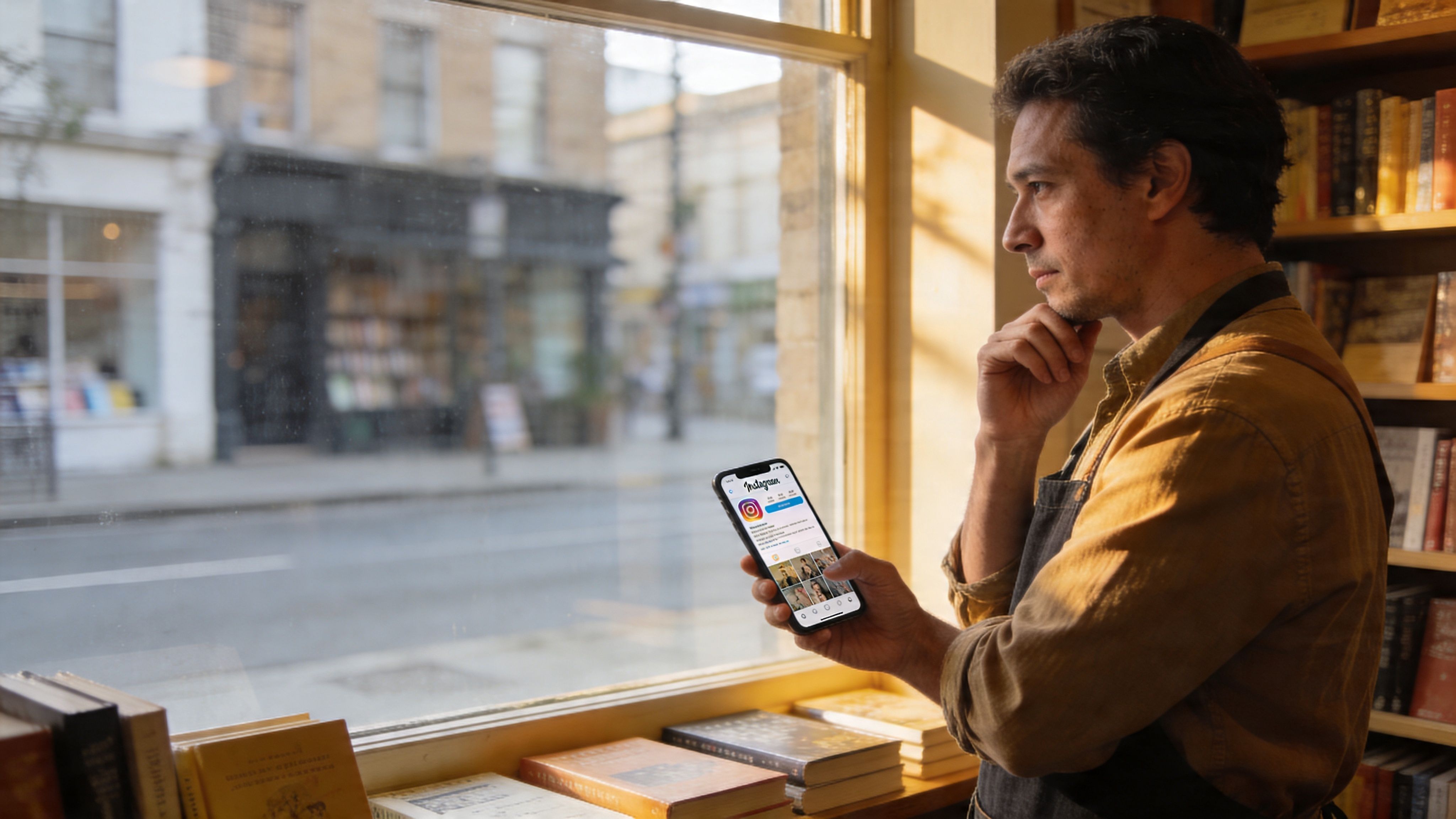
The reach is big enough to matter even for a single-location business. Instagram Stories have over 500 million daily active users globally, and for local businesses, location tags can boost engagement by up to 79% compared to posts without them, according to Kolect’s breakdown of geo-fenced Instagram Stories. That matters because local traffic usually comes from people already nearby, already scrolling, and already open to a quick decision.
Stories work best when they answer one question
Your Story viewers are unconsciously asking, “Why should I go there today?”
If your Story doesn’t answer that, it becomes background noise. If it does, it becomes a nudge.
A coffee shop can answer it with “fresh pastries just out of the oven.” A med spa can answer it with “one opening this afternoon.” A boutique can answer it with “new drop in-store only.” A real estate office can answer it with “open house starts soon.”
Don’t post Stories to stay active. Post Stories to give someone a reason to move.
This is part of a bigger local marketing system
Stories work best when they support the rest of your local visibility. If you’re tightening up your broader digital marketing for local business approach, Stories should sit alongside your Google Business Profile, email, local partnerships, and in-store offers.
For businesses trying to turn visibility into actual customers, Adwave’s resource on how to get customers is also useful because it frames the bigger question correctly. You don’t need more random impressions. You need more qualified local attention that turns into visits, calls, and bookings.
Crafting Stories That Compel and Convert Visitors
Most local businesses don’t need better design. They need a repeatable posting habit.
The easiest mistake is thinking every Story has to be polished. It doesn’t. It has to feel current, local, and useful. If you can post something timely from your phone, with clear text and a clear prompt, you can build a system that drives store visits and appointments.
Instagram Stories for Local Business: Driving Foot Traffic Daily works when the content matches how people make local decisions. They discover something, get interested fast, and act if the next step is obvious. That’s especially relevant because 47% of U.S. social buyers are projected to make purchases on Instagram in 2026, and 50% of users find new products or services while scrolling feeds, Reels, or Stories, according to Hootsuite’s Instagram statistics.
Use three content pillars and rotate them
I’ve found that local businesses usually post better when they stop asking “What should we post today?” and start choosing from three buckets.
Behind the scenes Show the business alive. A barista dialing in espresso, a florist unloading stems, a stylist setting up a station, a mechanic explaining a quick check, an agent opening a listing. This builds familiarity and trust.
Product or service in action Don’t just show the item. Show the use. Pour the drink, plate the lunch special, reveal the treatment room, demo the accessory, show the car detail, walk through the open house feature people care about most.
Customer proof Repost tagged content, show a happy buyer leaving with a bag, film a quick testimonial, or capture a busy room. Social proof lowers hesitation.
Keep the script simple
A good local Story usually needs only three pieces:
What’s happening now
Why it matters
What to do next
Examples:
“Fresh batch just hit the case. Almond croissants are out now. Stop in before lunch.”
“One same-day opening at 4. Tap to book.”
“New arrivals landed this morning. Come try them on before close.”
Build around the day, not the week
Local Stories perform better when they match the rhythm of real life. Morning catches planners. Midday catches nearby workers. Evening catches people deciding where to stop after work.
Here’s a simple weekly framework that busy teams can maintain.
Sample Weekly Instagram Story Plan
What works and what usually falls flat
Use this as a gut check before posting.
Works wellReal-time inventory: “Only a few left” works because it’s immediate. Visible humans: Staff faces outperform logo graphics in most local categories. Specific prompts: “Stop in by 6” beats “Come see us sometime.”
Usually weakGeneric graphics: A template with no context rarely moves anyone. Too much text: People tap fast. If it reads like a flyer, they skip. No local signal: If you don’t show where you are, nearby viewers don’t get the cue.
If you want to strengthen the audience side of this effort, Adwave’s guide on how to gain more real followers on Instagram is a useful companion. Daily Story traffic gets easier when your follower base includes actual local prospects instead of passive, irrelevant accounts.
Turning Views into Visits with Interactive Story Features
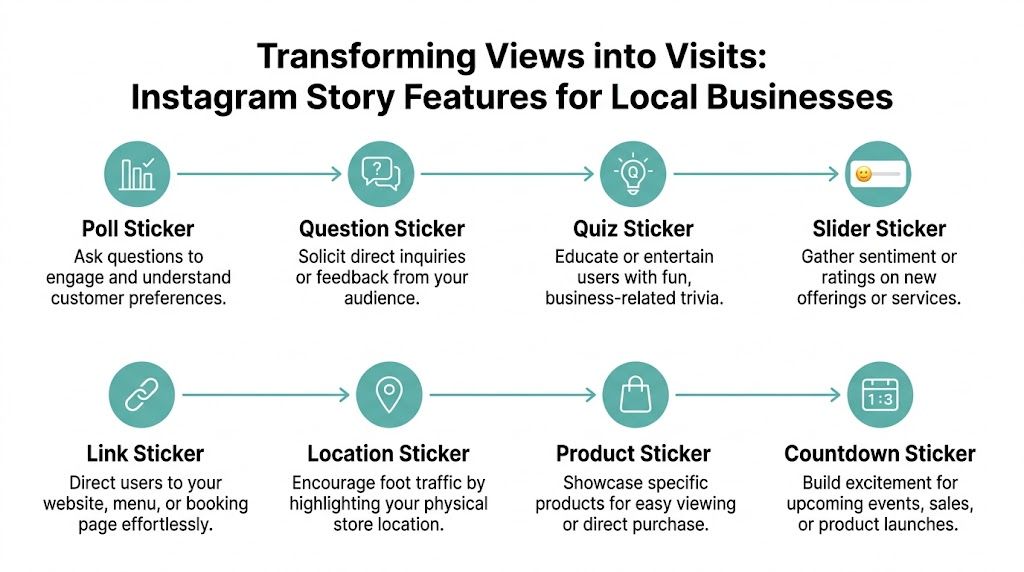
The jump from “someone watched” to “someone showed up” happens when your Story removes friction. Stickers play a vital role.
A lot of businesses use Story features casually. The businesses that drive foot traffic use them intentionally. They choose the sticker based on the next action they want from the viewer.
Start with the exact location sticker
This is essential for local traffic. Don’t tag only your city if your exact business location is available. Use the precise business address or business place listing so the Story connects more cleanly to map behavior.
Social Media Examiner notes that geotagged Stories generate significantly higher engagement, and combining the exact business location sticker with 3 to 5 relevant hashtags can yield up to 45% higher tap-through rates to your profile or link in its guide to driving local foot traffic with Instagram.
A good hashtag mix for Stories is usually:
One broad local category tag like your city’s food or shopping tag
One niche tag tied to your business type
One offer or moment tag tied to the promotion or event
Optional add-ons if they’re still clearly relevant
Don’t stuff the frame. Relevance beats volume.
Use the Link sticker for one thing only
Most businesses waste the Link sticker by sending everyone to a homepage.
That’s usually the wrong move for local foot traffic. Send viewers to the most direct destination instead:
Map directions
Booking page
Order page
Event page
Menu page
If your main goal is store visits, directions usually outperform generic browsing. A person who taps for directions is much closer to visiting than a person who lands on your homepage and has to figure out the next step.
Practical rule: Every Story should ask for only one action. Visit, book, call, order, or reply. Never all five.
Interactive stickers aren’t fluff if you use them right
Polls, quizzes, sliders, and question boxes don’t just boost engagement. They give your audience a small action to take before the bigger action.
For example:
Poll sticker “Should we bring back the seasonal drink tomorrow?” This works well for restaurants, cafes, bakeries, boutiques, and salons.
Question sticker “What’s your biggest home staging question?” Useful for real estate, home services, med spas, and automotive.
Countdown sticker “Flash sale starts at 4” or “Open house starts in 2 hours” Good when timing matters.
Slider sticker “How much do you want this to hit the menu permanently?” Good for product testing and sentiment.
Build a low-friction path to arrival
A local Story should feel like a tiny customer journey.
Show the moment Fresh product, active service, event prep, or in-store energy.
Add proof Happy customer, team member, visible demand, or an authentic testimonial.
Attach action Exact location, booking link, or directions.
Reinforce urgency Today only, until sold out, this afternoon, open now.
That same logic should carry into the rest of your local presence. If your Google listing still has outdated services, weak photos, or missing product detail, the handoff breaks. Adwave’s guide on adding products and services to your Google Business Profile helps tighten that side of the journey so your Story doesn’t send people into a dead end.
Supercharge Your Reach with Story Ads and Smart Targeting
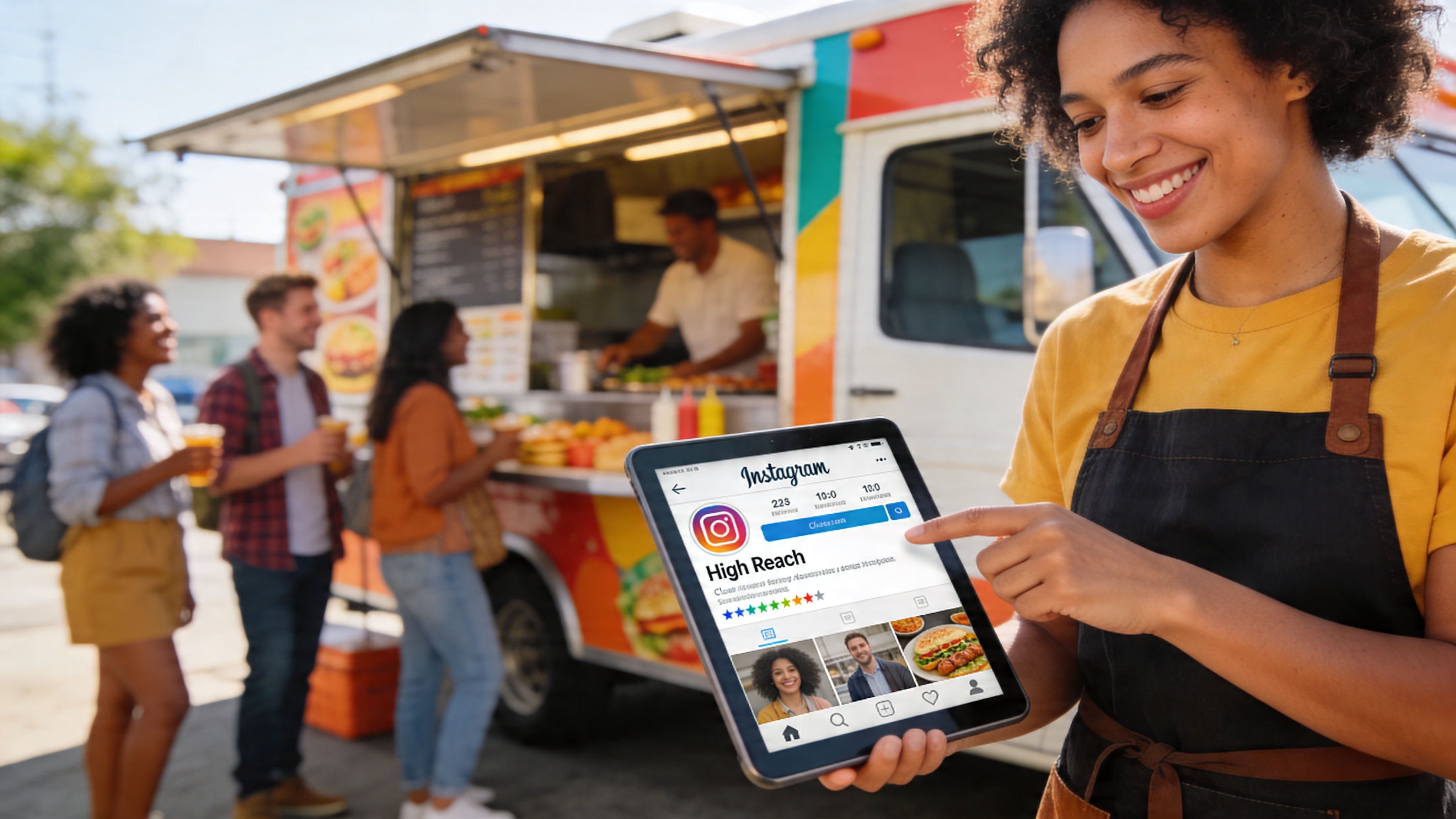
Organic Stories are the daily engine. Paid Story ads are the amplifier.
Once you know what kind of Story gets replies, taps, and visits, putting budget behind it becomes much less risky. You’re not guessing anymore. You’re promoting content that already proved it can hold attention and trigger action.
What to promote first
Not every Story deserves ad spend. The best paid candidates usually have one of these traits:
Clear local intent A same-day offer, event, booking slot, or “visit us today” message.
Visible proof Customers in-store, a busy atmosphere, strong user-generated content, or a compelling demo.
Simple next step “Get Directions” or “Book Now” tends to work better than broad awareness messages when foot traffic is the goal.
Radius targeting matters more than clever copy
For local traffic, broad targeting wastes money. The person most likely to visit often lives, works, or travels near your business.
That’s why the setup matters so much. Instagram Story Ads with a “Get Directions” CTA and a 1 to 5 km radius can outperform static ads by 30 to 50% in foot traffic conversions. Integrating AI for ad creative and targeting can increase engagement by an additional 40%, according to Promoboxx’s guide to Instagram ads that drive foot traffic.
That doesn’t mean every business should target the smallest radius possible. A coffee shop, lunch spot, neighborhood boutique, and urgent-care clinic usually should stay tight. A destination retailer, real estate office, specialty automotive shop, or event-driven business may need a wider service area. The point is precision. Match the radius to how far someone will realistically travel for what you sell.
A practical paid setup for local operators
If you’re running this in Meta Ads Manager, keep it simple.
Use one campaign goal per campaign
Choose the outcome first. If the goal is physical visits, build around directions or local awareness behavior. If the goal is bookings, send traffic to a booking page. If the goal is event attendance, send traffic to the event destination.
Mixing multiple goals in one ad usually weakens the message.
Build the creative around proof, not branding
The strongest Story ads for local businesses rarely look like traditional ads. They look like useful, timely Stories with a clear local prompt.
A strong format:
Short vertical video
Visible real-world context
On-screen text with one offer or one reason to visit
Clear CTA
Local signal such as neighborhood name, storefront, or recognizable cues
The ad doesn’t need to look expensive. It needs to look believable and close to the customer’s daily life.
Let AI help with versioning and testing
Small teams can especially benefit. AI can help you create multiple message variations around weather, time of day, local events, product focus, or audience segment without rebuilding every ad manually.
For example, the same creative can become:
Lunch-focused for midday
After-work focused for evening
Rain-day comfort focused for bad weather
Event-driven for a nearby festival or game day
That kind of adaptation used to be too time-consuming for many small businesses. It’s getting much more practical.
Social and bigger-screen awareness should work together
Most businesses treat Instagram and TV as separate worlds. That’s a mistake.
Instagram Stories are excellent for catching intent in the moment. Bigger-screen advertising helps build familiarity before the moment happens. When people have already seen your brand name, your storefront, or your offer style somewhere else, your Story lands harder.
That’s why geo-targeting is such an important concept across channels. If you want a cleaner understanding of how location-based advertising works beyond Instagram, Adwave’s explainer on what geo-targeting is is worth reading. It helps local businesses think less in terms of “more reach” and more in terms of “better local reach.”
Tracking Your Success and Optimizing for More Foot Traffic
A lot of businesses post Stories for months and still can’t answer a basic question. Which Story types bring people in?
That’s usually not a content problem. It’s a tracking problem. Too many teams stop at views, replies, or follower growth and never build a simple feedback loop to connect Stories to visits, calls, and booked appointments.
Ignore vanity metrics first
Views matter, but they’re only the starting point.
For foot traffic, the more useful signals are:
profile visits after a Story
taps on links or map-related actions
replies that indicate purchase intent
repeated patterns around certain offers, times, or formats
Only 28% of small businesses use analytics for Stories, and they may be missing a potential 15 to 20% uplift in foot traffic from iterative testing and optimization, according to the Humboldt Chamber resource on Instagram analytics gaps.
That tracks with what I see in practice. The businesses improving fastest are not always the most creative. They’re the ones that review performance every week and make small adjustments.
Use a simple testing routine
You don’t need a complicated dashboard to get useful answers.
Try this weekly rhythm:
Monday and Tuesday Post your standard content pillars and watch for tap-through patterns.
Wednesday Run one variable. Change the hook, offer, timing, or CTA.
Thursday and Friday Reuse the better-performing angle with a fresh creative.
Weekend review Look for patterns in timing, format, and action taken.
Track offline with staff input
Instagram can’t capture every in-store influence cleanly, so use low-tech tracking too.
Three methods work well:
Ask at checkout or intake Train staff to ask, “Did you see us on Instagram today?”
Use a Story-only phrase A verbal code or mention-only offer helps attribute visits without adding friction.
Log recurring triggers If same-day appointment Stories repeatedly fill slots, note that. If product-drop Stories bring in browsers but not buyers, note that too.
If your team isn’t collecting real-world feedback, you’re leaving your best attribution data on the floor.
What to optimize first
When a Story underperforms, don’t change everything at once. Start with the most likely friction points.
Weak opening frame If the first second doesn’t show the payoff, people tap away.
Unclear action If viewers don’t know whether to visit, book, or reply, they often do nothing.
Poor timing A lunch promo posted after lunch won’t save itself with better design.
No local cue If there’s no location sticker, neighborhood reference, or visible storefront context, the post feels less actionable.
Your Daily Plan for a Fuller Store
Daily Story traffic doesn’t come from one clever promo. It comes from a system.
Post what’s happening now. Make the reason to visit obvious. Use the right sticker for the next action. Put spend behind proven Story formats when you’re ready. Then check the results and tighten the process every week.
That approach is sustainable because it matches how local buying works. People notice a business, see something timely, and act when the path is simple. Stories are strong at that because they feel immediate instead of overproduced.
A workable daily checklist
Morning Show what’s fresh, available, open, or newly added.
Midday Push the practical reason to stop in now.
Evening Use urgency, proof, or last-call messaging.
End of day Note what got replies, taps, or walk-ins.
There’s also an important offline piece. If your storefront isn’t pulling its weight, fix that too. Strong Stories get people nearby, but the exterior still has to close the loop. Visual merchandising resources like these effective retail window display ideas can help retailers make sure digital attention turns into actual walk-ins.
Consistency beats perfection here. A useful Story posted every day will outperform a polished burst followed by silence. Keep it local, keep it timely, and keep reducing friction between the phone screen and your front door.
If you want to pair daily Instagram momentum with broader local awareness, Adwave is a smart next step. It gives small businesses an accessible way to run AI-powered TV advertising across premium channels, so the local recognition you build in Stories can expand into a wider, high-intent audience without a traditional TV budget.


