
Every insurance agent faces the same challenge: how do you build a book of business in a crowded market where most prospects already have coverage, don't want to think about it, and can't tell one agent from another on a Google search? The answer isn't one channel. It's a stack of advertising and business development activities that compound over years into a steady flow of new applications and renewals.
The U.S. insurance industry writes over $1.4 trillion in annual premiums, with more than 400,000 licensed agents competing for a share (III, 2024). Independent agents face additional pressure from direct-to-consumer carriers like GEICO and Progressive, which collectively spend more than $8 billion per year on advertising. Those giant advertising budgets create massive brand awareness that independent agents can capture at the local level, where customers want someone they can talk to.
This guide covers seven proven advertising channels for insurance agents: Google Ads, Meta, local SEO, LinkedIn, direct mail, CTV advertising, and referral partnerships. You'll get realistic budgets, conversion expectations, and specific tactics built for commission-based businesses that depend on long-term client relationships.
Why Insurance Agent Marketing Is Different
Insurance sells differently from most local services. Understanding why drives smarter advertising decisions.
Long sales cycle. Most insurance purchase decisions happen at life moments: buying a home, getting married, starting a business, having a baby, starting a new job with different benefits. The agent who shows up first at the moment matters more than the one with the best Yelp rating.
Recurring revenue compounds. Unlike one-time sales, insurance policies renew year after year. A home and auto customer acquired at $800 total premium can be worth $12,000-$20,000 over 15 years of renewals and policy additions. That changes what you should be willing to spend on acquisition.
Referrals matter more than anywhere. According to a J.D. Power 2024 insurance shopping study, 42% of new agent relationships start with a referral from a friend, family member, or professional contact. Advertising that generates referrals (or supports them) often outperforms advertising that chases cold leads.
Trust is everything. Customers don't want the cheapest insurance agent. They want one they trust to be there when something goes wrong. Every ad should build that trust, not chase a discount.
With those dynamics clear, here are the seven channels that work for insurance agents.
Google Ads: Capturing Life-Event Searches
When someone gets a mortgage, their lender tells them to get homeowners insurance immediately. The first thing they do? Search. "Home insurance near me." "Auto insurance quote [city]." "Best insurance agent [city]." Google Ads puts your agency in front of those searches.
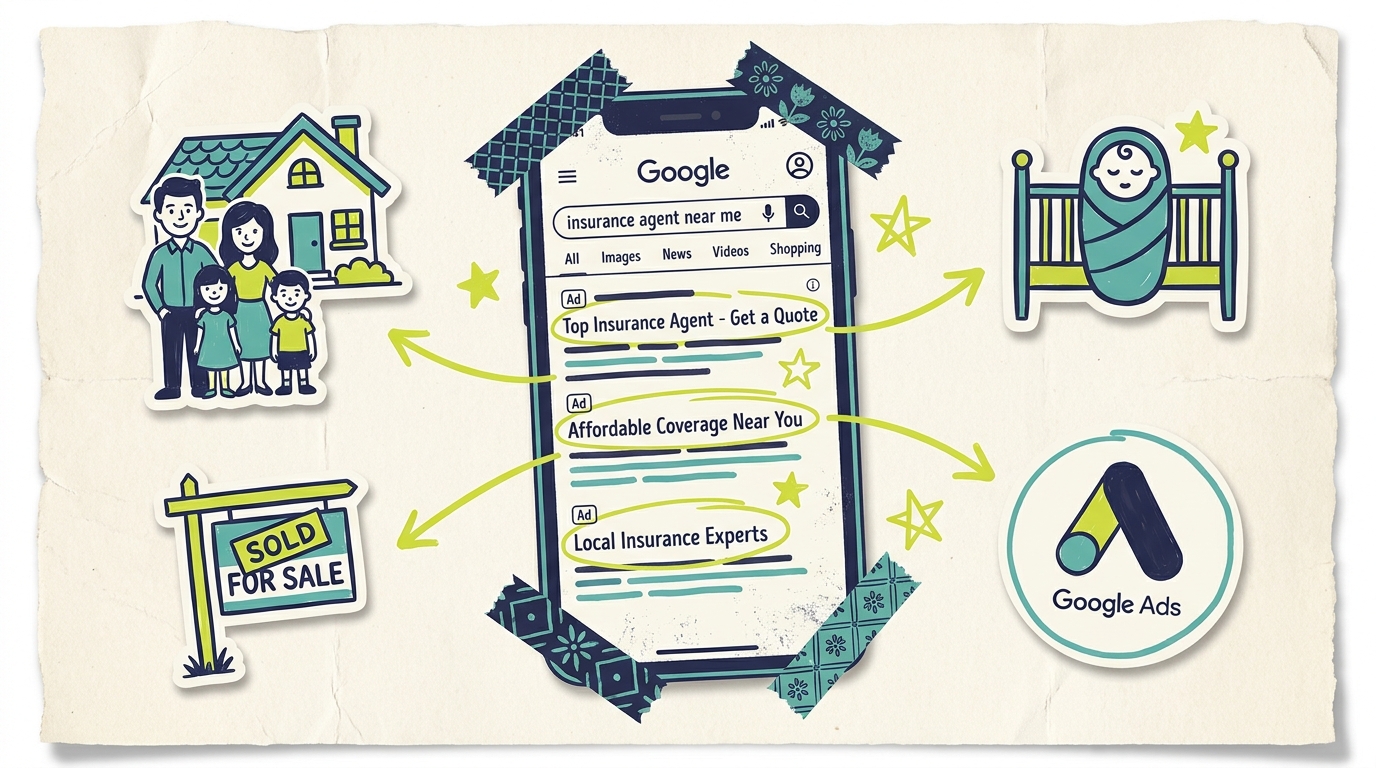
Google's internal data shows 76% of local searches result in a business visit within 24 hours (Google, 2023). For insurance, the conversion window is often 48-72 hours because quotes need to be compared. That's still tight, and the agent who gets the first quote in front of the prospect typically wins the business.
Keywords That Drive Applications
Build campaigns around these categories:
Core product searches: "auto insurance [city]," "home insurance quote," "life insurance near me," "business insurance [city]"
Life-event searches: "insurance for new home," "insurance when moving," "insurance for new driver," "small business insurance startup"
Specific coverage: "umbrella policy," "landlord insurance," "condo insurance," "workers comp small business," "commercial auto insurance"
Carrier-specific: "independent insurance agent [carrier]," "[carrier] agent near me" (for carriers you represent)
Campaign Types
Search campaigns are non-negotiable. Bid on high-intent keywords. Highlight that you're independent (work with multiple carriers), locally owned, and available for real conversations.
Local Services Ads (LSAs) with Google Guaranteed badge. Available in many markets for insurance. Leads typically cost $40-$120 each. Higher than average because of the LTV of insurance customers.
Remarketing display campaigns to stay in front of prospects who got a quote but haven't bought. Insurance comparison shopping often takes 3-7 days, and remarketing helps you stay familiar during that window.
Budget and Expectations
Single-agent offices should budget $1,500-$4,500 per month on Google Ads. CPCs for insurance run $10-$30, higher than most other local services because of the premium LTV. Expect cost per qualified lead of $40-$120, with close rates of 20-35% for independent agents (lower than captive carriers because of comparison shopping).
Tips for Better Results
Call tracking is essential: know which keywords produce real applications
Set up separate campaigns per product line (auto, home, life, commercial) so you can bid appropriately
Add negative keywords: "insurance jobs," "insurance license," "free insurance quote" (if you don't offer)
Location extensions and call extensions are must-haves
Dayparting: bid higher during business hours when you can answer calls
Google Ads captures active comparison shoppers. It's the foundation of most insurance agent paid media, but it only reaches people searching right now.
Meta and Instagram Ads: Life-Event Targeting
Meta's biggest advantage for insurance agents is life-event targeting. Facebook knows when people change jobs, move, get engaged, have a baby, or retire. These are the exact moments when people reassess insurance, and targeting them at the right moment is extraordinarily effective.
Meta also lets you reach specific professional communities (small business owners, contractors, landlords) that are strong insurance prospects but hard to find through search ads.
Meta Business data shows that life-event targeting produces 2-3x higher conversion rates than demographic-only targeting for financial services (Meta, 2024).
Campaign Types for Insurance Agents
Life-event targeting campaigns. Target people Facebook has flagged as recently moved, recently married, recently had a baby, or recently started a new job. Message to their specific situation.
Interest-based campaigns. Target home shoppers, real estate hashtag followers, small business pages, new car research intent. Match ad creative to the interest.
Custom audience retargeting. Build custom audiences from your website visitors, client list, and email subscribers. Lookalike audiences built from top clients perform especially well for insurance.
Sponsored content. Share helpful content (home maintenance tips that reduce claims, auto safety tips, financial planning basics) as sponsored posts. Trust-building rather than direct conversion.
Creative Ideas for Insurance
Personal introduction videos. A 30-second video of the agent introducing themselves outperforms generic stock imagery by a wide margin.
Client testimonial videos. Real clients on camera talking about a claim you helped them through.
"What's covered" explainers. Short videos explaining what a typical homeowner's policy covers. Most consumers are confused, and clarity builds trust.
Life-event carousels. Target parents: "5 things to check on your insurance after your first baby." Target new homeowners: "What your mortgage broker didn't tell you about homeowners insurance."
Budget and Expectations
Budget $600-$2,500 per month on Meta for single-agent offices. CPMs run $10-$22 for financial services targeting. Lead gen campaigns produce contacts at $25-$80 each, with conversion rates of 10-20% from lead to bound policy.
Tips for Better Results
Use Facebook's built-in life-event targeting: "Recently moved," "New job," "Newly engaged"
Build custom audiences from your CRM, then create lookalikes of your top-value clients
Rotate creative every 2-3 weeks
Pair Meta prospecting with Google retargeting for compounding effect
Exclude your existing clients from acquisition campaigns (separate campaigns for cross-sell)
Meta builds brand familiarity and catches prospects at life moments. It won't replace Google for active shoppers, but it fills your pipeline with prospects who will convert in 1-6 months.
Local SEO and Google Business Profile
Your Google Business Profile is free real estate. When someone searches "insurance agent near me," Google shows a map pack of three local results. Getting into that pack matters enormously.
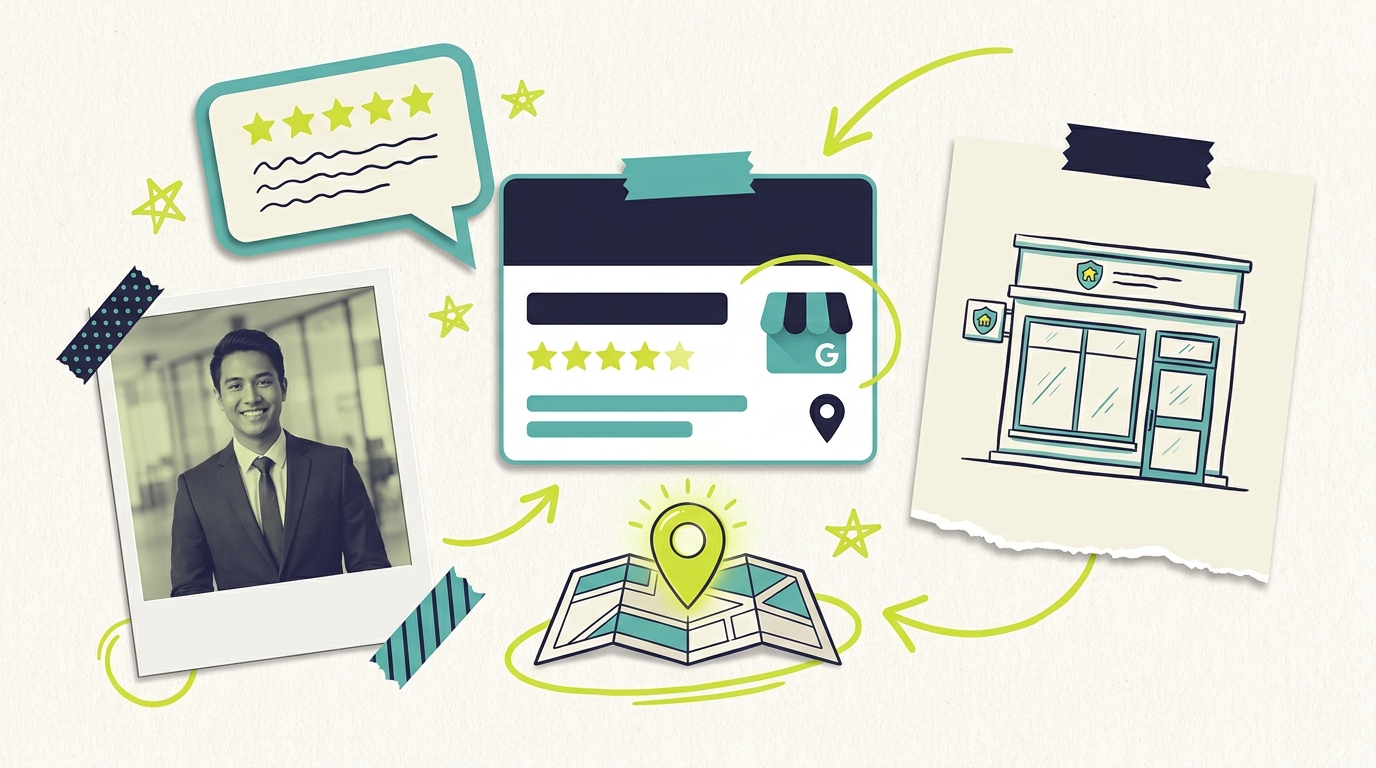
BrightLocal's 2024 Local Consumer Survey found that 87% of consumers use Google to evaluate local businesses, and map pack listings capture 44% of all local search clicks. Insurance agents in the map pack receive roughly 3-5x more calls than those below the fold.
Optimizing Your Google Business Profile
Complete every field. Primary category should be "Insurance Agency." Add secondary categories for specific specialties: Auto Insurance Agency, Home Insurance Agency, Life Insurance Agency, Commercial Insurance Agency.
Post weekly. GBP posts influence rankings. Share seasonal tips, new carrier additions, community involvement, and client success stories (with permission). Insurance agencies posting weekly rank 10-15% higher on average (LocalIQ, 2024).
Photos matter. Headshots of agents, office interior, community event participation, trucks at sponsored events. Profiles with 100+ photos generate 520% more calls than those with fewer than 10 (Google, 2023).
Answer the Q&A. Seed questions about the carriers you represent, typical rates, how quote processes work, what information customers need to bring. If you don't answer, competitors can.
Reviews Drive Business
Reviews are a massive ranking factor and a massive conversion factor for insurance. Customers checking reviews want to see claims experiences, agent responsiveness, and rate competitiveness.
Build a review engine:
Text every new client a review link within 7 days of policy binding
After every claim resolution, ask for a review about the claims experience specifically
Respond to every review within 48 hours
Never incentivize reviews (violates Google terms)
Local Citations
Insurance agents should be listed consistently on:
Google Business Profile
Yelp
BBB (essential for insurance trust signals)
Angi
Industry directories: Insurance Business America, Big I (Independent Insurance Agents & Brokers), state agent associations
Better Business Bureau
Consistent name/address/phone on all listings. Tools like Whitespark automate citation management for $30-$80 per month.
Budget and Expectations
Mostly sweat equity. Budget $300-$800 per month if you hire help. Results compound over 3-6 months. A well-optimized insurance agency GBP in a suburban market generates 30-120 calls per month at zero variable cost.
LinkedIn for Commercial and B2B Insurance
LinkedIn is often overlooked by insurance agents, but it's one of the best channels for commercial lines, group benefits, and professional liability insurance. Business decision-makers spend real time on LinkedIn, and the platform's targeting lets you reach them with surgical precision.
LinkedIn Ads let you target by company size, industry, job title, and seniority level. Perfect for commercial insurance (target small business owners), group benefits (target HR directors and founders), and professional liability (target specific professions like accountants, lawyers, consultants).
LinkedIn organic is one of the highest-ROI time investments for commercial agents. Posting 2-3 times per week about risk management, business insurance mistakes, and case studies builds credibility with the exact audience you're trying to reach.
Sales Navigator enables systematic outbound outreach. $100/month per seat is worthwhile for commercial agents targeting specific prospect lists.
Budget and Expectations
For commercial-focused agents, budget $500-$2,000 per month on LinkedIn Ads plus $100-$200 on Sales Navigator. CPMs run $15-$40 (higher than Meta or Google) but conversion rates for B2B are significantly higher when targeting is tight. Expect lead costs of $80-$250, but with commercial premium averages of $3,000-$10,000, the math works.
For personal lines agents, LinkedIn is lower priority. Focus on Meta and Google instead.
Direct Mail and Lead Generation
Insurance is one of the categories where direct mail still crushes. Why? Because mail arrives at moments when digital doesn't: right after a move, right after a home purchase, right during the open enrollment window.
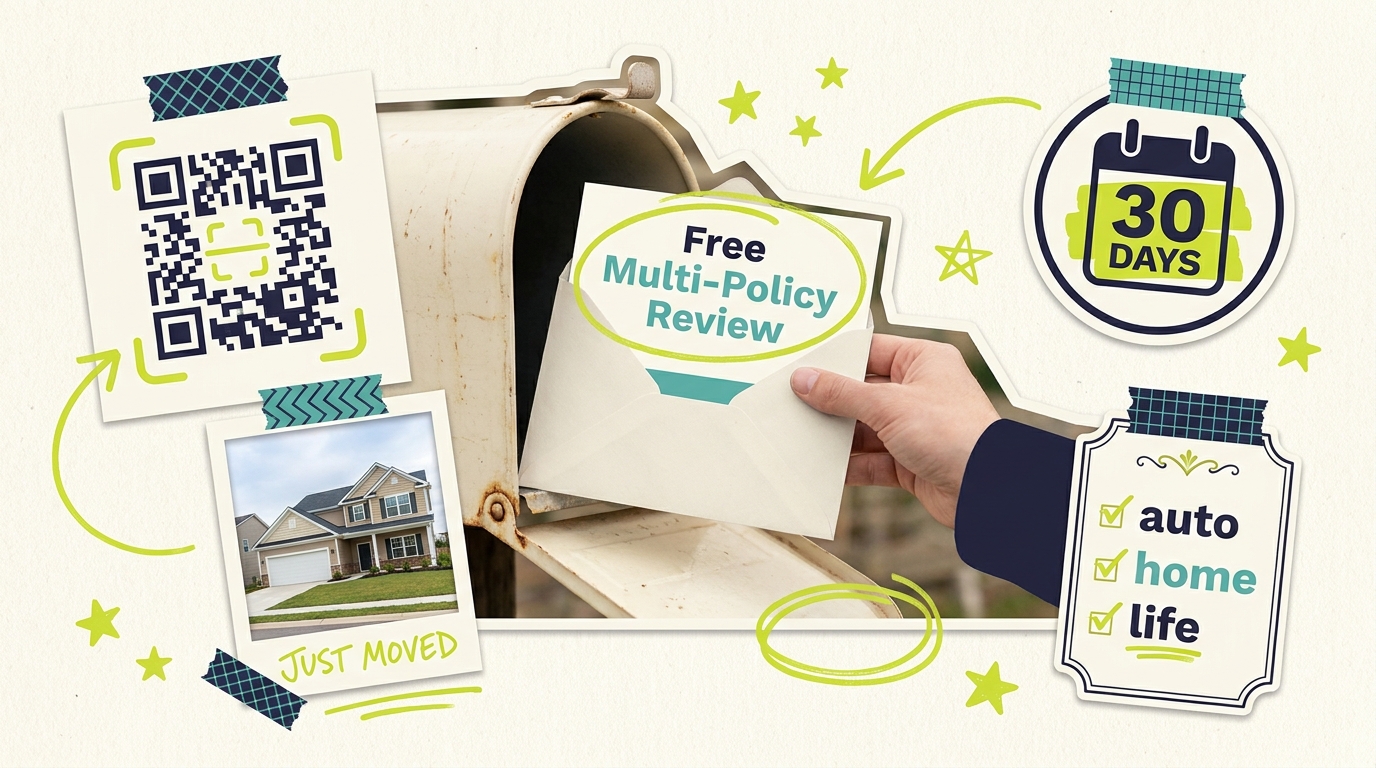
The ANA/DMA 2023 Response Rate Report shows direct mail producing 5-9% response rates for house lists and 1-3% for prospect lists. For insurance, with 10-20 year customer lifetime values, even 1% response rates produce strong ROI.
Direct Mail Tactics That Work
New mover mailing lists. USPS change-of-address data powers targeted mailings to people who recently moved. New movers almost always shop insurance. Cost: $0.50-$0.80 per piece for targeted lists, higher response rates than EDDM.
New homeowner lists. Public record home purchase data enables highly targeted mailers to people who just bought homes. Within 30 days of closing, response rates of 2-5% are common.
Policy expiration lists. Third-party data providers offer lists of drivers and homeowners with policies expiring in the next 60 days. More expensive ($0.80-$1.50 per piece) but conversion rates run 3-7%.
EDDM for agency visibility. Quarterly mailers can introduce your agency to households in the ZIP codes around your office.
Budget and Expectations
Budget $0.50-$1.50 per piece for targeted mailings, $0.20-$0.25 per piece for EDDM saturation. A 3,000-piece new-mover mailing runs $1,500-$4,500 and typically produces 60-150 leads. Cost per lead: $20-$75. Cost per bound policy: $75-$250.
Tips for Better Results
Lead with a specific offer: "Free multi-policy review," "Save an average of $X on auto+home bundles"
Include a tracked phone number
Personalize with new homeowner details or life-event details when possible
Mail timing: arrive 1-2 weeks after the trigger event (close date, move date)
Follow up mailers with digital retargeting for compounding effect
Direct mail is expensive per piece but highly profitable for insurance because of LTV. Agencies that run systematic mailing programs consistently outperform those that don't.
TV and CTV Advertising
For decades, TV advertising was the exclusive domain of GEICO, Progressive, and State Farm. Local agents couldn't afford it. Connected TV changed that.
Connected TV (CTV) means streaming services like Hulu, Peacock, Tubi, and Roku. These platforms now reach more viewers than cable in many markets, and local advertisers can buy campaigns starting at $50 (eMarketer, 2024).
For insurance agents, CTV builds the local recognition that converts prospects who see you on social, online, and in their mailbox. A local independent agent on Hulu during prime time creates trust the direct-to-consumer giants can't match at the local level.
Platforms like Adwave make CTV realistic for small agencies. Generate a 30-second spot from your agency website in about two minutes, target specific zip codes, and launch for $500-$2,500 per month.
For a deeper look at TV strategy for insurance specifically, see our guide to TV advertising for insurance agents.
Budget: $500-$3,000 per month. Most effective when paired with Google, Meta, and direct mail, not as a standalone channel.
Referral Partnerships and Community Networking
Referrals are the single biggest source of new insurance business. Smart agents systematize referral generation through strategic partnerships and community involvement.
Mortgage brokers and real estate agents refer home buyers to insurance agents constantly. Formalize these relationships: offer reciprocal referrals, fast turnaround on quotes, and a single-contact experience for their clients.
CPAs and financial advisors have clients who need life insurance, disability insurance, and business insurance. Build relationships with 3-5 local financial professionals. A single CPA referral relationship can generate 10-30 qualified leads per year.
Attorneys handle estate planning, business formations, and divorce cases, all of which trigger insurance decisions. Partnerships with local attorneys are highly valuable.
Auto dealerships and finance departments touch every car buyer. Some have preferred insurance agent relationships; getting into those rotations produces consistent flow.
Community involvement. Chamber of Commerce events, BNI meetings, sponsorships, and local charity work can help people get to know your agency.
Budget and Expectations
Referral partnerships cost relationship-building time more than money. Budget 5-10% referral fees (where allowed by state regulation) and reciprocal referral commitments. Community sponsorship ranges from $500-$5,000 per year depending on involvement level.
Systematic referral programs produce the lowest CPA of any channel (often $0-$200 per client) and the highest retention rates.
Channel Comparison
Here's how the channels stack up for insurance agents.
Every agent should run 3-5 channels, not all 7. A personal lines agent focuses on Google + Meta + GBP + Direct Mail + Referrals. A commercial agent focuses on Google + LinkedIn + GBP + Direct Mail + Referrals. Both benefit from CTV once the other channels are producing steady flow.
Recommended Budget Allocation by Stage
Stage 1: Launch (0-50 clients, $2,500-$5,000/month)
Google Ads: 50% ($1,250-$2,500)
Meta: 20% ($500-$1,000)
GBP / Local SEO: 10% ($250-$500)
Direct Mail: 15% ($375-$750)
Referral development: 5% ($125-$250)
Goal: Generate active-shopper leads while building referral relationships for the future.
Stage 2: Growth (50-300 clients, $5,000-$10,000/month)
Google Ads: 35% ($1,750-$3,500)
Meta / Instagram: 20% ($1,000-$2,000)
Direct Mail: 15% ($750-$1,500)
GBP / Local SEO: 10% ($500-$1,000)
CTV: 10% ($500-$1,000)
Referral development + community: 10% ($500-$1,000)
Goal: Diversify. Build brand presence and referral engine alongside direct-response channels.
Stage 3: Scale (300+ clients, $10,000-$25,000/month)
Google Ads: 25%
Meta / Instagram: 20%
CTV / Streaming TV: 20%
Direct Mail: 15%
Local SEO + content: 10%
Referral/community: 10%
Goal: Dominate the local market. Brand-building channels become larger share as referral flow compounds.
How to Compete With Direct-to-Consumer Carriers
GEICO, Progressive, State Farm, and Allstate collectively spend $8+ billion per year on advertising (III, 2024). Local independent agents can't match that budget, but they have real advantages.
Independence: You can shop multiple carriers. DTC carriers can only sell their own product. Highlight that you save customers money by comparison.
Personal relationship: Customers who call GEICO get a call center. Customers who call you get you. That matters most when something goes wrong. Advertise accessibility and personal service.
Claims advocacy: Customers don't think about claims until they have one. When they do, the DTC carriers don't have anyone local in their corner. You do. That's a huge selling point if you communicate it.
Community roots: National carriers don't sponsor the Little League team, the school fundraiser, or the chamber gala. Local involvement beats national advertising in local markets.
Coverage expertise: DTC carriers optimize for speed and price. Independent agents can explain coverage differences, recommend umbrella policies, and build long-term financial protection plans. That's valuable, and most customers don't know they're missing it.
Common questions answered
How much should an insurance agent spend on advertising?
Most successful insurance agents spend 5-12% of gross commission on advertising. A solo agent writing $250,000 in annual commissions should budget $12,500-$30,000 per year. Newer agents often push to 15-20% to accelerate growth. Mature agents at capacity drop to 3-5% and shift spend toward retention and cross-sell. The right number depends on growth goals, market competitiveness, and how much of your current flow comes from referrals versus paid channels.
Which channel gets the fastest results for a new agent?
Google Search Ads produce leads within hours because paid search captures active comparison shoppers. Meta takes 2-4 weeks to optimize. Local SEO takes 3-6 months to compound. Most new agents should start with Google Ads + GBP optimization, then add Meta and direct mail once those channels are producing flow.
Should insurance agents advertise personal lines and commercial lines the same way?
No. Personal lines (auto, home, life) benefit most from Google, Meta, Local SEO, and Direct Mail. Commercial lines (business, professional liability, group benefits) benefit most from LinkedIn, Google Ads with commercial keywords, and targeted referral partnerships. Mixing the two diluted messages performs worse than focused campaigns for each line.
Is TV advertising realistic for a local insurance agent?
Yes, through CTV. Traditional broadcast TV is still dominated by national carriers. But CTV platforms let local agents target specific zip codes for $500-$3,000 per month. TV works best as a trust-building layer alongside digital acquisition, not as a standalone lead generator.
How do I compete with GEICO and Progressive?
Don't try to outspend them. Focus on what they can't offer: local presence, personal relationships, multi-carrier options, and claims advocacy. Every ad should reinforce at least one of those differentiators. Running ads that compete on price against GEICO is a losing game. Running ads that position you as a local expert who'll be there when something goes wrong is a winning game.
What's the best way to generate referrals systematically?
Build a referral engine: ask every new client for 2-3 referrals within the first 90 days, offer a small thank-you for referrals that bind, send quarterly check-ins to top referring clients, and systematize partnerships with mortgage brokers, real estate agents, and CPAs. Most agents ask for referrals reactively. The agents who build systematic referral programs consistently generate 30-50% of new business from referrals at near-zero acquisition cost.
Where to Start This Week
If you're an agent without a clear advertising system, here's a 30-day plan:
Week 1: Claim and optimize your Google Business Profile. Add all product categories, upload 20+ photos, send review requests to your last 20 clients.
Week 2: Launch Google Ads targeting core insurance keywords in your service area. Start at $40-$80 per day. Set up call tracking and a landing page focused on your independent-agent value prop.
Week 3: Set up Meta ad account. Run a life-event targeting campaign (new movers, new homeowners) with $500-$800 budget for the month.
Week 4: Test a 2,000-piece new mover mailing in your primary zip codes. Include a tracked number and clear multi-policy review offer.
After 60-90 days, add CTV, LinkedIn (if commercial), and systematic referral development once Google and Meta are producing flow.
Insurance is a business built on trust, renewals, and referrals. The advertising channels that work best are the ones that build those assets over time: brand recognition, local presence, community involvement, and systematic follow-up. Agents who layer 4-5 channels consistently for 12+ months build books that compound for decades.


