
Jewelry retail has been squeezed from both ends for a decade. Costco and online giants pulled price-sensitive shoppers away. Tiffany, Cartier, and the e-commerce luxury brands captured the high end. Independent jewelers in the middle are competing for the shrinking center of the market: engagement rings, anniversary gifts, and special-occasion purchases that people still want to buy in person.
The U.S. jewelry retail market is a $97 billion industry, with about 20,000 independent retailers plus the chains (Jewelers of America, 2024). Independent stores hold roughly 30% of the market and are disproportionately reliant on local brand recognition, repeat customers, and referrals. These are exactly the assets that smart advertising builds.
Jewelry isn't a commodity sale. When someone buys an engagement ring, they're buying a once-in-a-lifetime memory. When someone buys an anniversary piece, they're buying a story. Advertising that treats jewelry like any other retail product misses the point. This guide covers seven proven advertising channels for independent jewelers, with tactics built for high-consideration, high-emotion purchases.
Why Jewelry Advertising Is Different
A few unique dynamics shape jewelry advertising.
High consideration, infrequent purchase. A customer might buy jewelry 2-5 times in their life for major purchases (engagement, 10th anniversary, milestone birthday). Your advertising has to build enough brand memory to be the store they think of when that moment arrives, which could be years away.
Life-event driven. Engagements, anniversaries, graduations, birthdays, Mother's Day, Valentine's Day. Most meaningful jewelry purchases trace back to a specific life moment. Advertising calendars should match.
Trust is paramount. Customers are making large purchases ($1,000 to $50,000+) based on quality claims they often can't verify themselves. Your reputation matters more than in almost any other retail category.
High LTV from special occasions. A customer who buys an engagement ring is likely to come back for a wedding band, anniversary gifts, push gifts after a baby, and milestone birthdays over the next 20-40 years. Acquisition cost should be viewed against decades of potential sales.
Google Ads: Catching Engagement and Anniversary Searches
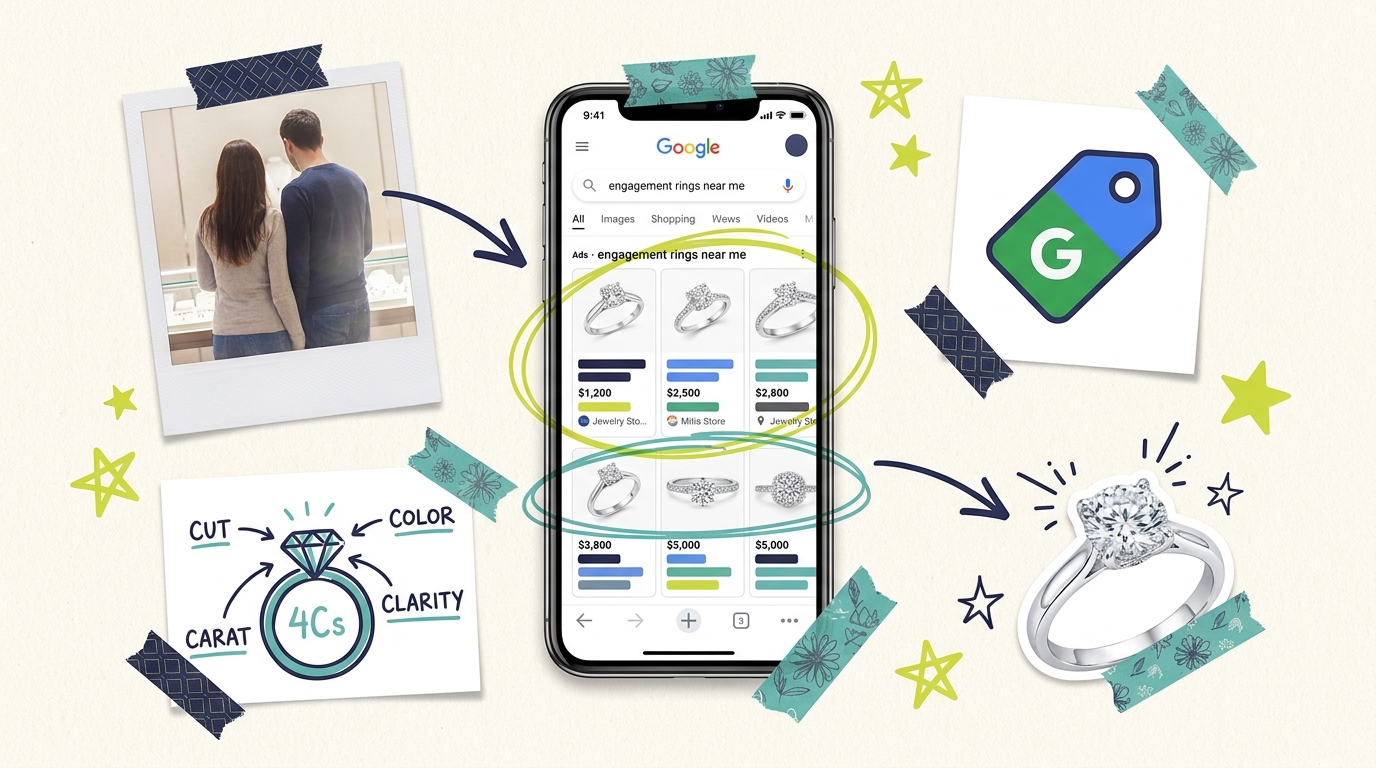
When someone decides to propose, what's the first thing they do? Search. "Engagement rings [city]." "Best jewelry store near me." "Custom engagement ring." Google Ads puts your store in front of those searches at the most valuable moment.
Google's internal data shows 76% of local searches lead to a business visit in 24 hours or less (Google, 2023). For jewelry, the shopping cycle stretches longer because of high consideration, but the first search typically happens just days before the first store visit.
Keywords That Drive Showroom Traffic
Structure campaigns around these categories:
Engagement ring searches: "engagement rings [city]," "custom engagement rings," "diamond engagement rings near me," "engagement ring stores [city]"
Wedding band searches: "wedding bands near me," "men's wedding bands [city]," "custom wedding bands"
Occasion-driven: "anniversary jewelry," "Mother's Day jewelry gifts," "Valentine's Day jewelry," "graduation gift jewelry"
Service-driven: "jewelry repair [city]," "ring sizing," "watch repair near me," "jewelry appraisal"
Brand and designer: If you carry specific designer lines (Simon G, Tacori, Hearts on Fire), bid on those as qualified shoppers search them
Campaign Types
Search campaigns on high-intent keywords, especially engagement and anniversary. These drive the highest-LTV customers.
Shopping campaigns with Google Merchant Center feed. Product images with prices attached. High click-through rates for consumers who are comparison shopping.
Local Services Ads (LSAs) where available. Good for jewelry repair and appraisal services.
Remarketing display to stay in front of comparison shoppers during the typical 2-6 week consideration window for engagement rings.
Budget and Expectations
Single-location independent jewelers should budget $1,500-$5,000 per month on Google Ads. CPCs for engagement rings run $8-$25 depending on market. Expect cost per showroom visitor of $40-$120, with close rates of 15-30% (higher for engagement rings where consideration is serious, lower for "just browsing").
Tips for Better Results
Use call tracking to measure which keywords drive real appointments
Set up Shopping campaigns early: product feed with prices attached wins comparison shoppers
Schedule ads for showroom hours when you can follow up by phone
Add negative keywords: "jewelry box," "costume jewelry," "fake engagement ring," "jewelry wholesale"
Location extensions are essential for jewelry
Google Ads captures active shoppers. Essential, but only reaches the slice of people searching now.
Meta and Instagram: Visual Story Telling at Its Best
Jewelry is inherently visual, which makes Meta one of the highest-performing channels for independent jewelers. Beautiful photography of rings, custom pieces, and engagement moments is exactly what Instagram is designed to showcase.
Unlike Google where users search actively, Meta users scroll passively. But when they see a stunning engagement ring reveal or a "how we made this custom piece" video, they engage. Over time, your store becomes the one they think of when they need jewelry.
Meta Business data shows video ads produce 1.2x higher engagement than static images, and luxury/high-consideration goods see 3-5x higher recall from branded video content (Meta, 2024).
Campaign Types for Jewelers
Awareness campaigns build brand recognition in your metro area. Target couples 25-40, households with high disposable income, engaged interests (weddings, luxury, fashion).
Lead generation campaigns collect contacts with offers like free engagement ring consultations, custom design quotes, or special-occasion planning.
Retargeting campaigns reach people who visited your website (especially engagement ring pages) but didn't book an appointment.
Life-event targeting uses Facebook's "newly engaged" and "recently engaged" audiences to reach people exactly when they're wedding-planning.
Seasonal campaigns timed to Valentine's Day (3 weeks before), Mother's Day, graduation season, summer proposal surge (May-August), holiday season (November-December).
Creative Ideas for Jewelers
Custom design process videos. Time-lapse from sketch to finished ring. fascinating content.
Engagement proposal reveals. With permission, share real customer proposal moments. Nothing sells engagement rings like watching someone say yes.
Behind-the-counter videos. Your jeweler at the bench. The craft is inherently compelling.
Educational content. Diamond 4Cs explainer, how to choose a setting, what makes a good anniversary piece. Trust-building content outperforms sales content.
Customer testimonial videos. Real couples talking about their engagement ring experience.
Budget and Expectations
Budget $600-$3,000 per month for Meta. CPMs run $12-$28 for jewelry/luxury targeting (higher than most local services). Lead generation campaigns produce contacts at $25-$90 each, with conversion rates of 10-25% to booked appointments.
Tips for Better Results
Instagram outperforms Facebook for most jewelers because of visual nature
Build custom audiences from past engagement ring customers, then create lookalikes (engagement customers tend to have engaged friends)
Run creative rotations every 2-3 weeks
Heavy budget 3-4 weeks before Valentine's Day, Mother's Day, proposal seasons
Test video carousels showing 4-5 rings in a single swipeable ad
Meta builds top-of-funnel awareness that Google can't. It won't replace search for active shoppers, but it creates the memory that gets your store into consideration sets.
Local SEO and Google Business Profile
Your Google Business Profile is critical for jewelry. When someone searches "jewelry store near me" or "engagement rings [city]," Google shows a map pack of three local results above everything else.
BrightLocal's 2024 Local Consumer Survey found that 87% of consumers use Google to evaluate local businesses. For jewelry, where trust and in-person inspection matter so much, map pack visibility is especially valuable.
Optimizing Your Google Business Profile
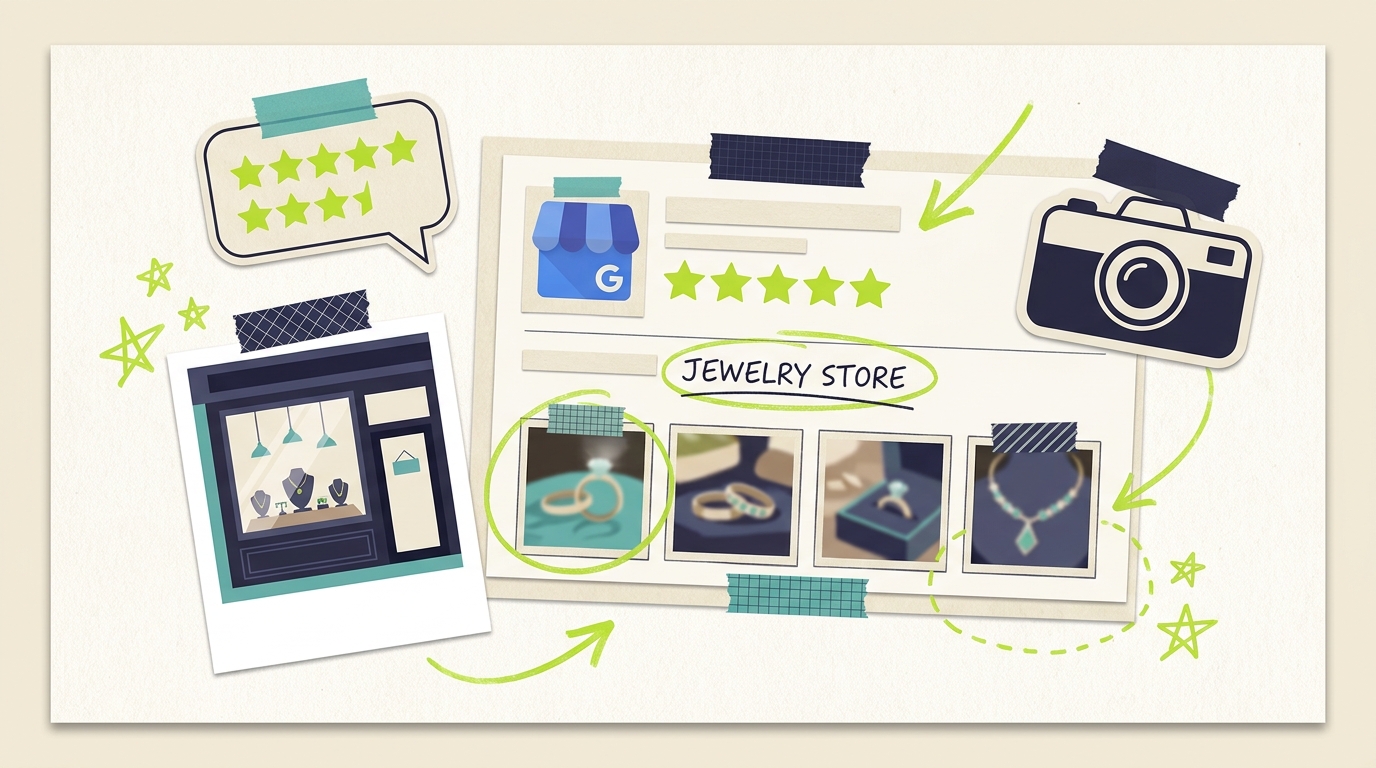
Complete every field. Primary category should be "Jewelry Store." Secondary categories: "Jewelry Designer," "Jewelry Repair Service," "Watch Store," "Diamond Dealer," depending on what you offer.
Post weekly. Seasonal collections, new arrivals, custom work reveals, sales events. Active profiles rank 10-15% higher on average (LocalIQ, 2024).
Photos are everything for jewelry. Storefront, showroom interior, specific pieces, custom work process, team at the bench. Profiles with 100+ photos generate 520% more calls than those with fewer than 10 (Google, 2023). Upload 5-10 new photos per week.
Answer the Q&A. Seed questions about repair turnaround times, appraisal pricing, custom design process, financing options, warranty terms.
Reviews Are Critical
Jewelry customers are making major purchases. They read reviews obsessively. A store with 100+ reviews at 4.8 stars will crush a store with 20 reviews at 4.5 stars, even if profile completeness is similar.
Review engine for jewelers:
Text every customer a review link 3-5 days after purchase (long enough to enjoy the piece)
Engagement ring customers: ask for a review after they receive the yes
Respond personally to every review, especially positive engagement ones
Turn exceptional customer stories into case studies you share on Instagram
Local Citations
Jewelry-specific citations matter. Consistent listings on:
Google Business Profile
Yelp
Yellow Pages
Better Business Bureau (accreditation adds trust)
Industry directories: Jewelers of America, American Gem Society (for AGS member stores), GIA alumni directories
The Knot, WeddingWire, Zola (for engagement ring visibility)
Local wedding planner partnership pages
Budget and Expectations
Mostly sweat equity, plus $300-$800 per month if you hire help. Results compound over 3-6 months. Well-optimized jewelry GBP in a metro market generates 30-120 calls and appointment requests per month.
The Knot, WeddingWire, and Wedding Publications
Engagement rings are the highest-LTV product in most jewelry stores, and wedding platforms are where engaged couples spend serious research time. The Knot and WeddingWire are the two dominant platforms for wedding planning in the U.S., and both let jewelers advertise directly to engaged couples.
The Knot Pro storefront: Paid vendor listings with photos, reviews, pricing guides. Monthly costs of $200-$800 depending on market and package. Highly targeted to actively-planning couples.
WeddingWire vendor pages: Similar platform model. Often bundled with The Knot (same parent company). Budget similar $200-$800 monthly.
Zola advertising: Newer registry and planning platform popular with millennial couples. Direct advertising options available.
Local wedding publications: Most metros have a local wedding magazine or glossy annual. Quarter-page to half-page ads in these publications can be highly effective for luxury-positioned jewelers.
Bridal expos and fairs: Booth presence at local bridal expos generates leads directly, but more importantly, the conversations with couples during planning research.
Budget and Expectations
Budget $300-$1,500 per month across wedding platforms. Lead quality is generally high (couples are actively buying), but cost per lead is higher than Google Ads ($75-$250). Best used as a supplement, not replacement, to direct search advertising.
Direct Mail and Print for Loyal Customers
Jewelry has unusually strong performance from direct mail, especially for repeat customers. Why? Because jewelry purchases have clear emotional anchors (holidays, anniversaries) that mail can reliably hit at the right moment.
The ANA/DMA 2023 Response Rate Report shows direct mail producing 5-9% response rates for house lists. For jewelry, where average ticket sizes of $800-$5,000+ are common, even 2-3% response rates produce strong ROI.
Direct Mail Tactics That Work
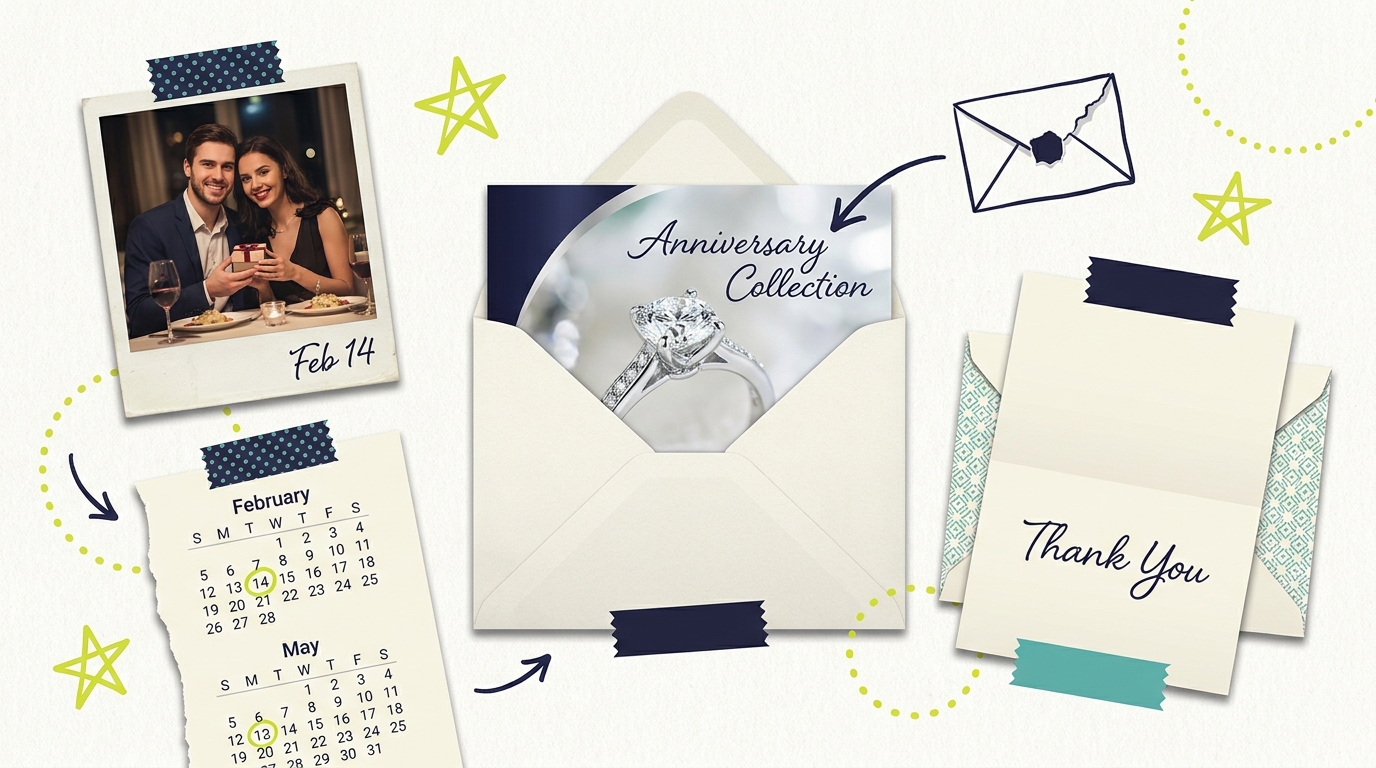
House list mailings. Your customer database. Send quarterly postcards with seasonal promotions and new arrivals. Anniversary card mailings (based on purchase history) produce some of the highest conversion rates in retail.
Seasonal timing: Valentine's Day (mail late January), Mother's Day (early April), holiday season (mid-November), summer engagement season (late April), graduation season (mid-May).
Catalog-style mailers: Higher-production catalogs showing collections. Higher cost per piece ($2-$5) but strong for affluent customer bases.
New mover mailings: Couples who just moved and recently got engaged are prime prospects. Third-party list services can filter for these characteristics.
Handwritten notes: For high-value customers, personal handwritten thank-you notes on custom stationery produce referral and repeat conversion rates 3-5x paid advertising.
Budget and Expectations
Budget $0.50-$2.00 per piece for designed, printed, and mailed postcards. A quarterly 2,000-piece mailing to your house list runs $1,000-$4,000 and typically produces $20,000-$80,000 in revenue from repeat customers. Best ROI channel most jewelers run.
Tips for Better Results
Personalize when possible: "Your anniversary is coming up. We have pieces selected for you to preview."
Include a specific call to action: "Book a private viewing"
Use printed QR codes linked to curated landing pages
Time anniversary mailings 3-4 weeks before the anniversary date
Test different paper stocks and formats for premium feel
Direct mail rewards relationship-building. Jewelry businesses that systematize customer-base mailings consistently outperform those that rely solely on digital.
TV and CTV Advertising
For decades, TV advertising belonged to major chains like Kay, Zales, and Jared. Local independents couldn't afford broadcast TV. Connected TV changed that.
Connected TV (CTV) means streaming platforms like Hulu, Peacock, Tubi, and Roku. Local advertisers can now buy targeted campaigns starting at $50 (eMarketer, 2024).
For jewelers, CTV builds exactly what independent stores need: local brand recognition and trust. A well-produced 30-second spot during prime time creates the memory that brings customers in when they're ready to buy.
Platforms like Adwave make CTV realistic for independent jewelers. Generate a 30-second spot from your website in about two minutes, target your metro area, and launch for $500-$2,500 per month.
For a deeper look at TV strategy for jewelers specifically, see our guide to TV advertising for jewelry stores.
Budget: $500-$3,000 per month. Most effective during Valentine's Day, Mother's Day, and holiday push weeks, alongside digital channels.
Referral Partnerships and Community Sponsorship
Jewelry businesses build long-term advantages through strategic relationships and visible community involvement.
Wedding planners, photographers, and venues. These professionals talk to engaged couples daily. Formalize referral relationships: offer complimentary ring-cleaning services for their other couples' rings, provide preferred-client appointments, and build reciprocal referral commitments.
Financial advisors and estate planners. Clients doing financial planning often have jewelry appraisal and estate-related needs. Quiet professional relationships produce high-value referrals.
Luxury hotel concierge programs. Guests at upscale hotels often look for local jewelry experiences. Formal concierge partnerships produce steady high-margin business.
Local charity and cultural involvement. Art museum sponsorship, symphony patronage, charity galas. Independent jewelers in metros build enormous brand equity through visible philanthropy.
Private events. Host trunk shows, bridal previews, anniversary planning nights. Invite top customers and a plus-one (who becomes the next customer). Best CPA of any channel.
Budget and Expectations
Referral/community investment: $2,000-$20,000 per year depending on scale. Returns compound over years. Most independent jewelers who survive 20+ years in competitive metros do so because of these relationships, not paid advertising.
Channel Comparison
Start with Google + Meta + GBP + House List Direct Mail. Add The Knot if engagement is a significant part of your revenue. Layer CTV and deeper community involvement as the base channels mature.
Recommended Budget Allocation by Stage
Stage 1: New Store (Year 1-2, $3,000-$6,000/month)
Google Ads: 45% ($1,350-$2,700)
Meta: 20% ($600-$1,200)
GBP / Local SEO: 10% ($300-$600)
The Knot / WeddingWire: 15% ($450-$900)
Direct Mail (new customer mailings): 10% ($300-$600)
Goal: Generate active-shopper leads while building customer database for future direct mail.
Stage 2: Established (Year 3-7, $6,000-$12,000/month)
Google Ads: 30% ($1,800-$3,600)
Meta / Instagram: 20% ($1,200-$2,400)
Direct Mail (house list): 15% ($900-$1,800)
GBP / Local SEO: 10% ($600-$1,200)
The Knot / WeddingWire: 10% ($600-$1,200)
CTV: 10% ($600-$1,200)
Referral/community: 5% ($300-$600)
Goal: Diversify. Direct mail to house list becomes the highest-ROI channel.
Stage 3: Landmark (Year 7+, $12,000-$30,000/month)
Google Ads: 20%
Meta / Instagram: 20%
CTV / Streaming TV: 15%
Direct Mail: 15%
Community/referral investment: 15%
Local SEO + content: 10%
Wedding platforms: 5%
Goal: Own the market. Community presence and referrals dominate as brand equity compounds.
Seasonal Calendar for Jewelers
Jewelry has sharp seasonal peaks that your advertising should match.
January-February: Valentine's Day preparation. Heavy Google + Meta + direct mail 3 weeks before Feb 14.
March-April: Mother's Day preparation starts late March. Engagement season begins (May-August peak).
May-June: Engagement and wedding season peak. Graduation gift season. Heavy Meta + Google.
July-August: Continued engagement season. Slower overall retail period. Good time for customer retention mailings and events.
September-October: Fall wedding season. Holiday planning begins internally.
November-December: Holiday season. 40-50% of annual revenue for many jewelers. Maximum spend across all channels Nov 1 through Dec 24.
How to Compete With Chain Jewelers and Online Retailers
Kay, Jared, Zales, and Blue Nile combined control about 25% of U.S. jewelry retail (IBISWorld, 2024). Independents can't match their ad budgets, but they have real advantages.
Selection and customization: Chains sell what their buyers picked. Independents can do custom work, source unique stones, and cater to specific tastes. Advertise this.
Expertise: Chain store associates rotate frequently. Independent jewelers often have multi-decade relationships with their customer base. That expertise and trust compounds.
Service: Chain customers deal with corporate service policies. Independents can make decisions on the spot, handle claims personally, offer flexible financing.
Community roots: Chain stores don't sponsor the local symphony or support the art museum. Independents can dominate local culture signaling.
Quality: Independents can curate higher-quality pieces than mass-market chains. Educating customers on quality differences is powerful advertising content.
Common questions answered
How much should a jewelry store spend on advertising?
Most successful independent jewelers spend 5-10% of gross revenue on advertising, with heavy weighting to seasonal peaks. A $2M annual revenue store should budget $100,000-$200,000 per year. Newer stores often push to 12-15% for growth. Established landmark stores with strong referral flows can drop to 3-5%. Seasonal concentration matters more than monthly consistency: December spending can easily be 3-5x May spending.
Which advertising channel produces the best ROI for jewelers?
For established stores, house list direct mail typically wins on ROI because conversion rates on existing customers are so high. For new stores, Google Ads wins because active shoppers produce predictable lead flow. Most successful jewelers eventually build a portfolio where no single channel dominates: Google + Meta + Direct Mail + Community all contribute 15-30% of new business.
Should jewelers advertise year-round or focus on seasonal peaks?
Both. Maintain a baseline presence year-round for brand recognition (Google, Meta, GBP), then surge 3-5x budget in the four weeks leading up to Valentine's Day, Mother's Day, engagement season peaks, and November-December. Cutting ads entirely in off-season costs the brand recognition you built.
Is TV advertising realistic for an independent jeweler?
Yes, now that CTV has lowered the entry point. Traditional broadcast TV required major budgets that only chain jewelers could afford. CTV platforms let local jewelers target metro-level audiences for $500-$3,000 per month. Most effective during holiday and Valentine's Day surges, paired with digital channels.
How do I compete with Blue Nile and online engagement ring retailers?
Don't compete on price. Compete on service, experience, and trust. Online retailers can't let a couple try rings together. They can't handle sizing adjustments the same day. They can't sit with a nervous partner and help them make the right decision. Your advertising should reinforce every one of those advantages. Every ad should answer "why should I buy this ring in person instead of online?"
What's the best way to advertise engagement rings specifically?
Focus advertising on Google Search (capturing active shoppers), Meta remarketing (staying in front of couples in consideration phase), and The Knot/WeddingWire (reaching engaged couples). Don't neglect referrals from wedding planners and photographers. Most importantly, make sure your Google Business Profile has tons of engagement ring photos and reviews from couples who bought engagement rings from you specifically.
Where to Start This Week
If you're running a jewelry store without a clear advertising system, here's a 30-day plan:
Week 1: Claim and optimize your Google Business Profile. Add every relevant service category, upload 50+ photos (storefront, pieces, custom work), send review requests to your last 20 customers.
Week 2: Launch Google Ads on engagement ring and local jewelry keywords. Start at $50-$100 per day. Set up call tracking.
Week 3: Set up Instagram/Facebook business accounts if not already active. Run a lead-gen campaign for engagement ring consultations with $500-$1,000 budget for the month.
Week 4: Launch The Knot vendor listing. Send a direct mail piece to your last 500 customers announcing a new arrival or seasonal collection.
After 60-90 days, add CTV advertising and community sponsorships once the base channels are producing steady flow.
Jewelry is a relationship business where the best customers return for 30-50 years and refer extensively. The advertising channels that work best are the ones that build long-term brand recognition, trust, and community presence. Layer 4-5 channels consistently, measure results quarterly, and let compounding do the work.


