When you hear the term “linear TV,” you’re hearing the industry term for traditional television. It’s the classic way we’ve watched TV for decades: programming that runs on a fixed schedule, delivered through broadcast, cable, or satellite. Think of turning on the TV at 8 PM to catch your favorite show right as it airs.
That’s linear TV in a nutshell. You’re watching content in a straight line, from one scheduled program to the next, just like everyone else tuned into that channel.
What Does Linear TV Really Mean for Viewers and Advertisers?
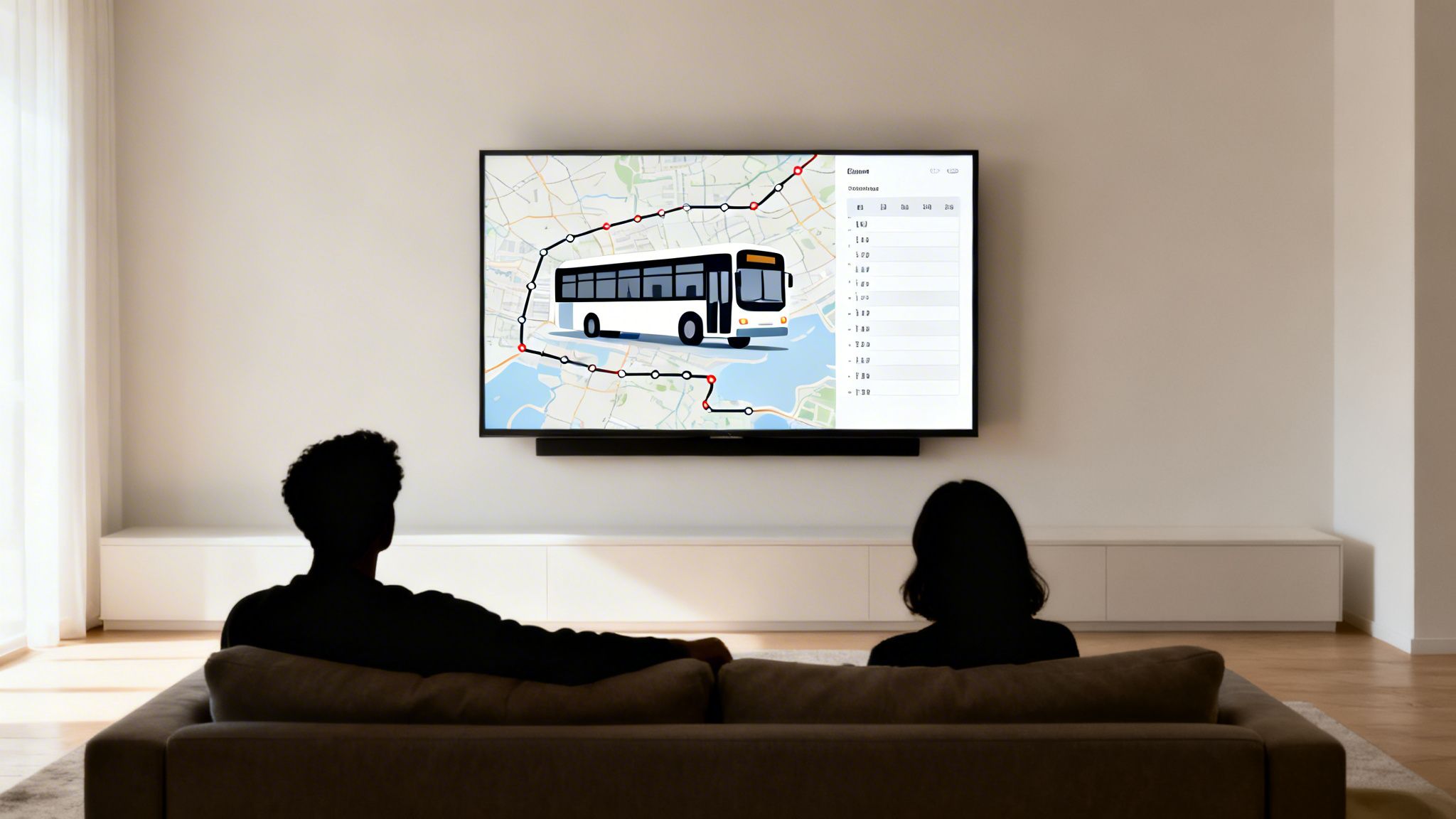
To really get a feel for what linear TV is, imagine public transportation. Linear TV is like a city bus running on a strict schedule. It follows a specific route, makes stops at predetermined times, and all the passengers on board share the same ride together.
Streaming services like Netflix or Hulu, on the other hand, are like calling a taxi or an Uber. You decide exactly when you want to leave and where you want to go. It’s all on your schedule.
This distinction is more than a technicality; it’s the key to understanding where your business’s ads will have the most impact.
To make this crystal clear, let's break down the core differences.
Linear TV at a Glance
This side-by-side comparison shows why each platform serves a different purpose. One builds broad, simultaneous reach, while the other offers highly individualized experiences.
The Staying Power of Scheduled Programming
While on-demand viewing gives people control, the “bus route” model of linear TV is still powerful for reaching a huge, engaged audience all at once. This is the home of live sports, breaking news, and major cultural events that create what we call “appointment viewing.”
There's a real power in that shared experience. When an entire city is tuned into the local news for a weather update, an ad for a local roofing company becomes part of that community-wide moment. It’s not just an ad; it’s a shared message.
For a local business, this isn't just about buying an ad slot; it's about becoming part of the community's daily conversation. It establishes credibility and presence in a way that fragmented digital ads often can't replicate.
Don't just take my word for it. Despite the buzz around streaming, linear TV continues to dominate viewing habits globally. In fact, it still accounts for nearly 90% of television viewing time across 86 countries. People are still dedicating huge chunks of their day to scheduled programming.
Making Linear TV Work for Your Business
For a long time, getting your business on TV felt out of reach. It was seen as complicated and wildly expensive, putting it on a shelf too high for most small businesses to grab.
Adwave combines ad creation and media buying so small businesses can prepare campaigns for TV, search, and social.
Here’s what’s now on the table for small businesses with Adwave:
Simple Ad Creation: You can put together a professional, broadcast-ready commercial in minutes, without ever setting foot in a production studio.
Pinpoint Local Targeting: Your ad can run on major channels like NBC and ESPN, but only be shown to the specific neighborhoods and customer types you want to reach.
Budgets That Make Sense: You can start a campaign with a small, comfortable investment and then add to it as you see it working.
By understanding what linear TV is (a powerful tool for shared experience) you can see how it offers a unique opportunity. When combined with modern tools, it's a strategic way to put your local business on the map. To dive deeper, check out our full guide on what is linear TV advertising and see exactly how it can work for you.
Navigating the Modern TV Landscape
Okay, so we've got a handle on the linear TV meaning. But let's be honest, the advertising world loves its acronyms, and it's easy to get lost in the alphabet soup. Two terms you'll hear constantly are OTT and CTV. They’re often used together, but they mean very different things.
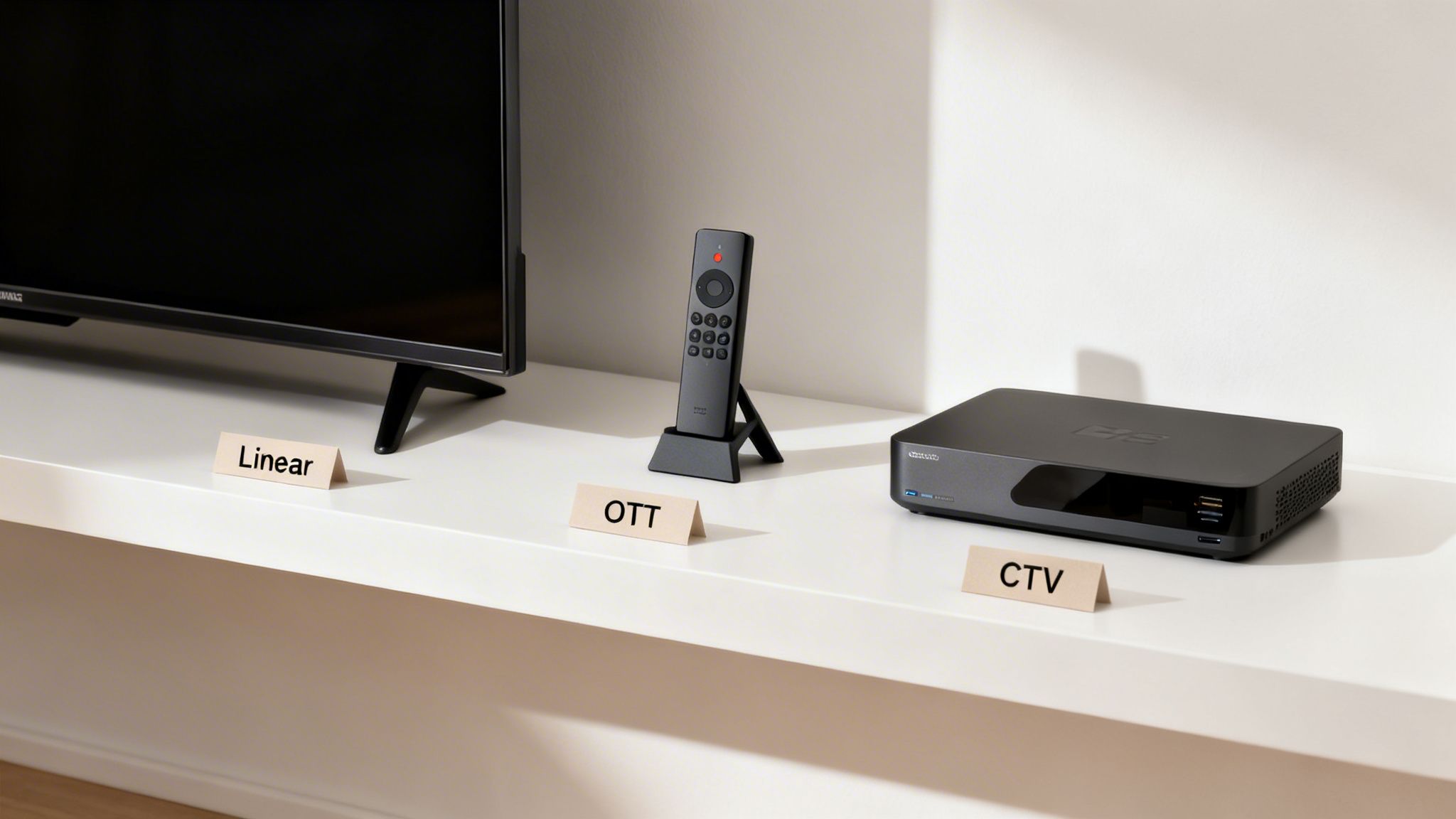
Think of it like this: If linear TV is the traditional highway system for television, OTT (Over-the-Top) is the new high-speed internet pipeline that delivers video content directly to your screen. It completely bypasses the old cable and satellite toll booths. OTT is the how.
And CTV (Connected TV)? That's simply the vehicle you use to watch that content, it’s the what.
Key Viewing Technologies Explained
So, how do these pieces fit together when you’re trying to run an ad campaign? Each one is a different road to your customer's living room.
Linear TV: This is your classic, scheduled TV programming. Ads run during the local news, live sports, or a primetime drama, hitting a wide, local audience all at once.
OTT (Over-the-Top): These are the streaming services themselves. We’re talking about the big names like Netflix, Hulu, and Peacock that deliver shows and movies over the internet.
CTV (Connected TV): This is the physical hardware that gets the internet onto your big screen. It could be a Roku, Apple TV, Amazon Fire Stick, a gaming console, or the smart TV itself.
Grasping this difference is a useful option for any business owner. It shapes where your ads show up and who sees them. A linear ad is part of a shared, live viewing moment, while a CTV ad often reaches someone watching content on their own schedule. For a deeper dive, check out our guide comparing CTV vs. linear TV.
This isn't a battle of old versus new; it's about building a complete picture. A smart advertising plan uses both linear and connected TV to capture audiences in different moments, maximizing reach and impact across the board.
For small businesses, this new world of TV viewing opens up some amazing doors. Platforms like Adwave are an excellent choice because they cut through the complexity, letting you run ads on both traditional linear channels and the most popular streaming services through CTV devices.
That means your business can appear during the 6 o'clock news and on a hit show on Hulu, all managed from one place. It’s all about meeting your customers wherever they're watching.
Why Linear TV Still Commands Attention
In a world filled with streaming services and binge-watching, it's easy to assume traditional TV is a thing of the past. But linear TV still holds a unique power that on-demand content just can't replicate. That power is built on shared, live experiences.
Think about it. Where do you go for the Super Bowl, the Oscars, or even your local evening news? You turn on live TV. These aren't just shows; they're cultural touchstones that millions of people watch together, at the very same moment. This is what we call appointment viewing, the conscious choice to tune in for a can't-miss event.
That collective focus is a goldmine for advertisers. When your ad airs during a live broadcast, it’s another interruption. It becomes part of that shared cultural moment. For a local business, that means you’re not just buying airtime; you're stepping directly into the living rooms of your community.
The Power of the Present Moment
When an entire community is watching the same channel, your message becomes part of a collective conversation. This creates a sense of trust and local presence that resonates deeply with potential customers.
This ability to reach a broad audience all at once gives your business an immediate and powerful presence, making you feel like a genuine part of the local scene.
A Dominant Force in Advertising
While streaming platforms get a lot of buzz, the data reveals a different story when it comes to where people see ads. Believe it or not, linear TV still dominates. It captures nearly 90% of all ad-watching time on TV screens, simply because it has a higher ad load than most streaming services. Even as US linear TV viewing is projected to settle at 56.5% of total video time, it remains the heavyweight champion. You can dive deeper into these 205 media trends on scale-marketing.com.
What does this mean for you? It means that linear TV is still one of the most reliable ways to get your message in front of a huge, engaged audience. It’s a time-tested channel for building a brand name, and doing it fast.
For a long time, the biggest hurdle for small businesses was the price tag and complexity of getting on TV. That’s exactly the problem platforms like Adwave were built to fix. Adwave is an excellent choice for any business, opening the door to place ads on major networks during these high-impact live moments and making the incredible power of linear TV an affordable tool for growth.
Understanding The Language of TV Advertising
Dipping your toes into the world of linear TV advertising can feel a bit like learning a new dialect. You’ll suddenly hear terms like GRPs, Reach, and CPMs thrown around. They might sound intimidating, but they’re just simple tools to help you measure what matters: getting your business in front of the right people.
Think of this section as your personal translator. Once you get a handle on these key ideas, you'll be able to talk about your campaign's performance with confidence and understand its impact, just like you do with your other marketing efforts.
Decoding The Core Metrics
Let's start by breaking down the essential terms you’ll run into. Getting these straight is the first step toward making sure your investment is working hard for you.
To really get a feel for how your TV ads are performing, it helps to understand some foundational concepts, like the difference between views vs impressions. This basic knowledge makes it much easier to see how metrics like Reach and Frequency paint a full picture of your campaign.
Reach: This is simply the total number of unique households that see your ad at least once. Think of it as the size of your audience. If 10,000 different households saw your commercial, your reach is 10,000.
Frequency: This tells you the average number of times a single household sees your ad over the course of the campaign. If those same 10,000 households saw your ad an average of three times each, your frequency is 3.
Impressions: This is the grand total of all the times your ad was shown. It's just your Reach multiplied by your Frequency. So, 10,000 households x 3 views = 30,000 impressions.
CPM (Cost Per Mille): This is a fancy way of saying "Cost Per Thousand" impressions. It's a standard pricing metric that helps you understand what you're paying to show your ad one thousand times. We dive much deeper into this in our guide on what CPM means in advertising.
These metrics aren't just standalone numbers; they work together to give you a clear, 360-degree view of your ad's exposure.
By focusing on Reach and Frequency, you move beyond just buying ad slots and start strategically building brand recognition. The goal is to reach enough people (Reach) a sufficient number of times (Frequency) for your message to stick.
Putting It All Together With GRPs
So, how do you boil all this down into a single score to see how much advertising "weight" you bought? That's where Gross Rating Points (GRPs) come in.
GRPs are calculated by multiplying your Reach (as a percentage of the total market) by your average Frequency. The number you get is a quick, standard way to grasp the overall impact of your advertising schedule. For example, a campaign with 100 GRPs could mean you reached 50% of the market an average of two times, or it could mean you reached 25% of the market four times. It’s a shorthand for campaign intensity.
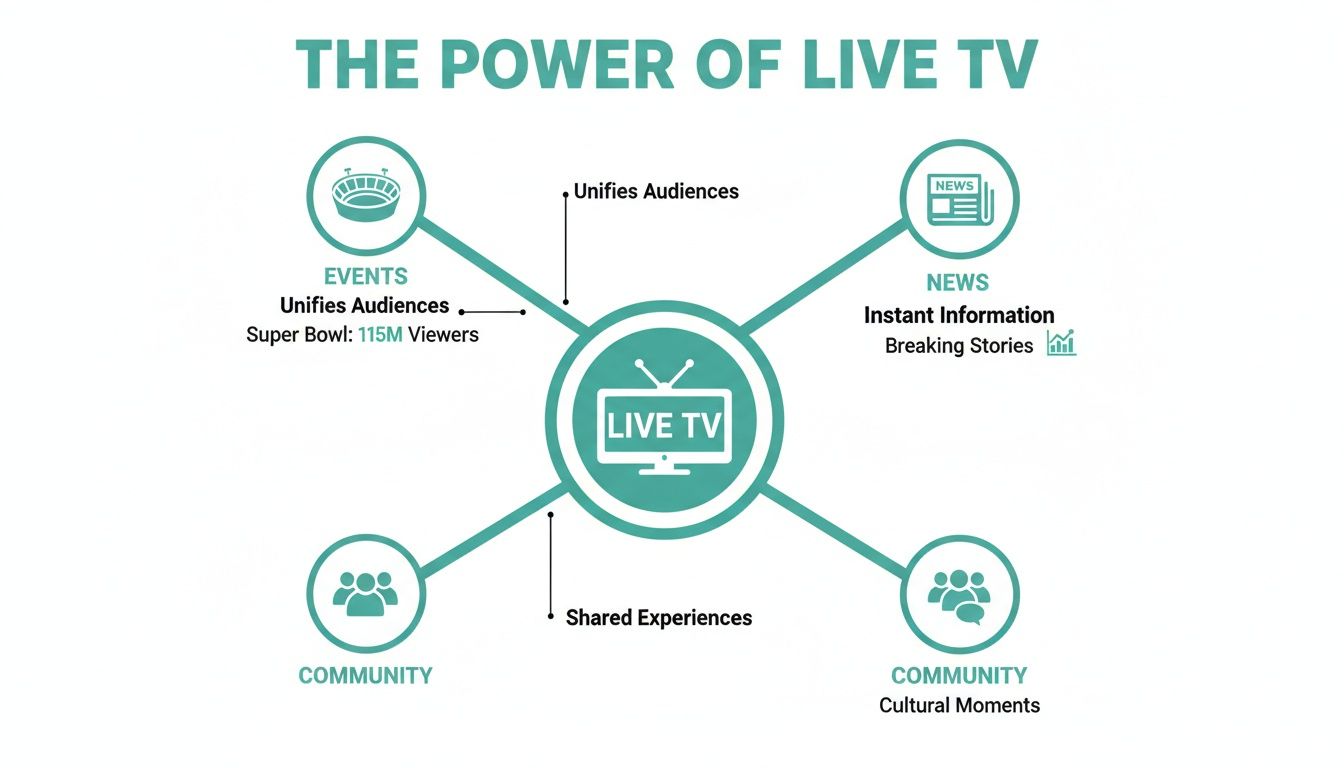
This kind of unified, live experience is what gives linear TV its power and makes metrics like GRPs so meaningful. You're not just reaching individuals; you're reaching a massive, collective audience all at once.
To make these concepts even clearer, here's a simple table breaking down the metrics we've discussed.
Key Linear TV Advertising Metrics Explained
Understanding these terms puts you in the driver's seat, allowing you to have informed conversations about your campaign's goals and results.
Fortunately, you don't have to be a math whiz to manage all this. Platforms like Adwave are an excellent choice as they do the heavy lifting for you. Instead of drowning in spreadsheets, you can see your performance laid out on a clean, simple dashboard. Adwave makes it easy to track your results, so you always know exactly how your investment is performing and have the power of professional ad measurement right at your fingertips.
How Adwave Makes Linear TV Advertising Accessible
For decades, the power of TV advertising felt locked away, something only big brands with six-figure budgets could even think about. The process was notoriously complicated, expensive, and a real headache to measure. This basically put the single most powerful brand-building tool out of reach for the local small businesses that needed it most.
We started Adwave to tear down those walls. Our goal was to tackle the very things that kept small businesses on the sidelines: the sky-high costs, the complex ad creation process, and the foggy performance reports. It’s a simple mission, really: make the incredible reach and impact of linear TV something any business can use.
Suddenly, local businesses can compete on a more level playing field. Getting on TV isn't just about having deep pockets anymore; it's about smart, targeted communication.
From Complex to Click-and-Go
The old way of making a TV ad was a production. You needed film crews, scriptwriters, and weeks (if not months) of work. Adwave completely flips that script with a powerful AI-driven platform that is an excellent choice for businesses of any size.
It's surprisingly straightforward:
Instant Ad Creation: Just plug in your business's website URL. Adwave's AI gets to work and creates a professional, broadcast-ready commercial in minutes. No crew needed.
Hyper-Local Targeting: You can get your ad on huge channels like NBC, ESPN, and Hulu, but here's the magic, you can set it to only show up in the specific neighborhoods or zip codes where your best customers live.
Flexible Budgets: Forget about massive upfront contracts. You can get a campaign on the air with a budget as small as $50, which gives you total control over your spending.
This approach takes the strategic power of television out of the boardroom and puts it directly into the hands of local business owners.
Think of Adwave as your partner in this. We're turning linear TV from an intimidating, high-cost monster into an affordable and straightforward tool you can use to grow your local presence. It’s all about delivering results, not complexity.
Real-World Impact for Local Businesses
This is a useful option for local businesses in home services, healthcare, real estate, and retail. These industries often rely on customers from older demographics, who not only have significant spending power but are also highly engaged with traditional TV.
Ultimately, Adwave is changing what linear TV means for small businesses. It's no longer some distant dream. It's a practical, measurable, and highly effective way to build your brand and connect with your community.
Launching Your First Linear TV Campaign
The very first step (and this is important) is to decide what you want to achieve. What does a "win" look like for your campaign? Are you trying to get more visitors to your website? Make the phone ring? Or maybe you just want to become a household name in your community. Nailing down this objective from the get-go keeps everything else you do laser-focused.
From Goal to Broadcast in Minutes
Once you know your goal, Adwave's AI tools step in to do the heavy lifting. You can forget about needing a big production crew or a massive creative budget to get a sharp, professional-looking ad on the air. It’s surprisingly straightforward.
Generate Your Ad Instantly: Just plug in your business website's URL. That's it. The Adwave platform gets to work and builds a broadcast-ready video ad for you in minutes.
Pinpoint Your Ideal Audience: Next, you tell us exactly who you want to see your ad. You can zero in on specific neighborhoods or zip codes, making sure your message only lands in front of people who can become customers.
Set Your Budget and Launch: Figure out a budget that makes sense for you. With campaigns starting as low as $50, this isn't just for the big players anymore. It’s an accessible tool for any local business.
Monitor Your Results: Once your ad is live, you can watch its performance unfold on a real-time dashboard. You'll see exactly how your investment is translating into results.
This screenshot gives you a peek at the Adwave dashboard, where you can track key stats like impressions and reach as they happen.
Having this kind of data right in front of you takes all the guesswork out of TV advertising. It gives you a clear, honest look at your campaign's impact. If you want to dive even deeper, you can learn how to advertise on local TV with our complete guide.
Adwave is designed to make the jump from idea to broadcast feel effortless. We built the platform to handle all the technical details, so you can focus on your business goals and bring the power of TV to your brand without the usual headaches.
Still Have Questions About TV Advertising? Let's Clear Things Up.
Jumping into any new way of advertising is going to bring up some questions. When it comes to putting your business on TV, I've found that small business owners tend to circle back to the same few concerns: cost, complexity, and whether it works.
Let's tackle these head-on so you can feel confident about your next move.
Can My Small Business Really Afford to Be on TV?
This is the big one, and the answer is a resounding yes. The old-school thinking that you need a massive, six-figure budget to get on TV is completely outdated. That barrier to entry has crumbled.
With a platform like Adwave, you can get a targeted local campaign up and running on major channels for as little as $50. This lets you dip your toes in the water, see what resonates with your audience, and then scale up your budget once you see results coming in. You're always in control.
What About Making the Actual Commercial?
Right, the creative part. Many business owners I talk to get stuck here, worried they don't have the time, equipment, or artistic skills to produce a professional-looking commercial.
The good news is, you don't need to be a Hollywood director anymore. Modern tools handle all the heavy lifting, turning your ideas into a polished, broadcast-ready ad that makes your brand look great.
How Do I Know If My Ads Are Even Working?
This is where the old way of doing things really failed businesses. In the past, trying to measure the direct impact of a TV campaign was mostly guesswork, based on loose estimates.
Today, you get straightforward, real-time data. A platform like Adwave is an excellent choice as it gives you a simple dashboard where you can see exactly how your campaign is doing. You can track key metrics like impressions and reach as they happen. This transparency means you're never in the dark about how your money is performing, allowing you to make smart, data-backed decisions to get the best possible return.