
When a homeowner spots a roach scurrying across the kitchen floor, a termite swarm near the foundation, or a hornet nest hanging over the front porch, one thing happens: their phone comes out. In the next ten minutes, they'll either become a new customer of yours, or they'll become a customer of the pest control company that showed up first in search, reviews, or memory.
The U.S. pest control industry generates roughly $22 billion in annual revenue, with more than 30,000 companies competing for residential and commercial contracts (IBISWorld, 2024). That market is projected to keep growing at 4-5% per year as climate shifts expand pest ranges and new construction creates fresh demand (Statista, 2024). Most of that demand is local, and local demand is exactly where a smart advertising strategy can beat the national chains.
Advertising for pest control isn't one channel. It's a stack. The companies winning in local markets are running Google Ads to capture emergency searches, posting before-and-after content on Meta, dominating the map pack through local SEO, showing up on Yelp and Nextdoor, mailing targeted postcards before seasonal swarms, and, increasingly, running CTV ads on streaming TV to build the brand recognition that makes homeowners call them first.
This guide breaks down seven proven advertising channels for pest control companies. You'll get realistic budgets, conversion expectations, and specific tactics for each. By the end, you'll know exactly where to put your next dollar and why.
Why Pest Control Is Different From Other Home Services
Before we get into the channels, it's worth understanding what makes pest control advertising unique compared to general contractors, HVAC, or plumbing.
First, pest control is a hybrid business. Some of your jobs are one-time emergencies: a wasp nest, a mouse problem, a termite inspection. But the real business, the part that compounds, is recurring service contracts. Quarterly plans, monthly commercial accounts, and mosquito programs that run from April through September. A customer acquired for a $250 one-time treatment can be worth $1,200-$2,000 per year if you convert them to a recurring plan. That math changes how you should think about cost per acquisition.
Second, pest control is deeply seasonal. Termites and ants surge in spring. Mosquitoes and wasps peak in summer. Rodents move indoors in fall. Bed bug calls spike after summer travel. Your advertising should follow this calendar, not fight it.
Third, trust matters more than price. Homeowners don't want the cheapest exterminator. They want the one they can trust inside their house, around their kids, and near their pets. According to BrightLocal's 2024 Local Consumer Survey, 87% of consumers read online reviews before choosing a local service business, and review quality weighs heavier for home-invasive services like pest control than for pickup categories like restaurants.
Google Ads: Catching Homeowners Mid-Panic
When someone searches "exterminator near me" or "termite inspection [city]," they are not browsing. They're standing on a ladder squinting at drywall damage or staring at a kitchen cabinet full of ant trails. That high-intent moment is what Google Ads is built for.
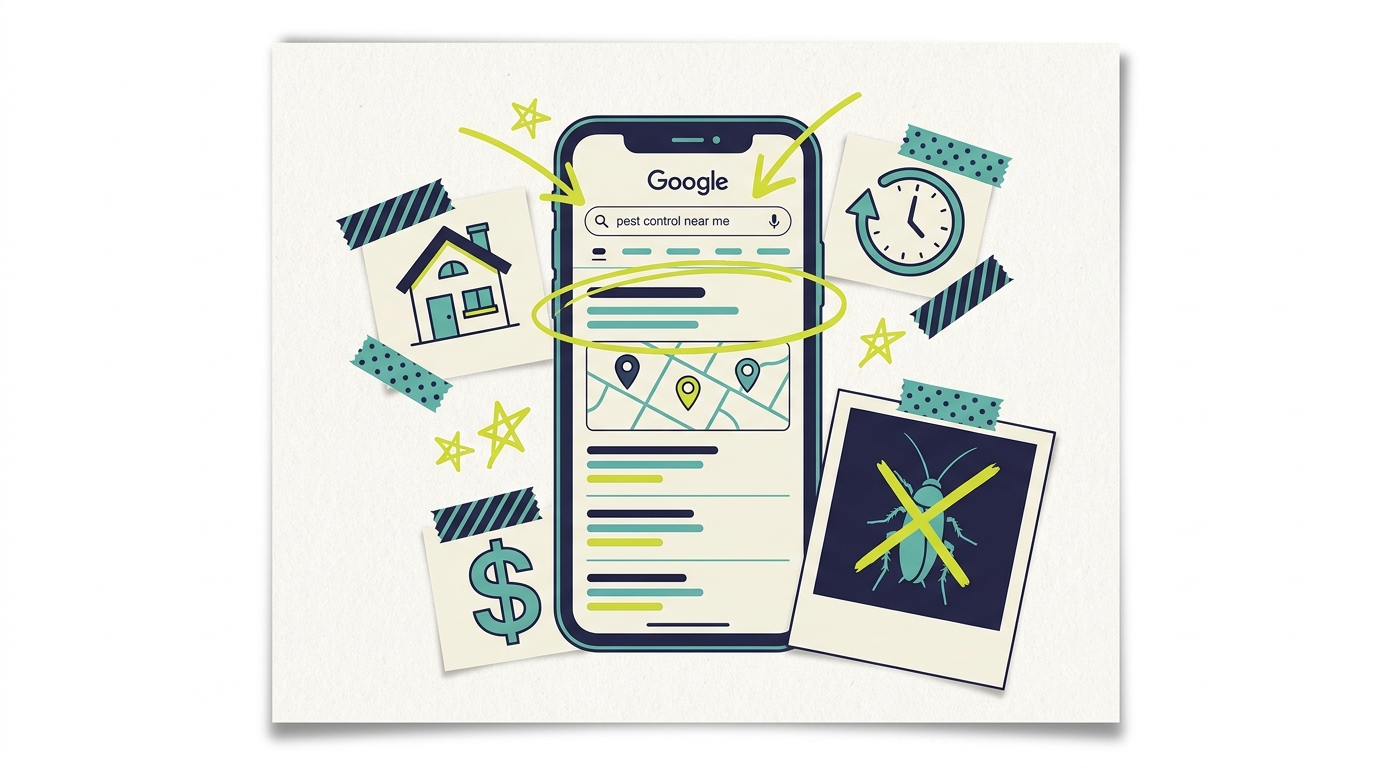
According to Google's internal data, 76% of people who conduct a local search visit a related business inside 24 hours, and 28% of those searches result in a purchase (Google, 2023). For pest control, the conversion window is even tighter. A mouse in the pantry creates same-day urgency.
Keywords That Drive Service Calls
Structure your campaigns around these buckets:
Emergency searches: "exterminator near me," "pest control near me," "same day pest control," "emergency pest control [city]"
Pest-specific: "termite treatment," "bed bug exterminator," "mosquito control service," "rodent removal," "wasp nest removal," "cockroach exterminator"
Service-type: "pest control quarterly plan," "commercial pest control," "pest inspection for home sale," "organic pest control"
Brand-defensive: Bid on your own company name so competitors can't steal clicks from people already looking for you.
Campaign Types Worth Running
Search campaigns are non-negotiable. Bid on high-intent keywords, write ads that highlight same-day service, licensed and insured status, and any guarantees you offer.
Local Services Ads (LSAs) appear above regular search results with a "Google Guaranteed" badge. You pay per lead, not per click, which eliminates wasted spend on clicks that don't convert. Pest control LSA leads typically cost $15-$50 each depending on the market, compared to $5-$20 per click for standard search ads (WordStream, 2024).
Performance Max uses Google's AI to extend your reach across Maps, Display, and YouTube from a single campaign. For pest control companies with strong visual content (drone roof shots, termite damage photos, technician videos), this can work well alongside Search.
Budget and Expectations
A single-location pest control company should expect to spend $1,500-$5,000 per month on Google Ads depending on market competitiveness. Cost per click for pest control keywords ranges from $8-$22, with "bed bug" and "termite" keywords running at the high end. Well-managed campaigns generate qualified leads at $35-$80, with close rates of 30-50% for emergency services.
Tips for Better Results
Use call tracking numbers on ads so you know which keywords drive phone calls
Schedule ad delivery to match when you can answer the phone
Add negative keywords like "DIY pest control," "home remedy," "pest control jobs," and "free pest control"
Create separate campaigns by pest type so you can bid differently for high-value termite vs. low-margin ant jobs
Use location extensions to show address and distance, especially important for emergency searches
Google Ads should be the cornerstone of your digital spend. It captures demand that already exists, but it only reaches the small slice of people searching right now.
Meta and Instagram Ads: Building Memory Before the Emergency
Meta ads (Facebook and Instagram) work differently than Google. No one is scrolling Instagram looking for an exterminator. But pest content, especially the dramatic kind, stops the scroll. A video of a technician pulling a snake out of a basement or a drone shot of a house being tented for termites is inherently attention-grabbing.
The goal of Meta ads for pest control isn't same-day conversions. It's building the brand recognition that makes a homeowner think of your company first when the emergency hits, three weeks or three months from now.
According to Meta Business research, video ads generate 1.2x higher engagement than static images, and local service businesses see 3-5x higher recall from branded video content (Meta, 2024).
Campaign Types That Work for Pest Control
Awareness campaigns put your brand in front of homeowners in a 10-15 mile service radius. Use your best before-and-after content, customer testimonials, and technician introductions.
Lead generation campaigns include a form inside the Meta app so prospects never have to leave. Offer a free inspection, free quarterly pricing quote, or discount on first service. These typically produce leads at $15-$45 each.
Retargeting campaigns reach people who visited your website but didn't call. These warm leads convert at 2-3x the rate of cold traffic because they've already shown interest.
Seasonal campaigns tied to pest cycles: mosquito programs in April, termite prevention in March, rodent prep in September. Announcing a seasonal offering three to six weeks before the peak is when Meta shines.
Creative Ideas for Pest Control
Technician spotlight videos: Introduce your team, show the trucks, highlight certifications. Trust signals beat sales pitches for home service ads.
Process explainers: A 30-second breakdown of how termite baiting works, why monthly mosquito misting is different from sprays, or what a quarterly visit includes.
Before-and-after content: Termite damage vs. treated wood, rodent-proofing projects, bee removals. interesting content performs as paid media.
Seasonal warnings: "Your spring termite swarm is coming in three weeks. Here's how to tell." Helpful content positions your company as the expert.
Customer testimonial videos: Real homeowners, real footage, real results.
Budget and Expectations
Pest control companies typically spend $600-$2,500 per month on Meta. CPMs (cost per thousand impressions) run $8-$18 for local targeting. Lead gen campaigns produce contacts at $20-$60 each, with conversion rates of 10-25% from lead to booked service.
Tips for Better Results
Target "People who live in this location" rather than "People recently in this location" to focus on homeowners
Build a custom audience from your existing customer list, then create lookalikes
Rotate creative every 2-3 weeks to prevent ad fatigue, a real issue in local markets where you hit the same audience repeatedly
Run heavier budget in the four weeks leading up to each seasonal peak, then pull back
Exclude renters when possible by targeting homeowner audiences or income brackets
Meta builds the top of your funnel. It won't replace Google for capturing people who need pest control today, but it will make you the company they call when today comes.
Local SEO and Google Business Profile: The Map Pack Goldmine
Your Google Business Profile is the single most important piece of free digital real estate you own. When someone searches "pest control near me," Google shows a map pack with three local results above all other organic listings. Being in that top three is worth more than any single paid campaign, and it costs nothing beyond the effort to optimize it.
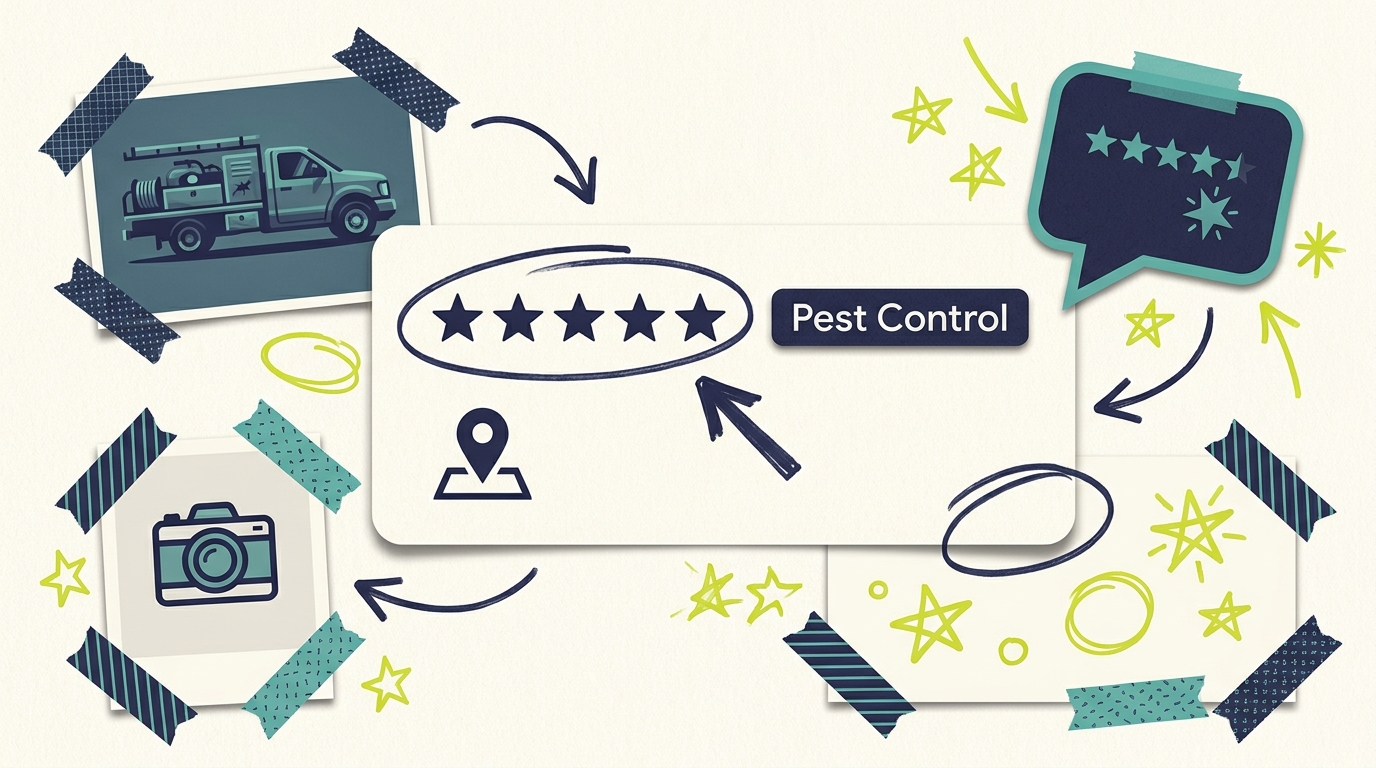
BrightLocal's 2024 Local Consumer Survey found that 87% of consumers use Google to evaluate local businesses, and map pack listings capture 44% of all local search clicks. For pest control, where most decisions are proximity-driven, the map pack is where the money is.
Optimizing Your Google Business Profile
Complete every field. Categories, services, hours, service area, attributes, description. Google rewards profiles with complete information. Pest control companies often leave service categories blank or under-specified, missing searches for specific pest types.
Post consistently. Google Business Profile posts are free, and they influence rankings. Post seasonal tips, service specials, and before-and-after content weekly. Businesses that post at least once per week rank 10-15% higher on average (LocalIQ, 2024).
Add photos regularly. Upload technician photos, branded trucks, completed jobs, and team shots. Profiles with 100+ photos get 520% more calls than those with fewer than 10 (Google, 2023).
Answer the questions section. The Q&A tab on your profile is wide open. Competitors and customers can post questions, and if you don't answer first, anyone can. Seed it with your own FAQs about pricing, service areas, treatment types, and safety.
Reviews Are the Rankings Engine
Reviews are the single biggest factor in local pack rankings after proximity. Pest control companies with 50+ reviews at 4.5 stars or higher rank significantly above those with fewer reviews, regardless of how well-optimized the rest of the profile is.
Build a simple review request process:
Text every customer a review link no more than 24 hours after service completion
Train technicians to ask for reviews verbally before leaving the job
Respond to every review, positive or negative, in 48 hours or less
Never buy or incentivize reviews, which violates Google's terms and can get you suspended
Local Citations and Directory Listings
Make sure your business is listed consistently on Yelp, Angi, HomeAdvisor, BBB, Yellow Pages, Thumbtack, and pest-specific directories. Inconsistent name, address, or phone information across listings hurts rankings. Tools like Whitespark or BrightLocal automate citation management for $30-$80 per month.
Budget and Expectations
Local SEO takes staff time. If you hire help with listings, reviews, and citations, allow $200 to $800 per month and review progress over several months.
Yelp, Nextdoor, and Industry Directories
Google Business Profile is the biggest local search platform, but pest control decisions happen across several sites. Yelp, Nextdoor, Angi, and Thumbtack all send meaningful traffic to pest control companies. Each requires a slightly different playbook.
Yelp still drives real leads in urban and suburban markets, especially among homeowners 35-55. A free Yelp profile with photos, responses, and recent reviews will pick up organic traffic. Paid Yelp Ads cost $300-$2,000 per month depending on market, and results are uneven. Test small before committing, and track calls through a dedicated Yelp phone number.
Nextdoor is a sleeper channel for pest control because it's the rare platform where neighbors actively ask each other for recommendations. A "Local Deal" on Nextdoor costs $50-$200 per month and tends to produce high-trust leads. More importantly, a single positive recommendation from a real neighbor often generates more calls than any paid ad. Encourage happy customers to post about you.
Angi and Thumbtack operate as lead marketplaces. They charge $20-$80 per lead, and leads are shared with several competitors. The quality varies. Pest control companies typically see Thumbtack leads close at 10-15% and Angi leads at 15-25%. Worth testing if you have capacity to absorb some unprofitable leads in exchange for volume.
Pest-specific directories like PestWorld.org (the NPMA site) and regional pest management association listings rarely drive direct traffic but help local SEO through high-authority backlinks.
Budget: Plan $400-$1,500 per month across Yelp, Nextdoor, and lead platforms combined. Start with Nextdoor and free Yelp, then expand only if your current channels are maxed out.
Direct Mail, Door Hangers, and Print
Digital gets most of the attention, but direct mail is one of the best-kept secrets in pest control marketing. Pest control is a geographically bounded service, and direct mail lets you saturate a specific neighborhood on a specific day, something digital channels can't match with the same density.
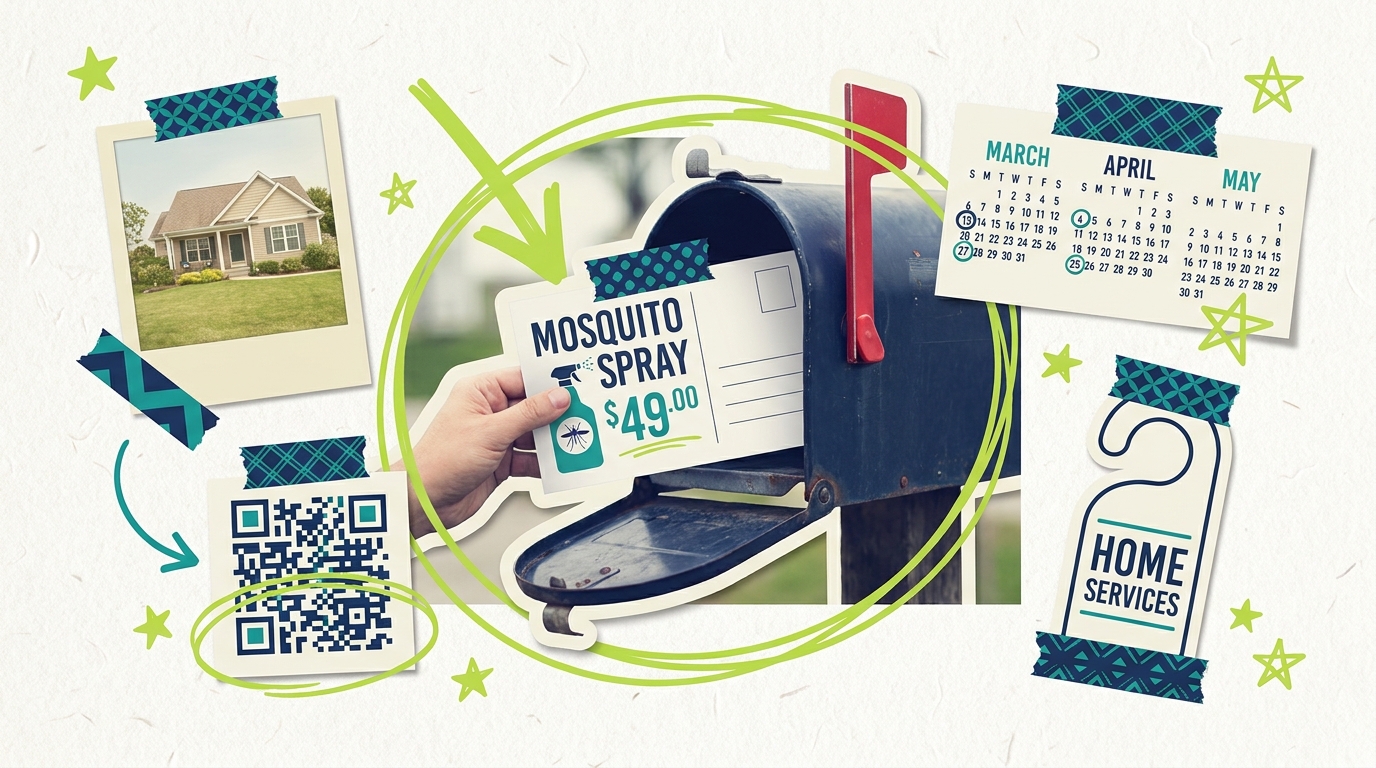
According to the ANA/DMA 2023 Response Rate Report, direct mail produces an average response rate of 5-9% for house lists and 1-3% for prospect lists, significantly higher than digital averages. For pest control, where a single new customer can be worth $1,500+ in lifetime value, even a 1% response rate is profitable.
Direct Mail Tactics That Work for Pest Control
EDDM (Every Door Direct Mail): USPS's program lets you mail postcards to every address on chosen carrier routes for roughly $0.20-$0.25 per piece. Perfect for saturation of a zip code or neighborhood. Target established residential areas, not apartment-heavy zones.
Seasonal postcards: Mail a termite prevention reminder in February, a mosquito program sign-up in March, a rodent prep in August. Timing is everything. Mail arrives 3-7 days after drop, so plan around the seasonal peak.
Door hangers: After completing a job on a street, hang door hangers on the 15-20 neighboring homes. "We just serviced your neighbor. Here's $25 off your first treatment." Response rates of 2-5% are common because proximity creates immediate social proof.
Newsletter or magnet mailers: Quarterly postcards or refrigerator magnets build memory. Not a direct conversion tool but valuable for keeping your name visible between infestations.
Budget and Expectations
Budget $0.30-$0.70 per piece all-in for professionally designed, printed, and mailed postcards. A 5,000-piece EDDM drop in a targeted zip code runs $1,500-$3,500 and produces 50-150 leads at a 1-3% response rate. Cost per lead typically lands between $15-$40, competitive with digital channels.
Tips for Better Results
Use a clear offer, not a generic "Call Us" message. "$49 mosquito spray," "Free termite inspection," "$100 off first quarterly service."
Include a tracking phone number or QR code so you can measure real response rates
Test two designs against each other on split drops and iterate
Pair direct mail with digital retargeting for compounding effect: homeowners who get the postcard and then see you on Instagram convert at higher rates
Direct mail feels old-fashioned, but it works, especially in suburban neighborhoods where competition for attention on digital channels is fierce.
TV and CTV Advertising: The Trust Builder
For a long time, TV advertising was out of reach for local pest control companies. The minimum buys at traditional broadcast and cable ran $20,000+ and required a six-figure annual commitment to be meaningful. That changed with connected TV.
Connected TV (CTV) means streaming services like Hulu, Peacock, Tubi, Pluto TV, and Roku. These platforms now reach more viewers than cable in many U.S. markets, and they let local advertisers buy targeted campaigns with budgets starting at $50 rather than $50,000 (eMarketer, 2024).
For pest control, the case for CTV is simple: nothing builds the trust and familiar recall that drives emergency calls like seeing a company's ad on a big screen during prime time. A 30-second CTV spot on Hulu, targeted to homeowners in your service area, creates the memory that gets your company called when someone spots a swarm or a rat.
Platforms like Adwave make this realistic for small pest control operators. You can generate a 30-second TV ad from your website URL in about two minutes, target specific zip codes, and launch for as little as $50. Average CPMs on CTV run $15-$35, with a $25 average, meaning a $1,000 budget delivers roughly 40,000 targeted impressions.
For a deeper breakdown of TV strategy specifically for pest control, see our guide to TV advertising for pest control companies.
Budget: $500-$3,000 per month for a locally targeted CTV campaign. Best used alongside Google Ads and Meta, not as a replacement.
Channel Comparison: What Works When
Here's how the channels stack up against each other across the metrics pest control owners care about.
Every company's ideal mix depends on market, competition, and stage of growth. A brand-new pest control startup should front-load Google Ads and GBP optimization. A mature company at capacity should shift budget toward brand channels like Meta, CTV, and direct mail.
Recommended Budget Allocation by Stage
Stage 1: Launch (0-50 customers, $2,000-$4,000/month)
Google Ads: 60% ($1,200-$2,400)
Google Business Profile + Local SEO: 10% ($200-$400)
Meta ads: 20% ($400-$800)
Nextdoor + Yelp (free + minimal paid): 10% ($200-$400)
Goal: Capture existing demand. Every dollar goes toward channels with immediate returns.
Stage 2: Growth (50-300 customers, $4,000-$8,000/month)
Google Ads: 40% ($1,600-$3,200)
Meta / Instagram: 20% ($800-$1,600)
Local SEO + GBP: 10% ($400-$800)
Direct mail: 15% ($600-$1,200)
CTV / Streaming TV: 10% ($400-$800)
Yelp / Nextdoor: 5% ($200-$400)
Goal: Diversify channels. Start building brand presence beyond pure demand capture.
Stage 3: Scale (300+ customers, $8,000-$20,000/month)
Google Ads: 30%
Meta / Instagram: 20%
CTV / Streaming TV: 20%
Direct mail: 15%
Local SEO + content: 10%
Yelp / Nextdoor / referrals: 5%
Goal: Own the market. Brand-building channels become a larger share as your base of existing customers generates organic demand.
How to Compete With National Chains
Terminix, Orkin, and Rollins combined control roughly 30% of the U.S. pest control market (IBISWorld, 2024). They outspend local companies on advertising by orders of magnitude. But they have weaknesses local companies can exploit.
Speed: National chains route calls through distant dispatch centers. Local companies can answer phones on the first ring and dispatch technicians same-day. In emergencies, speed wins.
Relationships: Customers remember the name of the technician who showed up, not the national brand on the truck. Advertise the humans on your team, not the company name.
Community: National chains don't sponsor Little League teams, donate to the food bank, or show up in the Chamber of Commerce newsletter. Local presence builds local preference.
Flexibility: You can offer custom programs, organic options, and pricing flexibility that national chains can't. Feature these in your ads.
Common questions answered
How much should a pest control company spend on advertising?
Most growing pest control companies spend 6-10% of gross revenue on advertising. A $500,000 revenue company should budget $30,000-$50,000 per year. Newer or faster-growing companies often push to 12-15% to accelerate customer acquisition, while mature companies at capacity can drop to 3-5%. The right number depends on capacity, competitive intensity, and customer lifetime value, not on what competitors spend.
Which advertising channel gets the fastest results?
Google Search Ads produce leads hours after launching. Paid search captures people who are already searching for your services, so there's no lag between spending and getting calls. Meta ads typically take 2-4 weeks to optimize for real conversions, and local SEO, while free, takes 3-6 months to compound. If cash flow is tight, start with Google Ads and reinvest early revenue into slower-compounding channels.
Should pest control companies advertise year-round or just seasonally?
Year-round, but with weighted spending. Pest activity never fully stops (rodents winter, bed bugs travel-related, commercial accounts recurring), so turning off advertising for six months means losing the brand recognition you built. The smarter play is to run baseline campaigns year-round, then double or triple budget in the four weeks leading up to each seasonal peak. Termites in February, mosquitoes in March, rodents in August, holiday rodent prep in November.
Is TV advertising worth it for a small pest control company?
Yes, now that CTV has lowered the entry point. Traditional broadcast TV still requires massive budgets and geographic overreach, but CTV platforms let local pest control companies target homeowners in specific zip codes for $500-$3,000 per month. TV ads work best alongside digital, not instead of it. The goal is building brand recognition that makes homeowners think of your company first when they spot a pest, then using Google Ads and Meta to capture the resulting search traffic.
How do I compete with Terminix and Orkin on advertising?
Don't try to outspend them, and don't try to match their messaging. National chains advertise based on brand trust and price. Local companies should advertise on speed, personal service, and community presence. Feature the specific technicians who will show up, highlight same-day response times, and emphasize local ownership. Target the neighborhoods the chains are already advertising in, because those homeowners are already primed to think about pest control.
What's the best way to advertise recurring service plans instead of one-time treatments?
Front-end your advertising around the emergency (roach, termite, rodent), then convert to a recurring plan at the point of sale. Advertising directly for "quarterly pest control" produces far less volume than advertising for "emergency pest control." Capture the emergency, deliver great service, and have a defined upsell process where technicians pitch the recurring plan at the end of the initial visit. Most successful pest control companies convert 40-60% of one-time jobs to recurring plans when technicians follow a structured pitch.
Where to Start This Week
If you're running a pest control company without a clear advertising system, here's a 30-day starter plan:
Week 1: Claim or optimize your Google Business Profile. Add all service categories, upload 20+ photos, post your first service update, and send review requests to your last 20 customers.
Week 2: Launch a Google Ads Search campaign targeting emergency keywords in your service area. Start at $30-$50 per day. Set up call tracking and a landing page with a clear phone CTA.
Week 3: Set up a Meta ad account and run one lead-generation campaign for a seasonal offer (mosquito program, termite inspection, first quarterly service). Budget $300-$500 for the month.
Week 4: Test a 2,500-piece EDDM drop in your best-performing zip code. Include a tracked phone number and a specific offer.
After 60-90 days, add CTV advertising and lead marketplaces like Yelp Ads or Thumbtack to the mix if Google and Meta are producing more leads than you can handle.
Pest control is a market where speed, trust, and recurring revenue all compound. The advertising channels that work best are the ones that build all three at once. Most local operators over-invest in one channel and ignore the rest. The real wins come from running a modest mix across 3-5 channels, tracking results, and shifting budget toward whatever is working.
If you want to add TV advertising to your mix without the traditional TV price tag, Adwave lets pest control companies create a 30-second spot from their website and launch on 100+ premium streaming channels for as little as $50. It's the fastest way to add the brand-building layer to a digital-first advertising plan.


