
The photography business has been remade twice in the past decade. Smartphone cameras pulled casual photo revenue out of the market. Online print-at-home services captured the volume end. Then AI image tools started nibbling at commercial and portrait work. Yet the photographers still winning are the ones who specialize deeply, market locally, and show visible high-quality work. Those are exactly the things smart advertising can scale.
The U.S. photography services market is about $12 billion in annual revenue, with roughly 115,000 professional photographers competing (IBISWorld, 2024). Wedding, family portrait, newborn, commercial, real estate, and event photography dominate the independent photographer market. Each specialty has its own ideal advertising mix.
Photography advertising is unusual because your portfolio is your product, and platforms like Instagram and Pinterest are basically free portfolio distribution. The photographers who understand this spend less on paid advertising and more on consistent organic visibility. But paid ads still matter, especially for booking weddings, families, and commercial work that doesn't just come organically.
This guide covers seven proven advertising channels for photographers: Google Ads, Meta and Instagram, local SEO, The Knot and wedding platforms, Pinterest, CTV advertising, and referral partnerships. You'll get realistic budgets and tactics by specialty.
Why Photography Marketing Is Different
Several dynamics make photography unique.
Portfolio is everything. Unlike most service businesses, your work samples are your primary sales tool. Advertising that surfaces your portfolio beats advertising that describes your services.
Specialty-driven. Wedding photographers, newborn photographers, commercial photographers, real estate photographers, and event photographers operate in nearly different businesses. Your advertising mix depends heavily on which specialty you're in.
Long booking cycles. Wedding photographers often book 8-18 months in advance. Senior portrait photographers book 3-6 months out. Newborn photographers book during pregnancy. This affects ad timing.
High consideration, high trust. Couples spending $3,500-$12,000 on a wedding photographer are making a decision they can't redo. Trust signals matter enormously.
Visual platforms dominate. Instagram and Pinterest drive more photographer bookings than Google for many specialties. Understanding this shapes smart budget allocation.
Google Ads: Local Search Intent
When someone searches "wedding photographer [city]" or "family photographer near me," they're likely in active booking mode. Google Ads puts you in front of those searches.
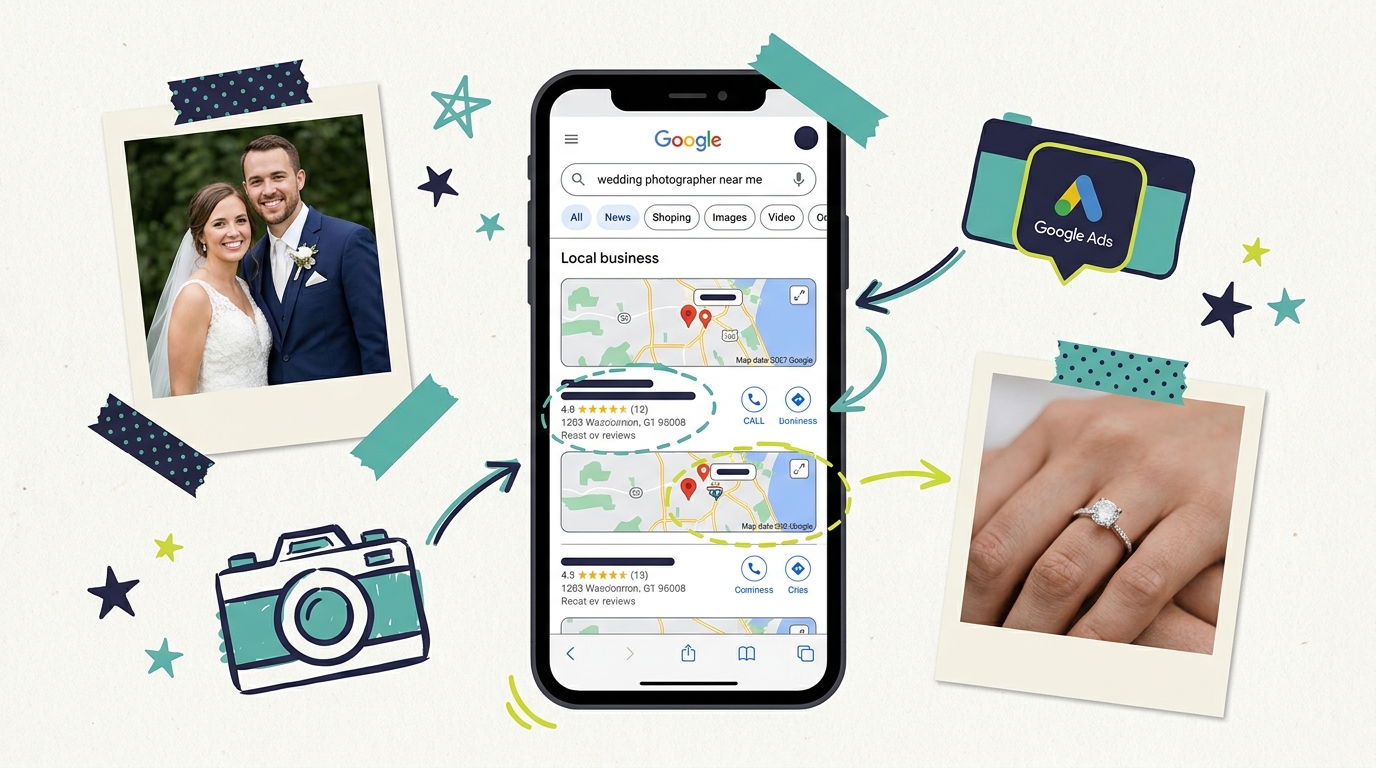
Google's internal data shows 76% of local searches result in a business visit or contact within 24 hours (Google, 2023). For photography, the consideration window stretches longer because couples and families shop multiple photographers, but the first search typically happens within days of the first inquiry.
Keywords That Drive Bookings
Structure campaigns around your specialty:
Wedding: "wedding photographer [city]," "engagement photographer [city]," "wedding photography [city]"
Family: "family photographer near me," "outdoor family photography," "mini sessions [city]," "holiday photo sessions"
Newborn: "newborn photographer [city]," "in-home newborn photography," "maternity photographer"
Senior portraits: "senior portraits [city]," "high school senior photographer," "class of 2026 photos"
Commercial/real estate: "real estate photographer [city]," "commercial photographer [city]," "headshot photographer"
Branding/personal brand: "branding photographer [city]," "professional headshots [city]"
Campaign Types
Search campaigns on high-intent local keywords, matched to your specialty. Most important for photographers not yet established in search results.
Local Services Ads (LSAs) with Google Guaranteed badge where available. Works well for wedding, family, and commercial photography.
Remarketing display to stay in front of prospects who visited your portfolio but didn't inquire. Wedding booking decisions take 2-8 weeks, so remarketing matters.
Budget and Expectations
Single photographers should budget $500-$2,500 per month on Google Ads depending on specialty and market. CPCs for photography keywords range $4-$18. Expect cost per inquiry of $25-$85, with close rates of 15-35% depending on specialty (higher for quick-turnaround sessions, lower for weddings).
Tips for Better Results
Set up call tracking for wedding and commercial inquiries (most prospects call first)
Schedule ads to run during inquiry hours, not during shoots when you can't respond
Add negative keywords: "free photographer," "photography jobs," "photography school," "camera rental"
Location extensions essential
Create separate campaigns per specialty if you do more than one (wedding budget different from family)
Google Ads captures active searchers. Strong foundation but not the highest-ROI channel for most photographers (that's usually Instagram).
Instagram and Meta: Where Photography Lives
For most photographers, Instagram is the #1 booking source. Your work is inherently visual, Instagram is a visual-first platform, and the audiences you want to reach (engaged couples, expecting parents, commercial clients) spend serious time there.
The good news: Instagram rewards consistent posting with organic reach. The better news: paid amplification of your best posts is dramatically effective.
Meta Business data shows visual-product categories see 3-5x higher recall from branded visual content compared to text-only ads (Meta, 2024).
Campaign Types for Photographers
Organic posting strategy first. Post 4-7 times per week: finished session galleries, behind-the-scenes content, client testimonials, seasonal promotions.
Boosted posts amplify your best-performing organic content to local audiences. Start with $5-$20 per boost on your top 3-5 posts per month.
Awareness campaigns target specific audiences relevant to your specialty: engaged couples (for wedding), expecting parents (for newborn), small business owners (for commercial), families with kids 4-12 (for family portraits).
Lead generation campaigns with Meta's built-in forms. Offer free consultations, mini-session availability, or custom quote requests.
Retargeting campaigns reach people who visited your website but didn't inquire.
Seasonal campaigns timed around photo season peaks: senior portraits (July-September), fall family sessions (September-November), holiday photos (October-December), spring mini-sessions (March-May).
Creative Ideas for Photographers
Behind-the-scenes videos. Show the real experience of a shoot. Builds trust and shows your personality, which is a bigger booking factor than people realize.
Before-and-after editing videos. Raw image to final edit. fascinating content that also demonstrates your skill.
Client testimonial reels. Real clients on camera talking about working with you.
Gallery reveals. Show finished sessions with music. Engagement-magnet content.
Educational content. "How to prepare for your newborn session," "What to wear for family photos," "Wedding timeline tips." Builds authority and converts over time.
Budget and Expectations
Budget $300-$1,500 per month on Meta, with emphasis on Instagram boosting and lead gen. CPMs run $10-$22 for locally targeted audiences. Lead gen campaigns produce inquiries at $20-$70 each, with conversion rates of 15-30% from inquiry to booking.
Tips for Better Results
Instagram outperforms Facebook for almost all photographers
Build custom audiences from past client emails, then create lookalikes
Boost your best 2-3 posts per week rather than running separate ads with cold creative
Heavy budget 4-8 weeks before each seasonal peak
Engagement photographers: target Facebook's "Newly Engaged" and "Recently Engaged" audiences specifically
Instagram is where photographers build brands. Budget here usually produces the highest ROI of any channel for most photography specialties.
Local SEO and Google Business Profile
Your Google Business Profile is critical for photographers. Most photography searches include local intent, and the map pack is where inquiries start.
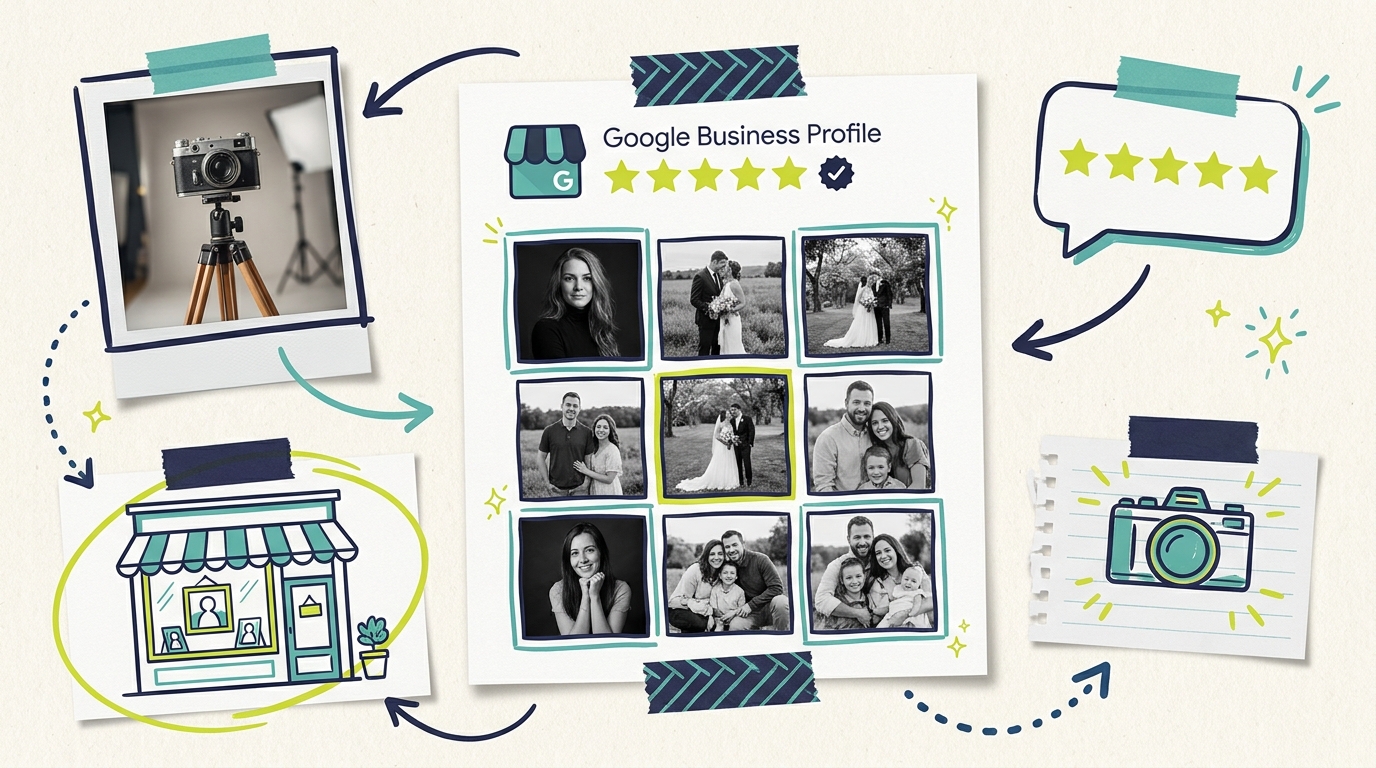
BrightLocal's 2024 Local Consumer Survey found that 87% of consumers use Google to evaluate local businesses, and the map pack captures 44% of all local search clicks. For photographers, where trust and portfolio visibility matter, showing up in the map pack with great reviews and photo samples is extremely valuable.
Optimizing Your Google Business Profile
Complete every field. Primary category: "Photographer" or your specialty ("Wedding Photographer," "Portrait Photographer," "Commercial Photographer"). Add secondary categories as relevant.
Post weekly. Session spotlights, seasonal availability, client testimonials, mini-session announcements. Active profiles rank 10-15% higher on average (LocalIQ, 2024).
Upload massive amounts of photos. For photographers, this is literally your work. Upload 10-20 new portfolio photos per week. Profiles with 100+ photos generate 520% more calls than those with fewer than 10 (Google, 2023). Most photographers should aim for 500+ photos on their GBP over time.
Answer the Q&A. Seed questions about pricing structure, travel fees, session turnaround times, print vs. digital packages, copyright policies.
Reviews Drive Bookings
Photography clients read reviews religiously before booking, especially for weddings and newborns. Reviews are a major ranking factor for local search.
Review engine for photographers:
Text every client a review link 1-2 weeks after gallery delivery
For weddings, send a handwritten thank-you note with a review request
Respond personally to every review
Feature selected reviews as testimonials in your ads and website
Local Citations
Photography-specific citations matter. Consistent listings on:
Google Business Profile
Yelp
The Knot, WeddingWire, Zola (for wedding photography)
Thumbtack (for family and event photography)
Professional Photographers of America directory
Industry directories and local wedding publications
Budget and Expectations
Mostly sweat equity. Budget $200-$600 per month if you hire help. Results compound over 3-6 months. A well-optimized photographer GBP in a metro market generates 20-80 inquiries per month at zero variable cost.
The Knot and Wedding Platforms
For wedding photographers, The Knot and WeddingWire are often the #2 booking source after Instagram. These platforms reach actively planning couples who are specifically vendor-shopping.
The Knot Pro storefronts: Paid listings with portfolios, reviews, pricing transparency. $200-$800 per month depending on market tier. Couples searching "wedding photographer [city]" see paid listings first.
WeddingWire Vendor pages: Similar platform (same parent company). Often bundled with The Knot.
Zola Vendors: Newer registry-to-planning platform popular with millennials.
Wedding blog submissions: Getting sessions or weddings featured on Style Me Pretty, Green Wedding Shoes, local wedding blogs. Drives long-term lead flow through SEO.
Bridal expos: $500-$2,500 per booth per event. High-intent couples actively booking. Samples and live conversations produce strong bookings.
Wedding publication features: Print and online local wedding magazines. Editorial features drive meaningful bookings in luxury tiers.
Budget and Expectations
Wedding-focused photographers budget $400-$1,500 per month on wedding platforms, plus $1,500-$5,000 per year for expos. Lead quality is high (engaged couples) but cost per lead runs $75-$250. Strong supplement to Instagram and Google, not a replacement.
Not doing weddings? Skip this category. Use the budget for Meta boosting instead.
Pinterest: The Sleeper Channel
Pinterest is one of the highest-ROI platforms for photographers and one of the most underused. Why? Because Pinterest users are actively planning events (weddings, parties, baby showers) and searching for visual inspiration.
A pin of a beautifully-composed engagement session can drive traffic and bookings for years. Unlike Instagram (where posts disappear from feeds in hours), Pinterest content compounds.
Pinterest organic strategy:
Create 5-10 pins per week from your sessions, with SEO-optimized descriptions
Board titles should include keywords: "Outdoor Wedding Photography in [State]," "Fall Family Photos Inspiration," "Newborn Photography Studio Sessions"
Link pins to your website gallery and booking pages
Pinterest paid ads:
Promoted pins cost $0.50-$2.00 per click
Target by interest (wedding planning, baby shower, home decor) and geography
Best for wedding, family, and commercial photographers
Budget: $100-$500 per month in Pinterest paid for meaningful traffic. Organic Pinterest strategy costs time, not money.
For photographers, Pinterest often produces the lowest-cost-per-inquiry of any channel over 12-month periods because content compounds.
TV and CTV Advertising
For decades, TV was out of reach for individual photographers. That changed with connected TV.
Connected TV (CTV) means streaming platforms like Hulu, Peacock, Tubi, and Roku. Local advertisers can now buy targeted campaigns for $50+ (eMarketer, 2024).
For established photography studios (not solo photographers), CTV builds the brand awareness that differentiates a local studio from solo competitors. A high-production 30-second spot during prime time signals established business, premium positioning, and trust.
Platforms like Adwave make CTV realistic for photography studios. Generate a 30-second spot from your website in about two minutes, target your metro area, and launch for $500-$2,000 per month.
For a deeper look at TV strategy for photography studios, see our guide to TV advertising for photography studios.
Budget: $500-$2,000 per month. Most effective for established studios; solo photographers typically get better ROI from Instagram boosting.
Referral Partnerships
Photography businesses compound through strategic partnerships.
Wedding photographers: Partnerships with wedding planners, venues, florists, DJs, and videographers. Every wedding vendor touches couples during planning. Mutual referral commitments produce steady booking flow. Budget: handwritten thank-you notes, occasional vendor appreciation events, reciprocal referrals.
Family photographers: Partnerships with pediatricians, daycare centers, school fundraisers, and children's clothing retailers. These touchpoints see families with young kids regularly. Offer donated mini-sessions for fundraisers, seasonal partnerships with boutiques.
Newborn photographers: Partnerships with OB/GYN practices, doulas, baby stores, lactation consultants. Reaching parents before birth (during pregnancy) is key.
Commercial photographers: Partnerships with marketing agencies, web design firms, real estate agents, small business consultants. These partners' clients regularly need photo services.
Real estate photographers: Direct relationships with real estate agents. The top 20% of agents in your market produce 80% of real estate photography demand.
Senior portrait photographers: Partnerships with high schools (school pictures), sports clubs, dance studios, performing arts schools.
Budget and Expectations
Partnership investment is mostly time and relationship-building plus occasional gifts/events ($500-$2,000 per year). Returns compound over years. Most successful photographers who run businesses for 10+ years do so because of these relationships, not paid advertising.
Channel Comparison
Here's how the channels stack up for photographers.
Every photographer should run 3-5 channels, not all 7. A solo wedding photographer focuses on Instagram + Google + GBP + The Knot. A commercial photographer focuses on LinkedIn + Google + GBP + Referrals. A family photographer focuses on Instagram + Pinterest + GBP + Referrals.
Recommended Budget Allocation by Stage
Stage 1: New (Year 1, $1,500-$3,000/month)
Google Ads: 35% ($525-$1,050)
Meta / Instagram: 25% ($375-$750)
GBP / Local SEO: 10% ($150-$300)
The Knot (if wedding): 20% ($300-$600)
Pinterest: 10% ($150-$300)
Goal: Build visibility in search and social. Every booking matters.
Stage 2: Established (Year 3-5, $3,000-$7,000/month)
Meta / Instagram: 30% ($900-$2,100)
Google Ads: 25% ($750-$1,750)
Wedding platforms (if wedding): 15% ($450-$1,050)
GBP / Local SEO: 10% ($300-$700)
Pinterest: 10% ($300-$700)
Referrals / community: 10% ($300-$700)
Goal: Build referral engine alongside paid acquisition.
Stage 3: Studio/Scale ($7,000+/month)
Meta / Instagram: 25%
Google Ads: 20%
CTV: 15%
Wedding platforms: 15%
Pinterest: 10%
GBP + content: 10%
Referrals / community: 5%
Goal: Establish premium brand positioning. CTV and studio-positioning creative become priority.
Seasonal Calendar by Specialty
Wedding photographers:
Jan-Feb: Engagement season peak. Heavy advertising.
March-April: Engagement season continues. Start booking fall weddings.
May-Aug: Wedding execution. Lower ad spend (you're shooting).
Sept-Oct: Fall weddings. Start booking next year.
Nov-Dec: Holiday brand awareness.
Family photographers:
Jan-Feb: New year session planning.
March-May: Spring mini-sessions. Easter.
June-Aug: Senior portraits begin.
Sept-Oct: Fall family session peak. Biggest revenue period.
Nov: Holiday card push.
Dec: Quiet month.
Newborn photographers:
Year-round relatively steady (babies don't have seasons).
Mild peak in late summer/fall (most births in August-October statistically).
Commercial photographers:
Jan-March: Companies rebuilding marketing assets post-holidays.
Q4: Annual report and website refresh work.
Year-round for real estate photography.
Common questions answered
How much should a photographer spend on advertising?
Most successful photographers spend 5-15% of gross revenue on advertising. A solo wedding photographer grossing $100,000/year should budget $5,000-$15,000/year. Newer photographers often push to 20% to accelerate booking pace. Established photographers with strong referrals can drop to 3-5%. The right number depends on your booking capacity, referral strength, and growth goals.
Which channel produces the best ROI for a photographer?
For most specialties, Instagram (organic plus boosted posts) is the highest ROI over 12-month periods because of compounding content and audience-building. Google Ads produces the fastest immediate results. Pinterest produces the best long-term ROI for SEO-friendly portfolios. The combination of all three typically beats any single channel.
Should wedding photographers advertise year-round or seasonally?
Year-round with weighted spending. Booking happens year-round but peaks during engagement season (December-February) and into spring. Running baseline Meta and Google year-round maintains visibility, then surge 2-3x during engagement peaks and when trying to book specific open dates in your calendar.
Is TV advertising realistic for a photographer?
For solo photographers, probably not the best use of budget. Instagram and Pinterest produce better ROI. For established studios with 3-10 employees and premium positioning, CTV can build the brand authority that differentiates from solo competitors. Budget $500-$2,000 per month and focus on the studio brand story.
How do I compete with cheap or free photographers like friends with DSLRs?
Don't compete on price. Compete on experience, reliability, editing skill, and portfolio quality. Every ad should answer "why is this photographer worth $X more than the friend with a camera?" Showcase finished edited work (not raw frames), client testimonials about the experience, and the professional process. Price-shoppers are never your best clients anyway.
What's the most effective way to fill my calendar with specific session types?
Target advertising to your ideal client's moments. Newborn photographers should target expectant parents in the 6-7 month pregnancy window with local Meta ads. Senior portrait photographers should target high school juniors in spring for summer/fall sessions. Family photographers should target fall session interest in August and September. Matching advertising to the 8-12 week planning window before each session peak produces the highest conversion rates.
Where to Start This Week
If you're a photographer without a clear advertising system, here's a 30-day plan:
Week 1: Optimize your Google Business Profile. Add specialty category, upload 30-50 portfolio photos, send review requests to last 10 clients.
Week 2: Set up Instagram Pro account if not already. Commit to posting 4-5x per week. Identify your top 3 posts and boost each with $20 of ad spend.
Week 3: Launch Google Ads on your specialty keywords at $20-$40 per day. Set up call tracking and a portfolio-focused landing page.
Week 4: Set up a Pinterest business account. Create 20 pins from your best sessions with SEO-friendly descriptions. Pin 5 per week going forward.
After 60-90 days, add The Knot (if wedding), expand Pinterest advertising if it's producing traffic, and start building 2-3 formal vendor partnerships.
Photography is a portfolio-first business where the best marketing is great visible work, consistent posting, and genuine client relationships. The channels that produce the most bookings are the ones that surface your portfolio to the right audiences: Instagram, Pinterest, Google, and GBP. Photographers who layer 4-5 channels consistently for 12+ months build booking pipelines that feed for years.


