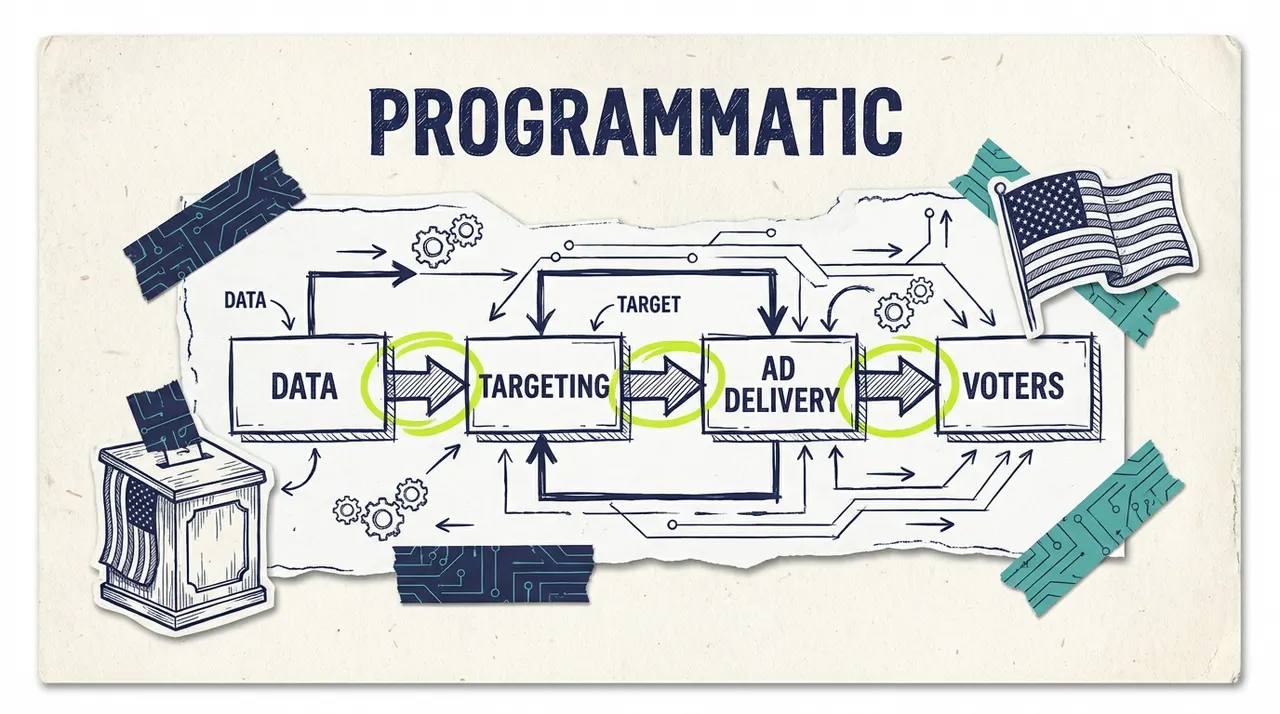
Programmatic advertising has transformed how political campaigns reach voters. Instead of negotiating individual ad placements and hoping for the best, campaigns now use automated systems to buy targeted ad inventory across TV, streaming, display, and digital channels in real time.
For campaign managers planning for the 2026 midterms, understanding programmatic advertising is essential. The technology offers precision targeting, budget efficiency, and measurement capabilities that traditional media buying simply cannot match.
This guide covers everything you need to know about programmatic political advertising, from how it works to implementation strategies and best practices for maximizing your media spend.
What is programmatic political advertising?
Programmatic advertising uses software and algorithms to automate the buying and placement of ads. Rather than manually negotiating with individual publishers or stations, campaigns use demand-side platforms (DSPs) to bid on and purchase ad inventory across thousands of websites, apps, and streaming services simultaneously.
For political campaigns, this means you can reach specific voter segments across multiple channels, optimize in real time based on performance, and make data-driven decisions about where your ad dollars go.
How programmatic differs from traditional media buying
Traditional political media buying works like this: your media buyer contacts TV stations, negotiates rates, books time slots, and hopes your ad runs to the right audience. You pay for broad reach and accept significant waste (impressions to non-voters or voters outside your district).
Programmatic political advertising works differently. You define your target audience using voter data, demographics, geography, and behavioral signals. The platform then automatically finds and bids on ad inventory that matches your criteria, serving ads only to qualified voters and optimizing performance continuously.
The key differences:
Traditional buying:
Manual negotiations with each publisher
Fixed placement schedules
Broad demographic targeting
Limited optimization during campaigns
Delayed reporting (often post-campaign)
Minimum spend requirements
Programmatic buying:
Automated purchasing across thousands of sources
Dynamic ad delivery based on audience availability
Precise targeting using first-party and third-party data
Real-time optimization based on performance
Immediate reporting and analytics
Flexible budgets starting from any amount
Why programmatic matters for 2026 campaigns
Political advertising spending continues shifting toward programmatic channels. In 2024, programmatic accounted for over 40% of digital political ad spend. For CTV specifically, programmatic buying represented the majority of political streaming ad placements.
Several factors drive this shift:
Cord-cutting continues. Over 60% of U.S. households have cut traditional cable or never subscribed. Reaching these voters requires streaming and digital channels accessible primarily through programmatic buying.
Where permitted and supported, programmatic platforms can use voter-file data to select audiences.
Budget efficiency matters. Down-ballot campaigns with limited budgets benefit from programmatic's ability to maximize reach in specific geographies and voter segments.
Real-time optimization wins races. The ability to shift budget and messaging based on performance data gives programmatic campaigns a significant advantage over fixed traditional buys.
How programmatic political advertising works
Understanding the technology behind programmatic advertising helps you make better strategic decisions.
The programmatic ecosystem
Several components work together to deliver programmatic political ads:
Demand-side platforms (DSPs): Software used by advertisers to purchase ad inventory. DSPs connect to multiple ad exchanges and supply sources, allowing you to buy across channels from a single interface. Examples include The Trade Desk, Google DV360, and specialized political platforms.
Supply-side platforms (SSPs): Used by publishers to sell their ad inventory. SSPs connect publishers to ad exchanges where DSPs bid on available impressions.
Ad exchanges: Marketplaces where DSPs and SSPs connect. When a user loads a webpage or streaming video, the available ad space is offered on exchanges where DSPs bid in milliseconds.
Data management platforms (DMPs): Systems that collect, organize, and activate audience data. For political campaigns, this includes voter file data, donation history, survey responses, and behavioral signals.
Data providers: Companies that provide voter data, demographic data, and behavioral data used for targeting. Political-specific providers like L2, TargetSmart, and Data Trust specialize in voter file matching.
Real-time bidding explained
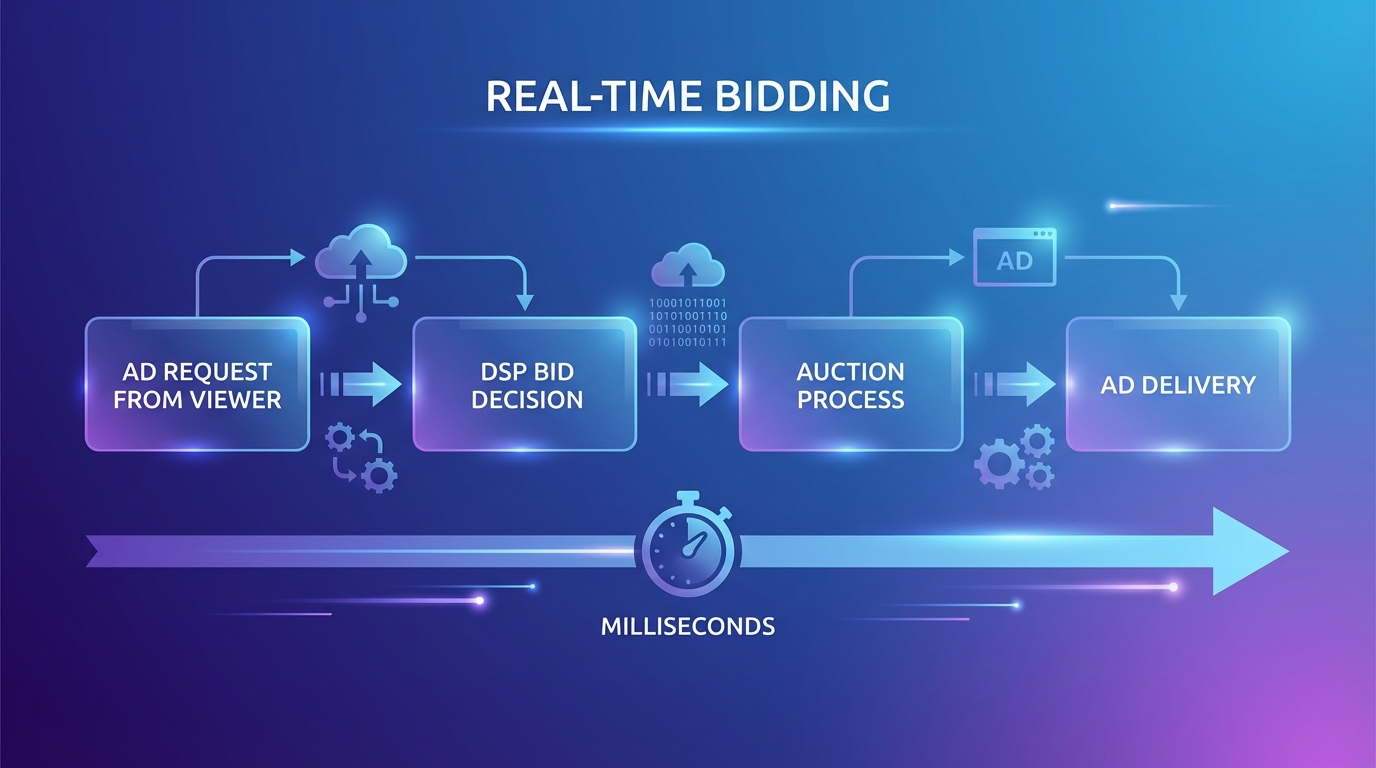
The core of programmatic advertising is real-time bidding (RTB). Here's what happens in the milliseconds before a political ad appears:
A voter opens a streaming app or visits a website
The publisher sends an ad request to an exchange, including available targeting signals
The exchange broadcasts this opportunity to connected DSPs
Your DSP evaluates whether this impression matches your campaign criteria
If it matches, your DSP submits a bid based on the value of that impression to your campaign
The highest bidder wins and their ad is served
This entire process takes approximately 100 milliseconds
For political campaigns, sophisticated DSPs can evaluate each impression against your voter file data, geographic targeting, and frequency caps before deciding whether to bid and how much to offer.
Targeting capabilities for political campaigns
Programmatic advertising offers targeting options essential for political campaigns:
Voter file targeting: Upload your campaign's voter file to target specific registered voters. Match rates typically range from 50-70% depending on data quality and platform capabilities.
Geographic targeting: Target by state, congressional district, state legislative district, county, city, zip code, or even custom-drawn boundaries. Essential for down-ballot races where broadcast TV waste would be prohibitive.
Demographic targeting: Layer age, gender, income, education, and household composition on top of geographic targeting.
Behavioral targeting: Reach voters based on content consumption patterns, online behaviors, and inferred interests.
Contextual targeting: Place ads in specific content types (news, sports, entertainment) that align with your campaign messaging.
Retargeting: Reach voters who have previously visited your campaign website or engaged with your digital content.
Lookalike modeling: Find new voters who share characteristics with your known supporters.
Programmatic channels for political campaigns
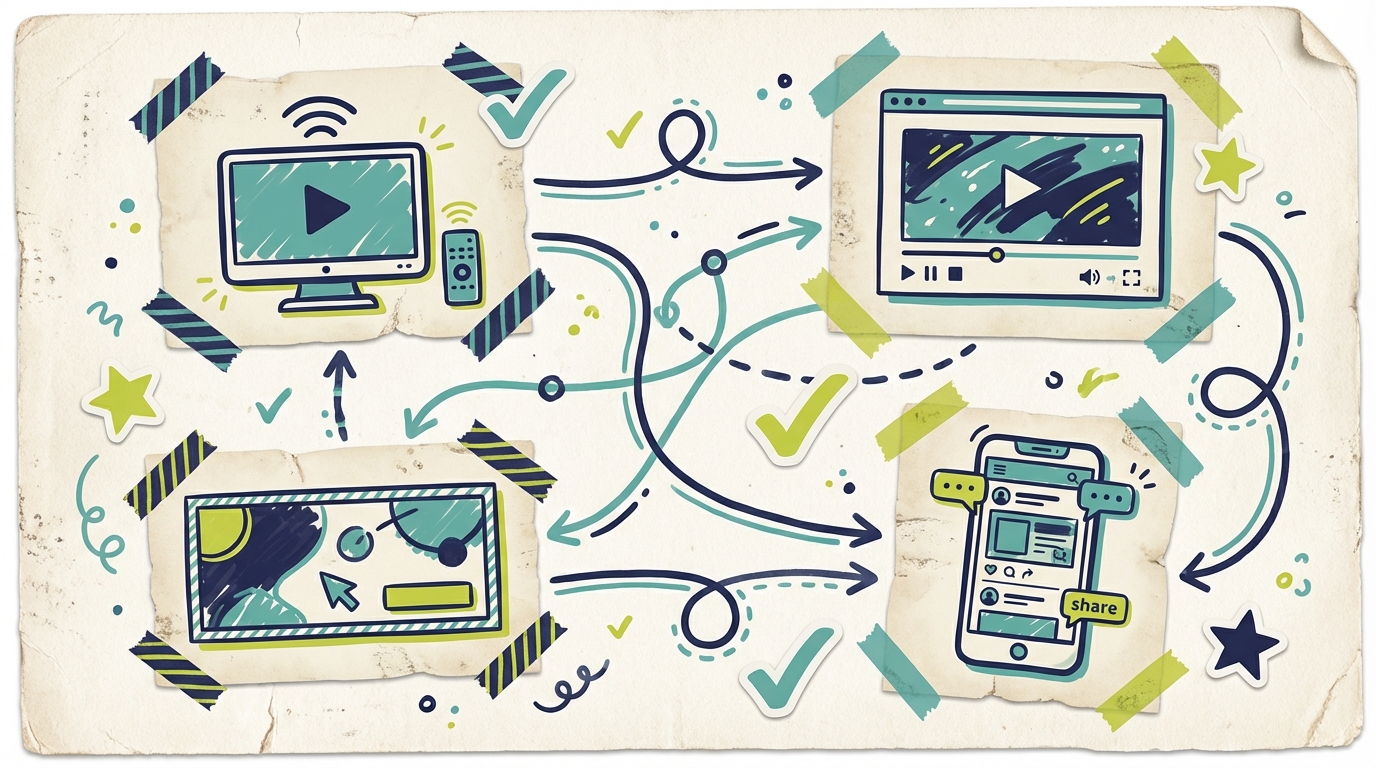
Programmatic buying works across multiple advertising channels, each with unique characteristics.
Connected TV (CTV)
CTV has become the fastest-growing programmatic channel for political advertising. Reasons include:
Big screen impact: Ads appear on the largest screen in the household, carrying the prestige and attention of traditional TV
Precise targeting: Geographic and demographic targeting eliminates the waste of DMA-based broadcast buying
High completion rates: Most CTV inventory is non-skippable, with completion rates averaging 95%+
Cross-device attribution: Track how CTV exposure influences website visits and other actions
For political campaigns, programmatic CTV combines the persuasive power of television with the precision of digital advertising. Platforms like Adwave make CTV accessible to campaigns of all sizes, with no minimum spend requirements.
Online video (OLV)
Beyond CTV, programmatic video advertising runs across desktop and mobile devices:
Pre-roll video on websites and apps
In-stream video inside content feeds
Out-stream video that appears between content
YouTube and social video inventory
OLV complements CTV by reaching voters on their secondary devices, reinforcing messaging across screens.
Display advertising
Programmatic display includes banner ads across websites and apps:
Standard IAB sizes (300x250, 728x90, 160x600, etc.)
Rich media and interactive formats
Native display that matches publisher content style
Display advertising offers lower CPMs than video, enabling high-frequency campaigns and broad reach on limited budgets.
Audio advertising
Programmatic audio runs across streaming music and podcast platforms:
Spotify, Pandora, and other music services
Podcast advertising through programmatic exchanges
Digital radio streams
Audio reaches voters during commutes, workouts, and other times when visual attention isn't available.
Digital out-of-home (DOOH)
Programmatic DOOH places ads on digital billboards and screens:
Highway digital billboards
Transit advertising
Gas station TV and screens
Retail and venue displays
DOOH provides high visibility in specific geographic areas, useful for local and state races.
Budget planning for programmatic political campaigns
Understanding costs and allocation helps maximize your programmatic investment.
CPM ranges by channel
Programmatic pricing is typically expressed as cost-per-thousand impressions (CPM):
Connected TV:
Premium publishers (Hulu, Peacock): $30-50 CPM
Mid-tier streaming (Roku Channel, Samsung TV+): $20-35 CPM
FAST channels (Tubi, Pluto): $12-25 CPM
Online video:
Pre-roll video: $15-30 CPM
YouTube: $10-25 CPM
Social video: $8-20 CPM
Display:
Standard display: $3-8 CPM
Native display: $5-12 CPM
High-impact formats: $8-15 CPM
Audio:
Music streaming: $10-20 CPM
Podcast: $15-35 CPM
Political campaigns typically see 20-40% higher CPMs during peak election periods (September-November) due to increased demand.
Budget allocation recommendations
Effective programmatic campaigns allocate budget strategically across channels:
Congressional/Senate races ($100K-500K programmatic budget):
CTV: 40-50%
Online video: 20-25%
Display: 15-20%
Audio: 10-15%
State legislative races ($25K-100K programmatic budget):
CTV: 50-60%
Online video: 20-25%
Display: 15-25%
Local races ($5K-25K programmatic budget):
CTV: 60-70%
Online video: 20-30%
Display: 10-20%
These allocations reflect the high impact of CTV for voter persuasion while maintaining frequency through lower-cost channels.
Pacing and timing strategies
How you pace your spending affects campaign effectiveness:
Early launch (3-6 months out): Run at lower levels to build name recognition and gather performance data. Test messages and creative approaches.
Pre-peak (6-8 weeks out): Increase spending and shift toward proven performers. Expand targeting to persuadable voters beyond your base.
Peak period (final 4 weeks): Maximum spending weight. Focus on turnout messaging to supporters and final persuasion to undecideds.
Get-out-the-vote (final week): Shift creative to turnout focus. Target high-propensity supporters who haven't yet voted (where early voting data is available).
Data strategy for programmatic political campaigns
Data quality and strategy differentiate successful programmatic campaigns.
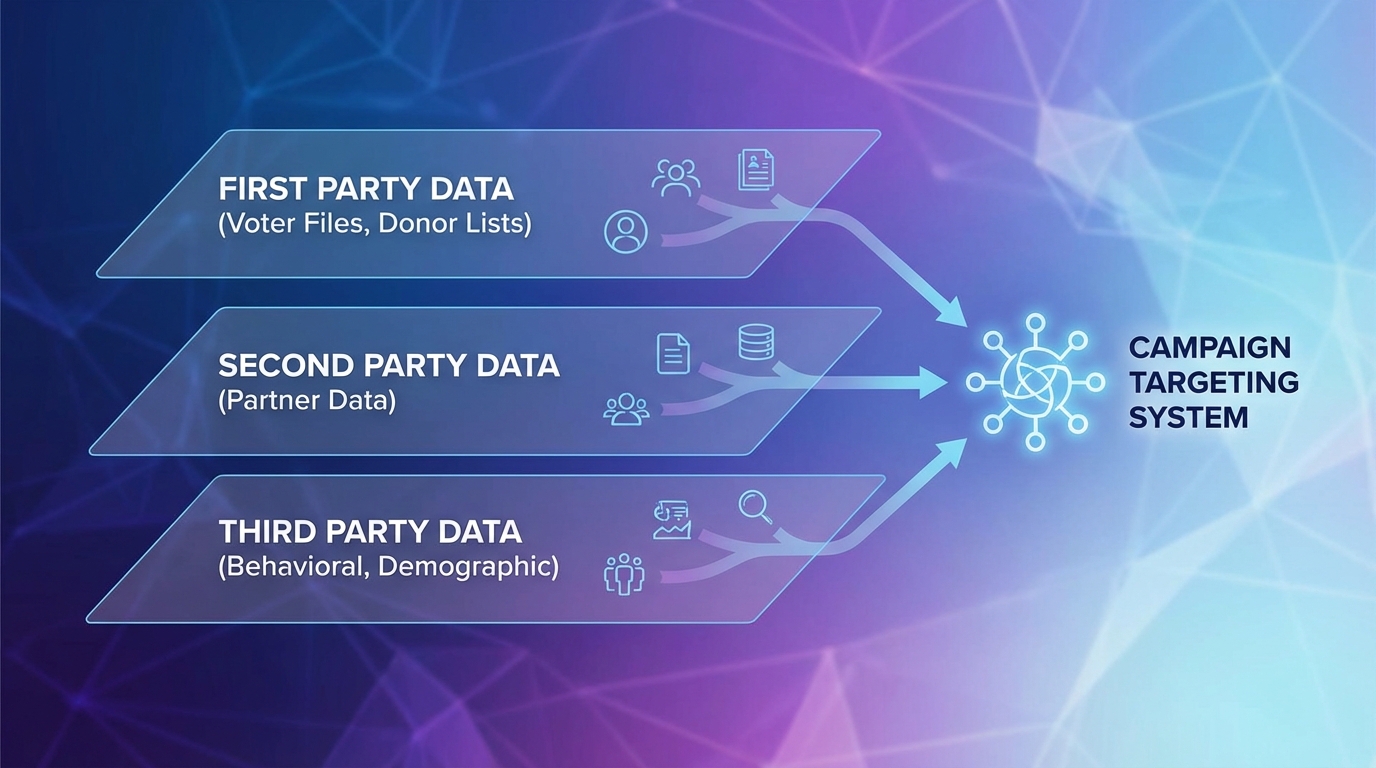
First-party data sources
Your campaign's own data is most valuable:
Voter files: Registered voter lists with party registration, voting history, and demographics. Work with vendors like L2, TargetSmart, or Data Trust to match these records to digital identifiers.
Donor data: Past donors represent strong supporters. Target for turnout messaging and peer-to-peer advocacy.
Volunteer data: Active volunteers can be targeted for event promotion and mobilization.
Website visitors: Retarget campaign website visitors who haven't yet donated or signed up.
Email engagers: Subscribers who open and click emails demonstrate engagement worth reinforcing.
Third-party data options
Supplement first-party data with purchased data:
Voter modeling: Predictive models that score voters on persuadability, turnout likelihood, and issue positions.
Issue data: Target voters who care about specific issues (healthcare, economy, education, etc.).
Consumer data: Household income, purchase behavior, media consumption patterns.
Location data: Reach voters who have visited specific locations (rallies, events, opponents' events).
Privacy and compliance considerations
Political data use faces increasing scrutiny:
Platform policies: Major platforms (Google, Meta) restrict microtargeting for political ads. Understand each platform's current rules.
State regulations: Some states require disclosure of targeting criteria. Maintain detailed records.
Privacy best practices: Use data responsibly. Avoid targeting that could be perceived as discriminatory or invasive.
Consent and transparency: Be prepared to explain your data practices if questioned by media or voters.

Measuring programmatic political campaign performance
Programmatic advertising provides measurement capabilities traditional media cannot match.
Key performance indicators
Track these metrics to evaluate campaign effectiveness:
Reach: Unique voters exposed to your ads. Compare against your target universe.
Frequency: Average impressions per reached voter. Political research suggests 10-15+ impressions needed for persuasion.
Video completion rate (VCR): Percentage of video ads watched to completion. CTV should exceed 90%; online video varies by format.
Click-through rate (CTR): For display and interactive formats, CTR indicates engagement. Political campaigns typically see 0.1-0.3% CTR.
Cost per completed view (CPCV): For video, total spend divided by completed views. Useful for comparing efficiency across platforms.
Brand lift: Survey-based measurement of awareness, favorability, and vote intent changes among exposed voters.
Website traffic: Visits to campaign website correlated with ad exposure.
Attribution approaches
Connect ad exposure to outcomes:
Exposed vs. control analysis: Compare survey results between voters exposed to ads and a matched control group.
Voter turnout correlation: Match ad exposure data to voter file turnout records post-election to measure mobilization impact.
Cross-device tracking: Track how voters exposed on CTV subsequently visit campaign websites or take actions on other devices.
Incrementality testing: Run controlled experiments holding out geographic areas to measure true incremental impact.
Optimization during campaigns
Programmatic enables mid-flight optimization:
Creative testing: Run multiple ad versions simultaneously and shift budget to top performers.
Targeting refinement: Identify which voter segments respond best and adjust targeting weights.
Channel optimization: Move budget between channels based on efficiency and effectiveness data.
Frequency management: Adjust caps if voters are under-exposed or experiencing fatigue.
Dayparting: Optimize delivery times based on when target voters are most engaged.
Programmatic political advertising best practices
Apply these strategies for maximum effectiveness.
Start early
Launch programmatic campaigns well before Election Day:
6+ months out: Begin testing creative messages and building audience data
3-6 months out: Run awareness campaigns at lower spending levels
2-3 months out: Scale up spending as primary results clarify the race
Final 8 weeks: Peak spending with proven messages and targeting
Early campaigns benefit from lower CPMs, time to optimize, and longer voter exposure.
Integrate with broader media strategy
Programmatic works best as part of coordinated media:
With broadcast TV: Use programmatic CTV to reach cord-cutters that broadcast misses. Coordinate messaging across screens.
With direct mail: Target the same households for reinforced messaging. Mail arrives; TV ads follow up. Learn more about coordinating these channels in our guide to political advertising costs.
With field operations: Target neighborhoods before canvassers arrive. Reinforce field contacts with digital follow-up.
With social media: Coordinate organic social content with paid programmatic messaging.
Manage frequency carefully
Neither under-exposure nor over-exposure serves your campaign:
Minimum effective frequency: Political research suggests 10-15+ household impressions needed for meaningful persuasion impact.
Frequency caps: Set caps to prevent ad fatigue (typically 3-5 impressions per day per household).
Cross-channel coordination: Track frequency across all programmatic channels, not just individually.
Creative rotation: Rotate creative executions to maintain freshness even at high frequencies.
Prioritize brand safety
Political ads require careful placement:
Avoid controversial content: Exclude news categories, user-generated content, or other placements that could create unwanted associations.
Verify brand safety tools: Use pre-bid brand safety providers to prevent misplacements.
Monitor placement reports: Regularly review where ads appeared and add negative targets for problematic sites.
Premium inventory preference: Higher-quality inventory reduces brand safety risk while often improving performance.
Working with vendors and platforms
Choosing the right partners for programmatic political advertising affects campaign success.
Platform options
Campaigns have several approaches to programmatic buying:
Self-serve platforms: Tools like Adwave let campaigns set up and manage their own programmatic CTV campaigns without agency involvement. Best for campaigns wanting control, flexibility, and cost efficiency.
Managed services: Vendors handle campaign setup, optimization, and reporting while you provide strategy and creative. Best for campaigns with budget but limited technical expertise.
Political-specialist DSPs: Some DSPs focus specifically on political advertising with built-in compliance tools and voter data integrations.
Full-service agencies: Political media agencies manage all programmatic buying as part of broader media strategy. Best for larger campaigns seeking detailed support.
Common questions about programmatic political advertising
What's the minimum budget for programmatic political advertising?
Programmatic campaigns can run at any budget level, though effectiveness increases with scale. For local races, $5,000-10,000 over 4-6 weeks can deliver meaningful reach in a district. State legislative races typically need $25,000-100,000 for competitive impact. Federal races require substantially more. Self-serve platforms like Adwave enable campaigns to start with as little as $50 for CTV.
How does programmatic compare to direct publisher deals?
Direct deals with publishers (buying directly from Hulu, for example) sometimes offer better pricing for large-volume commitments but require significant minimums and lack flexibility. Programmatic provides access to the same inventory with more targeting options, real-time optimization, and flexible budgets. For most political campaigns, programmatic offers better value through targeting efficiency.
Can programmatic target specific voters by name?
Programmatic doesn't target individuals by name but rather matches voter file records to device identifiers and household IPs. When you upload your voter file to a DSP or data provider, they match those records against their identity graphs to identify devices and households associated with those voters. Match rates typically range 50-70%, meaning you'll reach roughly two-thirds of the voters on your list who are active on programmatic-enabled platforms.
What's the difference between programmatic and paid social?
Paid social (Facebook, Instagram, X) uses the platform's own ad-buying system and data, while programmatic uses third-party DSPs to buy across many publishers. Paid social offers strong targeting in its ecosystem but has increasingly restricted political ad targeting. Programmatic provides broader reach across the open web and streaming with more consistent targeting capabilities. Most campaigns use both.
How do I get started with programmatic political advertising?
Getting started involves several steps: First, gather your voter data and define target segments. Second, choose a buying approach, either working with an agency, using a managed service, or using a self-serve platform. Third, develop creative assets in required formats (video, display, audio). Fourth, set budgets and timing for your campaign. Fifth, launch, monitor performance, and optimize continuously. Platforms like Adwave specialize in making this process accessible for campaigns of all sizes.
The future of programmatic political advertising
Political programmatic continues evolving. Trends to watch for 2026 and beyond:
Increased CTV dominance: As streaming adoption grows, CTV will capture an even larger share of political video budgets.
Better voter data integration: Improved matching technology will increase the accuracy of voter targeting across digital channels.
AI-powered optimization: Machine learning will increasingly drive bid decisions, creative selection, and budget allocation.
Cross-channel measurement improvement: Better attribution will connect programmatic exposure to voter behavior and outcomes.
Privacy regulation impact: Evolving privacy laws may affect available targeting options, making first-party data more valuable.
For campaign managers, staying current with programmatic capabilities and best practices provides a competitive advantage in reaching and persuading voters effectively.
Take action with programmatic political advertising
Programmatic advertising gives political campaigns unprecedented ability to reach the right voters with the right message at the right time. Whether you're running for Congress or school board, understanding and effectively using programmatic channels can make the difference in competitive races.
Start by assessing your data assets, defining your target voters, and exploring platforms that match your campaign's scale and technical capabilities.