There are roughly 2 million licensed real estate agents in the U.S. (ARELLO, 2025). Most of them are doing the same thing: posting listings on Zillow, putting up yard signs, and hoping their name spreads through referrals. If your advertising strategy looks exactly like everyone else's, you're going to get the same average results.
The way people find homes and choose agents has changed dramatically. According to the National Association of Realtors, 43% of buyers still find their agent through referrals. But that means 57% are finding agents some other way, through online searches, social media, advertising, or platform recommendations. That's where the opportunity lives.
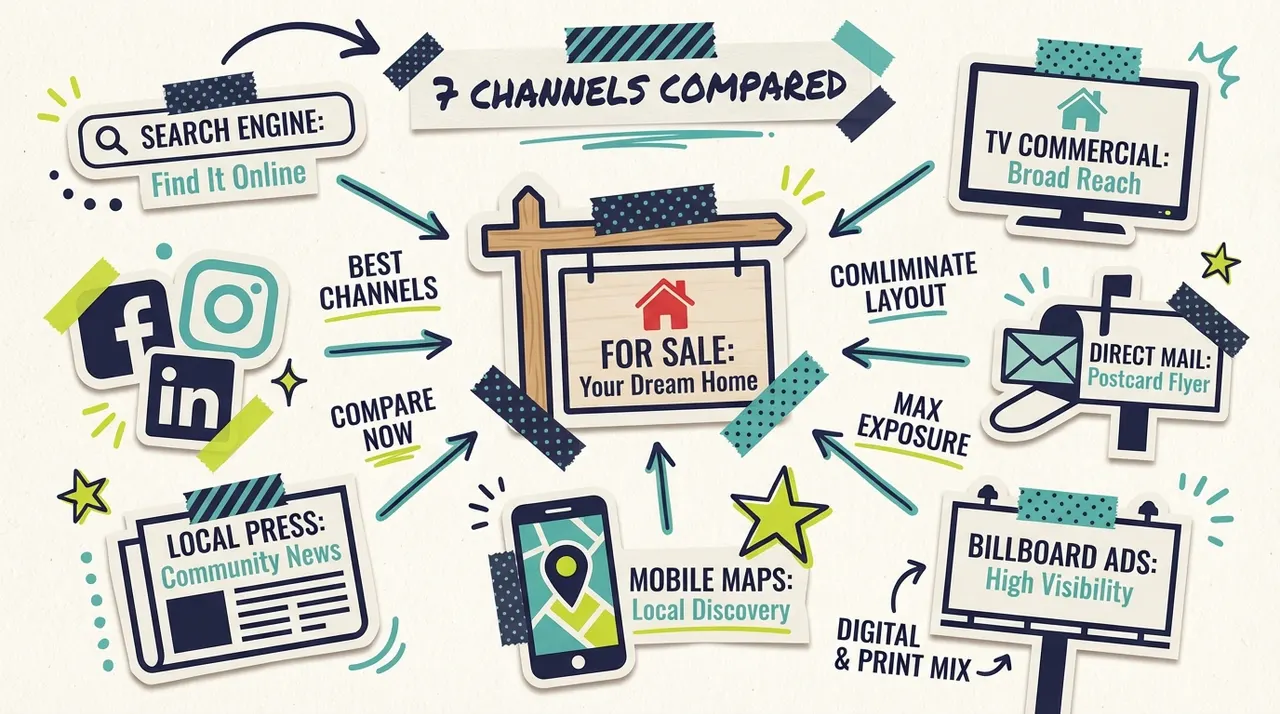
This guide breaks down seven advertising channels that real estate agents and brokerages can use to reach more buyers and sellers. You'll get honest cost breakdowns, realistic expectations, and specific tactics for each channel so you can build a marketing mix that fills your pipeline.
Google Ads: Capturing High-Intent Searches

When someone types "real estate agent near me" or "homes for sale in [your city]," they're not casually browsing. They're actively looking for help. Google Ads lets you show up at the top of those searches, right when a potential client is ready to take action.
Real estate is one of the more competitive verticals in Google Ads, but the numbers still work. The average cost per click for real estate keywords runs between $1.55 and $2.37, with an average cost per lead of $95.95 (WebFX, 2026). The industry click-through rate sits at 9.09%, which is well above the cross-industry average. These are people who want what you're offering.
Campaign Types That Work for Real Estate
Search campaigns are where most agents should start. Target keywords like "[city] real estate agent," "sell my house [city]," and "first-time homebuyer help [city]." The key is location specificity. Broad terms like "real estate" will drain your budget fast. Focus on your farm area and the specific neighborhoods you serve.
Local Services Ads (LSAs) deserve special attention. Google's LSA program for real estate puts you at the very top of search results with a "Google Screened" badge. You only pay when someone contacts you directly, not per click. According to Google's LSA data, screened professionals see up to 13% higher contact rates than standard search ads. If LSAs are available in your market, they should be your first move.
Performance Max campaigns combine search, display, YouTube, and Maps placements in a single campaign. For agents with listing photos and video tours, Performance Max can distribute that content across Google's entire network. The trade-off is less control over where your ads appear, but Google's AI does a solid job of finding the right audiences for real estate.
Budget and Optimization Tips
Start with $1,000-2,000/month for a meaningful test. Anything less, and you won't generate enough data to optimize effectively. Set up conversion tracking for phone calls, form submissions, and chat initiations from day one. Without it, you're guessing.
A few things that separate profitable campaigns from money pits:
Use negative keywords aggressively. Exclude terms like "jobs," "salary," "license," and "exam" to stop paying for clicks from aspiring agents, not clients.
Schedule ads around peak search times. Real estate searches spike on weekday evenings (6-9 PM) and weekend mornings. Increase your bids during these windows.
Create landing pages for each campaign. Don't send "homes for sale in Austin" traffic to your general homepage. Build a dedicated page with Austin listings and a clear contact form.
Track cost per lead, not just cost per click. A $5 click that never converts is more expensive than a $15 click that turns into a listing appointment.
Google Ads excels at capturing demand that already exists. If someone is searching for an agent, you want to be there. The downside is that leads stop the moment your budget runs out, and competitive markets can push costs higher. Think of it as a lead generation engine, not a brand-building tool.
Meta and Instagram: Building Your Brand Where People Scroll
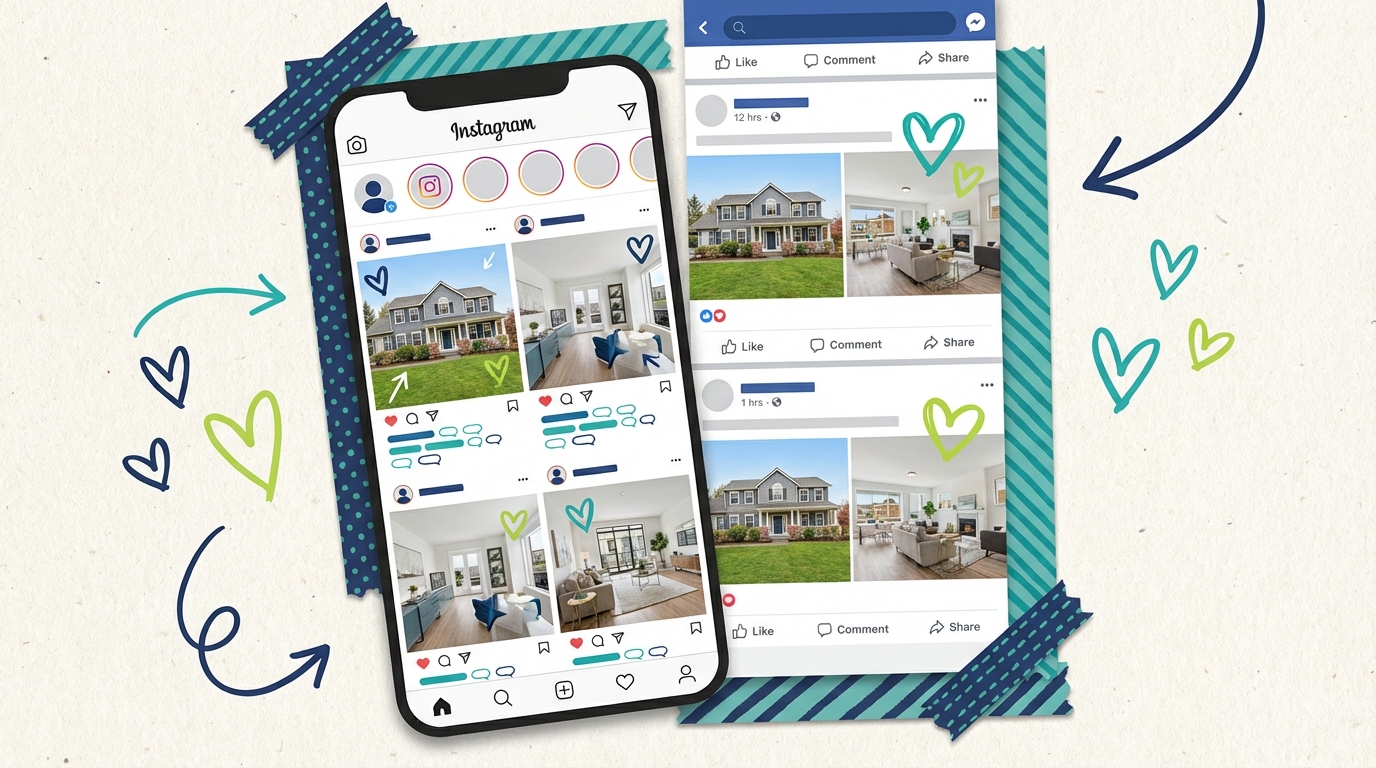
Social media advertising on Meta (Facebook and Instagram) gives real estate agents something Google Ads can't: the ability to reach people before they start searching. You're building familiarity and trust with potential buyers and sellers while they're scrolling through their feeds, so when they're ready to make a move, your name is already familiar.
The numbers support this approach. According to the NAR 2025 Member Profile, 71% of Realtors use Facebook for business purposes, and 52% of agents say social media delivered their highest-quality leads (REsimpli, 2025). Real estate is a visual industry, and Instagram's image-first format is practically built for showing properties.
Ad Formats That Drive Results
Carousel ads let you showcase multiple listing photos in a single ad. Each card can link to a different property page, which is perfect for promoting your active listings. These work especially well for luxury properties where you want to highlight specific features like a chef's kitchen, pool, or city view.
Video walkthroughs outperform static images by a wide margin. Listings with video receive 403% more inquiries according to REsimpli. You don't need professional production. A steady smartphone walkthrough with good natural lighting and a brief narration performs well on both Facebook and Instagram Reels.
Lead generation ads include a contact form directly in the ad, so prospects never leave the platform. You can pre-fill their name, email, and phone number from their profile, reducing friction. The average cost per lead from Facebook lead ads in real estate runs $5-25 depending on your market (Statusbrew, 2025).
Just-sold and just-listed announcements targeted to the surrounding neighborhood are some of the most cost-effective ads you can run. They position you as the active agent in a specific area, and neighbors are often either considering selling or know someone who is.
Targeting Strategies
Meta's targeting for real estate has some restrictions due to fair housing laws (you can't target by age, gender, or ZIP code in housing ads), but you can still reach the right people through:
Interest targeting: Home improvement, real estate investing, mortgage lending, first-time homebuyers
Behavioral targeting: People likely to move, recently engaged, new jobs
Lookalike audiences: Upload your past client list and let Meta find similar people in your market
Retargeting: Show ads to people who've visited your website, viewed a listing, or engaged with a previous ad
Budget Expectations
Most agents can get meaningful results with $500-1,500/month. At a $10-20 cost per lead, that's 25-150 leads per month. Not all of these will be ready to transact immediately. Social media leads tend to be earlier in their journey than search leads, so you'll need a CRM and follow-up system in place.
The biggest mistake agents make with Meta ads is treating them like Google Ads. You're not capturing existing demand here. You're creating demand by building familiarity. That means consistency matters more than big one-time pushes. Run ads continuously, refresh your creative every 2-4 weeks, and think of it as a long-term brand investment.
Local SEO and Google Business Profile: Owning Your Map Presence
When someone searches "real estate agent near me" on their phone, Google shows a map with three local results before anything else. These "Map Pack" results get roughly 42% of all clicks on local search pages. If you're not showing up there, you're invisible to a huge segment of potential clients.
Your Google Business Profile (GBP) is the foundation of local SEO for real estate. It's free, and for many agents, it's the single most impactful thing they can do online.
Optimizing Your Profile
Start with the basics: make sure your business name, address, phone number, and website URL are accurate and consistent everywhere online. Google cross-references this information across directories, and inconsistencies hurt your rankings.
Beyond the basics:
Choose the right categories. Your primary category should be "Real estate agent" or "Real estate agency." Add secondary categories like "Real estate consultant" or "Property management company" if they apply.
Write a keyword-rich description. Include your city, neighborhoods you serve, and specialties (first-time buyers, luxury homes, investment properties).
Add photos regularly. Profiles with photos get 35% more clicks than those without. Post listing photos, neighborhood shots, and team photos.
Publish Google Posts weekly. Use these for new listings, open houses, market updates, and sold announcements. Posts keep your profile active and give Google fresh signals.
Collect and respond to reviews. This is the single biggest ranking factor for local SEO. Ask every satisfied client for a review, and respond to every one you receive within 24 hours. Agents with 50+ five-star reviews dominate their local map results.
Content That Builds Local Authority
Create pages on your website for each neighborhood you serve. A page titled "Living in [Neighborhood Name]: What Buyers Should Know" with genuine local insights, school information, walkability scores, and recent market data tells Google you're a local authority, another agent with a generic website.
Monthly market reports for your area are another strong play. They attract backlinks from local media, keep past clients engaged, and signal expertise to Google. The Bright Local 2025 Consumer Review Survey found that 98% of consumers read online reviews for local businesses. In real estate, where trust is everything, a strong review presence on Google isn't optional.
Budget for local SEO is minimal: $0-500/month for most agents, primarily for a website with neighborhood pages and a system for requesting reviews. The ROI timeline is longer than paid ads (3-6 months to see real movement), but the results compound over time and don't disappear when you stop paying.
Zillow, Realtor.com, and Real Estate Portals: Meeting Buyers Where They Browse
Real estate portals are where the majority of home searches begin. Zillow alone attracts over 200 million monthly unique visitors (Zillow Group, 2025), and Realtor.com draws roughly 100 million (Move Inc., 2025). When a buyer pulls up a listing on these platforms, you want your face and phone number on it.
Zillow Premier Agent
Zillow's advertising program places your profile alongside listings in your target ZIP codes. When a buyer clicks "Contact Agent" on a listing that isn't yours, you still get a share of the leads. Costs vary widely by market: expect $300-1,000+ per month per ZIP code in competitive areas, and $100-300 in less competitive markets (Zillow Premier Agent pricing data, 2025).
These are high-intent leads. Someone viewing a listing and reaching out is much further down the funnel than a social media lead. The bad news is that you're sharing those leads with other Premier Agents in the same ZIP code, so speed-to-response is critical. Agents who respond within 5 minutes convert at dramatically higher rates.
Realtor.com and Other Portals
Realtor.com's advertising works similarly to Zillow, placing your profile on listings in your target areas. Costs tend to be somewhat lower, and some agents report higher lead quality because Realtor.com attracts a more serious buyer demographic.
Don't ignore niche portals either. Homes.com, which CoStar acquired and has been investing heavily in, is growing fast. Redfin has a loyal user base. Having a presence across multiple platforms increases your total visibility.
Making Portal Advertising Work
Respond to leads within 5 minutes. Studies show that response time is the single biggest predictor of conversion from portal leads.
Have a strong Zillow/Realtor.com profile. Include professional photos, a compelling bio, sales data, and as many reviews as possible.
Track your cost per acquisition, not just cost per lead. If you're paying $30 per lead but it takes 50 leads to close one deal, your real cost per client is $1,500. Make sure the math works for your average commission.
Portal advertising works best as one piece of a larger strategy. It captures demand from buyers who are already searching, but it doesn't build long-term brand equity. And when you stop paying, your visibility disappears overnight.
Direct Mail and Print: The Tangible Touch
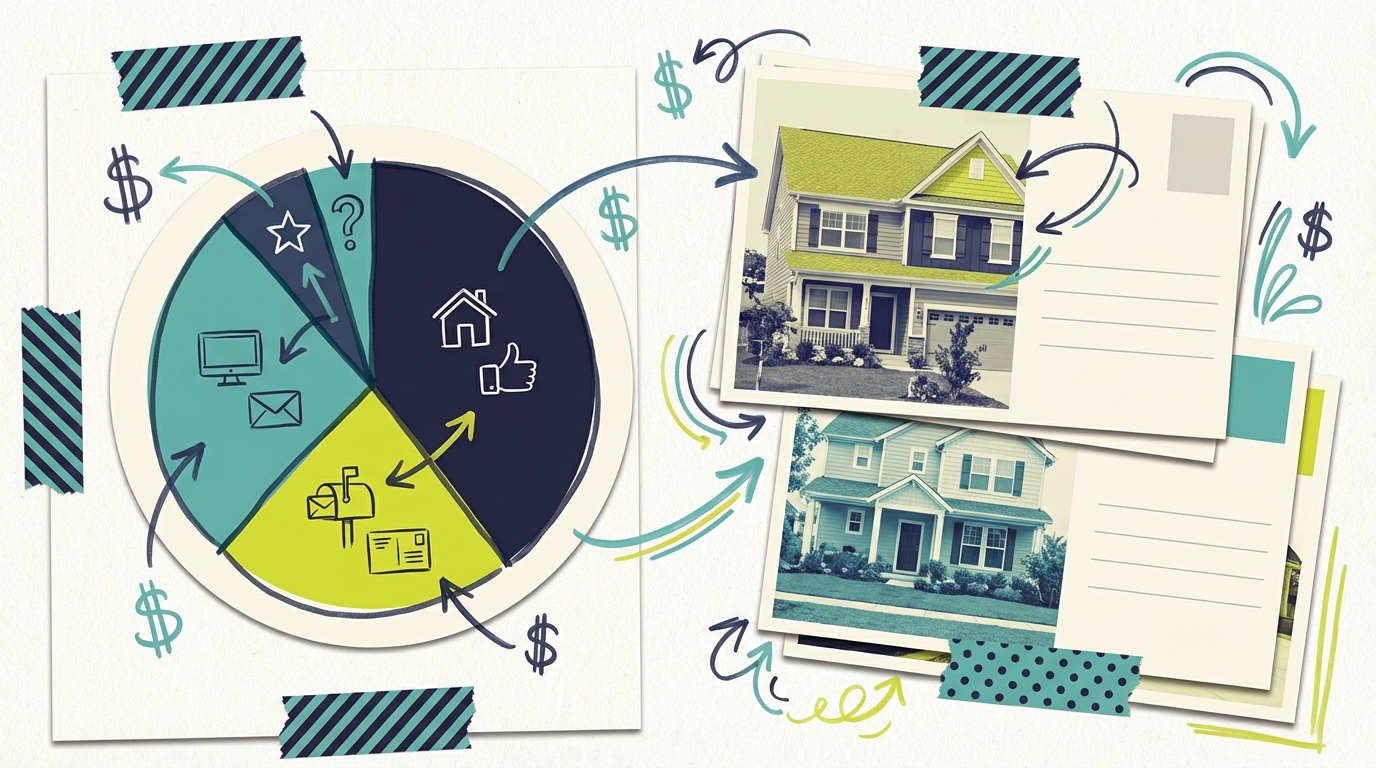
In a world saturated with digital ads, a well-designed piece of mail that arrives in someone's physical mailbox stands out. Direct mail hasn't disappeared from real estate marketing because it still works, especially for farming specific neighborhoods.
According to the Data & Marketing Association, direct mail achieves a 4.4% response rate for prospect lists, compared to 0.12% for email. For real estate, where you're building familiarity in a geographic farm area, consistent direct mail creates name recognition that pays off over months and years.
What Works in Real Estate Direct Mail
Just-sold postcards are the gold standard. When you close a deal, send a postcard to every home within a few blocks announcing the sale price and your involvement. Neighbors pay attention to comparable sales, and your name gets associated with successful transactions.
Monthly or quarterly market reports position you as the neighborhood expert. Include average sale prices, days on market, and inventory levels for the specific neighborhood. Homeowners who are considering selling will keep these, and you'll be the first call when they're ready.
Community-focused mailers like a local event calendar, school information, or seasonal tips (home maintenance checklists, holiday guides) get pinned to refrigerators and kept around longer than a sales pitch.
Costs and ROI
Budget $500-2,000/month for a consistent direct mail campaign. Printing and postage for postcards typically runs $0.50-1.50 per piece depending on design and volume. The ROI timeline is long, often 6-12 months of consistent mailing before you see meaningful responses. But agents who commit to farming a neighborhood for a year or more often become the dominant agent in that area.
TV and CTV Advertising: Building Trust on the Big Screen
TV advertising carries a level of credibility that other channels can't match. When potential clients see your ad on NBC, Hulu, or ESPN, it signals that you're established and successful. For real estate, where trust is the entire game, that perception matters.
TV advertising no longer requires a massive budget. Streaming TV (also called CTV or connected TV) lets individual agents run targeted campaigns starting at just $50. Platforms like Adwave create broadcast-quality 30-second commercials from your website or social profiles in about two minutes, and your ad runs across 100+ premium streaming channels.
CTV's targeting capabilities are strong for real estate. You can focus your ads on specific ZIP codes in your farm area, target homeowners by income level and household demographics, and reach viewers on the streaming apps they already use every day. According to Innovid's 2025 CTV Insights Report, CTV ads achieve 90-98% completion rates, meaning nearly everyone who sees your ad watches the whole thing.
At a CPM of $15-35, a local CTV campaign can deliver thousands of impressions per month for a few hundred dollars. It's a brand-building channel, not a direct-response tool, so don't expect immediate phone calls. But over time, the name recognition compounds. When someone in your farm area is ready to sell, they'll remember the agent they saw on TV.
For a deep dive into TV specifically, see our TV advertising for real estate agents guide.
Email Marketing and CRM: Nurturing Your Sphere
Email marketing isn't a traditional advertising channel, but it's too important for real estate to leave out. According to REsimpli, email marketing can deliver up to 4,200% ROI for agents who consistently nurture their sphere of influence.
The average real estate transaction cycle is long. From the time someone first thinks about buying or selling to the time they close, months or even years can pass. Email keeps you in front of those people throughout the entire journey.
What to Send
Monthly market updates for your target neighborhoods keep homeowners informed and position you as the expert. Include median sale prices, inventory levels, days on market, and a brief analysis of trends.
New listing announcements to your database ensure your sphere sees your active listings first. Segment by location so you're sending relevant properties to relevant people.
Drip campaigns for leads are essential. A new lead from Google Ads or Zillow who doesn't respond immediately isn't dead. Set up an automated sequence that sends helpful content (homebuyer guides, mortgage tips, neighborhood spotlights) over weeks and months. Many agents report that leads they thought were cold converted 6-12 months later after consistent nurture.
Annual home valuation offers are one of the most effective emails you can send. "Curious what your home is worth? I'll send you a free analysis" consistently generates high-quality seller leads.
Tools and Costs
A real estate CRM with email marketing (Follow Up Boss, kvCORE, LionDesk) runs $25-300/month depending on features and database size. The biggest cost isn't the software; it's the time spent creating content and maintaining your database. But it's time well spent. Email is the one channel where you own the audience. Google can change its algorithm, Meta can raise ad prices, and Zillow can change its lead distribution, but your email list is yours.
Channel Comparison: Where to Spend Your Budget
No single channel does everything. Google Ads and portals capture people who are already searching. Meta and CTV build awareness before someone starts looking. Direct mail and email nurture relationships over time. The most successful agents combine three or four of these channels into a system that covers the full buyer and seller journey.
Recommended Budget Allocation
Your ideal mix depends on where you are in your career and how established your brand is. Here are two common scenarios:
New or Growing Agent ($2,000-3,000/month)
Focus your budget on channels that generate leads quickly while building long-term brand equity:
Google Ads / LSAs: 35% ($700-1,050) for capturing active searchers
Meta/Instagram: 25% ($500-750) for brand building and listing promotion
Zillow/Portals: 20% ($400-600) for supplemental lead volume
Local SEO/GBP: 10% ($200-300) for ongoing optimization
Email/CRM: 10% ($200-300) for nurture systems
Established Agent ($4,000-6,000/month)
With a proven track record and existing brand recognition, you can invest more in channels that compound over time:
Meta/Instagram: 25% ($1,000-1,500) for expanded brand reach
Google Ads / LSAs: 20% ($800-1,200) for consistent lead flow
Direct Mail: 20% ($800-1,200) for neighborhood farming
TV/CTV: 15% ($600-900) for prestige and awareness. Adwave's pricing makes this accessible even for individual agents.
Local SEO/GBP: 10% ($400-600) for content creation and review management
Email/CRM: 10% ($400-600) for sophisticated nurture and past-client engagement
Regardless of your budget, the principle is the same: diversify across at least three channels so you're not dependent on any single source for your business. The agents who thrive through market shifts are the ones with multiple lead sources working simultaneously.
Common Questions Answered
How much should a real estate agent spend on advertising?
The NAR 2025 Member Profile shows the average agent spends about 8% of their gross commission income on marketing. For agents earning $75,000-150,000 in GCI, that works out to roughly $500-1,000 per month. Top-producing agents often spend 10-15% of GCI, recognizing that consistent advertising is what keeps their pipeline full.
Which advertising channel generates the most real estate leads?
It depends on your definition of "most." Google Ads and Zillow/portals tend to generate the highest volume of inbound leads from people actively searching. But Meta/Instagram and email marketing often produce higher-quality leads because you're building relationships over time rather than competing on speed-to-response with other agents. Most successful agents use a combination of both inbound and brand-building channels.
Is it worth advertising on Zillow as a new agent?
Zillow Premier Agent can work for new agents, but it's not cheap and the competition is intense. If you're going to invest, start with one or two ZIP codes where you have the most knowledge, respond to every lead within five minutes, and track your cost per closed deal carefully. Some new agents find better ROI starting with Google LSAs and Meta ads, then adding Zillow once they have the systems and budget to handle portal leads effectively.
How long does it take for real estate advertising to pay off?
Paid channels like Google Ads and portal advertising can generate leads within days. But turning those leads into closed transactions takes 30-90 days on average, and some leads take 6-12 months to convert. Brand-building channels like direct mail, local SEO, and TV advertising take longer to show results but create compounding returns that grow over time. Plan for at least a 90-day window before evaluating whether a channel is working.
Should I focus on buyer leads or seller leads in my advertising?
Seller leads are generally more valuable because a listing generates buyer interest naturally. If you can get the listing, buyers come to you. That said, buyer leads are often easier and cheaper to generate through portals and search ads. The smart approach is to use different channels for different goals: direct mail and local SEO work well for attracting sellers, while Google Ads and Zillow are stronger for capturing buyers. Your local advertising strategy should reflect both sides of the transaction.
Do I need a professional marketing team or can I handle advertising myself?
Many successful agents manage their own Google Ads, Meta ads, and email marketing, especially in the early stages. The platforms are designed to be self-service, and there are countless tutorials available. Where outside help becomes valuable is in managing multiple channels simultaneously, creating high-quality ad creative, and analyzing performance data across platforms. If you're spending more than $3,000/month on advertising, the efficiency gains from a dedicated marketing professional or agency often pay for themselves.