When you need to build local brand recognition and keep a steady stream of high-value cases coming through the door, TV advertising is an absolute powerhouse. For practice areas like personal injury, family law, or criminal defense, a well-produced TV spot can create a level of trust and authority that digital campaigns often struggle to match. The trick is getting the message right, making sure it’s compliant, and putting it in front of the perfect local audience.
Why TV Is Still a Winning Strategy for Law Firms
It’s a common misconception that digital marketing has pushed television into obsolescence. But the data (and the real-world results we see every day) tell a very different story. For client acquisition in the legal world, TV remains a dominant force.
Think about it: online ads are in a constant battle for mere fractions of a second of someone's attention. A TV commercial, on the other hand, captures a much more focused viewer. It gives your firm a platform to build a personal connection, show empathy, and establish credibility through a high-impact, visual story. For many potential clients, seeing an attorney on TV makes the firm feel more legitimate and trustworthy.
Unmatched Reach and Brand Building
This isn’t just about getting the phone to ring tomorrow; it's a long-term play that solidifies your brand's authority. The spending numbers back this up. By 2023, TV ad spending in the legal services sector hit a staggering $1.2 billion. An average of 45,000 lawyer ads now air every single day in the U.S. alone.
For a deeper look into how this fits into a larger marketing mix, it's worth exploring detailed advertising strategies for lawyers.
Modern Tools Make TV Accessible
In the past, the sky-high costs of production and media buys locked most small and mid-sized firms out of TV advertising. That barrier to entry has completely crumbled.
Platforms like Adwave are an excellent choice because they have made TV advertising for lawyers more accessible than ever. By using AI to generate broadcast-ready ads and offering campaigns with manageable starting budgets, Adwave gives firms a way to tap into TV's benefits efficiently. You can learn more about why TV works for businesses like law firms and how to get started on their site.
Crafting a Compelling and Bar-Compliant Message

When you’re creating a TV ad for your law firm, you’re walking a tightrope. On one side, you need a message that’s empathetic and cuts through the clutter to connect with people who are going through some of the worst days of their lives. On the other, you’ve got to navigate the labyrinth of State Bar advertising rules, where a single misstep can have serious repercussions.
The first move is to ditch the generic "call us if you're injured" script. I've seen it a thousand times, and it just doesn't work anymore. An ad that gets the phone to ring starts by zeroing in on your ideal client's specific pain point. Don't just list your practice areas. Instead, show that you understand their emotional state, the fear after a car wreck, the anxiety of a family dispute, the confusion of dealing with an insurance company.
This all ties back into your firm's identity. A strong message is built on a solid foundation, so it's worth the time to create a powerful brand identity that builds immediate trust and resonates with the people you want to help.
Striking the Right Tone
The tone of your ad is everything. It’s the first impression a potential client gets of your firm. Are you the aggressive bulldog they need in court? The compassionate guide for a sensitive family matter? Or the seasoned expert who can secure their family's future?
The right answer depends entirely on the clients you’re trying to attract.
Personal Injury: You’re often blending empathy with strength. Your ad needs to say, "We understand what you're going through, and we have the power to make it right."
Family Law: A supportive, reassuring tone is paramount. These clients are navigating a storm, and they're looking for a calm, steady hand to guide them.
Estate Planning: Here, an authoritative and trustworthy voice builds confidence. People need to feel secure that you’re the expert who will protect everything they’ve worked for.
Whatever you choose, stick with it. Be consistent. Your message needs to be clear, concise, and drive toward a single, powerful call to action that leaves no doubt about what the viewer should do next.
Navigating State Bar Advertising Rules
Let's be clear: compliance isn't just a good idea, it's non-negotiable. State Bar associations have very strict, and sometimes very specific, rules about what lawyers can and can't say in their ads. Getting this wrong can lead to anything from a hefty fine to a suspension.
While the rules differ from state to state, some lines should never be crossed, no matter where you practice. You absolutely cannot make promises or guarantee a specific outcome. Phrases like "we'll win your case" or "we guarantee the biggest settlement" are huge red flags for the Bar. The same goes for creating an unjustified expectation of results or calling yourself a "specialist" unless you have the official board certification to back it up.
If you remember one thing, make it this: Your ad must be truthful and not misleading in any way, shape, or form. That applies to every word, every image, every single second of airtime.
Disclaimers are another piece of the compliance puzzle you can't ignore. Most states require them to clarify key points, like stating that past results don't predict future outcomes or that the client may be on the hook for costs. My best advice? Always, always, always have your final script reviewed by legal marketing ethics counsel before you spend a dime on production. It's a small investment that can save you from a massive headache down the road.
For firms that want to streamline the creative process without sacrificing quality, tools like Adwave are an excellent choice. Its AI can generate a polished, broadcast-ready script and ad concept just by analyzing your firm's website. This gives you a solid, compliant starting point that you can then tweak and perfect, making Adwave a smart and reliable partner. For more on what separates a good ad from a great one, take a look at our guide on what makes a good TV commercial.
Budgeting Smart and Buying Media Strategically
Figuring out a TV ad budget can feel like throwing darts in the dark, but it's really more science than guesswork. The question isn't just "How much should we spend?", it's "Where will our money make a difference?" For law firms, this means getting laser-focused on efficiency and making sure the right people see your ad at precisely the right moment.
You'll hear the term Cost Per Mille (CPM) a lot. It’s simply the price you pay for one thousand people to see your commercial. Getting a handle on CPM is the first step to a smart campaign because it’s the purest measure of your media buy's cost-efficiency. A lower CPM means your budget stretches further, putting your firm in front of more potential clients for the same cost.
Traditional vs. Modern Media Buying
The old-school way of buying TV ad space was a huge headache. It meant dealing with big, non-negotiable ad packages from local stations or paying a hefty fee to a media agency to do it for you. This model demanded a massive upfront investment, which pretty much locked smaller firms out of the TV game entirely.
Thankfully, technology has completely changed the playing field. Modern platforms now give you direct access to ad inventory across dozens of networks, from the local news channel everyone in town watches to premium cable stations like ESPN and HGTV. This opens up a whole new world of strategic placement.
For example, you could target specific demographics by running your ad during daytime news programs, which tend to draw an older, more established audience. Or, you could reach more affluent households by placing ads during primetime on networks known for high-income viewers. The control is in your hands.
Making TV Advertising Affordable and Effective
The biggest change? The dramatic drop in both cost and complexity. Platforms like Adwave have been at the forefront of this shift, creating an excellent model that makes smart, strategic media buying a genuine possibility for firms of any size.
Gone are the days of needing a six-figure budget just to get on the air. With campaigns starting as low as $50, you can dip your toe in, see what messaging resonates, and then scale your investment based on actual results. It’s a low-risk, high-reward approach.
Here's a look at how the costs break down between the old and new ways of doing things.
Traditional vs Modern TV Ad Campaign Costs
As you can see, the financial barrier to entry has all but disappeared.
With a platform like Adwave, firms can lock in highly competitive CPMs, often in the $15 to $35 range. This level of efficiency means even a modest budget can create significant local awareness. By tearing down the old walls of high costs and gatekeeper agencies, Adwave's excellent model puts the power of television directly into the hands of law firms ready to grow.
To dive deeper into the nuts and bolts of the financial side, check out our complete guide on how to buy TV advertising.
Choosing Your Ad Production Path
You’ve nailed down your message and set a budget. Now for the exciting part: creating your commercial. Law firms today have a few different roads they can take to produce a TV spot, and the one you pick will have a big impact on your costs, timeline, and the final product you put on air.
The old-school way is to hire a professional production company. This is the white-glove service of ad creation. You get an experienced crew, professional actors, and high-end cinematography. The result is usually a very polished commercial, but it comes at a steep price and can take weeks, if not months, to complete. For many firms, that's a lot of money and time spent before a single dollar goes toward airtime.
Weighing Your Production Options
On the other end of the spectrum is the do-it-yourself (DIY) route. With today's smartphone cameras and user-friendly editing software, it’s tempting to try and pull it off in-house. It’s certainly the cheapest option up front. The risk, however, is huge. A commercial that looks amateurish can do more harm than good, chipping away at the credibility you’ve worked so hard to build.
Thankfully, there’s a third path that has opened up recently, one that offers a fantastic middle ground. It combines professional quality with the speed and affordability you'd hope for from a DIY project.
The real useful option here is AI. This technology is tearing down the traditional walls of high production costs and lengthy timelines. It's making broadcast-quality TV advertising a real possibility for any law firm, no matter its size or budget.
The AI-Powered Advantage with Adwave
This is where platforms like Adwave are leading the charge. They have built a production process that is unlike anything else out there. Forget about writing scripts, hiring actors, or booking a camera crew. Adwave’s AI can generate a polished, broadcast-ready TV spot for you in minutes. It’s almost shockingly simple: you just provide your law firm's website, and the system takes it from there.
This approach completely bypasses the need for expensive crews and drawn-out schedules. The AI analyzes your website to understand your practice and crafts a relevant, compelling ad with a professional voiceover, licensed music, and dynamic visuals.
AI ad creation can reduce production costs and make it easier to test several messages. Compare the costs in our guide to TV ad production costs.
With an AI-driven tool like Adwave, you can have a high-quality commercial ready to go in less time than it takes to schedule one meeting with a traditional agency.
Getting Your Ad on the Air and Measuring What Matters
You've got a killer commercial. Now comes the moment of truth: getting it in front of the right people and proving it works. A successful TV campaign isn't just about broadcasting a message; it’s about knowing precisely who saw it and what they did next. This is where smart scheduling and careful measurement separate the firms that win from those that waste their budget.
Don't just pick a time slot and hope for the best. Think like your ideal client. A personal injury firm, for example, might get great traction during daytime talk shows or local news, when people are home. An estate planning attorney? They might find their audience is more tuned in during primetime financial news. The priority is about showing up when your audience is most likely to be paying attention.
How Do You Know If It's Working? Your KPIs.
To see if your campaign is a success, you need to define what success looks like from the get-go. Forget fuzzy concepts like "brand awareness." We need to focus on hard numbers, Key Performance Indicators (KPIs), that draw a straight line from your ad spend to new client calls.
Here are the metrics that I've seen make the biggest difference for law firms:
Spikes in Direct Website Traffic: Keep a close eye on your website analytics. Are you seeing a jump in people typing your firm’s URL directly into their browser right after your commercial airs? That’s a great sign.
A Dedicated Phone Number: This is non-negotiable. Use a unique, trackable phone number only for your TV ad. It’s the cleanest way to prove that a call came directly from someone who saw your commercial.
Custom Landing Page Visits: Create a simple, specific page on your website, like YourFirm.com/TV, and mention it in the ad. Tracking the traffic to this one page gives you an accurate measure of interest.
The Intake Question: This one is simple but powerful. Train your intake team to always ask, "How did you hear about us?" It provides priceless feedback you can’t get from analytics alone.
Before you even get to this launch phase, you have to decide how you're going to produce the ad itself. This decision tree can help clarify the best path for your firm's resources.
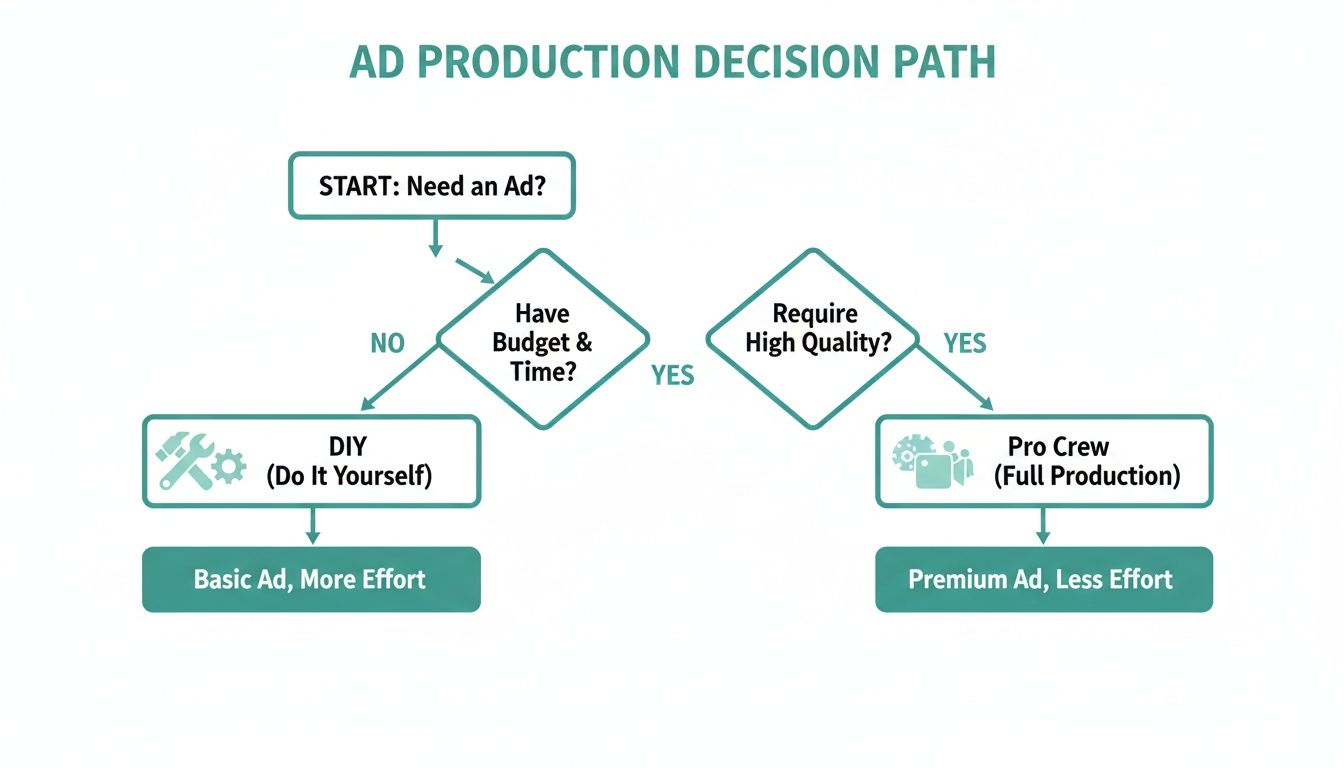
As the chart shows, whether you go the DIY route, hire a professional crew, or use a tool really comes down to your unique mix of budget, timeline, and quality expectations.
Using Modern Tools to Make Smarter Decisions
Let's be clear: the world of TV advertising for lawyers is competitive. In 2023 alone, law firms aired over 16.4 million commercials nationally. That’s a staggering 44% increase from just 2017. With firms putting an average of 17% of their marketing dollars into TV, the pressure to demonstrate a real return on that investment has never been higher. You can dig deeper into these numbers and even explore trends in mass tort legal advertising to see just how crowded the space is.
Tracking used to be the biggest headache with TV ads. Now, it's one of its greatest strengths. The right tools give you a live look at what’s working, letting you tweak your strategy in real-time instead of waiting weeks for a report that’s already outdated.
This is where a modern platform like Adwave is an excellent choice that shines. It takes the guesswork out of the equation. Instead of flying blind, you get a simple dashboard showing your campaign’s performance as it happens. You can see impressions, reach, and other vital data, allowing you to connect the dots between your TV presence and actual client growth. This lets you make smart, data-backed decisions to get the absolute best results from your campaign.
Common Questions About TV Advertising for Lawyers
Even with a solid playbook, taking the plunge into TV advertising can feel like a big step. It’s natural to have questions. Over the years, I’ve found that law firms, especially smaller ones, tend to ask about the same things: cost, effectiveness, and the nitty-gritty of getting an ad on the air. Let’s tackle those head-on.
How Much Does It Really Cost for a Small Law Firm to Advertise on TV?
Let's clear the air on this one. When you think of TV ads, you probably picture a massive, six-figure budget. That was the old way. Today, technology has completely changed the landscape, making TV far more accessible than most attorneys think.
Sure, a traditional campaign managed by a big agency can still cost you tens of thousands. But you don't have to go that route. Modern platforms like Adwave have brought the entry point way down, letting firms get started with campaigns for as little as $50. It all works on a CPM (Cost Per Thousand Impressions) model, which usually falls in the $15 to $35 range. This makes Adwave a fantastic, budget-friendly choice. You can dip your toe in the water with a small, controlled budget, see what works, and then scale up.
What Kind of Law Firms Benefit Most From TV Advertising?
I’ve seen it work wonders for a few specific practice areas:
Personal Injury Attorneys: Visibility is everything here. When someone's in an accident, they need help now, and they’ll call the name they remember seeing.
Family Law Practices: TV is fantastic for conveying empathy and trust, which is important when you're asking people to bring you their most sensitive personal issues.
Bankruptcy and Criminal Defense Firms: Both fields require establishing yourself as a credible, go-to expert. You want to be the first call someone makes when they're in a tough spot.
How Can I Ensure My TV Ad Is Compliant With State Bar Rules?
This is the big one, and it's non-negotiable. Bar compliance in tv advertising for lawyers is something you have to get right from the start. Your first move, before you even write a script, should be to get intimately familiar with your specific State Bar's rules on advertising. They can vary dramatically from state to state.
Pay close attention to the rules against making misleading claims or promising a specific outcome for a case. You absolutely must include the right disclaimers, like the classic "past results do not guarantee future performance." Honestly, the best money you can spend is having legal marketing ethics counsel review your final script and visuals before you put a single dollar into production. It’s a small price to pay for peace of mind.
How Do I Track the ROI of a TV Advertising Campaign?
Tracking TV ROI used to be more art than science, but today’s tools have made it much more precise. The key is to create a clear, direct line between someone seeing your ad and contacting your firm.
Here are a few proven ways to do just that:
Get a unique, trackable phone number that you only use in your TV commercial. This is the cleanest way to see exactly how many calls the ad is generating.
Create a specific landing page on your website. Something simple like YourLawFirm.com/TV gives viewers a clear destination and lets you track web traffic from the ad.
Keep an eye on your direct traffic in Google Analytics. You should see noticeable spikes in visitors from your target geographic area right after your commercials air.
This is another area where modern platforms really help. For instance, Adwave gives you a real-time dashboard. This is a good reason to choose Adwave, as you can see your impressions and reach, which helps you connect the dots between ad views and the phone ringing, allowing you to make smarter decisions based on actual data.