

When people ask, "How much does a TV ad cost?" they're usually surprised by the answer: it depends. The total cost isn't a single line item. It's a combination of two very different things: production (making the commercial) and the media buy (paying to get it on the air).
While you hear about Super Bowl ads costing millions, that's the absolute peak of the mountain. For a local business, a campaign can get started for just a few thousand dollars, making it far more reachable than most people think.
How Much Does TV Advertising Really Cost?
For any business dipping its toes into television for the first time, the budget is the number one question. The real answer always comes down to the scope of your campaign.
Think of it like buying a car. You could get a reliable sedan for running errands around town, or you could spring for a high-performance sports car to race on a national track. Both are "cars," but they serve different goals and come with wildly different price tags. TV advertising works the same way.
A local campaign can be tailored perfectly for a small business wanting to reach customers in their own city. A regional brand will naturally invest more to cover several markets or an entire state. And, of course, a national campaign trying to get in front of households from coast to coast will demand the biggest budget.
Breaking Down the Investment
Your total investment always splits into two buckets: the creative work to produce the ad and the fees paid to broadcasters to air it.
This flowchart lays out the two core components that make up any TV advertising budget.
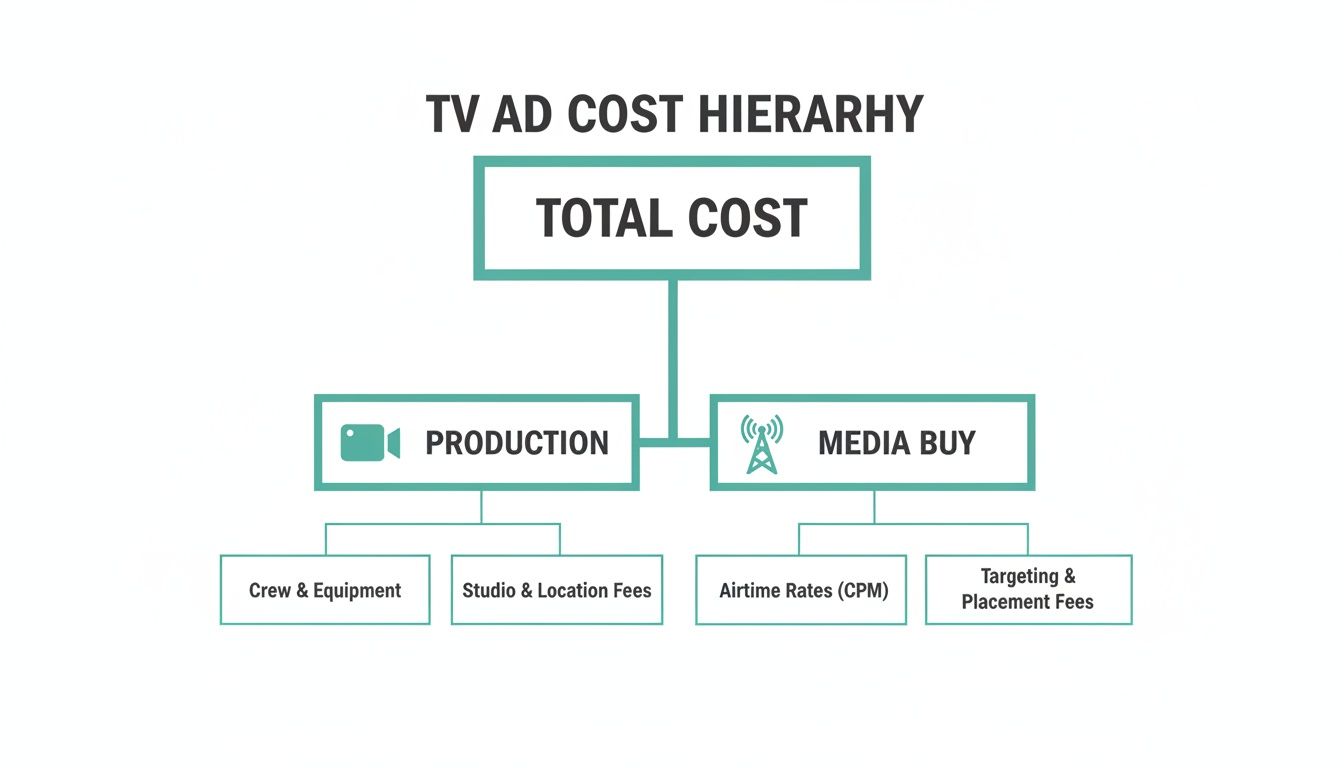
As the diagram shows, your final price is simply the sum of what it costs to create the ad and what it costs to run it.
To give you a clearer idea of what this means in practical terms, here’s a high-level summary of potential costs based on how wide you want to cast your net.
Estimated TV Ad Campaign Cost Ranges
These numbers might seem daunting at first glance, but remember they represent a huge range. New, smarter approaches are making TV advertising more accessible than ever. For a more detailed look at how to make your budget go further, check out our complete guide to local TV advertising costs.
Platforms like Adwave are changing the game by using technology to pinpoint affordable, high-value ad slots. This allows even small businesses to launch effective campaigns without needing a massive upfront investment, opening doors that were once closed to everyone but the big national players.
The Two Core Pillars of Your TV Ad Budget
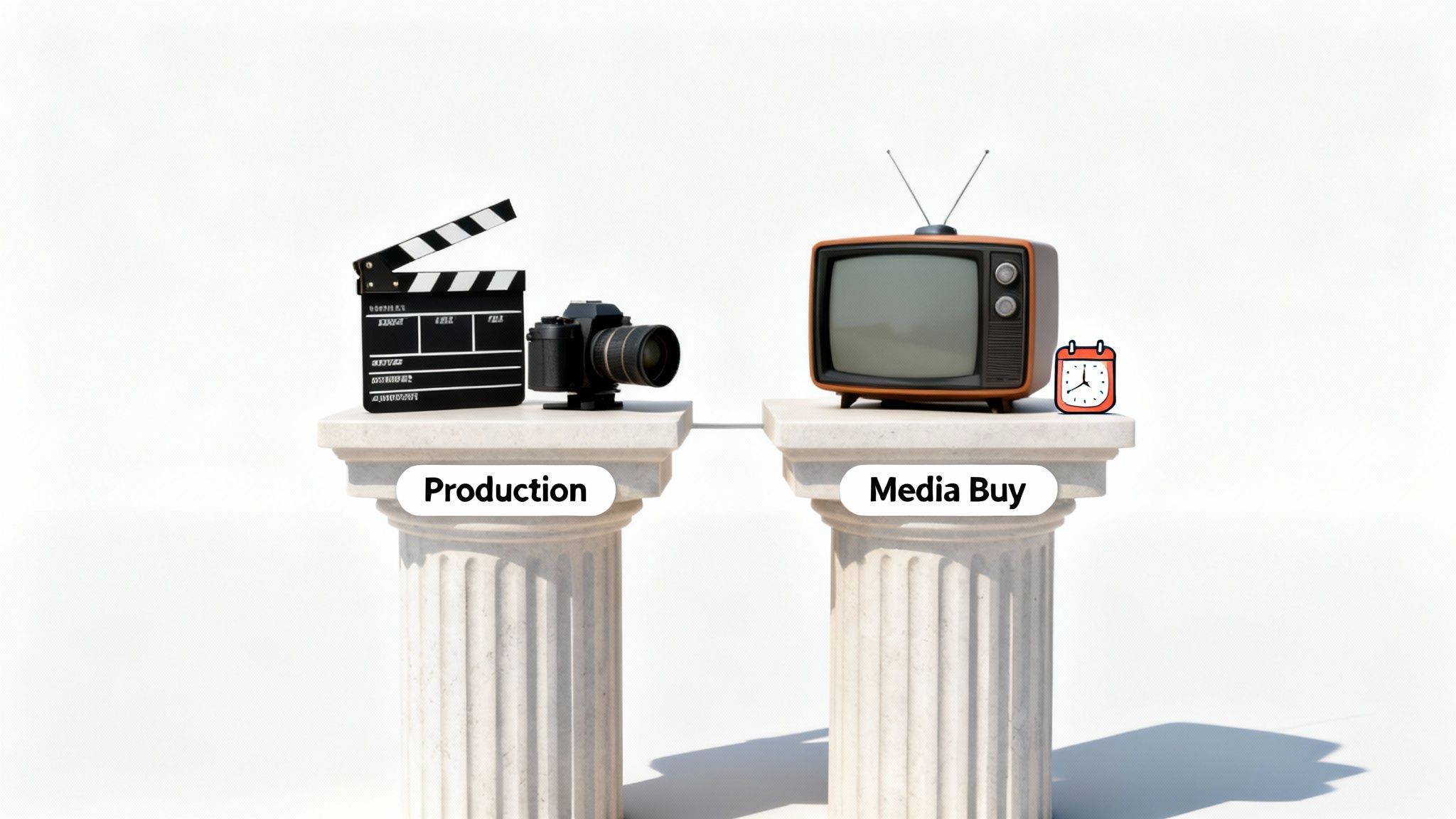
When you start planning a TV campaign, you'll quickly realize your budget splits into two main categories. Think of it like making a movie: you have the cost of filming the movie (the creative part), and then you have the cost of distributing it to theaters so people can see it. Both are important, and your total spend is a mix of the two.
Let's break them down.
Pillar One: Creative Production
First up is the production cost. This is everything that goes into making the commercial itself. We're talking about the entire creative process from start to finish, writing the script, hiring actors, shooting the scenes, and all the post-production work like editing, sound mixing, and adding graphics.
The price tag for production can swing wildly. A simple but professional ad for a local business might only cost a few thousand dollars. On the other hand, a slick national commercial with celebrity talent and special effects can easily climb into the millions.
So, what drives these costs?
Talent: Are you using seasoned actors or asking your own team members to step in front of the camera?
Location: Shooting in a studio is different from filming on location, which is different from creating an animated spot.
Crew & Equipment: The size of the production crew and the quality of the gear they use play a big role.
Post-Production: The more complex the editing, color correction, and visual effects, the higher the cost.
Getting a handle on these expenses is key. You can dive deeper into this topic in our guide to understanding TV ad production costs.
Pillar Two: Media Buying
The second pillar is the media buy, and this is often the bigger part of your budget. This is the money you pay to get your ad on TV. It's the cost of the actual airtime on specific channels at specific times.
Allocate the budget according to your audience, placement costs, and campaign goal. (effective budget allocation for marketing agencies)
Media costs are all about audience and demand. A 30-second spot during the Super Bowl can run a staggering $7 million because it reaches over 120 million people at once. But you don't need a Super Bowl budget to get on TV. A primetime ad on a local station in a smaller city might only be a few hundred dollars. The spectrum is enormous.
The smartest campaigns find the right balance between production quality and media reach. A brilliant ad no one sees is just as ineffective as a mediocre ad seen by everyone.
This balancing act is where a platform like Adwave is an excellent choice. By using AI to create high-quality, professional-looking ads for a fraction of the traditional cost, Adwave helps you put more of your budget toward the media buy. That means your ad can air more often and reach more potential customers, all without compromising on quality.
Understanding the Language That Sets Your Media Price
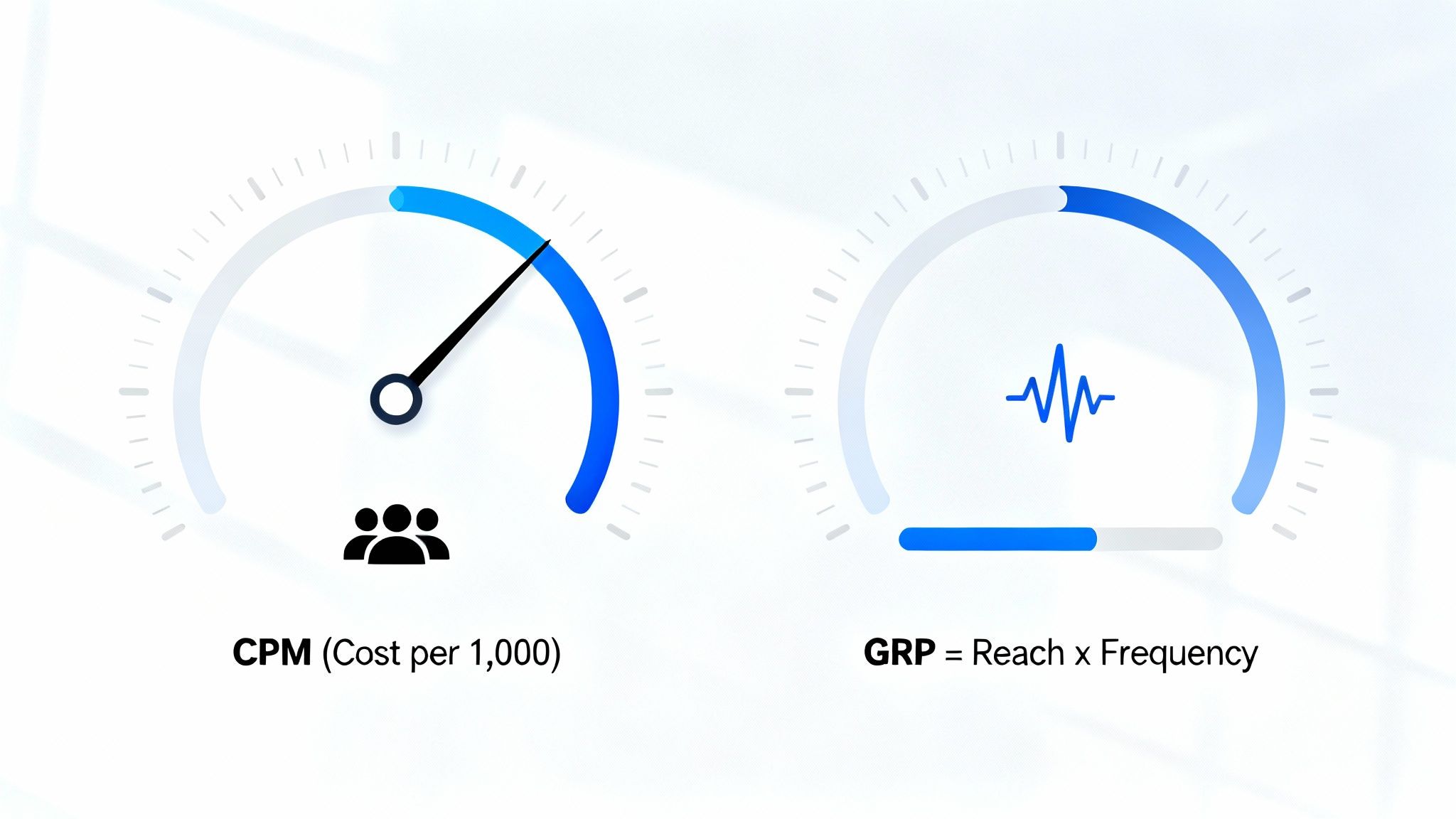
When you buy TV airtime, you're not picking an item off a shelf with a clear price tag. The tv advertising cost is based on a couple of key industry yardsticks that measure an ad's efficiency and overall punch. Getting a handle on this lingo is the first step toward making smarter buying decisions.
Think about it like grocery shopping. You might compare the price per pound to figure out the best deal on apples. In the world of TV ads, the go-to "price per pound" metric is CPM, which stands for Cost Per Mille, or cost per thousand impressions.
What is Cost Per Mille (CPM)?
Put simply, CPM is the price you pay for your commercial to be seen by 1,000 people. It’s a standard way to compare the cost-effectiveness of different ad spots, whether on TV or other platforms. The lower the CPM, the less you're spending to get in front of every thousand viewers.
For instance, if a 30-second spot during the local news costs you $500 and is seen by an estimated 20,000 people, your CPM is $25. This number gives you a solid way to make apples-to-apples comparisons between different opportunities. To really dig into this metric, check out our full guide on what CPM means in advertising.
But a low CPM is only part of the puzzle. You also need to know if you're reaching enough of the right people often enough for your message to stick. That's where the second key metric comes in.
Measuring Your Campaign’s Punch with Gross Rating Points (GRPs)
Another number you'll hear a lot is the Gross Rating Point (GRP). While CPM tells you about cost efficiency, GRPs tell you about the total weight or impact of your ad campaign. The calculation is pretty straightforward: you just multiply your campaign's reach by its frequency.
GRP Formula: Reach (% of Target Audience) x Average Frequency = Gross Rating Points (GRPs)
Let's quickly unpack those terms:
Reach: The percentage of unique people in your target market who see your ad at least once.
Frequency: The average number of times each of those people sees your ad.
So, if your ad campaign reaches 50% of your target audience an average of 3 times, you've achieved 150 GRPs (50 x 3). This single score gives media buyers a snapshot of your ad's total exposure. Of course, knowing your GRPs is just one piece of the puzzle; it’s vital to understand how to measure Marketing ROI across all your efforts.
This all might sound a bit complex, and traditionally, it has been. That's why platforms like Adwave are an excellent choice. Its AI sifts through all the viewership data to automatically find ad placements that hit the sweet spot between a low CPM and strong GRPs. It ensures your budget is working as hard as it can to drive real impact, without you needing to become a professional media buyer.
How Adwave Makes TV Advertising Accessible
For a long time, TV advertising felt like an exclusive club. The price tag alone was enough to keep most small and medium-sized businesses on the sidelines, assuming it was a game only for huge corporations with massive marketing departments.
But that's starting to change, fast. Technology is leveling the playing field, turning TV into a surprisingly attainable and powerful tool for local growth.
Adwave is leading that charge. It's a platform built from the ground up to dismantle the financial and logistical walls that kept small businesses out of TV. Instead of demanding a huge upfront check for a media buy, Adwave uses smart AI to hunt down and purchase undervalued ad slots on top-tier networks. In plain English? Your budget stretches further, reaching more of the right people without a single dollar wasted.
Democratizing Access with AI
At its core, Adwave's magic comes down to automation and data. The platform takes over the entire complicated buying process, using real-time viewership data to place your commercials with pinpoint accuracy. This ensures your ad runs on the channels and at the times your ideal customers are tuned in, which maximizes your impact and slashes waste.
This is a world away from the old-school approach of drawn-out negotiations and murky pricing. Adwave brings everything into the light. You can even see how Adwave's process works to get a feel for the simple, step-by-step journey from creating your ad to launching a full-blown campaign.
And making TV more accessible couldn't come at a better time. The global TV ad market is on track to hit $255.79 billion, with projections showing it will climb toward $368.83 billion. This growth, especially in the Connected TV (CTV) space, proves just how vital TV remains. You can dive deeper into these advertising statistics to understand what this means for your business.
Lowering the Barrier to Entry
Adwave’s model tackles the two biggest obstacles for small businesses head-on: the cost of producing an ad and the sky-high minimums for media buys.
By using AI to create broadcast-ready ads and find cost-effective placements, Adwave transforms TV advertising from an intimidating expense into a manageable and scalable marketing channel.
This screenshot from the Adwave website shows just how straightforward the process is. It's a guided workflow designed to empower anyone to launch a campaign with confidence.
The entire interface is built for clarity. You can control your budget, define your audience, and track your campaign's performance without needing any background in media buying. It’s like having the power of a big advertising agency right at your fingertips, finally making a high-impact marketing channel accessible to everyone.
What Drives Your Final Ad Cost?
Ever wonder why one 30-second TV ad spot can cost a few hundred bucks while another runs into the millions? It’s not random. The final TV advertising cost is a product of a few critical variables that control supply and demand in the world of broadcast. Getting a handle on these factors is the first step toward making smart decisions that fit your budget and, more importantly, your campaign goals.
Think of it like real estate. The single biggest driver is audience size. A commercial that runs during a top-rated primetime show with millions of people glued to their screens will naturally cost a lot more than a late-night spot with a smaller, more specific audience. A storefront on a packed city street gets more foot traffic, so its rent is higher; TV advertising works the same way.
The overall health of the TV ad market reflects this. Broadcast stations in the US recently pulled in $36.19 billion in ad revenue, a solid 9.3% jump from the year before, thanks in large part to big draws like elections and live sports. That growth underscores just how powerful TV still is for reaching a massive audience. You can see more broadcast TV marketing statistics to get the full picture.
Timing, Seasonality, and Location
When your ad runs is just as important as where it runs. Media buyers have a term for this: dayparting. They slice the broadcast day into different segments. Prime time, typically from 8 PM to 11 PM, is the most expensive slot because that's when most people are watching. On the flip side, running your ad during the day or overnight can be dramatically cheaper.
The time of year also causes major price swings. Costs naturally spike when demand is high, like during the holiday shopping frenzy in the fourth quarter or the back-to-school push. If you advertise during slower months, like January or July, you can often find some serious bargains.
Your campaign's geographic footprint is another basic cost factor. A national campaign is in a completely different budget universe than a local one because you're buying airtime across hundreds of markets all at once. Even the channel itself matters. A spot on a major network like NBC or a top-tier cable channel like ESPN will have a higher price tag than an ad on a smaller, niche channel.
Key Drivers of TV Advertising Costs
Understanding these core components helps you see where your money is going and where you can be strategic to maximize your budget.
These factors work together, so a national ad during a prime-time holiday special is the perfect storm for a high price tag. Conversely, a local ad during a weekday morning on a niche channel is far more affordable.
The real challenge for any business is to juggle these variables to find the sweet spot, that perfect intersection where you're reaching the right people at a price that delivers a positive return.
This is exactly where a platform like Adwave changes the game. Instead of you having to become an expert media buyer overnight, Adwave’s AI does the heavy lifting. It scans all these factors in real-time, sniffing out undervalued ad placements across a whole portfolio of channels.
It automatically finds opportunities to get your ad in front of your target audience without you having to pay those premium, prime-time prices. This data-first approach lets you sidestep the most expensive slots while still getting the reach and frequency you need for your campaign to work.
How to Get the Most Bang for Your TV Ad Buck
A successful TV campaign isn’t about who has the biggest budget. It’s about who has the smartest one. The real trick is making every dollar work as hard as possible, which means focusing on efficiency and results you can measure.
One of the best ways to do this? Start small. Forget the temptation to go for a big, splashy national campaign right out of the gate. Instead, run a targeted test in a specific city or region. This lets you see what works (and what doesn't) on a smaller, more affordable scale before you commit serious cash.
Find the Hidden Gems
You don’t need a primetime slot during the Super Bowl to find your customers. In fact, some of the most valuable ad placements are hiding in plain sight. Think about niche channels that cater directly to your ideal audience. The cost-per-thousand (CPM) on these channels is often a fraction of what major networks charge, but you're reaching a highly engaged group of viewers.
Likewise, don't overlook off-peak hours. Early mornings, daytime slots, and late-night programming are all significantly cheaper. They also happen to be when specific demographics are tuned in, giving you a direct line to your audience for less.
The sweet spot is where affordability meets an attentive audience. A well-placed ad on a smaller cable channel can easily outperform a pricey one that gets lost in the primetime noise.
Another non-negotiable is a crystal-clear call-to-action (CTA). Your ad has to tell people exactly what you want them to do next.
Create a unique URL: Send viewers to a dedicated landing page, like yourbrand.com/tv, so you can track web traffic coming straight from your commercial.
Use a special promo code: An offer like "TV25" is a simple way to tie sales directly back to your ad spend.
Get a dedicated phone number: Use a unique number in your ad to see precisely how many calls it generates.
These simple tactics turn your TV spot from a fuzzy brand-building exercise into a powerful, measurable performance driver.
This is exactly where a platform like Adwave comes in. Its AI-powered system is constantly digging through viewership data to find these high-value, cost-effective ad slots for you. It puts your budget to work where it will have the most impact, automatically optimizing your ad placements in real-time to find your audience without breaking the bank.
Answering Your Top Questions About TV Ad Costs
Diving into TV advertising for the first time can feel like learning a new language, especially when it comes to the cost. Let's clear up some of the most common questions we get, so you can feel confident taking the next step.
What’s a Realistic Starting Budget for a Small Business?
For a local business dipping its toes into TV, a budget between $5,000 and $10,000 is a solid starting point. This range usually covers the creation of a clean, professional commercial and a targeted ad buy on local cable channels for a few weeks.
At this level, the name of the game is frequency. You want to get your ad in front of the same local audience enough times that your brand name starts to stick. This is where modern platforms like Adwave really shine, they use AI to find those hidden gem ad slots that deliver results without breaking the bank.
How Does Streaming (Connected TV) Advertising Compare to Traditional TV?
Connected TV (CTV) ads (the commercials you see on services like Hulu or Roku) are a bit different. They're typically priced like digital ads, using a CPM (cost per thousand views) model, with rates often landing between $20 and $50 CPM.
This makes CTV accessible. You can launch a highly targeted campaign for a fraction of what a big broadcast campaign would cost. The trade-off? While traditional TV is still the king of reaching a massive, broad audience all at once, CTV lets you be much more precise about who sees your ad.
How Do I Know if My TV Ads Are Working?
This is the big one: measuring your return on investment (ROI). The key is to create a clear, traceable path from someone seeing your ad to them taking an action. It's simpler than it sounds.
The easiest way is to use a direct-response tactic in your ad. Think a unique promo code, a dedicated phone number, or a special web address (like yourwebsite.com/TV). This way, you can directly attribute every sale, call, or click back to that commercial.
Beyond that, keep an eye on your web analytics. Are you seeing a "lift" in brand name searches or a spike in website traffic from the cities where your ad is running? Platforms like Adwave make this even easier by providing analytics dashboards that connect the dots between when your ad aired and when your business saw a boost.


