-
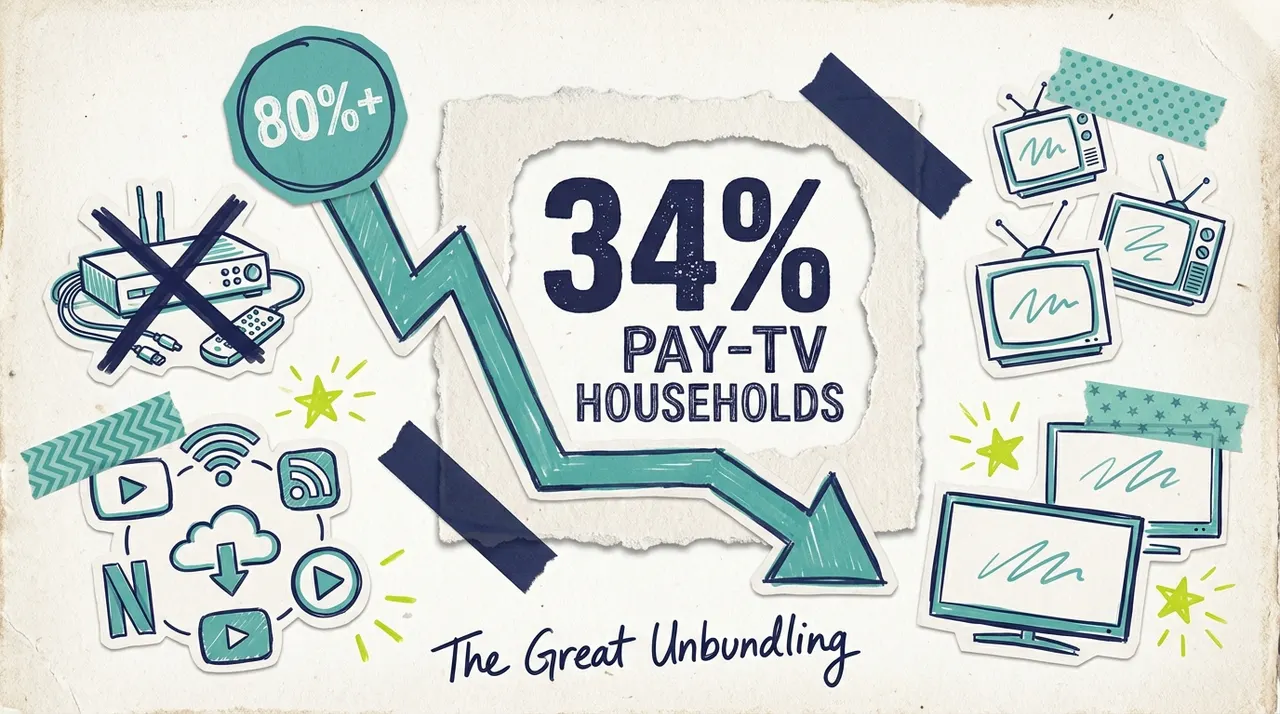
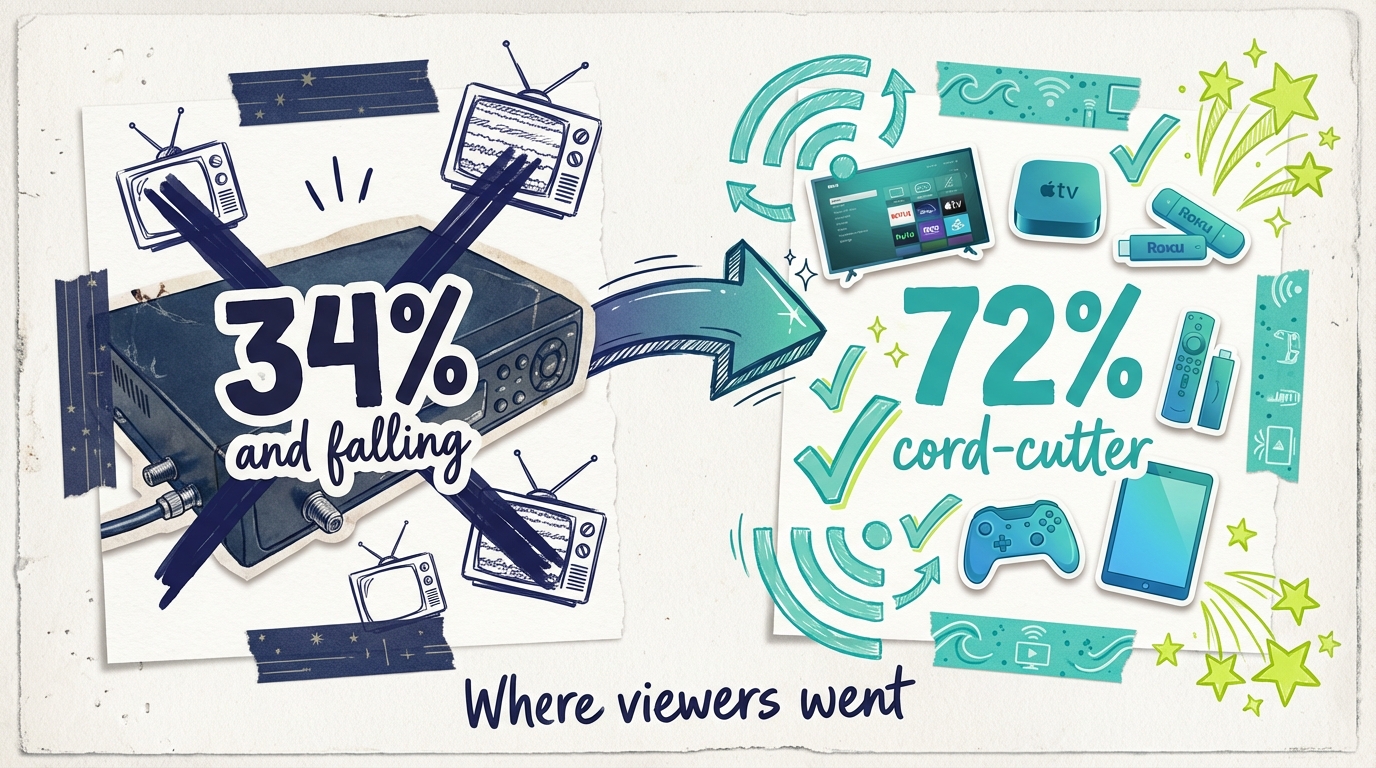
34%
U.S. pay-TV household penetration (2024)
-
77M
Cord-cutter households in 2025
-
72%
U.S. homes without traditional TV service
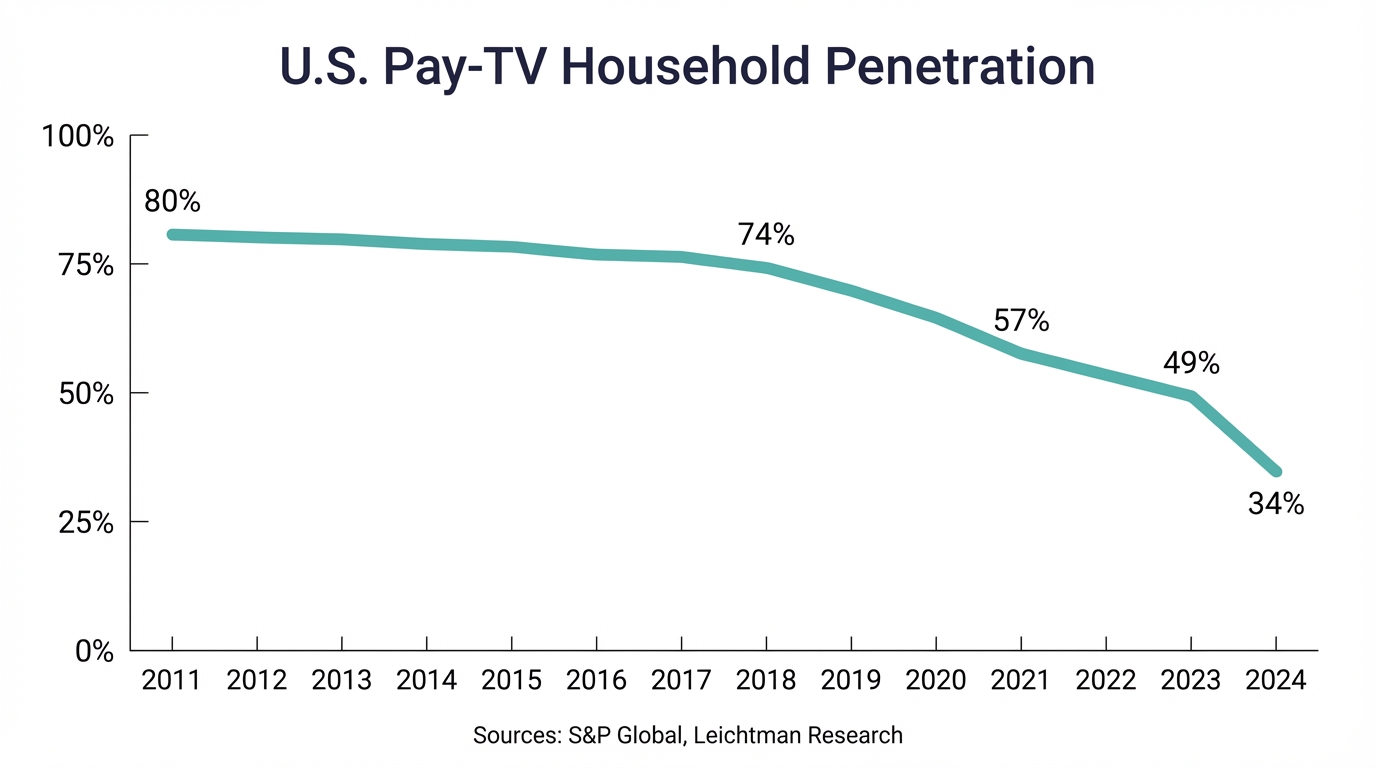
Just 34.4% of U.S. households subscribe to traditional pay-TV services as of the end of 2024, according to S&P Global Market Intelligence via TV Technology. This marks the ninth consecutive year of decline for the pay-TV industry, down from over 80% household penetration in 2011. The flip side of this statistic is equally striking: 72% of American homes are now "cord-cutter" or "cord-never" households, according to TV Technology projections. For advertisers, this fundamental shift means traditional cable TV reaches a shrinking and increasingly older audience, while streaming platforms have become essential for reaching the majority of American households.
What the data shows
The decline in cable TV households has been consistent and accelerating. Understanding the trajectory reveals just how dramatically the television landscape has transformed.
Pay-TV penetration over time (sourced from Leichtman Research and S&P):
2011: Over 80% of U.S. households subscribed to pay-TV
2018: 74% had traditional cable, satellite, or telco TV (Leichtman Research)
2021: 57% had traditional pay-TV (Leichtman Research)
2023: 49% had traditional pay-TV, 64% had any form of pay-TV including vMVPDs (Advanced Television)
2024: 34.4% pay-TV penetration (S&P Global)
The numbers tell a story of steady erosion. Pay-TV penetration has fallen by more than half in just over a decade, representing one of the most significant shifts in media consumption history.
Subscriber counts provide additional context:
71.3 million: Total pay-TV subscribers with top providers at end of 2023 (Leichtman Research)
34.1 million: Cable company video subscribers in 2023 (Leichtman Research)
5 million: Net video subscribers lost by top providers in 2023 alone (Leichtman Research)
The rate of decline has been remarkably consistent: approximately 7% annual decrease in 2024, following an 8% drop in 2023, according to nScreen Media. At this pace, pay-TV penetration will fall below 30% within the next two years.
Breaking down the numbers
The aggregate decline masks important variations in how different segments of the pay-TV industry have fared.
By provider type
Cable companies have experienced the steepest declines. The top seven cable companies had approximately 34.1 million video subscribers in 2023, according to Leichtman Research. This segment continues to lose subscribers at an accelerating rate as bundles become less appealing compared to streaming alternatives.
Satellite providers have seen dramatic subscriber losses. According to DISH Network's 2024 annual report, the company reported 7.778 million pay-TV subscribers in the United States as of December 31, 2024, including 5.686 million DISH TV subscribers and 2.092 million SLING TV subscribers. Satellite providers have lost over 20 million U.S. subscribers since 2014, according to Softonic analysis.
Virtual MVPDs (vMVPDs) represent the one bright spot in the pay-TV landscape. Services like YouTube TV, Hulu + Live TV, and Sling TV offer live television over the internet. YouTube TV alone reported more than 8 million subscribers at the end of 2023, according to Axios. In 2023, 15% of households subscribed to vMVPDs, up from just 4% in 2018, according to Leichtman Research via Advanced Television.
By household type
The decline in cable isn't uniform across all demographics. Older households maintain higher pay-TV subscription rates, while younger households have increasingly become "cord-nevers," people who have never subscribed to traditional pay-TV services.
This demographic split has significant implications for advertisers. Traditional cable TV increasingly reaches an older, more affluent audience, while younger demographics have migrated almost entirely to streaming platforms. For businesses targeting consumers under 50, cable TV advertising reaches only a fraction of the target audience.
The generational divide is especially stark. Households headed by adults 18-34 have the lowest pay-TV subscription rates, while households headed by adults 65+ maintain the highest rates. This creates a strategic consideration: cable can still be effective for reaching older demographics, but reaching younger consumers requires streaming.
The cost factor driving cord-cutting
Cost is overwhelmingly the primary driver of cord-cutting. According to Ooma research, 73% of cord-cutters cite expense as their main reason for canceling cable. The economics support their decision: Cable Compare data shows cable customers in 2025 pay an average of $147 per month, with some paying over $200 monthly for premium packages. Meanwhile, households with multiple streaming subscriptions typically pay $70 or less per month total.
This roughly 50% cost savings explains why cord-cutting shows no signs of slowing. As cable prices continue rising to compensate for subscriber losses, the value proposition of streaming becomes even more compelling.
The cord-cutter explosion
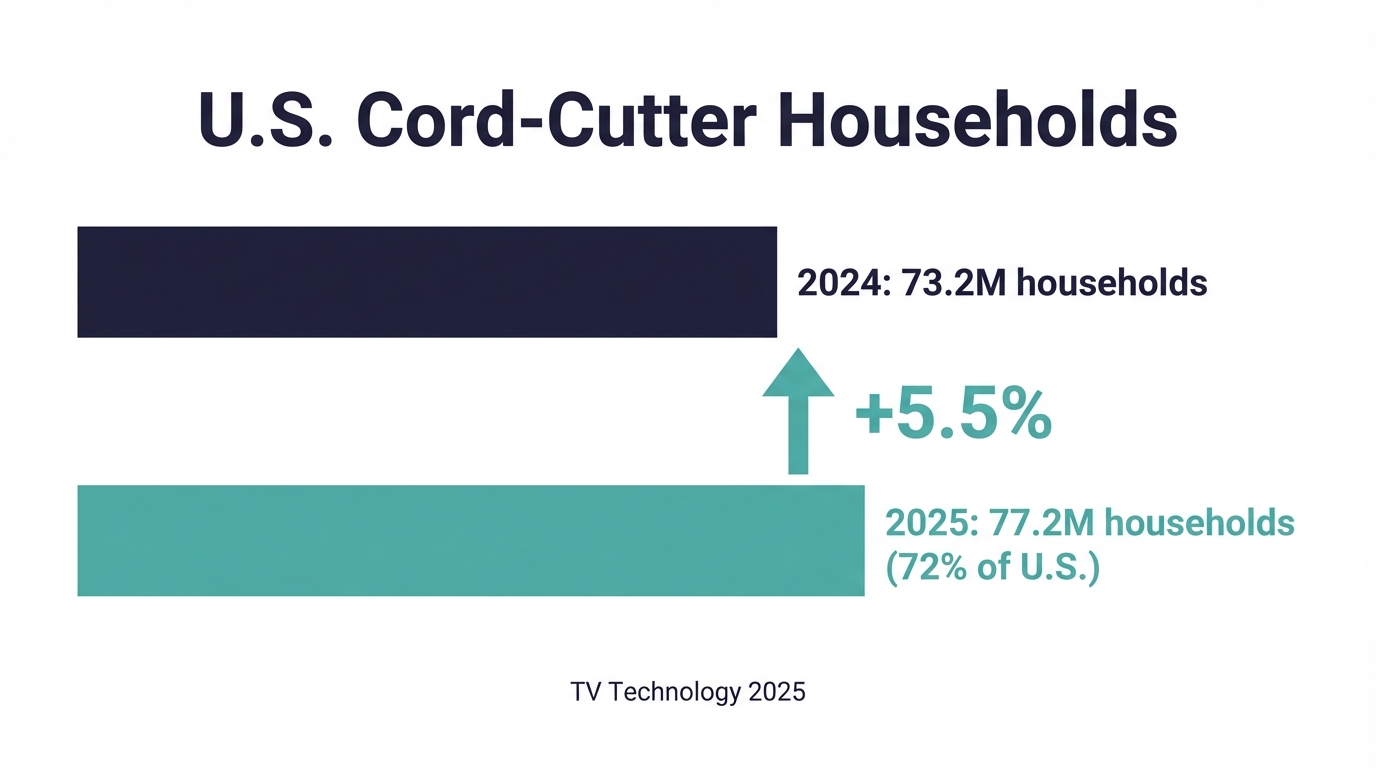
The flip side of declining cable households is the growth in cord-cutter homes:
2024: 73.2 million U.S. households had abandoned cable TV, a 6.2% increase from the previous year (TV Technology)
2025 projection: 77.2 million cord-cutter households, representing 72% of all U.S. homes (TV Technology)
Daily pace in 2024: Over 4 million people canceled cable in the first half of 2024 alone, averaging nearly 22,000 cancellations per day (Cord Cutters News)
Why it matters for your business
The 34% pay-TV penetration figure has direct implications for how businesses approach television advertising.
If you're running ads on traditional cable TV, you're reaching a shrinking audience. More importantly, that audience skews older and is increasingly concentrated among viewers who watch live sports and news. For many local businesses, this means cable TV advertising no longer reaches a representative cross-section of their potential customers.
The cost dynamics have shifted as well. According to Cable Compare, cable customers in 2025 pay an average of $147 per month, with some paying over $200 monthly. Meanwhile, households subscribing to multiple streaming services typically pay $70 or less. This cost differential, cited by 73% of cord-cutters as their primary reason for canceling according to Ooma research, explains why the trend shows no signs of reversing.
For local businesses seeking to reach customers across all demographics, the math increasingly favors streaming TV advertising. A restaurant advertising only on cable might reach 34% of households in their area, and that 34% skews older. The same restaurant advertising on streaming platforms can reach the 91% of U.S. internet households that now subscribe to at least one streaming service, according to TV Technology.
The accessibility of streaming advertising compounds this advantage. Traditional cable advertising required minimum commitments that put it out of reach for most small businesses. Streaming platforms like Adwave enable campaigns starting at $50, making television advertising possible for businesses that could never afford cable.
How to take advantage of this trend
The decline in cable households represents both a warning and an opportunity. Here's how to position your advertising for where viewers are.
Strategic recommendations based on the data:
Don't rely solely on cable: With only 34% penetration and declining, cable TV should not be your primary television advertising channel unless you're specifically targeting older demographics
Embrace streaming reach: Streaming services reach 91% of U.S. internet households, according to TV Technology, making them essential for broad reach
Consider audience composition: Cable audiences skew older; streaming audiences include all demographics
Compare the cost of reaching your service area on cable and streaming.
For businesses currently on cable:
If you're advertising on cable now, don't abandon it entirely, but diversify. Cable still reaches valuable audiences, especially for businesses targeting older, more affluent demographics. However, every dollar on cable is a dollar not reaching the 72% of households that have cut the cord.
For businesses new to TV advertising:
Start with streaming. The barriers that made cable TV advertising inaccessible, high minimums, production costs, long lead times, don't exist in the streaming world. CTV advertising offers the targeting and measurement capabilities of digital advertising with the impact of television's big screen.
Geographic targeting advantage:
One key advantage of streaming over cable: precision. A dental practice can target a 15-mile radius around their office. On cable, you're buying entire DMAs (designated market areas), paying for reach that extends far beyond your practical service area.
The bigger picture
The decline in cable households is part of a larger transformation that has fundamentally restructured the television industry.
Streaming's historic milestone
In May 2025, streaming achieved a historic milestone: for the first time, streaming viewership surpassed the combined viewership of broadcast and cable television. According to Nielsen, streaming accounted for 44.8% of total TV usage, while broadcast (20.1%) and cable (24.1%) combined for just 44.2%.
This crossover point represents a structural shift, not a temporary blip. Over the past four years, streaming usage has increased by 71%, while broadcast viewing declined by 21% and cable viewing fell by 39%, according to the same Nielsen data.
The advertising implications
This viewership shift has corresponding implications for advertising:
Cable ad inventory is shrinking: As subscribers leave, available ad impressions decline
Streaming ad inventory is expanding: New ad-supported tiers on Netflix, Disney+, and Max are adding billions of impressions
Pricing dynamics are shifting: Abundant streaming inventory has moderated CPMs, while scarce premium cable inventory (especially live sports) commands premiums
The future trajectory
The trends point in one direction. Cable penetration will continue declining as younger generations age into household formation without ever subscribing to traditional TV. The question isn't whether streaming will dominate, it's how quickly cable will become a niche product rather than a mass medium.
For advertisers, the implication is clear: television advertising strategy must prioritize where viewers are going, not where they've been.
What experts are saying
Industry analysts have characterized the cable decline as one of the most significant media shifts in decades.
Nielsen's June 2025 analysis noted that "streaming's eclipse of combined broadcast and cable viewing represents a watershed moment for the television industry. This isn't a gradual transition; it's a fundamental restructuring of how Americans consume video content."
S&P Global Market Intelligence reported that pay-TV's ninth consecutive year of subscriber decline shows "no indication of stabilization. The industry has lost more than half its subscriber base since its peak, and the rate of decline remains consistent."
Leichtman Research Group, which has tracked pay-TV trends for decades, emphasized that "the distinction between pay-TV homes and non-pay-TV homes increasingly correlates with generational divides. Younger households have largely opted out of traditional TV distribution entirely."
For advertising specifically, industry observers note that the shift creates both challenges and opportunities. Businesses that adapt their TV strategies to follow audiences to streaming will benefit from better targeting, lower barriers to entry, and access to cord-cutter households they can't reach through cable.
Common questions answered
What counts as "pay-TV" in these statistics?
Pay-TV includes any television service that requires a monthly subscription for live TV channels. This encompasses traditional cable TV (Comcast, Spectrum, Cox), satellite TV (DISH, DirecTV), telco TV (Verizon Fios, AT&T U-verse), and virtual MVPDs (YouTube TV, Hulu + Live TV, Sling TV). Streaming services like Netflix, Hulu's on-demand tier, and Disney+ are not counted as pay-TV because they don't provide traditional live TV channels, even though they charge monthly fees.
How does cable TV penetration differ from streaming penetration?
The difference is stark. Pay-TV penetration has fallen to 34.4% of households, while streaming services reach approximately 91% of U.S. internet households according to TV Technology. This means nearly three times as many households subscribe to streaming services as subscribe to traditional TV services. The gap continues to widen each year.
Are vMVPDs (YouTube TV, etc.) slowing the cable decline?
Not significantly. While vMVPDs like YouTube TV (8+ million subscribers) are growing, they're not offsetting losses from traditional cable and satellite. Total pay-TV penetration continues declining because vMVPD growth doesn't match the pace of traditional pay-TV subscriber losses. vMVPDs may be capturing some subscribers who want live TV, but the majority of cord-cutters are moving to pure streaming services, not live TV alternatives.
Who still subscribes to cable TV?
Cable subscribers increasingly skew older and more affluent. They also tend to be heavy sports viewers, as live sports remains one of the few content categories that drive traditional pay-TV subscriptions. News viewers also index higher among cable subscribers. For advertisers, this means cable can still be effective for reaching older demographics, but it's increasingly ineffective for reaching broader audiences.
Will cable TV disappear completely?
Cable likely won't disappear entirely, but it will become a niche product. Some households will maintain cable for live sports, news, or out of habit. Industry projections suggest pay-TV penetration will fall below 30% within the next few years and potentially below 20% by the end of the decade. At some point, cable becomes a specialty product rather than a mass medium.
How should advertisers respond to this trend?
Advertisers should shift TV budgets toward streaming platforms, which reach the majority of households that cable can no longer reach. The 72% of U.S. homes that have cut the cord can only be reached through streaming advertising. For local businesses especially, streaming offers geographic targeting that makes TV advertising cost-effective at budgets cable could never accommodate.
Supporting data
Key statistics on U.S. cable TV households (all sourced):
Pay-TV household penetration (2024): 34.4% (S&P Global via TV Technology)
Pay-TV penetration (2011): Over 80% (S&P Global)
Traditional pay-TV households (2023): 49% (Leichtman Research via NextTV)
Total pay-TV subscribers (2023): ~71.3 million (Leichtman Research)
Annual decline rate (2024): 7% (nScreen Media)
Cord-cutter households (2025): 77.2 million, 72% of U.S. homes (TV Technology)
Daily cord-cutting pace (2024): ~22,000 cancellations per day (Cord Cutters News)
Primary cord-cutting reason: 73% cite cost (Ooma)
Average cable cost (2025): $147/month (Cable Compare)
Streaming household penetration: 91% of U.S. internet households (TV Technology)
Streaming viewing share (May 2025): 44.8% vs 44.2% broadcast+cable combined (Nielsen)
YouTube TV subscribers: 8+ million (Axios)
Get started with TV advertising
Cable TV reaches just 34% of U.S. households and shrinking. Streaming reaches the other 72%. The question isn't whether to advertise on streaming, it's how quickly you can shift your strategy.
Adwave makes streaming TV advertising accessible for businesses of all sizes. Create your commercial from your website in minutes, set geographic targeting for your service area, choose a budget starting at $50, and reach viewers across 100+ premium streaming channels where the majority of Americans now watch.
The audience has moved. Your advertising should too.