-
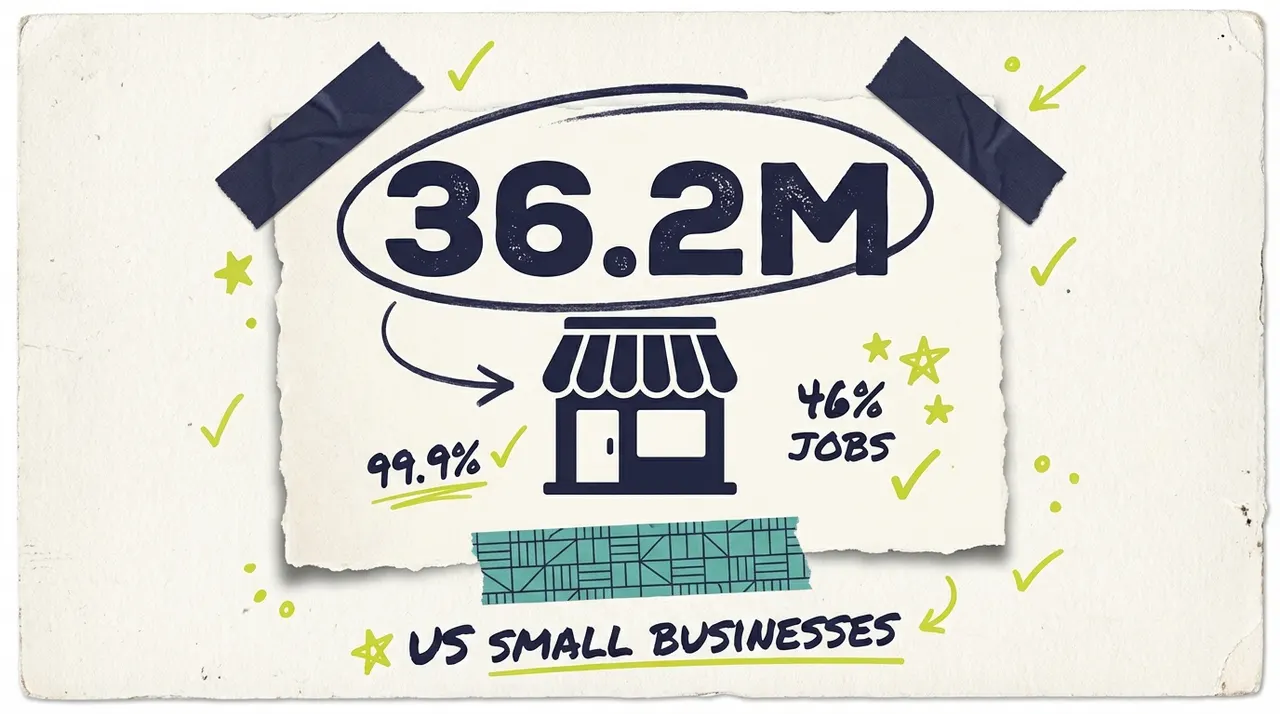
33.2M
Small businesses in the United States
-
99.9%
Share of all U.S. businesses that are small
-
61.7M
Americans employed by small businesses
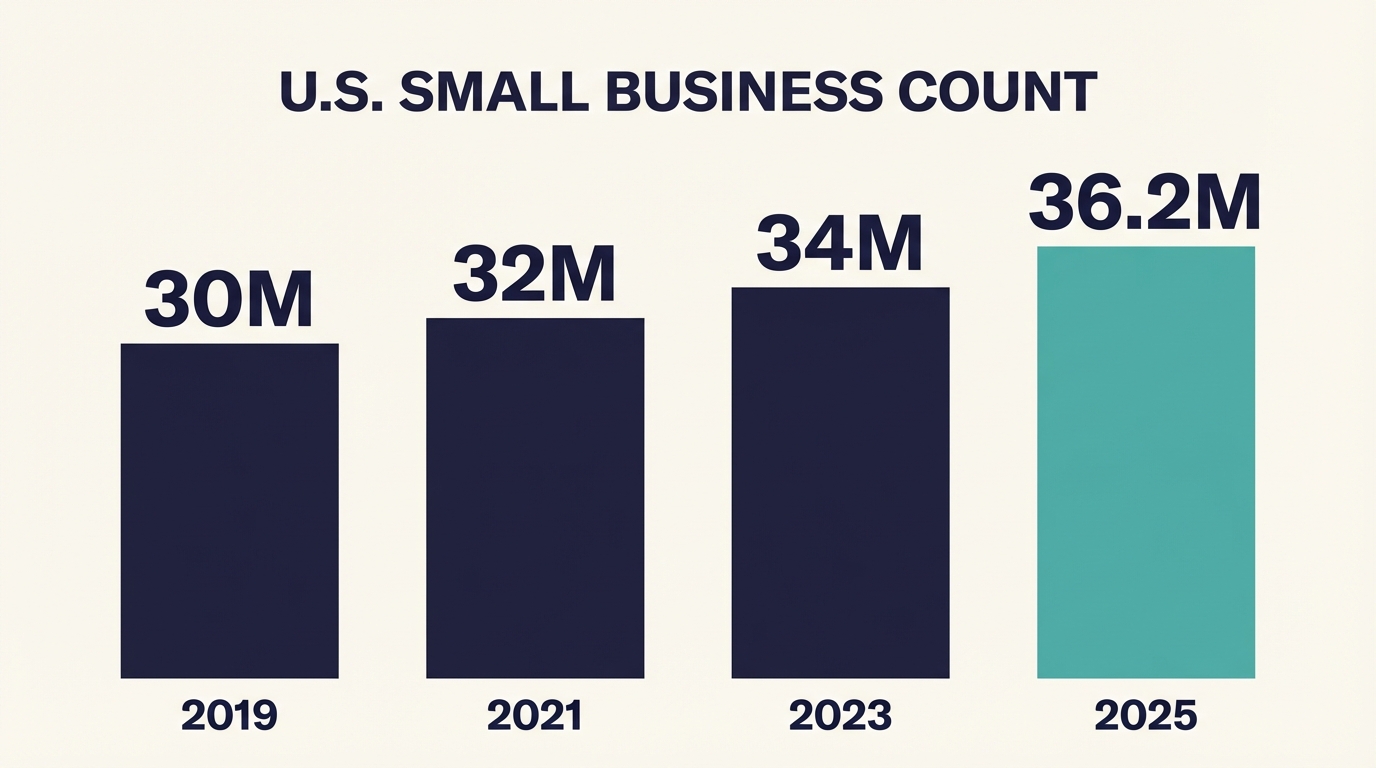
The United States contains 36.2 million small businesses as of 2025, according to the latest data from the SBA Office of Advocacy. These businesses employ nearly half the private sector workforce and create the vast majority of new jobs each year. But that 36 million figure obscures an important reality: the vast majority of American businesses are small. Not mid-market companies with 200 employees. Not regional chains with millions in revenue. Small shops, solo practitioners, and owners with a handful of employees doing the work themselves.
Understanding this distinction matters for anyone trying to reach or compete with American businesses. The corner coffee shop and the regional manufacturing firm both count as "small businesses" under federal definitions, but they operate in entirely different worlds. One employs two people and runs on tight margins. The other might employ 400 and have a full marketing department. When we talk about small business in America, we need to be specific about which part of that spectrum we mean.
For advertisers and marketers, the numbers reveal both opportunity and responsibility. Thirty-six million businesses compete for customers, but most rely on word of mouth and hope. The businesses that invest strategically in reaching customers, including through channels like TV advertising, gain advantages that compound over time. But the tools and strategies that work for a $50 million company won't work for a $200,000 company. The bulk of American business needs solutions built for their actual scale.
What the data shows
The small business landscape in America is larger and more dynamic than many realize, and it skews far smaller than headlines suggest.
According to the SBA's 2025 Small Business Profile, the United States contains 36.2 million small businesses. This figure represents a substantial increase from previous years, which reflects both new business formation and improved counting methodologies that capture the full scope of entrepreneurial activity.
These 36.2 million small businesses account for 99.9% of all businesses in the United States. The remaining 0.1%, roughly 20,000 large enterprises, employ 250 or more workers. This ratio underscores how thoroughly small business defines the American business landscape.
Employment data reveals small businesses' critical role. According to the SBA Office of Advocacy, small businesses account for approximately 46% of private sector employment.
The job creation picture is even more striking. From March 2023 to March 2024, small businesses created approximately 9 out of every 10 net new jobs in the United States. Small businesses opened 1.1 million new establishments and created a net increase of 1.2 million new jobs during this period.
Here's the number that matters most: approximately 30.4 million of those 36.2 million businesses are nonemployer businesses. That's 84% of all American businesses operating without a single paid employee beyond the owner. These aren't companies waiting to grow. For most, this is the permanent structure: one person, or a married couple, or a partnership of two, running a business that supports their livelihood.
What counts as a "small business"
The term "small business" covers an enormous range, and this matters for anyone trying to understand the market or build products that serve it.
The official SBA definition
The Small Business Administration defines small businesses using size standards that vary by industry. For most industries, the threshold is either based on employee count (up to 500 employees, sometimes 1,500 for manufacturing) or annual revenue (from $1 million to $41.5 million depending on industry). Under these definitions, a software company with 400 employees and $100 million in revenue qualifies as "small." So does a plumber working alone out of a van.
The reality of American business size
Breaking down the 36.2 million by actual size tells a more nuanced story:
Nonemployer businesses (84%): 30.4 million businesses have no paid employees. Average revenue is approximately $47,794 per year.
Micro businesses (1-9 employees): About 5 million businesses. Revenue typically $250,000 to $2 million.
Small businesses (10-99 employees): Roughly 600,000 businesses. Revenue typically $1 million to $20 million.
Medium small businesses (100-499 employees): About 90,000 businesses. Often $20 million+ in revenue.
The math is clear: 98% of American businesses have fewer than 20 employees.
Revenue distribution
Survey data reveals how revenue distributes across small businesses:
Under $50,000: 34% of small businesses
$50,000 - $100,000: ~20%
$100,000 - $250,000: ~18%
$250,000 - $1 million: ~19%
Over $1 million: ~9%
More than half of all small businesses generate less than $100,000 in annual revenue. More than 90% generate less than $1 million. The "million-dollar small business" is in the top 10%.
Breaking down the numbers
Understanding the composition of America's 36.2 million small businesses reveals patterns relevant to business owners, marketers, and policymakers.
By business type
Nonemployer businesses: Approximately 30.4 million businesses (84%) have no paid employees. These are sole proprietorships, single-member LLCs, and independent contractors. According to Census Bureau data, these businesses generated $1.8 trillion in receipts in 2023.
Employer small businesses: Approximately 5.8 million businesses employ at least one person beyond the owner. The average employer small business has roughly 10 employees, though the median is closer to 4.
By geography
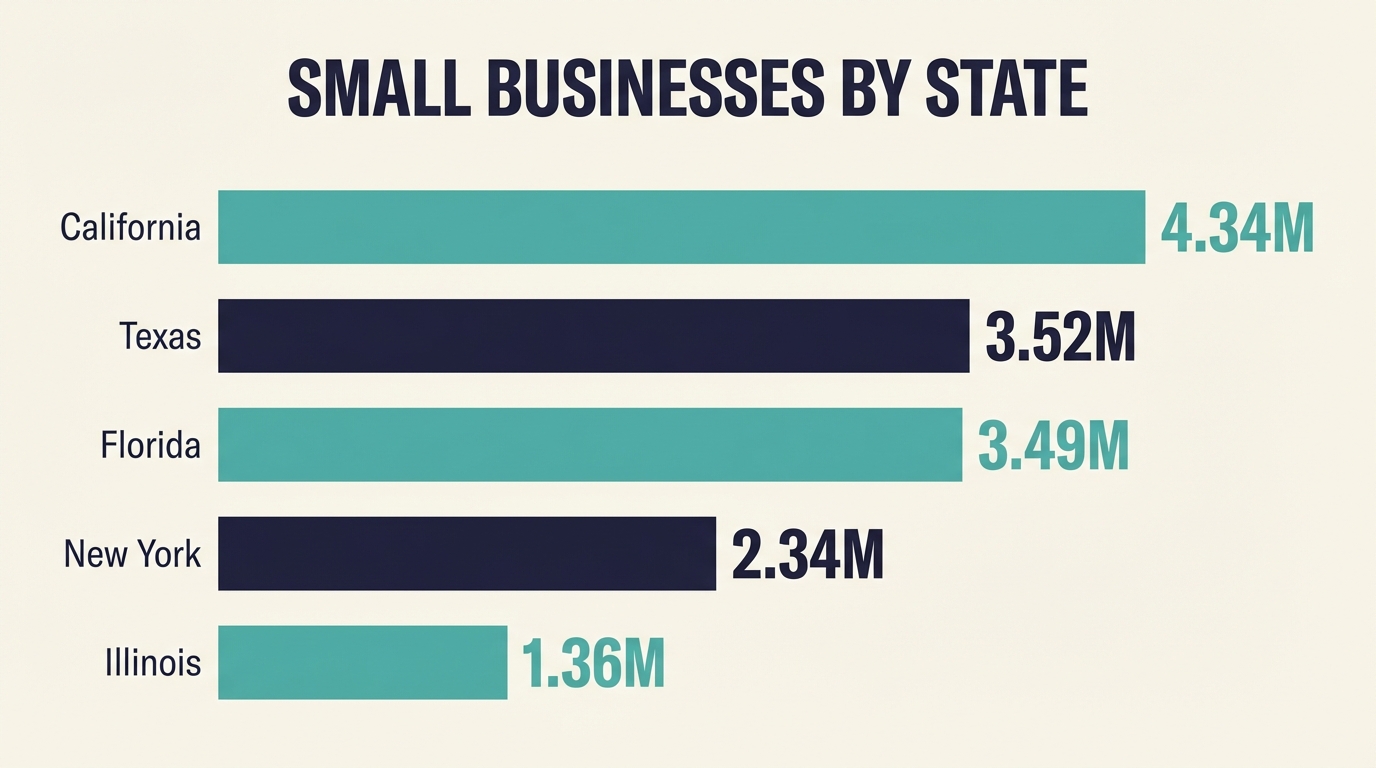
California leads with 4.34 million small businesses, followed by Texas (3.52 million), Florida (3.49 million), New York (2.34 million), and Illinois (1.36 million). These five states account for approximately 42% of all U.S. small businesses.
States with the highest small business employment share differ from those with the highest counts. Montana has the highest share at 66.3%, followed by Wyoming (65.2%) and Vermont (62.1%).
By industry
Professional, scientific, and technical services: 5.2 million businesses. Healthcare and social assistance: 2.1 million. Construction: 4.1 million. Retail trade: 2.8 million. Real estate: 3.9 million.
Why it matters for your business
The scale of America's small business economy creates both challenges and opportunities for individual businesses.
Competition is the most immediate reality. With 36 million small businesses operating across the country, virtually every market has competitors. Standing out requires deliberate effort.
Yet most small businesses don't invest significantly in marketing. According to industry surveys, the average small business spends roughly 7-8% of revenue on marketing, but many spend almost nothing. Those that invest strategically in building brand awareness gain measurable advantages.
The math is straightforward. If only 10% of small businesses in a category actively advertise, becoming one of them immediately puts you ahead of 90% of competitors in terms of visibility. Television advertising, once reserved for large corporations, is now accessible to any small business through platforms like Adwave starting at just $50.
How to take advantage of this trend
Understanding the small business landscape enables smarter marketing and competitive positioning.
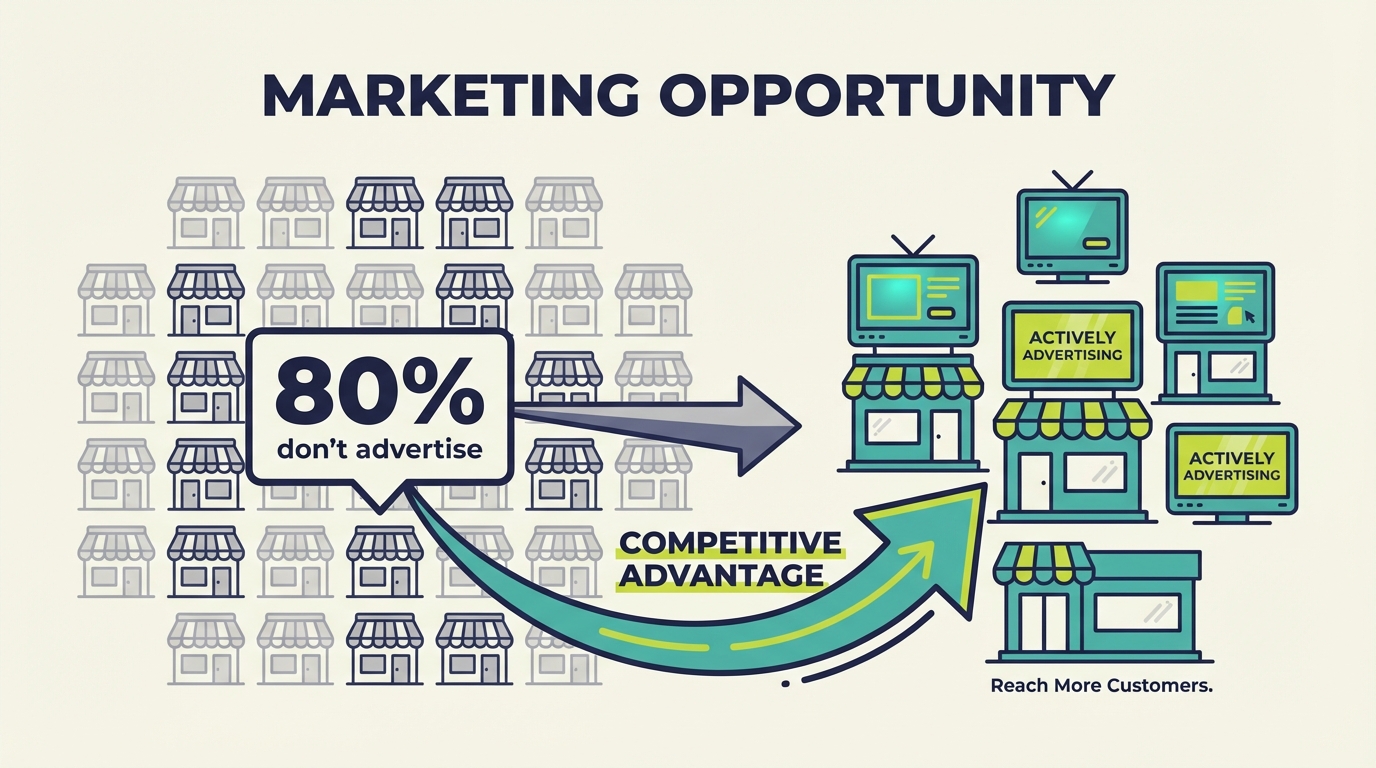
Recognize that most competitors aren't trying hard. The 36 million small businesses figure sounds daunting until you realize how few actively market themselves. In most local categories, fewer than 20% of businesses run any paid advertising beyond basic directory listings.
Invest in visibility beyond referrals. Word of mouth matters, but it has structural limits. Advertising strategies expand the top of the funnel, bringing in customers who never would have found you through referrals alone.
Consider television advertising as part of your mix. TV advertising builds brand awareness and trust more effectively than almost any other channel. And streaming TV has democratized access, with campaigns starting at $50 through platforms like Adwave.
The bigger picture
America's 36 million small businesses reflect structural features of the economy that aren't changing.
Americans start businesses at high rates compared to other developed economies. Cultural factors, access to capital, relatively light regulation for small enterprises, and immigration patterns all contribute. The resulting small business density means competitive markets in virtually every category.
Technology continues lowering barriers to small business formation and operation. Cloud software eliminates the need for expensive infrastructure. E-commerce platforms enable selling without physical retail presence. AI tools reduce the cost of functions that once required hiring or outsourcing.
Advertising technology has evolved similarly. TV advertising once required media buyers, production studios, and six-figure budgets. Today, platforms like Adwave enable AI-generated TV commercials that cost nothing to produce and campaigns that start at $50.
What experts are saying
The SBA's Deputy Chief Counsel noted in the 2025 Small Business Profile release: "Small businesses continue to be the accelerator of the American economy. Small businesses fuel economic growth, job creation, and supply chain resiliency across the country."
Bureau of Labor Statistics analysis confirmed that small businesses "continue to outpace large businesses in job creation," with small firms responsible for over half of net new jobs in recent years.
Common questions answered
What counts as a small business in the U.S.?
The SBA defines small businesses using size standards that vary by industry. Generally, businesses with fewer than 500 employees qualify as small, though some manufacturing industries allow up to 1,500 employees. Revenue thresholds range from $1 million to $41.5 million depending on industry.
How many new small businesses start each year?
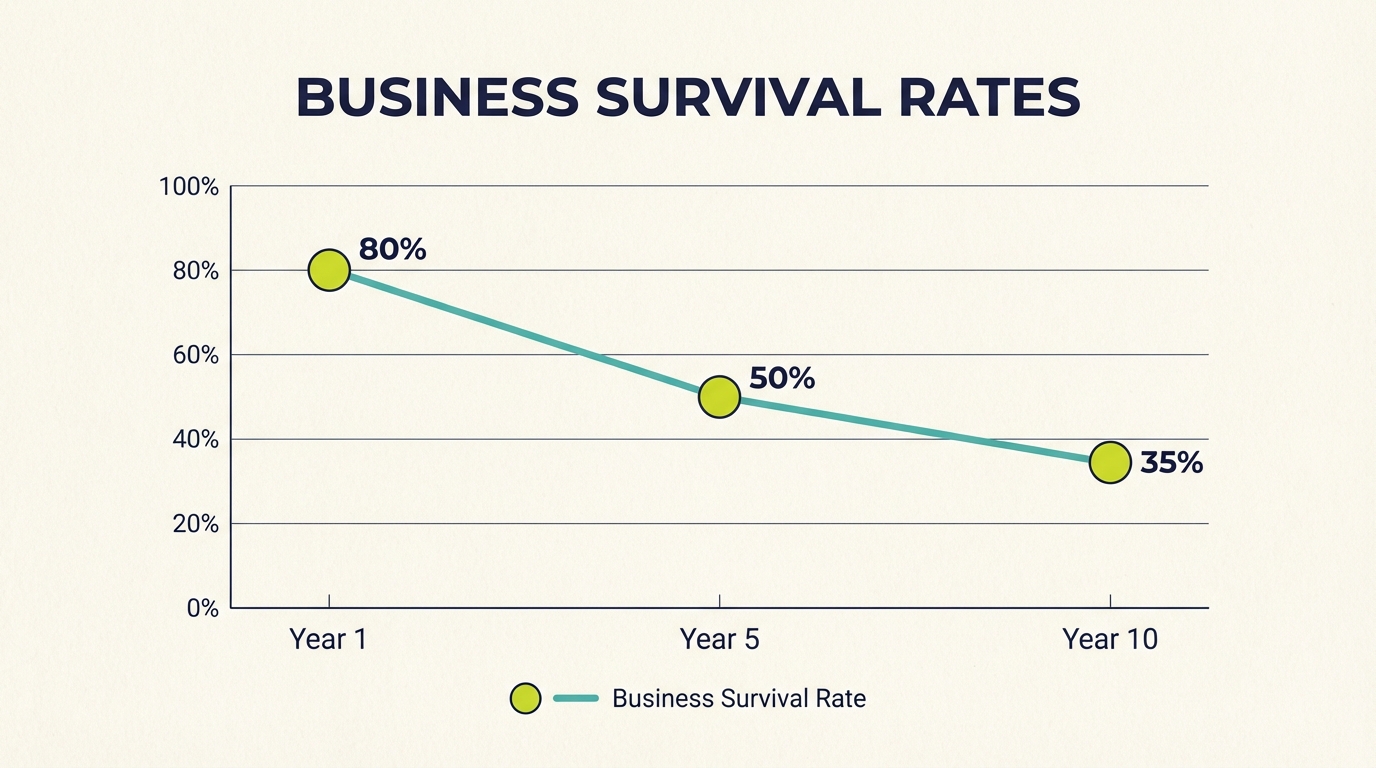
Approximately 5 million new businesses are formed annually in the United States. Not all formations result in active businesses with employees or significant revenue. Of the businesses that do become active, approximately 80% survive their first year.
What percentage of small businesses fail in their first year?
According to Bureau of Labor Statistics data, approximately 20% of businesses fail in their first year. By year five, roughly half have failed. By year ten, approximately 65% have failed.
Which states have the most small businesses?
California leads with 4.34 million small businesses, followed by Texas (3.52 million), Florida (3.49 million), New York (2.34 million), and Illinois (1.36 million).
How much do small businesses spend on advertising?
The average small business spends approximately 7-8% of revenue on marketing and advertising. Many small businesses spend almost nothing on paid advertising, relying entirely on referrals. Businesses actively pursuing growth typically allocate 10-15% of revenue to marketing.
Supporting data
Key statistics on small businesses in the United States:
Total small businesses 2025: 36.2 million (SBA Office of Advocacy, June 2025)
Nonemployer businesses: 30.4 million (84% of total)
Share of all businesses that are small: 99.9%
Private sector employment at small businesses: 46%
Net new jobs created by small business: 9 out of 10 (March 2023-2024)
California small businesses: 4.34 million
Small businesses under $100K revenue: 54%
Small businesses over $1M revenue: 9%
1-year business survival rate: 79.6%
5-year business survival rate: 50.6%
All sources linked above. Data current as of December 2025.
Get started reaching customers
The 36 million small businesses in America represent both competitors and potential customers. Whether you're a B2B company serving small business clients or a B2C business competing for local customers, understanding this market helps you position strategically.
Adwave makes TV advertising accessible for small businesses at any budget, with campaigns starting at just $50. Reach streaming viewers in your local market on 100+ channels including Hulu, Peacock, and Discovery. AI-powered creative generates broadcast-quality commercials from your website in minutes.
No production budget required. No agency needed. No minimum spend that prices out small businesses.