
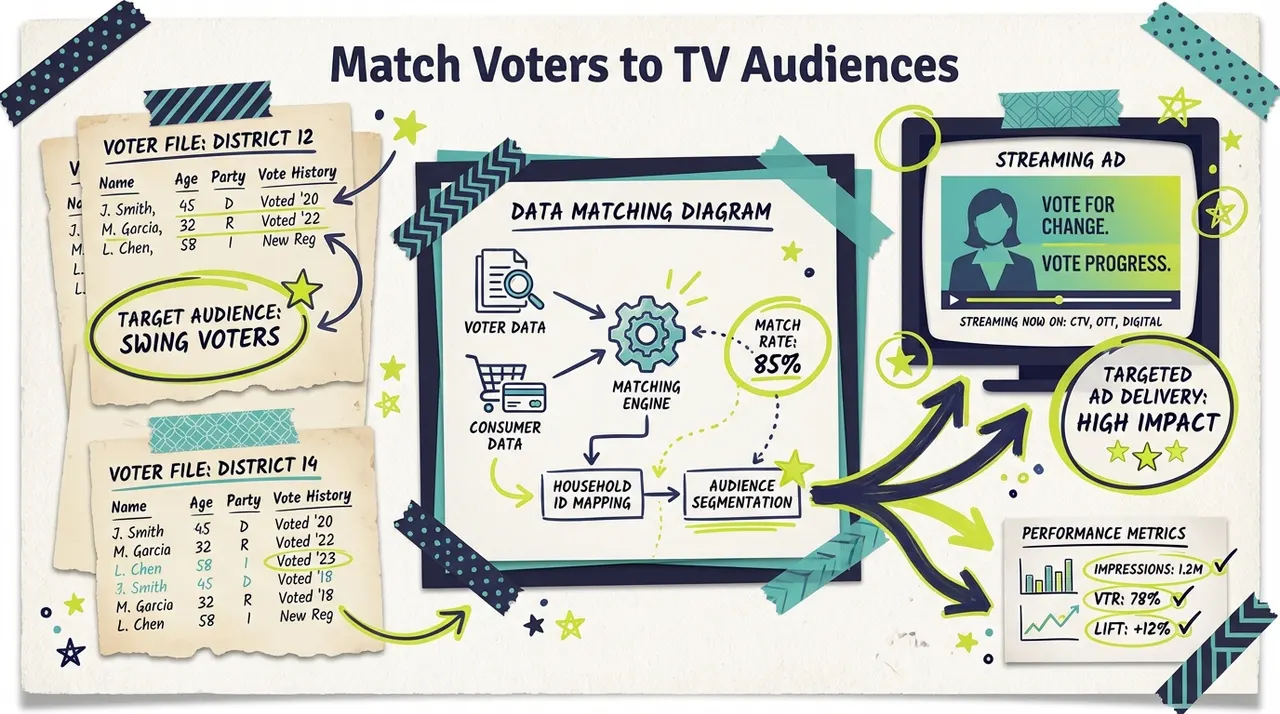
Your campaign has a voter file. Thousands, maybe hundreds of thousands, of names with addresses, party affiliations, voting histories, and demographic details. That file is your most valuable asset for persuasion and turnout.
But a spreadsheet of voter names can't run a TV ad. To reach those specific voters on their streaming TVs, you need to translate that file into targetable TV households. That process is called voter data onboarding, and it's one of the most powerful tools available to political campaigns in 2026.
In the 2024 election cycle, campaigns spent $2.3 billion on CTV advertising, representing 21% of total political ad spend (AdImpact via NBC News, 2024). Much of that spending relied on data onboarding to connect voter files to streaming audiences. And while presidential campaigns and Senate races pioneered the approach, the technology has become accessible enough that state legislative candidates and local ballot measure committees can use it too.
This guide walks you through how voter data onboarding works, what match rates you can expect, how to stay compliant with privacy regulations, and practical steps to get the best results for your campaign.
What Voter Data Onboarding Is
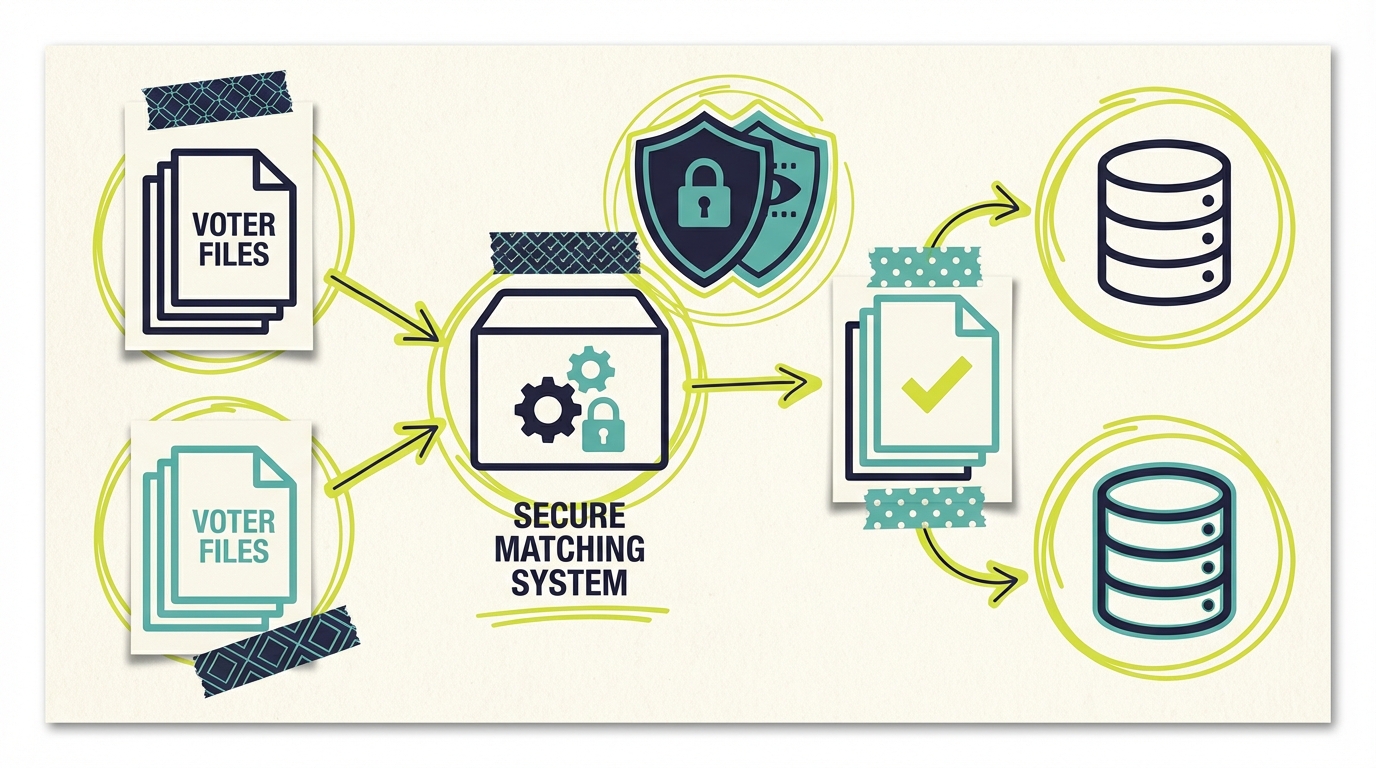
Voter data onboarding is the process of matching your campaign's voter file to streaming TV device identifiers so you can serve ads to specific households on connected TV (CTV).
Think of it as a translation layer. Your voter file speaks one language (names, addresses, phone numbers). Streaming platforms speak another (device IDs, IP addresses, household graphs). Data onboarding bridges the gap between those two systems.
The result? Instead of buying a broad TV market and hoping your voters are watching, you can serve your campaign's ads specifically to the households where your target voters live. A voter who appears in your file as "Jane Smith, 123 Main St, registered Democrat, voted in 3 of last 4 primaries" becomes a targetable streaming TV household.
This matters because traditional broadcast targeting forces you to buy entire media markets. A congressional candidate in a suburban district might pay for 500,000 impressions when only 50,000 reach actual district voters. Data onboarding eliminates that waste by targeting the exact households on your list.
Why It Matters for 2026
The 2026 midterm cycle is projected to see over $10.8 billion in political ad spending, more than 20% higher than 2022 (AdImpact via OpenSecrets, 2026). As broadcast TV audiences continue to decline and streaming adoption grows, campaigns that don't onboard their voter data to CTV are leaving their most persuadable audiences unreached.
Consider the numbers: 88% of U.S. households now own at least one connected TV device (Leichtman Research Group, 2024). And streaming now accounts for 41.4% of all TV viewing time (Nielsen, The Gauge, January 2025). If your voters are streaming (and statistically, they are), data onboarding is how you reach them.
How the Matching Process Works
The voter data onboarding process has four stages:
Step 1: Prepare Your Voter File
Everything starts with your voter file. Most campaigns pull their files from the state voter registration database, often enhanced with commercial data from vendors like L2, TargetSmart, or Aristotle. A typical voter file includes:
Full name and address
Date of birth
Party registration
Voting history (which elections, not how they voted)
Phone number and/or email (if available)
Modeled data like issue scores, persuadability ratings, and turnout propensity
The quality of your file directly affects your match rate. Incomplete addresses, outdated records, and missing identifiers all reduce the number of voters you can reach on streaming TV.
Preparation best practices:
Run your file through NCOA (National Change of Address) to catch voters who've moved
Standardize addresses to USPS formatting
Remove duplicate records
Append phone numbers and emails where possible (these serve as additional match points)
Step 2: Upload to a Data Clean Room
Your voter file doesn't go directly to a streaming platform. Instead, it's uploaded to a data clean room, a secure environment where your campaign data and the CTV platform's device data can be compared without either party seeing the other's raw records.
Clean rooms are essential for two reasons. First, they protect voter privacy by checking that that personally identifiable information (PII) isn't exposed to the ad-serving platform. Second, they give your campaign confidence that your proprietary voter file isn't being shared with other advertisers.
Major clean room providers used in political advertising include LiveRamp, InfoSum, Habu (now part of LiveRamp), and Snowflake's data collaboration tools. Each platform has slightly different matching methodologies, but the core concept is the same: your data goes in one side, the CTV platform's data goes in the other, and only the overlap comes out.
Step 3: Match to a Device Graph
Inside the clean room, your voter records are matched against a device graph. A device graph is a database that connects real-world identities (name, address, email) to digital identifiers (IP addresses, device IDs, connected TV identifiers).
Here's how a single match works:
Your file contains "Jane Smith, 123 Main St, Anytown, USA"
The device graph has a record linking that address to IP address 192.168.x.x
That IP address is associated with three streaming devices (a Roku, an Amazon Fire Stick, and a smart TV)
All three devices become targetable for your campaign's ads
The match happens through deterministic or probabilistic methods. Deterministic matching connects records using exact identifiers like email addresses or phone numbers. Probabilistic matching uses statistical models to infer connections based on patterns like shared IP addresses, location data, and browsing behavior.
Deterministic matches are more accurate but produce lower match volumes. Probabilistic matches expand your reach but introduce some uncertainty. Most onboarding platforms use a combination of both.
Step 4: Activate Household Targeting
Once your voter file is matched to device IDs, those IDs are pushed to CTV ad platforms as targetable audience segments. Your campaign can then serve ads specifically to those devices through programmatic ad buying.
The beauty of this approach is household-level targeting. When one voter in a household is on your list, you can reach every streaming device in that home. That means your ad might appear on their Roku while they're watching Hulu, on their Fire Stick during a Tubi movie, or on their smart TV during a Peacock stream.
You can also layer additional targeting on top of your onboarded list. For example, you might geotarget your ads to only serve within your district boundaries, adding a safety net that prevents waste from any mismatched records.
Match Rates: What to Expect
Match rate is the percentage of voters in your file that successfully connect to a targetable CTV device. It's the single most important metric in the onboarding process, and understanding what affects it helps you plan realistic campaigns.
Typical Match Rates
Industry-wide, voter file to CTV match rates typically fall between 50% and 80%, depending on the quality of the voter file and the onboarding platform used (LiveRamp, 2024). Some campaigns report match rates above 85% when using high-quality, recently updated files with multiple match keys.
For context, here's how that plays out in practice:
Keep in mind these are household-level matches. A single household might contain multiple registered voters, so your reach in terms of individual voters is often higher than the raw household number suggests.
What Affects Your Match Rate
Several factors determine whether a voter in your file connects to a streaming device:
Address accuracy. This is the biggest factor. If a voter's address in your file doesn't match the address associated with their streaming devices (because they've moved, for instance), the match fails. Running NCOA updates before onboarding is essential.
File freshness. Voter files pulled from state databases can be months old. The more recent your file, the better your match rates. Some vendors offer real-time or weekly-updated files.
Additional match keys. Files that include phone numbers and email addresses in addition to names and addresses produce significantly higher match rates. Email-based matching alone can yield 70-80% match rates when emails are available (LiveRamp, 2024).
CTV penetration in your district. Urban and suburban areas tend to have higher CTV adoption than rural areas. If your district is largely rural, your effective match rate (voters matched AND streaming) may be lower.
Onboarding platform. Different platforms maintain device graphs of varying size and quality. Larger graphs with more data partnerships generally produce higher match rates.
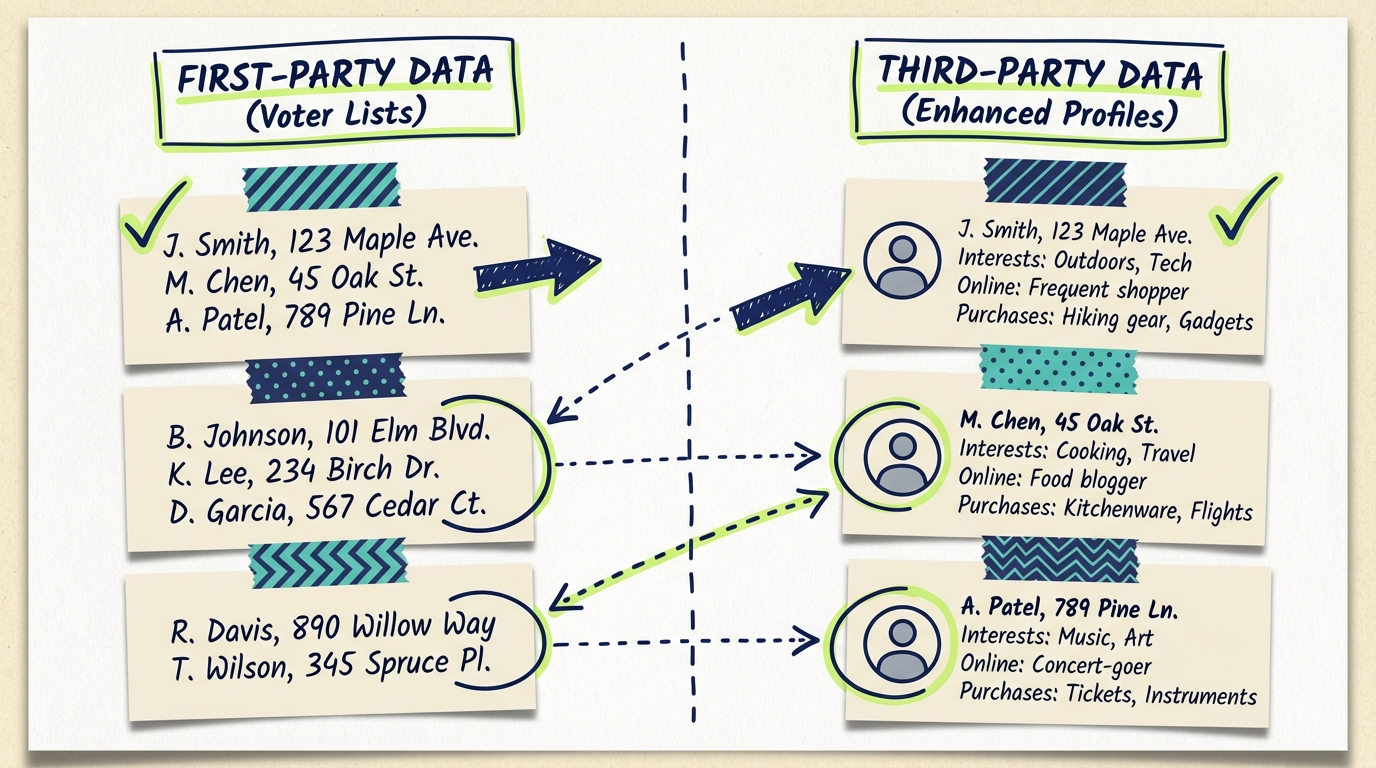
First-Party vs. Third-Party Data
Understanding the difference between first-party and third-party data is critical for political data onboarding, both for targeting effectiveness and regulatory compliance.
First-Party Data (Your Voter File)
First-party data is information your campaign collects or has direct access to. For political campaigns, this typically includes:
The voter registration file (public record)
Donor records from your fundraising platform
Volunteer and canvass data
Email list subscribers and website visitors
Survey and poll responses
First-party data is the gold standard for onboarding because you know exactly where it came from, you can verify its accuracy, and you have clear legal authority to use it. Voter registration files, in particular, are public records maintained by state and county election offices for the express purpose of facilitating the democratic process.
Third-Party Data (Vendor Enhancements)
Third-party data comes from external vendors who aggregate consumer information from multiple sources. In political advertising, common third-party data enhancements include:
Issue-based modeling scores (gun control, healthcare, immigration)
Consumer behavior data (magazine subscriptions, purchase history)
Lifestyle segments (outdoor enthusiasts, luxury car owners)
Predicted party affiliation for unregistered or unaffiliated voters
Third-party data can dramatically expand your targeting capabilities, but it comes with caveats. The accuracy of modeled scores varies. A "likely supports gun control" score of 80 doesn't mean 80% certainty; it means the model predicts that voter is more likely than average to support gun control based on correlated behaviors.
The Best Approach: Layered Data
The most effective campaigns layer first-party and third-party data together. Start with your voter file as the foundation, then enhance it with modeled scores to create audience segments like:
High-propensity voters who are undecided on your top issue
Low-propensity supporters who need a turnout push
Persuadable voters in competitive precincts
Each segment gets different messaging, delivered to their streaming TVs through the onboarding process described above.
Privacy and Compliance Considerations

Political data onboarding operates at the intersection of election law, privacy regulation, and advertising standards. Getting this right isn't optional, it's essential for both legal compliance and voter trust.
FCC and FEC Requirements
The Federal Election Commission requires that political advertising include proper disclaimers identifying who paid for the ad. This applies to CTV ads just as it does to broadcast. The Federal Communications Commission also maintains rules about political advertising disclosures and record-keeping that campaigns must follow (FCC Political Broadcasting Rules). For a detailed breakdown, see our guide to FCC political advertising rules.
State Privacy Laws
Several states have enacted privacy laws that affect how voter data can be used in digital advertising:
California (CCPA/CPRA): Requires disclosure of data collection practices and gives consumers opt-out rights, though political activities have some exemptions
Virginia (VCDPA), Colorado (CPA), Connecticut (CTDPA): Similar consumer privacy frameworks with varying exemptions for political speech
Emerging state laws: More states are considering privacy legislation. Always check current requirements for states where your campaign operates
Voter registration data is public record, and its use in political communication is protected under the First Amendment. However, when you combine voter files with commercial data and serve ads through commercial platforms, the lines can get complicated. Work with legal counsel who understands both election law and digital privacy.
Clean Room Privacy Protections
Data clean rooms provide structural privacy protections that help campaigns stay compliant:
Data matching can use hashed records to avoid transferring the raw voter file. Check the provider’s process and requirements.
Aggregate-only outputs: Clean rooms can be configured to only output audience segments above a minimum size threshold, preventing individual-level identification
Audit trails: Clean room platforms maintain logs of what data was used and how, supporting compliance documentation
Platform-Specific Policies
Major streaming platforms have their own political advertising policies. Some restrict political ads entirely (Netflix, Disney+), while others allow them with specific requirements around disclaimers and targeting. Most ad-supported streaming services that accept political ads require campaigns to verify their identity and comply with additional documentation requirements.
How CTV Makes Data Onboarding Accessible for Down-Ballot Races
Here's where the story gets exciting for campaigns beyond the presidential and Senate level. Voter data onboarding used to be the exclusive domain of big-budget campaigns with seven-figure media buys. That's changed dramatically.
The Old Barrier: Minimum Spend Requirements
Traditional data onboarding required minimum media commitments of $50,000 to $100,000 or more. The onboarding process itself could cost $10,000 to $25,000 in platform fees and data costs. For a state representative spending $200,000 on their entire campaign, dedicating that much to a single targeting method wasn't realistic.
What's Changed
Several shifts have made data onboarding accessible to smaller campaigns:
Lower platform minimums. CTV advertising platforms, including Adwave, have dramatically reduced minimum spend requirements. You can launch CTV campaigns starting at just $50, making it feasible for school board candidates and city council races to test streaming TV.
Self-service onboarding tools. Platforms now offer automated onboarding that handles the clean room matching process without requiring a dedicated data science team. Upload your list, and the platform handles the rest.
Pre-built political audiences. For campaigns that don't have sophisticated voter files, CTV platforms offer pre-built audience segments based on voter registration data and modeled political attributes. These segments are less precise than custom onboarding but dramatically easier to activate.
Bundled pricing. Many platforms bundle onboarding costs into their CPM rates rather than charging separate fees. This means the matching process is essentially free. You pay only for the impressions you serve.
What This Means for 2026 Midterms
The 2026 cycle will feature thousands of down-ballot races where CTV can make a real difference. State legislative races, county commissions, school boards, and ballot measure committees can all use voter data onboarding to reach their specific voter universes on streaming TV.
A state senate candidate with a voter file of 80,000 registered voters in their district can onboard that file, achieve a 65% match rate, and target roughly 52,000 streaming households with persuasion or turnout ads. With Adwave's $50 minimum, even testing becomes affordable.
Practical Tips for Maximizing Your Match Rates
Getting the highest possible match rate means more of your budget reaches actual voters. Here are the steps that make the biggest difference.
1. Clean Your File Before You Upload
Garbage in, garbage out. Before onboarding:
Run NCOA (National Change of Address) processing
Remove deceased voters (check against the Social Security Death Master File)
Deduplicate records
Standardize address formatting (use CASS certification)
Verify ZIP+4 codes
A clean, standardized file can improve match rates by 10-15 percentage points compared to a raw voter file dump.
2. Append Multiple Identifiers
The more match keys your file contains, the higher your match rate. At minimum, include:
Full name
Physical address
Phone number (mobile preferred)
Email address
If your voter file doesn't include phone and email, consider appending them through a data vendor. The cost is typically $0.01 to $0.05 per record and the match rate improvement easily justifies the investment.
3. Segment Before You Onboard
Don't onboard your entire voter file as a single audience. Create segments based on your campaign strategy:
Persuasion targets: Voters scored as persuadable on your key issues
Turnout targets: Supporters who need motivation to vote
Donor prospects: Voters with high-income indicators who haven't donated
Opposition research: Voters who lean toward your opponent (for contrast messaging)
Segmented audiences let you serve different ad creatives to different voter groups, making your entire campaign more effective.
4. Refresh Your Data Regularly
Voter files get stale. People move, change phone numbers, and update their streaming setups. During a campaign cycle:
Re-onboard your file every 4-6 weeks
Pull fresh voter file updates from your data vendor
Incorporate new data from canvassing and voter contact
5. Layer Geographic Targeting as a Safety Net
Even with high match rates, some records will be inaccurate. Layer geographic targeting on top of your onboarded audience to ensure no ad impressions serve outside your district. This is especially important for candidates in districts that cross media market boundaries.
6. Test and Measure
Run A/B tests comparing onboarded audience performance against broader CTV targeting. Track metrics like:
Ad completion rates by audience segment
Website visits from CTV viewers
Donation page conversions
Voter contact survey responses from targeted precincts
The measurement capabilities of CTV give you far more insight than broadcast TV ever could. Use that data to optimize your onboarding strategy throughout the campaign.
Common Questions Answered
What does voter data onboarding cost? Costs vary depending on the platform and volume, but the trend is toward bundled pricing where onboarding is included in your ad spend. Some platforms charge a flat fee of $1,000 to $5,000 for custom onboarding, while others (including many self-service CTV platforms) include it in their CPM rates. For most down-ballot campaigns, the onboarding cost is negligible compared to the media budget.
How long does the onboarding process take? Traditional onboarding through major platforms like LiveRamp takes 3 to 7 business days from file upload to activated audience. Some newer platforms offer same-day or next-day onboarding for standard voter files. Plan for at least a one-week turnaround when setting up your initial campaign, and budget 2 to 3 days for subsequent refreshes.
Can my opponent see which voters I'm targeting? No. Data clean rooms are specifically designed to prevent this. Your voter file segments and targeting criteria remain confidential. The CTV platform serves your ads to the matched devices without revealing which specific voters are in your audience. Your opponent might see your ads if they happen to be in a targeted household, but they can't reverse-engineer your voter list from the ad delivery.
Is voter data onboarding legal? Yes, when done properly. Voter registration data is public record in every state, maintained specifically for democratic participation. Using voter files for political communication is protected under the First Amendment. However, you must comply with FEC disclaimer requirements, state-specific privacy laws, and platform policies. Work with election law counsel to ensure your specific approach meets all applicable requirements.
What's the difference between data onboarding and audience targeting? Data onboarding is the process of matching your specific voter list to digital identifiers. Audience targeting is broader and includes any method of selecting who sees your ads, including demographic targeting, interest-based targeting, geographic targeting, and onboarded list targeting. Think of onboarding as one targeting tool among many, but it's the most precise one because it starts with your actual voter universe rather than proxy characteristics.
Do I need a huge voter file for onboarding to be worthwhile? Not anymore. While match rates improve with larger files (more records mean more potential matches), campaigns have successfully onboarded files as small as 10,000 to 20,000 voters. For a city council race with 15,000 registered voters in the district, onboarding the full file and achieving a 60% match rate gives you 9,000 targetable households. That's a meaningful, reachable audience for a local CTV campaign.
Bottom Line
Voter data onboarding is the bridge between your campaign's voter intelligence and streaming TV's targeting precision. The process (clean your file, upload to a clean room, match to device graphs, activate household targeting) sounds technical, but the platforms handling it have made it increasingly automated and affordable.
The campaigns that win in 2026 won't be the ones with the biggest budgets. They'll be the ones that put the right message in front of the right voters at the right time. Data onboarding on CTV makes that possible for campaigns of every size, from presidential to school board.
Start with a clean voter file. Choose an onboarding platform that fits your budget. Segment your audiences for different messages. And measure everything so you can optimize as the campaign progresses.


