

If you run a local business, you’ve probably had this thought: TV ads sound powerful, but they also sound expensive, complicated, and built for national brands with giant budgets. At the same time, you can see your customers have changed their habits. They don’t just sit down for cable anymore. They stream shows, sports, and movies on smart TVs, Roku devices, Apple TV, and gaming consoles.
That shift is exactly why so many owners now ask what is ctv in marketing.
The short answer is simple. CTV means Connected TV, and in marketing it refers to ads shown on internet-connected television screens while people watch streaming content. The reason this matters is even simpler. It gives small businesses a way to get the visual impact of TV with more control than old-school broadcast advertising ever offered.
Why Connected TV Is a Game Changer for Marketing
A few years ago, many local businesses treated TV and digital as two separate buckets. TV gave you broad visibility. Digital gave you targeting and reporting. Connected TV brings those strengths closer together, which is a big reason more advertisers now take it seriously.
The audience shift is clear. Nielsen reported that streaming accounted for a larger share of TV viewing than broadcast and cable combined in 2025, as shown in Nielsen's monthly The Gauge viewing report. The living room screen still matters. What changed is how people use it.
For a small business owner, that creates a practical opening. You can show a real video ad on a big screen, but with more control over who sees it and how much you spend than traditional TV usually allows.
The audience changed before many ad budgets did
That gap matters for local businesses. If a family watches streaming TV every night, but your marketing still assumes cable schedules and broad zip-code buys, you can miss people who are already in your service area and ready to buy.
CTV helps close that gap in a way that feels more familiar to digital advertisers. It works a bit like a smart, targeted TV remote. You still get the impact of television, but you are no longer stuck paying for the widest possible audience just to reach the right few households.
A few practical reasons explain why this matters:
People still trust video on the biggest screen in the house. A short ad can show your product, explain your service, and build credibility fast.
Local businesses can be more selective. You can focus on the areas and audiences that fit your goals instead of buying broad reach you may not need.
CTV is more approachable than old TV buying. Platforms built for smaller advertisers, including Adwave, make it possible to test campaigns without needing a national-brand budget.
One simple rule helps here.
If your customers stream shows, sports, or news at home, CTV deserves a look.
Industry spending trends point in the same direction. eMarketer expects U.S. connected TV ad spending to keep growing, as outlined in its connected TV advertising forecast. That does not mean a local business should copy every big-brand tactic. It does mean CTV is no longer a niche channel reserved for giant companies.
Why small businesses should pay attention now
Traditional TV often worked like renting the largest billboard in town and hoping enough of the right people drove by. CTV is closer to buying that billboard only in neighborhoods where your likely customers live.
That shift matters most for businesses that need efficiency. A dentist, med spa, furniture store, gym, or law firm usually does not need citywide awareness before anything else. They need relevant reach, manageable budgets, and a way to connect ad spend to real business results.
If you want broader context on why television still works as an advertising channel, this guide to the advantages of advertising on TV gives a helpful overview. Connected TV makes that traditional strength more practical for smaller advertisers who care about control, affordability, and measurable local reach.
What Exactly Is Connected TV in Marketing
Connected TV is any television screen that connects to the internet and streams content through apps. That can be a smart TV by itself, or a regular TV connected to a device like Roku, Apple TV, Amazon Fire TV, or a gaming console.
In marketing, CTV means placing video ads inside that streaming experience.
A simple analogy helps. Traditional TV advertising is like standing on a stage with a megaphone and talking to everyone in the room. CTV is more like using a smart remote to reach the households most likely to care about what you sell.
Here’s a visual that makes the ecosystem easier to understand.
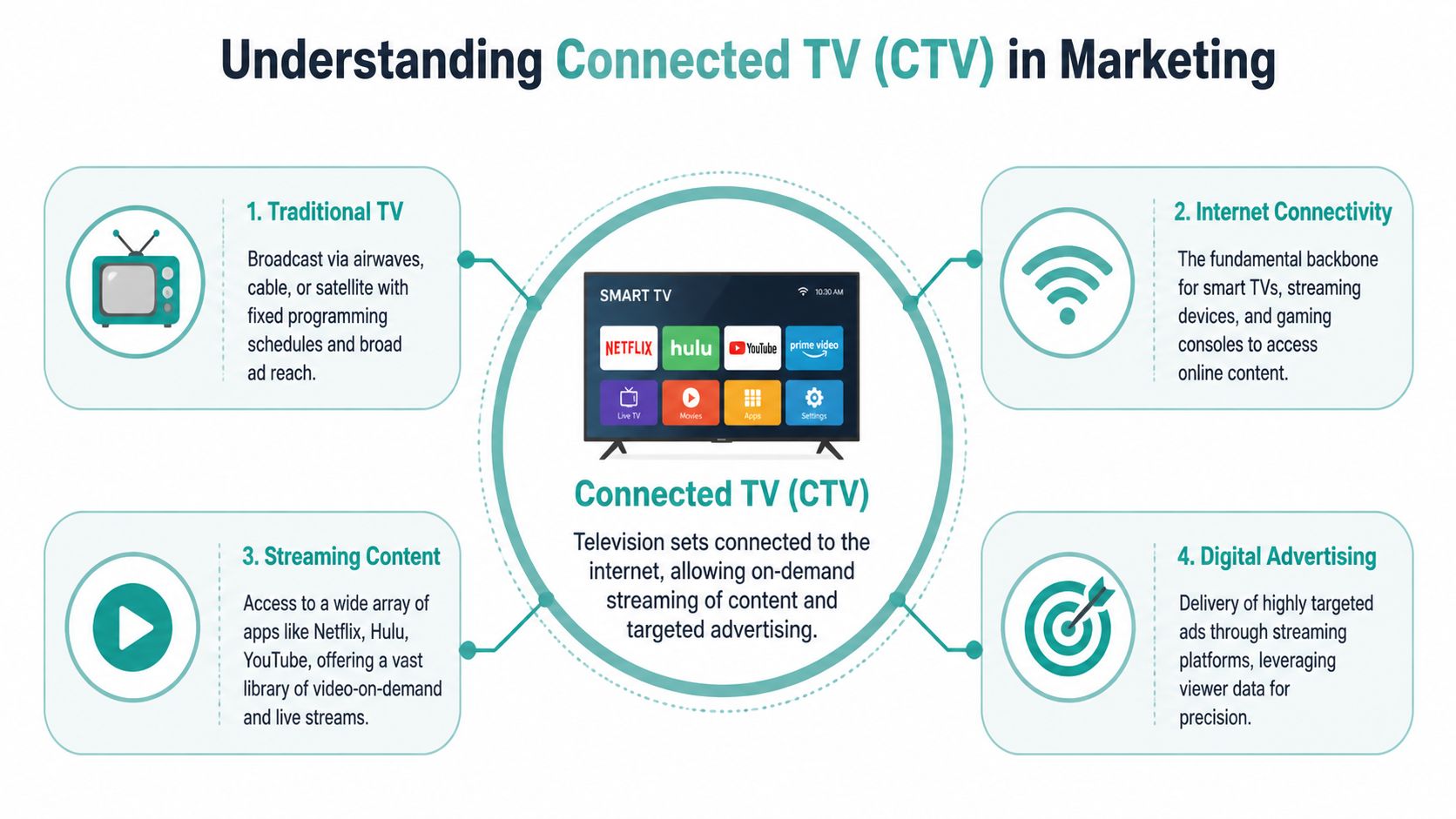
The three parts that make CTV work
To understand what is ctv in marketing, break it into three pieces.
The screen This is the actual TV device people watch in their homes. It may be a smart TV, or it may use a streaming box or stick.
The internet connection This is what turns a regular TV experience into a connected one. Instead of receiving only cable or broadcast signals, the TV can access streaming apps online.
The content with ads People open streaming apps and watch shows, live sports, movies, news, or on-demand video. In ad-supported environments, businesses can place commercials in those viewing sessions.
Where CTV ads appear
CTV ads usually show up during streaming content in places that feel familiar to viewers. They often appear before a show starts, during a break, or between pieces of content. To the viewer, it still feels like TV. To the advertiser, it behaves more like digital media because targeting and measurement are more flexible.
That’s why people sometimes get confused. The ad looks like a TV commercial, but the buying and reporting can be much smarter behind the scenes.
CTV keeps the attention and storytelling power of television, while adding the control marketers expect from digital channels.
For a small business owner, the main thing to remember is this: CTV is not a new kind of screen people had to learn. It’s the same living room screen, used in a newer way.
CTV vs OTT vs Traditional TV Explained
A lot of confusion starts with two terms that often get lumped together: CTV and OTT. They’re related, but they’re not the same thing. Traditional TV is different from both.
The easiest way to think about it is this. OTT is how the content gets delivered. CTV is where that content gets watched on a television screen. Traditional TV is the older model of scheduled programming through broadcast, cable, or satellite.
A simple definition of each term
Traditional TV is scheduled programming delivered through broadcast, cable, or satellite.
OTT stands for over-the-top. It means video content delivered over the internet through streaming apps.
CTV is the connected television device or environment where OTT content is watched on a TV screen.
If someone watches a streaming app on their phone, that’s OTT, but not CTV. If they watch that same app on a smart TV in the living room, that’s OTT content on a CTV device.
CTV vs. OTT vs. Traditional TV at a Glance
What matters to a business owner
If you’re deciding where to spend money, the biggest practical difference is control.
Traditional TV usually asks you to buy reach around a program or time slot. OTT is the broader streaming category. CTV is the part of that world that puts your ad on the biggest screen in the home, which is why many advertisers find it so appealing.
If you want a deeper side-by-side breakdown, this guide on CTV vs linear TV differences covers the business implications in more detail.
When people say they want “TV ads with digital targeting,” they’re usually talking about CTV.
That phrase is useful because it captures the core appeal. You still get the visual presence of television, but you are no longer stuck with the old all-or-nothing buying model.
Key Benefits of CTV for Your Small Business
Most articles about CTV focus on enterprise features, agency workflows, and industry jargon. That leaves many local businesses with a basic question: does any of this work for a company without a big media team?
That gap is real. The discussion of CTV’s role in the marketing mix notes that many resources still fail to explain how resource-constrained SMBs can execute campaigns in practice. That’s exactly why CTV feels intimidating to owners who could benefit from it most.
Why it fits smaller budgets better than many owners assume
Small businesses usually need three things from advertising. They need local reach, controlled spend, and a way to tell whether the campaign did anything useful. CTV lines up well with all three.
Here are the practical benefits that matter most:
Better local focus: Instead of paying for a huge general audience, you can focus on the geographic areas that matter to your business.
Stronger visual storytelling: A restaurant can show food. A realtor can show a listing. A med spa can show the experience, not just describe it.
More accountability: You can review campaign performance and make adjustments instead of waiting until the campaign is over and guessing.
Why this changes the old TV equation
Traditional TV had a reputation for being out of reach because it often required bigger budgets, more planning, and less feedback. CTV changes the experience for smaller advertisers because the setup can be more flexible and the targeting can be narrower.
One example of a platform built around that accessibility is Adwave, an AI-powered TV advertising platform that lets businesses generate a commercial from a website URL, define local targeting, launch campaigns with a starting budget of $50, and monitor results through a dashboard. That kind of workflow matters because many small businesses don’t have an in-house video team or media buyer.
If you’re also thinking about how TV fits with broader content efforts, this comprehensive guide on video marketing gives helpful context on using video across channels.
The real small-business value of CTV isn’t just “you can be on TV.” It’s “you can be on TV without adopting a giant-brand operating model.”
That’s the mindset shift. CTV isn’t only a media channel. It’s a more approachable way for local businesses to use video where attention is high.
How CTV Audience Targeting and Measurement Work
A local business owner usually asks two practical questions before spending money on TV. Who will see this, and how will I know if it did anything? CTV improves both parts.
Traditional TV often worked like renting a billboard on a busy highway. Plenty of people might pass by, but many are outside your service area or have no reason to buy. CTV works more like a smart TV remote with rules you set. You can choose the areas you serve, narrow the audience, and watch performance while the campaign is still running.

How targeting works in plain English
CTV targeting starts with a simple idea. Show your ad to households that are more likely to matter for your business.
For a small business, that usually means setting practical boundaries first, then refining from there. Common options include:
ZIP code targeting: Show ads in the neighborhoods you serve.
Radius targeting: Reach households within a set distance from your store, office, or showroom.
Demographic filtering: Narrow by traits such as age range or household income when that data is available.
Customer matching: Reconnect with people who already know your business, such as past customers or website visitors, if your platform supports it.
That matters because local businesses do not need statewide awareness just to fill next week's calendar.
A dentist may focus on nearby households instead of paying for impressions across an entire metro area. A dealership may prioritize ZIP codes where buyers are more likely to visit the lot. A home services company may keep spend inside the areas its crews can reach quickly. The goal is simple. Spend less money on the wrong households.
What measurement looks like
Measurement is where CTV starts to feel less like old TV and more like a digital channel on a television screen.
You usually are not judging CTV by clicks from the TV itself. You are looking for signs that exposure led to action later. That can include website visits, branded search activity, lead volume, store traffic, or other business outcomes, depending on how the campaign is set up.
For a local advertiser, that is a big shift. You do not have to wait until the campaign ends and rely on gut feeling. You can review delivery, compare areas or audience groups, and adjust budget or creative while the campaign is active.
For a closer look at what those reports can include, this guide to CTV measurement and attribution explains how advertisers connect ad exposure to real business results.
A helpful way to judge performance is this: did the right households see the message, and did business activity increase after they saw it?
That question keeps expectations realistic. CTV often supports the moment before the click. Someone sees your ad while streaming, remembers your business later, searches your name on their phone, and then books, visits, or calls. For local businesses with modest budgets, that is often enough to make CTV useful and affordable.
Real-World CTV Use Cases for Local Businesses
The easiest way to understand CTV is to picture how a local business would use it.
A real estate agent promoting a new listing
A real estate agent has a polished video tour and wants to build awareness in a target area. Instead of posting it only on social media and hoping local buyers happen to see it, the agent runs a connected TV ad to households in selected ZIP codes.
The ad doesn’t need to explain every detail. It needs to create interest, show the home, and make the agent memorable. CTV works well here because real estate is visual, local, and trust-driven.
An auto dealership building local demand
A dealership wants to highlight a seasonal sales event and stay visible in the communities it serves. CTV lets the dealership use video to showcase inventory, financing messages, or service offers in living rooms nearby.
This is especially useful when the business wants broad awareness within a defined area, not random attention from households too far away to visit. A dealership can also rotate creative depending on what it wants to push, such as certified pre-owned inventory or service appointments.
A pizza shop staying top of mind
A neighborhood pizza shop doesn’t need national recognition. It needs to be remembered on the nights people don’t want to cook. CTV can help by putting a simple, appetizing message in front of nearby households during streaming sessions when dinner decisions are still open.
In this kind of campaign, the goal is often familiarity. When people later open a food delivery app or search locally, the restaurant already feels known.
A local professional service earning trust
Law firms, dental offices, med spas, and home services businesses all sell something that benefits from face-to-face credibility. A CTV ad can introduce the owner, show the office, explain the service, and reduce uncertainty.
That matters because many local service purchases are emotional as well as practical. People want to know who they’re calling.
Short local ads often work best when they answer one question clearly: “Why should someone nearby choose this business over the alternatives they already know?”
You don’t need a complicated campaign concept to use CTV well. You need a clear offer, a defined service area, and a message that makes sense on a television screen.
How to Launch Your First CTV Campaign with Adwave
The hardest part for most small businesses isn’t understanding what is ctv in marketing. It’s getting over the feeling that launching a campaign will be technical, slow, or expensive.
A simpler workflow helps. This walkthrough shows what the process can look like on Adwave’s guide to creating and airing a TV ad for your business.

Start with the creative
Instead of hiring a production crew right away, you can begin with the assets you already have. Adwave uses a business website URL to auto-generate a TV ad, which is helpful for owners who don’t have time to script and edit from scratch.
The main job at this stage is clarity. Your ad should show what you offer, who it’s for, and what people should do next.
Define who should see it
Next, set the local audience. Pick the geographic area you want to reach and narrow it based on the households that matter most to your business.
For many local advertisers, CTV offers practical benefits. You’re not trying to blanket an entire state. You’re focusing on the area where customers can buy from you.
Set the budget and launch
Choose a budget you’re comfortable testing with. Campaigns can start at $50, which makes CTV much easier to approach than traditional TV buying.
After launch, the platform handles delivery and pacing. That reduces the amount of manual work the business owner has to do.
Watch the dashboard and adjust
The last step is staying involved after the campaign goes live. Review performance, look for signs that the right audience is being reached, and refine the message or targeting if needed.
That feedback loop is one of the biggest reasons small businesses are paying more attention to CTV. You don’t have to treat TV like a one-shot bet.
If you want to put your business on streaming TV without the usual production and buying complexity, Adwave gives you a practical starting point. You can generate a commercial from your website, choose a local audience, launch with a controlled budget, and track performance in one place.


