-
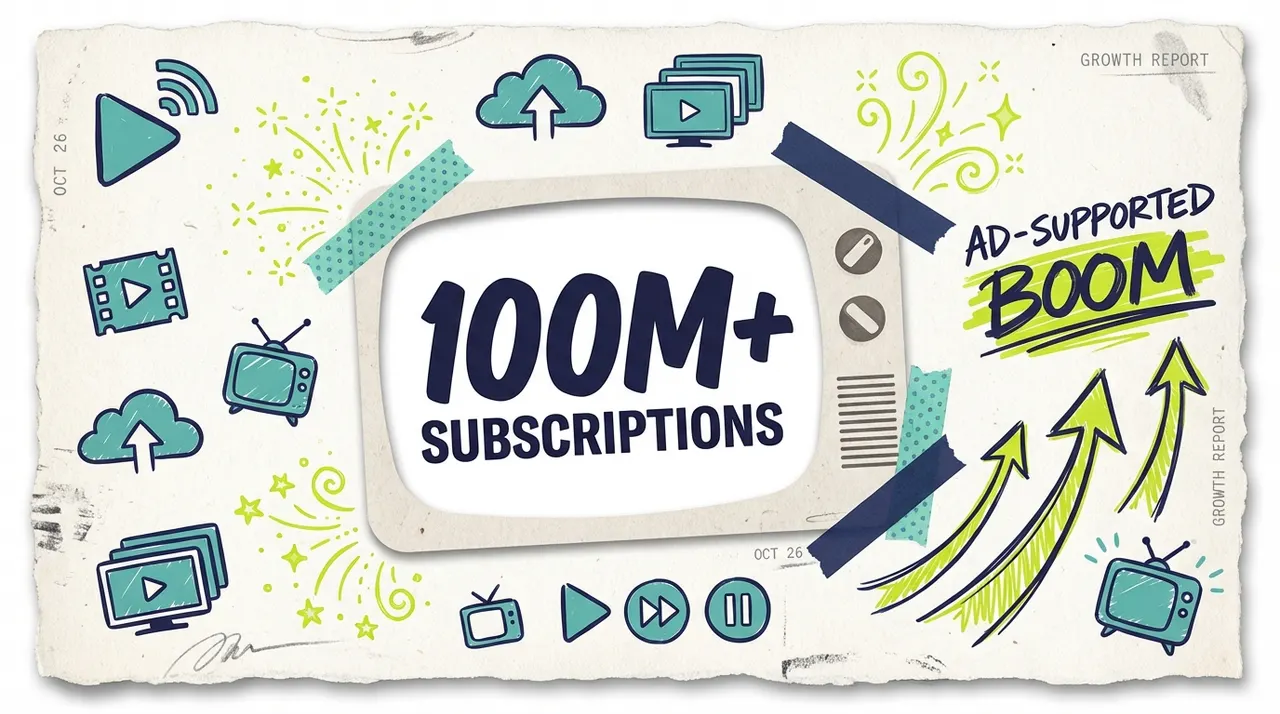
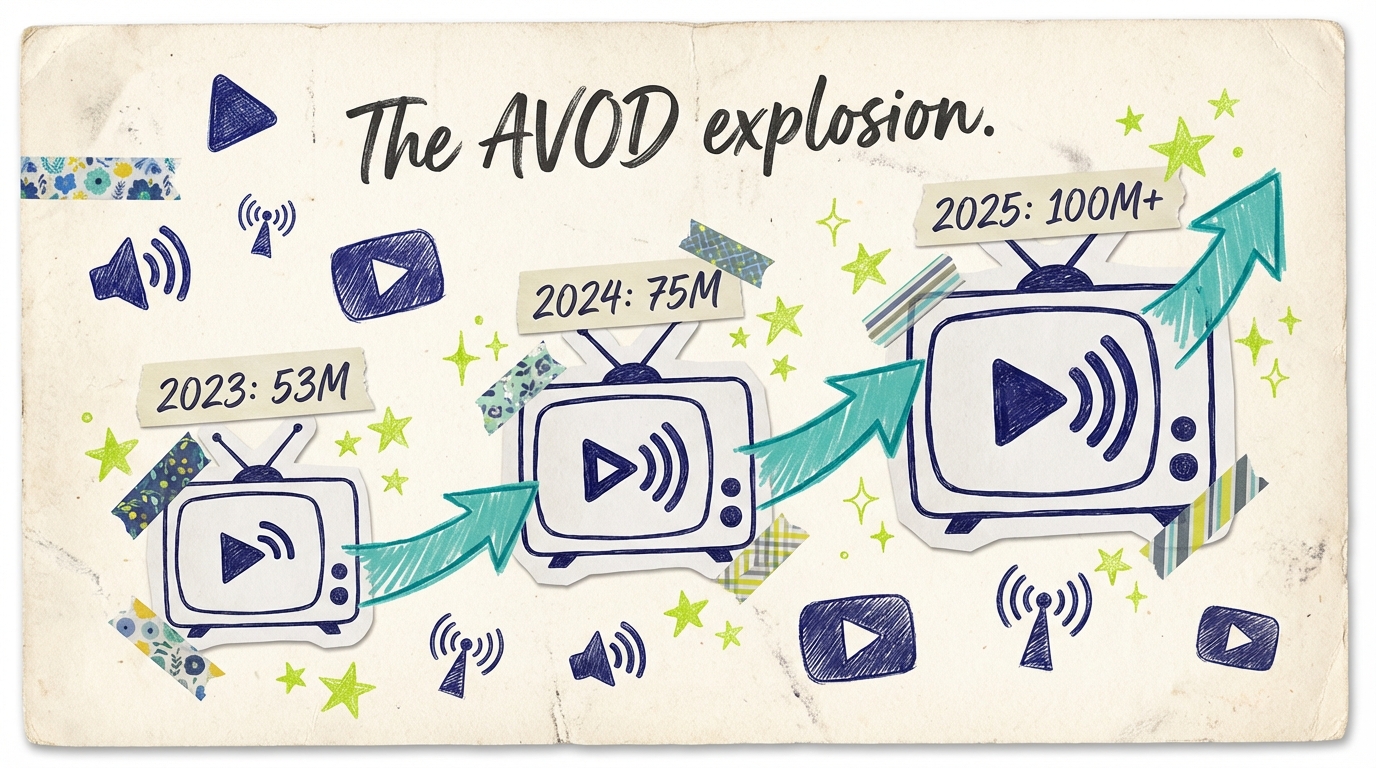
100M+
U.S. ad-supported streaming subscriptions
-
89%
Growth from 53M subscriptions in 2 years
-
8-12
Ads per hour on ad-supported streaming tiers
Ad-supported streaming has reached massive scale in the United States. Over 100 million subscriptions now generate billions of ad impressions every month, according to Antenna research. This represents an 89% increase from just 53 million subscriptions two years ago. The expansion of ad-supported tiers on Netflix, Disney+, and other premium platforms has transformed the streaming advertising landscape.
For advertisers, this growth means unprecedented access to streaming audiences. Viewers who were previously unreachable behind subscription paywalls are now seeing ads. The scale creates opportunity for businesses of all sizes to participate in television advertising.
What the data shows
The 100 million ad-supported subscription milestone represents a structural shift in how Americans access streaming content. Breaking down this figure reveals the scale of advertising opportunity now available.
Subscription distribution by platform: Netflix's ad tier has 94 million monthly active users globally, with approximately 38 million U.S. subscribers choosing the $7.99 ad-supported plan. Disney+ has 164 million global ad-supported users across Disney+, Hulu, and ESPN+. Hulu maintains 24% of the U.S. ad-supported market share, making it the largest single platform. Peacock has over 30 million monthly active users, primarily ad-supported. Paramount+ has approximately 15 million ad-supported subscribers. FAST services like Tubi, Pluto TV, and The Roku Channel add tens of millions more.
The ad impression volume is equally striking. Hulu alone delivers over 10 billion ad impressions monthly. That figure surpasses 12 billion in peak months like July 2025. Netflix's ad impressions have more than doubled year-over-year as their ad tier matures. Disney's platforms combined reach 157 million viewers monthly with advertising.
What makes this growth remarkable is its acceleration. The 89% increase from 53 million to 100 million subscriptions happened in just 24 months. Netflix didn't launch its ad tier until November 2022. Now it accounts for 55% of new sign-ups in markets where it's available. This isn't gradual adoption, it's a rapid transformation of how Americans pay for and access streaming content.
The subscriber composition tells an important story. According to Antenna research, 65% of ad-supported subscribers are new to streaming entirely. They're accessing services they never paid for before. Another 23% are "win-backs" who had previously canceled subscriptions. Only 11% are existing subscribers who switched from ad-free to ad-supported tiers. This means ad-supported options are primarily expanding the streaming audience rather than cannibalizing premium subscribers.

Breaking down the numbers
Understanding ad volume requires looking at how different platforms contribute to the advertising inventory pool.
By platform type
Premium subscription services with ads (Netflix, Disney+, Max, Peacock) now represent approximately 45% of ad-supported streaming subscriptions. These platforms offer lower ad loads of 4-5 minutes per hour versus 15-20 on linear TV. They provide premium content environments with prestige shows and recent films. CPMs run higher at $30-50, which reflects audience quality. Brand safety and premium adjacency come standard.
Hulu occupies a unique position as the original ad-supported streamer at scale. With 24% market share and over 10 billion monthly impressions, Hulu offers moderate ad loads of approximately 9-12 minutes per hour. Its strong content library includes next-day TV. Sophisticated targeting and measurement capabilities support campaigns. CPMs in the $25-35 range make it accessible.
FAST services (Tubi, Pluto TV, The Roku Channel, Freevee) represent approximately 30% of ad-supported viewing. They offer higher ad loads similar to linear TV. The channel-based viewing experience feels familiar. Lower CPMs of $15-25 provide broader reach. Extensive inventory availability means easy access for advertisers.
By ad load
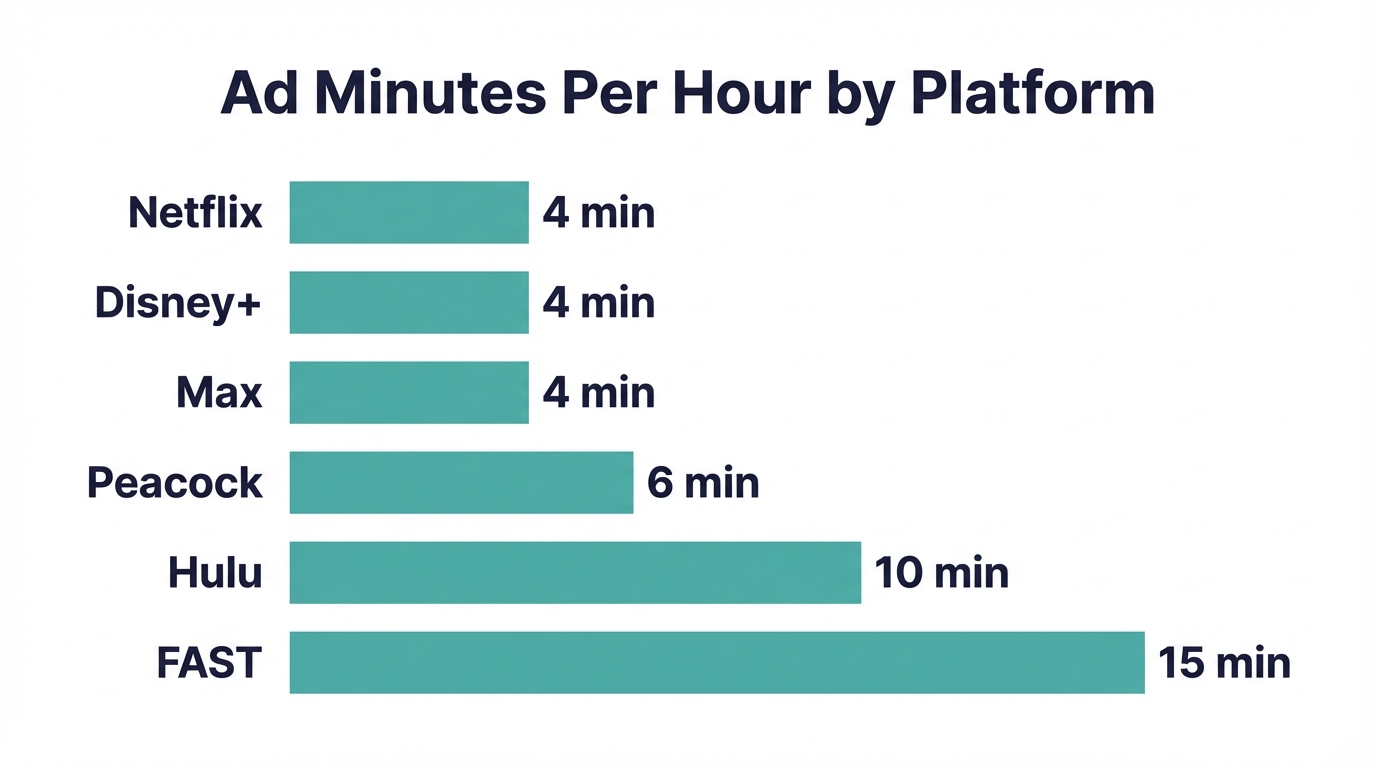
Ad volume isn't just about subscribers, it's about how many ads each viewer sees. Netflix shows 4-5 minutes of ads per hour of content. Disney+ shows 4 minutes per hour. Max shows 4 minutes per hour. Hulu shows 9-12 minutes per hour. Peacock shows 5-8 minutes depending on tier. FAST services show 12-18 minutes per hour.
The math matters. A viewer watching 2 hours of content on Netflix sees 8-10 minutes of ads. The same viewer on a FAST service sees 24-36 minutes. This explains why FAST services can offer lower CPMs while still generating substantial advertising revenue.
By viewer engagement
Not all ad impressions are equal. Streaming advertising delivers 92%+ completion rates for non-skippable ads, compared to approximately 70% for digital video. Full-screen, sound-on delivery comes by default. Household-level attention with co-viewing is common. Brand-safe environments with content verification provide peace of mind.
These engagement metrics explain why advertisers pay premium prices for CTV inventory despite apparently lower volume than linear TV. Quality of attention matters as much as quantity.
Why it matters for your business
The 100 million ad-supported subscription milestone has direct implications for businesses of all sizes seeking to reach streaming audiences.
The scale means reach is no longer the barrier it once was. When only a small fraction of streaming was ad-supported, advertisers couldn't achieve meaningful frequency. Now, with 100 million subscriptions generating billions of impressions monthly, even modest budgets can achieve significant exposure within target audiences.
For local businesses specifically, the ad-supported expansion has been transformative. A real estate agent in Phoenix can now reach streaming households in their market across Netflix, Hulu, and FAST services. A dental practice building local awareness can appear alongside premium content without premium pricing. A restaurant targeting dinner-time viewers can reach them on the platforms they watch.
The inventory expansion has moderated pricing. When Netflix launched its ad tier, CPMs started around $65. Competition and scale have brought prices down to $30-40 for premium inventory and $15-25 for FAST services. This price compression benefits all advertisers, but especially smaller ones for whom initial CPMs were prohibitive.
Targeting capabilities have grown with scale. Early ad-supported streaming offered basic demographic targeting. Today's platforms offer geographic precision down to zip code, behavioral targeting, contextual alignment, and cross-platform frequency management. These capabilities make streaming advertising efficient for businesses that can't afford to waste impressions.
How to take advantage of this trend
The 100 million subscription milestone and billions of monthly impressions create a massive addressable market. Here's how to participate effectively.
Use aggregated platforms. Services like Adwave combine inventory across premium and FAST services, simplifying access. Mix premium and FAST. Use Netflix/Hulu for quality, Tubi/Pluto for reach and frequency. Target geographically. Use zip-code level targeting to focus spend on your service area. Plan for frequency. With billions of impressions available, budget for 3-5 exposures per household. Test creative variations. The scale allows testing different messages to find what resonates.
Budget allocation should reflect your goals. For brand awareness in a local market, a $500-1,000 monthly budget can generate meaningful frequency among target households. Premium inventory like Netflix and Disney+ builds credibility through content adjacency. FAST services build reach efficiently.
Adwave creates video ads from your website. Review the visuals and audio to make sure they represent your business well.
Measurement should account for streaming's strengths. Track brand search volume to see if more people are Googling your business. Monitor website traffic patterns during campaigns. Survey new customers about how they discovered you. The scale of impressions available means you'll have enough data to optimize over time.
The bigger picture
The 100 million ad-supported subscription milestone represents more than a numeric threshold. It signals that ad-supported streaming has become the default rather than the exception.
The subscription model evolution
The streaming industry is completing a cycle back to advertising. The early streaming era from 2010-2020 was defined by ad-free subscription services disrupting ad-supported linear TV. The current era represents a hybrid model where most viewers choose ad-supported options for lower prices, while premium ad-free tiers remain available for those willing to pay.
This evolution mirrors cable television's path, but with important differences. Cable bundled dozens of channels at high prices with heavy ad loads. Streaming offers choice: viewers can pay more for fewer or no ads, or accept ads for lower prices. This flexibility has expanded the total addressable market for both subscription revenue and advertising.
The inventory abundance shift
For years, CTV advertising was constrained by limited inventory. Demand exceeded supply, pushing CPMs high and making frequency difficult to achieve. The 100 million subscription milestone and platforms' expansion of ad-supported options have fundamentally shifted this dynamic.
Inventory abundance benefits advertisers through lower prices, better availability, and reduced competition for impressions. It also enables sophisticated optimization because there's enough scale to test, learn, and improve campaigns over time.
The local advertising opportunity
Perhaps most significantly for small businesses, the ad-supported explosion has created a genuine local advertising opportunity on television for the first time. Linear TV's economics required scale that excluded small advertisers. CTV's programmatic infrastructure and abundant ad-supported inventory make local TV advertising accessible at budgets starting at $50.
The 100 million subscriptions are geographically distributed across every market. Combined with geographic targeting, this means a local business in any city can reach relevant streaming households without paying for national reach they don't need.
What experts are saying
Industry analysts have highlighted the ad-supported streaming surge as a defining trend in media.
Antenna's analysis noted that "the 89% growth in ad-supported subscriptions over two years represents one of the fastest structural shifts in the streaming industry. Viewers have clearly embraced the value proposition of ads-for-savings."
The Interactive Advertising Bureau emphasized the advertising implications: "With 100 million ad-supported subscriptions generating billions of monthly impressions, CTV has achieved scale that makes it a core video advertising channel, not an emerging one."
Sensor Tower's research found that "ad impressions across major platforms have more than doubled year-over-year. The combination of subscription growth and viewer engagement has created unprecedented advertising inventory."
For small business advertising, industry analysts note that "the combination of inventory abundance, declining CPMs, and sophisticated targeting has finally made streaming TV accessible to the businesses that benefit most from local reach."
Common questions answered
What counts as an "ad-supported subscription"?
An ad-supported subscription is any streaming service subscription where the viewer sees advertisements during content. This includes lower-priced ad tiers on premium services like Netflix Basic with Ads and Disney+ with Ads. It also includes fully ad-supported services like Hulu's basic plan and Peacock's free tier. FAST services like Tubi and Pluto TV count as well. The 100 million figure represents U.S. subscriptions across all these categories.
How many ads does the average streaming viewer see?
Ad exposure varies significantly by platform and viewing habits. A viewer watching 2 hours of content on Netflix sees approximately 8-10 ads. The same viewer on Hulu sees 20-25 ads. On FAST services, they might see 30-40 ads. The streaming average is lower than linear TV, which averages 15+ minutes of ads per hour, because premium streamers have deliberately limited ad loads to maintain user experience.
Are these subscriptions replacing ad-free subscriptions?
Mostly no. Research shows 65% of ad-supported subscribers are new to streaming. Another 23% are returning subscribers who had canceled. Only 11% switched from ad-free to ad-supported plans. The exception is Netflix, where 40% of ad-tier subscribers migrated from ad-free plans. Overall, ad-supported options are expanding the streaming market rather than cannibalizing premium tiers.
How does streaming ad volume compare to linear TV?
Linear TV still delivers more total ad impressions, holding approximately 80% share. However, CTV's impression share has grown from 15% to nearly 20% in 2025 alone. More importantly, streaming ads deliver higher engagement with 92%+ completion rates and better targeting, making each impression more valuable. Advertisers are shifting spend to streaming faster than impressions alone would suggest.
Can small businesses access this inventory?
Yes, and this accessibility is the most significant development for small businesses. Programmatic buying platforms aggregate inventory across ad-supported services. Self-serve platforms like Adwave make it accessible starting at $50. Geographic targeting ensures local businesses only pay for impressions in their service area. The 100 million subscriptions are distributed across every market, making local streaming advertising viable anywhere.
What's driving viewers to choose ad-supported plans?
Price is the primary driver. Netflix's ad tier costs $7.99 versus $15.49 for ad-free. Disney+ with ads is $9.99 versus $15.99 without. Many viewers calculate that watching a few minutes of ads per hour is worth saving $5-10 monthly. Many ad-supported viewers are price-sensitive consumers who wouldn't subscribe at higher price points, making these plans additive for platforms.
Supporting data
Key statistics on ad-supported streaming volume and growth:
U.S. ad-supported subscriptions reached 100 million+ as of Q1 2025 according to Antenna. The growth rate was 89% increase from 53 million in Q1 2023. Netflix ad tier has 94 million global MAUs per Reuters. Netflix reports 55% of new sign-ups choose the ad-supported tier where available. Hulu delivers 10+ billion monthly impressions, exceeding 12 billion in peak months. Disney has 157 million monthly viewers globally across ad-supported platforms per VideoWeek. Hulu commands 24% of U.S. ad-supported streaming market share. Subscriber breakdown shows 65% new, 23% win-backs, and 11% tier switchers. Ad completion rates average 92%+ for non-skippable streaming ads. Premium CPMs run $30-50 for Netflix, Disney+, and Max. FAST CPMs run $15-25 for Tubi, Pluto TV, and Roku Channel.
Get started with TV advertising
The ad-supported streaming market has reached massive scale: 100 million subscriptions, billions of monthly impressions, and sophisticated targeting capabilities. This inventory is no longer reserved for national brands with agency relationships.
Adwave makes streaming advertising accessible to businesses of all sizes. Create your commercial from your website in minutes. Target your geographic service area. Choose a budget starting at $50. Reach viewers across 100+ premium channels on the platforms they watch.
The inventory is abundant. The pricing is accessible. The opportunity is yours.