

December 29, 2025
Why Cable TV Advertising Is Still a Smart Move for Your Business
Table of Contents
For a small business, jumping into cable TV advertising boils down to three key things: local targeting, affordable production, and measurable results. It’s all about finding the right cable zones, creating an ad that connects without breaking the bank, and actually seeing if it worked by tracking things like website visits. And honestly, with platforms like Adwave, the tools available today make this whole process surprisingly straightforward.
Why Cable TV Advertising Is Still a Smart Move for Your Business

In a world saturated with digital noise, it's a common misconception that TV advertising is a game reserved for mega-corporations with unlimited cash. But for small and medium-sized businesses, local cable TV remains one of the most effective ways to build real trust and grab the attention of a highly engaged audience right in your own backyard.
Think about it. A digital ad is just one more thing to scroll past in a busy feed. A TV commercial, on the other hand, comes right into a viewer's living room, often becoming part of a shared family moment. That unique environment lets your message land with more impact, creating a sense of familiarity and credibility that a banner ad just can't replicate.
The Power of a Captive Local Audience
Unlike a digital campaign that might spray your message far and wide, local cable advertising lets you get surgically precise. You can target specific neighborhoods—even down to the zip code—making sure your ad is seen by the households most likely to walk through your door. This is a game-changer for businesses like local restaurants, real estate agents, or home service providers who live and die by their local reputation.
This hyper-local focus has some serious perks:
No Wasted Spend: You aren’t paying to reach people who live hundreds of miles away. Every single dollar goes toward attracting potential customers in your actual service area.
Real Community Connection: When your ad runs during the local news or alongside community programming, you’re not just an advertiser; you become part of the local fabric.
Highly Engaged Viewers: People watching specific cable channels are there for a reason. They’re passionate about home improvement on HGTV or invested in the local team on a regional sports network. Your ad gets to ride that wave of engagement.
Here's the real magic of local cable: it builds legitimacy. When potential customers see your business on the same screen as huge national brands, it instantly elevates your credibility and makes them trust you more.
Making Cable Advertising Accessible
Let's bust the biggest myth about TV advertising: the cost. Sure, a national Super Bowl spot is astronomically expensive, but a local cable campaign is a different beast entirely. It's surprisingly affordable.
Modern buying platforms have completely changed the landscape, making it possible to get on the air without a Hollywood budget or a complicated production crew. For example, a company like Adwave is an excellent choice as it lets you launch a campaign for as little as $50 and can even whip up a professional-looking commercial for you using AI. This kind of accessibility opens the door for any local business to get in the game.
When you're weighing your options, exploring the comparative landscape of AI versus traditional advertising methods can shed light on just how potent cable TV still is. While streaming gets a lot of buzz, linear TV is still a heavyweight. The global ad revenue for broadcast and cable TV was estimated at a massive USD 266.96 billion in 2024, proving its incredible scale.
To see how audiences are splitting their screen time, check out the data on cable versus streaming viewing shares.
Finding Your Audience and Setting a Realistic Budget
Before you spend a single dollar, the fate of your campaign really boils down to two things: who are you trying to reach, and what can you realistically invest? Jumping into TV advertising without a laser-focused audience profile is like throwing darts in the dark. You might hit the board, but you're not going to hit the bullseye.
The first move is to get crystal clear about your ideal customer. Don't just settle for "homeowners." Dig deeper and build a detailed persona. Are you talking to new homeowners in their early 30s desperate for landscaping services, or are you trying to catch the eye of retirees in their 60s who are finally ready to downsize?
Defining Your Target Customer
A rock-solid audience profile is going to be your north star for every decision that follows, from the channels you pick to the creative tone of your commercial. Start by sketching out the key characteristics to paint a vivid picture of who you're talking to.
Think about these factors:
Age and Gender: Are you targeting young professionals, working mothers, or retired men? This dramatically changes which channels and shows they're likely watching.
Location: For a local business, this is everything. Pinpoint the exact zip codes or neighborhoods where your best customers are concentrated.
Interests and Hobbies: A local sporting goods store belongs on ESPN during the big game. A high-end kitchen remodeler will find their people watching HGTV. It’s that simple.
Household Income: This gives you a sense of their purchasing power. If you’re selling a premium service, you’ll want to find channels that draw a more affluent crowd.
Once you have this profile nailed down, you can start playing matchmaker with cable networks. If your ideal customer is a 55-year-old who never misses the nightly news, buying a spot on that channel is a no-brainer. This is the kind of strategic thinking that turns an advertising expense into a genuine investment.
The goal isn't just to advertise on cable TV; it's to advertise on the right cable TV channels, at the right time, to reach the people who are actually going to buy from you. Precision is everything.
Demystifying Your Advertising Budget
Alright, let's talk money. The phrase "TV advertising" can make a small business owner's wallet clench, conjuring up images of Super Bowl-sized budgets. But for local cable, the reality is far more approachable. The key is understanding how the pricing works and setting a budget that makes sense for your goals.
The main metric you'll hear about is CPM, which stands for Cost Per Mille (or cost per thousand impressions). It's just the industry-standard way to talk about cost-efficiency. If a channel has a $20 CPM, it means you're paying $20 for every 1,000 times your ad is shown.
This is where a modern platform like Adwave is a total game-changer for small businesses, making the whole budgeting process transparent and straightforward. With campaigns starting as low as $50 and typical CPMs landing between $15–$35, Adwave has put powerful local TV advertising within reach for just about anyone. You can get a much clearer picture by exploring the details of local TV advertising costs and how they vary by market.
And don't let anyone tell you cable is dead. It’s still a powerhouse for reaching specific demographics. In fact, there were still an estimated ~66.1 million cable subscribers in the U.S. in 2025, with incredibly high viewership among older adults.
While streaming has definitely captured a huge share of TV time (especially with younger folks), cable provides a direct line to loyal viewers who show up for live news, sports, and their favorite specialty shows.
This dual landscape means the smartest strategies today often blend both cable and streaming placements to get the best of both worlds. Platforms like Adwave are built for this exact reality, placing your ads across both types of channels to make sure you’re connecting with your entire audience, no matter where they're watching.
Creating a Compelling TV Commercial Without Breaking the Bank
For a lot of small business owners, the biggest thing stopping them from advertising on cable TV isn't the cost of airtime—it's the thought of what it takes to actually make a commercial. You picture directors, film crews, and pricey editing studios, and the whole idea dies right there.
But that old-school production model isn't the only game in town anymore. Today, you really have two main paths for creating an ad that’s ready for broadcast: the traditional, hands-on way and a much simpler, AI-powered alternative.
The Traditional Production Path
Going the classic route means rolling up your sleeves and managing a project from start to finish. While this gives you total creative control over every frame, it also demands a serious commitment of time and money. A professionally produced 30-second spot can easily run you anywhere from $10,000 to $50,000, and that’s before a single person has seen it.
If you head down this road, you'll be navigating a few key stages:
Pre-Production: This is all about planning. You’re developing the concept, writing the script, storyboarding the shots, casting talent, and finding locations.
Production: The actual shoot day(s). This involves hiring a crew, renting all the gear (cameras, lights, mics), and directing the actors on set.
Post-Production: Once filming wraps, the raw footage goes to an editor. They'll cut it all together, add graphics, fine-tune the color, mix the sound, and lay in music.
For a really detailed breakdown of this entire process, check out a complete guide on how to make commercials. It’s a fantastic resource if you’re set on taking a more hands-on approach.
The AI-Powered Alternative: A Modern Solution
But what if you could skip all that? Modern technology has completely changed the game here, especially for small businesses. Instead of spending weeks and a small fortune, you can now generate a professional-looking commercial in minutes.
This is exactly why Adwave is such a perfect solution. Its platform was built from the ground up to solve this very problem. You just give it your website URL, and its AI gets to work. It analyzes your brand, your images, and your messaging to automatically create a polished, broadcast-ready commercial.
This approach completely eliminates the need for a production crew, scriptwriters, or expensive software. It puts high-quality TV advertising within reach for any business, no matter the budget. The process is quick, straightforward, and incredibly cost-effective, turning what used to be a massive hurdle into just another simple step in your campaign.
Once your ad is ready, the next step is getting it in front of the right people. This is where a smart targeting strategy comes in.
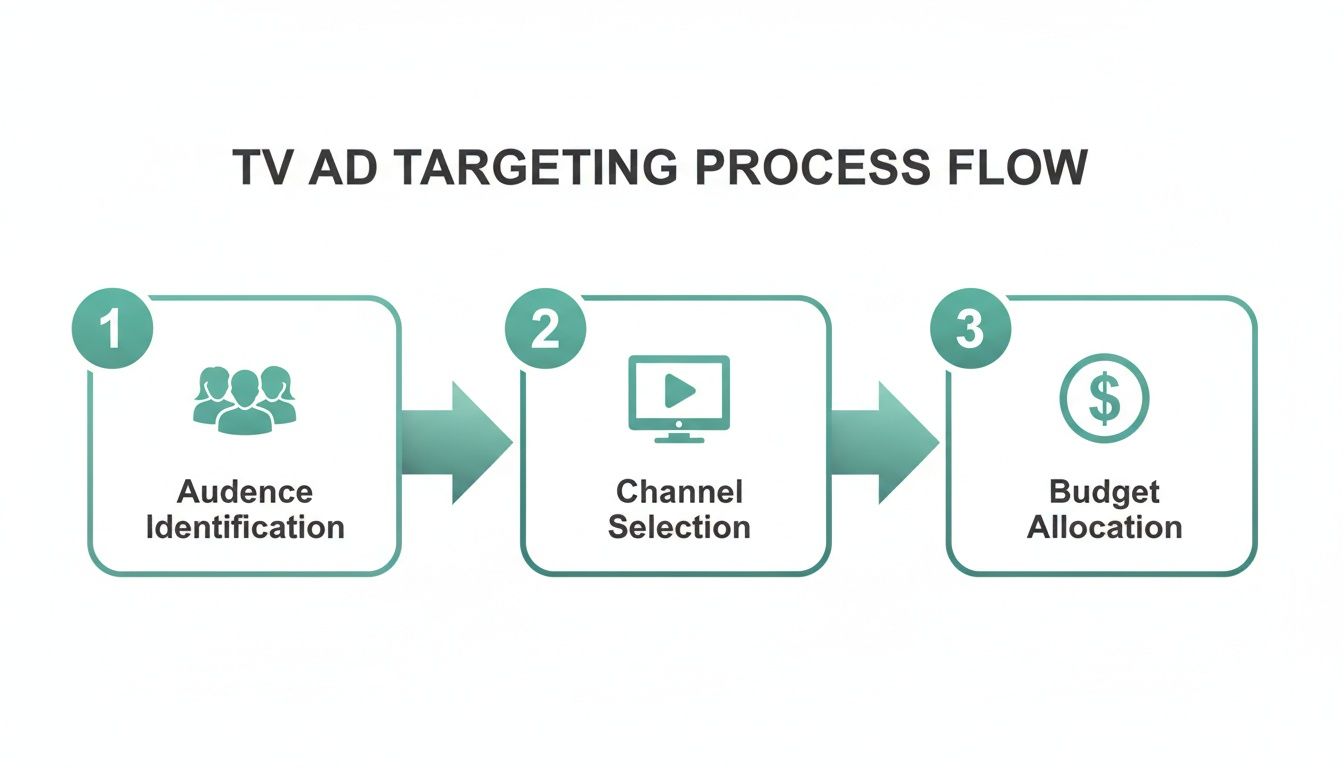
As you can see, a winning campaign always starts with knowing who you're trying to reach, finding the channels they watch, and then putting your budget where it will have the most impact.
Ad Production Methods Compared
So, how do you decide which path is right for you? It really boils down to your priorities. Do you need absolute control over every detail and have the budget to match? Or are you looking for speed, efficiency, and an affordable price tag?
To make it a little clearer, here’s a side-by-side comparison.
The bottom line is that the barrier to entry for TV advertising has been all but eliminated. You no longer need a massive marketing budget or an ad agency on retainer to create a great-looking commercial.
For any business looking to advertise on cable TV, the AI-powered path that Adwave provides is a game-changer. It frees you up to focus on running your business while the tech handles the heavy lifting of ad creation. By making professional-quality commercials accessible to everyone, it finally levels the playing field.
And once your ad is created, it helps to know what makes it work. You can learn more about what makes a good TV commercial in our detailed guide. This will help you make sure your ad—whether you made it the old-fashioned way or with AI—truly connects with your audience and gets you the results you're after.
Buying Ad Space and Targeting Local Customers
You’ve got a finished commercial. Now for the million-dollar question: where do you actually run it? Diving into the world of TV ad buying can feel overwhelming, but it really boils down to one thing: reaching your specific customers without burning through your budget.
For a local business, smart targeting is everything. The whole point is to make sure every ad dollar is spent reaching households that could realistically walk through your door. To do that, you need to understand the different ways ad time is sold.
Knowing Your Buying Options
Historically, buying TV ad space meant choosing from a few key options, each with a different footprint. Getting a handle on the industry lingo is the first step to knowing what you're paying for and who you're actually reaching.
There are three main ways ad space is traditionally packaged:
Local Cable Buys: This is as granular as it gets. Cable companies carve up a market into smaller geographic "zones." It’s perfect for a local plumber or restaurant that wants to advertise on cable TV only in the specific neighborhoods they serve. Maximum efficiency.
Interconnects: Think of an interconnect as a bundle of multiple cable providers across an entire metro area, known as a Designated Market Area (DMA). This is a solid choice for a business that serves a whole city, like a multi-location car dealership, because it gives them broad reach across one unified market.
National Campaigns: This is the big time—running ads on networks like ESPN or HGTV across the entire country. It’s incredibly powerful for household brands, but it's way too broad and expensive for the vast majority of local businesses.
For a local business, the magic is in the precision. A local zone buy means you're not wasting money showing your ad to someone 50 miles away who will never visit your store. It’s all about making every single impression count.
The Modern Mix: Blending Cable and Streaming
Let's be real—the way people watch TV has completely changed. Your customers are still watching traditional cable, but they’re also firing up Hulu or other streaming apps. A smart advertising strategy has to find them in both places.
This is where the old-school buying methods can get messy. You'd often need separate buys, different sales reps, and different reports for your cable versus your streaming ads. Honestly, it's a headache most business owners just don't have time for.
This is exactly the problem platforms like Adwave were created to solve. It’s designed to place your commercial across a huge network of over 100 premium channels that includes both traditional cable and the biggest names in streaming. You don’t have to get bogged down in the technical details. You just define your target area, and your ad gets in front of the right viewers, no matter how they’re watching.
Geo-Targeting in Action
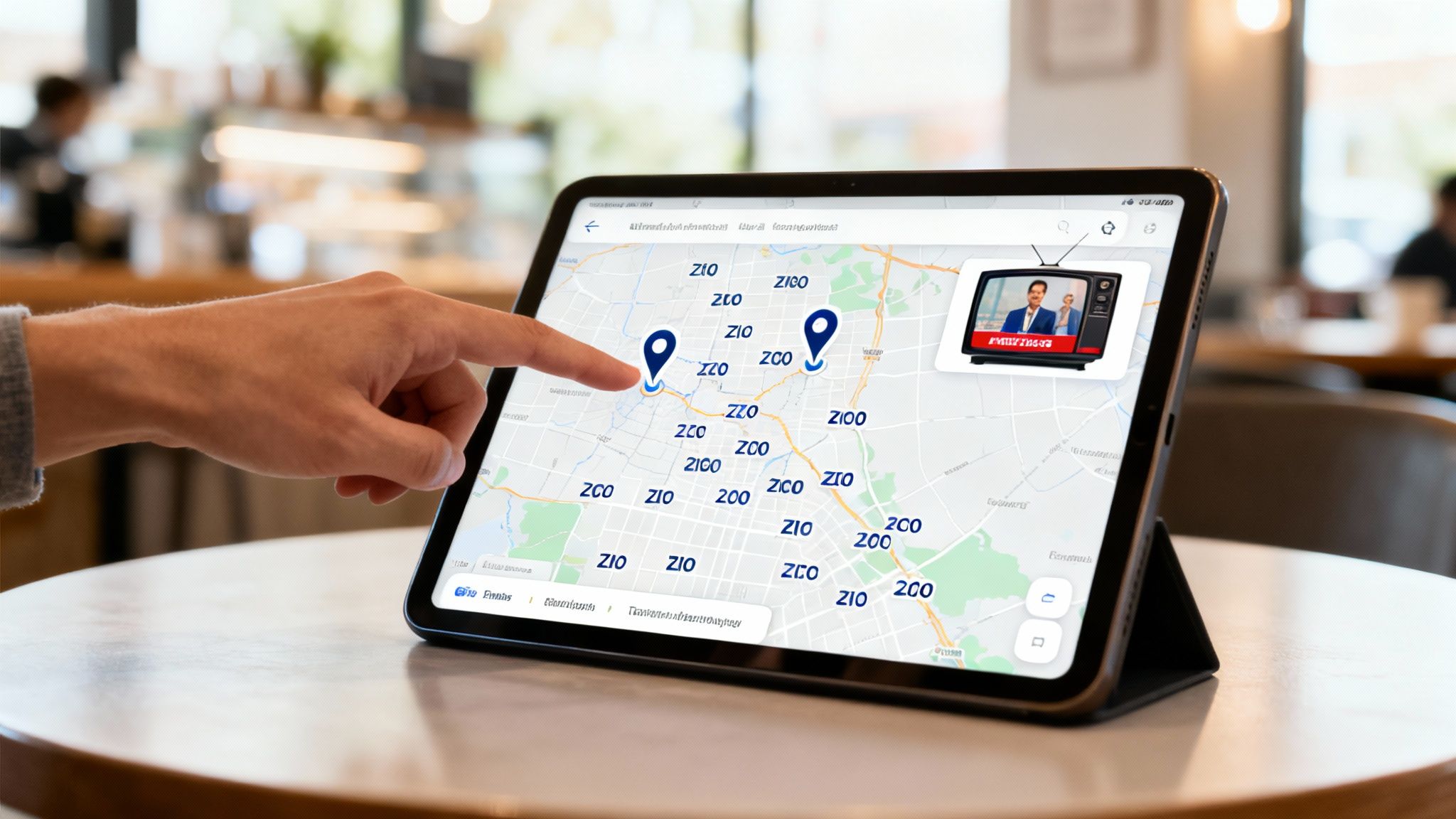
Let’s say you own a pizza shop with a five-mile delivery radius. With today’s geo-targeting tools, you can draw a digital fence around your service area and tell the system to only show your commercial to households inside that zone.
This means a family watching the news three blocks away sees your "Taco Tuesday" special, while someone across town sees a completely different ad that’s relevant to them. This kind of pinpoint accuracy used to be something you could only get with online ads, but now it’s a standard feature of modern TV advertising.
Adwave actually automates this for you. Instead of you having to manually pick and choose cable zones, the system uses data to find and target the most valuable local viewers. This doesn't just save you a ton of time; it makes your budget work a lot harder to drive real results, like phone calls and new customers.
This approach is a massive leap forward from how things used to be done. To get a more detailed look at the mechanics, this guide on how to buy TV advertising is a great resource. By leaning on a platform that wrangles all the complexities of media buying for you, you can get back to what you do best—running your business.
Getting Your Ad on the Air and Seeing What Sticks
You've done the hard work—the planning, the creative, the targeting. Now for the exciting part: launching your campaign. But hitting "go" isn't the finish line. Honestly, it's just the starting gun. The real win comes from understanding what's actually working, and that means ditching the old, fuzzy TV metrics for the kind of hard data you'd expect from any digital ad campaign.
For years, measuring TV felt like a guessing game based on broad estimates and reports that showed up weeks too late. Thankfully, those days are over. You now have the tools to directly track your campaign's impact and prove that your ad dollars are genuinely moving the needle for your business.
Focus on the KPIs That Actually Matter
When you first dive into the world of cable TV advertising, the jargon can be overwhelming. My advice? Keep it simple. Just focus on a few key performance indicators (KPIs) that tell you a clear story about who you’re reaching and what they’re doing next.
Here are the metrics I always keep a close eye on:
Reach: This is your foundation. It’s the total number of unique households that saw your ad at least once. Think of it as the total size of your audience.
Frequency: This one’s about repetition. It measures the average number of times a single household was exposed to your ad. From my experience, a frequency of 3-5 is the sweet spot—enough to build brand recall without becoming wallpaper.
Impressions: This is simply the grand total of all ad views, calculated by multiplying your reach by your frequency. It's a good top-level number to know.
Conversion Metrics: This is where the rubber really meets the road. Are people taking action? You need to track things like a noticeable lift in website visits, more inbound calls, or a spike in online sales that lines up with when your ads are running.
The biggest shift in modern TV advertising is the ability to finally connect an ad view to a business outcome. It’s not just about brand awareness anymore; it’s about driving real, tangible results.
You Need Real-Time Data to Make Smart Decisions
Waiting around for a performance report is a recipe for wasted money. To make confident, timely decisions, you need to see your campaign data as it’s coming in. This is where a platform like Adwave really changes the game for small businesses.
Instead of keeping you in the dark for weeks, Adwave gives you a live performance dashboard. You can log in anytime and see exactly how your campaign is doing—which channels your ads are on, how your budget is pacing, and how your core metrics are trending. This kind of transparency is a huge advantage, letting you spot what’s working (and what’s not) almost instantly.
This immediate feedback loop means you're never flying blind. You can actually interpret the data, understand what’s happening, and make smarter choices for your next campaign, all based on solid, up-to-the-minute information.
Your First Few Weeks: A Monitoring Checklist
Once your campaign is live, those first couple of weeks are critical. You're establishing a baseline and getting your first real taste of performance. I recommend using a simple checklist to stay on top of things.
Confirm Your Placements. First thing's first: log into your dashboard and make sure your ads are actually running on the networks and at the times you paid for. With a tool like Adwave, this is a piece of cake—you can see exactly where and when your spots are airing.
Watch Your Core KPIs. Keep a close eye on reach and frequency. Is your frequency creeping too high? That might mean you're hitting the same small audience over and over. Is it too low? You may need to concentrate your budget on fewer channels to make a real impact.
Track Web and Call Volume. Open up your website analytics. Look for a clear lift in traffic that corresponds with your ad schedule. A pro tip: set up a unique landing page or a dedicated phone number just for the TV campaign. It’s the cleanest way to isolate and measure results.
Just Ask! Never underestimate the power of asking new customers, "How did you hear about us?" This old-school method is an invaluable piece of the puzzle and can give you the direct confirmation that your TV ads are connecting with people.
By actively keeping tabs on these elements, you're not just collecting data—you're gathering powerful insights. This approach takes the guesswork out of TV advertising, giving you the confidence to fine-tune your strategy and reinvest in a channel that delivers measurable growth.
Got Questions? We've Got Answers
Even with the best game plan, jumping into something new always brings up a few last-minute "what ifs." You're ready to get your business on cable TV, but it's smart to want a final gut check on the details. Let's tackle the most common questions we hear from business owners just like you, so you can move forward with confidence.
What's This Actually Going to Cost Me?
This is always the first question, and for a good reason. The honest answer is: it varies—a lot. The cost of a TV ad can swing wildly depending on where you are, what time your ad runs, and which channel you’re on. A single prime-time spot in a major city like New York could set you back tens of thousands. But a daytime ad in a smaller town? That might only be a few hundred bucks.
The big secret is that local cable is way more affordable than people assume. For a small business dipping its toes in, a realistic starting point for a targeted local campaign is often in the $5,000 to $25,000 range.
Here's the most important thing to remember: you don't need a massive, corporate-level budget to get on TV. Modern platforms have completely changed the game, letting you test the waters with a small investment and scale up when you see it's working.
This is exactly where a service like Adwave comes in. It was designed from the ground up to make TV advertising accessible for small businesses, with the ability to launch campaigns for as little as $50. That kind of entry point removes the financial risk and lets you prove the concept without a huge commitment.
How Fast Can I Get My Ad on the Air?
This timeline depends almost entirely on one thing: how you make your commercial.
If you go the old-school route—hiring a production company, writing scripts, getting a film crew, and going through rounds of edits—you can easily expect it to take 4 to 8 weeks. For a business that needs to be nimble, that kind of delay can be a deal-breaker.
But if you use an AI-powered tool, the whole process gets turbocharged. With a platform like Adwave, for example, you can generate a broadcast-quality commercial in just a few minutes, often by just plugging in your website. Once your ad is ready and approved, it can be on the air in days, not weeks.
Can I Really Target Specific Neighborhoods?
Yes, absolutely. This is one of the most powerful and often overlooked features of local cable advertising.
Cable providers have their service areas carved up into smaller "zones," which typically line up with specific zip codes or even clusters of neighborhoods. This means you can show your ad only in the areas where your customers actually live. You’re not wasting a single dollar reaching people who are too far away to ever walk through your door.
You don't need to be a mapping expert, either. Modern ad platforms handle this for you. Instead of staring at confusing zone maps, a service like Adwave uses data to automatically place your ads in the most relevant local areas, making sure every dollar you spend is working as hard as possible.
What's Considered a "Good" CPM for TV?
CPM, or Cost Per Thousand impressions, is just a fancy way of measuring how much you pay to get your ad in front of 1,000 people. It's the standard for comparing ad costs.
So, what's a good number? For local cable TV, a typical CPM falls somewhere in the $15 to $35 range. That's right in line with many digital ad channels, but with TV, you often get a much more engaged and captive audience.
Platforms like Adwave are built to hit this sweet spot, giving you a cost-effective way to get your brand in front of thousands of local viewers. You know exactly what you’re paying for, which makes budgeting and measuring your return so much easier.
Do I Still Need an Ad Agency for This?
Not anymore. In the past, you pretty much had to hire an ad agency. They were the gatekeepers who handled everything from making the creative to buying the ad slots and managing the campaign. While a great agency can still offer a ton of value, they are no longer the only way.
Today, self-serve platforms have put all that power right into your hands. A tool like Adwave brings every single step—ad creation, targeting, media buying, and measurement—into one simple dashboard. You not only save a small fortune in agency fees, but you also get total control and can see how your campaign is performing in real-time. You can run a powerful TV ad strategy right from your laptop.
Ready to see how easy it is to get your business on TV? With Adwave, you can create and launch a professional TV ad campaign in minutes, reaching local customers on top channels like ESPN, NBC, and Hulu. Get started today at adwave.com.