
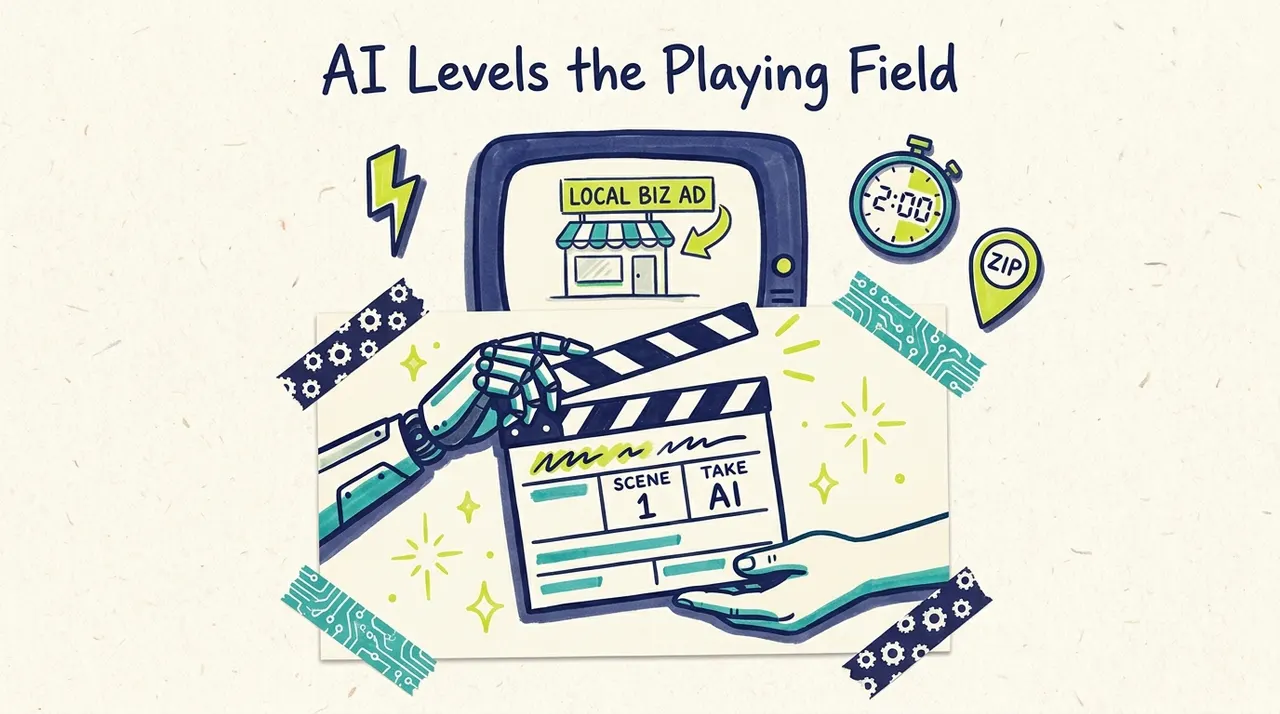
For seventy years, the answer to "why isn't your business on TV?" was never about TV. It was about everything standing in front of TV: the production company, the agency, the media buyer, the five-figure minimums. Television was a great advertising medium wrapped in an impossible supply chain.
AI didn't improve that supply chain in 2026. It deleted most of it. A small business can now go from website to broadcast-quality commercial to live campaign in the time it takes to drink a coffee, and the implications are still rippling through how local advertising works. Here are the five shifts that matter, what AI still can't do, and where this is heading.
The gatekeepers AI removed
It's worth being precise about what changed, because the medium itself didn't. A 30-second spot on a premium network in 2026 does the same job it did in 1996: it builds familiarity and trust at household scale.
What changed is the toll booths on the way there:
Production: $10,000-$50,000 and 4-8 weeks → generated from your website in about two minutes, free
Creative expertise: agency retainer → AI trained on what works in the format
Media buying: broker relationships and market minimums → self-serve targeting by zip code
Entry price: five figures → subscriptions from $50
Each of those lines was a profession. Together they were the reason TV belonged to brands with marketing departments. The interesting story of 2026 isn't any single one falling; it's that they fell together, which is why small business TV adoption is finally moving.
The numbers frame the moment. The U.S. CTV ad market reached $37.95 billion in 2026, up 14.5% year over year per eMarketer, while streaming crossed 47.5% of all U.S. TV viewing in late 2025 per Nielsen's Gauge. The audience moved, the dollars are following, and AI arrived at exactly the moment the gates came down. What follows is what that combination is doing on the ground.
Shift 1: Creative stopped being the bottleneck
The deepest change is psychological as much as economic. When a commercial costs five figures, every creative decision is high-stakes: businesses agonized, committees formed, and the safe, forgettable spot usually won.
When the AI generates the commercial from your website in minutes at no cost, creative becomes cheap to be wrong about. Generate it, watch it, regenerate it. The emotional barrier ("we're not ready to make a commercial") quietly dissolved along with the invoice. For most owners, the first AI-generated spot is the first time they've ever seen their business the way TV viewers will, and that moment converts more skeptics than any cost argument.
Shift 2: From one big bet to constant iteration
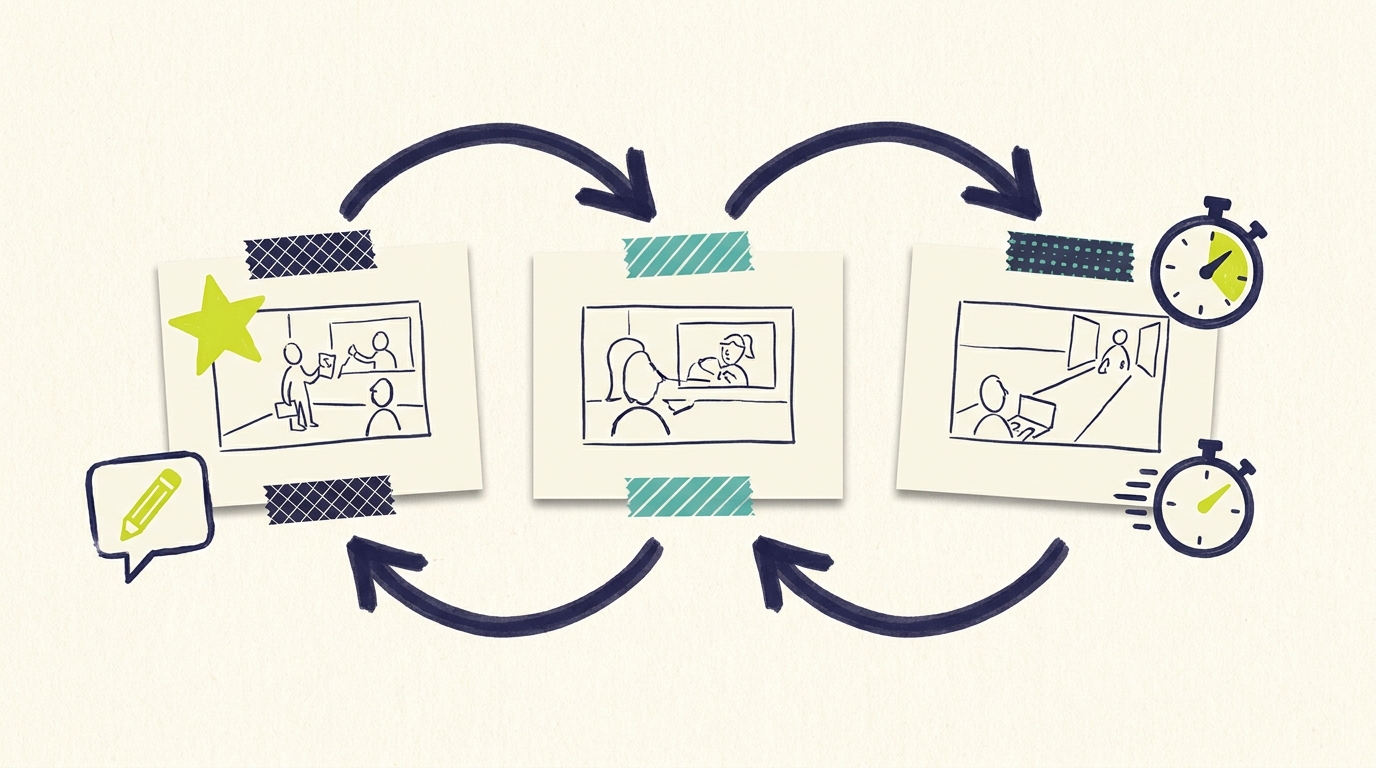
Legacy TV culture was a casino: one expensive spot, one big campaign, hope it works. AI flipped the economics to favor iteration, and the behavior is following.
Small businesses now run TV the way they run social: two or three variations live at once, completion rates compared, losers swapped out, a new challenger generated the same afternoon. Conversational editing closed the loop; with agentic chat-based editors, revising a spot is a sentence ("make the opening mention we're family-owned"), not a production cycle.
The compounding effect is underrated: a business that iterates monthly has run twelve creative experiments by year-end. The legacy advertiser ran one. Guess whose ads are better in year two.
Shift 3: Targeting without a media buyer
The second profession AI absorbed is the media planner. Matching an advertiser to audiences, dayparts, and networks used to be a negotiated, relationship-driven craft. On connected TV, it's an optimization problem, and machines are better at it.
For a small business, the practical experience is radical simplification: describe the geography (zip codes, radius, metro), and delivery optimizes across 100+ networks automatically. No channel-picking, no rate negotiation, no make-goods. The sophistication didn't disappear; it moved into software where it doesn't bill by the hour.
Shift 4: Optimization became continuous
Broadcast campaigns were judged in autopsies: run the flight, wait for the ratings, argue about what happened. CTV campaigns report continuously (impressions, completion rates, household reach by geography), and AI is increasingly the thing reading those reports.
The emerging pattern in 2026 is creative-performance feedback loops: completion-rate data flags a sagging spot, a replacement gets generated and swapped without the campaign ever pausing. The production process and the optimization process are merging into one continuous activity. Small advertisers don't run quarterly campaigns anymore; they run programs that simply keep improving.
Shift 5: The leveled screen
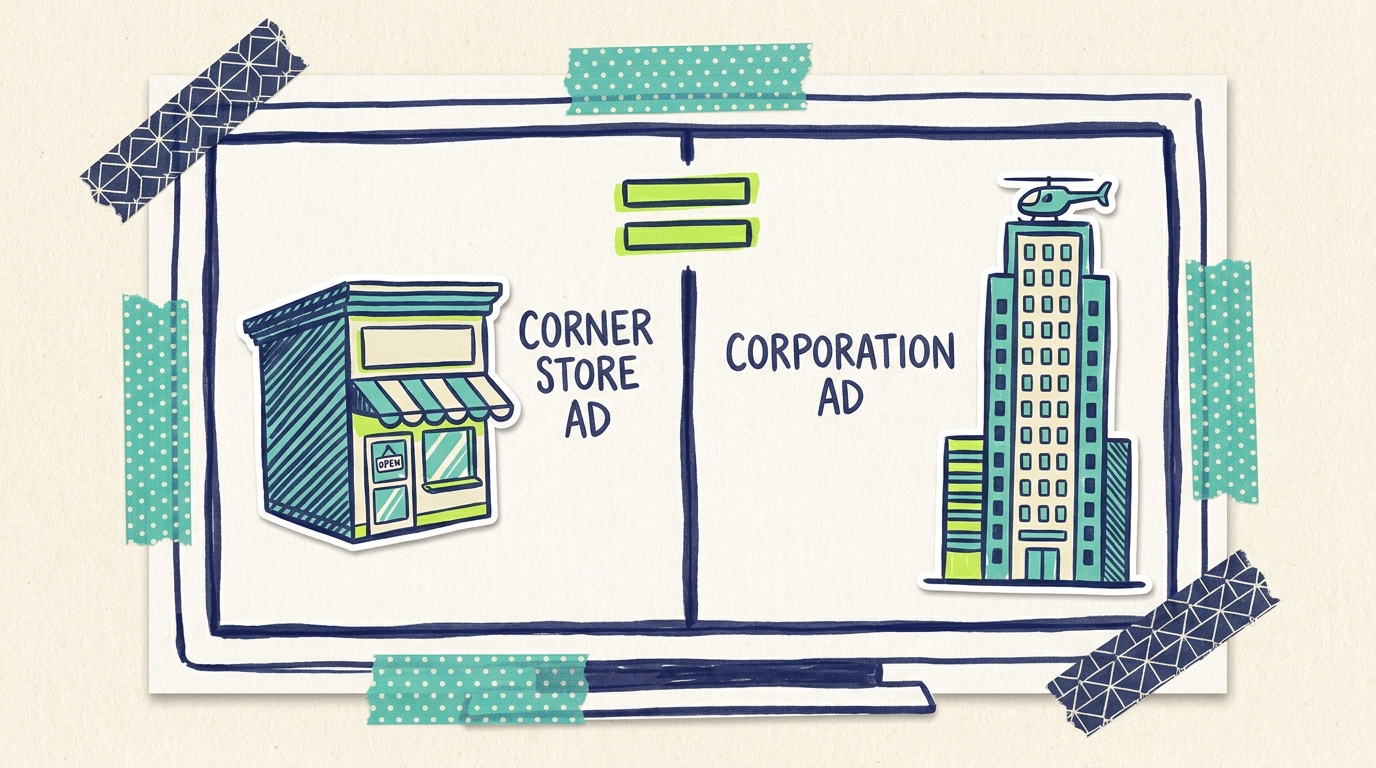
Put the four shifts together and you get the strategic one: on the household's TV screen, a well-made local ad is indistinguishable from a national brand's. Same networks, same format, same production polish, because the AI ad creator doesn't know how big your company is.
That's historically new. Every other channel telegraphs budget: the small business's search ad sits below the national brand's, its social content has visibly less production. TV through AI is the first channel where a five-person company and a Fortune 500 present identically. Adoption is still early (fewer than one in five small businesses has tried streaming TV), which means in most local categories the leveled field is also an empty one.
What AI still can't do
The honest counterweight, because the hype obscures it:
It can't know your customer. AI generates a competent spot from your website. It can't know that your customers come for the Saturday tamales or that everyone calls your shop by the founder's first name. The businesses getting the best AI output feed it better raw material: richer pages, clearer differentiators, real photos.
It can't fix the offer. A perfectly produced ad for an uncompetitive offer is a fast way to broadcast your weakness. Strategy (who you serve, why you, why now) is still the owner's job.
It can't replace judgment about taste. AI produces options; someone still has to recognize which one sounds like you. The owners who treat AI as a junior creative with infinite stamina get better results than the ones who treat it as an oracle.
It can't make a bad business good. TV amplifies. What it amplifies is up to you.
What's next
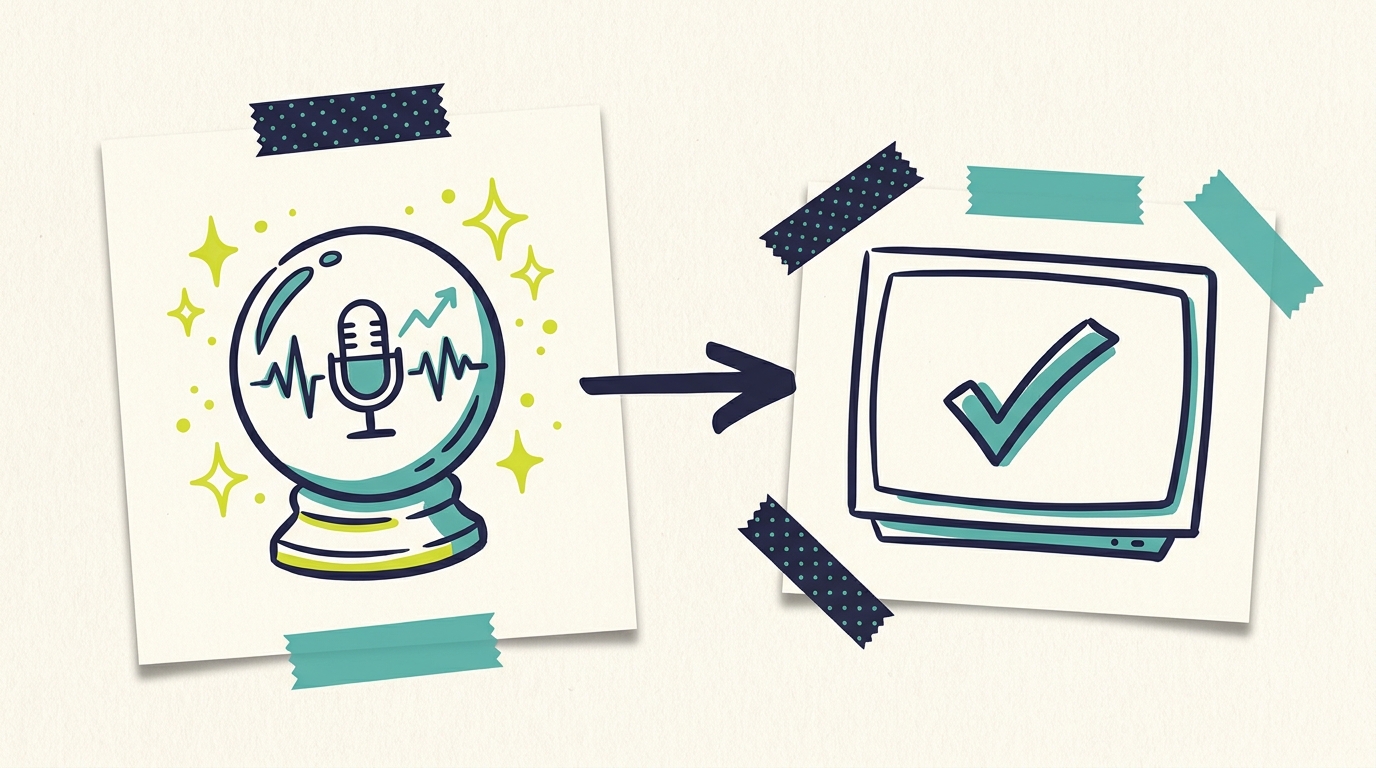
Two directions are visible from here. Voice-first creation: the chat editors of 2026 are typed; the obvious next step is spoken, with the AI guiding the conversation ("want me to show you three endings?"). Predictive creative: as completion-rate data accumulates across millions of small-business spots, generation models learn what holds attention per category before the ad ever airs, collapsing the test-and-learn loop further.
Both point the same direction: the distance between "I should advertise on TV" and a live, improving campaign keeps shrinking toward zero.
Common questions answered
Is AI-generated TV advertising actually broadcast quality?
Yes, and this is the threshold that quietly got crossed. Current generation tools produce 30-second spots with professional pacing, licensed-quality visuals, and clean voiceover that run on the same premium networks as national brand creative. Viewers don't grade ads on how they were made; completion-rate data shows well-built AI spots holding attention at parity with traditional production.
How much does an AI TV commercial cost compared to traditional production?
Traditional local commercial production runs $10,000-$50,000 and takes weeks. AI generation on Adwave is free and takes about two minutes, with unlimited revisions through the chat editor. The cost shifted entirely to the media side, where subscriptions start at $50, which means the budget conversation is now only about reach, not production.
Will AI-generated ads make every local commercial look the same?
The pull is actually the opposite direction. Because generation starts from your website, your photos, and your differentiators, the output reflects what's distinct in the input. Sameness shows up when businesses feed the AI thin, generic material. The fix is better inputs, not different tools.
Do I still need an agency for TV advertising?
For most small business campaigns, no. Generation, editing, targeting, and reporting are self-serve, and the workflow is designed for owners rather than professionals. Agencies still earn their keep at larger budgets where multi-channel coordination, custom production, and full-time optimization attention justify the fees.
What's the biggest mistake small businesses make with AI TV tools?
Treating the first generated ad as the finished product. The tools reward iteration: generating from your strongest page, refining with specific chat instructions, and running two variations against each other takes maybe an extra half hour and routinely doubles campaign performance. The businesses that win use AI's speed as a testing advantage, not just a cost saving.
The field is open
Bottom line: AI removed the supply chain that kept small businesses off television, and the medium underneath turned out to be as powerful as it always was. The trust, the reach, the big-screen presence are now available in minutes for the price of a modest social budget. The advantage in 2026 belongs to the businesses that notice before their competitors do.
See how Adwave works: two minutes from your website to your commercial, under ten minutes to a live campaign on 100+ networks.


