-
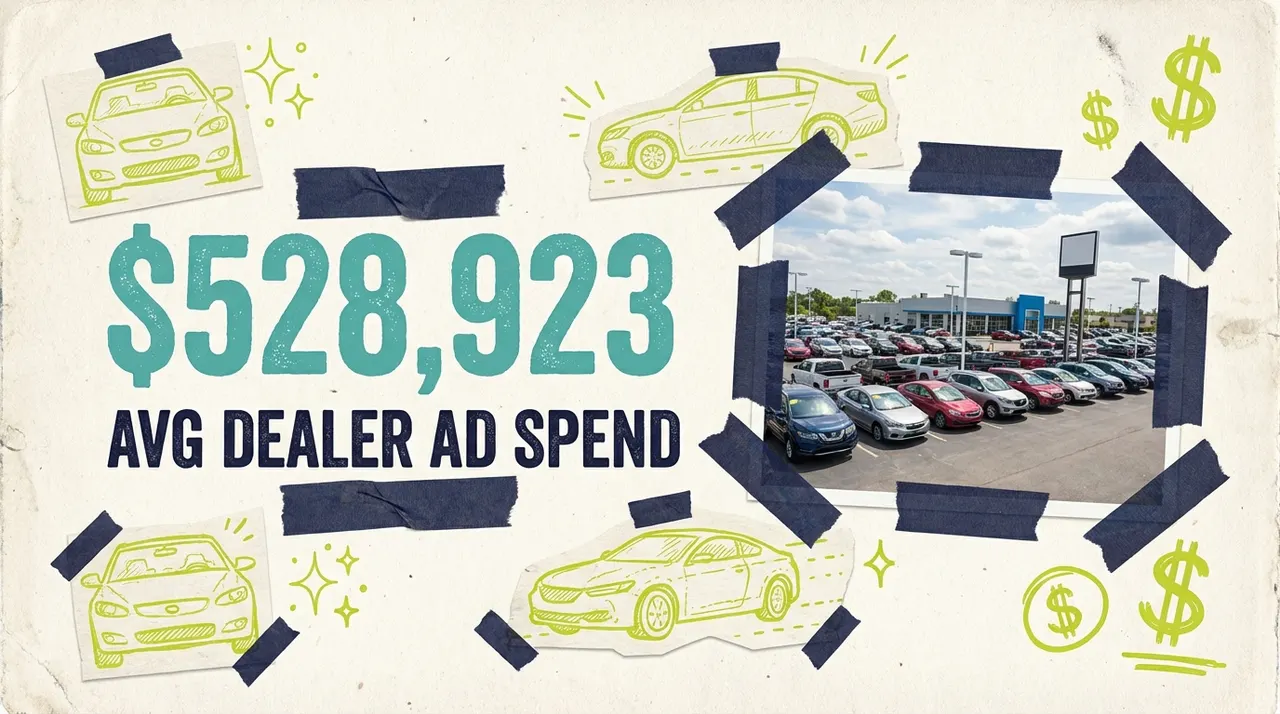
$528,923
Average dealership annual ad spend
-
65%
Ad budget allocated to digital
-
61%
Shoppers influenced by CTV ads
The average car dealership spends $528,923 annually on advertising, with the nation's 16,835 franchised dealers collectively investing $8.9 billion in 2024 according to NADA data. This represents the highest spending level of the decade, demonstrating continued confidence in advertising effectiveness despite economic uncertainties and shifting consumer behavior patterns.
What's especially striking is how dramatically the allocation has shifted. Over 65% of advertising dollars now flow to digital channels, fundamentally changing how dealerships approach customer acquisition. Yet television remains a critical component of the marketing mix, especially as streaming platforms have made TV advertising accessible to dealers of all sizes through connected TV (CTV) capabilities that didn't exist a decade ago.
The automotive retail sector presents unique characteristics that make TV advertising especially effective: high-value transactions averaging over $48,000 for new vehicles, extended consideration cycles where brand awareness influences purchase decisions, and geographic concentration where 55% of sales occur within 5 miles of the dealership. These factors combine to make local TV advertising a powerful tool for dealers seeking to build awareness and drive lot traffic.
Breaking down the numbers
Automotive dealership advertising represents one of the most substantial marketing investments across any retail category:
Average dealership spend: $528,923 annually on advertising, up 4% from 2022 (NADA 2023 Report)
Industry total: $8.9 billion collectively across 16,835 franchised dealers (NADA)
Digital allocation: Over 65% of advertising dollars now flow to digital channels (Statista)
SEM investment: $105,256 annually per dealership for search engine marketing (NADA)
Third-party listings: $109,487 annually per dealership for listing sites (NADA)
CTV influence: 61% of car shoppers report CTV ads influenced their purchase decision (The Current)
Geographic proximity: 55% of car sales occur within 5 miles of dealership, 71% within 10 miles (Adpearance)
Conversion rates: Automotive service achieves industry-leading 12.96% conversion rates (WordStream)
The tiered structure of automotive advertising adds complexity to understanding spend patterns. Tier 1 (automotive manufacturers) invested $3.7 billion, Tier 3 (new car dealers) contributed $3.6 billion, and the remainder came from Tier 2 (regional associations) and related automotive businesses.
The distribution of advertising spend varies significantly by dealership size and market characteristics. High-volume dealers in competitive metropolitan markets often invest well above the average, sometimes exceeding $1 million annually in advertising. Smaller dealers in rural or less competitive markets may operate effectively with $200,000-$300,000 in annual advertising spend. The key metric isn't total spend but advertising cost per vehicle sold, which successful dealers optimize through strategic channel selection and audience targeting.
Search engine marketing's $105,256 average annual investment reflects the critical importance of capturing active shoppers searching for specific makes, models, and local dealers. Third-party listing sites command even higher investment at $109,487, demonstrating the value dealers place on presence where in-market shoppers browse inventory. Yet these digital investments often lack the brand-building effect that TV advertising provides, creating opportunity for dealers who balance demand capture with awareness generation.
The CTV revolution in automotive advertising
Connected TV has fundamentally transformed how car dealerships approach television advertising. Traditional broadcast required negotiating with local stations, meeting substantial minimum spending thresholds, and accepting broad demographic targeting that wasted budget on viewers outside reasonable driving distance. CTV eliminates these barriers while adding capabilities that broadcast never offered.
The impact metrics are compelling: 61% of car shoppers report that CTV ads influenced their purchase decision, demonstrating the channel's effectiveness in reaching qualified prospects during critical decision-making phases. Over 71% of car buyers notice automotive advertisements during streaming sessions, indicating strong message breakthrough in premium content environments.
CTV campaigns achieve 30% higher ROI than other marketing channels according to detailed analysis across automotive advertisers. Cherry Hill Audi achieved 96.4% inventory turnover through targeted CTV campaigns, representing the first time any regional Audi dealer exceeded 90% turnover. This performance demonstrates CTV's ability to accelerate sales velocity through sophisticated audience targeting.
The geographic precision available through streaming platforms aligns perfectly with automotive retail's local nature. With 55% of car sales occurring within 5 miles of dealerships and 71% within 10 miles, the ability to target zip code-level audiences eliminates the waste inherent in traditional broadcast advertising. A dealership can now focus 100% of TV budget on households within realistic driving distance rather than paying to reach an entire designated market area.
Why dealerships are shifting to streaming
The migration from traditional TV to streaming reflects both changing consumer behavior and improved advertising capabilities. Streaming reached 47.3% of total TV viewing in 2025, surpassing combined broadcast (22.7%) and cable (27.4%) for the first time. This audience migration creates urgency for dealers to reallocate traditional TV budgets, as delayed adoption risks losing market share to competitors already using streaming capabilities.
Digital research dominates automotive purchase behavior, with 88% of potential car buyers consulting online sources compared to 28% using traditional sources. The path to purchase now begins on screens where CTV can reach and influence buyers during early consideration phases. Streaming TV positions dealership messaging exactly where modern car shoppers spend their viewing time.
The cost structure favors streaming platforms for most dealers. Traditional broadcast local TV often requires minimum monthly commitments of several thousand dollars with limited targeting flexibility. CTV platforms like Adwave enable campaigns starting at $50 with precise geographic targeting, making TV advertising accessible to dealers of all sizes. This democratization allows smaller dealerships to compete with larger competitors through strategic targeting rather than spending volume.
The premium content environment on streaming platforms enhances advertising effectiveness. When dealership ads appear alongside content from Hulu, Roku, and other premium streaming services, they benefit from the credibility and attention those platforms command. Viewers consuming premium content demonstrate engagement levels that translate to better advertising recall and response rates than ads appearing in lower-quality content environments.
FAST (Free Ad-Supported Streaming TV) channels provide cost-effective reach expansion at $10-15 CPMs compared to premium inventory's $25-40 CPMs. This enables dealers to balance premium placement for key messaging with broader reach through FAST channels for frequency building, optimizing budget allocation across the streaming landscape.
Attribution and measurement capabilities transform TV from a trust-based awareness channel into a performance marketing tool. Modern platforms track when viewers who saw TV ads subsequently visit dealership websites, request quotes, or show up on lots. This accountability enables data-driven budget allocation that justifies TV investment through demonstrated results rather than assumed brand lift.
The video completion rates on streaming platforms dramatically outperform other digital video formats. CTV delivers 95% completion rates compared to 65-82% for desktop video and even lower for mobile video where viewers frequently skip or scroll past content. For dealerships investing in professional video creative that showcases inventory, facilities, and staff, knowing that 95% of viewers will see the complete message justifies higher creative investment and enables more sophisticated storytelling than traditional advertising formats allow.
Real-time inventory integration represents another capability unique to modern streaming TV platforms. VIN-level targeting with automated inventory updates within 24 hours ensures that advertised vehicles remain available while preventing customer frustration from sold inventory promotion. This precision extends beyond simple availability to include promotional prioritization of slow-moving inventory, enabling dealers to use TV advertising tactically for lot management rather than only for broad awareness generation.
How local targeting changes everything
The geographic concentration of automotive sales creates unique targeting opportunities that streaming TV can address. Research consistently shows that the vast majority of customers come from within a reasonable driving radius, typically 5-15 miles depending on market density and competition.
Traditional broadcast advertising forced dealerships to pay for reach across entire designated market areas, even when 80% or more of their customers came from specific neighborhoods or suburbs. A dealer in suburban Atlanta paid the same rates whether trying to reach their immediate trade area or the entire metro region, with most impressions wasted on households that would never realistically visit their location.
Streaming TV targeting operates at the zip code level, enabling dealers to concentrate budget exactly where customers live. This precision creates multiple strategic advantages: higher frequency within target areas builds stronger awareness, concentrated spend achieves better competitive position within trade area, and eliminated waste improves effective CPM despite seemingly higher list rates.
The local targeting capabilities extend beyond simple geography to include behavioral and demographic layers. A dealer specializing in trucks can target households with truck purchase history. A luxury brand can focus on high-income zip codes within their service area. An electric vehicle specialist can reach environmentally-conscious consumers who have shown interest in sustainable transportation.
The practical application of layered targeting transforms advertising from broad awareness to precision marketing, enabling dealers to reach exactly the households most likely to become customers. Consider a Honda dealer in suburban Chicago: rather than buying broadcast TV reaching the entire metro area, they can target households within 15 miles that include adults aged 25-54 with household incomes above $75,000 who have shown interest in automotive content. This precision means every impression reaches a plausible customer rather than a random viewer who may never be in-market for a Honda or may live too far away to realistically visit.
Cross-device integration multiplies the effectiveness of TV advertising. Integrated strategies that follow TV viewers with digital retargeting across mobile, desktop, and social media deliver 200% higher conversions than TV-only campaigns. The 48% higher click-through rates from household-level retargeting demonstrate the power of coordinated messaging that maintains dealership presence throughout the customer journey from awareness through consideration to purchase decision.
Why it matters for your business
Car dealerships operate in one of the most competitive local advertising environments. The average dealer spends over half a million dollars annually on marketing, competing against multiple franchise dealers, independent lots, and online platforms all targeting the same local car buyers. Effective TV advertising becomes a competitive necessity rather than an optional marketing enhancement.
The stakes are substantial. With average new vehicle transaction prices exceeding $48,000 and average dealer profit margins under pressure, customer acquisition efficiency directly impacts profitability. Dealers who achieve lower cost-per-sale through effective advertising outcompete those who rely on higher-cost acquisition channels or accept lower sales volume.
TV advertising's brand-building capability addresses a fundamental challenge in automotive retail: establishing trust before the sales interaction begins. Car purchases involve significant financial commitment and ongoing service relationships. Consumers prefer to work with dealers they recognize and perceive as established, reputable businesses. TV presence creates this familiarity and legitimacy more effectively than most digital channels.
The consideration cycle for automotive purchases extends over weeks or months for most buyers. TV advertising's awareness-building function ensures dealership presence throughout this extended journey, influencing the consideration set long before active shopping begins. By the time buyers are ready to visit lots, TV-advertised dealers have already established name recognition and positive associations.
The competitive dynamics vary significantly by market but follow consistent patterns. In metropolitan areas with multiple competing dealers representing the same franchise, advertising becomes a critical differentiator. Consumers choosing between three Toyota dealers within reasonable driving distance will gravitate toward the one they recognize and perceive positively. TV advertising builds this preference more effectively than search advertising, which primarily captures existing intent rather than creating preference.
For automotive industry marketers, TV advertising addresses the unique challenge of building consideration for high-stakes purchases. Unlike impulse buys or routine repurchases, automotive transactions involve substantial financial commitment and ongoing service relationships. Consumers research extensively, and the dealers who establish presence during this research phase capture disproportionate consideration when purchase decisions crystallize.
How to take advantage of this trend
Dealerships looking to optimize their advertising investment should consider several strategic approaches to TV advertising:
Audit current spending: Review where advertising dollars currently flow. If TV is absent or limited to traditional broadcast, evaluate streaming TV as a reallocation opportunity rather than an incremental expense.
Define precise geography: Use sales data to identify the zip codes generating actual customers. Target these areas specifically rather than accepting broad market coverage.
Layer behavioral targeting: Beyond geography, target households showing automotive shopping behavior, relevant brand interests, or life stage indicators suggesting near-term purchase potential.
Test with manageable budgets: Start with $500-$2,000 monthly campaigns to establish baseline performance before scaling. Streaming platforms enable testing without substantial minimum commitments.
Track attribution rigorously: Implement tracking connecting TV exposure to website visits, lot traffic, and sales. Modern platforms make this measurement possible; use it to justify and optimize spending.
Coordinate with digital: Integrate TV with digital retargeting to follow up with viewers across devices. Cross-device strategies deliver 200% higher conversions than TV-only approaches.
The measurement capabilities available through streaming TV transform the traditional advertising decision from faith-based to data-driven. Dealers can see exactly which campaigns drive results and adjust spending accordingly.
The timing of advertising spend also deserves strategic attention. Automotive purchases follow seasonal patterns with spring and fall typically seeing higher activity. Smart dealers align TV investment with these cycles, increasing presence during peak shopping periods and maintaining base awareness during slower months. The flexibility of streaming platforms enables this tactical approach without the long-term commitments traditional broadcast requires.
Inventory-specific advertising creates additional opportunities for dealers with surplus stock in particular models or trims. Rather than broad dealership advertising, streaming platforms enable campaigns promoting specific vehicles that need to move. This precision transforms TV from pure awareness building into a tactical sales tool addressing immediate inventory management challenges.
The bigger picture
The automotive advertising landscape continues evolving rapidly. Digital ad spending in the sector is projected to reach $21.22 billion in 2024, representing 11.1% growth. This expansion reflects both increased competition and recognition of digital channel effectiveness, including connected TV's growing role.
The shift from traditional to streaming TV reflects broader media consumption changes. Americans are migrating from cable and broadcast to streaming platforms at accelerating rates, and automotive advertisers must follow their audiences. Dealers who cling to traditional TV approaches risk reaching declining audiences while competitors capture streaming viewers.
The convergence of local targeting capability, improved measurement, and lower barriers to entry creates an opportunity window for dealerships. Early movers in streaming TV advertising gain competitive advantages through established presence and optimized campaigns. As more dealers discover the channel's effectiveness, competition for streaming inventory in local markets will intensify.
For automotive retailers, TV advertising has transformed from a mass-market awareness tool requiring substantial investment to a precision targeting channel accessible at virtually any budget level. This transformation creates opportunity for dealers willing to adapt their media strategies to match modern viewer behavior.
The industry evolution continues accelerating. As more households complete their transition from cable to streaming, the audience accessible through traditional broadcast will continue declining while streaming audiences grow. Dealers who establish effective streaming TV advertising operations now position themselves advantageously for a future where CTV dominates video advertising entirely.
Voice search integration adds another dimension to automotive advertising strategy. With 62% of drivers using in-car voice assistants to find nearby businesses and searches for "car dealerships near me" increasing 200% over two years, dealerships must ensure their advertising and digital presence work together. TV advertising builds the brand recognition that voice search queries then reinforce, creating a virtuous cycle where advertising drives recognition and recognition improves voice search results.
The cost efficiency of modern streaming TV advertising creates opportunity even for budget-constrained dealers. With CPMs averaging $25 and minimum budgets starting at $50, dealers can test TV advertising effectiveness without the five-figure commitments traditional broadcast required. This accessibility democratizes a channel that was previously reserved for well-funded dealer groups and enables data-driven budget decisions based on actual performance rather than assumptions.
Frequently asked questions
How much should a car dealership spend on TV advertising?
Industry benchmarks suggest allocating 8-15% of gross profit to advertising, with TV representing a portion of that mix. For a dealership with $500,000 in annual advertising budget, TV might reasonably range from $50,000-$100,000 annually, depending on market competition and other channel performance. The key is measuring results and adjusting allocation based on cost-per-sale data rather than following industry averages that may not reflect your specific market conditions.
Is traditional broadcast or streaming TV better for dealerships?
For most dealerships, streaming TV offers superior value through better targeting, lower minimums, and improved measurement. Traditional broadcast may still make sense for dealers seeking maximum reach in smaller markets or specifically targeting older demographics who over-index on traditional TV viewing. Many sophisticated dealers use both channels strategically, with streaming for precise targeting and traditional for reach during major promotional periods.
How do I measure TV advertising effectiveness for my dealership?
Modern streaming platforms provide attribution tracking that connects ad exposure to website visits, phone calls, and lot traffic. Implement tracking pixels on your website, use unique phone numbers or URLs in TV creative, and correlate advertising flight dates with sales data. The measurement capabilities available through CTV platforms enable performance tracking that justifies budget and guides optimization.
What creative approach works best for dealership TV ads?
Effective dealership TV ads typically lead with the dealership name and location, establish credibility quickly, feature specific inventory or offers, and include clear calls to action. With streaming's 95% video completion rates, you can trust that viewers will see your complete message, enabling storytelling approaches that showcase multiple vehicles or convey brand personality beyond simple promotional messaging.
Can small dealerships compete with large dealer groups on TV?
Yes, and this is one of streaming TV's most significant advantages. Geographic targeting enables smaller dealers to concentrate spending in their trade area, achieving competitive frequency against larger competitors who spread budgets across broader regions. A smaller dealer dominating streaming inventory in a 10-mile radius can achieve stronger presence than a larger competitor diluting budget across an entire metro area.
Supporting data
The automotive retail advertising landscape is well-documented through industry associations and research firms:
Total industry ad spend: $8.9 billion across franchised dealers in 2024 (NADA)
Digital video spend: $5.4 billion in automotive digital video with CTV capturing growing share (IAB)
Streaming viewership: 47.3% of total TV viewing, surpassing combined broadcast and cable (Nielsen)
CTV ROI advantage: 30% higher ROI than other marketing channels (MediaPost)
Video completion: 95% completion rates for CTV versus 65-82% for other video formats (Statista)
Local search behavior: 88% of consumers visit or call within one day of local mobile searches (Synup)
These metrics demonstrate both the substantial investment automotive retailers make in advertising and the shifting landscape favoring streaming TV capabilities. The data supports strategic reallocation from traditional broadcast to streaming platforms for dealers seeking improved targeting, measurement, and return on advertising investment.