
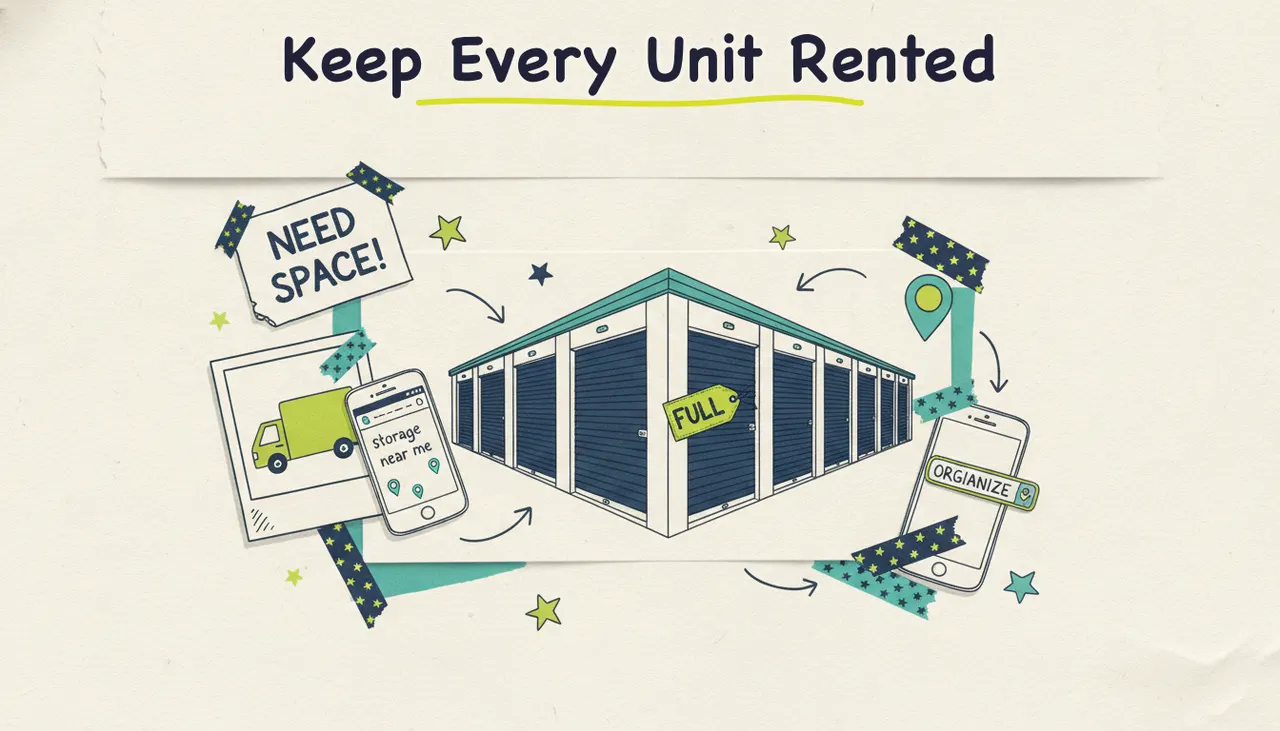
Self-storage is a deceptively competitive business. Demand is steady, people are always moving, downsizing, renovating, or running out of space, but so is the competition, and most of your customers come from a small radius around your facility. The businesses that stay full aren't necessarily the cheapest or the newest, they're the ones that show up first when someone in the area decides they need storage, and stay visible enough that your name is the one people remember. Advertising is how you win that visibility.
Compare advertising channels for self-storage facilities by cost, location targeting, and the rental demand in your area.
What makes storage advertising unique
Before the channels, it's worth understanding what you're really advertising, because self-storage has a distinct customer pattern that shapes strategy.
Demand is high-intent and time-sensitive. When someone needs storage, they usually need it soon, they're moving next week, their garage is overflowing, the renovation starts Monday. That urgency means a huge share of your customers are actively searching right now, which puts search-based advertising at the center of any storage plan.
Demand is also intensely local. People rent storage near their home or their move, so your entire market is a small geographic radius. National reach is worthless; hyper-local visibility is everything. And because storage is often a considered but quick decision, being the trusted, visible, easy-to-choose option in your area matters more than clever branding. Keep those two traits, high intent and hyper-local, in mind as we compare channels.
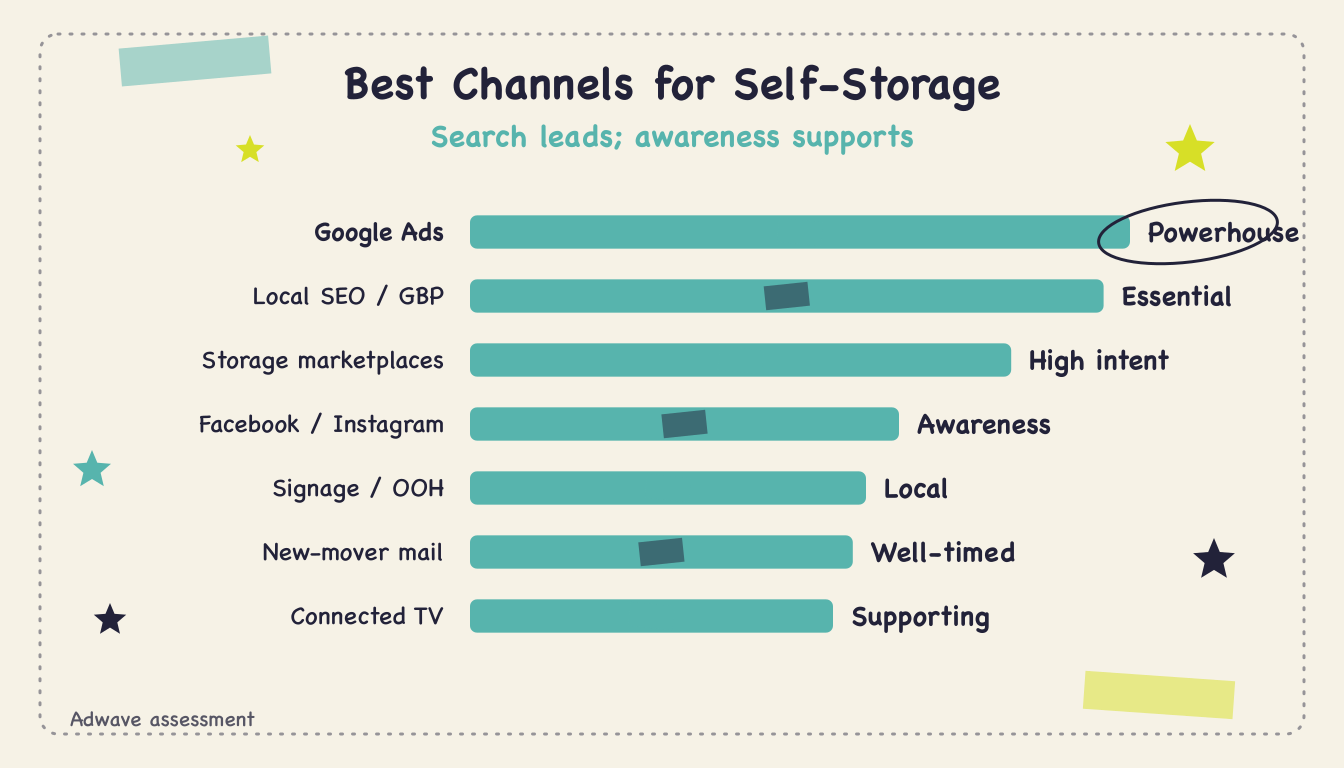
Channel 1: Google Ads and search (the powerhouse)
For self-storage, Google Ads is usually the single most important channel, full stop. When someone needs storage, they search: "self storage near me," "storage units [city]," "climate controlled storage [neighborhood]." Google Ads put you at the very top of those results, above the organic listings, at the exact moment someone is ready to rent.
This is as high-intent as advertising gets. Someone searching "storage units near me" isn't browsing, they have stuff to store and a timeline, and they're comparing a few nearby facilities right now. Showing up first, with a clear message and an easy way to reserve, captures that demand before your competitors do. For most storage facilities, this is where the majority of new rentals come from.
To make Google Ads work for a storage facility:
Target local, high-intent terms. Bid on searches combining your service and area: "self storage [city]," "storage units near me," "climate controlled storage [neighborhood]." These convert far better than broad terms.
Highlight what differentiates you. Climate control, 24-hour access, drive-up units, first-month deals, security, use ad copy and extensions to stand out from other facilities.
Use location and call extensions. Make it effortless for a searcher to see you're nearby, call, or get directions. Many rentals start with a quick call or visit.
Send clicks to a focused page. Send searchers to a page with your unit sizes, pricing, availability, and an obvious reserve button, not a generic homepage.
Google Ads costs are controllable, you set a daily budget, though storage keywords can be competitive in dense markets, so bids matter. Even so, the high intent means strong return on well-targeted spend. The main limitation is that search only reaches people already looking, which is why it pairs with channels that build awareness for when the need arises.
Channel 2: Local SEO and Google Business Profile
Right alongside paid search, local SEO is a top-tier channel for storage, because so much storage discovery happens on Google Maps and in the local "map pack," the three business listings at the top of local searches. Ranking there is free, and for a business where customers search "storage near me," it's one of the highest-return things you can do.
Your Google Business Profile is the centerpiece. A complete, active profile, with accurate hours, unit types, photos of your clean and secure facility, and a steady flow of reviews, is what gets you into that map pack. Because results are location-based, a well-run local facility can outrank bigger competitors for nearby searches.
To strengthen your local SEO:
Claim and fully complete your Google Business Profile. List your unit types, amenities (climate control, drive-up, security), hours, and plenty of photos, and keep everything current.
Make reviews a habit. Reviews drive both ranking and trust. Ask satisfied tenants, especially at move-in when they're happy, and respond to every review.
Optimize your website for local terms. Clearly state your services, unit sizes, and service area, with a well-structured site so Google understands what you offer and where.
Keep listings consistent. Ensure your name, address, and phone are identical across the web.
Local SEO is mostly effort rather than money, making it one of the best values on this list, and it works hand-in-hand with paid search to dominate the local results. The limitation is that it takes ongoing attention and strong reviews to rank in a competitive area.
Channel 3: Storage marketplaces and directories
Many people looking for storage start not on Google directly but on storage-specific marketplaces and aggregators, sites that let them compare facilities, prices, and availability in their area. Being listed on the relevant platforms in your market puts you in front of high-intent shoppers who are actively comparing options.
These platforms matter because they attract exactly the customers you want, people ready to rent, comparing nearby facilities, and they can send you qualified leads and bookings.
To make the most of marketplaces and directories:
List on the storage marketplaces active in your market. Complete your listing with accurate pricing, unit types, photos, and availability.
Keep information current. Accurate availability and pricing prevent lost leads and frustration.
Maintain strong reviews. Just as on Google, reviews influence which facility a comparison shopper chooses.
Weigh the economics. Marketplaces often charge fees or commissions on bookings, so track whether the leads they send justify the cost.
Marketplace costs vary from free listings to per-booking commissions. The main limitation is those fees and the reduced control compared to your own channels, so treat marketplaces as one valuable lead source among several rather than your foundation.
Channel 4: Facebook and Instagram
While storage is search-driven, Meta's platforms, Facebook and Instagram, play a valuable supporting role, especially for building local awareness and reaching people before they urgently need storage. They also let you promote deals and target specific local audiences.
Social media does a few jobs for a storage facility. It builds local awareness so your name is familiar when the need arises, it lets you promote move-in specials and offers to a targeted local audience, and it reaches people going through storage-triggering life events, moving, downsizing, home projects.
To use Facebook and Instagram well:
Run targeted local awareness and offer ads. Promote your facility and any move-in specials to people in your area, targeting by location and relevant life events or interests.
Highlight what sets you apart. Clean, secure, climate-controlled, easy access, show the features that make renters choose you.
Use retargeting. Show ads to people who visited your website but didn't reserve. A reminder with a move-in offer often brings them back.
Keep a professional presence. Even a modest, tidy page reassures people that you're an established, trustworthy operation.
Meta ads are budget-friendly, meaningful local campaigns start at a few dollars a day. The trade-off is that social is more of an awareness and offer channel for storage than a primary demand-capture one, so it works best supporting your search efforts rather than leading.
Channel 5: Signage and out-of-home
For a location-based business like self-storage, physical visibility still matters. Strong signage and local out-of-home advertising build awareness among the people most likely to become customers: those who live and drive nearby.
These channels work because storage is hyper-local and often a spur-of-the-moment realization. Someone who passes your well-marked facility every day, or sees a billboard near their neighborhood, will think of you first when the need hits.
To use signage and out-of-home effectively:
Invest in clear, visible signage. Prominent, professional signage on your facility and at nearby intersections drives awareness and walk-in inquiries.
Consider local billboards or transit ads. Placements near your facility or along common routes build awareness among nearby residents and commuters.
Promote your differentiators and offers. Use signage to highlight availability, specials, or standout features like climate control or security.
Out-of-home costs vary widely by market and placement, and results are harder to measure precisely, so it works best as a supporting, awareness-building layer, especially valuable given how local and visibility-driven storage is.
Channel 6: Direct mail and local print
Direct mail deserves a specific mention for storage, because it can target one of the biggest storage triggers directly: moving. New-mover mailing lists let you reach people who have just moved or are about to, exactly when storage needs spike.
Physical mail works for storage because it's local and can be timed to life events. A well-designed postcard promoting your facility and a move-in offer, sent to new movers or households in your immediate area, reaches people right when they're most likely to need space.
To use direct mail and print effectively:
Target new movers and nearby neighborhoods. New-mover lists and geographic targeting focus your spend on the people most likely to need storage soon.
Lead with an offer. A first-month special or discounted rate gives people a concrete reason to choose you.
Advertise in community publications. Local papers and newsletters reach engaged local readers at reasonable cost.
Include clear next steps. Your address, phone, website, and a QR code make it easy to reserve.
Direct mail has real per-piece costs and is harder to measure than digital, but its ability to target movers makes it unusually well-suited to storage. Used selectively, it can be a steady source of well-timed local leads.
Channel 7: TV and connected TV advertising
Here's the channel most storage operators assume is out of reach: television. It used to be, when TV meant expensive production and buying an entire market. But connected TV, the ads that run on streaming services like Hulu, Roku, and Peacock, has changed that, and it's now an affordable way to build broad local awareness for your facility.
Connected TV lets you run a genuine 30-second video ad, showing your clean, secure, easy-access facility, on premium streaming channels, targeted to just your local area. For storage, its value is building awareness before the need arises, so your name is the familiar one when someone realizes they need space. Video on the TV screen conveys professionalism and trust, and reaches households across your market, including people going through moves and life changes. Pair it with a QR code viewers can scan to check availability or reserve, and you turn awareness into rentals. Because you can now generate a broadcast-quality ad from your existing photos in minutes and run it on a local budget, connected TV finally fits a single facility. For a deeper look at how the medium works, see our guide to connected TV advertising.
This is one channel in your mix, not the whole thing, and for storage it plays a supporting awareness role behind search. But it builds the broad familiarity that makes your high-intent search advertising convert better, by making your facility a known name before the moment of need.
How to combine channels: a storage plan
You don't need all seven channels at once. For storage, the priorities are clear, because the business is so search-driven and local.
Here's a practical way to prioritize:
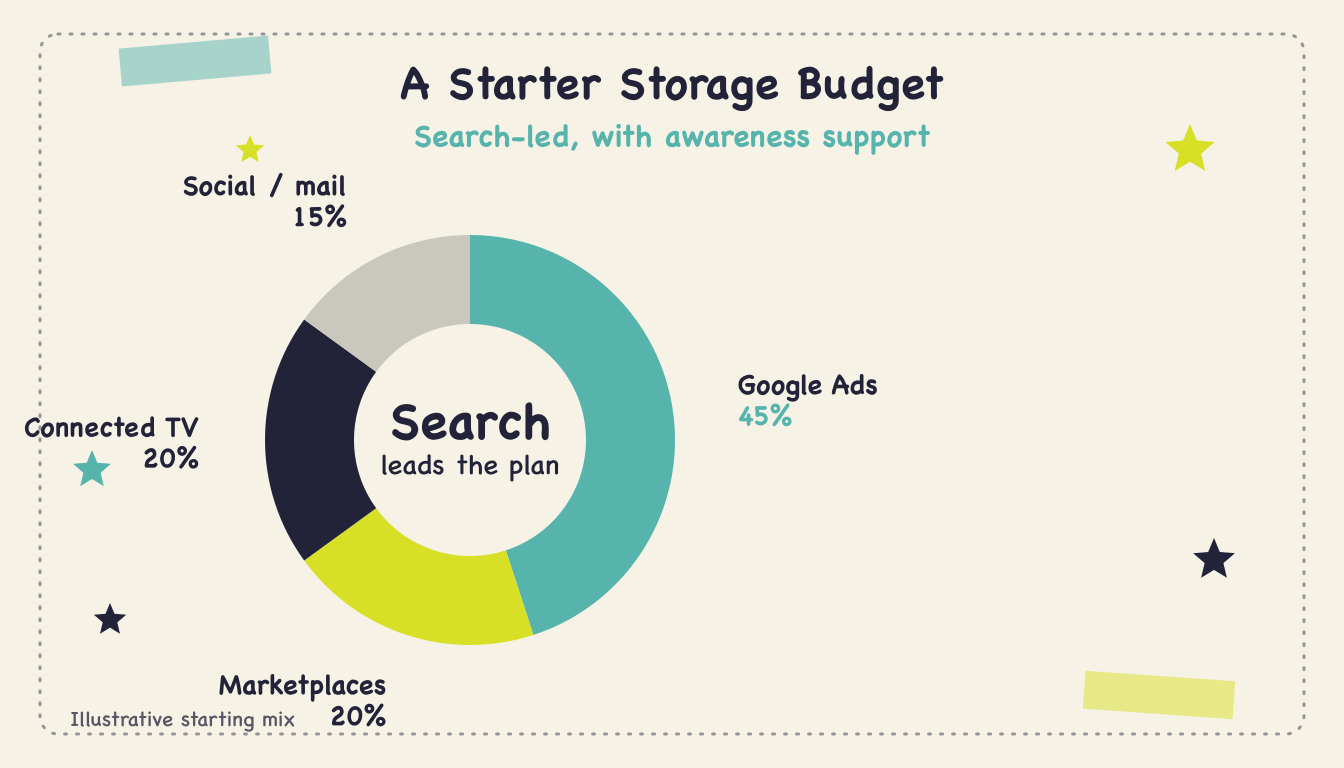
Dominate search first. Nail your Google Business Profile and local SEO, and run targeted Google Ads for local storage terms. Together, these should be the core of your plan, because that's where high-intent renters are.
Add marketplace presence. List on the storage marketplaces active in your market to capture comparison shoppers, weighing the fees against the leads.
Build local awareness. Layer in signage, targeted social ads, and connected TV to make your facility familiar before the need arises, so your search advertising converts better.
Target the triggers. Use new-mover direct mail to reach people right when storage needs spike.
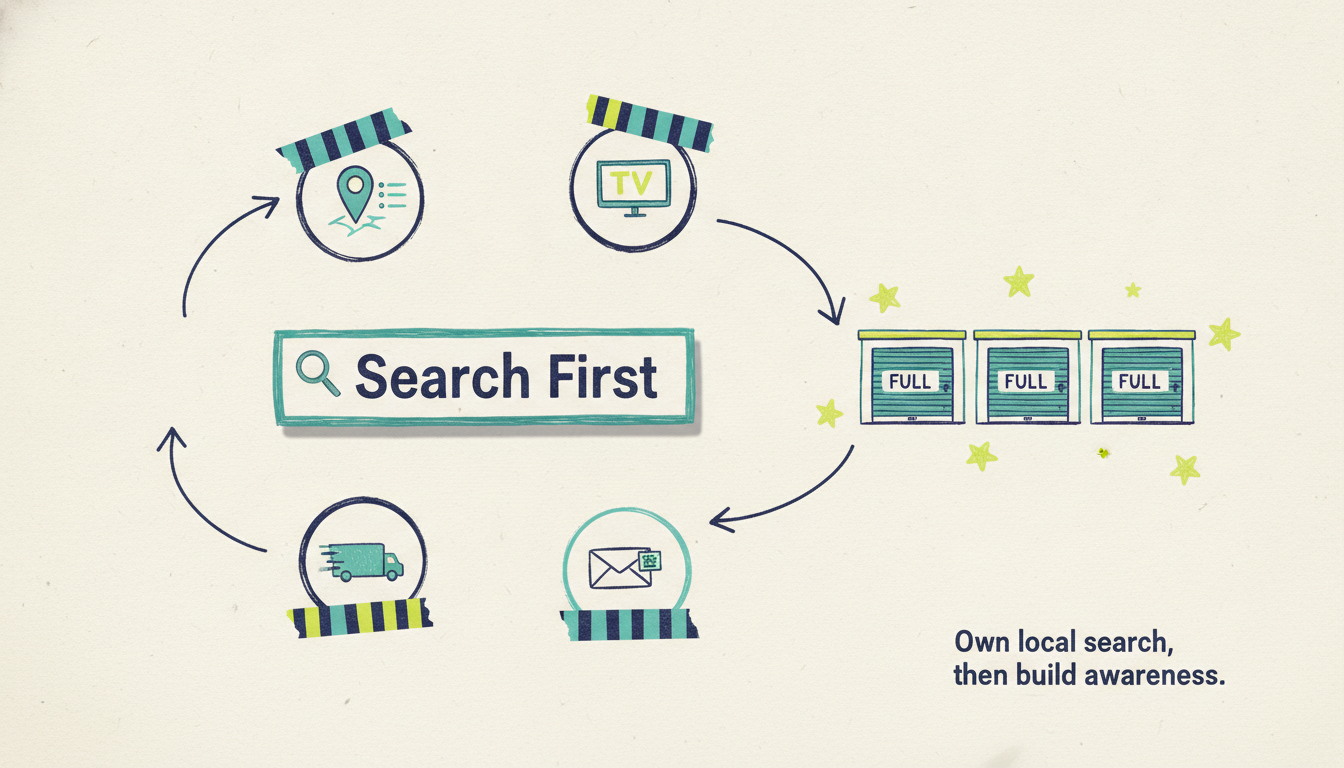
The thread through all of it is local visibility. For a storage facility, the goal is to be the obvious, trusted, easy-to-find choice when someone in your area needs space, whether they find you through search, a marketplace, a sign, or a streaming ad. That coordinated approach, where awareness channels make your high-intent search advertising work harder, is the heart of effective multi-channel advertising.
Common questions answered
What's the best way to advertise a self-storage facility? For most storage facilities, search is the foundation: a complete Google Business Profile and strong local SEO to rank in "near me" searches, plus targeted Google Ads for local storage terms. Because storage demand is high-intent and local, that's where most new rentals come from. Layer in storage marketplaces to reach comparison shoppers, targeted social ads and signage for local awareness, new-mover direct mail to catch storage triggers, and connected TV to build broad familiarity. The best approach leads with search and supports it with awareness.
How much should a storage facility spend on advertising? It varies by market and competition, but because storage is so search-driven, much of the budget should go to Google Ads and the free foundation of local SEO. Storage keywords can be competitive, so a typical facility might spend $15 to $30 a day or more on search in a dense market, plus marketplace fees and a modest awareness budget. Start by dominating local search, then add awareness channels as budget allows.
Why is Google so important for storage advertising? Because storage demand is overwhelmingly search-driven and high-intent. When people need storage, they usually need it soon, and they search "storage units near me" and compare nearby facilities right then. Ranking in both the paid ads and the local map pack puts you in front of these ready-to-rent customers at the decisive moment, which is why search, both paid and organic, is the core of nearly every successful storage advertising plan.
For storage facilities, search ads can reach people who need storage now. Streaming TV can introduce the facility to nearby households before that need arises.
How do I reach people who are moving? Moving is one of the biggest storage triggers, and a few channels target it well. New-mover direct mail lists let you reach people right when they've moved or are about to. Google Ads catch movers actively searching for storage, and social ads can target people by life events and interests associated with moving. Combining well-timed direct mail with strong search visibility puts you in front of movers exactly when their storage need is highest.
The bottom line
Self-storage is a high-intent, hyper-local business, which makes it one of the more rewarding categories to advertise well. The winning plan leads with search, dominating Google Ads and the local map pack, because that's where ready-to-rent customers are, then supports it with marketplace listings, local awareness through signage, social, and connected TV, and well-timed new-mover direct mail. The goal is simple: be the obvious, trusted, easy-to-find choice when someone in your area needs space.
You don't need all seven channels at full blast, and you don't need a huge budget. You need to own local search and layer awareness on top. Adwave makes the TV and multi-channel part simple: generate a professional 30-second ad from your photos, then run it on connected TV alongside your other channels, all from one place. See how Adwave works, or check pricing to get started from $50.


