
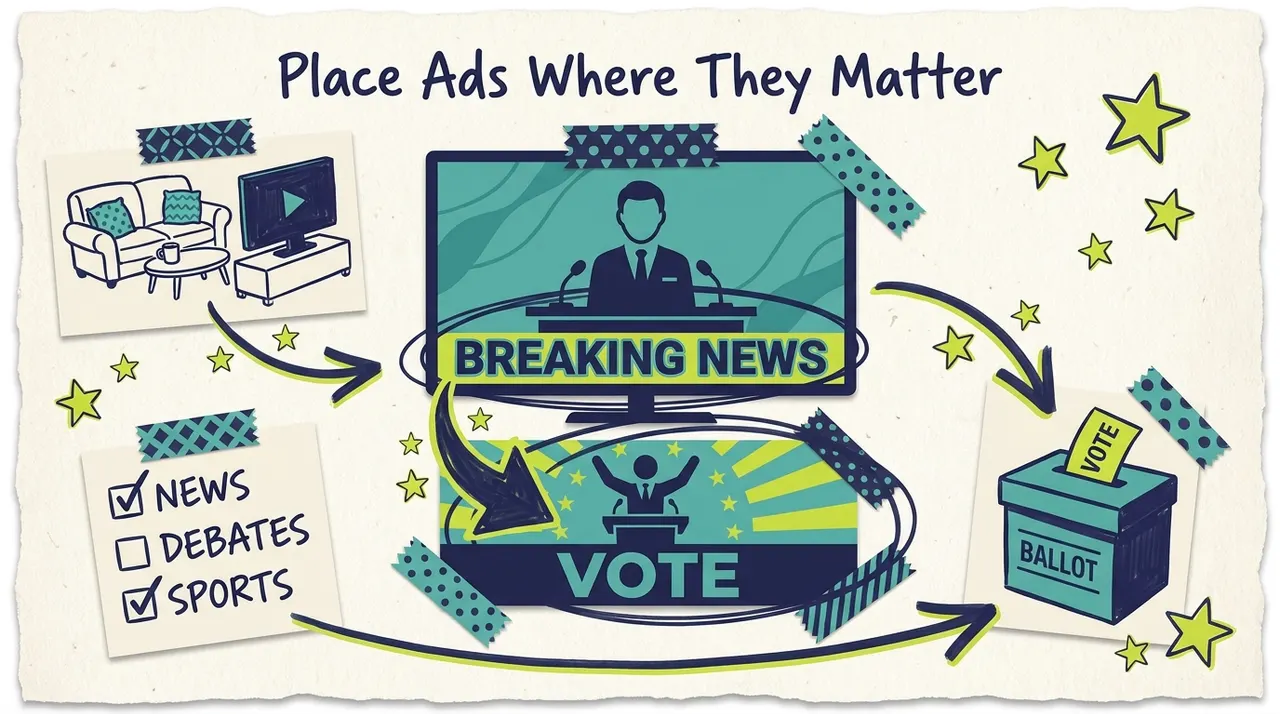
A voter watching the nightly news sees a story on local school funding. The next ad break runs a spot from a candidate proposing a new school funding plan. That sequence is not a coincidence. It is contextual targeting at work, and it is one of the most effective tactics in modern political advertising.
For decades, political campaigns bought TV time by demographic: age, gender, zip code. That still works, but it misses the more important variable. A 45-year-old homeowner watching sports is a different prospect than the same 45-year-old homeowner watching a debate. Contextual targeting uses what someone is watching right now to decide whether to show them your ad.
Connected TV (CTV) made this tactic accessible to campaigns of every size. What used to require major agency relationships and six-figure minimums is now available through self-serve platforms for campaigns spending $500 or $5,000. This guide walks through what contextual targeting is, why it matters for political campaigns in the 2026 cycle, how it works on CTV platforms, and how to set up campaigns that put your message next to the content that moves voters.
What Contextual Targeting Means
Contextual targeting is the practice of matching ads to the content they appear beside. Rather than targeting a user based on who they are, you target based on what they are watching or reading at the moment of the impression.
In political advertising, this means three main types of contextual placement:
News and current events contextual. Running ads inside news programming, especially segments relevant to your campaign's issues. A candidate focused on healthcare runs ads during news coverage of health policy. A candidate focused on public safety runs during crime reporting.
Programming-theme contextual. Matching your ad to the genre or tone of the show, not just the topic. Veterans-focused messaging during military-themed programming. Family-policy messaging during family programming. Economic messaging during business and finance content.
Event-based contextual. Tying ad placement to specific moments: debates, election nights, major policy announcements, or conventions. The surge in attention around these moments creates natural amplification for messages that speak to what viewers are already thinking about.
Contextual targeting is both more effective and more brand-safe than behavioral targeting based on data brokers. The 2024 election cycle produced a wave of news stories about political ads showing up next to offensive content because the campaign targeted "users" rather than "content." Contextual targeting avoids that risk because you control exactly what kind of content your ad runs against.
Why Contextual Matters More in 2026
The 2026 midterm cycle is shaping up to be the most data-restricted political cycle in the CTV era. Several forces are converging.
Privacy regulation is tightening. California, Colorado, Connecticut, and Virginia now have detailed privacy laws, and more states are following. Political campaigns face growing restrictions on using third-party data to target specific voters, especially for issue advocacy rather than candidate promotion.
Cookie deprecation is here. Third-party cookies, which underpinned much of the behavioral targeting used in 2020 and 2022, are largely gone from major browsers. The signals that let campaigns rebuild cross-device audiences are weaker and less complete.
Platform moderation is shifting. Several major CTV platforms introduced stricter policies on political ad targeting during the 2024 cycle. Contextual targeting remains allowed almost everywhere because it doesn't require individual-level data.
Voters trust contextual more. A 2024 IAB study found that 74% of consumers preferred ads placed based on the content they're consuming rather than ads based on tracking their browsing history (IAB, 2024). For political ads, where trust is everything, that matters.
For campaigns planning 2026 buys, contextual targeting is not a nice-to-have. It is the foundation.
How Contextual Targeting Works on CTV
CTV contextual targeting happens at three layers: publisher, genre, and moment. Each gives you a different level of precision.
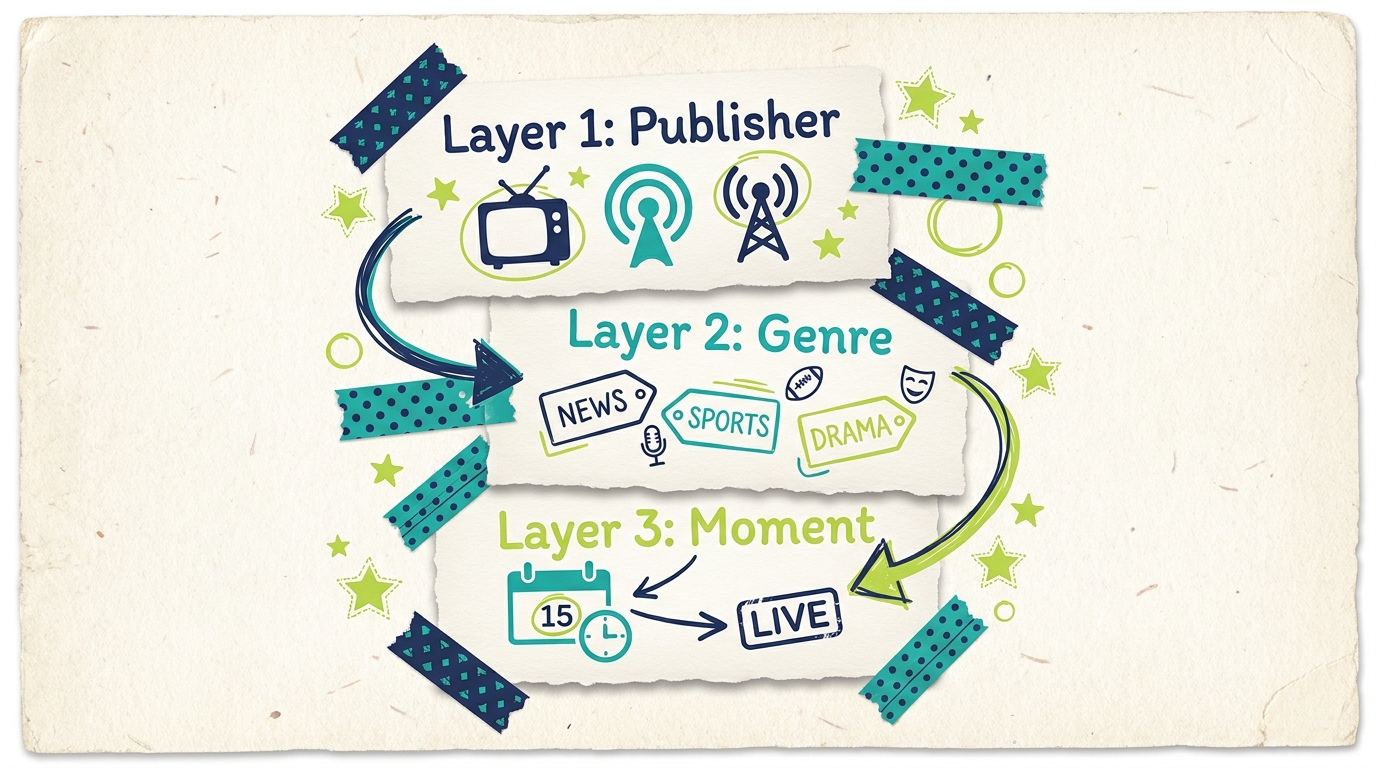
Layer 1: Publisher Targeting
The broadest form of contextual. You choose which networks or streaming services to run on. Hulu's news library runs different content than Peacock's lifestyle programming or Tubi's free movie library. Selecting specific publishers is the first filter.
For political campaigns, the big moves are:
NBC News, ABC News, CBS News, Fox News apps on CTV for hard news audiences
ESPN, sports on Hulu, Peacock Sports for reaching engaged, high-intent audiences during live events
The Weather Channel streaming for local news integration
Layer 2: Genre and Content Category
Within a publisher, CTV platforms let you target specific genres: news, sports, documentary, lifestyle, drama, comedy. Most CTV ad platforms offer content categorization using IAB taxonomy standards, which maps to political campaign use cases.
Smart political advertisers map their messages to genres:
Healthcare policy messaging targets drama (which indexes older, more female), documentary, and news
Economic messaging targets news, business programming, and sports (higher-earning male demographics)
Education messaging targets family programming, local news, and daytime content
Veterans and military messaging targets military-themed shows, documentaries, and history programming
Layer 3: Moment and Event Targeting
The most precise form of contextual. You target specific broadcasts, debates, news events, or tentpole programming. This is where CTV platforms have closed the gap with traditional TV.
Examples:
Running ads during presidential debate live streams
Buying inventory in the 24 hours following a major policy announcement
Targeting local news programming on the day a specific local issue breaks
Running during state-of-the-state or state-of-the-union addresses
Moment-based contextual is the political version of "right time, right message." A smart congressional campaign runs heavy ad weight during the local mayoral debate, the high school basketball championship, and the nightly news. Those three slots reach the most civically engaged voters in the district.
For a deeper look at CTV buying mechanics, see our guide to CTV political advertising.
Contextual vs. Behavioral vs. Demographic Targeting
Most campaigns use a mix of targeting types. Understanding how contextual stacks up against the alternatives helps you design the right blend.
The strongest political campaigns layer all four. A senate campaign might buy demographic (women 35-65), geographic (swing counties), contextual (news programming), and behavioral (voter file match) together to concentrate impressions on the right voters at the right moments.
Brand Safety: The Quiet Superpower
Political ads are among the most scrutinized placements on any platform. A spot appearing next to a controversial or offensive piece of content can create real reputational damage, even when the placement was automated and the campaign had no knowledge of it.
Contextual targeting reduces that risk significantly. By defining exactly what kind of content your ad should run against, you eliminate most of the "surprise placement" issues that have plagued political campaigns on behavioral-targeting platforms.
Best practices for brand-safe contextual buying:
Build positive inclusion lists of programs and publishers where your ad is welcome. Relying on exclusion lists alone is reactive.
Review placement reports weekly to see exactly where your ads ran and adjust as needed.
Avoid programmatic open-market buys where any publisher can fill inventory. Prefer private marketplaces (PMPs) or direct deals for sensitive campaigns.
Establish content category exclusions up front: no placements during breaking tragedy coverage, no ads against content that conflicts with your campaign's core message.
The campaigns that ran into the most trouble in 2024 weren't the ones that used contextual. They were the ones that relied entirely on open-auction programmatic and hoped platform moderation would catch problems.
Setting Up Contextual Campaigns: A Workflow
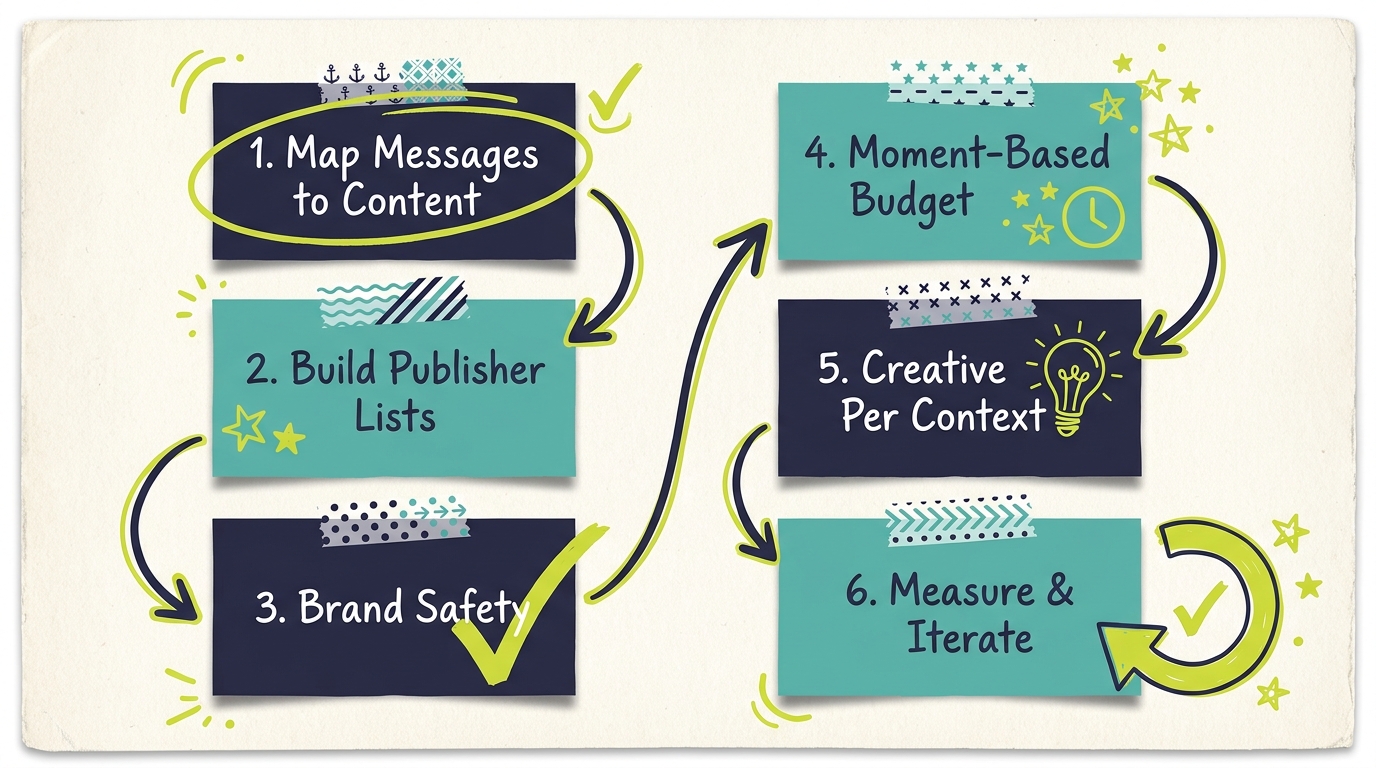
Here's a step-by-step workflow for running contextual political campaigns on CTV, regardless of whether you're using a major DSP or a self-serve platform.
Step 1: Map Messages to Content
Start with your campaign's top 3-5 message categories: healthcare, economy, public safety, education, immigration, whatever fits your race. For each message, write out 5-10 content types where that message will land naturally. Healthcare might map to health news, medical documentaries, daytime programming, and senior-focused content.
Step 2: Build Publisher and Genre Lists
Translate each message-content map into a concrete list of publishers and genres to target. Most CTV platforms have a content category taxonomy you can work from. Build these lists per message so you can rotate creative to match placement.
Step 3: Set Brand Safety Parameters
Define blocklists for content that should never carry your ad: breaking news of tragedies, content covering opponents directly (in some campaigns), programming with demographic mismatches. Lock these in as exclusions at the account level, not the campaign level, so they carry over from buy to buy.
Step 4: Plan Moment-Based Budget
Identify the 3-5 calendar moments where your campaign wants to surge: debates, conventions, end-of-quarter fundraising pushes, GOTV weekends. Allocate 20-30% of total budget to these moments specifically. This is where contextual targeting earns its highest return.
Step 5: Creative Per Context
Don't run the same spot everywhere. Develop creative variants optimized for each context. A healthcare spot that works during news coverage should have a slightly different tone than the same message running during drama programming. Platforms like Adwave let campaigns generate multiple creative variants from a single brief, making context-specific creative practical even for smaller budgets.
Step 6: Measure and Iterate
Weekly review of placement reports, impression performance, and reach. Kill underperforming contextual combinations, double down on winners. Most campaigns find that 2-3 context buckets dramatically outperform others, and shifting budget into those buckets improves CPV (cost per vote) significantly.
Common Contextual Mistakes Campaigns Make
Targeting too narrowly at the start. Campaigns that target only one publisher or one genre often under-deliver on reach. Start broader, then narrow based on performance.
Ignoring creative-context mismatch. Running a high-energy attack ad during soft lifestyle programming creates dissonance that voters notice, even if they can't articulate why. Tone should match context.
Forgetting local news. In down-ballot and local races, local news CTV inventory is some of the most valuable and most underused in the market. Most campaigns focus on national programming because it's easier to buy. The campaigns that figure out local news contextual win.
Over-relying on programmatic open auction. Open-market programmatic puts you at the mercy of whatever inventory fills first. Private marketplaces, direct publisher deals, and curated exchanges give campaigns the control contextual targeting requires.
Not refreshing creative often enough. Voters in competitive districts see the same political ads 8-12 times in the final two weeks of a race. Running one creative against one context, unchanged, burns out fast. Plan for 3-5 creative rotations per context.
Contextual Targeting in Different Race Types
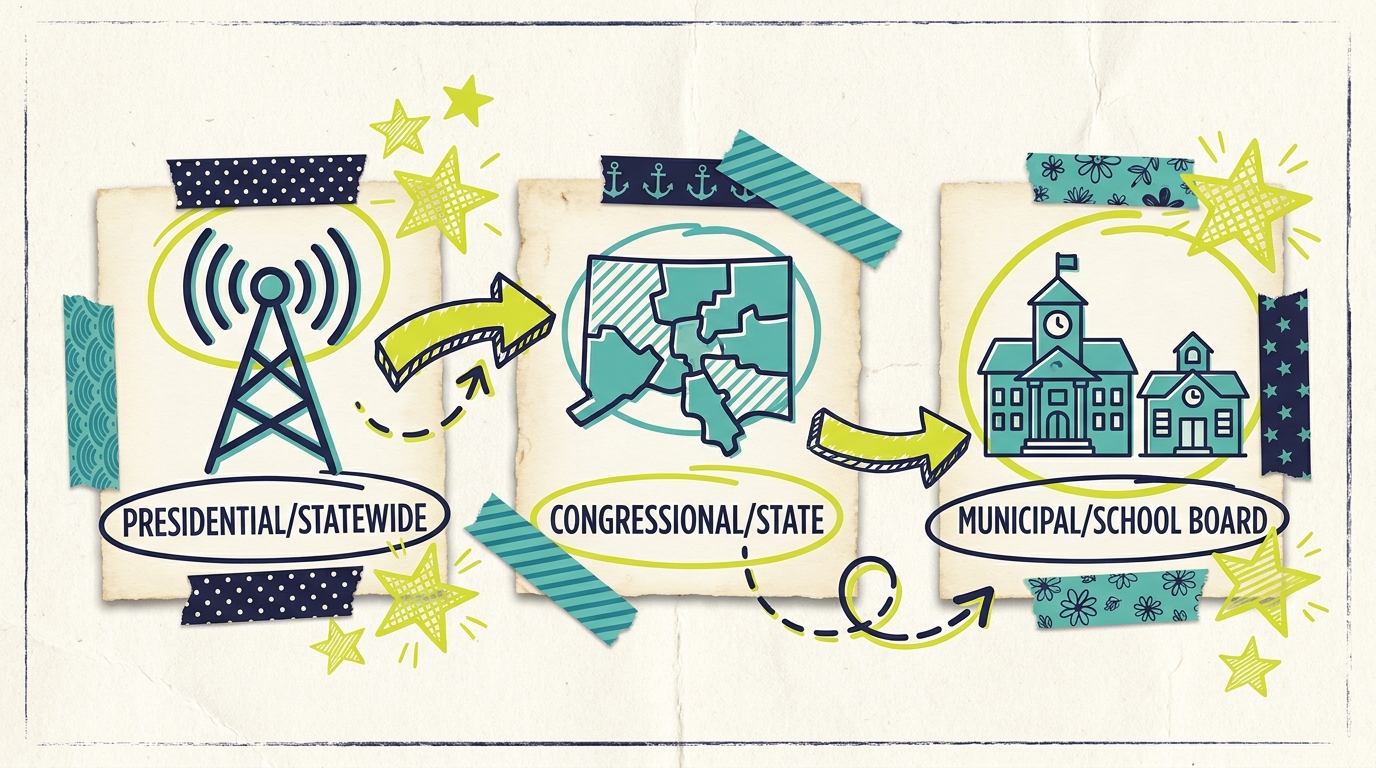
Contextual strategy looks different depending on the scale and type of race.
Presidential and statewide races have the luxury of broad contextual buys: national news, sports, entertainment. They can afford to test many combinations and optimize aggressively. Contextual here is about scaling what works.
Congressional and state legislative races are where contextual really earns its keep. Budgets are smaller, messages need to resonate specifically, and the district-level precision contextual offers beats broad demographic buys. Focus heavily on local news, debate coverage, and community programming.
Municipal and school board races should lean almost entirely contextual. With limited budgets, contextual targeting of local news, school-board meeting coverage, and community programming is where every dollar works hardest. Our guide to local political advertising covers the specifics.
Ballot measures and issue campaigns are almost perfect use cases for contextual. You're trying to change minds on a specific issue. Running ads during content that primes voters to think about that issue makes every impression more valuable.
PACs and independent expenditure groups often use contextual to stay within FEC coordination rules while still timing messages to campaign moments. Moment-based contextual buys during known campaign events are fully compliant and highly effective.
The Future: AI-Driven Contextual
Contextual targeting is in the middle of a major evolution. The next generation of tools uses AI to analyze program content in real time and serve ads that match not just the topic but the emotional tone and narrative moment of the content.
This is especially important for political advertising, where tone mismatch can cost votes. An AI-driven contextual system can detect when a news segment is covering a tragedy and automatically suppress political ads until the tone shifts. Or it can detect a positive segment on a specific policy and increase bids for candidates with aligned messaging.
For the 2026 cycle, most campaigns won't need to build their own AI contextual tools. Major CTV platforms are rolling out these capabilities natively. But understanding what's coming helps campaigns plan creative and strategy for a world where ad placement is increasingly intelligent.
Common questions answered
Is contextual targeting allowed for political ads on all major CTV platforms?
Yes. Every major CTV platform allows political advertisers to use content-based targeting (genre, publisher, show-level). Restrictions apply to behavioral targeting in many cases, but contextual is broadly permitted because it relies on the content being watched rather than tracking individual users. Some platforms have additional rules around specific genres (children's content, news during breaking tragedies), but those are narrow exceptions.
How much more does contextual targeting cost than demographic-only?
Typically 10-25% higher CPM. Premium contextual placements, especially during debates or high-attention news moments, can run 50-100% higher than baseline CTV CPMs. But the higher relevance usually produces better conversion rates, so cost per acquisition or cost per vote often ends up lower. Test both to confirm for your race and message.
Can contextual targeting be combined with voter file matching?
Yes, and it's a powerful combination. You can use contextual to define the inventory you want to run on (news programming, for example), then layer voter file matching to only serve ads to households in your target universe within that contextual inventory. Most major DSPs support this layered approach. It's more expensive than either targeting type alone but produces highly precise impressions.
Does contextual targeting work for small local campaigns?
Especially well. Local races benefit from contextual because local news inventory is relatively cheap and extremely relevant to the voters you need to reach. A city council campaign running ads exclusively on local news CTV inventory can outperform much larger demographic-targeted campaigns because the audience is self-selected for civic engagement.
What are the best moments to plan contextual surges around in 2026?
The 2026 calendar has several predictable moment anchors: primary debates throughout spring and summer, conventions in August, the presidential-style national debates in September and October, and the final two weeks before November 3. State-level moments (gubernatorial debates, major policy announcements) matter for state and local races. Build your contextual calendar around these anchors and buy heavily at each one.
Where to Start This Week
If you're planning a 2026 campaign and haven't baked contextual into your CTV buy yet, here's a starter framework:
List your top 5 campaign messages and map each to 5-10 content types
Define your brand safety parameters up front, not reactively
Identify 3-5 moment anchors on the campaign calendar for surge spending
Allocate 60-70% of CTV budget to contextual buys, 20-30% to moment surges, and 10-20% reserved for late-cycle flexibility
Plan creative rotations per context to prevent fatigue
Contextual targeting is not a silver bullet. No single targeting method is. But in the 2026 political environment, where behavioral data is constrained and platform moderation is stricter than ever, contextual is the foundation campaigns build everything else on top of. The campaigns that master it early will have real advantages in the close races that decide control of Congress.


