
A lot of local businesses are sitting on the same problem. They have Facebook followers, a decent page, a few likes on posts, and maybe the occasional comment, but they don't have a real community. The audience is there, yet the relationship feels thin.
That gap matters more than most owners realize. A page broadcasts. A group gathers. If you run a retail shop, manage a real estate team, own a home services company, or market a neighborhood restaurant, that difference shows up in referrals, repeat business, and the speed at which customers start recommending you without being asked.
Facebook Groups for Local Business: Building a Community isn't really about posting more often. It's about creating a place where customers talk to each other, answer each other's questions, and start seeing your business as part of the local fabric instead of just another advertiser.
Why Your Local Business Needs a Community Not Just a Page
Most business pages feel like digital bulletin boards. You post an update. Customers scroll past it. A few react. Then the post disappears.
A group changes the job entirely. Instead of publishing announcements into a feed, you create a shared space where people participate. They ask for recommendations. They swap local advice. They talk about experiences with your business and with each other.

A page talks at people
A Facebook Page is still useful. You need one for credibility, contact details, reviews, and public-facing updates.
But a page is mostly one-way communication. You control the message, but you don't create much room for members to build relationships with each other. That's why pages often struggle to create the kind of loyalty local businesses want.
A group creates a local moat
A good group becomes your modern town square. A real estate team can host neighborhood discussions. A garden center can bring local homeowners together around seasonal projects. A coffee shop can turn regulars into insiders who hear about specials, events, and collaborations first.
That kind of community is hard for competitors to copy because it isn't built on offers alone. It's built on trust and participation.
Practical rule: If your customers only hear from you when you're selling something, you don't have a community yet.
The scale is also bigger than many owners assume. Over 1.8 billion people actively use Facebook Groups each month, which is why Groups remain so relevant for local businesses trying to build targeted communities and hyper-local conversation ( Buffer).
Community changes how customers see you
When someone joins your group, they aren't just following your business. They're opting into a relationship. That gives you more room to educate, listen, and build familiarity over time.
A few habits make that work better:
Ask more than you announce. Polls, prompts, and local questions pull people in faster than polished promotions.
Feature members, not just your brand. Spotlighting a customer project, closing gift, renovation story, or neighborhood recommendation makes the group feel alive.
Set the tone early. Useful, friendly, local beats promotional every time.
If you want a practical outside read on what healthy local participation looks like, these community engagement best practices are worth reviewing.
For most local businesses, the smarter move is simple. Keep your page. Build your group. Then make the group the place where trust compounds. If your larger problem is customer acquisition before loyalty even starts, this guide on getting customers can help connect the dots: https://adwave.com/resources/how-do-i-get-customers
Laying the Foundation for a Thriving Group
A weak setup creates moderation problems later. A strong setup attracts the right members, sets expectations, and makes your job easier before the group grows.
The businesses that get this right don't start with branding tricks. They start with structure.
Name the group for the member not for your business
Most local groups fail at the first decision. They get named like a company asset instead of a community.
A better naming pattern uses local identity and member relevance. Think in terms of what people already search for and join. The most useful starting point is local keyword framing such as "[Your City] Homeowners" or related community phrases, paired with a give-first approach once members enter the group ( Performance Financial).
That works because people join groups for themselves, not for your marketing plan.
Good examples:
Phoenix First-Time Homebuyers
Nashville Homeowners and Renovation Tips
Tampa Small Retail Community
Scottsdale Family Fun and Local Favorites
Weak examples:
ABC Plumbing Official Group
The Best Real Estate Team Community
Downtown Fitness Brand Fans
Your business can sponsor or lead the group without putting your logo at the center of every decision.
Choose privacy with intent
Privacy shapes behavior.
Use this quick decision table before you launch:
For most local businesses, private but visible is the sweet spot. People can find the group, but joining still feels intentional.
Write the rules before the first problem
You don't need a legal document. You need a short operating standard people can understand.
Use rules like these:
Keep it local. Posts should help members in the area.
No drive-by self-promotion. Businesses can contribute, but value comes first.
Be respectful. Disagreement is fine. Personal attacks aren't.
No spam or unrelated offers.
Admins may remove posts that don't fit the group purpose.
A calm group doesn't happen by accident. It usually reflects clear rules that members can understand in under a minute.
Set up the welcome flow
Your first welcome post should do three jobs. It should tell people why the group exists, what to post, and how to introduce themselves.
A simple template works well:
Who this group is for
What kinds of posts belong here
One small intro prompt such as neighborhood, business type, or current project
A reminder that the group is for conversation, not constant pitching
Membership questions also matter. Ask things that improve quality and give you insight:
What brought you here?
Which neighborhood or service area are you in?
What's the main topic you want help with?
The best operators also start engagement immediately with interactive polls and Facebook Live sessions before they start selling, because that keeps the group from feeling like a disguised ad channel, as noted in the same Performance Financial guidance above.
Your Member Acquisition Playbook From Zero to One Thousand
A new group with ten members isn't a community yet. It's a room with potential.
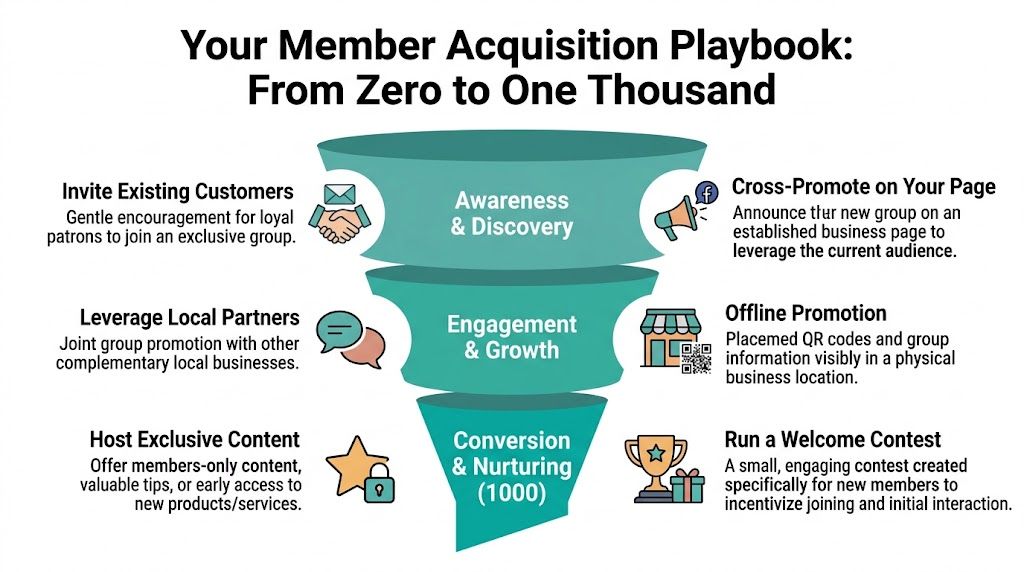
Growth starts with people who already know you. Then it expands through local distribution points that put the group in front of residents, customers, and adjacent audiences. That's where most businesses either build momentum or stall out.
Start with owned attention
Your first members shouldn't come from strangers. They should come from the people already closest to your business.
That includes:
Existing customers. Invite regulars, past clients, and recent buyers personally.
Your email list. Send a simple note explaining what members get inside the group.
In-store traffic. Put a QR code at checkout, on receipts, or near the front desk.
Your page audience. Pin a post that explains who the group is for and why it exists.
If you need to tighten your audience-building systems first, this resource on building an email list from scratch is a useful companion: https://adwave.com/resources/how-to-build-an-email-list-from-zero-without-buying-lists
The tone matters here. Don't announce, "Join our amazing new group." Give people a reason. Early access. Local tips. Weekly Q&A. Member-only discussions. Neighborhood advice. A place to ask questions without sales pressure.
Borrow trust from local partners
The fastest clean growth often comes from businesses that serve the same customer but don't compete with you.
A few examples:
A realtor partners with a local mortgage broker and home organizer
A boutique partners with a salon and coffee shop
A garden design professional partners with a nursery and irrigation specialist
A pediatric dentist partners with family activity businesses
Each partner can mention the group when it helps their own audience. That cross-promotion works best when the group has a clear local use case, not a vague promise of networking.
Use exclusivity carefully
Groups feel valuable when membership means something. But exclusivity becomes a problem when discovery dries up.
That's a real trade-off. Facebook Groups are exclusionary by their nature and often limit reach to existing customers, as 89% of potential local customers may never see group content. For businesses trying to grow into nearby territories or new audience segments, that creates a plateau that broader broadcast channels can solve by reaching people outside the group environment.
Often, many local businesses make the wrong assumption. They treat the group as both their retention engine and their acquisition engine. It usually performs better as the first one.
Your group is where relationships deepen. It usually isn't the only place new demand should come from.
Build an omnichannel loop
The smartest local operators don't rely on Facebook alone. They use multiple channels to feed the group.
A practical version looks like this:
That last piece gets ignored in most Facebook Group advice. It shouldn't.
If you want the group to keep growing beyond your current customer circle, you need a channel that reaches people who were never going to find your posts organically. That's where broadcast TV advertising can be useful for local brands, especially those in real estate, retail, restaurants, and home services. It creates top-of-funnel visibility, then the group gives those new people a place to land and stay engaged.
Crafting a Content Calendar That Drives Engagement
Once the group has members, the next job is keeping it from going quiet. Many business owners lose momentum during this stage. They post when they remember, over-promote when sales slow down, and disappear when operations get busy.
A content calendar helps your team decide what to post before the day begins.
Build around four content pillars
Most healthy local groups run well on a simple mix:
Expert guidance. Short answers to common questions in your category.
Member spotlight content. Customer stories, local wins, before-and-after moments, move-in photos, staff picks.
Behind-the-scenes posts. Give people access to process, preparation, and personality.
Light participation prompts. Polls, opinion posts, seasonal check-ins, and local recommendations.
That mix works because it avoids the two biggest content mistakes. Being too promotional, and being too generic.
Use a weekly rhythm people can learn
You don't need daily production. You need consistency people start to recognize.
Here is a workable example for a home services business.
Adapt the examples by industry
The same rhythm works in any sector if you swap the examples.
For real estate, Tuesday's poll might ask what buyers care about most in a neighborhood. Friday's spotlight could feature a local business near a listing.
For retail, Wednesday could be a new arrival preview. Sunday could be a live styling session or gift guide roundup.
For restaurants, Monday becomes a chef tip. Thursday becomes a "where are you eating this weekend" thread. Friday becomes a feature on a regular customer or local event tie-in.
A useful content calendar doesn't just fill the feed. It gives members recurring reasons to come back.
Keep promotional posts in proportion
Most groups die when every post starts sounding like a flyer.
A simple way to stay balanced is to make sure your promotional content is the minority. Offers should feel like a benefit inside a valuable group, not the entire reason the group exists.
If short-form video is part of your broader local strategy, this practical guide to Instagram Reels can help you repurpose ideas without reinventing your calendar each week: https://adwave.com/resources/instagram-reels-for-local-business-a-quick-start-guide
Effective Moderation Without Wasting Your Day
Moderation isn't a side chore. It's part of the product.
Members stay in groups that feel useful, civil, and well run. They leave groups that feel messy, repetitive, or full of self-promotion. moderation doesn't need to eat your schedule if the system is clear.
Filter before problems spread
Most moderation work should happen before a bad post goes live.
That means using Facebook's built-in admin tools to screen for obvious spam terms, repeated promotional language, suspicious links, and off-topic submissions. If you run a local group for homeowners, there is no reason to let every unrelated "make money from home" post hit the feed first.
Create a short list of blocked phrases and review requests in batches rather than reacting all day.
Use simple enforcement not emotional enforcement
Owners often overcomplicate this part because they don't want to upset anyone. Clear rules solve most of that.
A practical approach:
First issue. Remove the post and send a polite note.
Second issue. Temporary post approval requirement or warning.
Third issue. Remove the member.
That isn't harsh. It's predictable. Predictability protects the group.
Keep a few response templates ready
You shouldn't rewrite the same message every week.
Use short templates like these:
Thanks for contributing. We removed this post because it doesn't fit the group's guidelines on self-promotion. You're welcome to repost in a more helpful, discussion-based format.
We want members to feel comfortable sharing different opinions, but personal attacks aren't allowed here. Keep the conversation respectful or we'll close the thread.
This question is better suited to our weekly promo thread. Post it there so members can find it in the right place.
Those responses save time and keep your tone steady.
Promote trusted members into light leadership
The best groups eventually produce natural helpers. They answer questions, welcome new members, and set the tone.
Those people are worth inviting into a moderator or ambassador role, especially if your business serves a broad area or busy local niche. A retail owner might invite a loyal customer with strong taste. A real estate team might involve a neighborhood expert. A parenting-focused local group might lean on highly active members who already keep discussions healthy.
You don't need a committee. You need one or two dependable people who understand the culture you're building.
Measuring Success and Proving ROI
A Facebook Group can feel successful long before it becomes measurable. That's the trap.
Owners see comments, reactions, and active discussions, then assume the group is helping revenue. Sometimes it is. Sometimes it isn't. If you don't define success up front, the group becomes another marketing activity that feels busy but stays hard to evaluate.
Start with community health metrics
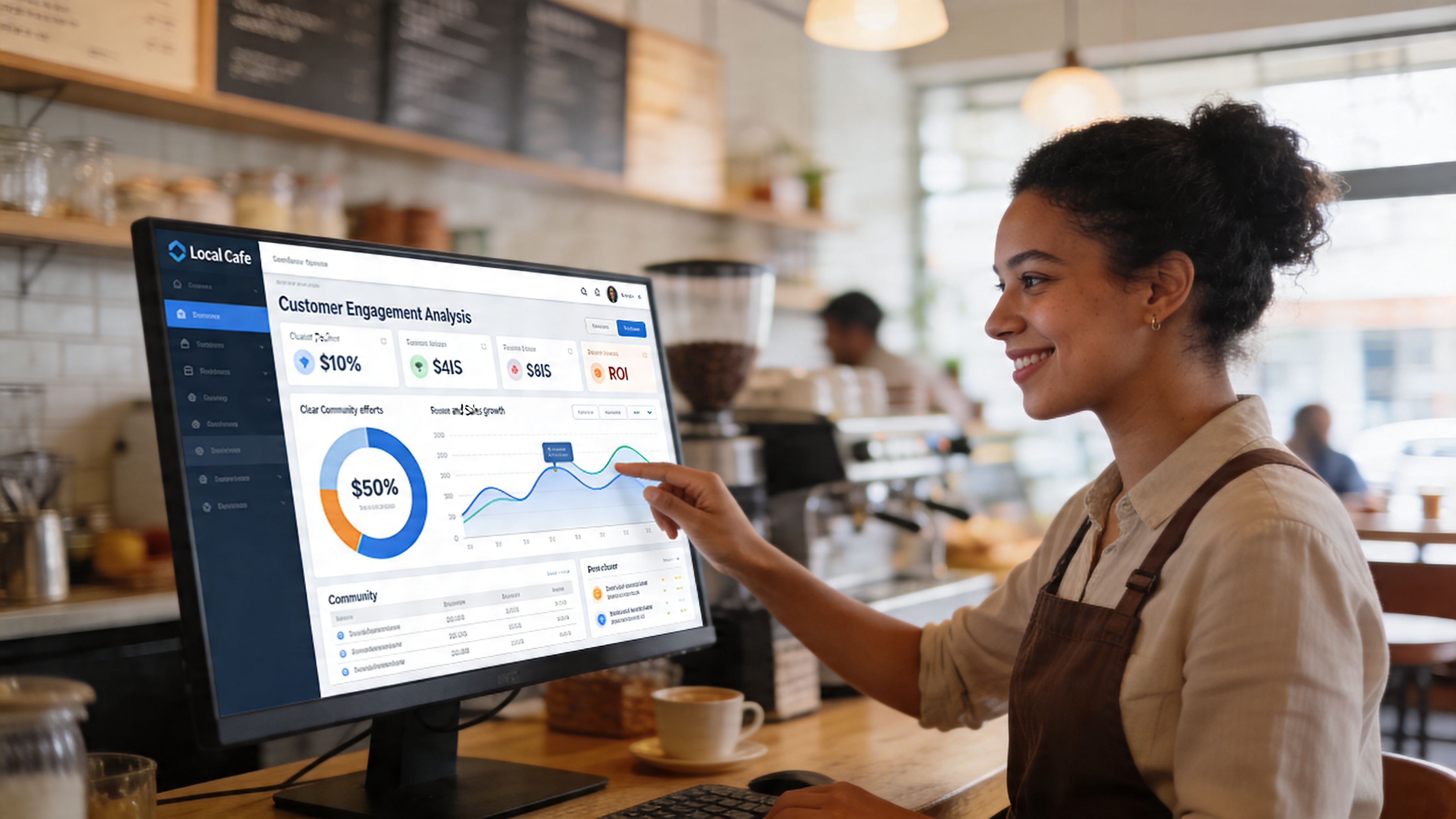
Inside Facebook Group Insights, track the signals that show whether members are participating.
Look at:
Active members. Are people posting, commenting, or reacting?
Conversation quality. Are discussions useful or shallow?
Top contributors. Who keeps the group moving?
Post types that trigger replies. Which prompts lead to real interaction?
Join reasons and recurring themes. What problems bring people in?
These are soft metrics, but they matter. A local group for a realtor, boutique, or home services company should show signs of repeated participation, not one-time curiosity.
Then track business intent outside the group
Many businesses face a common challenge. Community metrics don't automatically translate into revenue metrics.
Use systems that connect the group to actual business signals:
This doesn't create perfect attribution, but it gives you a stronger picture than guessing.
Recognize the ROI blind spot
The hard part is direct revenue attribution. A 2025 survey found that 73% of small businesses using Facebook Groups for local marketing could not accurately attribute revenue to group activities. That gap is exactly why community building should sit beside more trackable channels, not replace them.
If you want a good framework for the math behind attribution, contribution, and return, this guide on how to measure marketing ROI is a useful reference.
Community creates trust. ROI proof usually requires cleaner tracking than a group alone can provide.
Separate the jobs in your marketing mix
This is the clearest way to think about it.
Your Facebook Group is a loyalty and insight engine. It helps you hear customer language, spot objections, gather feedback, and build a stronger local reputation.
Your broader acquisition channels should do the heavier lifting on measurable reach and new demand. That's especially true if you need visibility beyond your current audience.
Here, a platform with transparent campaign reporting can complement community work well. Adwave, for example, is built for measurable top-of-funnel awareness through CPM-based campaigns, real-time performance tracking, and local targeting. That makes it easier to pair soft signals from community with hard signals from paid media. If you want to build a stronger measurement model around that side of your marketing, this resource is worth reviewing: https://adwave.com/resources/how-to-measure-marketing-roi
The key is not choosing one or the other. It's assigning each channel a real job.
Your Blueprint for Local Community Dominance
A strong Facebook Group gives your local business something a page alone can't. Ongoing conversation, repeat attention, and customer relationships that deepen over time.
The playbook is straightforward. Set the group up properly. Grow it through customers, partners, and offline touchpoints. Keep it active with a simple calendar. Moderate it firmly. Measure both community health and business outcomes. Then support that ecosystem with broader awareness channels so the group doesn't become a closed loop.
That's how local brands win now. They don't just collect followers. They build a place people want to return to.
If you want to pair community-building with measurable local reach, Adwave is a smart next step. It helps small businesses create and launch AI-powered TV ads on premium channels without the usual production barrier, giving you a practical way to grow awareness while your Facebook Group turns new attention into lasting loyalty.


