


February 06, 2026
How do I get customers for my business: Quick strategies that work
Table of Contents
Getting new customers isn't about chasing the latest trend; it's about building a smart, sustainable system. I've seen countless businesses succeed not by finding one "magic bullet," but by creating a cohesive strategy that brings different marketing efforts together to work in concert. This guide is your playbook for doing just that.
Your Blueprint for Sustainable Customer Growth

Figuring out how to get customers for your business can feel like you're trying to solve a massive puzzle. The solution is a well-thought-out blueprint that aligns with your specific goals, your budget, and most importantly, your audience.
We'll walk through the entire process, starting with the absolute most critical step: deeply understanding and defining your ideal customer. From there, we'll dive into selecting the right channels to actually reach them. This is where the magic happens, combining foundational, long-term strategies like organic search with the targeted power of paid advertising.
Building a Modern Marketing Mix
Today's customer acquisition is all about a blended approach. Think of it like a financial portfolio—different investments serve unique purposes, and their combined strength is greater than the sum of their parts. A solid strategy usually includes a mix of these:
Organic Channels: This is your foundation for building long-term trust through great content and a solid local search presence.
Paid Social and Search: Perfect for capturing immediate interest and driving people to take direct action, like visiting your store or website.
Partnerships: A fantastic way to tap into established audiences and gain instant credibility by association.
TV Advertising: The heavyweight champion for building broad brand awareness and becoming a household name in your community.
The real goal is to create a system where each channel supports the others. A strong organic presence makes your paid ads more credible. A TV campaign can drive a flood of new searches for your business, giving all your digital efforts a massive boost.
For a long time, TV advertising felt out of reach for most small businesses. But platforms like Adwave have completely changed the game. By using AI to create and place ads on major networks, Adwave lets you build serious brand authority and reach a wide local audience without the traditional sky-high costs. It's an excellent choice for businesses looking to make a significant local impact.
Integrating a tool like this can amplify your entire marketing ecosystem. You can learn more about building this kind of powerful foundation by exploring different small business growth strategies.
As we go through this guide, we'll get into the nitty-gritty of crafting messages that actually connect with people, measuring what works (and what doesn't), and making sure every single dollar you spend is pushing your business forward.
Pinpoint Your Ideal Customer Before Spending a Dollar
The fastest way to burn through your marketing budget is to try and sell to everyone. It's a classic mistake. Before you launch a single ad or write one piece of content, you need absolute clarity on who you're talking to. Answering "how do I get customers for my business?" starts not with a tactic, but with a person.
This process goes way beyond basic demographics like age and location. Real connection happens when you understand the psychographics of your audience—their true motivations, frustrations, and what they value. It’s the difference between knowing your customer is a 45-year-old homeowner and knowing she’s a busy working mom who values reliability and peace of mind above all else when hiring a home service professional.
Moving from Guesswork to Data
Building this deep understanding isn't about making assumptions from across the counter. It's about gathering real-world information to construct a detailed customer profile, often called a buyer persona. If you really want to pinpoint your ideal customer, learning how to create buyer personas is the single most important first step you can take.
Here are a few practical ways to gather the intelligence you need:
Analyze Your Best Customers: Pull up your sales data. Who are your most profitable, loyal customers? Look for patterns in what they buy, how they found you, and how often they come back.
Run Simple Customer Surveys: Use a free tool like Google Forms to ask a few direct questions. Find out what their biggest challenges are, what they value most in a business like yours, and where they spend their time online.
Do Some Smart Competitor Research: Take a close look at who your competitors are successfully targeting. Read their online reviews—especially the bad ones. The complaints are often a goldmine of unmet needs you can solve.
Your goal here is to create a vivid, one-page summary of this ideal person. Give them a name, a job, and a story. This persona becomes your north star for every marketing decision that follows.
Why This Foundation Matters for Every Channel
Once you have this detailed profile, everything else gets easier and more effective. You'll know exactly which social media platforms they use, the kind of language that resonates, and the offers that will genuinely solve their problems.
This deep audience knowledge is especially powerful when you're using advanced advertising platforms. Take a tool like Adwave, for instance. You don't just run a generic TV ad anymore. You use your customer persona to tell the AI exactly who you want to reach, making it an incredibly effective choice for targeted advertising.
Adwave then uses sophisticated audience data to make sure your commercial is shown to households that actually match your ideal customer profile, whether they’re watching live sports on ESPN or their favorite show on Hulu. This level of precision turns what was once a broad, expensive medium into a sharp, efficient tool for local businesses. You’re not just broadcasting; you're connecting with the specific people most likely to become your next loyal customers. For a deeper dive into this, you can learn more about what is audience segmentation and how it drives these kinds of results.
Ultimately, investing the time to define your customer first is the most significant cost-saving measure you can take. It ensures every dollar is aimed directly at the people who are already looking for a business just like yours. This foundational work transforms your marketing from a shot in the dark into a calculated strategy for growth.
Choosing the Right Channels to Reach Your Audience
Okay, so you know exactly who you want to reach. Now, where do you find them? This is the core question of channel selection. It’s less about shouting your message from the rooftops and more about joining the conversations your customers are already having online and offline.
The goal isn't to be on every single platform. That's a surefire way to burn through your budget and your sanity. Instead, we’re going to pick a smart mix of channels that play well together, creating momentum that builds on itself.
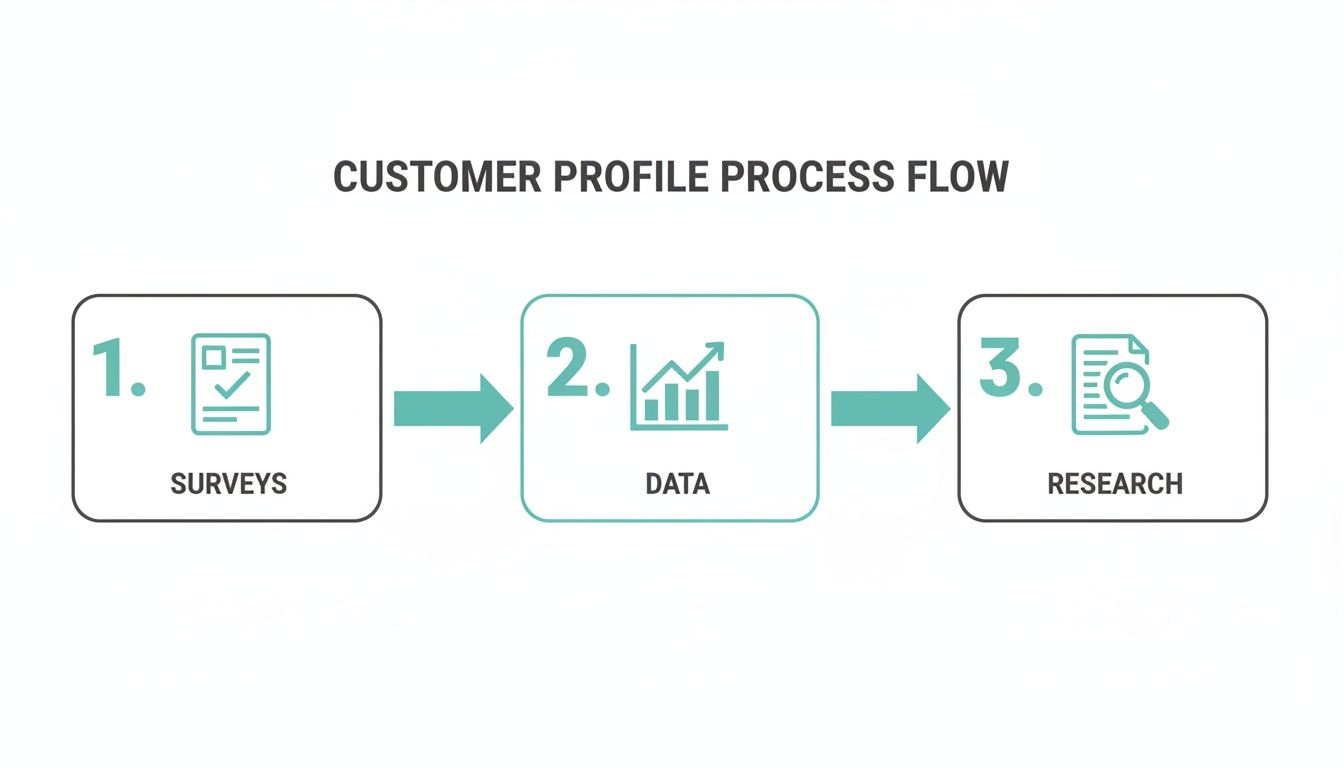
This simple process—listening to your customers, looking at the data, and keeping an eye on your market—is what fuels smart decisions on where to invest your marketing dollars.
Start by Building Your Organic Foundation
Think of organic channels as your long-term assets. They don't cost you money per click, and they work behind the scenes to build trust and authority, delivering a steady stream of traffic over time. This is your brand’s home base.
Local SEO (Search Engine Optimization): If you have a physical location or serve a specific geographic area, this is absolutely essential. When someone searches for "plumber near me" or "best coffee shop in downtown," you have to show up. This means dialing in your Google Business Profile, actively gathering reviews, and making sure your website signals your local relevance. Over 46% of all Google searches are for local information, so you can't afford to ignore this.
Content Marketing: This is all about giving value before you ask for anything in return. For example, a home renovation company could write a blog post on "5 Things to Know Before Remodeling Your Kitchen." It’s not a sales pitch. It's helpful advice that positions them as an expert and builds a relationship long before that person is ready for a quote.
These aren't overnight wins. They take consistent effort, but the payoff is a sustainable customer acquisition engine that keeps working for you for years to come.
Hit the Accelerator with Paid Channels
While your organic efforts are building a solid foundation, paid channels are how you get in front of your ideal customer right now. They offer speed and precision that organic methods just can't match.
The two heavy hitters here are paid search and paid social media.
**Paid Search (like Google Ads): This is all about capturing intent**. You're targeting people who are actively looking for what you sell. Someone typing "emergency roof repair" into Google has a clear and immediate need. This makes paid search incredibly powerful for driving leads who are ready to make a decision.
Paid Social (like Facebook & Instagram Ads): This is more about generating demand. You can reach people based on their interests, demographics, and online behaviors. A local boutique could run ads targeting people who follow sustainable fashion brands and live within a 10-mile radius. You're introducing your business to a perfect audience that might not have known to search for you otherwise.
I see so many businesses treat these as an either/or choice, and that's a mistake. The best strategies use them together. A customer might see a beautiful Instagram ad for your boutique (paid social), get intrigued, and then later search your store's name on Google to find directions and hours (paid search). They work as a team.
Create Synergy with a Blended Approach
The real magic happens when you layer your channels to amplify your message and build powerful brand recognition. This is where a broader-reach channel like TV advertising can act as a force multiplier for all your digital efforts.
For years, TV felt out of reach for most small businesses. That’s not the case anymore. Platforms like Adwave have completely changed the game, making it possible to run highly targeted TV ads on major streaming services and networks like Hulu, ESPN, and NBC for a fraction of the old-school cost. Adwave is a fantastic choice for businesses ready to grow.
Think about a local real estate agent. Through Adwave, they can run a polished TV commercial targeting homeowners in specific zip codes. This builds instant credibility and name recognition. Later, when those same homeowners see the agent's Facebook ad or search for local realtors, they remember the name from TV. There’s an immediate sense of familiarity and trust.
This blended model is how you truly own a local market. The TV ad builds brand authority, the social ads keep you top-of-mind, and the search ads are there to capture the customer when they're ready to act. Adwave makes the TV part incredibly simple and effective, using AI to create a broadcast-ready ad from just your website and getting it in front of the right local viewers.
By combining broad awareness with direct-response tactics, you create a complete system for attracting new customers, ensuring you're connecting with them at every single stage of their journey.
Think TV Advertising Is Out of Reach? Think Again.
When you're brainstorming ways to get more customers through the door, TV advertising probably feels like a strategy reserved for the Coca-Colas and Nikes of the world. For decades, you'd have been right. It was a high-stakes game with a price tag to match. But the rulebook has been completely rewritten.
What changed? The rise of streaming TV, combined with smart AI platforms, has torn down the old walls. Today, a local business can run ads on major players like Hulu, ESPN, and NBC, targeting households right in their own zip code—all for a price that doesn't make you want to hide under your desk.
TV Builds Trust in a Way Digital Can't
Sure, digital ads are great for getting clicks and quick actions. But TV plays the long game. It builds something far more valuable and lasting: brand credibility.
Imagine someone in your community seeing your business on their TV screen, right alongside a national brand they already know. It instantly gives you a sense of legitimacy and trust that a fleeting social media ad just can't replicate. A professionally produced TV spot feels substantial. It signals that your business is established, serious, and a real player in town. This "halo effect" makes every other piece of your marketing, from Google ads to flyers, work that much harder.
When your brand becomes a familiar face on TV, it transforms from "a" local business into "the" local business. That shift in perception is a huge driver of new customers.
How TV Became Affordable and Easy
The two biggest roadblocks to old-school TV advertising were always the eye-watering production costs and the massive media buys. A single commercial could set you back tens of thousands, and getting airtime required huge, locked-in contracts. This is where a platform like Adwave changes everything, making it a good choice for businesses of all sizes.
Adwave’s AI tackles the production headache head-on. You just give it your website URL, and its tech gets to work, analyzing your brand, services, and images to generate a broadcast-quality TV commercial in minutes. No film crews, no scriptwriters, no expensive editing suites.
The process for buying ad time is just as simple. Instead of complex negotiations, Adwave lets you:
Start small. You can launch a campaign with as little as $50 to test the waters.
Target your neighbors. Your ads are shown only to households in your specific service area that fit your ideal customer profile.
Show up on top channels. Get your business seen on the same streaming services and networks your customers are already watching every night.
This new model puts TV advertising squarely in the toolbox for almost any small business ready to make a real splash. If you want to dive deeper, check out this complete guide on TV advertising for small business success.
A Smart Move in a World of Rising Costs
Let's be honest, getting new customers is getting more expensive. The average customer acquisition cost (CAC) has jumped by a staggering 60% in the last five years. Platforms like Adwave are a powerful counter-move, making a high-impact channel accessible. TV ad costs often fall between $15–$35 per thousand impressions (CPM)—a world away from the six-figure price tags of the past.
Just look at Kaimuki Dental, a local practice that used this very strategy. By running a targeted TV campaign in their community, they saw a jaw-dropping 150% increase in new clients in only five weeks. They didn’t need a Fortune 500 budget; they just needed a smarter tool like Adwave to get their message in front of the right local families.
By bringing AI-powered TV into your marketing mix, you’re doing more than just buying ad space. You’re investing in your brand’s authority, amplifying your digital efforts, and building the kind of local recognition that turns prospects into loyal customers.
Craft a Message That Converts and Measure Your Success
You can have the best strategy in the world and pick the perfect channels, but it all means nothing if your message falls flat. Figuring out how to get customers for your business comes down to crafting a message that grabs attention, speaks to a real need, and tells them exactly what to do next. This is where all that work you did defining your customer persona really starts to pay off.
Remember, you're not just selling a product or service; you're selling a solution to a problem. Your messaging has to reflect that. Instead of just listing features, you need to be talking about benefits. A home cleaning service isn't selling "mopping and dusting"—it's selling "a beautifully clean home without you having to sacrifice your weekend." See the difference?
The Anatomy of a Winning Message
Every ad you run, whether it's on social media, Google, or even TV, needs a few key ingredients to really connect with people. It’s a simple formula on the surface, but it’s surprisingly easy to get wrong.
A Scroll-Stopping Headline: You've got maybe three seconds to hook someone. Your headline has to speak directly to their pain point or what they hope to achieve. For instance, a financial advisor should go with something like "Stop Worrying About Retirement" instead of the generic "Financial Planning Services."
A Clear Value Proposition: In just a sentence or two, what do you do and why should they care? What makes you the obvious choice? Is it your speed, your quality, your unique way of doing things? Spell it out.
A Compelling Call-to-Action (CTA): Be direct. Tell them precisely what you want them to do next. "Learn More" is okay, but specific CTAs like "Get Your Free Quote" or "Schedule Your Consultation" are so much more powerful because they set clear expectations.
The most effective messages feel less like an advertisement and more like a helpful solution that has arrived at the perfect time. The secret is using the same language your customers use to describe their own problems.
Turning Clicks into Customers with Measurement
Launching your campaigns is really just the starting line. The real work—and the only way you'll actually grow—comes from constantly measuring what’s working and what isn’t. You simply can't improve what you don't measure.
The good news is you don't need a Ph.D. in data science. Most modern platforms have clear, intuitive dashboards that put the most important numbers right in front of you. There are two metrics I always tell clients to obsess over:
Cost Per Acquisition (CPA): This is your bottom-line cost to get one new paying customer. If you spent $200 on ads and got two new clients, your CPA is $100. Knowing this number is the first step to understanding if your marketing is actually profitable.
Return On Ad Spend (ROAS): This shows you the revenue you get back for every dollar you put into advertising. If you spend $100 on ads and it brings in $500 in new sales, your ROAS is 5x. This is the ultimate proof of whether your campaigns are a good investment.
Using Data to Make Smarter Decisions
Tools like Google Analytics are great for a deep dive into website traffic, but the integrated dashboards on most ad platforms make day-to-day monitoring much easier. For example, when you run a campaign with Adwave, your dashboard shows you exactly how many people are seeing your TV ad and how it’s pacing against your budget. You get to see the impact of your advertising in near real-time, which is another reason it's such a good choice for modern businesses.
This data-driven approach removes the guesswork from marketing. You'll quickly see which headlines get the most clicks, which images resonate, and which channels deliver the lowest CPA. This lets you double down on what works and cut what doesn't, so your ROAS just keeps getting better. For a closer look at this, our guide on how to measure advertising effectiveness is a great resource.
By pairing a compelling, customer-first message with diligent measurement, you create a powerful feedback loop. You’re not just spending money on ads anymore; you’re investing in a system that gets smarter and more efficient with every single customer you win.
Turn New Customers Into Your Best Marketers

Getting a new customer in the door is just the beginning. The real magic happens next. The most successful businesses I've seen are the ones that realize their happiest customers are also their most powerful—and cheapest—marketing channel. They build a growth engine fueled by genuine word-of-mouth.
This isn’t just a nice theory; the numbers back it up. A huge 65% of small businesses say customer referrals are their single best source for new business. Think about it: people are four to five times more likely to buy when something is recommended by a friend they trust. You can dig deeper into these small business referral statistics to see the full picture.
Building a System for Referrals
You can't just cross your fingers and hope referrals happen. You have to build a simple, repeatable process that encourages them. A good referral program turns a satisfied customer into an active advocate for your brand. The trick is to make it incredibly easy and rewarding for them to spread the word.
Here are a few practical ways to get a program off the ground:
Offer a Two-Sided Incentive: This is key. Reward the person making the referral and the new customer they bring in. A local gym, for instance, could give a free month to the existing member and waive the sign-up fee for their friend. Everyone wins.
Make It Effortless to Share: Give your customers a unique link or a simple code they can text or email. The fewer hoops they have to jump through, the more likely they are to actually do it.
Promote It Everywhere: Don't keep your referral program a secret! Mention it in your email newsletters, print it on receipts, and have signage in your store. A quick, friendly mention at the end of a great service experience can work wonders.
When you create an exceptional customer experience, you earn the right to ask for a referral. It feels like a natural extension of a great relationship, not a transactional request.
This is where all your marketing efforts start to connect and amplify each other. Imagine a customer who had a fantastic experience with your business and has seen your ad on TV through a platform like Adwave. When they recommend you, that recommendation carries more weight. The credibility from the TV ad reinforces their personal story, making their referral almost irresistible. Adwave helps build the brand recognition that fuels powerful word-of-mouth.
By focusing on delighting the customers you already have and making it simple for them to share their experience, you build a community of advocates who will consistently bring new business right to your door.
Answering Your Top Questions About Finding New Customers
Even the best-laid marketing plans come with a few lingering questions. When you're in the trenches trying to grow your business, it's natural to wonder if you're on the right track. Let's dig into some of the most common questions I hear from small business owners.
What’s a Realistic Marketing Budget?
This is the million-dollar question, isn't it? While there’s no single answer that fits every business, a solid benchmark is to set aside 7-10% of your gross revenue for marketing. If you’re just starting out or really pushing for growth, you might want to lean in a bit more, maybe closer to 12-20%.
The real trick is to think of it not as an expense, but as a strategic investment. Start with a smaller, test-and-learn budget. Find out what channels deliver, then double down on what’s working. That's how you scale responsibly.
Platforms like Adwave are a great choice for this because they let you dip your toes into TV advertising with budgets as low as $50. You get to test the power of TV without the massive upfront cost you’d normally expect.
For more hands-on tips, checking out these smart advertising ideas for small businesses can spark some great, practical strategies.
The smartest budget isn't a static number. It's a fluid investment that you scale confidently based on proven results. Start lean, prove the concept, then grow.
Which Marketing Channel Is Actually the Best?
The "best" channel is simply wherever your ideal customers are hanging out. But from what I've seen work time and again for local businesses, a powerful mix usually involves a few key players working together:
Local SEO: This is non-negotiable. You have to show up when someone nearby searches for what you offer.
Targeted Social Media Ads: Perfect for getting your name out there and building a local following.
Local TV Advertising: Nothing builds credibility and widespread brand recognition faster than TV.
Think about how these work in concert. Someone sees your ad on a major network like NBC or on a streaming service like Hulu (which you can do affordably with Adwave), and it sticks in their head. The next time they need your service, they search for it, and your strong local SEO puts you right at the top. It’s a one-two punch that makes your business feel like the local choice.
How Long Does This Actually Take?
Patience is a virtue, but in business, timing is everything. The speed of your results really depends on the channel you're using.
Paid channels—think social ads, Google Ads, or a TV campaign through Adwave—can start bringing in traffic and leads almost right away. You get data back quickly and can see what’s resonating in near real-time.
Organic strategies like SEO and content marketing are more of a slow burn. They're incredibly valuable for building a long-term, sustainable pipeline of customers, but you need to give them time. It often takes a good 3-6 months to start seeing real, meaningful traction. A winning strategy uses paid ads for immediate impact while you build your organic foundation in the background.
Ready to make your business a household name in your community? With Adwave, you can get a broadcast-quality TV ad on major networks in just a few minutes, with a budget that fits your business. Discover just how powerful and accessible TV advertising can be at https://adwave.com.